
Published on: March 19, 2024
Updated on: October 26, 2026
If you are searching for exercises to lose belly fat, start with one important fact: no single movement can force your body to remove fat only from your stomach.
Crunches can strengthen your abs. Planks can improve core strength. Walking, cycling, swimming, and other cardio can help you use more energy. Strength training can help you keep or build muscle. When these habits are combined with an eating pattern that supports fat loss, your waist and overall body fat may decrease over time.
The best plan is not hundreds of sit ups. It combines aerobic exercise, whole body resistance training, core work, recovery, and a sustainable nutrition plan.
This article is for general information and education. It does not replace medical advice, diagnosis, or treatment.
Stop exercising and seek urgent medical care for chest pain, fainting, severe shortness of breath, confusion, sudden weakness, severe dizziness, or symptoms that feel sudden or dangerous. Stop an exercise if it causes severe or sharp pain.
Quick Answer: Which Exercises Help Reduce Belly Fat?
The most useful exercises to lose belly fat are activities that help reduce overall body fat while improving fitness and preserving muscle. Good choices include brisk walking, cycling, swimming, jogging, intervals, squats, lunges, hinges, rows, push ups, carries, dead bugs, bird dogs, and planks.
Research shows that regular aerobic exercise can reduce body fat and waist circumference. A large 2024 review of randomized trials found that aerobic exercise at around 150 minutes per week was associated with meaningful reductions in waist size and body fat measures.
You do not need to do all 22 exercises. Choose a mix of cardio, strength, and core movements that fits your ability and that you can repeat week after week.
Table of Contents
- Can exercise really reduce belly fat?
- Can you target fat only from the stomach?
- Why visceral fat matters
- 22 exercises to lose belly fat
- Cardio exercises
- Strength exercises
- Core exercises
- Exercise comparison table
- Beginner workout
- Seven day plan
- Four week progression plan
- How much exercise you need
- How hard to exercise
- HIIT versus moderate cardio
- Nutrition and calorie deficit
- Common mistakes
- When to get medical advice
- Internal links and hubs
- About the author
- Frequently asked questions
- References and Sources
Can Exercise Really Reduce Belly Fat?
Yes, exercise can help reduce abdominal fat, but not by commanding fat to leave one exact spot.
A 2024 systematic review and dose response meta analysis of 116 randomized trials found that aerobic exercise was associated with reductions in body weight, waist circumference, body fat, and measures of visceral and subcutaneous fat in adults with overweight or obesity.
That means exercise matters, even though the mechanism is not “do an ab exercise and burn the fat above your abs.”
For a broader explanation, read the NextFitLife Belly Fat Loss Guide.
Can You Target Fat Only From Your Stomach?
For practical fitness advice, you should not rely on spot reduction.
Research on localized fat loss is limited and mixed. One small 2023 study in adult men reported more trunk fat loss after a specific abdominal endurance protocol than after treadmill exercise. However, this is not enough evidence to tell most people that abdominal exercises alone will reliably remove belly fat.
Your body decides where fat is stored and where it is lost. Genetics, hormones, age, sex, total body fat, food intake, activity, sleep, and other factors can all play a role.
Core exercises still matter because they make your trunk stronger. They simply should not be advertised as magic belly fat burners.
What Is Visceral Fat?
Visceral fat is fat stored deeper inside the abdomen around internal organs. It is different from the softer subcutaneous fat just under the skin.
Higher amounts of visceral fat are associated with increased health risks, including type 2 diabetes and cardiovascular disease.
You cannot accurately measure visceral fat by looking in a mirror. Waist size can provide useful information about abdominal fat, but it does not directly measure visceral fat.
22 Effective Exercises to Lose Belly Fat Safely
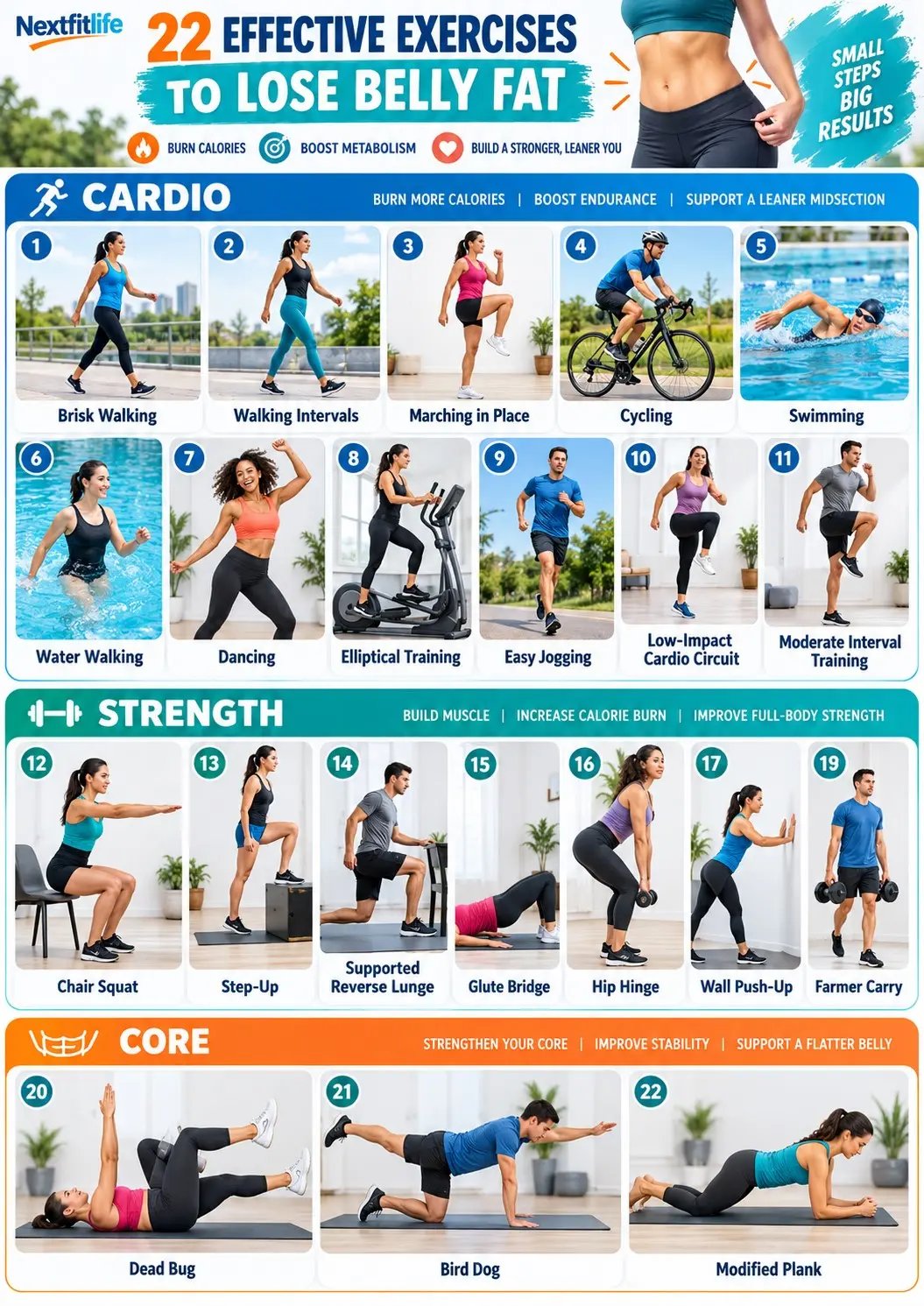
The exercises below are divided into cardio, strength, and core groups. You do not need to perform them all in one session.
Cardio Exercises
1. Brisk Walking
Walking is one of the easiest ways to start increasing your daily activity.
Walk fast enough that your breathing becomes quicker while you can still speak in sentences.
Beginner start: 10 minutes.
Build toward: 20 to 40 minutes.
Walking is especially useful because it requires little equipment and can be adjusted easily as your fitness improves.
Read our Walking for Weight Loss guide for a complete plan.
2. Walking Intervals
Walking intervals let you increase effort without running.
- Walk easily for 2 minutes.
- Walk faster for 1 minute.
- Return to an easy pace.
- Repeat for 10 to 20 minutes.
The fast section should feel challenging but controlled.
3. Marching in Place
Marching is useful when you have little space or prefer to exercise indoors.
- Stand tall near a stable surface if needed.
- Lift one knee gently.
- Lower it and switch sides.
- Swing your arms if comfortable.
Start with: 3 to 5 minutes.
Build toward: 10 to 20 minutes.
4. Cycling
Cycling can provide steady cardiovascular fitness work without the impact of jogging.
Use an indoor bike or ride outdoors in a safe area.
Start with: 10 to 15 minutes.
Build toward: 20 to 45 minutes.
5. Swimming
Swimming can train many muscles while also increasing heart rate.
If you are not a strong swimmer, use a supervised pool and stay where you feel safe.
Start with: 10 minutes of easy swimming or water activity.
6. Water Walking
You do not have to swim to exercise in a pool.
Walking through water creates resistance while reducing impact on the body.
Start with: 10 minutes.
Build toward: 20 to 30 minutes.
7. Dancing
Dancing can be a practical cardio session if it keeps you moving continuously.
Use music you enjoy and choose steps you can perform safely.
Start with: 10 minutes.
Build toward: 20 to 30 minutes.
8. Elliptical Training
An elliptical can provide steady cardio while avoiding the repeated landing impact of running.
Begin at low resistance and focus on smooth movement.
Start with: 10 minutes.
9. Easy Jogging
Jogging raises the intensity compared with walking, but you do not need to run to lose body fat.
If you are ready, try short periods of jogging mixed with walking.
Example: Jog for 1 minute, then walk for 2 minutes.
Repeat only while your form remains comfortable.
10. Low Impact Cardio Circuit
A simple circuit can raise your heart rate without jumping.
Try:
- March for 60 seconds.
- Step side to side for 60 seconds.
- Do gentle knee lifts for 60 seconds.
- Walk in place for 60 seconds.
Rest, then repeat if comfortable.
11. Moderate Interval Training
You do not need all out sprints to use intervals.
Try 30 to 60 seconds at a faster pace followed by 1 to 2 minutes at an easier pace.
This can be done while walking, cycling, swimming, or using an elliptical.
Strength Exercises
Resistance training helps maintain or build muscle and can support long term weight management.
CDC guidance recommends muscle strengthening work on at least two days each week for adults.
12. Chair Squat
- Stand in front of a stable chair.
- Place your feet around hip width apart.
- Push your hips back.
- Lower toward the chair.
- Stand back up.
Start with: 8 to 12 reps.
13. Step Up
- Use a low, stable step.
- Place one foot on it.
- Push through that foot to stand up.
- Step back down slowly.
Start with: 6 to 10 reps per side.
14. Supported Reverse Lunge
- Stand beside a stable chair or wall.
- Step one foot backward.
- Bend both knees within a comfortable range.
- Push back to standing.
Start with: 5 to 8 reps per side.
15. Glute Bridge
- Lie on your back with knees bent.
- Place your feet on the floor.
- Lift your hips gently.
- Pause.
- Lower with control.
Start with: 8 to 12 reps.
16. Hip Hinge
The hip hinge trains the hips and back of the legs.
- Stand tall.
- Soften your knees.
- Push your hips backward.
- Keep your back comfortable and controlled.
- Stand tall again.
Start with: 8 to 12 reps.
Learn the movement without weight before adding resistance.
17. Wall Push Up
- Stand facing a wall.
- Place your hands on the wall.
- Keep your body in a straight comfortable line.
- Bend your elbows.
- Press back to the starting position.
Start with: 8 to 12 reps.
18. Resistance Band Row
Rows work the upper back and arms.
- Secure a resistance band safely.
- Hold the handles or ends.
- Pull your elbows backward.
- Pause briefly.
- Return slowly.
Start with: 8 to 12 reps.
19. Farmer Carry
A farmer carry trains grip, posture, legs, and trunk control.
- Hold a manageable weight in each hand.
- Stand tall.
- Walk slowly.
- Keep your shoulders level.
Start with: 20 to 30 seconds.
Core Exercises
Core work will not directly melt stomach fat. It strengthens the muscles that help control your trunk during walking, lifting, pushing, pulling, and daily movement.
20. Dead Bug
- Lie on your back.
- Bend your hips and knees.
- Lower one heel toward the floor.
- Return slowly.
- Switch sides.
Start with: 5 to 8 reps per side.
21. Bird Dog
- Start on your hands and knees.
- Reach one arm forward.
- If comfortable, extend the opposite leg.
- Pause.
- Return and switch sides.
Start with: 5 to 8 reps per side.
22. Modified Plank
A modified plank gives you the benefits of trunk bracing without requiring a long full plank.
- Place your forearms on the floor.
- Keep your knees down.
- Gently brace your trunk.
- Breathe normally.
- Stop if your back hurts.
Start with: 10 to 20 seconds.
For more core options, visit our Core Workouts at Home guide.
22 Exercises at a Glance
| Exercise | Type | Beginner Start | Main Goal |
|---|---|---|---|
| Brisk walking | Cardio | 10 min | Endurance |
| Walking intervals | Cardio | 10 min | Higher effort |
| Marching | Cardio | 3 min | Home movement |
| Cycling | Cardio | 10 min | Endurance |
| Swimming | Cardio | 10 min | Whole body cardio |
| Water walking | Cardio | 10 min | Lower impact |
| Dancing | Cardio | 10 min | Enjoyable activity |
| Elliptical | Cardio | 10 min | Steady cardio |
| Easy jogging | Cardio | Short intervals | Higher intensity |
| Low impact circuit | Cardio | 4 min | Home cardio |
| Moderate intervals | Cardio | 10 min | Fitness |
| Chair squat | Strength | 8 reps | Leg strength |
| Step up | Strength | 6 per side | Leg strength |
| Reverse lunge | Strength | 5 per side | Lower body |
| Glute bridge | Strength | 8 reps | Hips |
| Hip hinge | Strength | 8 reps | Posterior chain |
| Wall push up | Strength | 8 reps | Upper body |
| Band row | Strength | 8 reps | Back strength |
| Farmer carry | Strength | 20 sec | Whole body |
| Dead bug | Core | 5 per side | Core control |
| Bird dog | Core | 5 per side | Stability |
| Modified plank | Core | 10 sec | Core strength |
Which Exercise Burns the Most Belly Fat?
There is no single exercise that guarantees the most stomach fat loss for every person.
The better question is: which form of exercise can you perform consistently enough to improve fitness and increase energy use?
For many beginners, walking is one of the strongest choices because it is simple, scalable, and easy to repeat.
For fitter adults, cycling, running, swimming, and intervals may produce a higher energy cost per minute.
The activity that looks best on paper is not useful if you hate it and stop after four days.
Does HIIT Reduce Belly Fat Faster?
High intensity interval training can reduce body fat and abdominal fat in some studies, but it is not required for success.
A 2024 review found interval training produced a small additional reduction in body fat percentage compared with moderate continuous training. That does not mean intervals are automatically best for every person.
Hard intervals may be less suitable if you are new to exercise, have joint problems, are recovering from illness, or have a medical condition that affects exercise safety.
Moderate walking and cycling still count.
Why Strength Training Matters for Fat Loss
When body weight decreases, some of the weight lost can come from lean tissue as well as fat.
Strength training provides a reason for your body to maintain muscle and also improves everyday function.
A useful full body workout should train your legs, hips, back, chest, shoulders, arms, and core rather than focusing only on your abdomen.
Visit our Strength Training Hub for more resistance training options.
Why Core Work Still Belongs in the Plan
A stronger core helps you control your trunk during walking, lifting, carrying, turning, and reaching.
Core exercises are useful even though they do not directly burn the fat sitting above those muscles.
Think of core work as strength training for your middle, not as a stomach fat removal tool.
Simple Beginner Workout
If you have not exercised recently, start smaller than you think you need.
Cardio: Walk for 10 minutes.
Strength:
- Chair squat: 8 reps
- Wall push up: 8 reps
- Glute bridge: 8 reps
- Band row: 8 reps
Core:
- Dead bug: 5 reps per side
- Bird dog: 5 reps per side
Do one round. Rest whenever you need to.
Seven Day Exercise Plan
| Day | Activity | Main Goal |
|---|---|---|
| Day 1 | Brisk walk | Cardio |
| Day 2 | Full body strength and core | Strength |
| Day 3 | Easy walk or rest | Recovery |
| Day 4 | Cycle, swim, dance, or elliptical | Cardio |
| Day 5 | Strength and core | Strength |
| Day 6 | Brisk walk or intervals | Cardio |
| Day 7 | Rest or gentle movement | Recovery |
Four Week Beginner Progression
Week 1
Walk for about 10 minutes on four or five days. Add one short strength session.
Week 2
Increase selected walks toward 15 minutes. Add a second strength session if recovery is good.
Week 3
Build selected cardio sessions toward 20 minutes. Keep two strength sessions.
Week 4
Work toward 20 to 30 minutes of moderate activity on several days if that feels comfortable. Keep two strength days and one or two short core sessions.
You do not have to increase every week. Repeat a week when your body needs more time.
How Much Exercise Do You Need?
CDC guidance says adults should aim for at least 150 minutes of moderate intensity aerobic activity per week or 75 minutes of vigorous activity, plus muscle strengthening work on at least two days.
More activity can provide additional benefits, but a beginner does not need to begin at that level.
Some activity is better than none.
Start from where you are and build gradually.
How Hard Should You Exercise?
Moderate Intensity
Your breathing gets faster, but you can still talk.
Brisk walking is a common example.
Vigorous Intensity
Your breathing becomes much harder and speaking full sentences is difficult.
Running and harder cycling may be vigorous for many adults.
Your fitness level changes how difficult the same activity feels.
Exercise Alone or Exercise Plus Nutrition?
Exercise supports health even if the scale changes slowly.
However, if your goal is body fat loss, food intake matters too.
A calorie deficit means your body uses more energy than you consume over time. This does not require starving, skipping entire food groups, or using detox products.
NIDDK guidance recommends combining healthy eating, physical activity, and behavior changes as common foundations of weight management.
Use our Complete Weight Loss Guide for a broader strategy and the High Protein Foods for Weight Loss guide for meal ideas.
Does Walking Help Reduce Belly Fat?
Walking can support fat loss because it increases activity and energy use.
It can also improve fitness and is easier to recover from than harder cardio for many people.
Walking does not tell your body to burn stomach fat first, but it can still be a valuable part of reducing total and abdominal fat over time.
Do Sit Ups Burn Belly Fat?
Sit ups train your abdominal muscles. They do not directly remove the fat above those muscles.
You can use sit ups if they feel good and fit your program, but hundreds of repetitions are not required for fat loss.
Do Planks Flatten Your Stomach?
Planks strengthen your core. They do not guarantee a flat stomach.
Your waist appearance is affected by body fat, body shape, genetics, skin, digestion, posture, age, and other factors.
Does Sweating Mean More Fat Loss?
No.
Sweat is primarily a cooling response. A hot room, heavy clothing, humidity, and individual biology can make you sweat more without meaning that you burned more body fat.
Judge a workout by its consistency, effort, progression, and how well it fits your plan, not by the size of the sweat patch on your shirt.
Common Belly Fat Exercise Mistakes
Doing Only Ab Exercises
Core work is useful, but a complete fat loss plan also needs broader movement and whole body strength.
Starting Too Hard
A workout that leaves you unable to move comfortably for four days is not automatically better.
Ignoring Strength Training
Cardio is useful, but strength work helps maintain muscle and function.
Using Exercise as Punishment for Eating
Exercise should support health and fitness. It does not need to become a punishment for food.
Expecting Fast Waist Changes
Fat loss takes time. Daily waist size can also change because of food volume, hydration, bowel habits, and bloating.
Ignoring Sleep and Recovery
Constant fatigue can make exercise harder to sustain.
Training Through Pain
Sharp or worsening pain is a signal to stop and reassess.
When Should You Get Medical Advice?
Speak with a healthcare professional before starting a major exercise or weight loss program if you have:
- Heart disease
- Uncontrolled high blood pressure
- Diabetes with complications
- Significant joint problems
- Recent surgery
- Severe obesity with mobility limitations
- Pregnancy
- Repeated dizziness or fainting
- A history of an eating disorder
- A medical condition affected by exercise
Seek urgent care for chest pain, fainting, severe breathing difficulty, confusion, sudden neurological symptoms, or a serious injury.
Internal Links and Hub
Continue with these NextFitLife guides:
- NextFitLife Fitness Hub for complete training guidance.
- Complete Weight Loss Guide for food, movement, sleep, and weight management.
- Belly Fat Loss Guide for abdominal fat and waist management.
- Walking for Weight Loss for a simple cardio starting point.
- Cardio and Endurance Hub for aerobic exercise ideas.
- Strength Training Hub for resistance training plans.
- Core Workouts at Home for more trunk strengthening exercises.
- Home Workouts and Equipment Hub for practical home exercise ideas.
- High Protein Foods for Weight Loss for nutrition support.
- Recovery and Injury Prevention Hub for safer training and recovery.
Conclusion
The most useful exercises to lose belly fat are not secret abdominal movements. They are cardio exercises you can repeat, whole body strength movements that protect muscle, and core exercises that improve trunk strength and control.
Start with walking, two simple strength sessions, and a small amount of core work. Add time and resistance gradually. Pair your training with a sustainable nutrition plan if body fat loss is your goal.
Your next step: choose one cardio exercise, four strength movements, and two core exercises from this guide. Use them for the next two weeks before deciding what needs to change.
About the Author
Adel Galal is a father of four (three sons and a daughter) and a grandfather of four, with 33 years of hands-on parenting experience. He is the founder of Parnthub.com, based in Cairo, Egypt, where he shares practical guidance on feeding, development and family life from newborns to teenagers. Adel is not a medical professional; health articles cite trusted sources and are for general information only.
Learn more on the NextFitLife About Us page.
Frequently Asked Questions
What are the best exercises to lose belly fat?
The best exercises to lose belly fat are activities that support overall fat loss, such as brisk walking, cycling, swimming, jogging, intervals, and full body strength training. Core work improves strength but does not directly remove stomach fat.
Can I lose belly fat by doing sit ups every day?
Sit ups can strengthen your abdominal muscles, but they do not reliably force fat to disappear from your stomach. Overall activity, nutrition, body fat loss, sleep, and other factors matter more.
Does walking burn belly fat?
Walking can support reductions in total and abdominal fat by increasing activity and energy use. It does not choose belly fat first, but it can be a useful part of a sustainable fat loss plan.
How often should I exercise to lose belly fat?
Adults can work toward at least 150 minutes of moderate aerobic activity each week plus strength work on two days. Beginners should start with less and increase gradually.
Is cardio or strength training better for belly fat?
Both can help. Cardio raises energy use and improves aerobic fitness, while strength training helps maintain muscle and function. A combined plan is practical for most people.
Does HIIT burn more abdominal fat?
HIIT can reduce body and abdominal fat, but it is not required. Moderate cardio such as brisk walking and cycling can also support fat loss and may be easier for beginners to sustain.
How long does it take to lose belly fat?
There is no fixed timeline. Progress depends on starting body fat, food intake, activity, genetics, sleep, health, medicines, age, and consistency.
Do planks burn belly fat?
Planks strengthen the core but do not directly burn fat from the stomach. They are useful as part of a balanced exercise plan.
Do I need a gym to lose belly fat?
No. Walking, home cardio, chair squats, wall push ups, resistance band rows, bridges, bird dogs, and planks can all be done at home with little equipment.
Is exercise enough to lose belly fat?
Exercise can reduce abdominal fat and improve health, but nutrition matters when body fat loss is the goal. A sustainable energy deficit usually requires attention to both food intake and activity.
References and Sources
- Centers for Disease Control and Prevention. Adult Activity: An Overview.
https://www.cdc.gov/physical-activity-basics/guidelines/adults.html - National Institute of Diabetes and Digestive and Kidney Diseases. Eating and Physical Activity to Lose or Maintain Weight.
https://www.niddk.nih.gov/health-information/weight-management/adult-overweight-obesity/eating-physical-activity - Jayedi A, et al. Aerobic Exercise and Weight Loss in Adults: Systematic Review and Dose Response Meta Analysis of Randomized Clinical Trials. Open access via PubMed Central.
https://pmc.ncbi.nlm.nih.gov/articles/PMC11672165/ - Kolnes KJ, et al. Effect of Exercise Training on Fat Loss and Abdominal Adipose Tissue. Open access via PubMed Central.
https://pmc.ncbi.nlm.nih.gov/articles/PMC8497689/ - Poon ETC, et al. Efficacy of Interval Training in Improving Body Composition in Adults. Open access via PubMed Central.
https://pmc.ncbi.nlm.nih.gov/articles/PMC11560999/

Health & wellness writer with 30+ years of experience in nutrition, fitness, and healthy aging. Founder of NextFitLife.com — evidence-based health guidance.

