Last Updated: June 2026 - Updated with 2026 clinical evidence
The heart health supplements market is worth billions of pounds. Omega-3. CoQ10. Berberine. Red yeast rice. Resveratrol. Nattokinase. Every year, new products appear with bold claims.
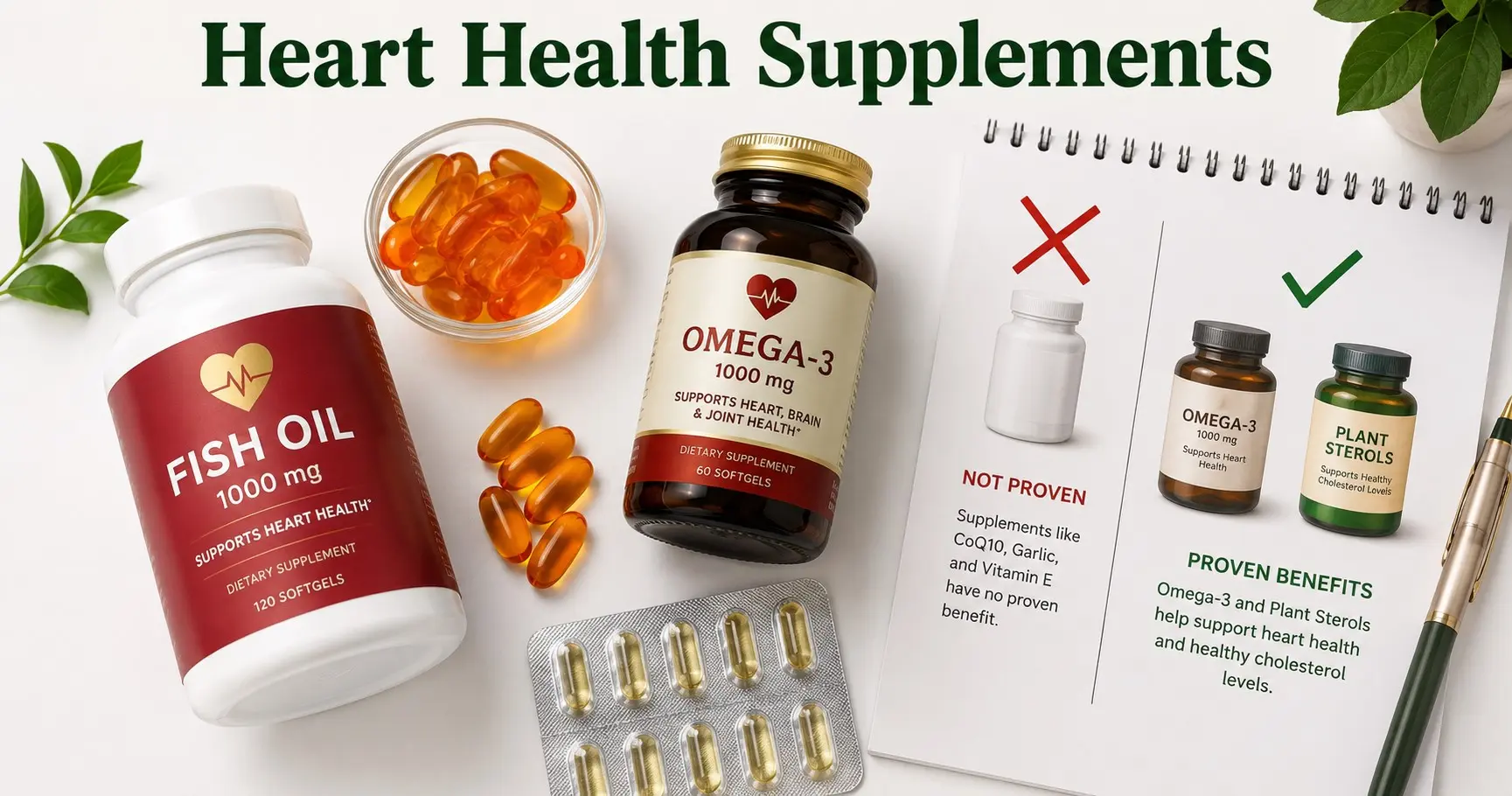
Some of these heart health supplements have factual evidence behind them. Others are cleverly marketed with very little science. A few carry genuine risks. Knowing the difference matters — both for your wallet and your heart.
I have reviewed all the major evidence. I have taken some of these supplements myself. In this guide, I give you the honest picture. No sales pitch. No exaggeration. Just what the research actually shows. Heart health complete guide
| MOST IMPORTANT RULE | No supplement replaces a heart-healthy lifestyle.
Omega-3 will not undo smoking. CoQ10 will not compensate for inactivity. Heart Health Supplements support good habits. They do not replace them. Always inform your doctor and pharmacist about every supplement you use.. |
The Complete Heart Health Supplements Evidence Table
Here is an honest, evidence-based rating of the major heart health supplements available today.
| Supplement | Evidence | Best Use Case | Dose | Key Caution |
| Omega-3 (EPA and DHA) | Very strong — multiple large RCTs | Lower triglycerides. Reduce inflammation. Anti-arrhythmic | 1 to 4g EPA/DHA daily | High doses thin blood. Tell the doctor if on warfarin or aspirin |
| Plant sterols and stanols | Strong — well-validated | Lower LDL cholesterol by 7 to 10% | 2g daily in food or supplement form | Not recommended during pregnancy |
| Magnesium | Good — meta-analysis support | Lower blood pressure. Support the heart rhythm | 300 to 400mg magnesium glycinate daily | Start low. Can cause loose stools at high doses |
| CoQ10 | Moderate — specific uses | Reduce statin muscle pain. Modest BP effect | 100 to 200mg daily | Does not prevent heart attacks. Not a statin replacement |
| Berberine | Emerging — promising data | Lower LDL and blood glucose | 500mg twice daily with food | Interacts with many drugs. Needs medical supervision |
| Red yeast rice | Good for LDL — but complex | Lower LDL cholesterol | 1.2 to 2.4g standardized | Same risks as statins. Liver and muscle damage possible. Medical guidance essential |
| Vitamin D | Weak for heart outcomes | Only if genuinely deficient | 1,000 to 2,000 IU if deficient | VITAL trial found no significant CV benefit in the general population |
| Nattokinase | Very limited human data | No established cardiac use yet | Not established | Interesting theory. Insufficient evidence for recommendation |
| Resveratrol | Very limited human data | No established cardiac use | Not established | Animal results do not translate to humans. Poor bioavailability |
| Fish oil (standard) | Moderate — weaker than prescription EPA | General omega-3 support at lower doses | 1 to 2g daily | Benefits are dose-dependent. High-dose prescription EPA is far stronger |
Omega-3 - The Best-Evidenced Heart Health Supplement
Omega-3 fatty acids — specifically EPA and DHA — have the strongest cardiovascular evidence of any supplement. They work through several mechanisms at once. They lower triglycerides dose-dependently. They reduce platelet stickiness. They have anti-arrhythmic effects that reduce the risk of fatal heart rhythm problems.
The REDUCE-IT trial is the most impressive omega-3 study ever done. It used 4g per day of a prescription form of EPA called eicosapentaenoic acid. In adults with high triglycerides already taking statins, this dose reduced major cardiovascular events by 25 percent. That is a large, real clinical effect.
Standard fish oil capsules at 1 to 2g per day are not the same as prescription EPA at 4g. But they still provide meaningful benefits, especially for people with elevated triglycerides who do not eat oily fish twice weekly.
I take 2g of omega-3 EPA and DHA daily. I’ve kept it up for eight years. My triglycerides are 1.1 mmol/L, comfortably in the optimal range. I make sure to include oily fish in my meals twice each week. The supplement fills the gap on days when I do not. omega-3 and heart health guide
Plant Sterols and Stanols - The Underrated LDL Fighter
Plant sterols and stanols are found naturally in small amounts in vegetables and nuts. In concentrated form — in fortified spreads, yogurt drinks, or supplement capsules — they block the absorption of cholesterol in the gut.
The evidence is very clear. Taking 2g of plant sterols or stanols daily reduces LDL cholesterol by 7 to 10 percent. This is a consistent finding across multiple well-designed trials. It works on top of a healthy diet and on top of statin therapy. Mediterranean diet and heart health
They are available in branded products like Benecol spreads and Flora ProActiv drinks, or as capsule supplements. I like this one because it is simple, safe, and the evidence is solid. If your LDL is mildly elevated and you want a non-medication approach, plant sterols are a good starting point.
Magnesium - The Most Underestimated Heart Supplement
Magnesium plays a vital role in more than 300 enzymatic processes throughout the body. The heart muscle uses it constantly. It is involved in regulating blood pressure, heart rhythm, and muscle contraction. And most adults over 50 are mildly deficient.
A 2016 meta-analysis in Hypertension analyzed 34 clinical trials. It found that magnesium supplementation significantly reduced blood pressure, on average by 2 mm Hg systolic and 1.8 mm Hg diastolic. Small numbers, but meaningful when maintained consistently alongside other lifestyle measures.
Magnesium glycinate is the best-absorbed form. Start with 200mg and build to 300 to 400mg over a few weeks. The most common side effect of too much magnesium too quickly is loose stools, which is also a sign that you have exceeded your absorption capacity.
CoQ10 - Useful for One Thing Specifically
CoQ10 - coenzyme Q10 - is produced naturally by the body and is essential for energy production in cells. One unintended effect of statins is that they lower the body’s natural production of CoQ10. Some people on statins experience muscle pain and weakness.
Taking 100 to 200mg of CoQ10 daily reduces statin-related muscle symptoms in many — but not all — patients. This is the clearest clinical use case for CoQ10. It does not, however, prevent heart attacks or reduce cardiovascular events independently. It is supportive therapy, not primary prevention.
I want to be honest about this. CoQ10 is widely marketed as a heart supplement. But if you do not take statins and your heart function is normal, the evidence for supplementing CoQ10 is weak. If you do take statins and have muscle symptoms, it is worth trying.
Red Yeast Rice - Natural doesn’t automatically mean it’s safe.
Red yeast rice is one of the most misunderstood supplements in the heart health category. It contains a compound called monacolin K. This compound is chemically identical to lovastatin, a prescription statin drug.
This means red yeast rice lowers LDL cholesterol in foods to lower cholesterol . But it also means it carries the same risks as prescription statins: potential liver damage, muscle injury, and interactions with multiple medications. The concentration of monacolin K in supplements is not standardized. You do not know exactly what you are getting.
If you want to use red yeast rice as an LDL-lowering strategy, treat it the same way you would treat a statin prescription. Discuss it with your doctor. Monitor liver enzymes. Watch for muscle symptoms. Never use it because you think natural means safe. It is not safer than the equivalent drug.
What Supplements Cannot Do - The Most Important Section
This is the part I most want you to focus on. Every supplement in this guide is, at best, a support tool. None of them compensates for the big lifestyle factors.
- Stopping smoking reduces heart attack risk by 50 percent within one year. No supplement does anything close to this
- Regular exercise produces cardiac adaptations that cannot be replicated in a capsule
- A Mediterranean diet reduces major cardiovascular events by 30 percent. Plant sterols can reduce LDL by 10 percent. Diet wins
- Blood pressure medication - if your doctor recommends it, no supplement is an adequate substitute for a properly managed hypertensive patient
- Statin therapy — for people with high LDL and established cardiovascular risk, statins have mortality benefits that supplements and alternatives cannot match
| Adel Galal - What I Actually Take as Heart Health Supplements | I want to be transparent about this. Here are the supplements I personally use.
Omega-3: 2g EPA and DHA daily. This is the supplement I am most confident in. Twice each week, I add oily fish to my diet. The supplement covers the days I do not. Magnesium glycinate: 300mg nightly. I sleep better with it. My resting heart rate is slightly lower since I added it consistently three years ago. Plant sterols: I get these through fortified foods rather than capsules. I use plant sterol fortified spread and a yogurt drink a few times weekly. CoQ10: I do not take this currently. I am not on statins. That is the full list. I do not take berberine, red yeast rice, Nattokinase, Or resveratrol. The evidence for this is not strong enough for me personally. Everything I take, I have discussed with my doctor. |
Key Takeaways - Heart Health Supplements
| SUMMARY | Omega-3 (1 to 4g EPA/DHA daily) has the strongest cardiovascular evidence of any supplement
Plant sterols (2g daily) reliably reduce LDL by 7 to 10% - a safe, effective adjunct to diet Magnesium (300 to 400mg glycinate) supports blood pressure and heart rhythm, especially if deficient CoQ10 reduces statin muscle pain but does not independently reduce heart attacks Red yeast rice contains the same active ingredient as lovastatin - use only under medical supervision Resveratrol and nattokinase have insufficient human evidence - do not spend money on them No supplement compensates for smoking, inactivity, or a poor diet - lifestyle always comes first Always tell your doctor every supplement you take - many interact with cardiac medications |
References and Sources
1- REDUCE-IT Trial - High-Dose EPA and Cardiovascular Events - NEJM 2018
https://www.nejm.org/doi/full/10.1056/NEJMoa1812792
Landmark RCT. Use for: 25% CV event reduction with 4g prescription EPA in high-TG statin patients.
2- Plant Sterols and LDL Reduction - Cochrane Review
https://www.cochranelibrary.com/cdsr/doi/10.1002/14651858.CD000169.pub3/full
Cochrane gold standard. Use for: 2g plant sterols daily reduces LDL 7-10% consistently across trials.
3- Magnesium and Blood Pressure - Meta-analysis Hypertension 2016
https://pubmed.ncbi.nlm.nih.gov/27402922/
Meta-analysis of 34 trials. Use for: magnesium reduces BP 2 mmHg systolic and 1.8 mmHg diastolic.
4- VITAL Trial - Vitamin D Supplements and Cardiovascular Outcomes - NEJM 2019
https://www.nejm.org/doi/full/10.1056/NEJMoa1811403
Large RCT. Use for: Vitamin D supplementation showed no significant CV benefit in healthy adults.
5- Red Yeast Rice Safety - European Heart Journal Review
https://pubmed.ncbi.nlm.nih.gov/20015723/
Review. Use for: monacolin K, identical to lovastatin, safety concerns, and the need for medical supervision.
Part of Our Heart Health Series
Part of our complete cardiovascular resource. Read all topics in our Complete Heart Health Guide or browse the Heart Health Resource Directory.
Adel Galal
Health and Wellness Writer | 30+ Years Personal Practice | Founder, NextFitLife.com
Adel Galal has studied cardiovascular health for over 30 years. At 58, he takes a small number of evidence-based supplements and is transparent about exactly which ones and why. He is not a doctor. Everything here reflects personal research and consultation with healthcare providers. Always talk to your doctor before starting any supplement, especially if you take heart medications.

Health & wellness writer with 30+ years of experience in nutrition, fitness, and healthy aging. Founder of NextFitLife.com — evidence-based health guidance.