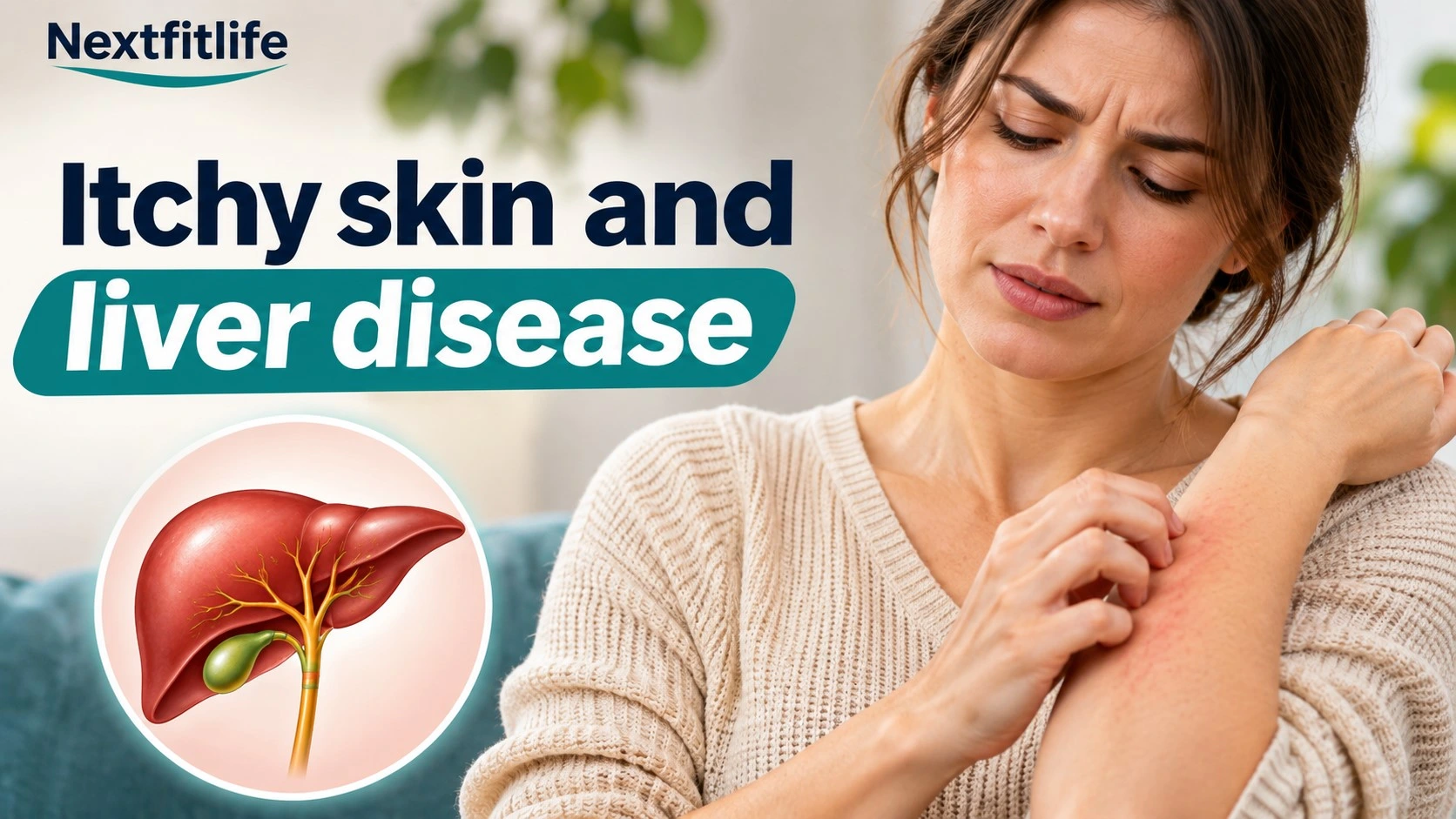
Itchy skin and liver disease can be connected, but itching by itself does not mean your liver is damaged.
The stronger clue is a pattern: persistent itching without an obvious primary rash, especially when it affects the palms or soles, becomes worse at night, or appears with yellow eyes, dark urine, pale stool, or known bile duct disease.
Itchy skin and liver disease are most strongly linked when bile flow is reduced, a problem called cholestasis. Liver related itch often starts without a rash, can affect the palms and soles, and may worsen at night. Jaundice, dark urine, pale stool, pregnancy, or persistent unexplained itching need medical assessment.
Doctors call this symptom cholestatic pruritus. It is especially linked with conditions that reduce or block normal bile flow, including primary biliary cholangitis, primary sclerosing cholangitis, bile duct obstruction, and intrahepatic cholestasis of pregnancy.
This article is for general information and education. It does not replace medical advice, diagnosis, or treatment.
Yellow skin or eyes, dark urine, pale stool, significant abdominal pain, fever, repeated vomiting, confusion, vomiting blood, black stool, or rapidly increasing abdominal swelling need medical attention. Jaundice itself should be assessed urgently.
For the wider picture, start with the NextFitLife Liver Health Guide and the Liver Health, Fatty Liver, Hepatitis, Gallbladder and Detox Claims Hub.
What You Will Learn
- Why bile flow problems can cause itching
- Why liver related itch often has no primary rash
- Why the palms, soles, and nighttime pattern matter
- Which liver and bile duct conditions are linked with itch
- Why fatty liver is not the usual explanation
- Which tests may help find the cause
- When itching needs prompt or urgent medical care
Table of Contents
- 1. Cholestasis Is the Main Liver Link
- 2. No Primary Rash Can Be a Clue
- 3. Palms, Soles, and Nighttime Itch
- 4. Itching Can Come Before Jaundice
- 5. PBC and PSC Can Cause Severe Itch
- 6. Pregnancy Changes the Urgency
- 7. Itch Severity Does Not Measure Liver Damage
- Fatty Liver and Itching
- Other Causes of Itchy Skin
- Liver Itch vs Dry Skin
- Tests That May Help
- Treatment Options
- When to Seek Care
- Conclusion
- References and Sources
- Internal Links and Hub
- About the Author
- Frequently Asked Questions
1. Cholestasis Is the Main Liver Link
The liver makes bile, and bile normally moves through small ducts before reaching the intestine.
Cholestasis means this process has slowed or become blocked because bile production, secretion, or movement is impaired.
That is the liver pattern most strongly linked with severe itching.
AASLD describes cholestatic pruritus as a common symptom of cholestatic liver disease. It can occur when bile ducts are damaged, when bile secretion falls, or when a blockage prevents bile from flowing normally.
Liver related itch is much more strongly linked with cholestasis than with the vague idea that any liver problem makes the skin itchy.
What Actually Causes the Itch?
The exact mechanism is still being studied.
Researchers have looked at bile acids, endogenous opioid signals, lysophosphatidic acid, serotonin, and other substances. Current evidence suggests that several chemical and nerve pathways may work together.
So the old explanation that bile salts simply collect in the skin is too simple.
2. No Primary Rash Can Be an Important Clue
Look at the skin before you scratch it.
DermNet states that cholestatic itching has no specific primary rash. The skin may look normal when the itching begins.
Scratching can later create:
- Red scratch marks
- Broken skin
- Scabs
- Thickened skin
- Small firm itchy bumps
- Areas of darker pigment after repeated inflammation
Those skin changes can be caused by scratching itself rather than the original disease.
If the skin looked normal before the itching started, tell the clinician. That detail can help separate a systemic itch from eczema, hives, fungal infection, contact dermatitis, and other skin problems.
3. Palms, Soles, and Nighttime Itching Fit the Pattern
Liver related itch can occur almost anywhere, so location alone cannot diagnose it.
Still, AASLD and DermNet both describe a recognizable pattern. The itch can be strongest on the palms, soles, and limbs before becoming more widespread.
It is also commonly worse in the evening or at night.
| Clue | Cholestatic Pattern | What It Means |
|---|---|---|
| Primary rash | Often absent | Systemic causes become more relevant |
| Palms and soles | Can be prominent | Supports the pattern but is not diagnostic |
| Nighttime | Often worse | Can disturb sleep and increase fatigue |
| Whole body | Possible | Generalized itch has many possible causes |
Itchy palms or feet do not prove liver disease. Fungal infections, eczema, dry skin, allergies, nerve problems, and other conditions remain possible.
The pattern becomes more meaningful when several clues appear together.
4. Itching Can Appear Before Obvious Jaundice
Do not wait for yellow skin before taking persistent unexplained itching seriously.
Jaundice develops when bilirubin builds up enough to make the skin or whites of the eyes appear yellow.
The NHS notes that jaundice can occur with darker urine, paler stool, and itchy skin. It should receive urgent medical assessment.
Clues That Raise Concern for Bile Flow Problems
- Dark urine
- Pale stool
- Yellow eyes or skin
- Persistent itching without a clear skin cause
- Upper right abdominal pain
- Nausea or reduced appetite
If urine color is part of your concern, read Dark Urine and Liver Disease: 7 Warning Clues. Dark urine plus pale stool and itching gives a clinician much more information than itching alone.
5. PBC and PSC Are Classic Liver Causes of Itching
Primary Biliary Cholangitis
Primary biliary cholangitis, or PBC, is an autoimmune liver disease that damages small bile ducts inside the liver.
Mayo Clinic lists itchy skin and fatigue among common PBC symptoms. More than half of people may have no symptoms when the condition is first diagnosed, which is another reason symptoms alone cannot tell you whether liver disease is present.
Other features can include:
- Dry eyes and mouth
- Upper right abdominal discomfort
- Jaundice
- Skin darkening unrelated to sun exposure
- Oily or greasy stool later in disease
Primary Sclerosing Cholangitis
Primary sclerosing cholangitis, or PSC, causes inflammation and scarring of bile ducts.
Itching can develop as bile flow becomes impaired.
Do not try to separate PBC from PSC by the way an itch feels. Diagnosis depends on medical history, blood tests, and sometimes imaging.
6. Pregnancy Changes the Urgency
Itching is common during pregnancy, and most pregnancy itching is not caused by a serious liver problem.
Still, intrahepatic cholestasis of pregnancy, or ICP, deserves prompt assessment.
RCOG states that ICP can cause persistent itching without a rash. It may involve the palms and soles and tends to become worse at night.
If you are pregnant and develop unexplained persistent itching, especially on the palms or soles or worse at night, contact your maternity team. Do not wait for jaundice or a rash.
Testing for suspected ICP includes liver blood tests and a bile acid blood test.
RCOG notes that bile acids can be abnormal even when routine liver function tests are normal. Itching can also begin days or weeks before blood results become abnormal, so persistent symptoms may need repeat testing.
7. Itch Severity Does Not Measure Liver Damage
This is one of the most useful facts to remember.
Severe itching does not automatically mean severe liver failure.
DermNet notes that the intensity of cholestatic pruritus does not reliably match the severity of cholestasis.
AASLD also shows that serious itch can occur even when bilirubin is still normal.
Someone can have severe itch with modest blood test changes, while another person can have important liver disease with little or no itching. Proper liver assessment uses history, examination, blood tests, imaging, and other testing when needed.
The NextFitLife Liver Health Guide explains why normal ALT and AST also do not guarantee that the liver is healthy.
Does Fatty Liver Usually Cause Itching?
Not usually.
This is where online explanations can become too broad.
Metabolic dysfunction associated steatotic liver disease, or MASLD, is common, but simple fatty liver is not a classic cause of cholestatic itching.
DermNet notes that pruritus is uncommon in steatohepatitis and in fatty liver disease unless a cholestatic problem is also present.
A person with fatty liver can still itch because of dry skin, eczema, diabetes, kidney disease, medicines, another liver disorder, or an unrelated skin problem.
If you have metabolic liver disease, the related Fatty Liver and Sleep Apnea Guide explains why shared metabolic risks matter more than assuming every symptom comes directly from liver fat.
Can Hepatitis Cause Itching?
It can, but the link is less specific than it is with classic cholestatic disorders.
Some people with chronic liver inflammation or viral hepatitis report itching, especially when bile flow is affected.
DermNet reports that itch occurs in some people with chronic hepatitis C, while it is less commonly reported with chronic hepatitis B.
The presence or absence of itching cannot tell you whether hepatitis is present. Testing is needed.
Can Alcohol Related Liver Disease Cause Itching?
Itching can occur when alcohol related liver disease causes cholestasis or more advanced liver dysfunction.
It is not a reliable early marker of alcohol related liver injury.
Other concerning signs can include jaundice, abdominal swelling, easy bruising, bleeding, confusion, muscle loss, or severe weakness.
Do not use the presence or absence of itch to decide whether alcohol has affected the liver.
What Else Can Cause Persistent Itching?
Many things, and skin disease is much more common than a hidden liver problem in many people.
The NHS and Merck Manual list a wide range of causes.
| Cause Group | Examples | Helpful Clue |
|---|---|---|
| Skin | Dry skin, eczema, psoriasis, hives, fungal infection, scabies | Visible rash, scale, dryness, or local skin changes are common |
| Kidney | Chronic kidney disease | Generalized itch can occur in advanced kidney disease |
| Hormonal | Overactive or underactive thyroid | Other thyroid symptoms may be present |
| Blood | Iron deficiency, some blood disorders | Blood testing helps find the cause |
| Medicines | Drug reaction, direct itch, or medicine related cholestasis | Review new and recently changed medicines |
| Nerve related | Local nerve irritation | Often localized without a classic skin rash |
This is why persistent itching without rash deserves a proper history instead of an automatic liver diagnosis.
Liver Itch vs Dry Skin
| Feature | Cholestatic Itch | Dry Skin |
|---|---|---|
| Skin at the start | Often normal looking | Often dry, flaky, rough, or cracked |
| Palms and soles | Can be prominent | Possible but less characteristic |
| Nighttime | Often worse | Can also worsen |
| Moisturizer | Can soothe but may not control the itch | Often helps substantially |
| Jaundice or dark urine | Raises concern for liver or bile disease | Not expected from dry skin |
The table is a comparison tool, not a diagnosis.
Why Antihistamines Often Disappoint With Liver Itch
Allergic itching is strongly linked with histamine.
Cholestatic itching is different.
AASLD notes that cholestatic pruritus is not primarily driven by histamine, so ordinary antihistamines have limited evidence for treating the underlying symptom.
Some older antihistamines make people sleepy, which may help someone sleep through nighttime itching. That is different from fixing the cause of the itch.
Do not increase antihistamine doses on your own because the itching persists.
Which Blood Tests May Help Find the Cause?
The exact workup depends on your symptoms, medicines, health history, and examination.
Possible tests include:
| Test | Why It May Matter |
|---|---|
| Alkaline phosphatase | Can rise with cholestasis and bile duct disease |
| GGT | Can help interpret a cholestatic liver test pattern |
| Bilirubin | Can rise when bilirubin handling or bile flow is impaired |
| ALT and AST | Help identify patterns of liver cell injury |
| Complete blood count | Can help investigate anemia and some other systemic causes |
| Kidney function | Kidney disease can cause generalized itch |
| Thyroid tests | Overactive and underactive thyroid disease can cause itch |
| Iron studies | Iron deficiency is another possible systemic cause |
| Bile acids in pregnancy | Important when intrahepatic cholestasis of pregnancy is suspected |
A high alkaline phosphatase result can support a cholestatic pattern, but it does not diagnose liver disease by itself because ALP also comes from other tissues such as bone.
If the blood test pattern suggests bile obstruction, imaging such as ultrasound or another bile duct study may be needed.
Can Liver Related Itching Happen With Normal Blood Results?
Sometimes.
A normal bilirubin does not rule out cholestatic itching.
Pregnancy adds another clear example. RCOG notes that bile acids can be raised even when routine liver function tests remain normal.
Itching in ICP can also begin before blood abnormalities appear, which is why persistent symptoms may need repeat tests.
One normal blood panel should therefore be interpreted in the context of the symptoms, timing, pregnancy status, medicines, and medical history.
What Can You Do at Home While Waiting for Assessment?
Simple measures can make the skin more comfortable while the cause is being investigated.
- Use a plain moisturizer or emollient.
- Choose lukewarm rather than very hot showers.
- Keep the room and skin comfortably cool.
- Wear loose, soft clothing.
- Keep fingernails short to reduce skin injury.
- Avoid repeatedly scratching the same area when possible.
AASLD and DermNet both include cooling measures and skin moisturizers among practical steps for cholestatic itch.
These steps improve comfort. They do not treat a blocked bile duct, PBC, PSC, pregnancy related cholestasis, or another underlying liver condition.
Which Medicines Are Used for Cholestatic Itching?
Prescription treatment belongs with a clinician because the right medicine depends on the cause, other medicines, liver function, pregnancy status, and possible interactions.
Cholestyramine
Cholestyramine is commonly used as a first treatment for cholestatic itch.
It can interfere with absorption of other medicines, so timing around other prescriptions matters.
Rifampin
Rifampin may be considered if first treatment does not work or cannot be used.
Because rifampin itself can cause liver injury and other side effects, clinical monitoring is needed.
Naltrexone
Naltrexone affects opioid signaling and can be used in selected cases.
Sertraline
Sertraline is another option clinicians may consider for difficult cholestatic itching.
Treatment sequence, medicine timing, interactions, liver monitoring, pregnancy, and other health conditions change what is safe.
Does Ursodiol Stop Liver Itching?
Ursodeoxycholic acid, also called ursodiol, is an important treatment for some cholestatic liver diseases.
That does not mean it reliably controls itching.
AASLD notes that ursodiol is central to PBC treatment, but its effect on the itch itself is limited. Separate treatment may therefore be needed for the symptom.
Treating the disease and treating the itch are related, but they are not always the same task.
When Should Persistent Itching Be Checked?
Arrange a medical review when itching:
- Persists without a clear cause
- Affects large areas of the body
- Repeatedly wakes you at night
- Occurs without an obvious skin problem
- Starts after a new medicine or supplement
- Occurs when you already have liver or bile duct disease
- Keeps returning despite simple skin care
Mayo Clinic specifically recommends assessment for severe, persistent generalized itching with no obvious cause because PBC and other systemic conditions can present this way.
When Is It Urgent?
Itching alone is rarely the emergency. The symptoms around it can be.
- Yellow skin or eyes
- Dark urine and pale stool
- Fever with abdominal pain
- Persistent vomiting
- Severe or worsening abdominal pain
- Rapid worsening of your general condition
Emergency Liver Warning Signs
Seek emergency medical help for:
- New confusion
- Extreme unusual sleepiness
- Vomiting blood
- Black or tarry stool
- Fainting
- Rapidly increasing abdominal swelling
- Severe jaundice with serious illness
The NextFitLife Liver Health Hub groups liver, gallbladder, bile duct, pancreas, hepatitis, and urgent symptom guides in one place.
Five Mistakes I Would Avoid
- Assuming every itch means liver disease. Dry skin and skin disorders are common causes.
- Assuming scratching marks prove a skin disease. Cholestatic itch can start with normal looking skin and create marks later.
- Waiting for jaundice. Liver related itch can appear before visible yellowing.
- Using itch severity to judge liver damage. Itch intensity and disease severity do not reliably match.
- Treating the symptom for months without asking why it is happening. Persistent generalized itch deserves an explanation.
A Simple Decision Guide
| Pattern | What It Suggests | Next Step |
|---|---|---|
| Itch with dry, flaky skin | Skin cause is more likely | Gentle skin care and assessment if persistent |
| Itch with hives or swelling | Allergy or skin reaction becomes more likely | Assess trigger and seek care if severe |
| Persistent itch without rash | Systemic causes deserve consideration | Arrange medical assessment if unexplained |
| Palms and soles, worse at night | Fits a cholestatic pattern, especially in pregnancy | Medical assessment |
| Itching plus jaundice | Liver or bile disease becomes more concerning | Urgent medical assessment |
| Pregnancy with severe nighttime itch | ICP must be considered | Contact maternity team promptly |
This table helps organize clues. It cannot diagnose liver disease.
Conclusion
Itchy skin and liver disease are most clearly connected through cholestasis, not every type of liver problem.
Pay attention to the pattern: persistent itch without a primary rash, nighttime worsening, palms or soles involvement, dark urine, pale stool, jaundice, or known bile duct disease deserves more than another moisturizer.
Your next step: if the itch has no clear skin cause or keeps returning, arrange medical assessment. If jaundice, severe illness, serious abdominal symptoms, or pregnancy related palm and sole itching is present, seek care promptly.
References and Sources
- American Association for the Study of Liver Diseases. Scratching the Itch: Management of Pruritus in Cholestatic Liver Disease.
https://www.aasld.org/liver-fellow-network/core-series/clinical-pearls/scratching-itch-management-pruritus-cholestatic - DermNet. Cholestatic Pruritus. Last reviewed February 2025.
https://dermnetnz.org/topics/cholestatic-pruritus - Mayo Clinic. Primary Biliary Cholangitis: Symptoms and Causes.
https://www.mayoclinic.org/diseases-conditions/primary-biliary-cholangitis/symptoms-causes/syc-20376874 - NHS. Jaundice.
https://www.nhs.uk/conditions/jaundice/ - Royal College of Obstetricians and Gynaecologists. Intrahepatic Cholestasis of Pregnancy.
https://www.rcog.org.uk/for-the-public/browse-our-patient-information/intrahepatic-cholestasis-of-pregnancy/ - Merck Manual Professional Edition. Pruritus.
https://www.merckmanuals.com/professional/dermatologic-disorders/approach-to-the-dermatologic-patient/pruritus
Internal Links and NextFitLife Hub
About the Author
Adel Galal is the founder and lead writer of NextFitLife.com. He has more than 15 years of health and wellness writing experience. He is not a licensed healthcare professional. Read the About page for sources and review rules.
Adel is not a medical professional; health articles cite trusted sources and are for general information only.
Frequently Asked Questions
Can liver disease cause itchy skin?
Yes. Itching is especially linked with cholestatic liver and bile duct conditions, where bile production or flow is impaired. Itching alone does not prove liver disease.
What does liver related itching feel like?
Cholestatic itching can be intense and widespread, often without a primary rash. It may involve the palms and soles and frequently becomes worse in the evening or at night.
Can liver itching happen without jaundice?
Yes. Cholestatic pruritus can occur without visible jaundice, and bilirubin may still be normal. Persistent unexplained itching should be assessed based on the whole clinical picture.
Does fatty liver usually cause itching?
Simple fatty liver is not a classic cause of cholestatic itching. A person with fatty liver can still itch because of another skin, metabolic, kidney, medicine, or liver problem.
Why are itchy palms and soles linked with liver problems?
The palms and soles are characteristic sites for cholestatic pruritus, although the itch can also become generalized. This pattern is a clue, not a diagnosis.
Can liver related itching be worse at night?
Yes. AASLD and DermNet describe cholestatic itching as commonly worse in the evening or at night, which can disturb sleep.
What tests are used for unexplained itching and liver concerns?
Testing may include alkaline phosphatase, GGT, bilirubin, ALT, AST, blood count, kidney tests, thyroid tests, iron studies, and other tests chosen from the person's symptoms. Pregnancy related itching may also require bile acid testing.
When is itching with liver symptoms urgent?
Seek prompt medical care for itching with jaundice, dark urine and pale stool, fever, significant abdominal pain, or persistent vomiting. Confusion, vomiting blood, black stool, fainting, or rapidly increasing abdominal swelling need emergency care.
Why is severe itching during pregnancy important?
Persistent itching during pregnancy, especially on the palms or soles or worse at night, can be a sign of intrahepatic cholestasis of pregnancy. Contact your maternity team because liver tests and bile acids may be needed.

Health & wellness writer with 30+ years of experience in nutrition, fitness, and healthy aging. Founder of NextFitLife.com — evidence-based health guidance.