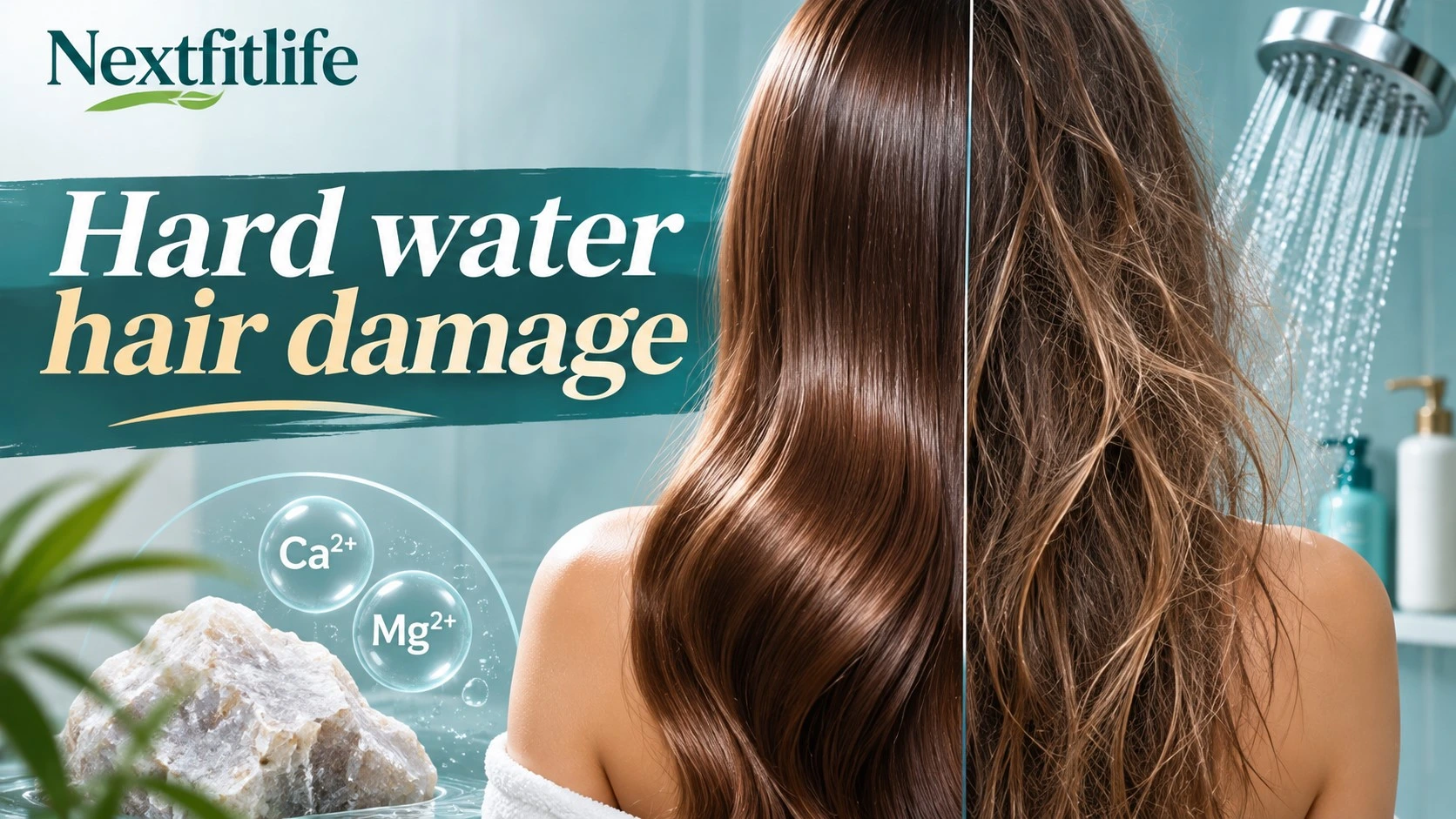
If your hair feels rough after washing, loses shine, tangles faster, or snaps more easily, hard water could be part of the problem.
But I would not blame every strand in the shower on your tap water. Hard water hair damage is best understood as mineral buildup and possible hair shaft stress, not as a proven direct cause of every type of hair loss.
Hard water hair damage happens when calcium and magnesium collect on or within the hair fiber. This can leave hair rough, dull, stiff, or harder to manage and may increase breakage in some people. Test your water, cleanse gently, use chelation when needed, condition well, and do not assume true hair loss comes from water hardness.
The U.S. Geological Survey explains that water hardness is driven mainly by dissolved calcium and magnesium. Hard water is common and is not, by itself, treated as a drinking water health hazard.
The hair question is different. Repeated exposure can leave mineral deposits on the hair shaft and change the way that fiber feels and behaves.
This article is for general information and education. It does not replace medical advice, diagnosis, or treatment.
A widening part, receding hairline, smooth bald patches, persistent scalp pain, heavy shedding from the root, scarring, or loss of eyebrows deserves proper assessment. Hair shaft breakage and follicular hair loss are different problems.
For help separating breakage from shedding and follicle loss, read the NextFitLife Hair Loss Causes and Treatment Guide.
What You Will Learn
- What hard water actually does to hair
- Why the research on breakage is mixed
- How breakage differs from true hair loss
- Why bleached and damaged hair may be more vulnerable
- How chelating and clarifying shampoos differ
- Whether filters and softeners solve the same problem
- Seven practical ways to protect hair
Table of Contents
- What Hard Water Does to Hair
- What the Research Really Shows
- Breakage vs Hair Loss
- Chemically Treated Hair
- Hard Water and Shampoo
- Chelating vs Clarifying Shampoo
- 7 Smart Ways to Protect Hair
- Shower Filter vs Water Softener
- Vinegar and Citric Acid
- Curly and Bleached Hair
- Scalp and Dandruff Questions
- How to Know the Routine Is Working
- Common Mistakes
- When to See a Dermatologist
- Conclusion
- References and Sources
- Internal Links and Hub
- About the Author
- Frequently Asked Questions
What Does Hard Water Actually Do to Hair?
Hard water contains relatively high levels of dissolved calcium and magnesium.
Those minerals can interact with soap and hair fibers. The U.S. Geological Survey notes that hard water makes soap lather less easily and can leave an insoluble residue on hair that makes it look dull and harder to manage.
Hair research adds another layer. Studies have found that calcium and magnesium can deposit on the hair shaft, particularly after repeated exposure.
That can help explain complaints such as:
- Rough texture
- Loss of shine
- A coated feeling
- More tangling
- Stiffer hair
- More snapping during brushing or styling
The minerals are not literally burning or poisoning the strand. The issue is how deposits can change the mechanical behavior and surface of the hair fiber.
What Does the Research Really Show?
The evidence is more interesting than the usual beauty claim that hard water simply “destroys” hair.
A 2013 study compared hair exposed to hard water with hair exposed to distilled water and found no significant difference in tensile strength or elasticity.
Later studies found different results. One study reported reduced tensile strength after hard water exposure, while another found greater calcium and magnesium deposition, a rougher hair surface, and lower measured fiber thickness.
Another scanning electron microscopy study found more magnesium deposition but did not find clear structural surface damage.
Then a systematic review and meta analysis brought the studies together.
Hard water appears to increase calcium and magnesium deposition and probably causes a modest reduction in hair tensile strength. That supports a higher risk of breakage, but the strength of evidence is lower for several other claimed effects.
That is a stronger and more useful conclusion than saying hard water either does nothing or ruins everyone's hair.
Hair Breakage and Hair Loss Are Different Problems
This distinction matters more than almost anything else in this article.
Hair breakage happens when the fiber snaps somewhere along its length.
Hair shedding involves a full strand leaving the scalp as part of the growth cycle or because that cycle has changed.
Alopecia describes hair loss from the follicle and has many possible causes.
| Problem | What You May See | What It Suggests |
|---|---|---|
| Breakage | Short pieces, uneven length, split ends, frizz | Damage to the hair shaft |
| Shedding | Full length hairs coming from the scalp | A change in the hair growth cycle may be involved |
| Pattern thinning | Wider part, thinner crown, receding hairline | Follicle miniaturization may be involved |
| Patchy loss | Round or irregular bald areas | Needs another explanation besides water hardness |
Hard water research mainly supports concerns about the fiber itself. It does not establish hard water as a common direct cause of follicular hair loss.
If your concern is thinning rather than snapping, use the Hair Loss Causes and Treatment Guide instead of assuming a new shower head will fix it.
Why Chemically Treated Hair May Struggle More
Bleached, colored, permed, relaxed, and otherwise chemically treated hair deserves more care around mineral buildup.
Research on human hair found that chemical damage increases the number of sites where calcium and magnesium can bind.
That means two people in the same house can wash with identical water and have very different results.
One has strong untreated hair. The other has repeatedly bleached lengths with a more damaged hair cuticle.
The second person may notice stiffness, tangling, roughness, and breakage sooner.
Hard water plus bleach plus frequent flat ironing plus rough detangling is a very different situation from hard water alone.
Hard Water Can Change How Cleansing Feels
Hard water makes traditional soap lather less easily because calcium and magnesium react with it.
The U.S. Geological Survey also notes that soap residue can remain on hair and make it feel dull, lifeless, or difficult to manage.
That can create a bad cycle.
Hair feels coated, so you shampoo harder. The scalp feels dry, so you wash again. Now you may have mineral residue plus irritation from overly aggressive cleansing.
If scalp redness, itching, or scale is becoming the main problem, read the Scalp Treatment for Dermatitis Guide. A scalp disorder needs a different plan from mineral buildup.
Chelating Shampoo and Clarifying Shampoo Are Not Always the Same
These labels are often used as if they mean the same thing.
They do not always.
Clarifying Shampoo
A clarifying shampoo is mainly aimed at removing oils, styling products, silicone residue, and other buildup.
Chelating Shampoo
A chelating shampoo or treatment contains ingredients that can bind metal ions such as calcium.
Ingredients you may see include EDTA, disodium EDTA, tetrasodium EDTA, citric acid, or other chelating agents.
The finished formula matters more than one ingredient name. A product containing a tiny amount of citric acid is not automatically a strong mineral remover.
7 Smart Ways to Reduce Hard Water Hair Damage
1. Confirm That Your Water Is Actually Hard
Do this before buying products.
Check your water utility report when one is available, or use a proper hardness test.
| Water Category | Hardness as Calcium Carbonate |
|---|---|
| Soft | 0 to 60 mg/L |
| Moderately hard | 61 to 120 mg/L |
| Hard | 121 to 180 mg/L |
| Very hard | More than 180 mg/L |
These are U.S. Geological Survey categories. Your local water system may report hardness in another unit, so compare units before deciding how hard the water really is.
2. Use a Gentle Shampoo for Normal Washing
Do not turn every wash into a deep clean.
Apply normal shampoo mainly to the scalp and roots. Let the rinse pass through the lengths rather than rubbing fragile ends aggressively.
This matters because friction and harsh cleansing can add their own damage.
3. Use Chelation When Buildup Is Plausible
A chelating wash makes more sense when the hair feels coated, unusually stiff, dull, rough, or much harder to detangle and you know the water is hard.
Use the product according to its directions.
Do not assume daily chelation produces faster repair.
4. Condition After Cleansing
Conditioner helps reduce friction between strands and improves combing.
That matters even more when the hair is long, curly, colored, bleached, or already prone to hair breakage.
If tangling is severe, a leave in conditioner can help with handling after the shower.
5. Reduce Other Damage While the Hair Feels Brittle
If the hair is snapping, give it fewer problems to fight at the same time.
Reduce very hot blow drying, repeated flat ironing, aggressive brushing, and overlapping bleach while the hair is fragile.
6. Detangle According to Your Hair Type
Wet hair can be easier to damage during rough brushing.
For straight or loosely textured hair, gentle detangling after some drying may reduce breakage. Tightly curled hair is often easier to detangle while damp and well conditioned.
The common rule is simple: reduce force.
7. Treat the Water if Hardness Is the Real Problem
If testing shows very hard water and mineral buildup keeps returning despite sensible hair care, a proper water softener may be more useful than buying stronger shampoo forever.
But check the device.
A basic shower filter is not automatically a water softener.
Shower Filter vs Water Softener
| Option | Main Job | Does It Soften Hard Water? |
|---|---|---|
| Basic shower filter | Depends on the filter media | Often not enough for true hardness |
| Carbon filter | Often targets chlorine, taste, or selected compounds | No |
| Sediment filter | Removes particles | No |
| Ion exchange softener | Reduces calcium and magnesium hardness | Yes |
| Chelating hair product | Helps remove metal buildup from hair | No, it treats the hair rather than the household water |
This distinction matters because a product can remove chlorine and still leave calcium and magnesium hardness almost unchanged.
Buy for the problem you actually have.
Can Vinegar Remove Hard Water Buildup?
Acids can help dissolve some mineral deposits.
That does not mean concentrated kitchen vinegar belongs on every scalp.
Strong homemade rinses can sting, irritate skin, and give you very inconsistent acidity from one recipe to another.
I would choose a formulated product over turning hair care into home chemistry.
What Does the Citric Acid Research Show?
This is one area where newer research is genuinely interesting.
A 2025 laboratory study tested citric acid on several kinds of chemically treated human hair.
The treatment reduced measured hair calcium levels by 21% to 42%. It also improved several mechanical measurements in those laboratory tested fibers.
The researchers suggested several mechanisms, including calcium chelation, acidity, and changes in protein interactions.
A controlled laboratory treatment does not prove that pouring concentrated citric acid or lemon juice onto your hair will produce the same benefit safely.
Does Hard Water Affect Curly Hair More?
Curly and coily hair can make mineral buildup easier to notice because these hair types may already need more careful moisture and detangling support.
A coating that makes strands stiffer or increases friction can therefore feel especially frustrating.
Still, I would not claim that all curly hair absorbs more calcium simply because it curls. The stronger point is that already dry or fragile hair has less margin for extra stiffness and friction.
What About Bleached Hair?
This is the hair I would watch most carefully.
Research found that chemically damaged hair can bind more hardness metals than healthier hair.
So if your bleached hair becomes unusually hard, tangled, dull, or brittle after moving to an area with harder water, mineral deposition is a reasonable possibility.
But bleaching itself weakens hair.
Do not blame the water for damage that began after aggressive chemical processing.
Can Hard Water Change Hair Color?
Mineral buildup can change how colored or lightened hair looks and feels.
The scientific evidence is stronger for metal deposition and mechanical changes than for one predictable color shift in every person.
If your color suddenly looks dull or behaves differently, ask whether buildup is present before adding stronger bleach or another harsh process.
Does Hard Water Cause Dandruff?
Not in a simple direct way.
Dandruff and seborrheic dermatitis have their own causes. Hard water and overly harsh washing can make the scalp feel dry or irritated, which may add flaking and discomfort.
That does not turn mineral buildup into the cause of every flaky scalp.
Greasy scale, persistent redness, intense itch, crusting, patchy hair loss, broken hairs, or scalp pain deserve a closer look. The Scalp Treatment for Dermatitis Guide explains why one shampoo cannot treat every scalp condition.
Can Hard Water Irritate the Scalp?
It can contribute to a harsher washing environment, but scalp irritation has many causes.
Research on hard domestic water and eczema has found associations in some populations, but the certainty has been limited, and water softeners have not clearly treated established eczema.
So if your scalp is painful, red, very itchy, crusted, or inflamed, do not assume softer water is the only treatment you need.
For the broader skin and hair context, see the NextFitLife Skin, Hair and Nail Health Hub.
How Do You Know the Routine Is Working?
Track the hair rather than the marketing claim.
Over several washes, look for:
- Less stiffness
- Easier detangling
- Better shine
- Less snapping
- Better conditioner performance
- Less coated feeling after washing
One great wash does not prove much.
The useful question is whether the hair becomes easier to manage over time without the scalp becoming dry or irritated.
A Simple Hard Water Hair Routine
- Confirm your water hardness.
- Use a gentle normal shampoo for routine washing.
- Use a formulated chelating wash when mineral buildup becomes noticeable.
- Condition the lengths after cleansing.
- Use a leave in conditioner if detangling is difficult.
- Reduce high heat and harsh chemical processing while breakage is active.
- Consider a true water softener when very hard water keeps causing the same problem.
Do not automatically use the strongest version of every step.
Your routine is working when the hair becomes easier to handle with less breakage, not when it feels stripped clean.
Five Mistakes I Would Avoid
- Calling every shed hair hard water damage. Breakage and follicular shedding are different.
- Using a strong clarifying shampoo every wash. You can trade mineral buildup for dry, irritated hair.
- Buying a filter without checking what it removes. Chlorine removal and water softening are not the same job.
- Using strong homemade acid rinses. More acid does not mean better hair care.
- Ignoring genuine hair loss. Thinning from the root needs another explanation.
When Should You See a Dermatologist?
See a dermatologist or qualified healthcare professional if you notice:
- Rapid thinning
- A widening part
- A receding hairline
- Round or irregular bald patches
- Scalp pain or burning
- Persistent redness
- Pus or open sores
- Scarring
- Heavy shedding that continues
- Hair loss that continues after you change your hair care routine
NextFitLife's Hair Loss Causes and Treatment Guide explains how inherited thinning, telogen effluvium, alopecia areata, traction, infection, scarring disease, nutrition, and hair shaft damage differ.
Conclusion
Hard water hair damage is real enough to take seriously, but it is often described too dramatically.
The best current evidence supports mineral deposition and a probable increase in hair shaft breakage. It does not prove that hard water directly causes every case of thinning or alopecia.
Your next step: test your water, use a gentle shampoo for normal washing, add a chelating treatment only when buildup is a real issue, and condition well. If the problem looks like true hair loss rather than breakage, get the cause checked.
References and Sources
- International Journal of Trichology. The Effects of Hard Water on Human Hair: A Systematic Review and Meta Analysis.
https://doi.org/10.4103/ijt.ijt_86_25 - PubMed. Effects of Hard Water on Hair.
https://pubmed.ncbi.nlm.nih.gov/24574692/ - PubMed. To Evaluate and Compare Changes in Baseline Strength of Hairs After Treating Them With Deionized Water and Hard Water and Its Role in Hair Breakage.
https://pubmed.ncbi.nlm.nih.gov/30034190/ - PubMed. Scanning Electron Microscopy of Hair Treated in Hard Water.
https://pubmed.ncbi.nlm.nih.gov/26711619/ - PubMed. Reinforcing Chemically Treated Human Hair With Citric Acid. International Journal of Cosmetic Science. 2025.
https://pubmed.ncbi.nlm.nih.gov/39757966/ - U.S. Geological Survey. Hard Water and Soft Water Guidance.
https://www.usgs.gov/water-science-school/science/water-qa-why-cant-i-rinse-soap-my-hands
Internal Links and NextFitLife Hub
Frequently Asked Questions
Can hard water damage hair?
Yes. Hard water can leave calcium and magnesium deposits on the hair, and current evidence suggests this can reduce hair tensile strength and raise breakage risk in some people.
Does hard water cause hair loss?
Hard water is better supported as a hair shaft and breakage issue than as a proven direct cause of follicular hair loss. Thinning, bald patches, or heavy shedding from the root should be assessed for other causes.
What does hard water buildup feel like on hair?
Hair with mineral buildup may feel stiff, rough, coated, dull, harder to detangle, or more prone to snapping. These clues are not specific, so testing the water helps.
What is the difference between clarifying and chelating shampoo?
Clarifying shampoo mainly removes oils and product residue. Chelating products contain ingredients designed to bind metal ions such as calcium and can be more useful when mineral buildup is the problem.
Should I use chelating shampoo every day?
Usually no. Strong cleansing used too often can leave some hair dry and difficult to manage. Use a gentle shampoo for normal washing and chelation when mineral buildup is actually present.
Does a shower filter soften hard water?
Not necessarily. Many shower filters target chlorine or sediment rather than calcium and magnesium hardness. A true water softener uses a process designed to reduce hardness minerals.
Can citric acid help remove mineral buildup from hair?
A 2025 laboratory study found that citric acid reduced calcium levels in chemically treated hair and improved several mechanical measurements. That does not mean strong homemade acid treatments are safe or equivalent to formulated products.
Is bleached hair more sensitive to hard water?
Chemically damaged hair can bind more hardness minerals than healthier hair, so mineral buildup may be more noticeable when hair is already bleached, colored, permed, or otherwise damaged.
When should hair problems be checked by a dermatologist?
Seek professional assessment for rapid thinning, a widening part, receding hairline, bald patches, persistent scalp pain or redness, scarring, heavy shedding, or hair loss that continues after changing your hair care routine.