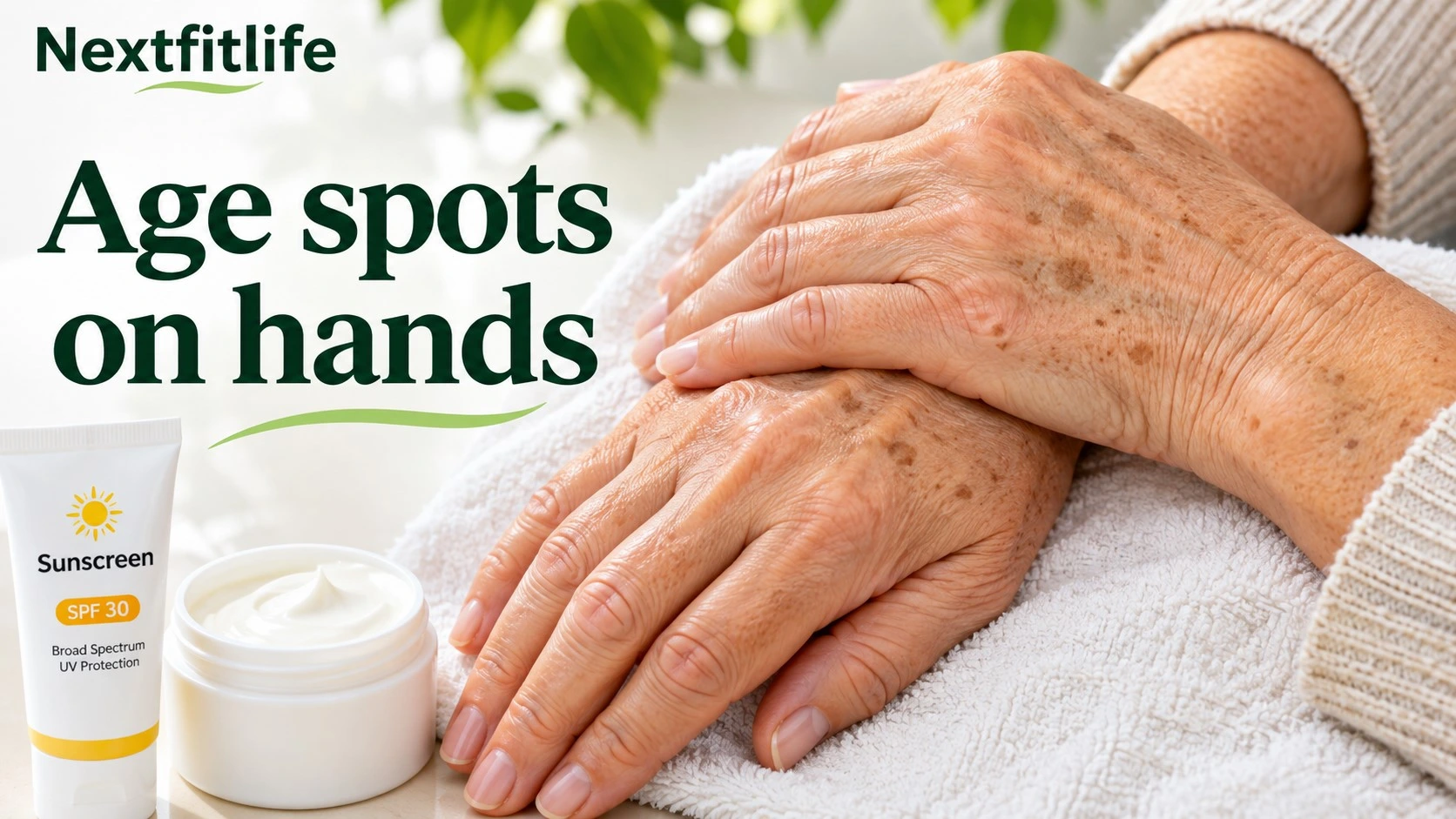
Most age spots on hands are harmless areas of pigment called solar lentigines. They usually appear after years of sun exposure and become more common with age.
Do not start fading every brown mark you see, though. First make sure the spot behaves like an ordinary age spot. Then choose treatment based on your skin tone, how fast you want results, and how much irritation or recovery time you are willing to accept.
Age spots on hands are usually flat tan or brown solar lentigines caused by years of ultraviolet exposure. Sunscreen helps prevent more spots, while creams, retinoids, peels, cryotherapy, IPL, and lasers can fade existing spots. A changing, bleeding, crusting, rough, or unusual mark should be checked before treatment.
The backs of the hands collect sunlight year after year. That is why they are one of the classic places to develop sun spots.
And despite the old name “liver spots,” these marks are not a sign of liver disease.
This article is for general information and education. It does not replace medical advice, diagnosis, or treatment.
A new or changing dark spot, a mark with several colors, an irregular border, bleeding, crusting, persistent itching, pain, or a sore that does not heal should be assessed by a healthcare professional or dermatologist. Some skin cancers can resemble an ordinary age spot.
For the broader basics of healthy skin, see Healthy Skin 101 and the NextFitLife Skin Health Guide.
What You Will Learn
- How typical age spots look
- Which warning signs need a skin check
- Why sunscreen belongs in every treatment plan
- What creams and retinoids can realistically do
- How cryotherapy and chemical peels compare
- When IPL or laser treatment may make sense
- Why darker skin needs careful procedure selection
- How to build a simple twelve week plan
Table of Contents
- What Age Spots Look Like
- 1. Confirm the Spot First
- 2. Protect Your Hands From UV
- 3. Set Realistic Expectations for Creams
- 4. Use Retinoids Carefully
- 5. Consider Cryotherapy
- 6. Compare Chemical Peels
- 7. Compare IPL and Laser
- 8. Know Where Microdermabrasion Fits
- Treatment Comparison
- Home Skin Care Options
- Age Spots vs Other Lesions
- Darker Skin Considerations
- Twelve Week Plan
- When to See a Dermatologist
- Conclusion
- References and Sources
- Internal Links and Hub
- About the Author
- Frequently Asked Questions
What Do Age Spots on Hands Usually Look Like?
A typical solar lentigo is flat, tan to brown, and easy to see against the surrounding skin.
DermNet describes these lesions as well defined spots that appear mainly on areas with long term UV exposure, including the backs of the hands and forearms.
A typical spot is usually:
- Flat or only slightly raised
- Tan, brown, or dark brown
- Fairly even in color
- Round, oval, or mildly irregular
- Painless
- Found on sun exposed skin
- Persistent rather than disappearing in winter
Several spots can sit close together and create a mottled look. They can also become larger over time.
The safety issue is not that a true solar lentigo turns into cancer. The problem is that another skin lesion can sometimes resemble an age spot.
1. Confirm the Spot Before You Treat It
This is the first step I would not skip.
AAD advises having suspected age spots checked before cosmetic treatment because seborrheic keratosis, actinic keratosis, and skin cancer can sometimes look similar.
Treating the wrong lesion with a fading cream can delay the diagnosis that actually matters.
A Typical Age Spot Usually
- Changes slowly
- Has fairly even pigment
- Does not bleed
- Does not form a persistent sore
- Does not repeatedly hurt or itch
Get a Spot Checked When It
- Changes quickly
- Becomes much darker
- Develops several colors
- Has an unusual border
- Bleeds
- Crusts repeatedly
- Becomes rough or scaly
- Looks different from your other spots
This same “diagnose before treating pigment” rule appears in the Skincare Routine for Women Over 50 and the Skincare Routine for Men Over 50.
2. Protect the Backs of Your Hands From More UV
This is the least exciting treatment step and one of the most useful.
Solar lentigines reflect years of sun damage. DermNet notes that careful sun protection reduces the risk of developing more spots and can modestly lighten existing ones.
If you fade one group of spots but continue exposing your hands every day, more pigmentation can keep appearing.
A Simple Hand Sun Plan
- Use broad spectrum sunscreen with SPF 30 or higher on exposed hands.
- Reapply when needed after washing or prolonged outdoor exposure.
- Use gloves during long drives, gardening, or outdoor work when practical.
- Do not forget the backs of the hands while protecting the face.
This is also one of the core steps in the Hand Wrinkles Guide, because the same ultraviolet exposure contributes to both pigment change and visible hand aging.
3. Expect Creams to Work Slowly
Creams are the slower route.
AAD notes that topical treatments usually need consistent use for weeks or months, while procedures such as laser tend to work more quickly.
Depending on your skin and diagnosis, a dermatologist may discuss:
- Retinoids
- Hydroquinone or another pigment treatment
- Cysteamine
- Azelaic acid
- Selected exfoliating acids
- Combination treatment
Mayo Clinic notes that prescription hydroquinone may be used alone or with tretinoin and sometimes a mild steroid to gradually fade age spots over several months.
These products can cause dryness, redness, burning, or irritation. A treatment that inflames your hands every night is not automatically working better.
4. Use Retinoids Carefully
Retinoids can help some sun related pigment and other signs of photoaging.
They are not instant spot removers.
Start slowly, use moisturizer, and protect the hands from ultraviolet exposure. If your skin develops persistent burning, swelling, cracking, or severe peeling, stop and reassess the routine.
Starting retinoid, glycolic acid, strong vitamin C, and a home peel together makes irritation more likely and makes it harder to know which product caused the reaction.
For product order and safer introduction of active ingredients, see Skincare Routine Order.
5. Cryotherapy Is Fast but Has Tradeoffs
Cryotherapy freezes the pigmented spot, usually with liquid nitrogen.
AAD describes it as a common and quick treatment for selected age spots. Temporary pain, blistering, redness, and swelling can occur.
The bigger cosmetic concern is pigment change.
The treated area can become lighter or darker than the surrounding skin, and scarring is possible even though permanent side effects are uncommon when treatment is done properly.
Who Needs Extra Care?
People with deeper skin tones should discuss pigment change risk before treatment.
That does not mean cryotherapy is forbidden. It means matching the procedure to the skin matters.
6. Chemical Peels Can Treat Several Spots at Once
A chemical peel removes controlled layers of surface skin so new skin can replace them.
AAD lists chemical peeling as an effective treatment for hand age spots. It can be useful when several spots sit across the backs of the hands rather than when there is only one isolated mark.
The strength of the peel matters, and so does the person performing it.
Possible Downsides
- Redness
- Peeling
- Irritation
- Temporary darkening
- Uneven pigment
A peel is a procedure, not just a stronger moisturizer. Home experiments with strong acids are not the same as a professionally selected peel.
7. IPL and Laser Usually Work Faster Than Creams
For someone who wants faster cosmetic improvement, IPL or laser treatment may make more sense than several months of topical treatment.
Mayo Clinic and AAD both list laser and intense pulsed light as treatment options for solar lentigines.
Mayo Clinic notes that some approaches require two or three sessions, while AAD notes that one or two laser sessions can sometimes treat age spots more quickly than creams.
Why People Choose Them
- Faster visible change
- Several spots can sometimes be treated together
- Some devices can also improve other signs of sun damage
Why I Would Not Call Them Automatically Better
They cost more, require trained treatment, and can cause temporary darkening, crusting, redness, swelling, or unwanted pigment change.
The device matters. The diagnosis matters. The operator matters.
8. Know Where Microdermabrasion Fits
Microdermabrasion removes part of the outer skin surface and can improve mild pigmentation and texture.
AAD includes it among treatment options for age spots and notes that it can be combined with chemical peeling.
For one sharply defined dark solar lentigo, I would not automatically make microdermabrasion the first choice. A dermatologist may prefer a more targeted option.
It makes more sense when texture and broader surface sun damage are also part of the problem.
Which Age Spot Treatment Works Fastest?
| Treatment | Typical Speed | Best Use | Main Tradeoff |
|---|---|---|---|
| Sunscreen | Preventive | Everyone | Does not quickly erase existing spots |
| Lightening cream | Weeks to months | Gradual home treatment | Slow and can irritate |
| Retinoid | Weeks to months | Pigment plus photoaging | Dryness and irritation |
| Cryotherapy | Fast | Selected individual spots | Blistering and pigment change |
| Chemical peel | Moderate | Several surface spots | Peeling and irritation |
| IPL | Fast | Multiple sun spots | Cost and pigment risk |
| Laser | Fast | Targeted pigment | Cost, crusting, pigment change |
| Microdermabrasion | Moderate | Texture plus mild pigment | Less targeted |
There is no universal best option. The right treatment depends on what the lesion actually is, your skin tone, cost, downtime, and how quickly you want improvement.
Can Age Spots Be Removed Permanently?
An individual treated spot can fade greatly or disappear.
That does not prevent another age spot from developing elsewhere.
DermNet recommends ongoing sun protection after treatment because continued ultraviolet exposure can lead to more solar lentigines.
Think of treatment as removing visible damage while prevention reduces the chance of adding more.
Do Over the Counter Hand Creams Work?
Some topical products can gradually improve hyperpigmentation, but an ordinary hand moisturizer will not remove a true solar lentigo on its own.
Moisturizer helps dryness, texture, and the way fine lines look. Pigment treatment needs ingredients that actually target pigment or a procedure that removes or destroys excess pigment.
If a spot is changing, skip the experiment with six brightening creams and have it assessed.
Can Vitamin C Help?
Vitamin C can fit into a routine for uneven tone and sun related pigment.
I would treat it as an optional supporting ingredient rather than the strongest choice for a long standing, clearly defined solar lentigo.
Sunscreen, correct diagnosis, and a targeted treatment deserve higher priority.
Can Niacinamide Help?
Niacinamide can support the skin barrier and is used in many products for uneven tone.
Do not expect a gentle niacinamide serum to behave like cryotherapy or a pigment laser.
The treatments work in different ways and offer different levels of change.
What About Glycolic Acid?
Glycolic acid can improve rough texture and uneven pigment over time.
It can also irritate the hands if you use too much or combine it with several other active products.
Start carefully, moisturize, and keep sun protection consistent.
Mild and repeatable is better than creating post inflammatory hyperpigmentation through irritation.
Age Spot vs Actinic Keratosis
Both can appear on sun exposed hands, but they are not the same thing.
| Feature | Age Spot | Actinic Keratosis |
|---|---|---|
| Surface | Usually smooth and flat | Often rough or scaly |
| Feel | Usually little to notice by touch | Can feel like sandpaper |
| Color | Tan to brown | Can be pink, red, tan, or brown |
| Medical concern | Benign when correctly diagnosed | Precancerous lesion that should be assessed |
If a brown patch feels much rougher than it looks, do not assume it is an ordinary age spot.
Age Spot vs Seborrheic Keratosis
A seborrheic keratosis can be tan, brown, or very dark.
It is commonly more raised, waxy, rough, or stuck on in appearance than a solar lentigo.
The two can still overlap visually, so an uncertain lesion deserves a real examination instead of a home diagnosis.
Age Spot vs Melanoma
Melanoma can sometimes look like a dark age spot, especially when a lesion is flat and pigmented.
DermNet notes that atypical solar lentigines can overlap in appearance with melanoma in situ, which is why an unusual lesion may need dermoscopy or biopsy.
A useful warning pattern is ABCDE:
- A for asymmetry
- B for an irregular border
- C for several colors or changing color
- D for diameter or size change
- E for evolution
Evolution is especially useful. A spot that is changing deserves attention even when it does not match every textbook feature.
Age Spots on Darker Skin Need a Careful Treatment Plan
The goal is not simply to remove pigment. It is to avoid creating a new pigment problem.
Destructive treatments such as freezing and some laser procedures can leave a treated area lighter or darker than the surrounding skin.
I would put more weight on the clinician's experience with your skin tone than on an advertisement claiming one device is the strongest.
How often do you treat solar lentigines in my skin tone, what pigment changes can happen, and what will you do if the treated area becomes darker or lighter?
A Simple Morning Hand Routine
- Apply moisturizer if the hands feel dry.
- Apply broad spectrum SPF 30 or higher to exposed skin.
- Reapply when needed after washing or prolonged sun exposure.
Simple works better than a routine you will not follow.
A Simple Evening Hand Routine
- Wash gently.
- Apply the chosen pigment treatment if it is suitable for you.
- Finish with moisturizer.
If treatment causes persistent burning, swelling, cracking, or severe peeling, stop and reassess rather than pushing through irritation.
How Long Do Age Spot Creams Take?
Think in weeks or months, not days.
AAD says creams and lotions require consistent application over weeks or months to produce visible fading.
Take a baseline photo in the same lighting if you want to judge progress. Otherwise it is surprisingly difficult to remember how dark the spot looked six weeks earlier.
How Fast Do Procedures Work?
Procedures are usually faster than topical treatment.
AAD notes that laser treatment can sometimes produce results after one or two sessions, while Mayo Clinic says certain laser and IPL approaches may require two or three sessions.
The exact number depends on the spot, device, skin tone, and treatment plan.
Faster treatment also comes with higher cost and a greater chance of temporary redness, crusting, swelling, or pigment change.
Five Mistakes I Would Avoid
- Treating every brown spot as an age spot. Diagnosis comes before cosmetic treatment.
- Skipping sunscreen while using fading products. Continued UV exposure works against the goal.
- Starting several strong acids at once. Irritation can create another pigment problem.
- Expecting moisturizer to remove a lentigo. Moisturizer helps dryness and texture, not deep pigment by itself.
- Choosing the strongest procedure instead of the right one. Treatment should match the lesion and your skin.
A Practical Twelve Week Plan
| Time | What to Do | Goal |
|---|---|---|
| Weeks 1 to 2 | Check that spots look typical, start hand sunscreen, moisturize, take a baseline photo | Confirm the starting point |
| Weeks 3 to 6 | Use one chosen topical treatment if the spots are confirmed benign | Test tolerance and consistency |
| Weeks 7 to 12 | Review change under the same lighting | Decide whether to continue or ask about a procedure |
This is a cosmetic planning framework, not a medical prescription.
The main benefit is that it stops you from switching products every two weeks before any treatment has had a fair chance to work.
When Should You See a Dermatologist?
Arrange an assessment when a hand spot:
- Changes in size
- Changes in color
- Develops several colors
- Bleeds
- Crusts repeatedly
- Itches repeatedly
- Hurts
- Becomes rough or scaly
- Develops an irregular border
- Looks different from your other spots
- Forms a sore that does not heal
AAD's advice is simple: what looks like an age spot can sometimes be something else, so suspicious lesions should be assessed before cosmetic fading treatment.
Conclusion
The best way to deal with age spots on hands is to diagnose first and fade second.
Protect the backs of your hands from ultraviolet exposure, give creams enough time to work, and consider cryotherapy, chemical peels, IPL, or laser when you want faster improvement and the diagnosis is clear.
Your next step: look at your spots in good light. If one is new, changing, rough, bleeding, or unlike the others, get it checked before buying another fading treatment.
References and Sources
- American Academy of Dermatology. What Can Get Rid of Age Spots?
https://www.aad.org/public/cosmetic/age-spots-marks/get-rid-spots - American Academy of Dermatology. What Can Make My Hands Look Younger?
https://www.aad.org/public/cosmetic/younger-looking/what-makes-hands-look-younger - Mayo Clinic. Age Spots: Symptoms and Causes. Updated May 3, 2025.
https://www.mayoclinic.org/diseases-conditions/age-spots/symptoms-causes/syc-20355859 - Mayo Clinic. Age Spots: Diagnosis and Treatment. Updated May 3, 2025.
https://www.mayoclinic.org/diseases-conditions/age-spots/diagnosis-treatment/drc-20355864 - DermNet. Solar Lentigo. Reviewed November 2025.
https://dermnetnz.org/topics/solar-lentigo - DermNet. Atypical Solar Lentigo.
https://dermnetnz.org/topics/atypical-solar-lentigo
Internal Links and NextFitLife Hub
- Skin Health: Complete 2026 Guide
- Healthy Skin 101: 10 Simple Daily Habits
- Hand Wrinkles: 11 Proven Ways to Smooth and Prevent Them
- Skincare Routine Order: What Goes First?
- Skincare Routine for Women Over 50: 6 Essential Steps
- Skincare Routine for Men Over 50: 5 Essential Steps
- NextFitLife About Us and Editorial Standards
About the Author
Adel Galal is the founder and lead writer of NextFitLife.com. He has more than 15 years of health and wellness writing experience. He is not a licensed healthcare professional. Read the About page for sources and review rules.
Adel is not a medical professional; health articles cite trusted sources and are for general information only.
Frequently Asked Questions
What causes age spots on hands?
Age spots are usually solar lentigines caused by years of ultraviolet exposure. They commonly appear on the backs of the hands because this skin receives repeated sun exposure.
Are age spots on hands dangerous?
A true solar lentigo is benign. The concern is that melanoma, actinic keratosis, seborrheic keratosis, and other lesions can sometimes resemble an age spot, so unusual or changing marks should be assessed.
Can age spots on hands be removed?
Yes. Topical treatments can gradually fade them, while procedures such as cryotherapy, chemical peels, IPL, and laser can produce faster cosmetic improvement in correctly diagnosed spots.
What is the fastest treatment for age spots on hands?
Procedures such as laser, IPL, and cryotherapy usually work faster than creams. The best option depends on the spot, skin tone, cost, downtime, and risk of pigment change.
How long do age spot creams take to work?
AAD notes that creams and lotions usually require consistent use for weeks or months. Results depend on the ingredient, strength, spot, and individual skin response.
Does sunscreen fade age spots?
Sun protection mainly helps prevent more ultraviolet damage and new spots. DermNet notes that careful sun protection may also modestly lighten existing solar lentigines.
Are liver spots caused by liver disease?
No. Liver spots are another name for age spots or solar lentigines. They are linked to ultraviolet exposure and aging rather than liver disease.
When should a brown spot on the hand be checked?
Have a spot assessed if it changes in size, border, or color, develops several colors, bleeds, crusts, becomes persistently itchy or painful, looks very different from your other spots, or does not heal.
Can age spots come back after treatment?
A treated spot can fade or disappear, but continued ultraviolet exposure can lead to new solar lentigines. Ongoing sun protection remains part of the treatment plan.

Health & wellness writer with 30+ years of experience in nutrition, fitness, and healthy aging. Founder of NextFitLife.com — evidence-based health guidance.