
Published on: May 12, 2024
Updated: October 30, 2026
The Best Compound Leg Exercises do not come from one magic lift.
A strong lower body program needs several movement patterns. Squats train the knees and hips together. Hip hinges place more work on the hips and posterior chain. Single leg exercises challenge each side on its own, while machines can let you train the legs hard with less balance demand.
You also do not need all 14 exercises in one session. Pick a few movements that cover the main jobs, train them consistently, and make them harder as you become stronger.
This article is for general information and education. It does not replace medical advice, diagnosis, or treatment.
Quick answer: The best compound leg exercises include squats, leg presses, Romanian deadlifts, trap bar deadlifts, hip thrusts, split squats, lunges, and step ups. A complete routine should train knee dominant movement, hip extension, the posterior chain, and at least one single leg pattern. Two well planned lower body sessions per week can be enough for many lifters.
Table of Contents
- What makes an exercise compound?
- Muscles a leg workout should cover
- 14 strong compound leg exercises
- Back squat
- Front squat
- Goblet squat
- Leg press
- Hack squat
- Romanian deadlift
- Trap bar deadlift
- Conventional deadlift
- Hip thrust
- Bulgarian split squat
- Reverse lunge
- Walking lunge
- Step up
- Sumo deadlift
- How to choose your exercises
- Beginner leg workout
- Muscle growth leg workout
- Strength focused workout
- Sets and repetitions
- Training effort
- Range of motion
- Recovery
- Common mistakes
- Frequently asked questions
What Is a Compound Leg Exercise?
A compound leg exercise uses movement at more than one joint and usually trains several muscles at once.
A squat involves the hips, knees, and ankles. A Romanian deadlift uses the hips while the knees remain slightly bent. A split squat combines hip and knee movement on one side while the other leg helps with balance.
Compound training is useful because one exercise can train several large muscle groups.
That makes it easy to build an efficient lower body workout.
Compound does not automatically mean better than isolation work. Leg curls, leg extensions, calf raises, and hip abduction exercises can still fill gaps that compound movements do not fully cover.
For more lower body options, see our Leg Exercises With Dumbbells guide.
What Muscles Should a Complete Leg Workout Train?
| Muscle Group | Main Job | Useful Compound Moves |
|---|---|---|
| Quadriceps | Extend the knee | Squat, leg press, split squat |
| Gluteus maximus | Extend the hip | Squat, hip thrust, RDL |
| Hamstrings | Hip extension and knee flexion | RDL, deadlift |
| Adductors | Hip control and extension | Deep squat, sumo deadlift |
| Calves | Control the ankle | Squats, lunges, step-ups |
A good program should not depend on one movement to train every muscle equally.
14 Best Compound Leg Exercises
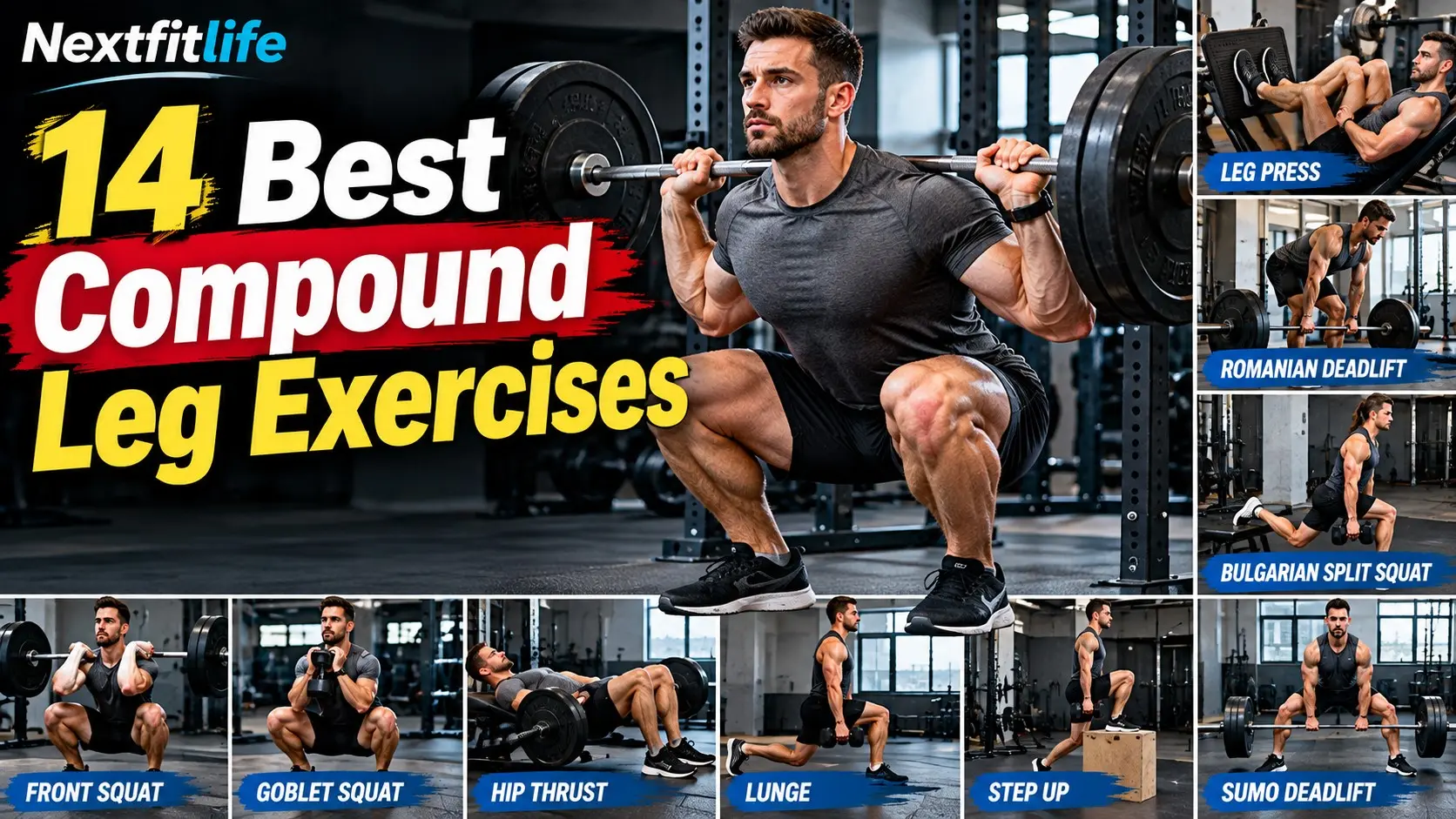
1. Barbell Back Squat
The back squat is one of the most useful quad exercises and glute exercises because it allows progressive loading through both the knees and hips.
It is not the only good leg exercise, and it is not mandatory.
How to do it:
- Place the bar securely across your upper back.
- Set your feet in a position that feels stable.
- Bend your knees and hips together.
- Lower through a range you can control.
- Keep pressure across the whole foot.
- Stand by extending the knees and hips.
Useful range: 5 to 12 repetitions.
Go as deep as you can control without forcing a position your joints do not tolerate.
2. Front Squat
The front squat places the bar in front of the shoulders.
This usually encourages a more upright torso than a back squat, although individual technique still varies.
It is a strong choice for lifters who want another knee-dominant squat option.
Useful range: 5 to 10 repetitions.
Wrist mobility can make the traditional front rack difficult. Crossed arms or suitable straps can be alternatives.
3. Goblet Squat
The goblet squat is one of my preferred starting squats because the load stays close to the body.
Hold one dumbbell or kettlebell near your chest.
Lower with your knees and hips working together, then stand with control.
Useful range: 8 to 15 repetitions.
The main limitation is often how much weight you can comfortably hold rather than how strong your legs become.
For more detail, see our Goblet Squat guide.
4. Leg Press
The leg press is a true compound movement because both the knees and hips move.
It does not isolate the legs in the technical sense.
What the machine does is remove much of the balance and bar control required during a free weight squat.
That can be useful when your goal is to train the legs hard.
Useful range: 8 to 15 repetitions.
Lower the platform only as far as you can while keeping your hips and back comfortably supported.
5. Hack Squat
The hack squat gives you a guided squat pattern.
It can be useful for leg hypertrophy because the machine provides stability while you focus on knee and hip extension.
Place your feet where you can keep them stable on the platform.
Lower through a comfortable range and drive back up without bouncing from the bottom.
Useful range: 6 to 15 repetitions.
6. Romanian Deadlift
The Romanian deadlift is one of the best choices for training the hip hinge.
It targets the hamstrings and glutes while teaching you to move through the hips.
- Hold the bar or dumbbells close to your thighs.
- Keep a small bend in your knees.
- Push your hips backward.
- Lower until you feel strong tension through the back of the thighs.
- Stand by extending the hips.
Useful range: 6 to 12 repetitions.
Your knees should stay slightly bent rather than completely locked.
If the hinge pattern feels unfamiliar, use our Hip Hinge Exercises guide.
7. Trap Bar Deadlift
The trap bar lets you stand inside the load instead of holding a straight bar in front of the legs.
Depending on your technique and bar design, it can combine substantial knee and hip extension.
This makes it useful for building lower body strength.
Useful range: 4 to 8 repetitions for strength or 6 to 12 for general training.
Use the handle height that lets you lift with a controlled starting position.
8. Conventional Deadlift
The conventional deadlift trains the hips, legs, back, grip, and trunk together.
It is a valuable strength exercise, but it is not automatically the best choice for maximizing leg muscle growth.
A squat or leg press may provide more direct quadriceps work, while an RDL can provide more focused lengthened hamstring loading.
Use the conventional deadlift when it fits your goals.
Useful range: 3 to 8 repetitions for most strength focused work.
9. Hip Thrust
The hip thrust is a loaded hip extension exercise.
It can be useful when you want more direct glute work without adding another squat.
Place your upper back against a stable bench, keep the load secure across the hips, and extend until the hips are fully raised without forcing the lower back into a large arch.
Useful range: 6 to 15 repetitions.
Hip thrusts and squats do not need to compete for one winner. They load the hip through different parts of the movement.
10. Bulgarian Split Squat
The Bulgarian split squat is one of the strongest unilateral leg exercises.
Your front leg performs most of the work while the rear foot provides support.
- Place the rear foot on a stable support.
- Set the front foot far enough forward to stay balanced.
- Lower the rear knee toward the floor.
- Keep the front foot planted.
- Drive through the front leg to stand.
Useful range: 6 to 12 repetitions per side.
If rear foot elevation feels awkward, use a normal split squat instead.
11. Reverse Lunge
A reverse lunge trains one leg at a time while usually being easier to control than a walking lunge.
Step backward, lower the rear knee, then push through the front leg to return.
Useful range: 8 to 15 repetitions per side.
You can use body weight, dumbbells, a barbell, or a Smith machine.
12. Walking Lunge
Walking lunges add repeated single leg work while moving forward.
They challenge the quads, glutes, balance, and coordination.
Useful range: 8 to 16 controlled steps per leg.
Do not choose a step length just because someone says it is the perfect glute or quad stance. Use a stride that feels stable and lets you control the movement.
13. Step Up
The step up is a simple way to train single leg strength.
Use a stable step that allows you to drive through the working leg without jumping from the floor.
Useful range: 8 to 12 repetitions per side.
Higher is not automatically better.
If the box is so high that your pelvis rolls or you need momentum, lower the step.
14. Sumo Deadlift
The sumo deadlift uses a wider stance and places the hands inside the legs.
It still trains multiple lower body muscles, including the glutes, quadriceps, adductors, and posterior chain.
It is not inherently better than a conventional deadlift.
Choose the stance that suits your body, goals, and training preference.
Useful range: 3 to 8 repetitions for strength or somewhat higher for general resistance training.
14 Compound Leg Exercises at a Glance
| Exercise | Main Emphasis | Good Fit For |
|---|---|---|
| Back squat | Quads and glutes | Strength and muscle |
| Front squat | Quads and trunk | Strength |
| Goblet squat | Quads and glutes | Beginners |
| Leg press | Quads and glutes | Muscle growth |
| Hack squat | Quads and glutes | Stable leg training |
| Romanian deadlift | Hamstrings and glutes | Posterior chain |
| Trap bar deadlift | Whole lower body | Strength |
| Conventional deadlift | Posterior chain | Strength |
| Hip thrust | Glutes | Hip extension |
| Bulgarian split squat | Quads and glutes | Single leg strength |
| Reverse lunge | Quads and glutes | Single leg training |
| Walking lunge | Quads and glutes | Strength and coordination |
| Step up | Quads and glutes | Single leg strength |
| Sumo deadlift | Glutes, quads, adductors | Strength |
Do You Need All 14 Exercises?
No.
A good leg day can use four or five exercises.
More exercises do not automatically mean more growth.
For most people, I would build the session around these categories:
- One squat or leg press pattern
- One hip hinge
- One single leg movement
- One hip extension or second squat pattern
- Optional isolation work
This gives you broad coverage without turning leg day into a two hour event.
Best Beginner Compound Leg Workout
| Exercise | Sets | Repetitions |
|---|---|---|
| Goblet squat | 2 | 8 to 12 |
| Romanian deadlift | 2 | 8 to 12 |
| Reverse lunge | 2 | 8 each side |
| Hip thrust | 2 | 10 to 15 |
Train this once or twice each week depending on the rest of your program.
Keep the early sessions controlled so you can learn the movement patterns.
Compound Leg Workout for Muscle Growth
| Exercise | Sets | Repetitions |
|---|---|---|
| Back squat or hack squat | 3 | 6 to 10 |
| Romanian deadlift | 3 | 6 to 10 |
| Bulgarian split squat | 2 to 3 | 8 to 12 each side |
| Hip thrust | 2 to 3 | 8 to 15 |
You can add a leg curl, calf raise, or leg extension afterward if those muscles need more direct work.
Compound Leg Workout for Strength
| Exercise | Sets | Repetitions |
|---|---|---|
| Back squat | 3 to 5 | 3 to 6 |
| Trap bar deadlift | 3 | 3 to 6 |
| Bulgarian split squat | 2 to 3 | 6 to 10 each side |
| Romanian deadlift | 2 to 3 | 6 to 8 |
Strength sessions usually benefit from longer rest periods than fast circuits.
How Many Sets Build Leg Muscle?
There is no single perfect number.
Current resistance training guidance supports enough weekly volume to challenge the target muscles while still allowing recovery.
For muscle growth, around 10 weekly hard sets per muscle group can be a useful general reference for many trained adults, but it is not a mandatory minimum or maximum.
Beginners may progress with much less.
Start with a volume you can recover from.
What Rep Range Is Best?
Muscle can grow across a wide range of loads when sets are sufficiently challenging.
For compound leg movements, practical ranges often look like this:
| Goal | Practical Range |
|---|---|
| Heavy strength | 3 to 6 reps |
| Strength and muscle | 5 to 10 reps |
| Muscle focused work | 8 to 15 reps |
You do not need every exercise in the same range.
How Hard Should Each Set Feel?
The last few repetitions should require effort.
If you finish ten squats and could easily do ten more, the set probably gives little stimulus for continued strength or muscle gains.
You also do not need to reach complete failure every time.
A practical approach is to finish many sets with about one to three good repetitions still possible.
This is called repetitions in reserve.
Read our Reps in Reserve guide if you want to use this method.
Do You Need Progressive Overload?
Yes.
Progressive overload simply means making training harder over time as your body adapts.
You can progress by:
- Adding a little weight
- Doing more repetitions
- Adding a set
- Improving control
- Increasing useful range of motion
- Moving to a harder variation
You do not need to add weight every workout forever.
How Deep Should You Squat?
Use the deepest range that you can control comfortably.
You do not need to stop automatically when the thighs become parallel.
A small 10 week study found similar quadriceps growth from full and half squats, but deeper squats produced greater growth in the gluteus maximus and adductors.
That does not mean every person must squat as deep as possible.
Your mobility, anatomy, goals, training experience, and comfort all matter.
Depth should serve the exercise, not become a competition.
Is a Squat Better Than a Leg Press?
Not automatically.
The squat asks you to control your body and the load through space.
The leg press gives you a guided path and removes much of the balance demand.
Both can train the quadriceps and glutes.
Your choice depends on:
- Goals
- Equipment
- Training experience
- Comfort
- Fatigue
- How much stability you want the exercise to require
You can use both in the same program.
Are Machines Real Compound Exercises?
Yes, if several joints move.
A leg press and hack squat use the hips and knees together.
Being guided by a machine does not turn them into isolation movements.
Machines may actually be useful when balance or trunk fatigue limits how hard you can train the legs.
Is the Deadlift a Leg Exercise?
Yes, but it is also much more than a leg exercise.
The conventional deadlift trains the hips, legs, back, grip, and trunk.
For pure quadriceps growth, a squat or leg press is usually a more direct choice.
For hamstrings and glutes, the Romanian deadlift often fits more cleanly into a bodybuilding style leg workout.
Do Compound Leg Exercises Train the Hamstrings Enough?
Not always.
This is an important point.
Squats involve the hamstrings, but squat training alone does not necessarily produce large hamstring growth.
Research comparing squat depths found little change in hamstring muscle volume despite clear growth elsewhere in the lower body.
That is why I would include a hinge such as an RDL and often add a knee flexion exercise such as a leg curl.
Do You Need Hip Thrusts if You Squat?
No exercise is mandatory.
Squats already train the glutes.
Hip thrusts provide another way to load hip extension and can be useful when you want additional direct glute work.
If glute development is a priority, combining movement patterns can make sense.
For upper glute training options, see Upper Glute Exercises.
Do You Need Single Leg Exercises?
You do not have to use them, but they are useful.
Single leg work can:
- Train each side individually
- Challenge balance
- Provide strong leg loading with less total external weight
- Add variety when bilateral squatting becomes tiring
Good options include split squats, reverse lunges, and step ups.
Should You Put Squats or Deadlifts First?
Put the movement that matters most to your goal first.
If squat strength is the priority, squat first.
If deadlift strength is the priority, deadlift first.
For general muscle growth, start with the exercise you most want to progress while you are fresh.
You do not need one fixed order for life.
How Long Should You Rest Between Sets?
Heavy compound exercises usually benefit from more rest than small isolation movements.
A practical starting point is:
- About 2 to 4 minutes after hard squats and deadlifts
- About 1.5 to 3 minutes after moderate compound work
- Longer when your next set would otherwise suffer badly
The goal is not to keep your heart rate high at all costs.
The goal is to perform useful training.
How Often Should You Train Legs?
Two lower body exposures per week work well for many people.
You could use:
- Two dedicated leg days
- Two full body workouts
- An upper and lower split
- Three full body sessions that spread leg work across the week
There is no magic split.
Weekly training volume, effort, progression, and recovery matter more than the name of the routine.
See Full Body vs Split Workout for a simple comparison.
Example Two Day Lower Body Plan
| Day A | Day B |
|---|---|
| Back squat | Leg press or hack squat |
| Romanian deadlift | Hip thrust |
| Reverse lunge | Bulgarian split squat |
| Optional leg curl | Optional leg extension |
| Optional calf raise | Optional calf raise |
This gives the legs more than one movement pattern without repeating the exact same session.
Are Box Jumps Good Compound Leg Exercises?
Box jumps use many lower body joints and muscles, but I would classify them mainly as a power exercise.
They are useful for athletes who need jumping ability and explosive power.
They are not one of my first choices for building maximum leg muscle because the goal is speed, not slow progressive muscular loading.
If hypertrophy is the goal, use squats, presses, hinges, split squats, and similar resistance exercises first.
Common Compound Leg Training Mistakes
Using Too Many Big Exercises
Four heavy compound lifts in one session may create more fatigue than useful training.
You do not need every exercise in the article at once.
Turning Every Set Into a Max Test
Muscle and strength are built through repeated training, not constant one repetition maximum attempts.
Ignoring the Hamstrings
A squat alone does not cover every hamstring function.
Add a hinge and consider direct knee flexion work.
Forcing One Squat Stance
People have different hip structures, limb lengths, and mobility.
A comfortable stance can differ between lifters.
Using Weight You Cannot Control
A heavier bar is only useful when you can perform useful repetitions with it.
Changing Exercises Too Often
Your body needs enough repeated practice for you to measure progress.
Keep the main lifts long enough to improve them.
Never Progressing
Doing the same easy load forever is exercise, but it may stop producing much adaptation.
What About Knee Pain?
Do not assume every squat is bad for every knee.
Also do not force a painful exercise because someone online says it is mandatory.
If one variation hurts, change:
- The exercise
- The load
- The range
- The stance
- The volume
Persistent swelling, locking, instability, or significant pain deserves professional assessment.
When Should You Stop Training?
Stop the session and seek appropriate medical help if you develop:
- Sudden severe pain
- A major acute injury
- New numbness
- Sudden weakness
- Fainting
- Chest pain
- Severe unusual shortness of breath
Training through a serious symptom is not a sign of toughness.
Simple Compound Leg Training Checklist
- Choose one squat or press pattern.
- Add one hip hinge.
- Use one single leg movement.
- Add hip extension if your goals call for it.
- Train through a controlled range.
- Keep most working sets challenging but technically sound.
- Add repetitions or resistance over time.
- Train the hamstrings through both hip extension and knee flexion when possible.
- Allow enough rest between hard sets.
- Recover before repeating a hard lower body session.
Conclusion
The Best Compound Leg Exercises are the movements that let you train the knees, hips, quads, glutes, hamstrings, and adductors hard enough to improve while still fitting your body and program.
You do not need one “king” exercise. Squats, leg presses, Romanian deadlifts, hip thrusts, split squats, step ups, and deadlift variations can all play useful roles.
Choose a few. Learn them well. Track your training and add challenge gradually.
Your next step: choose one squat, one hinge, and one single leg movement from this guide. Train them twice this week and record your sets, repetitions, and resistance.
References and Sources
- American College of Sports Medicine. Resistance Training Guidelines Update 2026.
https://acsm.org/resistance-training-guidelines-update-2026/ - Centers for Disease Control and Prevention. Adult Activity: An Overview.
https://www.cdc.gov/physical-activity-basics/guidelines/adults.html - Kubo K, Ikebukuro T, Yata H. Effects of Squat Training With Different Depths on Lower Limb Muscle Volumes.
https://pubmed.ncbi.nlm.nih.gov/31230110/ - Plotkin DL, et al. Hip Thrust and Back Squat Training Elicit Similar Gluteus Hypertrophy and Transfer Differently to Strength.
https://pubmed.ncbi.nlm.nih.gov/37877099/ - Rossi FE, et al. Strength, Body Composition, and Functional Outcomes in the Squat Versus Leg Press Exercises.
https://pubmed.ncbi.nlm.nih.gov/?term=Strength%2C+body+composition%2C+and+functional+outcomes+in+the+squat+versus+leg+press+exercises
Internal Links + Hub
- NextFitLife Fitness Hub
- Fitness Program Guide
- Leg Exercises With Dumbbells
- Goblet Squat Guide
- Hip Hinge Exercises
- Upper Glute Exercises
- Reps in Reserve
- Full Body vs Split Workout
- Push Pull Legs vs Full Body
- Minimum Effective Dose Strength Training
About the Author
Adel Galal is the founder and lead writer of NextFitLife.com and the founder of Parnthub.com.
He is a father of four, three sons and a daughter, and a grandfather of four, with more than 33 years of hands on family experience. Adel is based in Cairo, Egypt.
He has maintained a personal interest in health, fitness, nutrition, sleep, wellness, and healthy aging for more than 30 years and has more than 15 years of health and wellness writing experience.
His work focuses on reviewing trusted health and fitness sources, separating established guidance from uncertain claims, and turning exercise science into practical information for everyday readers.
Adel is not a doctor, physical therapist, exercise physiologist, registered dietitian, or certified personal trainer. NextFitLife content is for general information and education and does not replace individual medical or professional exercise advice.
Learn more about Adel and NextFitLife on the About Us page.
Frequently Asked Questions
What are the best compound leg exercises?
Strong choices include back squats, front squats, leg presses, hack squats, Romanian deadlifts, trap bar deadlifts, hip thrusts, split squats, lunges, and step ups. The best combination depends on your goals and equipment.
What is the best compound exercise for legs?
There is no single best exercise for everyone. Squats are excellent for knee and hip extension, while Romanian deadlifts emphasize the posterior chain and split squats provide strong single leg training.
Are squats enough for complete leg development?
No. Squats train the quadriceps, glutes, adductors, and other muscles, but they do not fully train every hamstring function. Adding a hip hinge and often a leg curl creates more complete lower body training.
Are deadlifts enough for legs?
No. Deadlifts provide strong hip and posterior chain training, but they do not replace knee dominant movements such as squats or leg presses when balanced lower body development is the goal.
Are leg presses compound exercises?
Yes. The leg press involves movement at both the hips and knees, which makes it a compound exercise even though the machine provides external stability.
Are hack squats compound exercises?
Yes. Hack squats use both knee and hip extension and train several lower body muscles at the same time.
Are Bulgarian split squats compound exercises?
Yes. Bulgarian split squats involve the hip and knee while training the quads, glutes, adductors, and other stabilizing muscles.
How many compound exercises should I do on leg day?
Three or four compound exercises can be plenty for one session. You can then add one or two isolation exercises if specific muscles need more direct work.
Are four compound leg exercises too many?
Not necessarily. Four can work well when training volume and effort are sensible. Four very demanding heavy exercises may create too much fatigue, so exercise selection matters.
How often should I train legs?
Training the lower body about twice each week works well for many people. Full body routines can also spread lower body work across three sessions.
How many repetitions should I do for leg growth?
Muscle can grow across a wide range of repetitions. For compound leg exercises, about 5 to 15 repetitions is a practical range for much of your training.
Should I train compound leg exercises to failure?
No. Complete failure is not required for muscle or strength gains. Many productive sets can finish with roughly one to three good repetitions still possible.
Should I squat below parallel?
Use the deepest range you can control comfortably. Research suggests deeper squats can provide more growth in the glutes and adductors than half squats, but individual mobility and comfort still matter.
Is the Romanian deadlift good for hamstrings?
Yes. The Romanian deadlift trains hip extension while placing the hamstrings under substantial tension as the hips move backward.
Do I need both squats and Romanian deadlifts?
You do not have to use those exact exercises, but pairing a knee dominant movement with a hip hinge is a simple way to train different parts of the lower body.
Are compound exercises enough for calves?
Usually not if calf growth is a priority. Squats, lunges, and step ups involve the calves, but direct calf raises often provide a clearer progression for calf training.

Health & wellness writer with 30+ years of experience in nutrition, fitness, and healthy aging. Founder of NextFitLife.com — evidence-based health guidance.

