Last Updated: July 14, 2026
Topic: Chest Exercises with Dumbbells
Reading Time: About 12 minutes
Content Note: This article is for education only. It does not replace medical advice.
Chest Exercises with Dumbbells can help you build upper-body strength at home or in the gym.
You do not need heavy weights.
You do not need a big bench setup.
You do not need unsafe shoulder positions.
You need light weights.
You need good form.
You need control.
You need a plan that trains the chest without hurting the shoulders.
Your chest muscles help you push.
They help you press.
They help with daily tasks like pushing a door, getting up from the floor, carrying items, and supporting your upper body.
This guide gives you safe dumbbell chest exercises, beginner options, home workout plans, form tips, recovery advice, and warning signs to respect.
Quick answer
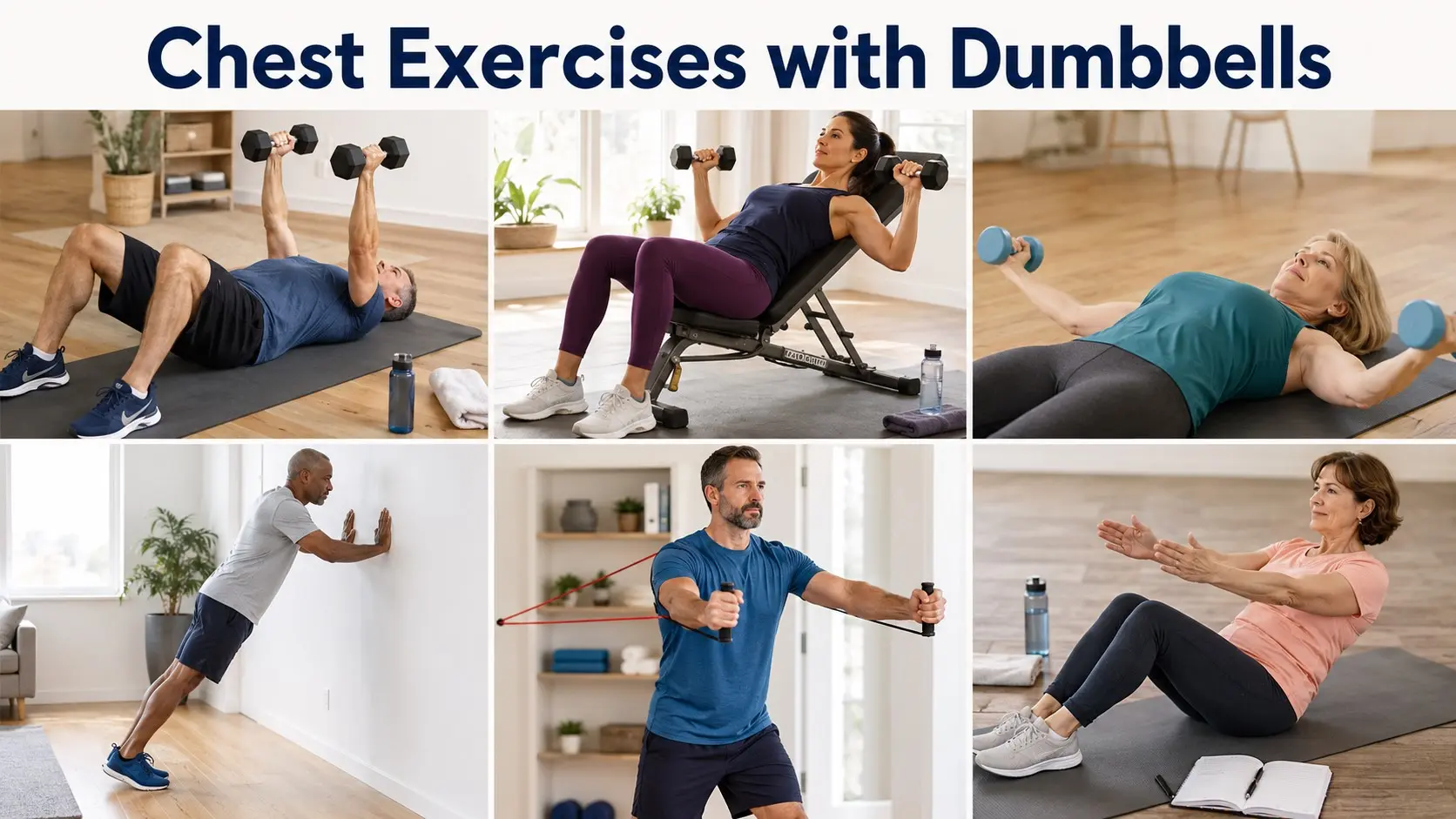
The best Chest Exercises with Dumbbells include dumbbell floor press, dumbbell chest press, incline dumbbell press, neutral grip press, one-arm dumbbell floor press, dumbbell squeeze press, light dumbbell fly, pullover, wall push-up, band chest press, and farmer carry.
Start light.
Move slowly.
Keep your shoulders relaxed.
Keep your wrists straight.
Train chest 2 days weekly at first.
Stop if you feel sharp pain, chest pain, numbness, tingling, severe dizziness, or shoulder pain that does not improve.
What muscles do dumbbell chest exercises train?
Dumbbell chest exercises mainly train your chest muscles.
They also use your shoulders.
They use your triceps.
They use your upper back for support.
They use your core to keep your body steady.
This is why chest strength matters for more than appearance.
It supports pushing power, posture, and daily movement.
Why use dumbbells for chest workouts?
Dumbbells are useful because each side works on its own.
They can help you notice if one side feels weaker.
They can be used at home.
They let you start light.
They can be easier to adjust than a barbell.
This makes dumbbell chest exercises a good choice for many beginners.
Before you start
Talk with a qualified healthcare professional before starting a dumbbell chest workout if you have chest pain, heart disease, high blood pressure, shoulder pain, neck pain, wrist pain, elbow pain, rotator cuff injury, recent surgery, dizziness, nerve symptoms, or a long-term health condition.
Stop exercising and seek help if you feel chest pain, fainting, severe shortness of breath, sudden weakness, severe dizziness, numbness, tingling that does not stop, or sharp pain.
Strength training should feel controlled.
It should not feel dangerous.
How to choose the right dumbbell weight
Start lighter than you think.
Your first goal is clean form.
You should be able to lift the weight with control.
Your wrists should stay straight.
Your shoulders should not pinch.
Your lower back should not arch hard.
Your last reps can feel hard.
But your form should stay safe.
This supports safe strength training.
Chest workout form rules
Use these rules for every move.
- Keep your wrists straight.
- Keep your shoulders away from your ears.
- Do not flare your elbows too wide.
- Lower the weights slowly.
- Breathe while you lift.
- Stop before sharp pain.
- Use lighter weights when form breaks.
- Train your back too.
Good form is better than heavy weight.
Warm up first
Warm up for 5 minutes before training.
- March in place for 2 minutes.
- Roll your shoulders 10 times.
- Do 8 wall slides if comfortable.
- Do 8 wall push-ups.
- Do 8 light band pull-aparts.
- Do one practice set with no weight.
This supports injury prevention.
Do not stretch cold muscles hard.
11 Chest Exercises with Dumbbells
You do not need to do all 11 moves in one workout.
Pick 5 or 6 exercises.
Start light.
Rest when needed.
1. Dumbbell floor press
The dumbbell floor press is one of the safest beginner chest moves.
The floor limits how far your elbows can drop.
That can feel better for some shoulders.
How to do it
- Lie on your back on a mat.
- Bend your knees.
- Hold a light dumbbell in each hand.
- Keep elbows about 45 degrees from your body.
- Press the weights up slowly.
- Lower until upper arms touch the floor gently.
Do 8 to 12 reps.
This is a useful dumbbell floor press.
2. Neutral grip dumbbell press
A neutral grip means your palms face each other.
This may feel better on the shoulders for some people.
How to do it
- Lie on a mat or stable bench.
- Hold dumbbells with palms facing each other.
- Keep elbows close to your body.
- Press up slowly.
- Lower with control.
Do 8 to 12 reps.
This supports neutral grip press training.
3. Dumbbell chest press on bench
This move trains the chest, shoulders, and triceps.
Use a stable bench only.
How to do it
- Lie on a flat bench.
- Keep feet on the floor.
- Hold dumbbells near your chest.
- Press up with control.
- Lower slowly.
Do 8 to 12 reps.
This supports dumbbell chest press strength.
4. Incline dumbbell press
The incline press trains the upper chest and shoulders.
Use a gentle incline.
Do not make the bench too steep.
How to do it
- Set a stable bench to a low incline.
- Hold light dumbbells.
- Keep shoulders relaxed.
- Press up slowly.
- Lower with control.
Do 8 to 10 reps.
This supports incline dumbbell press training.
5. One-arm dumbbell floor press
This move trains one side at a time.
It also asks your core to stay steady.
How to do it
- Lie on your back on a mat.
- Hold one dumbbell in one hand.
- Keep the other hand relaxed on the floor.
- Press up slowly.
- Lower with control.
- Switch sides.
Do 8 to 10 reps on each side.
This supports single-arm chest press control.
6. Dumbbell squeeze press
The squeeze press uses two dumbbells pressed together.
It can help you feel chest tension with a lighter weight.
How to do it
- Lie on a mat or bench.
- Hold two dumbbells together above your chest.
- Gently press the dumbbells toward each other.
- Press up slowly.
- Lower with control.
Do 8 to 12 reps.
This supports chest activation.
7. Light dumbbell fly
Dumbbell flys can be useful, but they need care.
Use very light weights.
Do not stretch too deep.
How to do it
- Lie on a mat or bench.
- Hold light dumbbells above your chest.
- Keep elbows slightly bent.
- Open arms slowly.
- Stop before shoulder strain.
- Bring weights back together.
Do 6 to 10 reps.
This supports dumbbell fly training.
Safety note
Skip this move if it causes shoulder pain or chest discomfort.
8. Dumbbell pullover
The pullover trains chest, back, and shoulder control.
Use a lightweight and a short range first.
How to do it
- Lie on a mat or bench.
- Hold one dumbbell with both hands.
- Start above your chest.
- Lower the dumbbell back slowly.
- Stop before shoulder strain.
- Return with control.
Do 6 to 10 reps.
This supports upper body mobility.
9. Wall push-up
This move uses body weight, not dumbbells.
It belongs here because it teaches safe pressing form.
How to do it
- Stand facing a wall.
- Place hands on the wall at chest height.
- Step feet back a little.
- Bend elbows slowly.
- Push back with control.
Do 8 to 12 reps.
This supports beginner chest workout training.
10. Band chest press
A band chest press is a light option for home training.
Use a secure setup and keep the band under control.
How to do it
- Anchor a resistance band safely behind you.
- Hold the handles near chest height.
- Step forward until the band has light tension.
- Press forward slowly.
- Return with control.
Do 8 to 12 reps.
This supports the resistance band chest press.
11. Farmer carries
Farmer carries do not look like chest exercises.
But they train grip, shoulders, posture, and core support.
That support helps your upper body training.
How to do it
- Hold light dumbbells at your sides.
- Stand tall.
- Keep shoulders relaxed.
- Walk slowly for 20 to 30 seconds.
Do 2 rounds.
This supports functional strength.
Beginner Chest Exercises with Dumbbells workout
Use this workout 2 days weekly.
Rest at least 1 day between sessions.
Warm up
- March in place, 2 minutes
- Shoulder rolls, 10 reps
- Wall push-ups, 8 reps
- Band pull-aparts, 8 reps
Round 1
- Dumbbell floor press, 8 to 12 reps
- Supported dumbbell row, 8 to 12 reps each side
- Wall push-up, 8 to 12 reps
Round 2
- Neutral grip dumbbell press, 8 to 10 reps
- Dumbbell squeeze press, 8 to 10 reps
- Farmer carry, 20 seconds
Start with 1 round if you are new.
Add a second round when your form feels steady.
This is a simple home chest workout.
10-minute dumbbell chest workout
Use this when time is short.
- Minute 1: Warm-up and shoulder rolls
- Minute 2: Wall push-ups
- Minute 3: Dumbbell floor press
- Minute 4: Rest and breathe
- Minute 5: Neutral grip press
- Minute 6: Supported row right side
- Minute 7: Supported row left side
- Minute 8: Squeeze press
- Minute 9: Farmer carries
- Minute 10: Cool down
Move slowly.
Do not rush the reps.
Why you should train your back with chest
A good chest workout should not ignore the back.
Rows and band pull-aparts help balance pressing.
They train your shoulder blades.
They may help your shoulders feel better during pressing.
Good options include:
- Supported dumbbell rows
- Band pull-aparts
- Rear delt raises
- Farmer carries
This supports upper back strength.
How often should you train your chest?
Many beginners can train their chest 2 days a week.
Rest at least 1 day between chest workouts.
You can add other training days for legs, walking, mobility, and core.
Do not train chest hard every day.
Muscles need time to recover.
How many sets and reps?
Start with 1 or 2 sets.
Use 8 to 12 reps for most exercises.
Use 6 to 10 reps for flies and pullovers.
Use 20 to 30 seconds for farmer carries.
When the workout feels easy and form stays clean, add reps, add one set, or use a slightly heavier dumbbell.
This supports progressive overload.
What if your shoulders hurt?
Shoulder pain means you should adjust.
- Use lighter weights.
- Use the floor press instead of the bench press.
- Use a neutral grip press.
- Reduce the range of motion.
- Skip flies for now.
- Add rows and band pull-aparts.
- Stop the sharp pain.
Ask a qualified professional if shoulder pain keeps returning.
What if your wrists hurt?
Wrist pain can happen if your wrist bends back under load.
- Keep wrists straight.
- Use lighter weights.
- Use neutral grip presses.
- Try wall push-ups instead of floor push-ups.
- Stop if pain is sharp.
What if your lower back arches?
Your lower back may arch when weights are too heavy or core control is low.
- Use lighter dumbbells.
- Keep ribs down.
- Use the floor press.
- Bend knees and keep feet flat.
- Slow down.
Common mistakes to avoid
- Using weights that are too heavy
- Dropping elbows too low during flys
- Flaring elbows too wide
- Arching the lower back
- Holding the breath
- Skipping warm-up
- Skipping back exercises
- Training through shoulder pain
Safe pressing works better than rushed pressing.
Can dumbbell chest exercises build muscle?
Yes, they can help build muscle when you train with good form, enough challenge, enough food, and enough recovery.
You do not need to lift the heaviest dumbbells right away.
Start with control.
Build slowly.
Stay consistent.
This supports muscle building more safely.
Can dumbbell chest exercises help with weight loss?
They can support weight loss as part of a full plan.
Strength training helps with muscle and daily movement.
But weight loss also depends on food habits, walking, sleep, stress, and consistency.
Dumbbell chest training alone will not burn fat from only the chest.
This is why body composition matters more than one body area.
Where leg dumbbell training fits
Leg dumbbell exercises are still important.
They train large muscles.
They support balance, hips, knees, and daily function.
But they deserve their own page.
Good leg dumbbell exercises include squats, step-ups, Romanian deadlifts, reverse lunges, glute bridges, and farmer carries.
Link your chest article to a leg article, but do not merge the topics into one confused page.
This supports a better full-body dumbbell workout content cluster.
Food and recovery for chest training
Your muscles need rest and fuel.
Try these habits:
- Eat protein at meals.
- Drink water.
- Sleep well.
- Rest sore muscles.
- Train your back and legs too.
- Walk on recovery days.
This supports workout recovery.
My simple rule
Do not ask only, “Which chest move builds strength fastest?”
Ask, “Which chest exercise can I repeat with clean form and no pain?”
That question works better.
Safe reps repeated over time build real strength.
Conclusion
Chest Exercises with Dumbbells can help you build a stronger chest, shoulders, triceps, and upper body control.
Start with dumbbell floor presses, neutral grip presses, chest presses, incline presses, wall push-ups, squeeze presses, and light rows for balance.
Use light weights.
Move slowly.
Protect your shoulders.
Rest well.
Your next step: choose 5 moves from this Chest Exercises with Dumbbells guide and complete one safe beginner workout this week.
Related guides from NextFitLife
This article is part of our Fitness Hub. You may also want to visit our Strength Training & Muscle Building Guide, Home Workouts & Equipment Guide, and Recovery & Injury Prevention Guide.
FAQ
What are the best chest exercises with Dumbbells?
The best chest exercises with Dumbbells include dumbbell floor press, neutral grip press, dumbbell chest press, incline press, one-arm floor press, squeeze press, light fly, pullover, wall push-up, band chest press, and farmer carry.
Can I do dumbbell chest exercises at home?
Yes. You can train your chest at home with light dumbbells, a mat, a stable bench if available, a resistance band, and safe form.
How often should I train my chest with dumbbells?
Many beginners can train their chest 2 days a week. Rest at least 1 day between chest workouts and avoid training through shoulder, wrist, or chest pain.
What dumbbell weight should I use for chest exercises?
Start with a weight you can control for 8 to 12 reps. If your wrists bend, shoulders pinch, or back arches hard, useless weight.
Are dumbbell flies safe?
Dumbbell flies can be safe for some people when done with very light weights and a short, comfortable range. Skip them if they cause shoulder pain.
Should I redirect leg dumbbell exercises to chest dumbbell exercises?
No, not if the leg page has value. Chest and leg dumbbell exercises are different intents. It is better to keep both pages and link them together.
References and Sources

Health & wellness writer with 30+ years of experience in nutrition, fitness, and healthy aging. Founder of NextFitLife.com — evidence-based health guidance.