
Published on: January 23, 2024
Updated on: October 25, 2026
CrossFit Workouts for Beginners should help you learn movement, build fitness, and leave enough energy to recover for the next session. Your first goal is not to match an experienced athlete’s weight or finish time.
A good beginner CrossFit session uses simple movements, sensible repetitions, light loads, and clear scaling. You can train hard without turning every workout into an all out test.
This guide gives you 18 beginner friendly WODs, correct CrossFit terms, practical scaling options, a first month plan, and updated advice on strength, conditioning, recovery, and injury risk.
This article is for general information and education. It does not replace medical advice, diagnosis, or treatment.
For broader training guidance, visit the NextFitLife Fitness Hub, Strength Training and Muscle Building Guide, and Fitness for Beginners.
Table of Contents
- CrossFit Workouts for Beginners: Quick Answer
- What CrossFit Actually Is
- What AMRAP, EMOM, WOD, and Rx Mean
- How Beginners Should Scale
- 18 Beginner CrossFit Workouts
- Bodyweight workouts
- Cardio workouts
- Dumbbell and kettlebell workouts
- Scaled benchmark workouts
- Best Workouts by Goal
- First Month CrossFit Plan
- How Often Beginners Should Train
- When to Add Weight or Speed
- Common Beginner Mistakes
- Frequently Asked Questions
- References and Sources
CrossFit Workouts for Beginners: Quick Answer
The best CrossFit Workouts for Beginners use movements you can perform well even when your breathing becomes faster.
A good first session might include:
- 5 minutes of easy walking, cycling, or rowing
- 3 rounds of 8 air squats
- 6 incline push ups
- 8 ring rows or supported dumbbell rows
- 30 seconds of easy cycling or rowing
Rest when you need it.
The workout should challenge you without making your squat, push up, row, or breathing pattern fall apart.
What Is CrossFit?
CrossFit combines elements of resistance training, cardio, gymnastics, weightlifting, and general functional fitness.
The workout changes often, which is why CrossFit uses the term WOD, meaning Workout of the Day.
A class often includes a warm up, skill or strength practice, a conditioning workout, and a cool down.
CrossFit can include advanced exercises, but advanced movements are not required for a beginner.
What Does the Research Say About CrossFit Style Training?
CrossFit is often studied under the broader term high intensity functional training.
A systematic review and meta-analysis published in 2025 included 19 studies and 911 healthy participants. The review found improvements in strength, power, speed, endurance, and agility.
A 2026 systematic review of CrossFit research also reported improvements in maximal oxygen uptake, muscular strength, hypertrophy, muscular endurance, and anaerobic capacity.
These benefits do not mean beginners need maximum intensity from day one.
Fitness improves when the training dose matches your current ability and gradually increases.
What Do AMRAP, EMOM, WOD, and Rx Mean?
| Term | Meaning | Beginner Use |
|---|---|---|
| WOD | Workout of the Day | The main workout for the session |
| AMRAP | As many rounds or reps as practical in a set time | Move steadily without sacrificing form |
| EMOM | Every minute on the minute | Do a small task, then rest for the remaining time |
| For Time | Complete the work and record the time | Use a sensible time cap instead of racing blindly |
| Rx | The prescribed version | Not a beginner target |
| Scaled | Adjusted to current ability | Often the right choice |
Scaling Is Part of CrossFit, Not a Shortcut
CrossFit’s own training material tells coaches to scale beginners.
You can change:
- Weight
- Speed
- Repetitions
- Number of rounds
- Workout time
- Running or rowing distance
- Movement difficulty
A pull-up can become a ring row.
A box jump can become a box step-up.
A handstand push-up can become an incline push-up.
A heavy barbell can become a light dumbbell, kettlebell, PVC pipe, or technique bar.
Scaling lets the workout keep its purpose while matching your ability.
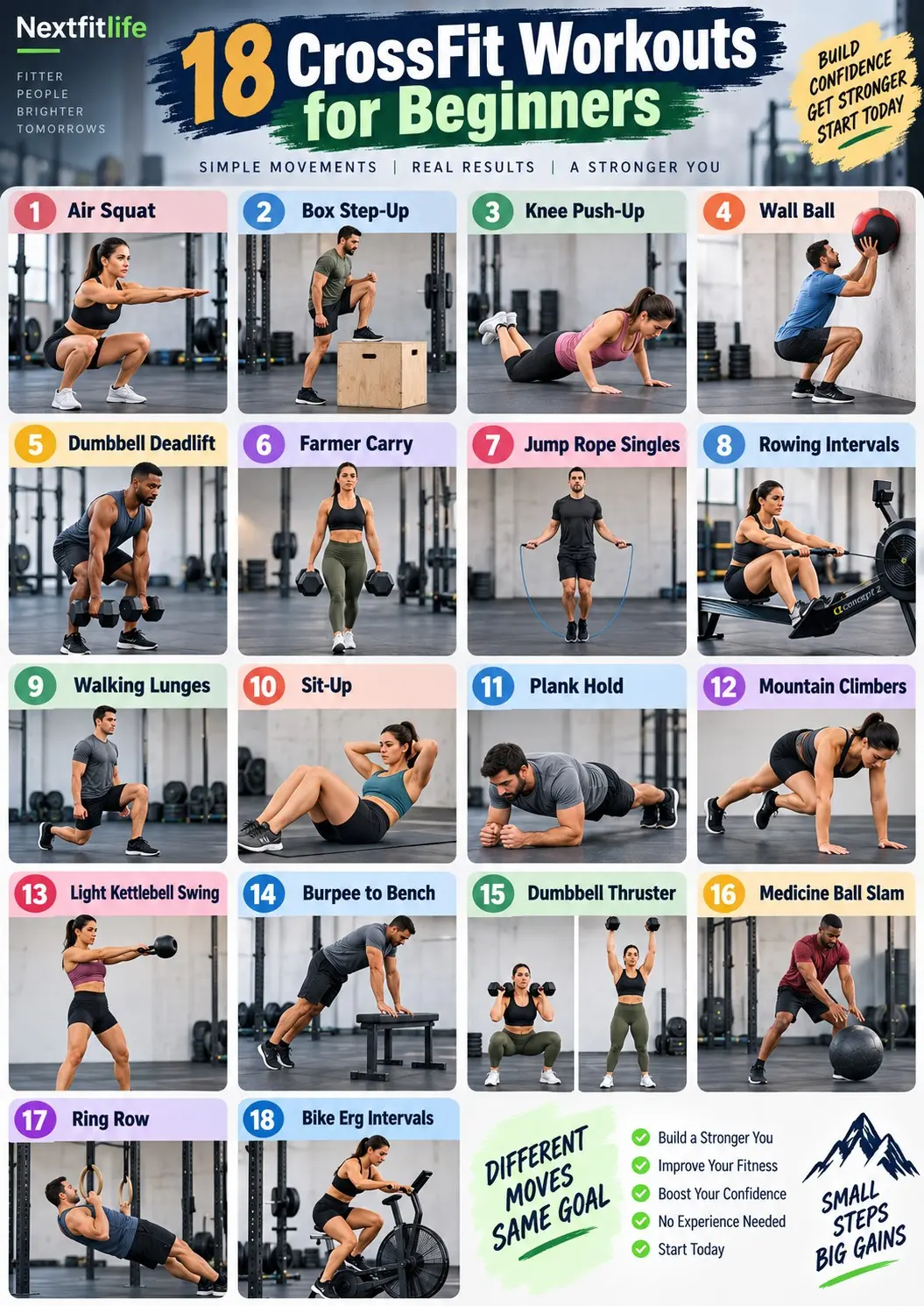
1. Beginner Bodyweight Triplet
This is one of the simplest CrossFit Workouts for Beginners.
Complete 3 rounds:
- 8 air squats
- 6 incline push ups
- 8 ring rows or supported dumbbell rows
Rest 30 to 90 seconds when needed.
Focus on clean repetitions rather than speed.
2. 8 Minute Beginner AMRAP
AMRAP for 8 minutes:
- 6 air squats
- 5 incline push-ups
- 6 alternating reverse lunges
Move at a pace that lets you breathe and maintain good form.
3. Beginner EMOM
8 minutes total:
- Odd minutes: 6 goblet squats
- Even minutes: 6 supported rows per side
Finish the repetitions, then rest for the remainder of the minute.
4. Walk and Squat WOD
Complete 4 rounds:
- 1 minute brisk walk
- 8 air squats
- 6 incline push ups
This is a useful option for someone new to structured exercise.
5. Row and Step Up WOD
Complete 3 rounds:
- 200 meter easy row
- 8 low box step ups
- 8 ring rows
Use a low, stable box.
Beginners do not need box jumps to get a useful conditioning session.
6. Bike and Bodyweight WOD
10 minute alternating workout:
- 30 seconds easy to moderate bike
- 6 air squats
- 5 incline push ups
Repeat at a sustainable pace.
7. Dumbbell Deadlift WOD
Complete 3 rounds:
- 8 light dumbbell deadlifts
- 8 step ups
- 30 seconds easy rowing or cycling
Learn the hip hinge before adding speed.
For more home strength ideas, visit Dumbbell Workouts at Home.
8. Goblet Squat and Row WOD
AMRAP for 8 minutes:
- 6 light goblet squats
- 6 one arm rows per side
- 20 meter farmer carry
Keep enough reserve to maintain control throughout the workout.
9. Kettlebell Foundation WOD
Complete 3 rounds:
- 8 kettlebell deadlifts
- 6 goblet squats
- 20 second suitcase carry per side
This is a better first kettlebell workout than immediately attempting high repetition swings.
When your hinge is ready for ballistic training, use the progression in Kettlebell Workouts for Men.
10. Beginner Push and Pull WOD
Complete 4 rounds:
- 6 incline push ups
- 8 ring rows
- 10 air squats
Rest enough to keep your shoulders controlled.
11. Scaled Cindy
The official Cindy benchmark uses a 20 minute AMRAP of:
- 5 pull ups
- 10 push ups
- 15 air squats
That can be too much volume for a true beginner.
Beginner version:
AMRAP for 8 to 10 minutes:
- 5 ring rows
- 5 incline push ups
- 10 air squats
Stop before repetitions become sloppy.
12. Scaled Helen
The classic Helen benchmark uses three rounds of running, kettlebell swings, and pull ups.
Beginner version:
Complete 3 rounds:
- 200 meter walk or easy run
- 10 light kettlebell deadlifts or controlled swings
- 6 ring rows
If you have not learned the kettlebell swing, use deadlifts.
13. Scaled Annie
The official Annie benchmark uses double unders and sit ups in a 50, 40, 30, 20, 10 repetition pattern.
It does not include push ups.
Beginner version:
- 30 single rope jumps or step overs
- 15 controlled sit ups or dead bugs
- 20 single rope jumps
- 10 sit ups or dead bugs
- 10 single rope jumps
- 5 sit ups or dead bugs
Choose dead bugs if repeated sit ups bother your back.
14. Scaled Barbara
The full Barbara benchmark contains very high repetitions of pull ups, push ups, sit ups, and squats.
That is not an ideal first week workout.
Beginner version:
Complete 3 rounds:
- 6 ring rows
- 8 incline push ups
- 10 dead bugs or sit ups
- 12 air squats
Rest 1 to 2 minutes between rounds.
15. Scaled Chelsea
The official Chelsea uses an every minute format for 30 minutes with pull ups, push ups, and air squats.
A beginner should use far less volume.
Beginner 10 minute EMOM:
- 3 ring rows
- 5 incline push ups
- 7 air squats
If you cannot finish comfortably within about 40 seconds, reduce the repetitions.
16. Beginner Fran Style Workout
The full Fran benchmark uses 21, 15, and 9 repetitions of barbell thrusters and pull ups.
It is fast, demanding, and not something a beginner needs to perform Rx.
Beginner version:
Complete 9, 6, and 3 repetitions of:
- Light dumbbell thrusters
- Ring rows
Use a load that lets you maintain a stable squat and overhead position.
17. Carry and Cardio WOD
Complete 4 rounds:
- 30 seconds easy bike or row
- 30 seconds farmer carry
- 8 air squats
This workout develops work capacity without complex gymnastics or Olympic lifting.
18. Beginner Full Body WOD
Complete 3 rounds:
- 8 goblet squats
- 6 dumbbell floor presses
- 8 dumbbell deadlifts
- 8 supported rows
- 1 minute easy walk, bike, or row
This gives you a squat, push, hinge, pull, and cardio element in one simple session.
Best CrossFit Workouts for Beginners by Goal
| Goal | Good Beginner Choice | Main Benefit |
|---|---|---|
| First workout | Bodyweight triplet | Simple movement learning |
| Cardio | Row and step up WOD | Aerobic conditioning |
| Strength | Full body dumbbell WOD | Basic resistance patterns |
| Grip | Carry and cardio WOD | Grip plus conditioning |
| Benchmark introduction | Scaled Cindy | Simple repeatable bodyweight test |
| Home workout | 8 minute AMRAP | Minimal equipment |
Your First Month of CrossFit Workouts for Beginners
Week 1
Train twice.
- Session 1: Bodyweight triplet
- Session 2: Walk and squat WOD
Learn the movement patterns and finish feeling like you could have done a little more.
Week 2
Train two or three times.
- Session 1: Beginner EMOM
- Session 2: Dumbbell deadlift WOD
- Optional Session 3: Easy row and step up workout
Week 3
Use slightly more work only if recovery is good.
- Session 1: Scaled Cindy
- Session 2: Full body dumbbell WOD
- Optional Session 3: Easy cardio plus carries
Week 4
Repeat one workout from Week 1 or Week 2.
Do not automatically add weight.
First check whether your movement feels smoother, your breathing recovers faster, or you finish more work with the same technique.
How Often Should Beginners Do CrossFit?
Two or three sessions per week are enough for many beginners.
This gives you days between demanding sessions to recover and learn how your body responds.
A simple week might look like:
- Monday: CrossFit
- Tuesday: Easy walk
- Wednesday: Rest or mobility
- Thursday: CrossFit
- Friday: Easy cardio
- Saturday: Optional light CrossFit or strength practice
- Sunday: Rest
You do not need five or six hard workouts each week to make progress.
Should a Beginner Do CrossFit Every Day?
Usually not.
Your muscles, tendons, joints, and skill need time to adapt to new training.
Recent prospective injury research found that greater weekly CrossFit exposure was associated with higher injury risk, while previous injury was also an important risk factor.
More training is not automatically better training.
How Hard Should CrossFit Workouts for Beginners Feel?
A beginner session can feel challenging without becoming maximal.
For most workouts, you should still be able to control your movements and understand what your body is doing.
If fatigue causes you to:
- Lose your squat position
- Round your back during lifting
- Land badly
- Miss repetitions repeatedly
- Lose control of a kettlebell or dumbbell
reduce the load, repetitions, speed, or movement difficulty.
When Should You Add More Weight?
Add load after you can perform the movement consistently.
The 2026 ACSM position stand confirms that heavier resistance can improve maximal strength, but that does not mean a novice should rush to heavy loading.
Use progressive overload in small steps.
You can progress by:
- Adding a small amount of weight
- Adding one or two repetitions
- Adding a round
- Improving range of motion
- Using a slightly harder movement
- Completing the same workout with better control
Technique Before Speed
This rule matters most during movements with higher skill demands.
Barbell snatches, cleans, jerks, kipping pull ups, handstand work, and high box jumps can all appear in CrossFit.
They do not belong in every beginner workout.
Recent injury research has identified barbell exercises, box jumps, and pull up related movements among activities associated with injuries in CrossFit populations.
This does not make those exercises bad.
It means they deserve skill practice, appropriate equipment, and sensible progression.
Should Beginners Do Olympic Lifts for Time?
Not while they are still learning them.
Practice complex lifts as technique work first.
A beginner can replace a snatch or clean and jerk workout with:
- Dumbbell deadlifts
- Goblet squats
- Light dumbbell presses
- Medicine ball movements
- Technique drills with PVC
Speed can come later.
Should Beginners Do Box Jumps?
They are optional.
A box step up trains the legs and raises heart rate without the same landing demand.
Use step ups until you have enough control, strength, and confidence for jumping.
Can CrossFit Workouts for Beginners Build Muscle?
Yes, when the workout includes enough resistance and that resistance increases over time.
Squats, deadlifts, rows, presses, carries, and other resistance movements can support muscle growth.
However, random workouts are not automatically the fastest way to maximize muscle size.
If hypertrophy is your main goal, track weekly training volume and progression.
See the Strength Training and Muscle Building Guide for a more focused approach.
Can CrossFit Improve Cardio?
Yes.
CrossFit style workouts often combine aerobic and anaerobic demands.
Research on high intensity functional training shows improvements in endurance and other fitness qualities.
That does not mean every workout must leave you exhausted.
Easy walking, cycling, and steady aerobic training still have an important place in a balanced program.
Can CrossFit Help With Weight Loss?
CrossFit can increase physical activity and may help support fat loss, but the evidence does not justify promising dramatic results from the workout alone.
A 2026 review of functional training in adults with overweight or obesity found possible reductions in body fat percentage, but the certainty of the evidence was rated very low.
Body weight and fat loss still depend heavily on nutrition, total activity, sleep, recovery, and consistency.
10 CrossFit Workouts for Beginners Mistakes
1. Trying to Train Rx Immediately
Rx is a workout description, not a badge you need to earn in your first month.
2. Choosing Speed Before Mechanics
Fast bad repetitions do not become better because the timer is running.
3. Using Too Much Weight
Reduce the load until the movement stays controlled.
4. Copying an Advanced Athlete
The correct scale for you may look very different from the workout of someone who has trained for years.
5. Doing High Skill Movements While Exhausted
Practice technical movements before the hard conditioning portion.
6. Starting With Huge Volume
Hundreds of repetitions are not required for a useful beginner workout.
7. Ignoring Previous Injuries
Tell your coach about prior shoulder, knee, back, wrist, or other problems before training.
8. Skipping Rest Days
Adaptation happens between workouts as well as during them.
9. Chasing Soreness
Soreness is not proof that a workout was effective.
10. Treating Every Workout as a Competition
Most training sessions should build fitness, not test your absolute limit.
When Should You Stop a CrossFit Workout?
Stop exercising and seek appropriate medical help if you develop:
- Chest pain
- Fainting
- Severe or unusual shortness of breath
- Sudden weakness
- Severe dizziness
- A sudden pop followed by major pain or swelling
- New numbness
- Loss of normal coordination
- Severe muscle pain with marked swelling or dark urine after extreme exertion
Extreme muscle pain, weakness, swelling, and dark urine after unusually hard exercise can be warning signs of rhabdomyolysis and require urgent medical assessment.
Conclusion: CrossFit Workouts for Beginners
CrossFit Workouts for Beginners should make you better at moving before they make you better at racing the clock.
Start with air squats, rows, incline push ups, step ups, carries, light deadlifts, and simple cardio. Scale load and repetitions freely, then add speed, volume, and harder movements only when technique stays strong.
Your next step is simple: choose one of the first six workouts in this guide and complete it at a pace you could repeat with confidence next week.
References and Sources
- CrossFit. Level 1 Training Guide. Scaling and Responsible Training.
https://library.crossfit.com/free/pdf/CFJ_English_Level1_TrainingGuide.pdf - CrossFit. CrossFit Methodology and Scaling.
https://www.crossfit.com/crossfit-methodology - Effects of High Intensity Functional Training on Physical Fitness in Healthy Individuals: A Systematic Review With Meta Analysis. 2025.
https://pubmed.ncbi.nlm.nih.gov/39930392/ - Biomechanical and Physiological Demands of CrossFit: A Systematic Review. 2026.
https://pubmed.ncbi.nlm.nih.gov/42713109/ - Understanding Sports Injury Risks in CrossFit: A Prospective Cohort Study. 2025.
https://pubmed.ncbi.nlm.nih.gov/40698870/ - From Sweat to Strain: An Epidemiological Analysis of Training Related Injuries in CrossFit. 2024.
https://pubmed.ncbi.nlm.nih.gov/39139214/ - American College of Sports Medicine Position Stand. Resistance Training Prescription for Healthy Adults. 2026.
https://pubmed.ncbi.nlm.nih.gov/41843416/
Internal Links + Hub
- NextFitLife Fitness Hub for strength, cardio, mobility, and training guidance.
- Fitness for Beginners for simple starting guidance.
- Strength Training and Muscle Building for progressive resistance training.
- Home Workouts and Equipment for practical training outside a gym.
- Bodyweight Workout Routine for Beginners for equipment free training.
- Effective Workout Routines at Home for structured home programs.
- Dumbbell Workouts at Home for simple resistance workouts.
- Kettlebell Workouts for Men for kettlebell progression and conditioning.
- Strength Training Exercises at Home for Beginners for beginner strength movements.
- Benefits of Exercise for broader health and fitness benefits.
- Recovery and Injury Prevention for recovery, soreness, and safer training guidance.
- Healthy and Active Lifestyle for sustainable activity, nutrition, sleep, and recovery.
- Physical Fitness and Mental Health for the wider mental and physical effects of regular activity.
About the Author
Adel Galal is a father of four, three sons and a daughter, and a grandfather of four, with 33 years of hands on parenting experience. He is the founder of Parnthub.com, based in Cairo, Egypt, where he shares practical guidance on feeding, development and family life from newborns to teenagers.
Adel is not a medical professional. Health articles cite trusted sources and are for general information only.
On NextFitLife, Adel researches and writes about fitness, strength training, CrossFit style workouts, home exercise, healthy aging, nutrition, and practical wellness habits with a focus on current evidence, safe progression, and realistic expectations.
Learn more about Adel and NextFitLife on the About Us page.
CrossFit Workouts for Beginners: Frequently Asked Questions
Can a complete beginner start CrossFit?
Yes. CrossFit workouts can be scaled by changing the movement, weight, repetitions, rounds, distance, or workout duration. Beginners should focus on movement quality before speed or heavy loading.
What are the best CrossFit Workouts for Beginners?
The best CrossFit Workouts for Beginners use simple movements such as air squats, incline push ups, ring rows, step ups, light deadlifts, carries, rowing, cycling, and walking.
How many days a week should a beginner do CrossFit?
Two or three sessions each week work well for many beginners. Recovery days between demanding sessions give muscles and joints time to adapt.
What does scaling mean in CrossFit?
Scaling means changing the workout to match your current ability. You can reduce load, repetitions, rounds, distance, duration, or movement difficulty.
What does WOD mean?
WOD means Workout of the Day. It refers to the main programmed workout for that training session.
What does AMRAP mean?
AMRAP means completing as many quality rounds or repetitions as practical within a set time. Beginners should never sacrifice technique just to record a higher score.
What does EMOM mean?
EMOM means every minute on the minute. You complete the programmed repetitions at the start of the minute and use the remaining time to rest.
Should beginners do CrossFit Rx?
Usually not. Rx is simply the prescribed version of a workout. A scaled workout that matches your ability is often the better training choice.
Is Cindy good for beginners?
The movements are simple, but the official 20 minute volume can be high. Beginners can shorten the workout and replace pull ups with rows and floor push ups with incline push ups.
Should beginners do Fran?
The full Rx version of Fran is demanding. Beginners can reduce the repetitions, use light dumbbells instead of a heavy barbell, and use ring rows instead of pull ups.
Do beginners need Olympic lifting?
No. Beginners can build excellent fitness with squats, deadlifts, presses, rows, carries, and cardio while learning Olympic lifting technique separately.
Are box jumps necessary?
No. Box step ups are an effective beginner alternative and reduce the landing demand while still training the legs and raising heart rate.
Can CrossFit Workouts for Beginners build muscle?
Yes. CrossFit Workouts for Beginners can support muscle growth when they include enough resistance and that resistance gradually increases over time.
Can CrossFit improve cardio fitness?
Yes. Research on high intensity functional training supports improvements in endurance and cardiorespiratory fitness, although easier aerobic work still has value.
Is CrossFit dangerous for beginners?
CrossFit is not automatically dangerous, but injury risk can rise when load, skill demand, volume, or fatigue exceed a person’s current capacity. Scaling, coaching, and gradual progression matter.
When should I stop a CrossFit workout?
Stop for chest pain, fainting, severe shortness of breath, sudden weakness, severe dizziness, loss of coordination, major acute pain, new numbness, or severe muscle pain with swelling and dark urine.

Health & wellness writer with 30+ years of experience in nutrition, fitness, and healthy aging. Founder of NextFitLife.com — evidence-based health guidance.

