
Last updated: October 10, 2026
Written and source checked by: Adel Galal, Founder and Lead Writer at NextFitLife
Medical review status: This article has not been medically reviewed by a doctor, gastroenterologist, hepatologist, surgeon, radiologist, pharmacist, or other licensed healthcare professional.
Pain beneath the right ribs can make you wonder whether your gallbladder or liver is responsible.
The difficulty is that both organs sit close together, so location alone is not enough.
Quick answer: Learning how to differentiate gallbladder and liver pain means looking at the whole pattern. Gallbladder pain often comes as a clear episode of steady upper right or upper middle abdominal pain, sometimes after a heavy meal and sometimes spreading to the right shoulder or back. Liver disease is often painless, but liver related discomfort may feel dull, heavy, full, or tender beneath the right ribs.
Fever, jaundice, dark urine, pale stool, severe persistent pain, repeated vomiting, confusion, or rapid worsening should prompt medical assessment.
This article is for general information and education. It does not replace medical advice, diagnosis, or treatment.
9 Red Flags That Need Urgent Medical Attention
Do not try to decide between gallbladder and liver pain at home if you have serious warning signs.
- Severe pain that does not settle.
- Fever or shaking chills.
- Yellow skin or yellow whites of the eyes.
- Dark brown or tea colored urine.
- Pale, grey, or clay colored stool.
- Repeated vomiting.
- Marked tenderness beneath the right ribs.
- Confusion, fainting, or unusual sleepiness.
- Rapid worsening of your general condition.
These symptoms can occur with acute cholecystitis, a blocked bile duct, cholangitis, acute hepatitis, pancreatitis, or another serious abdominal condition.
Chest pressure, sweating, shortness of breath, or pain spreading to the arm, neck, or jaw can also signal a heart problem and needs emergency care.
Table of Contents
- Where the Gallbladder and Liver Sit
- How to Differentiate the Pain
- Gallbladder Pain Pattern
- Liver Pain Pattern
- Biliary Colic vs Cholecystitis
- Jaundice and Bile Duct Blockage
- Other Conditions That Mimic the Pain
- Blood Tests
- Ultrasound, HIDA, and MRCP
- When ERCP Is Used
- Treatment Differences
- Frequently Asked Questions
Where Are the Gallbladder and Liver?
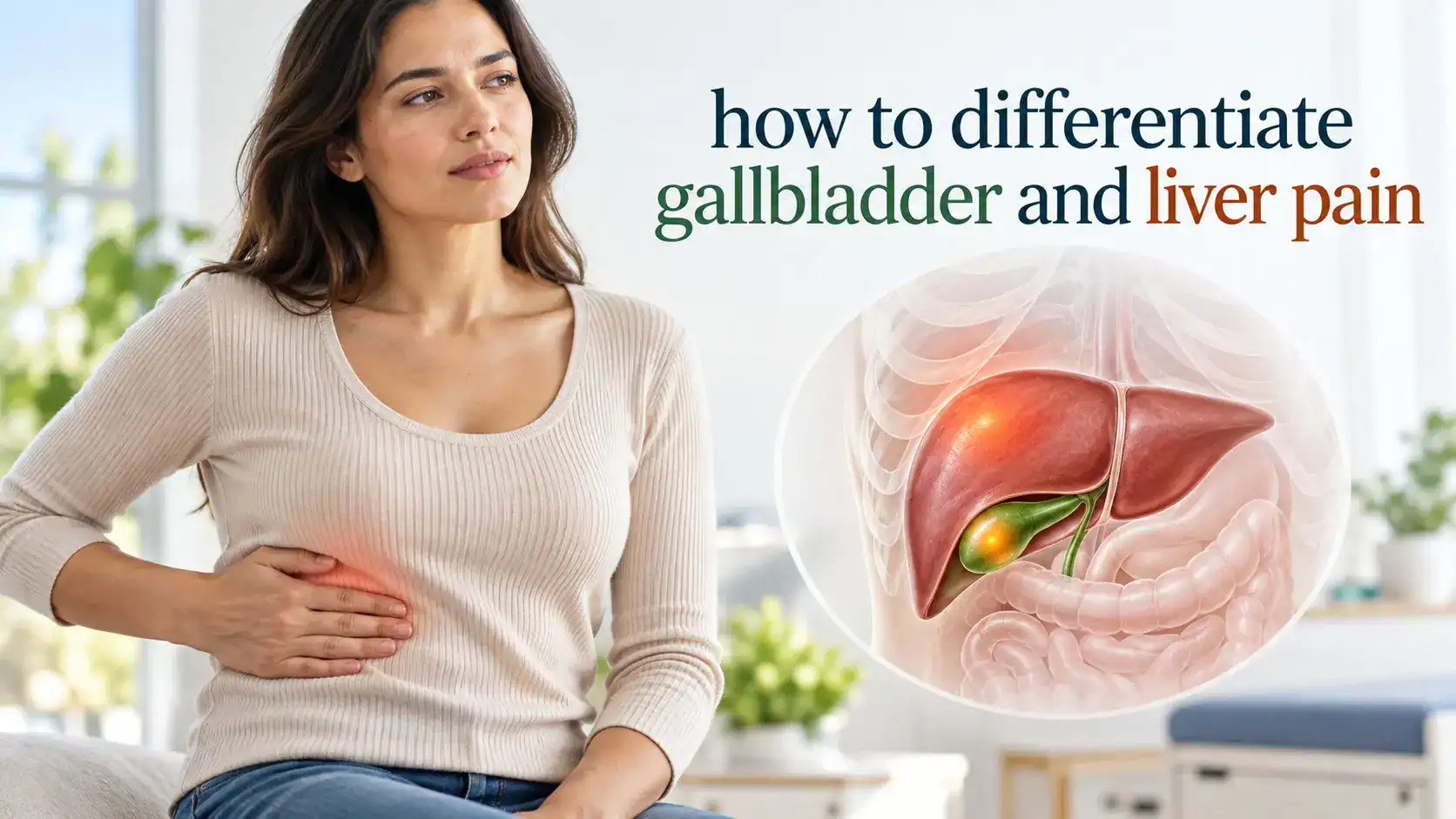
The liver is a large organ that sits mainly beneath the ribs in the upper right side of your abdomen.
The gallbladder is a small pear shaped organ tucked directly underneath the liver.
The liver makes bile. The gallbladder stores and concentrates that bile, then releases it into the intestine to help digest fat.
Because these organs sit so close together, right upper quadrant pain cannot be assigned to one organ simply by pointing to where it hurts.
For an anatomy overview, read Gallbladder and Liver Functions.
How to Differentiate Gallbladder and Liver Pain
The best clues are:
- How the pain starts
- How long it lasts
- Whether food triggers it
- Whether it spreads
- Whether fever is present
- Whether jaundice appears
- Whether urine or stool color changes
- Whether blood tests are abnormal
- What imaging shows
No single clue is perfect.
The pattern becomes more useful when several clues point in the same direction.
Gallbladder vs Liver Pain at a Glance
| Clue | Gallbladder Pattern | Liver Pattern |
|---|---|---|
| Pain area | Upper right or upper middle abdomen | Upper right abdomen beneath the ribs |
| Feeling | Often steady and moderate to severe | Often dull, heavy, full, tender, or absent |
| Timing | Distinct attacks | Can be vague, persistent, or absent |
| Duration | Often more than 30 minutes to several hours | Depends strongly on the cause |
| Meal link | Heavy meals can trigger attacks | Usually no reliable immediate meal trigger |
| Pain spread | May reach the right shoulder or upper back | Less characteristic |
| Fever | Raises concern for cholecystitis or cholangitis | Can occur with acute hepatitis or liver infection |
| Jaundice | Possible with a bile duct stone | Possible with hepatitis and other liver disease |
1. Gallbladder Pain Often Comes as a Clear Attack
A symptomatic gallstone can temporarily block the flow of bile.
The pain may begin in the upper right abdomen or the upper middle abdomen and build over a short period.
Once established, the pain is often steady.
This corrects a common misconception. Although the term biliary colic contains the word colic, gallstone pain does not need to come and go in waves.
2. Gallbladder Pain Often Lasts More Than 30 Minutes
A classic attack usually lasts longer than a brief stomach cramp.
NHS guidance describes gallstone pain as lasting from more than 30 minutes to several hours.
If severe pain remains persistent instead of settling, complications such as acute cholecystitis become more concerning.
3. Heavy Meals Can Trigger Gallbladder Pain
The gallbladder contracts when you eat so it can release bile.
If a gallstone blocks the outlet during that contraction, pain may begin.
This is why gallbladder attacks often follow large or fatty meals.
NIDDK also notes that attacks can happen during the evening or night.
The meal does not create the stone in that moment. It can reveal a problem that was already there.
4. Gallbladder Pain May Spread to the Shoulder or Back
Gallbladder pain can move toward:
- The right shoulder
- The right shoulder blade
- The upper back
This is called referred pain.
It is helpful information, but it cannot confirm gallstones by itself.
5. Liver Disease Often Causes No Pain
This is one of the most important points in how to differentiate gallbladder and liver pain.
Many liver disorders are silent.
For example, chronic hepatitis and MASLD can exist for years without clear liver pain.
That means the absence of pain does not prove the liver is healthy.
Visit the Liver Health Hub for more liver guidance.
6. Liver Discomfort Often Feels Like Pressure or Fullness
When the liver becomes enlarged or inflamed, a person may feel discomfort beneath the right ribs.
Possible descriptions include:
- Dull aching
- Pressure
- Heaviness
- Fullness
- Tenderness
An enlarged liver is called hepatomegaly.
The discomfort may result from stretching of the liver capsule and surrounding tissues rather than pain arising from the liver cells themselves.
7. Fever Changes the Picture
Fever is not typical of a simple uncomplicated gallstone attack.
Persistent upper right abdominal pain with fever raises concern for inflammation or infection.
One important cause is acute cholecystitis.
Possible symptoms include:
- Persistent upper right abdominal pain
- Fever
- Nausea
- Vomiting
- Sweating
- Marked tenderness
This normally requires urgent medical assessment.
8. Jaundice Can Come From Either Side of the System
Jaundice means yellowing of the skin or whites of the eyes.
Liver disease can cause it.
So can gallstones.
A gallstone can leave the gallbladder and block the common bile duct, stopping normal bile flow.
This is why jaundice does not automatically mean “liver disease.”
9. Dark Urine and Pale Stool Point Toward Bile Flow Problems
Dark urine and pale stool can appear when bilirubin and bile are not moving normally through the liver and bile ducts.
Possible causes include:
- Viral hepatitis
- A common bile duct stone
- Other liver disease
- Other bile duct disease
These changes deserve medical attention, especially when jaundice or abdominal pain is present.
Can Gallbladder Pain Be Mistaken for Liver Pain?
Yes.
The organs sit very close together, and both can cause discomfort beneath the right ribs.
The difference becomes clearer when you add timing and associated symptoms.
A meal linked attack lasting several hours with pain spreading toward the right shoulder fits gallbladder disease better.
Persistent fatigue, itching, jaundice, abdominal swelling, or abnormal liver tests may point more toward liver or bile duct disease.
What Is Biliary Colic?
Biliary colic usually happens when a gallstone temporarily blocks bile flow.
Symptoms commonly include:
- Steady pain in the upper right abdomen
- Upper middle abdominal pain
- Nausea
- Vomiting in some people
- Pain into the shoulder or back
The pain eventually settles when the obstruction resolves.
Once symptomatic gallstones cause an attack, further attacks can occur.
What Is Acute Cholecystitis?
Acute cholecystitis means inflammation of the gallbladder.
It most often occurs when a gallstone remains stuck and continues blocking the cystic duct.
| Feature | Biliary Colic | Acute Cholecystitis |
|---|---|---|
| Pain | Attack eventually settles | Persistent pain |
| Fever | Usually absent | May occur |
| Tenderness | May occur | Often marked |
| Care | Medical review | Urgent hospital assessment |
Can Fatty Liver Cause Right Sided Pain?
Yes, but many people with fatty liver disease have no symptoms.
When symptoms do occur, possible complaints include fatigue or discomfort beneath the right ribs.
MASLD cannot be diagnosed from pain alone.
Doctors may use:
- Blood tests
- Metabolic risk assessment
- Ultrasound
- Fibrosis scores
- Liver stiffness testing
Read Fatty Liver Disease and Fatty Liver Disease Treatments.
Can Hepatitis Cause Liver Pain?
Yes, acute hepatitis can cause right upper abdominal discomfort.
It may also cause:
- Fatigue
- Loss of appetite
- Nausea
- Vomiting
- Fever
- Dark urine
- Pale stool
- Jaundice
Chronic hepatitis can have no symptoms at all.
Read Hepatitis C and Autoimmune Hepatitis.
Can a Gallstone Block the Common Bile Duct?
Yes.
A stone can leave the gallbladder and enter the common bile duct.
This is called choledocholithiasis.
Possible symptoms include:
- Upper abdominal pain
- Jaundice
- Dark urine
- Pale stool
- Itching
- Nausea
- Vomiting
A blocked duct can also become infected.
What Is Cholangitis?
Cholangitis is infection and inflammation of the bile ducts.
It can occur when a blocked duct traps bacteria and bile.
A classic warning pattern includes:
- Upper abdominal pain
- Fever or chills
- Jaundice
This can become serious quickly and requires urgent medical care.
Could the Pain Actually Be Pancreatitis?
Yes.
Gallstones are one of the major causes of acute pancreatitis.
Pancreatitis often causes:
- Sudden severe upper abdominal pain
- Pain that does not go away
- Pain spreading into the back
- Nausea
- Vomiting
Severe persistent upper abdominal pain should not be self diagnosed as liver or gallbladder pain.
See Pancreatitis Causes for more information.
What Else Can Cause Pain Under the Right Ribs?
Several problems can mimic gallbladder or liver pain.
- Gastritis
- Stomach ulcer
- Duodenal ulcer
- Acid reflux
- Pancreatitis
- Kidney stones
- Kidney infection
- Pneumonia
- Pleurisy
- Muscle strain
- Rib injury
- Shingles
- Heart disease
If your symptoms mainly appear after meals, read Stomach Pain After Eating.
Which Blood Tests Help?
Blood tests can show whether inflammation, liver injury, bile duct blockage, or pancreatitis may be present.
Common tests include:
- Complete blood count
- ALT
- AST
- Alkaline phosphatase
- Bilirubin
- Albumin
- Lipase
ALT and AST
ALT and AST can rise when liver cells are injured.
They do not identify a single disease by themselves.
Alkaline Phosphatase
Alkaline phosphatase may rise when bile drainage is blocked.
It can also rise for reasons unrelated to the liver, so results must be interpreted with other tests.
Bilirubin
Bilirubin can rise in liver disease or bile duct obstruction.
This explains why a gallstone can create abnormal liver related blood results.
Lipase
Lipase is commonly checked when acute pancreatitis is suspected.
What Is the Best First Test for Gallstones?
Abdominal ultrasound is usually the first imaging test when gallstones are suspected.
It can help detect:
- Gallstones
- Gallbladder wall changes
- Bile duct enlargement
- Some signs of inflammation
- Changes in liver appearance
NIDDK describes ultrasound as the best imaging test for finding gallstones.
What Is a HIDA Scan?
A HIDA scan is a nuclear medicine test that follows bile as it moves from the liver through the biliary system.
It may help assess:
- Cystic duct blockage
- Gallbladder emptying
- Gallbladder function
- Some difficult cases of suspected cholecystitis
It is not required for every person with right upper abdominal pain.
What Is MRCP?
MRCP is a special MRI technique used to view the bile ducts and pancreatic ducts.
It is particularly useful when doctors suspect a common bile duct stone but ultrasound does not clearly demonstrate it.
MRCP is noninvasive.
What Is ERCP?
ERCP is more invasive.
An endoscope is passed through the digestive tract to reach the bile duct opening.
Its major advantage is treatment.
If a common bile duct stone is found, doctors can often remove it during the procedure.
For this reason, ERCP is generally used when treatment may be needed rather than as a routine first test.
Does Everyone With Gallstones Need Surgery?
No.
Many gallstones cause no symptoms.
These are often called silent gallstones and may not require treatment.
Repeated symptomatic attacks or complications make treatment more likely.
The usual definitive treatment is cholecystectomy, which is removal of the gallbladder.
A person can live without a gallbladder because the liver continues to make bile.
How Is Liver Disease Treated?
There is no single treatment for “liver pain.”
Treatment depends on the cause.
Examples include:
- Antiviral therapy for hepatitis C
- Selected antiviral treatment for hepatitis B
- Immune suppressing treatment for autoimmune hepatitis
- Weight and metabolic treatment for MASLD
- Antibiotics and drainage for liver abscess
- Cancer treatment when needed
- Specialist care for cirrhosis
Simply masking the pain does not address the underlying problem.
Should You Try a Liver or Gallbladder Detox?
No detox drink can diagnose or clear a blocked gallbladder or bile duct.
Some herbal products can also injure the liver.
The safer approach is proper diagnosis followed by treatment that matches the cause.
Read Liver Detox: Safer Ways to Support Liver Health.
Can a Low Fat Diet Stop Gallbladder Pain?
A lower fat meal pattern may reduce gallbladder contraction and decrease symptoms for some people with symptomatic stones.
It does not reliably dissolve gallstones or prevent every attack.
Once stones begin causing repeated symptoms, discuss definitive treatment with a healthcare professional.
Common Mistakes When Comparing Gallbladder and Liver Pain
Assuming Every Right Sided Pain Is Liver Pain
The gallbladder, kidney, stomach, pancreas, lungs, ribs, muscles, and heart can all cause nearby symptoms.
Assuming Gallbladder Pain Must Come in Waves
Gallstone attacks are often steady during the episode.
Assuming Fatty Food Proves Gallstones
Meal timing helps, but it cannot diagnose gallstones.
Assuming Alcohol Triggered Pain Is Definitely the Liver
Alcohol can affect the stomach, pancreas, liver, and other systems.
Assuming Jaundice Means Liver Disease Only
A common bile duct stone can also cause jaundice.
Ignoring Fever
Fever with persistent right upper abdominal pain can signal inflammation or infection.
Waiting Through Severe Pain Because It Happened Before
A previous uncomplicated gallbladder attack does not guarantee the next episode will be uncomplicated.
Conclusion
Understanding how to differentiate gallbladder and liver pain starts with looking beyond the location of the pain.
Gallbladder pain is more likely to appear as a clear episode of steady upper right or upper middle abdominal pain, often after a heavy meal and sometimes spreading toward the right shoulder or back. Liver disease often causes no pain, but when discomfort occurs it may feel like dull pressure, tenderness, or fullness beneath the right ribs.
The most useful clues are timing, duration, meal triggers, fever, jaundice, urine color, stool color, blood tests, and imaging.
Your next step is simple: note when the pain starts, how long it lasts, where it spreads, what you ate, and whether fever or jaundice appears. Seek prompt medical care if the pain is severe, persistent, or comes with warning signs.
References and Sources
- National Institute of Diabetes and Digestive and Kidney Diseases. Symptoms and Causes of Gallstones.Guidance on gallbladder attacks, meal triggers, pain duration, jaundice, fever, dark urine, pale stool, and gallstone complications.https://www.niddk.nih.gov/health-information/digestive-diseases/gallstones/symptoms-causes
- National Institute of Diabetes and Digestive and Kidney Diseases. Diagnosis of Gallstones.Authoritative guidance on ultrasound, MRI, HIDA scans, ERCP, and blood tests used to diagnose gallstones and related complications.https://www.niddk.nih.gov/health-information/digestive-diseases/gallstones/diagnosis
- National Institute of Diabetes and Digestive and Kidney Diseases. Treatment for Gallstones.Guidance on silent stones, symptomatic gallstones, gallbladder surgery, bile duct stones, and ERCP.https://www.niddk.nih.gov/health-information/digestive-diseases/gallstones/treatment
- NHS. Acute Cholecystitis.Guidance on persistent upper right abdominal pain, tenderness, fever, nausea, vomiting, complications, and hospital treatment.https://www.nhs.uk/conditions/acute-cholecystitis/
- NHS. Acute Pancreatitis.Guidance on severe persistent upper abdominal pain, back pain, vomiting, gallstones, and the need for urgent hospital care.https://www.nhs.uk/conditions/acute-pancreatitis/
- Centers for Disease Control and Prevention. Viral Hepatitis.Guidance on hepatitis symptoms including fatigue, nausea, abdominal pain, dark urine, pale stool, jaundice, and silent chronic infection.https://www.cdc.gov/hepatitis/about/index.html
- National Institute of Diabetes and Digestive and Kidney Diseases. Symptoms and Causes of MASLD.Guidance explaining that fatty liver disease is often silent but may cause fatigue or discomfort in the upper right abdomen.https://www.niddk.nih.gov/health-information/liver-disease/nafld-nash/symptoms-causes
Internal Links + Hub
- Liver Health Hub
- Digestive Health and Gut Hub
- Gallbladder and Liver Functions
- Gallbladder Pain Relief
- Liver Health
- Fatty Liver Disease
- Fatty Liver Disease Treatments
- Liver Detox
- Hepatitis C
- Autoimmune Hepatitis
- Stomach Pain After Eating
- Pancreatitis Causes
- Living With Pancreatitis
About the Author
Adel Galal is the founder and lead writer of NextFitLife. He has maintained a personal interest in digestive health, nutrition, liver health, healthy aging, fitness, and practical wellness education for more than 30 years, with more than 15 years of health and wellness writing experience.
His work focuses on comparing credible medical sources, identifying outdated wellness claims, highlighting important warning signs, and turning complex medical information into practical language.
Adel is not a doctor, gastroenterologist, hepatologist, surgeon, radiologist, pharmacist, registered dietitian, or other licensed healthcare professional. This content does not replace medical examination, blood tests, imaging, diagnosis, surgery, prescription treatment, or emergency medical care.
I am not a dermatologist or A doctor, and this content does not replace professional medical advice. What I share comes from real-life experience, extensive research, and consultation with healthcare providers. Always consult qualified medical professionals for diagnosis and treatment of any health condition.
Learn more about Adel, NextFitLife, and its editorial approach on the About NextFitLife page.
Frequently Asked Questions About How to Differentiate Gallbladder and Liver Pain
How do you differentiate gallbladder pain from liver pain?
Gallbladder pain often comes as a clear attack of steady upper right or upper middle abdominal pain, sometimes after a heavy meal and sometimes spreading to the shoulder or back. Liver disease often causes no pain, while liver enlargement or inflammation may cause dull pressure, tenderness, or fullness beneath the right ribs.
Where is gallbladder pain usually felt?
Gallbladder pain is commonly felt in the upper right abdomen or upper middle abdomen. It can spread to the right shoulder blade or upper back.
Where is liver pain felt?
Liver related discomfort is usually felt beneath the ribs in the upper right abdomen. It can feel like fullness, pressure, tenderness, or a dull ache.
Does gallbladder pain happen after eating?
It often can. Heavy or fatty meals stimulate the gallbladder to contract and can trigger symptoms when gallstones are present. Gallbladder attacks can also occur at other times.
How long does gallbladder pain last?
A gallbladder attack commonly lasts more than 30 minutes and may continue for several hours. Persistent pain that does not settle raises concern for complications such as acute cholecystitis.
Can gallbladder pain spread to the back?
Yes. Gallbladder pain can spread toward the right shoulder, shoulder blade, or upper back.
Can liver disease cause no pain?
Yes. Many chronic liver diseases can remain symptom free for years, so lack of liver pain does not prove that the liver is healthy.
Can fatty liver cause pain under the ribs?
Yes, some people with MASLD have discomfort in the upper right abdomen, but many have no symptoms. Blood tests and imaging are more useful than pain alone for diagnosis.
Does jaundice mean liver disease?
Not always. Hepatitis and other liver disorders can cause jaundice, but a gallstone blocking the common bile duct can cause it too.
What do dark urine and pale stools mean?
They can occur when bile flow or bilirubin processing is abnormal. Possible causes include hepatitis, bile duct obstruction, and other liver or biliary conditions.
What is the first test for suspected gallstones?
Abdominal ultrasound is usually the first imaging test for suspected gallstones. Blood tests are commonly performed at the same time.
When is a HIDA scan used?
A HIDA scan can assess bile flow, cystic duct obstruction, and gallbladder function when more information is needed after the initial evaluation.
What is MRCP used for?
MRCP provides detailed noninvasive images of the bile ducts and pancreatic ducts and can help detect common bile duct stones.
Why would someone need ERCP?
ERCP can treat a blocked bile duct. If a common bile duct stone is present, it can often be removed during the procedure.
When should right upper abdominal pain be treated as urgent?
Seek urgent medical care for severe or persistent pain with fever, chills, jaundice, dark urine, pale stool, repeated vomiting, confusion, fainting, or rapid deterioration.

Health & wellness writer with 30+ years of experience in nutrition, fitness, and healthy aging. Founder of NextFitLife.com — evidence-based health guidance.

