Next Review: August 2027, or sooner if major weight management, physical activity, or body composition guidance changes
Review Status: Fully rewritten and checked against current physical activity, weight management, body fat distribution, cellulite, and lipedema information
Many people want to know how to lose fat from hips.
The hips can feel like a stubborn area.
You may lose weight from the face or waist first.
Your jeans may still feel tight around the hips.
This can be frustrating.
But it does not mean your body is broken.
Genes, hormones, age, sex, and body shape affect where fat is stored.
You cannot force fat to leave only the hips.
You can still reduce overall body fat.
You can also build stronger glute muscles, improve posture, and shape the lower body.
This guide gives you a safe plan for food, cardio, strength, sleep, stress, and real progress.
Quick answer
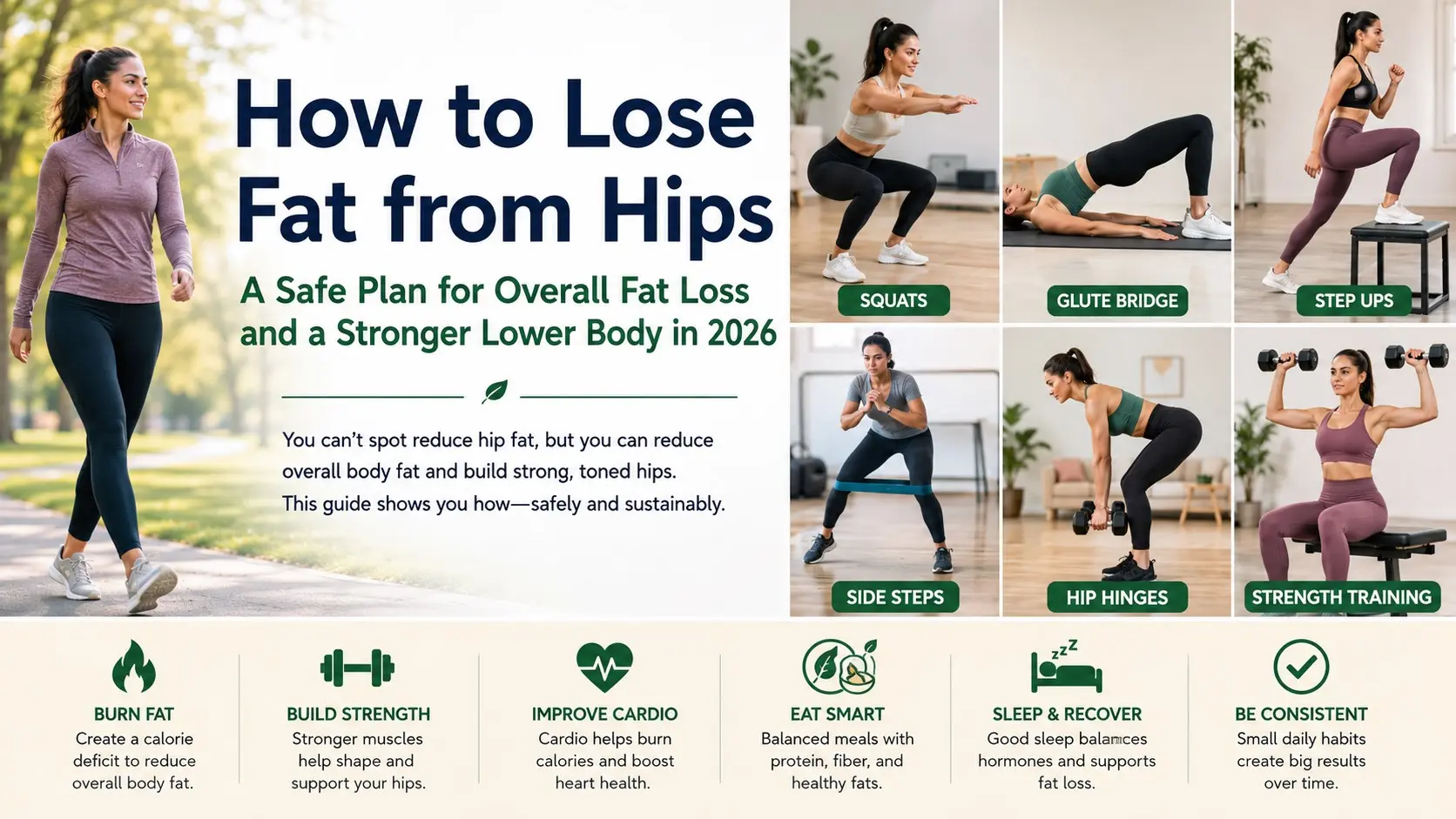
You cannot target hip fat with one exercise. The practical plan is to reduce overall body fat with a modest calorie deficit, regular aerobic activity, full body strength training, balanced meals, sleep, and steady habits. Squats, bridges, step ups, hinges, and side steps can strengthen and shape the muscles around the hips while overall fat slowly falls.
Medical warning
Ask a qualified professional before starting a weight loss or exercise plan if you have heart disease, diabetes, uncontrolled blood pressure, kidney disease, pregnancy, recent surgery, severe joint pain, an eating disorder history, or another condition that affects safe food or movement. Seek urgent help for chest pain, fainting, severe shortness of breath, sudden weakness, or a leg that becomes red, hot, very swollen, and painful.
Medical note: This content is for general educational purposes and does not replace professional medical advice, diagnosis, or treatment. Consult an appropriately qualified healthcare professional for personal medical concerns. This article explains published guidance and does not provide a personal clinical assessment. Always consult qualified medical professionals for diagnosis and treatment of any health condition.
What you will learn
- Why fat collects around the hips
- Why spot reduction does not work well
- Why hip fat is different from visceral fat
- How food supports overall fat loss
- Which exercises shape the lower body
- How walking and cardio help
- How menopause can change fat distribution
- The difference between hip fat, cellulite, and lipedema
- A four week beginner plan
- How to track progress safely
What Is Hip Fat?
Hip fat is usually subcutaneous fat.
This means it sits under the skin.
It often collects around the hips, buttocks, and thighs.
This lower body pattern is sometimes called gluteofemoral fat.
It is different from visceral fat.
Visceral fat sits deep inside the abdomen around organs.
Research shows that hip and thigh fat is generally less strongly linked with metabolic disease than visceral fat.
Some research suggests lower body fat may store fatty acids in a way that is less harmful than abdominal fat.
This does not mean unlimited weight gain is healthy.
It means body fat location matters.
Hip fat and deep abdominal fat do not have identical health implications.
Why Fat Collects Around the Hips
Genetics
Your genes help shape your body.
They affect where fat is stored and where it leaves first.
Some families have wider hips or more lower body fat.
You cannot change your genes.
You can improve fitness and body composition.
Sex hormones
Body fat distribution is influenced by hormones.
Many women store more fat around the hips and thighs before menopause.
Estrogen is one factor.
Men often store more fat around the abdomen.
These are common patterns, not strict rules.
Energy balance
Body fat rises when energy intake stays above energy use over time.
This can happen through large portions, liquid calories, frequent snacks, low activity, poor sleep, medicine, or health conditions.
Age
Muscle can fall with age.
Daily movement may also fall.
This can reduce energy use.
Strength training and regular movement become more important.
Menopause
Menopause weight gain is affected by aging, sleep, activity, and hormone change.
Fat distribution may shift from the hips toward the waist.
This means a woman may notice a larger waist even if the scale changes little.
Can You Spot Reduce Hip Fat?
Spot reduction means trying to lose fat from one area by training the nearby muscle.
Examples include side leg lifts for hip fat or situps for belly fat.
These exercises can strengthen muscles.
They do not reliably tell the body to remove fat from that exact area.
Fat loss happens across the body.
The order is affected by genes and hormones.
You may notice changes in the face, chest, waist, arms, or legs at different times.
This is why hundreds of side leg lifts may make the hip muscles stronger without making the hips much smaller.
Read Do Situps Burn Belly Fat? for another simple example of spot reduction.
Can Hip Exercises Still Change Your Shape?
Yes.
Hip exercises train the muscles under the fat.
They can improve:
- Strength
- Balance
- Posture
- Walking
- Hip stability
- Lower body shape
Strong glutes may make the hips and buttocks look firmer.
They can also support the knees and back.
This is a change in muscle, not local fat burning.
What Is the Best Way to Lose Hip Fat?
The best plan works on the whole body.
Use the following steps together.
1. Create a modest calorie deficit
A calorie deficit means you use more energy than you eat over time.
The deficit does not need to be extreme.
A very strict diet can cause hunger, weakness, poor sleep, and muscle loss.
Start with simple changes:
- Reduce sugary drinks
- Use smaller portions of oils and sauces
- Add vegetables
- Choose protein at meals
- Plan snacks
- Eat more slowly
Read the Complete Weight Loss Guide for a full plan.
2. Include protein at meals
Protein rich meals support fullness and muscle.
Useful foods include:
- Eggs
- Fish
- Chicken
- Lean meat
- Greek yogurt
- Cottage cheese
- Beans
- Lentils
- Tofu
- Fortified soy milk
There is no universal gram target for every person.
Needs depend on body size, age, activity, health, and kidney function.
3. Eat more fiber rich foods
Fiber rich foods can make meals more filling.
Choose vegetables, whole fruit, beans, lentils, oats, and whole grains.
Increase fiber slowly.
Drink based on your health needs.
4. Use healthy fats in useful portions
Olive oil, nuts, seeds, avocado, and fish can fit a healthy pattern.
They are also high in energy.
Use a small amount.
Healthy food can still slow fat loss when the portion is too large.
5. Reduce liquid calories
Soft drinks, sweet tea, large sweet coffees, and alcohol can add energy without much fullness.
Choose water or unsweetened drinks more often.
How Much Exercise Helps?
Current guidance says adults should work toward at least 150 minutes of moderate aerobic activity each week.
Adults also need muscle strengthening on at least two days.
For the greatest health benefit, adults may work toward 150 to 300 minutes of moderate activity.
You do not need to begin at the full amount.
Some activity is better than none.
Short sessions count.
The Best Cardio for Overall Fat Loss
Walking
Walking is simple.
It is easy to repeat.
Begin with ten minutes.
Add time slowly.
Read Walking for Weight Loss.
Cycling
Cycling trains the heart and legs with less impact than running.
Use a road bike, stationary bike, or recumbent bike.
Swimming
Swimming works the whole body.
Water supports the joints.
Dancing
Dancing can improve fitness and coordination.
Choose low impact steps when jumping causes pain.
Intervals
Intervals alternate a faster pace with an easier pace.
They do not need to be extreme.
Try one minute faster and two minutes easy.
Repeat four times.
Ten Strength Exercises for the Hips and Lower Body
1. Chair squat
Stand in front of a stable chair.
Push the hips back.
Touch the chair lightly.
Stand tall.
Use the hands for support when needed.
2. Glute bridge
Lie on the back with the knees bent.
Press the feet down.
Lift the hips gently.
Lower with control.
3. Step up
Use a low, stable step.
Place the full foot on the step.
Stand tall.
Use a rail when needed.
4. Hip hinge
Stand tall.
Push the hips backward.
Keep the spine long.
Return by squeezing the glutes.
5. Supported split squat
Place one foot forward and one foot back.
Hold a chair.
Lower a small distance.
Push through the front foot.
6. Side step
Stand tall.
Step to one side.
Bring the feet together.
Use a resistance band only after the basic movement feels easy.
7. Clamshell
Lie on one side with the knees bent.
Keep the feet together.
Lift the top knee without rolling the body backward.
8. Side lying leg raise
Lie on one side.
Keep the top leg straight.
Lift a small distance.
Lower slowly.
9. Farmer carry
Hold light weights or water bottles.
Stand tall.
Walk slowly.
This trains the hips, core, grip, and posture.
10. Deadlift pattern
Use a light weight.
Push the hips back.
Keep the weight close to the body.
Stand by pressing the feet down.
Ask for form help when the back hurts.
A Twenty Minute Lower Body Workout
Warm up with easy walking for three minutes.
Complete two rounds.
- Chair squat for eight to twelve repetitions
- Glute bridge for ten repetitions
- Step up for six repetitions on each side
- Side step for thirty seconds
- Hip hinge for eight repetitions
- Farmer carry for twenty seconds
Rest when needed.
Quality matters more than speed.
A Four Week Hip Fat Loss Plan
Week 1
- Walk for ten minutes on four days
- Complete one lower body strength session
- Add protein to breakfast
- Replace one sugary drink
Week 2
- Walk for fifteen minutes on four days
- Complete two strength sessions
- Add vegetables to lunch and dinner
- Measure the hips once
Week 3
- Walk or cycle for twenty minutes on four days
- Add four short faster intervals
- Complete two strength sessions
- Review snack portions
Week 4
- Build aerobic sessions toward twenty five or thirty minutes
- Keep two strength days
- Add one set when form stays good
- Plan the next four weeks
A Simple Weekly Schedule
| Day | Activity | Goal |
|---|---|---|
| Monday | Brisk walking | Aerobic fitness |
| Tuesday | Lower body strength | Glutes and legs |
| Wednesday | Easy walking or cycling | Movement and recovery |
| Thursday | Rest or mobility | Recovery |
| Friday | Full body strength | Muscle and function |
| Saturday | Longer enjoyable activity | Weekly activity |
| Sunday | Rest and planning | Consistency |
Three Day Meal Example
Day 1
Breakfast: Greek yogurt with oats, berries, and seeds.
Lunch: Chicken or chickpea salad with vegetables and whole grain bread.
Snack: Apple with a small amount of peanut butter.
Dinner: Fish or tofu with potato and green beans.
Day 2
Breakfast: Eggs with vegetables and whole grain toast.
Lunch: Lentil soup with salad.
Snack: Plain yogurt or a boiled egg.
Dinner: Chicken, beans, or tofu with brown rice and vegetables.
Day 3
Breakfast: Oats with milk or fortified soy milk, fruit, and nuts.
Lunch: Tuna or bean wrap with salad.
Snack: Vegetables with hummus.
Dinner: Turkey, tofu, or lentil chili with vegetables.
Change portions for your body, activity, and health.
Hip Fat After Age 50
Adults over 50 can still reduce body fat and build muscle.
Recovery may take longer.
Joint pain may affect exercise choice.
Strength training becomes very useful because muscle can fall with age.
Choose walking, cycling, swimming, chair squats, step ups, band rows, bridges, and carries.
Read How to Get Fit at 50 and Lifetime Fitness.
Hip Fat and Menopause
Menopause may change where fat is stored.
More fat may move toward the waist.
Sleep, hot flashes, stress, activity, and muscle loss can affect weight.
A useful plan includes:
- Protein at meals
- Strength training
- Aerobic activity
- Bone health care
- Sleep support
- Medical advice for symptoms
Read the Belly Fat Diet Plan for Women Over 50.
Hip Fat Versus Cellulite
Cellulite is a dimpled skin appearance.
It often appears on the hips, thighs, and buttocks.
It comes from the way skin, connective tissue, and fat are arranged.
Thin people can have cellulite.
Strong people can have cellulite.
Weight loss may change its appearance.
It may not remove it.
Cellulite is common and usually harmless.
Could It Be Lipedema?
Lipedema is not ordinary hip fat.
It is a chronic condition that mainly affects women.
It can cause symmetrical enlargement of the hips, thighs, legs, or arms.
The feet are often spared.
Common signs include:
- Pain or tenderness
- Heaviness
- Easy bruising
- Swelling
- A clear difference between the upper and lower body
- Fat that changes little with ordinary weight loss
Do not blame yourself.
See a qualified clinician when these signs fit.
A diagnosis needs medical history and examination.
How to Track Progress
Use more than the scale.
Track:
- Weekly activity minutes
- Strength sessions
- Hip measurement once each month
- Weight trend
- Walking distance
- Exercise repetitions
- Sleep
- Energy
- How clothes fit
Do not measure the hips every day.
Water, bowel changes, and measurement position can change the number.
What to Do When Progress Stops
A plateau is normal.
Review the plan.
- Check drinks
- Check oil and dressing portions
- Check weekend eating
- Check daily movement
- Check sleep
- Check strength progress
- Check medicine changes
Change one item.
Keep the change for two weeks.
Read the Weight Loss Plateau Guide.
Hip Width Is Not Always Hip Fat
The pelvis has a natural shape.
Bone width does not shrink with diet or exercise.
Muscle also changes the outline of the hips.
A person may have wide hips with a healthy body fat level.
Another person may have narrow bones with more body fat.
Do not use hip width alone to judge health.
Focus on fitness, blood pressure, blood sugar, strength, energy, and the full health picture.
Can Posture Make the Hips Look Wider?
Posture can change how the lower body looks.
A strong arch in the lower back may push the buttocks backward.
Weak hip control may make the knees move inward.
One hip may also sit higher because of habit, pain, or a leg length difference.
Strength training can improve control.
It cannot change the width of the pelvis.
See a physical therapist when one side looks very different and pain, weakness, or walking problems are present.
Exercise Changes for Hip or Knee Pain
Use a higher chair
A higher chair reduces the depth of a squat.
This may feel better for painful knees or hips.
Use a lower step
A low step requires less joint range.
Hold a rail.
Choose cycling or water exercise
These options may reduce impact.
Shorten the split squat
Use a small stance and shallow movement.
Reduce resistance
Good form with less weight is more useful than painful lifting.
Seek professional advice for swelling, locking, giving way, severe night pain, or pain after a fall.
A No Equipment Lower Body Routine
This routine uses a wall and chair.
Complete one or two rounds.
- March in place for one minute
- Chair squat for eight repetitions
- Glute bridge for ten repetitions
- Side step for thirty seconds
- Supported step up for five repetitions on each side
- Standing hip hinge for eight repetitions
- Supported balance for ten seconds on each side
Rest when you need it.
Stop when pain changes your movement.
How to Progress the Lower Body Workout
Add one challenge at a time.
You can add:
- One or two repetitions
- A second set
- A slightly stronger band
- A light weight
- A few more minutes of walking
- Better movement control
Do not add more time, weight, sets, and workout days in the same week.
Small progress protects recovery.
Can Weight Loss Medicine Help?
Some adults qualify for prescription weight medicine.
Medicine is not a way to target the hips.
It supports overall weight treatment.
A qualified prescriber should review health conditions, other medicine, side effects, pregnancy plans, cost, and long term care.
Food quality, strength training, and follow up remain important.
Do not buy injections or tablets from unknown sellers.
What About Liposuction?
Liposuction is a cosmetic procedure that removes fat from selected areas.
It is not a treatment for general obesity.
It does not replace healthy habits.
Risks include infection, bleeding, uneven shape, blood clots, and problems related to anesthesia.
Lipedema treatment is different from cosmetic fat removal and needs specialist assessment.
Discuss risks and realistic results with a qualified surgeon.
How to Know the Plan Is Working
Progress may appear in several ways.
- Walking feels easier
- You complete more controlled squats
- You use a stronger band
- Your clothes fit differently
- Your hip measurement changes over time
- Your energy improves
- Your sleep becomes more regular
- Your weight trend changes
Muscle gain and fat loss can happen together.
This may slow changes on the scale.
That does not mean the plan failed.
Common Mistakes
Doing only side leg lifts
They train muscle but do not create full body fat loss.
Using a crash diet
Very low food intake can harm energy and muscle.
Skipping strength training
Strength work supports muscle and shape.
Training hard every day
Recovery supports progress.
Expecting both hips to change at the same speed
Small differences between sides are common.
Comparing your body with edited images
Online pictures may use lighting, posing, filters, or surgery.
Common Myths
Myth: Side leg lifts melt hip fat
False.
They strengthen muscles.
Myth: Hip fat is always dangerous
False.
Lower body subcutaneous fat differs from visceral fat.
Myth: Women must avoid strength training
False.
Strength training supports muscle, bone, and function.
Myth: Water burns hip fat
False.
Water supports hydration but does not target fat.
Myth: One food removes hip fat
False.
The full eating pattern matters.
Myth: Cellulite means poor health
False.
Cellulite is common.
When to See a Doctor or Physical Therapist
Arrange professional advice for:
- One leg that becomes very swollen
- Redness, heat, and pain
- Repeated easy bruising
- Heavy, painful, symmetrical legs
- Severe hip or knee pain
- Numbness or weakness
- A new lump
- Unexplained rapid weight change
- Eating disorder symptoms
- Exercise pain that keeps returning
My Research and Experience
I have studied health, fitness, nutrition, weight management, and healthy aging for more than thirty years.
At 59, I care about safe progress and useful strength.
Choose a sustainable activity and eating plan that supports overall health rather than promising fat loss from one body area.
Conclusion
The safest answer to how to lose fat from hips is to work on overall fat loss while building a stronger lower body.
Use balanced meals, a modest calorie deficit, regular walking or cardio, and strength training twice each week.
Sleep. Recover. Track trends. Get medical help when pain, bruising, or unusual swelling suggests more than ordinary fat.
Choose one action today. Take a ten minute walk, prepare a protein rich breakfast, or complete one round of the lower body workout.
Explore Related NextFitLife Guides
- Weight Management and Metabolism Health Hub
- Fitness Hub
- Complete Weight Loss Guide
- Common Weight Loss Mistakes
- Walking for Weight Loss
- How to Get Fit Fast
- How to Get Fit at 50
- Lifetime Fitness
- Strength Training and Muscle Building Guide
- Cardio and Endurance Guide
- Exercises to Lose Belly Fat
- Do Situps Burn Belly Fat?
- Cortisol and Belly Fat
- Belly Fat Diet Plan for Women Over 50
- Healthy Lifestyle Roadmap
References and Sources
- Centers for Disease Control and Prevention: Current adult activity guidance with at least 150 minutes of moderate activity and two strength days. Open source
- United States Office of Disease Prevention and Health Promotion: Current guidance of 150 to 300 minutes of moderate aerobic activity for the greatest health benefit. Open source
- National Institute of Diabetes and Digestive and Kidney Diseases: Healthy eating and physical activity guidance for weight loss and long term weight management. Open source
- PubMed Central: Open review of gluteal and femoral fat distribution, hormones, and metabolic health. Open source
- National Health Service: Lipedema symptoms, diagnosis, and when to seek medical advice. Open source

Adel Galal has more than thirty years of personal experience with health, fitness, nutrition, weight management, and healthy aging. At 59, he writes from lived experience, extensive research, and consultation with qualified healthcare providers.
He is not a doctor, dermatologist, physical therapist, registered dietitian, endocrinologist, or licensed fitness professional. This article was source checked against current activity, body fat distribution, weight management, cellulite, and lipedema information. It was not medically reviewed by a named clinician.
Frequently Asked Questions About Losing Fat from the Hips
Can you lose fat only from your hips?
You cannot fully choose where body fat leaves first. Hip exercises strengthen the muscles around the hips, but fat loss usually happens across the body. Genetics, hormones, age, and starting body shape affect which area changes first.
What is the fastest safe way to reduce hip fat?
Use a modest calorie deficit, regular aerobic activity, full body strength training, protein and fiber rich meals, enough sleep, and steady progress. Extreme diets and daily hard workouts may increase fatigue and make the plan harder to maintain.
Which exercises help shape the hips?
Squats, step ups, hip hinges, bridges, side steps, split squats, and carries can strengthen the gluteal muscles and legs. They can improve shape and function, but they do not directly pull fat from the hip area.
Does walking reduce hip fat?
Walking can support overall fat loss by increasing activity and energy use. It is easy to repeat and can be combined with strength training and balanced food. It cannot target hip fat alone.
Why do women store more fat around the hips and thighs?
Genes and sex hormones influence body fat distribution. Many women store more subcutaneous fat in the hips and thighs, especially before menopause. This pattern is different from deep abdominal visceral fat.
Is hip fat unhealthy?
Hip and thigh fat is often subcutaneous fat and is generally less strongly linked with metabolic disease than visceral fat around the organs. Total health risk still depends on overall weight, waist size, blood pressure, blood sugar, fitness, and medical history.
Can menopause change hip fat?
Menopause can change body composition and may shift more fat toward the waist. Strength training, aerobic activity, protein rich meals, sleep, and medical care for symptoms can support healthy aging.
Is cellulite the same as hip fat?
No. Cellulite is a dimpled skin appearance caused by the way fat, skin, and connective tissue are arranged. Thin and larger people can both have cellulite. Weight loss may change its appearance but may not remove it.
When should I ask a doctor about large hips or thighs?
Ask for medical advice when both legs are unusually enlarged with pain, tenderness, heaviness, easy bruising, or swelling that stops at the ankles. These may be signs of lipedema or another condition and should not be treated as ordinary fat alone.
How long does it take to lose hip fat?
There is no fixed timeline. Progress depends on food intake, activity, genetics, hormones, sleep, medicine, health, and consistency. Track weight, hip measurement, strength, and walking over several weeks rather than expecting a fast local change.

Health & wellness writer with 30+ years of experience in nutrition, fitness, and healthy aging. Founder of NextFitLife.com — evidence-based health guidance.