

Published on: Sep 22, 2022
Last updated: September 16, 2026
Next review: September 2027, or sooner if major weight management, nutrition, physical activity, or obesity treatment guidance changes
Written and source-checked by: Adel Galal, Founder and Lead Writer at NextFitLife
Review status: This article is educational and source-checked. It has not been medically reviewed by a doctor, registered dietitian, obesity medicine specialist, endocrinologist, psychologist, or certified personal trainer.
You may simply feel ready to change.
But losing 10 pounds of body fat in 14 days is not a realistic goal for most people.
Your scale can move faster than your body fat does.
Water changes.
Food in your digestive system changes.
Carbohydrate stores change.
Sodium intake changes.
That can make the first week look dramatic.
It does not mean every pound was body fat.
The better goal is to use the next 14 days to start habits that support real fat loss without starving, dehydrating yourself, or exercising until you are exhausted.
Weight Loss Safety Notice
I am not a dermatologist or A doctor, and this content does not replace professional medical advice. What I share comes from real-life experience, extensive research, and consultation with healthcare providers. Always consult qualified medical professionals for diagnosis and treatment of any health condition.
I am also not a registered dietitian, obesity medicine specialist, endocrinologist, pharmacist, psychologist, or certified personal trainer.
Weight loss is not appropriate for every person.
Do not start a restrictive weight loss program without professional guidance if you are pregnant, breastfeeding, under 18, underweight, recovering from surgery or serious illness, or have a current or past eating disorder.
Get individual medical advice if you have diabetes, kidney disease, liver disease, heart disease, gallbladder disease, severe digestive disease, or use medicine that affects blood sugar, blood pressure, appetite, body weight, or fluid balance.
Quick Answer: Can You Lose 10 Pounds in 2 Weeks?
You may see a 10 pound change on the scale in two weeks in some situations, but losing 10 pounds of true body fat in 14 days is not a realistic or recommended target for most people. CDC guidance says gradual weight loss of about 1 to 2 pounds per week is more likely to stay off.
That means a more typical two week fat loss goal is much smaller.
Your individual result may be different.
People at higher starting weights can sometimes see larger early scale changes.
But a fast scale drop often contains water and fat.
What Does a 10 Pound Scale Change Actually Mean?
| Type of weight | Can it change quickly? | What it means |
|---|---|---|
| Body fat | Changes gradually | Requires an energy deficit over time |
| Body water | Can change quickly | Affected by sodium, carbohydrate intake, hormones, exercise, and hydration |
| Glycogen and stored water | Can change over days | Changes when carbohydrate intake and activity change |
| Digestive contents | Can change daily | Meal size, fibre, and bowel movements affect scale weight |
| Muscle | Can be lost during aggressive dieting | Not a desirable form of rapid weight loss |
This is why rapid weight loss can be misleading.
A lower number does not tell you exactly what was lost.
Why I Would Not Promise 10 Pounds in 14 Days
The current version of this article promised that losing 10 pounds in two weeks was completely achievable.
I would not make that promise now.
CDC guidance recommends gradual loss of about 1 to 2 pounds per week.
NIDDK also recommends realistic goals and warns against weight loss programs that promise dramatic results in very short periods.
That does not mean you cannot make meaningful progress in two weeks.
You can.
You can improve your food choices.
Walk more.
Strength train.
Sleep better.
Reduce liquid calories.
Learn your portions.
Start tracking.
Those habits matter after the 14 days are over.
16 Safe Weight Loss Tips for the Next 2 Weeks
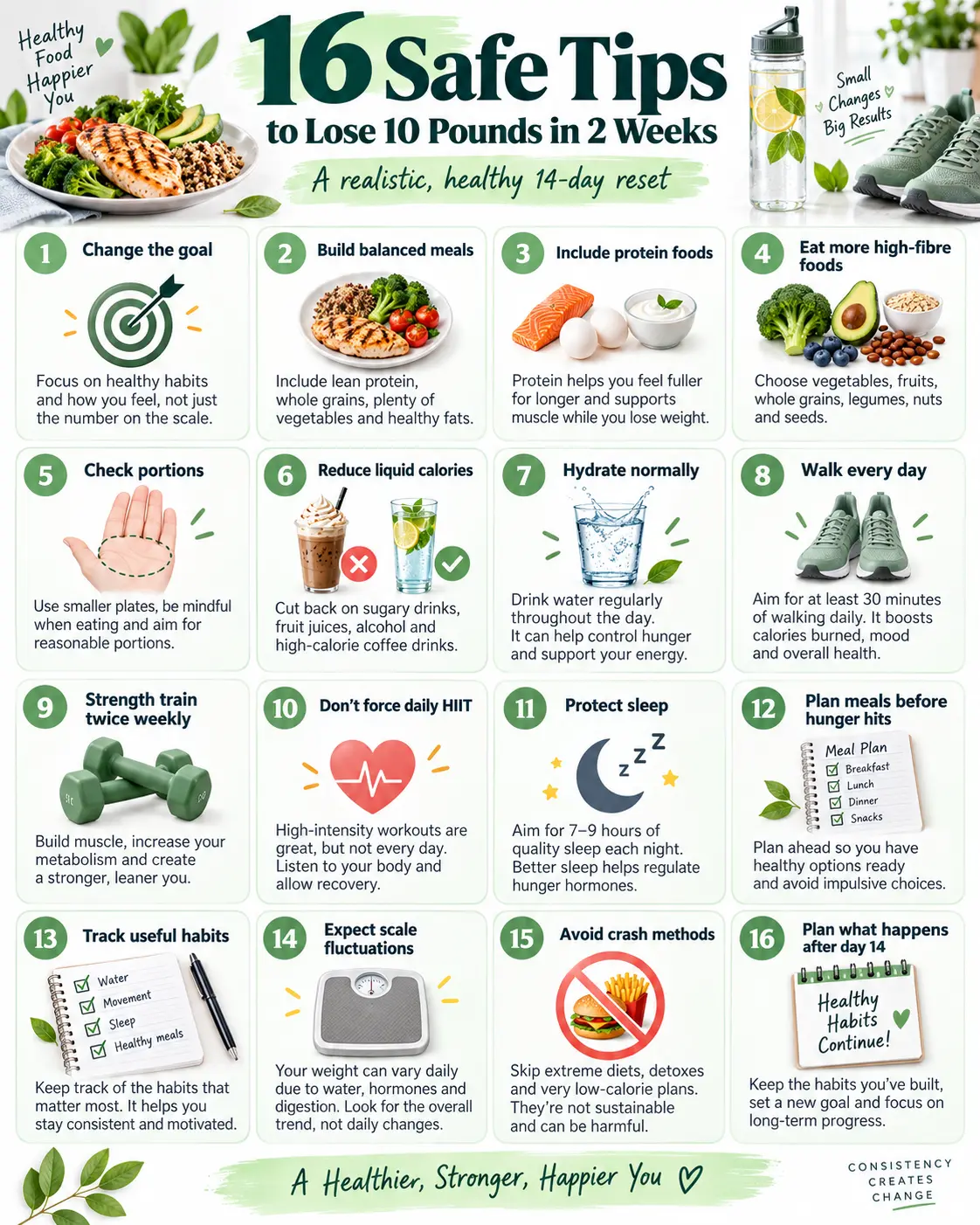
| Number | Action | Main purpose |
|---|---|---|
| 1 | Change the goal | Focus on habits instead of forcing 10 pounds |
| 2 | Build balanced meals | Improve food quality and portions |
| 3 | Include protein foods | Support muscle and satisfying meals |
| 4 | Eat more high fibre foods | Add volume and nutrition |
| 5 | Check portions | Reduce unnoticed excess intake |
| 6 | Reduce liquid calories | Make calorie reduction simpler |
| 7 | Hydrate normally | Avoid dehydration tricks |
| 8 | Walk every day you can | Increase activity without extreme workouts |
| 9 | Strength train twice weekly | Support muscle and function |
| 10 | Do not force daily HIIT | Reduce excessive fatigue and injury risk |
| 11 | Protect sleep | Support health and daily decision-making |
| 12 | Plan meals before hunger hits | Reduce impulsive choices |
| 13 | Track useful habits | See what actually changes |
| 14 | Expect scale fluctuations | Avoid reacting to one number |
| 15 | Avoid crash methods | Protect health and long-term progress |
| 16 | Plan what happens after day 14 | Turn a short start into a lasting routine |
1. Change the Goal Before You Change Your Food
Your goal controls your decisions.
If the goal is:
“I must lose 10 pounds in 14 days.”
You may be tempted to starve.
Skip water.
Train every day.
Cut whole food groups.
Take random supplements.
Use a sauna just to make the scale move.
That is the wrong direction.
A better two week weight loss plan is:
- Eat balanced meals.
- Reduce obvious excess calories.
- Move regularly.
- Strength train.
- Sleep enough.
- Track trends.
Your body may lose two pounds.
It may lose four.
It may lose more scale weight if water changes a lot.
The plan can still be successful even if the scale does not reach 10.
2. Build Balanced Meals Instead of Tiny Meals
The current Dietary Guidelines for Americans, 2025 to 2030, emphasizes whole, nutrient dense food.
A simple meal can include:
- A protein food
- Vegetables or fruit
- A carbohydrate food
- A source of healthy fat
Examples:
| Meal part | Examples |
|---|---|
| Protein | Eggs, fish, chicken, yogurt, beans, lentils, tofu, lean meat |
| Vegetables | Salad, broccoli, peppers, tomatoes, carrots, leafy greens |
| Fruit | Berries, apples, oranges, bananas, seasonal fruit |
| Carbohydrate food | Potatoes, oats, rice, beans, bread, whole grains |
| Healthy fats | Olive oil, nuts, seeds, avocado |
For broader guidance, visit the NextFitLife Weight Loss and Metabolism Hub.
3. Include Protein Foods in Your Main Meals
Protein helps build and maintain body tissues.
It can also make a meal feel more complete.
You do not need to eat chicken six times a day.
You do not need protein powder.
Useful foods include:
- Eggs
- Fish
- Chicken
- Lean meat
- Plain yogurt
- Beans
- Lentils
- Tofu
- Tempeh
The right amount depends on your size, health, age, activity, and goals.
People with kidney disease or another condition affecting protein needs should use individual guidance.
4. Eat More Fibre-Rich Whole Foods
High fibre foods can add volume and nutrients to meals.
Choose foods such as:
- Vegetables
- Whole fruit
- Beans
- Lentils
- Oats
- Whole grains
- Nuts
- Seeds
Increase fibre gradually if your current intake is low.
A sudden large increase can cause gas or bloating.
Drink normally as you increase fibre.
5. Check Portions Before You Ban Foods
You may not need a new diet.
You may need different portions.
Review:
- Cooking oil
- Dressings
- Nuts
- Cheese
- Sauces
- Takeaway portions
- Snack bags
- Desserts
These foods do not need to disappear.
A smaller portion can make a meaningful difference.
NIDDK recommends weight loss programs that use a healthy eating plan you can maintain rather than unrealistic quick fixes.
6. Reduce liquid calories first
This can be one of the simplest changes.
Check how often you drink:
- Soda
- Sweet tea
- Large flavored coffee drinks
- Energy drinks
- Fruit drinks
- Alcohol
You do not need a special fat-burning drink.
Water is fine for hydration.
Unsweetened tea or coffee can fit for many adults.
Milk and suitable fortified alternatives can also fit.
The goal is not liquid fasting.
It is removing calories you do not value much.
7. Hydrate Normally, Not Aggressively
The old article gave everyone a fixed 64 to 80 ounce water target.
Fluid needs are more individual than that.
They depend on:
- Body size
- Climate
- Activity
- Sweat
- Food
- Pregnancy
- Breastfeeding
- Medicines
- Kidney and heart health
Drink regularly.
Drink more when heat and exercise increase fluid loss.
Do not dehydrate yourself to make the scale lighter.
Water loss is not fat loss.
8. Walk Every Day You Can
Walking is underrated.
It is accessible.
It is easy to scale up or down.
You can do it without a gym.
Try:
- 10 minutes after breakfast
- A lunch break walk
- 15 to 30 minutes after dinner
- Walking while talking on the phone
CDC guidance says adults should work toward at least 150 minutes of moderate activity each week.
Some activity is better than none.
For more exercise options, read Best Exercises for Weight Loss.
9. Strength Train at Least Twice Each Week
Strength training during weight loss deserves a place in the plan.
Adults should include muscle strengthening activity on at least two days each week.
A beginner routine can include:
- Chair squats
- Wall push-ups
- Band rows
- Glute bridges
- Light dumbbell exercises
- Supported lunges
You do not need a bodybuilding program.
You need enough training to challenge your muscles safely.
10. Do Not Turn Two Weeks Into a Daily HIIT Challenge
The old article recommended daily exercise and presented HIIT as a fast result tool.
You do not need that.
High-intensity interval training can be useful.
It is also demanding.
If you are not trained for it, daily hard intervals can leave you exhausted or sore.
Walking, cycling, swimming, and other moderate exercise count.
If you enjoy HIIT and already train regularly, use it within a balanced program.
Do not treat exhaustion as proof of fat loss.
11. Protect Your Sleep
Sleep belongs in healthy weight loss.
Adults generally need at least 7 hours of sleep within a 24 hour period.
Try:
- A regular bedtime
- A regular wake time
- Less late caffeine if it affects your sleep
- A dark bedroom
- Less scrolling in bed
Sleep does not directly melt body fat.
But being rested can make food planning, movement, and decision making easier.
12. Plan Meals Before You Get Very Hungry
Meal planning does not mean eating the same chicken and broccoli every day.
It means knowing what your next meal is likely to be.
Keep easy foods available.
- Eggs
- Plain yogurt
- Frozen vegetables
- Fruit
- Beans
- Lentils
- Canned tuna or salmon when suitable
- Cooked chicken
- Oats
- Potatoes
- Rice
A plan makes it easier to avoid buying food only when you are very hungry.
13. Track Habits, Not Just Calories
NIDDK includes self-monitoring as a useful part of successful weight management programs.
You can track:
- Meals
- Drinks
- Walks
- Strength workouts
- Sleep
- Weight
- Waist measurement if useful
You do not have to count every calorie forever.
Tracking should teach you something.
It should not make eating frightening.
If tracking becomes obsessive or leads to extreme restriction, stop and seek professional help.
See Weight Loss Tracking.
14. Expect the Scale to Move Up and Down
Your body weight changes from day to day.
That is normal.
Common causes include:
- Sodium
- Carbohydrates
- Hydration
- Constipation
- Exercise soreness
- Menstrual cycle changes
- Meal timing
Do not change your whole plan because of one morning's number.
Look for a trend.
Learn more in How Weight Loss Works.
15. Avoid Crash Methods
This is the most important part of the article.
I would not recommend:
- Water fasting
- Intentional dehydration
- Laxatives
- Diuretics for scale weight
- Detox teas
- Random diet pills
- 500-calorie diets without medical supervision
- Multiple hard workouts every day
- Cutting every carbohydrate food
- Skipping food all day to compensate for eating
NIDDK specifically warns people to avoid programs built around dramatic rapid weight loss promises.
A diet that makes you weak and dizzy is not a successful plan.
16. Plan Day 15 Before You Start Day 1
This separates a diet from a lifestyle.
Ask yourself:
What happens after two weeks?
If the answer is:
“I go back to normal.”
Then the plan was never sustainable.
Instead, choose habits you can keep.
- Walking after dinner
- Strength training twice weekly
- Balanced breakfast
- Fewer sugary drinks
- Meal planning
- Enough sleep
These habits are less exciting than a crash diet.
They are also much more useful.
A Safer 14 Day Weight Loss Starter Plan
This is a habit plan.
It is not a starvation menu.
| Day | Main food goal | Movement goal | Lifestyle goal |
|---|---|---|---|
| 1 | Record normal meals | 15-minute walk | Set a realistic goal |
| 2 | Build balanced meals | Strength session | Plan bedtime |
| 3 | Reduce sugary drinks | 20-minute walk | Prepare tomorrow's lunch |
| 4 | Add vegetables and fruit | Easy movement | Review portions |
| 5 | Add a protein food to meals | 25-minute walk | Protect sleep |
| 6 | Practice sensible portions | Strength session | Track how you feel |
| 7 | Eat normally | Comfortable walk | Review week one |
| 8 | Repeat the best meals | 20 to 30 minute walk | Plan week two |
| 9 | Focus on whole foods | Strength session | Keep fluids normal |
| 10 | Review snack portions | 25 minute walk | Reduce late scrolling |
| 11 | Plan an eating out meal | Easy movement | Avoid all or nothing thinking |
| 12 | Keep meals balanced | Strength session | Plan day 15 |
| 13 | Repeat what worked | 30-minute walk or other cardio | Check your energy |
| 14 | No reward binge | Gentle movement | Review progress and continue |
What Can You Eat for Two Weeks?
You do not need a strict 14-day meal chart.
Use repeatable meals.
Breakfast Ideas
- Eggs with vegetables and whole grain toast
- Plain Greek yogurt with fruit and oats
- Oatmeal with milk, fruit, and nuts
- Beans with tomatoes and bread
- Tofu with vegetables and potatoes
Lunch Ideas
- Chicken, rice, and salad
- Lentil soup with whole grain bread and fruit
- Tuna and potato salad
- Beans, rice, and vegetables
- Tofu with grain and vegetables
Dinner Ideas
- Fish with potatoes and vegetables
- Chicken with rice and salad
- Lean meat with vegetables and a whole grain
- Lentil curry with rice
- Tofu stir-fry with vegetables
Snack Ideas
- Fruit
- Plain yogurt
- Vegetables and hummus
- A small portion of nuts
- A boiled egg
Snacks are optional.
Use them when they help you manage hunger.
See Healthy Lunch Ideas for Weight Loss for more meal ideas.
Should You Cut Carbohydrates for Two Weeks?
No universal carbohydrate restriction is required.
Fruit is a carbohydrate.
Beans are carbohydrates.
Oats are carbohydrates.
Potatoes are carbohydrates.
Rice is a carbohydrate.
Whole grains are carbohydrates.
These foods can fit healthy weight loss.
A sudden large reduction in carbohydrate intake can reduce stored glycogen and water.
That can make the scale fall quickly.
It does not mean the same amount of body fat disappeared.
Do you need intermittent fasting?
No.
Intermittent fasting is one eating schedule.
It is not required for fat loss.
Some people like eating within a set window.
Other people become too hungry and overeat later.
If fasting makes you dizzy, weak, obsessive about food, or unable to exercise normally, it is not a good plan for you.
People taking diabetes medicines, pregnant or breastfeeding people, adolescents, and people with eating disorder histories need particular caution.
Can You Lose Belly Fat in Two Weeks?
You cannot choose where your body loses fat first.
Ab exercises train abdominal muscles.
They do not pull fat from the stomach.
If your stomach looks flatter after two weeks, several things may have changed:
- Body fat
- Water
- Bloating
- Food volume
- Constipation
Spot reduction is not a reliable fat loss strategy.
What Is a More Realistic Timeline to Lose 10 Pounds?
CDC's general guideline of about 1 to 2 pounds per week suggests that many people may need roughly 5 to 10 weeks or longer to lose 10 pounds.
That is only a general estimate.
Your pace can change with:
- Starting weight
- Age
- Medicines
- Health conditions
- Activity
- Sleep
- Food intake
- Hormones
For a more complete discussion, read Healthy Rate of Weight Loss.
When Fast Weight Loss Needs Medical Supervision
There are medical situations where faster weight loss programs may be used.
Those programs are different from internet crash diets.
They may involve:
- Medical assessment
- Registered dietitian support
- Prescription weight management medicine
- Structured meal plans
- Regular monitoring
- Laboratory testing when appropriate
If you have obesity or a weight-related health condition, talk with a qualified healthcare professional about evidence-based treatment options.
You do not need to manage everything alone.
Who Should Not Try to Lose 10 Pounds in Two Weeks?
Do not attempt aggressive, rapid loss without professional guidance if you:
- Are pregnant
- Are breastfeeding
- Are under 18
- Are underweight
- Have an eating disorder or history of one
- Have diabetes treated with medicine
- Have kidney disease
- Have liver disease
- Have serious heart disease
- Are recovering from surgery
- Are losing weight without trying
Unintentional weight loss can be a symptom of illness and should be assessed.
Conclusion: Use the Two Weeks to Start Something Better
If your goal is to lose 10 pounds in 2 weeks, the most important fact is that a 10-pound scale drop is not the same as losing 10 pounds of body fat.
Do not starve.
Do not dehydrate yourself.
Do not punish yourself with exercise.
Build balanced meals.
Walk.
Strength train.
Sleep.
Track your progress.
Your next step: choose four of the 16 habits today and follow them for the next 14 days. Then keep the habits that still make sense on day 15.
The best two-week plan is one that leaves you healthier when the two weeks are over.
References and Sources
- Centers for Disease Control and Prevention. Steps for Losing Weight.CDC Steps for Losing Weight used for gradual weight loss, realistic goals, healthy eating, physical activity, sleep, stress, and the general 1 to 2 pound weekly guideline.
- National Institute of Diabetes and Digestive and Kidney Diseases. Choosing a Safe and Successful Weight Loss Program.NIDDK Safe Weight Loss Program Guide used for realistic goals, healthy reduced-calorie eating, activity, self-monitoring, long-term maintenance, professional support, and warnings about unrealistic rapid loss promises.
- United States Department of Health and Human Services and United States Department of Agriculture. Dietary Guidelines for Americans, 2025 to 2030.Current Dietary Guidelines for Americans for nutrient-dense food choices: vegetables, fruit, protein foods, healthy fats, dairy foods when suitable, whole grains, and reducing highly processed foods.
- Centers for Disease Control and Prevention. Adding Physical Activity as an Adult.CDC Adult Physical Activity Guidance updated December 2025. Used for 150 minutes of moderate activity, two strength days, gradual progress, and the principle that some activity is better than none.
- Centers for Disease Control and Prevention. Short Sleep Duration and Sleep Difficulties Among Adults.CDC Adult Sleep Data Brief published April 2026. Used for the recommendation that adults get at least 7 hours of sleep within 24 hours.
Continue Reading on NextFitLife
Use these NextFitLife guides to build a safer long-term weight management plan.
- Weight Loss and Metabolism Hub for food, portions, protein, fibre, exercise, sleep, medicines, plateaus, and safe weight management.
- Healthy Rate of Weight Loss for realistic weekly progress and safer expectations.
- How Weight Loss Works for fat loss, water weight, metabolism, and scale changes.
- Weight Loss Tracking for monitoring trends without overreacting to daily scale changes.
- Best Exercises for Weight Loss for walking, aerobic activity, and strength training.
- Strength Training Exercises at Home for Beginners for simple muscle strengthening.
- Healthy Lunch Ideas for Weight Loss for practical meal ideas.
- Tips to Lose Weight in a Week for a shorter, safe habit reset.
- Nutrition and Vitamins Hub for wider food and nutrient guidance.
About the Author
Adel Galal is the founder and lead writer of NextFitLife.
He has maintained a personal interest in health, fitness, nutrition, sleep, wellness, and healthy aging for more than 30 years.
His health and wellness writing and research communication experience spans more than 15 years.
Adel is not a physician, registered dietitian, endocrinologist, obesity medicine specialist, psychologist, pharmacist, certified personal trainer, or other licensed healthcare professional.
His role is research communication.
He compares reputable medical and public health sources, checks health claims, identifies evidence limits, and explains complex weight management topics in simple language.
Before founding NextFitLife, Adel spent 29 years working as an IT Manager for the Nestlé Egypt Region.
His professional work involved data, information systems, planning, structured review, information management, and problem-solving.
Those skills support his research process.
They are not medical or nutrition credentials.
For this article, the main claims about safe weight loss, nutrition, activity, sleep, rapid weight loss, and maintenance were checked against current CDC, NIDDK, and United States public health guidance.
Learn more about Adel, NextFitLife's research process, editorial standards, medical review policy, and corrections process on the About NextFitLife page.
Frequently Asked Questions About Losing 10 Pounds in 2 Weeks
Can I lose 10 pounds in 2 weeks?
Your scale may drop 10 pounds in some situations, especially when water weight changes, but losing 10 pounds of body fat in 14 days is not a realistic or recommended goal for most people.
How much weight can I safely lose in two weeks?
CDC guidance says gradual weight loss of about 1 to 2 pounds per week is more likely to stay off. That means roughly 2 to 4 pounds over two weeks is a general guideline, although individual results vary.
Why did I lose several pounds in the first week?
Early scale changes can include body water, glycogen, food in the digestive system, and body fat. A fast first week does not mean every pound was fat.
Can I lose 10 pounds of fat in 14 days?
That is not a realistic target for most people. Attempts to force that amount of fat loss usually require very aggressive restriction and are not a normal lifestyle approach.
How long does losing 10 pounds usually take?
At the general CDC pace of about 1 to 2 pounds per week, many people may need roughly 5 to 10 weeks or longer. Individual results vary.
Should I cut carbohydrates to lose weight faster?
You do not need to remove carbohydrates. Fruit, beans, oats, potatoes, rice, and whole grains can fit a healthy eating plan. Cutting carbohydrates sharply can also cause rapid water loss that may look like faster fat loss on the scale.
Do I need intermittent fasting?
No. Intermittent fasting is optional. Weight loss can occur with many eating schedules when the overall eating pattern supports an appropriate energy intake.
Should I exercise every day for two weeks?
No. Daily movement can be useful, but every day does not need a hard workout. Walking can be frequent, while strength and higher-intensity exercise should allow enough recovery.
Should I do HIIT every day?
No. Daily HIIT is not required for weight loss and may be too demanding for beginners. Walking, moderate cardio, and strength training can all support health and weight management.
Does drinking more water make you lose fat?
No. Water supports hydration but does not directly melt body fat. Fluid needs vary, and intentionally dehydrating yourself only lowers water weight.
Can I target belly fat in two weeks?
No. You cannot choose where fat leaves first. Ab exercises strengthen abdominal muscles but do not selectively remove stomach fat.
What should I eat during a two-week weight loss plan?
Build meals around nutrient-dense foods such as suitable protein foods, vegetables, fruit, whole grains or other carbohydrate foods, and healthy fats. Portion size and the overall eating pattern matter.
Is a 1,200 calorie diet safe for everyone?
No. Calorie needs vary widely based on body size, age, sex, activity, health, and other factors. A fixed calorie target should not be applied to everyone.
What should I do after the two weeks?
Keep the realistic habits. Continue balanced meals, physical activity, strength training, sleep, and progress tracking rather than returning to an old routine.
Who should talk to a doctor before trying to lose weight?
People who are pregnant, breastfeeding, under 18, underweight, have an eating disorder history, take certain medicines, or have diabetes, kidney disease, liver disease, heart disease, or other significant medical conditions should seek individual advice.
What is the safest way to start losing 10 pounds?
Use a realistic timeline. Improve food quality and portions, move regularly, include strength training, sleep enough, track trends, and choose habits you can maintain after the weight is lost.

Health & wellness writer with 30+ years of experience in nutrition, fitness, and healthy aging. Founder of NextFitLife.com — evidence-based health guidance.