
Updated on: October 16, 2026
Written and source checked by: Adel Galal, Founder and Lead Writer at NextFitLife
Medical review status: This article has not been medically reviewed by a doctor, pulmonologist, allergist, immunologist, occupational medicine specialist, pharmacist, or other licensed healthcare professional.
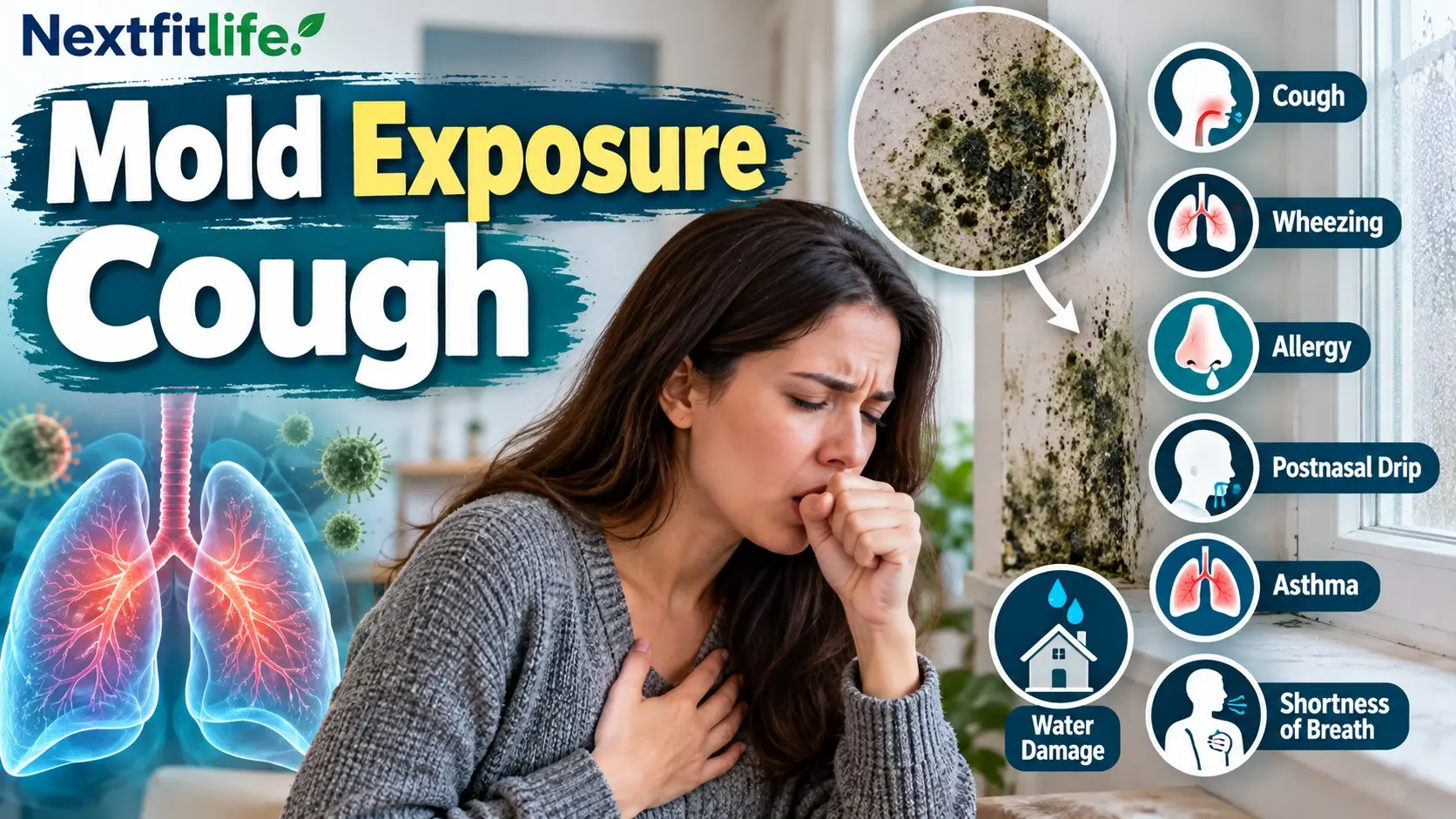
A mold exposure cough does not automatically mean poisoning or a fungal infection. Mold and damp indoor air can irritate the airways, trigger allergies, worsen asthma, and in some people contribute to more serious lung inflammation.
The useful question is not simply, “Did I see mold?”
Ask what happened with the cough. Did it start in one building? Do you also sneeze or wheeze? Does it improve when you leave? Do you have fever, severe fatigue, or shortness of breath?
This article is for general information and education. It does not replace medical advice, diagnosis, or treatment.
For a wider overview of cough, asthma, lung testing, and breathing symptoms, visit the NextFitLife Lung and Respiratory Health Hub.
Table of Contents
- What mold can do to the airways
- 9 warning clues to watch
- Simple irritation
- Allergy and postnasal drip
- Asthma symptoms
- Hypersensitivity pneumonitis
- High risk fungal infection
- Symptoms tied to one building
- Persistent or worsening cough
- Fever or breathing trouble
- Immune suppression or chronic lung disease
- Black mold and toxic mold claims
- Home testing and mold cleanup
- Questions to ask a clinician
- Tests a clinician may consider
- When to seek urgent care
- Frequently asked questions
What Can Mold Actually Do to Your Airways?
Mold exists indoors and outdoors.
Indoor problems usually start with moisture. A roof leak, plumbing problem, flooding, condensation, poor ventilation, or damp building material can create the conditions mold needs to grow.
When mold grows indoors, people can breathe in spores, fragments, allergens, and other material from the damp environment.
Possible effects include:
- Cough
- Wheezing
- Stuffy or runny nose
- Sore or irritated throat
- Burning or watery eyes
- Asthma symptoms
- Allergic reactions
Those symptoms do not all mean the same disease.
1. A Mild Dry Cough Can Be Simple Airway Irritation
Start with the less dramatic explanation.
Moldy or damp environments can irritate the eyes, nose, throat, and lungs even in people who do not have a mold allergy.
You might notice:
- A dry tickle in the throat
- Repeated throat clearing
- Mild dry cough
- Nasal burning
- Eye irritation
If the symptoms are mild, appear in one damp room, and improve after you leave, irritation becomes a reasonable possibility.
That pattern does not prove mold is the only trigger. Damp buildings can contain dust mites, chemicals, pest allergens, and other irritants too.
2. Cough Plus Sneezing and Itchy Eyes Points Toward Allergy
A lot of cough linked with mold starts in the nose rather than the lungs.
Mold allergy can cause:
- Sneezing
- Runny nose
- Blocked nose
- Itchy eyes
- Watery eyes
- Itchy nose or throat
- Cough
- Postnasal drip
Postnasal drip can trigger repeated throat clearing and coughing as mucus moves down the back of the throat.
If your cough comes with sneezing, congestion, and itchy eyes, ask whether allergy or upper airway drainage fits better than a lung infection.
For a broader allergy guide, see What Causes Allergies?
3. Wheezing or Chest Tightness Pushes Asthma Higher on the List
Now the picture changes.
Mold can trigger asthma symptoms in some people.
Possible clues include:
- Cough
- Wheezing
- Chest tightness
- Shortness of breath
- Nighttime cough
- Exercise related cough
You do not need loud wheezing to have asthma.
Some people have cough dominant asthma symptoms. Others have symptoms mainly at night, during exercise, or around specific triggers.
If cough keeps returning with chest tightness or shortness of breath in a damp building, ask whether asthma testing makes sense.
For subtle presentations, read Silent Asthma: Symptoms Without Obvious Wheezing.
4. Hypersensitivity Pneumonitis Is Different From Mold Allergy
Hypersensitivity pneumonitis is an immune related lung disease caused by inhaling certain environmental triggers.
Some fungi and molds can be among those triggers.
The symptoms go beyond a stuffy nose.
Possible signs include:
- Cough
- Shortness of breath
- Fever
- Chills
- Muscle aches
- Severe fatigue
- Night sweats
- Unexplained weight loss
One useful clue is the exposure pattern.
Symptoms can improve when the person spends time away from the trigger and return after renewed exposure.
This matters especially in workplaces involving damp buildings, agriculture, compost, moldy hay, or repeated environmental exposures.
A cough plus marked fatigue, feverish symptoms, or breathlessness deserves more attention than a simple itchy nose.
5. Fungal Lung Infection Is Mainly a Concern in Higher Risk People
Finding mold at home does not mean a healthy person has developed an invasive fungal infection.
The risk becomes more important in people with weakened immune defenses or some chronic lung diseases.
Higher risk groups can include people with:
- Major immune suppression
- Some cancers
- Chemotherapy treatment
- Organ transplantation
- Stem cell transplantation
- Some chronic lung conditions
If you belong to a high risk group and develop fever, worsening cough, chest pain, or shortness of breath after heavy mold exposure, contact your healthcare team promptly.
6. Symptoms That Change With Location Are Useful Clues
Pay attention to place.
Does the cough worsen after several hours at work?
Does it settle over the weekend?
Do you feel better after sleeping somewhere else for several nights?
Does it return when you go back into the damp room?
This type of pattern can strengthen the case for an environmental trigger.
It still does not prove that mold is the exact cause because damp buildings can contain several irritants and allergens.
Keep a simple exposure diary
Write down:
- Where you were
- When coughing started
- Whether you wheezed
- Whether your nose or eyes reacted
- Whether you had fever
- Whether you felt better after leaving
- Any visible dampness or musty smell
This can give your clinician much better information than saying, “I think mold is making me sick.”
7. A Persistent Cough Needs a Broader Differential Diagnosis
Do not become so attached to mold as the answer that you miss another cause.
A persistent cough can also come from:
- Respiratory infection
- Other allergies
- Postnasal drip
- Asthma unrelated to mold
- Acid reflux
- Smoking
- Vaping
- Medication effects
- Other lung disease
If the cough happens mainly at night, see Coughing Only at Night: Causes and Warning Signs.
If cold air triggers it too, read Cough After Breathing Cold Air.
8. Fever and Shortness of Breath Change the Picture
A mild throat tickle and severe breathlessness are not the same situation.
Get medical assessment when a cough is paired with:
- Fever
- Chills
- Marked fatigue
- Shortness of breath
- Chest pain
- Reduced ability to do normal activity
- Symptoms that continue to worsen
These symptoms can occur with conditions other than mold exposure too, including respiratory infections and other lung disease.
9. Asthma, Lung Disease, or Immune Suppression Lowers the Threshold for Care
Medical history changes how seriously an exposure should be treated.
Be more cautious if you have:
- Asthma
- COPD
- Other chronic lung disease
- Major immune suppression
- Previous severe allergic reactions
If your asthma symptoms worsen around dampness or mold, do not rely on cough medicine alone.
Use your prescribed asthma action plan and contact your clinician when control is worsening.
What Does a Mold Exposure Cough Feel Like?
There is no single sound or feeling that identifies mold as the cause.
The cough might be:
- Dry
- Tickly
- Linked with throat clearing
- Worse in one building
- Worse at night
- Paired with wheezing
- Associated with mucus from nasal drainage
The accompanying symptoms matter more than whether the cough sounds “deep.”
Dry Cough vs Wet Cough After Mold Exposure
| Pattern | Possible Explanation | Helpful Clues |
|---|---|---|
| Dry cough | Irritation, allergy, asthma | Itchy throat, wheezing, environmental pattern |
| Cough with throat mucus | Postnasal drainage | Congestion, sneezing, throat clearing |
| Wet chest cough | Several causes possible | Fever, illness, chest symptoms need context |
| Cough plus wheeze | Asthma more likely | Chest tightness, shortness of breath, trigger pattern |
| Cough plus fever and fatigue | Needs medical evaluation | Consider infection, hypersensitivity pneumonitis, or another illness |
Does Black Mold Cause Worse Symptoms?
The phrase black mold creates more fear than useful information.
Some molds can produce mycotoxins under certain conditions, but mold color alone does not tell you how dangerous a building is or explain a person's symptoms.
If you see indoor mold, treat it as a moisture problem that needs fixing.
You do not need to identify the exact species before repairing the leak or removing damaged material.
Do You Need a Home Mold Test?
Usually not.
Routine home testing has major limits.
There is no simple health based indoor mold number that tells you, “Below this is safe and above this caused your cough.”
A short sample also captures only one moment in a changing indoor environment.
If mold is visible or there is a persistent musty smell, you already have a reason to investigate moisture.
A home mold test cannot diagnose your cough.
Fix Moisture Before Buying Gadgets
This is where I would spend effort first.
If water is still entering the wall, no air purifier fixes the source.
Look for:
- Roof leaks
- Pipe leaks
- Bathroom moisture
- Condensation
- Flood damage
- Poor ventilation
- Wet carpet or drywall
Dry wet materials promptly.
EPA guidance recommends drying water damaged materials within about 24 to 48 hours when possible to help prevent mold growth.
Should You Clean Mold Yourself?
That depends on the size of the problem and your health.
EPA says many people can handle a small affected area of roughly less than 10 square feet by following safe cleanup guidance.
Professional help makes more sense when:
- The affected area is larger
- There has been major water damage
- Sewage is involved
- Heating or cooling systems are involved
- Mold keeps returning
- You have asthma or serious lung disease
- You are immunocompromised
Do not personally tear out a large moldy wall if your lungs already react badly to mold.
Do You Need Bleach to Remove Mold?
Not as the default answer.
The main job is to remove contaminated material when needed and correct the water source.
Simply killing surface mold does not remove the allergenic material.
Never mix bleach with ammonia or other incompatible cleaners.
Will an Air Purifier Stop a Mold Cough?
An air cleaner can reduce some airborne particles.
It cannot repair a leaking roof.
That distinction matters.
Filtration can be a supporting measure after you deal with the moisture source, but it should not become an excuse to leave active mold growth in place.
Can Antihistamines Help?
They can help if allergy is driving the symptoms.
For mold allergy, treatment can include antihistamines, nasal corticosteroids, and other allergy therapies depending on the symptoms.
But an antihistamine does not treat every cause of cough.
It will not fix:
- Uncontrolled asthma
- Hypersensitivity pneumonitis
- Pneumonia
- A fungal lung infection
- Another unrelated chronic cough cause
Do not judge the diagnosis only by whether one allergy pill helped.
What Questions Should You Ask a Clinician?
Could this be allergy or postnasal drip?
Ask this when the cough comes with sneezing, itchy eyes, congestion, or repeated throat clearing.
Could this be asthma or cough variant asthma?
This question becomes more relevant with wheezing, chest tightness, night cough, exercise symptoms, or repeated symptoms around environmental triggers.
Do I need spirometry?
Spirometry measures how much air you can blow out and how fast you can blow it out.
It is commonly used when asthma or another airway problem is suspected.
Would allergy testing help?
Skin testing or blood testing can identify sensitization to specific allergens when the clinical history supports testing.
A positive mold allergy test does not prove that every cough in your home is caused by mold.
Could this be hypersensitivity pneumonitis?
Ask when cough comes with significant shortness of breath, marked fatigue, feverish symptoms, or a strong work related exposure pattern.
Could another cause fit better?
This may be the best question on the list.
It keeps the evaluation open to reflux, infection, other allergies, medicine effects, asthma, or another lung condition.
What Should You Tell the Clinician?
Bring details rather than a diagnosis.
Tell them:
- When the cough started
- Where the suspected exposure occurred
- Whether mold was visible
- Whether the building smelled musty
- Whether there was flooding or a leak
- Whether symptoms improve when you leave
- Whether symptoms return when you go back
- Whether you wheeze
- Whether your nose and eyes react
- Whether you have fever or chills
- Whether you have asthma
- Whether you smoke or vape
- Which medicines you take
- Whether your immune system is suppressed
That information is more useful than the name of a mold species from an inexpensive home test.
What Tests Might a Clinician Consider?
There is no single blood test that proves household mold caused a cough.
The evaluation depends on the suspected condition.
| Possible Test | Why It Might Be Used |
|---|---|
| Physical examination | Checks breathing, nose, throat, chest, and overall illness pattern |
| Pulse oximetry | Measures blood oxygen level |
| Spirometry | Looks for airflow limitation and asthma patterns |
| Allergy testing | Looks for sensitization when allergy is suspected |
| Chest imaging | Used when pneumonia, hypersensitivity pneumonitis, or another lung problem is suspected |
| Additional lung tests | May be needed when symptoms are persistent or complex |
When Does a Mold Exposure Cough Need Urgent Care?
Get urgent medical help for:
- Severe breathing difficulty
- Blue or gray lips or skin
- Fainting
- Confusion
- Rapidly worsening breathlessness
- Severe chest tightness
- Significant coughing of blood
- Asthma symptoms that remain severe despite your prescribed rescue plan
These symptoms need assessment regardless of whether mold triggered them.
When Should You Book a Routine Appointment?
Arrange medical evaluation if:
- The cough keeps returning
- It repeatedly worsens in one building
- You wheeze
- You have chest tightness
- You wake at night coughing
- You become unusually short of breath with normal activity
- You have unexplained fever or fatigue
- Your asthma has become harder to control
- The cough is not settling as expected
Use a lower threshold for contacting your clinician if you are immunocompromised or have significant chronic lung disease.
Common Mold Cough Mistakes
| Mistake | Why It Fails | Better Move |
|---|---|---|
| Assuming black mold means poisoning | Color does not diagnose health effects | Fix moisture and assess symptoms |
| Buying tests before fixing the leak | Testing does not repair the moisture source | Stop water entry first |
| Calling every cough mold toxicity | Many diseases cause cough | Use the full symptom pattern |
| Using allergy medicine for wheezing | Asthma needs its own treatment plan | Get airway symptoms assessed |
| Personally disturbing a large mold area with severe asthma | Cleanup can increase airborne exposure | Consider professional remediation |
Conclusion: Follow the Symptom Pattern, Not the Mold Color
A mold exposure cough can come from simple irritation, allergy, postnasal drainage, asthma, or less common lung conditions.
Your next step should be practical.
Reduce ongoing exposure, fix the source of moisture, and write down when and where symptoms occur. If the cough comes with wheezing, shortness of breath, fever, marked fatigue, or keeps returning in the same environment, take that pattern to a healthcare professional.
Do not spend weeks trying to prove the species of mold while ignoring the leak or the symptoms.
References and Sources
- Centers for Disease Control and Prevention. Mold and Health.
Covers cough, wheezing, sore throat, eye irritation, asthma, chronic lung disease, immune suppression, and general mold health effects.
https://www.cdc.gov/mold-health/about/index.html - CDC National Institute for Occupational Safety and Health. Health Problems From Damp Buildings and Mold.
Covers allergic symptoms, asthma, irritation, hypersensitivity pneumonitis, occupational patterns, and respiratory effects.
https://www.cdc.gov/niosh/mold/health-problems/index.html - Mayo Clinic. Mold Allergy: Symptoms and Causes.
Explains cough, postnasal drip, sneezing, nasal congestion, itchy eyes, and mold related asthma symptoms.
https://www.mayoclinic.org/diseases-conditions/mold-allergy/symptoms-causes/syc-20351519 - Mayo Clinic. Mold Allergy: Diagnosis and Treatment.
Covers allergy evaluation, exposure reduction, nasal corticosteroids, antihistamines, and other treatments.
https://www.mayoclinic.org/diseases-conditions/mold-allergy/diagnosis-treatment/drc-20351525 - US Environmental Protection Agency. Mold Cleanup in Your Home.
Explains moisture control, cleanup decisions, the approximate 10 square foot threshold, and when professional help may be appropriate.
https://www.epa.gov/mold/mold-cleanup-your-home - US Environmental Protection Agency. Ten Things You Should Know About Mold.
Covers moisture control, water leaks, humidity, respiratory symptoms, and drying wet materials within 24 to 48 hours.
https://www.epa.gov/mold/ten-things-you-should-know-about-mold - US Environmental Protection Agency. Can Mold Cause Health Problems?
Covers allergens, irritants, asthma, respiratory complaints, and why moisture control matters.
https://www.epa.gov/mold/can-mold-cause-health-problems
Internal Links and Helpful NextFitLife Guides
- Lung and Respiratory Health Hub
- Silent Asthma: Symptoms Without Obvious Wheezing
- Cough After Breathing Cold Air
- Cough After Laughing
- Coughing Only at Night
- What Causes Allergies?
- Healthy Lifestyle Roadmap
About the Author
Adel Galal is the Founder and Lead Writer at NextFitLife. He researches respiratory health, allergies, asthma, environmental health, nutrition, fitness, and everyday wellness and turns current medical and public health guidance into clear practical information for everyday readers.
I am not a doctor or licensed healthcare professional, and this content does not replace professional medical advice, diagnosis, or treatment. I share information based on extensive research, real life experience, and consultation with healthcare providers. Always consult a qualified healthcare professional for diagnosis, treatment, or guidance about any health condition.
Learn more about Adel, NextFitLife, and the site's editorial approach on the About Us page.
Frequently Asked Questions
Can mold exposure cause a cough?
Yes. Mold and damp indoor environments can irritate the airways, trigger allergic symptoms, worsen asthma, and in susceptible people contribute to other respiratory conditions.
What does a mold exposure cough feel like?
There is no single mold cough. It can be dry, tickly, linked with throat clearing, paired with postnasal drip, or accompanied by wheezing and chest tightness when asthma is involved.
How do I know if mold is causing my cough?
A pattern can provide clues. Symptoms that repeatedly worsen in one damp building and improve away from it support an environmental trigger, but they do not prove mold is the only cause.
Can mold cause a dry cough?
Yes. Airway irritation, mold allergy, and asthma can all cause dry cough. Viral illness, reflux, medicines, and other irritants can cause the same symptom.
Can mold cause mucus and coughing?
Mold allergy can cause nasal congestion and postnasal drainage that leads to mucus and coughing. A wet chest cough has many other possible causes and should not automatically be blamed on mold.
Can mold trigger asthma?
Yes. Mold can trigger cough, wheezing, chest tightness, and shortness of breath in some people with asthma.
What is hypersensitivity pneumonitis?
Hypersensitivity pneumonitis is immune related inflammation in the lungs caused by inhaled environmental triggers. Symptoms can include cough, breathlessness, fever, chills, severe fatigue, night sweats, and weight loss.
Does black mold automatically mean toxic exposure?
No. Mold color does not diagnose illness or tell you how severe an exposure is. Any indoor mold growth should prompt investigation and correction of the moisture source.
Should I test my house for mold?
Routine home mold testing is often not useful for health decisions. If visible mold or a persistent musty odor is present, focus on finding and fixing the moisture source and removing mold safely.
Can an air purifier cure a mold cough?
No. Filtration can reduce some airborne particles, but an air purifier cannot repair a leak or remove active mold growth from building materials.
Should I take an antihistamine for a mold cough?
An antihistamine can help when mold allergy is contributing to symptoms, but it will not treat every cause of cough, including uncontrolled asthma, hypersensitivity pneumonitis, or respiratory infection.
When should a mold exposure cough be checked by a doctor?
Seek medical evaluation when the cough persists, repeatedly worsens in one environment, comes with wheezing or shortness of breath, disturbs sleep, or is associated with fever, marked fatigue, or worsening asthma.
When is a mold related breathing problem an emergency?
Get urgent help for severe breathing difficulty, blue or gray lips, fainting, confusion, rapidly worsening shortness of breath, severe chest tightness, or significant coughing of blood.

Health & wellness writer with 30+ years of experience in nutrition, fitness, and healthy aging. Founder of NextFitLife.com — evidence-based health guidance.

