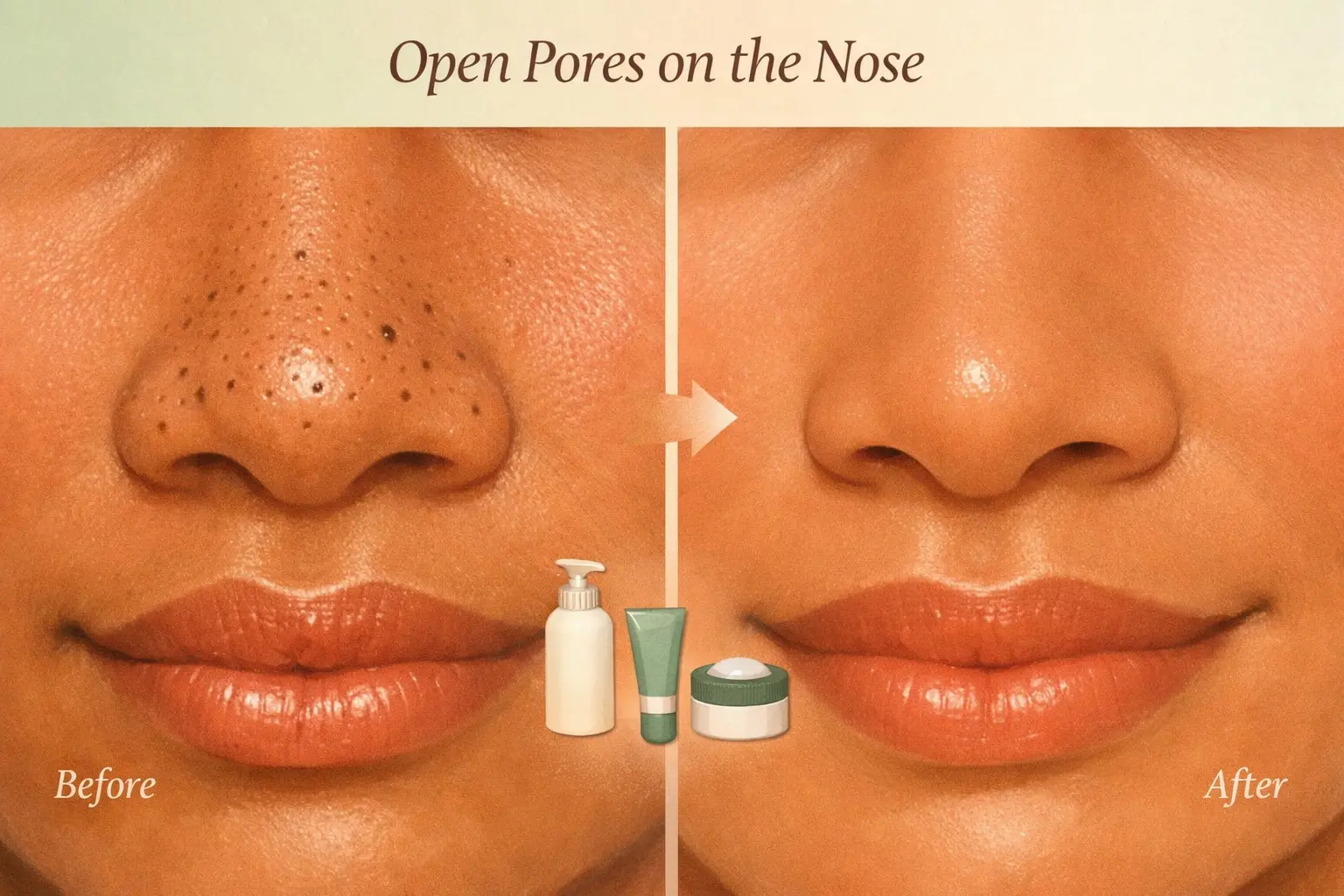
Last Updated: June 2026 - Fully updated and expanded. Merges our two open pores on the nose into one complete resource.
Open pores on the nose are one of the most searched skin concerns in the world. If you look in a mirror and see enlarged pores across your nose and the surrounding T-zone, you are not alone. This is one of the most common skin concerns across all skin types, all ages, and all genders.
The good news is that enlarged nose pores can be significantly minimized. Not eliminated - pores are a permanent feature of skin anatomy. But made much less visible with the right approach. The bad news is that most products marketed for this purpose either do not work or provide only temporary effects.
This guide gives you a complete, honest picture. Why do pores on the nose look enlarged? What works to make them smaller and clearer? The 10 best tips for smoother skin, combining both our previous guides into one resource. What to avoid. And a skincare routine you can start today. Skin Health: The Complete Guide to Healthy, Clear and Youthful Skin
| WHAT THIS GUIDE COVERS | Why pores on the nose appear enlarged - the actual causes
Can you shrink pores? The honest answer What makes pores look bigger than they are 10 proven tips for clearer, smoother nose skin The best ingredients for minimizing pore appearance Your daily skincare routine for open pores Professional treatments that reduce pore size What to avoid - products and habits that make pores worse When to see a dermatologist |
Why Pores on the Nose Look Enlarged - The Actual Causes
Before you can effectively minimize open pores on the nose, you need to understand why they appear enlarged. There are several distinct causes - and the right solution depends on which one applies to you.
| Cause | Why It Makes Pores Look Bigger | Who Is Most Affected |
| Excess sebum production | Oil fills the follicle and stretches the pore opening. The follicle becomes distended, and the opening appears larger | People with oily skin. The most common cause of enlarged nasal pores |
| Clogged pores (comedones) | Sebum mixed with dead skin cells blocks the follicle. The blockage stretches the pore and makes it more visible | Everyone. Blackheads on the nose are clogged pores that appear dark from oxidation |
| Loss of skin elasticity with age | Collagen and elastin in the dermis provide structural support around pores. As they decline, pore walls lose support and widen | Adults over 35. Nose pores become more visible with age, even without excess oil |
| Sun damage | UV radiation breaks down collagen and elastin around pore walls. Thickens the surface layer of skin (stratum corneum), making pores appear larger | People with a significant sun exposure history |
| Genetics | Pore size is partly inherited. Larger follicle diameter is a genetic trait | Some people are simply predisposed to more visible pores, regardless of skincare |
| Thick or oily skin | Thicker skin around the nose is more common in oily skin types and in men. The thicker skin itself makes pores appear more prominent | Oily skin types. Men, particularly The Ultimate Guide to Men's Skin Care Routine |
Can you actually shrink pores? The Honest Answer
This is the most important question to answer honestly. Pore size is genetically determined. The actual diameter of the follicle opening cannot be permanently reduced by any skincare product or treatment. Anyone claiming their product 'shrinks pores' is not being accurate.
What you CAN do - and what genuinely works - is:
- Keep pores clear and unclogged so they are not artificially stretched by debris
- Control excess sebum so oil does not fill and distend the follicle opening
- Support collagen and elastin around pore walls to maintain structural support
- Improve skin texture through exfoliation so the skin surface around pores looks smoother and less uneven
- Use ingredients like niacinamide and retinoids that have clinical evidence for measurably reducing visible pore size
These approaches do not change the underlying anatomy. But they produce a real, visible, measurable reduction in how large your pores appear. For most people, this is more than enough to achieve the smooth, clear nose skin they are looking for.
What Makes Nose Pores Look Bigger Than They Are
Several everyday factors make pores on the nose look significantly larger than their actual size. Addressing these produces fast visible improvement even before any active treatment takes effect.
- Blackheads - oxidized sebum plugs in pores create dark spots that draw the eye and make individual pores much more visible. Clearing blackheads is one of the fastest improvements you can make
- Applying foundation without primer - thick foundation settles into pores and accentuates them, making them appear larger. A pore-minimizing primer before foundation creates a smoother base
- Not cleansing properly - accumulated makeup, SPF, and sebum sitting in pores overnight enlarges them. Double cleansing when wearing SPF or makeup is important
- Dehydrated skin - when skin lacks moisture, it compensates by producing more sebum, which fills pores further. Well-hydrated skin produces less compensatory oil
- Heavy, pore-clogging products - comedogenic moisturizers, foundations, and sunscreens physically block pores and make them appear larger over time
- Poor exfoliation - dead skin cells accumulating around pores give the skin surface an uneven texture that makes pores more prominent
10 Proven Tips for Open Pores on the Nose - Clearer, Smoother Skin
These are the most effective, evidence-supported strategies for minimizing open pores on the nose. Applied consistently, they produce real visible improvement within 4 to 12 weeks.
Tip 1- Double Cleanse Every Evening
The most overlooked step for clearer nose pores is thorough evening cleansing. During the day, SPF, makeup, pollution particles, and sebum accumulate in pores. If this is not fully removed at night, it hardens and stretches pores further.
Use a double cleanse method every evening: first an oil-based cleanser or micellar water to dissolve SPF and makeup, then a gentle water-based cleanser to clean the skin itself. In the morning, a light water rinse or gentle cleanser is usually sufficient - overnight, there is no SPF or makeup to remove.
Tip 2- Use a BHA (Salicylic Acid) Exfoliant Regularly
Salicylic acid - a beta-hydroxy acid - is the most effective ingredient for nose pores specifically. Unlike AHAs, which work on the skin surface, BHA is oil-soluble. This means it can penetrate inside the sebaceous follicle, dissolve the sebum and dead cell mixture that clogs pores, and clear blockages from within.
Use a salicylic acid product at a 0.5 to 2 percent concentration 2 to 3 times per week. This can be a toner, serum, exfoliant, or cleanser. Do not use daily initially - start with twice weekly and assess tolerance. Always follow with SPF the next morning, as BHA increases photosensitivity.
Tip 3- Apply Niacinamide Daily
Niacinamide (vitamin B3) is one of the best-evidenced ingredients for reducing visible pore size. A randomized controlled trial published in the British Journal of Dermatology found that a 2 percent niacinamide moisturizer significantly reduced sebum excretion rate and pore appearance compared to placebo. Oily Skin Moisturizer: Revealing the Truth
Niacinamide works by reducing sebum production in the sebaceous glands, which reduces the amount of oil filling and distending pores. It also has anti-inflammatory effects and strengthens the skin barrier. Use a niacinamide serum or moisturizer at a 5 to 10 percent concentration both morning and evening. It is extremely well tolerated - even with sensitive skin.
Tip 4- Introduce Retinol or Retinoid Treatment
Retinoids address nose pores through two distinct mechanisms. First, they increase cell turnover - reducing the dead cell buildup around and inside pores that makes them appear larger. Second, they stimulate collagen production in the dermis - improving the structural support around pore walls and helping them maintain a tighter appearance over time.
Start with a retinol at 0.1 to 0.3 percent applied 2 to 3 times per week, increasing frequency over 8 to 12 weeks as tolerance builds. Prescription tretinoin produces faster results but requires a doctor. Always use SPF the following morning - retinoids increase UV sensitivity. Results for pore reduction typically appear at 8 to 12 weeks of consistent use.
Tip 5- Use a Clay Mask Once or Twice Weekly
Clay masks - particularly kaolin and bentonite clay - absorb excess sebum from the skin surface and from within pore openings. They provide a satisfying immediate improvement in how pores look by physically drawing out oil.
Apply a thin layer to the nose and T-zone for 10 to 15 minutes, then rinse thoroughly with lukewarm water. Use it once or twice weekly - not more frequently. Overuse of clay masks strips the skin of all moisture, triggering compensatory oil production that worsens pores. Follow with a hydrating toner and moisturizer after every clay mask.
Tip 6- Always Use Non-Comedogenic Products
Every product you put on your face - moisturizer, sunscreen, foundation, primer - should be labelled non-comedogenic. This means the formulation has been tested and confirmed not to block pores.
Comedogenic ingredients to specifically avoid near the nose: coconut oil (highly comedogenic), cocoa butter, isopropyl myristate, petrolatum in heavy concentrations, and some silicones, including simethicone in very high concentrations. Ingredients that are non-comedogenic and beneficial for oily, pore-prone skin include zinc oxide, glycerin, hyaluronic acid, and niacinamide.
Tip 7- Apply SPF Every Day Without Exception
UV radiation breaks down the collagen and elastin that provide structural support around pore walls. Without this support, pores widen and become more visible over time. Daily broad-spectrum SPF 30 to 50 prevents this ongoing structural damage.
For oily or pore-prone skin, choose a lightweight, non-comedogenic SPF gel or fluid. Many modern mineral (zinc oxide) formulas are now lightweight, non-whitening, and non-comedogenic. Avoid thick cream SPF formulas that sit heavily on the skin - these contribute to pore congestion.
Tip 8- Keep Skin Hydrated - Even Oily Skin Needs Moisture
This surprises many people with oily skin. Dehydrated skin produces more oil. When the skin barrier is dehydrated, sebaceous glands compensate by producing extra sebum to protect the skin. This excess sebum fills pores and makes them look more enlarged. Natural Skin Care Routine for Oily Skin
Use a lightweight, oil-free, non-comedogenic moisturizer in the morning and evening. Gel-textured moisturizers work well for oily skin around the nose. Look for hydrating ingredients like glycerin, hyaluronic acid, and ceramides without occlusive heavy oils or butters.
Tip 9- Do Not Squeeze or Pick at Nose Pores
Squeezing blackheads and extracting pores with fingers causes permanent pore enlargement. The mechanical force damages the follicle wall and stretches the pore opening. Repeatedly squeezing the same pore over months progressively enlarges it.
If you want to extract blackheads, use salicylic acid regularly to dissolve them chemically rather than extracting them mechanically. If you want professional extraction, a trained aesthetician or dermatologist can do this safely with proper technique and tools. Never extract yourself with fingers.
Tip 10- Consider Professional Treatments for Significant Pore Reduction
For people who want more significant improvement than skincare alone can achieve, several professional treatments are genuinely effective for nose pores.
| Treatment | How It Works | Realistic Outcome | Sessions |
| Chemical peels (BHA/AHA) | Professional-strength salicylic or glycolic acid dissolves pore congestion and improves surface texture | Significant pore clarity improvement. Visible after the first session, builds with a series | 3 to 6 sessions, 2 to 4 weeks apart |
| Microneedling | Fine needles create micro-channels in skin, stimulating collagen production around pore walls. Improve structural support | 20 to 40% reduction in pore appearance over a series. Cumulative benefit | 3 to 6 sessions, 4 weeks apart |
| Laser resurfacing (fractional) | Laser energy removes surface skin and stimulates deep collagen remodelling around pores | Significant pore size improvement. Best option for sun-damaged enlarged pores | 1 to 3 sessions, depending on depth |
| Radiofrequency microneedling (Morpheus8) | Combines microneedling with RF energy for deeper collagen stimulation around pore walls | Strong collagen response. Particularly effective for age-related pore enlargement | 3 sessions, 4 weeks apart |
| Professional extractions + BHA peel | Aesthetician manually extracts blockages, then applies professional BHA to maintain clarity | Immediate dramatic improvement in pore clarity. Maintenance monthly | Monthly maintenance sessions |
The Best Skincare Ingredients for Nose Pores - Evidence Guide
| Ingredient | How It Helps Pores | Concentration | When to Use |
| Niacinamide (Vitamin B3) | Reduces sebum production. Minimizes pore appearance. Anti-inflammatory. Strengthens barrier | 5 to 10% | Morning and evening - very well tolerated |
| Salicylic acid (BHA) | Oil-soluble - penetrates the follicle to dissolve sebum and dead cell plugs. Clears and prevents blackheads | 0.5 to 2% | 2 to 3 times weekly. Not daily initially |
| Retinol / Tretinoin | Increase cell turnover. Stimulates collagen around pore walls. Reduces dead cell buildup in pores | Retinol 0.1 to 0.5%. Tretinoin 0.025 to 0.1% | Evenings only. Build frequency slowly. SPF the next morning |
| AHA (glycolic or lactic acid) | Surface exfoliation. Removes dead cell buildup that makes pores look larger. Improves overall texture | 5 to 10% | 2 to 3 times weekly. Alternate with BHA rather than combining |
| Clay (kaolin, bentonite) | Absorbs excess sebum from pore openings. Provides immediate improvement in pore appearance | As used in masks | 1 to 2 times weekly as a mask |
| Zinc (in sunscreen or moisturizer) | Mild sebum-regulating properties. Non-comedogenic. Anti-inflammatory | As formulated | Daily use of sunscreen or moisturizer |
| Hyaluronic acid | Hydrates skin without adding oil. Prevents dehydration-triggered excess sebum | 0.1 to 2% | Morning and evening under moisturizer |
Your Complete Daily Skincare Routine for Open Nose Pores
Morning Routine
- Step 1- Gentle gel or foaming cleanser - removes overnight sebum. Low-pH, sulphate-free. 60-second massage, rinse with cool water
- Step 2- Niacinamide serum (5 to 10%) - apply to damp skin. Pat gently across the nose and T-zone. Let it absorb for 1 minute
- Step 3- Lightweight oil-free moisturizer - gel texture preferred. Non-comedogenic. Provides hydration without adding oil
- Step 4- Non-comedogenic SPF 30 to 50 - mineral or lightweight chemical formula. Apply as the final step. Never skip this
How to Care for Your Skin Daily
Evening Routine
- Step 1- Oil cleanser or micellar water - dissolves SPF and any makeup fully
- Step 2- Gentle water-based cleanser - second cleanse. Removes residue from first cleanse. Leaves skin clean and pH-balanced
- Step 3- BHA exfoliant (2 to 3 evenings per week) - salicylic acid toner or serum. Apply to the nose and T-zone. No need to rinse leave-on formulas
- Step 4- Retinol (2 to 3 evenings per week - alternate with BHA) - start slowly. 0.1 to 0.3% to begin. Built nightly over 8 to 12 weeks
- Step 5- Lightweight moisturizer - gel or lotion texture. Non-comedogenic. Seal in hydration
Weekly Additions
- 1 to 2 times per week: clay mask - apply to nose and T-zone for 10 to 15 minutes. Rinse thoroughly. Always moisturize afterwards
- As needed: professional extraction or chemical peel - if pursuing professional treatments, these replace or supplement the weekly clay mask step
What to Avoid - Products and Habits That Make Nose Pores Worse
| AVOID THESE BETTER NOSE PORES | Squeezing or picking at pores with fingers - permanently enlarges pore walls over time
Pore strips (Biore style) - temporarily pull out some surface sebum, but damage pore walls with repeated use Comedogenic moisturizers and oils - coconut oil, cocoa butter, heavy petrolatum formulas near the nose Over-cleansing more than twice daily - strips skin and triggers compensatory oil production Overusing clay masks more than twice weekly causes dehydration, which worsens oil and pore appearance Skipping moisturizer because skin is oily - dehydration worsens sebum production and pore distension Thick, heavy sunscreen or BB creams - settle into pores and accentuate them throughout the day Using alcohol-heavy toners - temporary mattifying effect followed by dehydration and rebound oiliness Sleeping in makeup - makeup blocks pores overnight and hardens into the follicle |
Realistic Timeline: When to Expect Results
| Timeframe | What to Expect? | Why |
| Week 1 to 2 | Cleaner-looking pores after thorough double cleansing. Less blackhead prominence | Cleansing removes accumulated debris that was making pores look larger |
| Week 3 to 4 | Measurable reduction in blackheads and sebum congestion from BHA use | Salicylic acid has cleared the follicle blockages that were stretching pores |
| Week 4 to 8 | Reduction in sebum production and visible pore size from niacinamide | Niacinamide's sebum-regulating effect becomes measurable at 4 to 8 weeks |
| Weeks 8 to 12 | Improvement in skin texture and pore support from retinoid use | Collagen stimulation from retinoids becomes visible at 8 to 12 weeks |
| 6 to 12 months | Significant overall pore improvement from a combined, consistent approach | Long-term collagen remodelling, ongoing sebum control, and maintained pore clarity |
When to See a Dermatologist About Pores
| SEE A DERMATOLOGIST IF | Pores are severely enlarged and not responding to 3 months of consistent skincare
You have persistent blackheads that do not clear with regular BHA use Pores are accompanied by significant acne that needs prescription treatment You want professional chemical peels, microneedling, or laser resurfacing You are considering prescription tretinoin for faster and stronger results than OTC retinol You notice any skin changes around pores - irregular growth, bleeding, or colour changes |
Key Takeaways - Open Pores on the Nose
| SUMMARY | Pore size is genetically determined and cannot be permanently changed, but appearance can be dramatically improved
The major causes are excess sebum, clogged pores, collagen loss with age, and sun damage Niacinamide (5 to 10%) is the best-evidenced ingredient for reducing sebum and visible pore size BHA (salicylic acid 1 to 2%) is oil-soluble and penetrates inside pores to dissolve blockages from within Retinoids increase cell turnover and stimulate collagen around pore walls - use consistently for 12+ weeks Clay masks, once or twice weekly, absorb excess sebum for immediate visible improvement Never squeeze or pick - this permanently enlarges pore walls over time Daily SPF prevents UV collagen breakdown that widens pores structurally over time Dehydrated oily skin produces more oil - a lightweight moisturizer is essential even for oily skin How to Clean Oily Skin: 10 Game-Changing Tricks Professional treatments (chemical peels, microneedling, laser) produce the most significant improvement |
References and Sources
1- Niacinamide and Sebum Production - British Journal of Dermatology RCT
https://pubmed.ncbi.nlm.nih.gov/16382662/
Randomized controlled trial. Use for: niacinamide 2% reduces sebum excretion rate and pore appearance vs placebo. Core clinical evidence for niacinamide pore claims.
2- Salicylic Acid for Acne and Comedones - Journal of Clinical and Aesthetic Dermatology
https://pubmed.ncbi.nlm.nih.gov/26203328/
Review. Use for: salicylic acid BHA mechanism of action in the follicle, oil-solubility enabling penetration, comedone clearance evidence.
3- Retinoids and Skin Cell Turnover - Journal of the American Academy of Dermatology
https://pubmed.ncbi.nlm.nih.gov/16427381/
Clinical review. Use for: retinoids increase cell turnover, stimulate collagen in dermis, reducing pore appearance through structural support improvement.
4- UV Damage and Skin Collagen Breakdown - Photochemistry and Photobiology
https://pubmed.ncbi.nlm.nih.gov/16706262/
Research. Use for: UV radiation breaks down collagen and elastin around pore walls, sun protection prevents pore widening, and SPF has clinical importance.
5- Sebaceous Gland Density and Pore Distribution - Journal of Investigative Dermatology
https://pubmed.ncbi.nlm.nih.gov/15107831/
Research. Use for: the nose and T-zone have higher sebaceous gland density, explaining why pores are more prominent there than in other facial areas.
Part of Our Skin Health Series
This article is part of our complete skin health resource. Read all skin health topics in our Complete Skin Health Guide or browse our Skin Health Resource Directory.
Adel Galal
Health and Wellness Writer | 30+ Years Personal Practice | Founder, NextFitLife.com
Adel Galal has studied skin health, skincare ingredients, and dermatological science for over 30 years. He applies evidence-based skincare practices daily and reviews the research carefully before writing. He is not a doctor or dermatologist. Everything here reflects personal research, experience, and consultation with healthcare providers. Always consult a qualified dermatologist for any skin condition or treatment decision.

Health & wellness writer with 30+ years of experience in nutrition, fitness, and healthy aging. Founder of NextFitLife.com — evidence-based health guidance.