
Published on: March 12, 2024
Updated on: October 26, 2026
Slimming Waist Exercises can build a stronger core, improve trunk control, and help your midsection look firmer as your fitness improves. What they cannot reliably do is tell your body to remove fat from the waist and nowhere else.
If your goal is a smaller waist, the best plan is wider than ab exercises. Combine core work with walking or other cardio, full body strength training, enough weekly movement, and nutrition habits that support your body composition goal.
This guide gives you 16 practical exercises, a simple home workout, progression options, and an honest explanation of what exercise can and cannot do for belly fat.
This article is for general information and education. It does not replace medical advice, diagnosis, or treatment.
For more training ideas, visit the NextFitLife Fitness Hub, Exercises to Slim Waist, and Exercises to Lose Belly Fat.
Table of Contents
- Slimming Waist Exercises: Quick Answer
- Can Exercise Really Slim Your Waist?
- What Spot Reduction Research Really Says
- 16 Smart Waist Exercises
- Beginner core moves
- Side core moves
- Whole body strength
- Cardio options
- 15 Minute Waist Workout
- How Often to Train
- How to Progress
- What Helps Reduce Abdominal Fat
- Common Mistakes
- Frequently Asked Questions
- References and Sources
Slimming Waist Exercises: Quick Answer
The best Slimming Waist Exercises strengthen your abdominal muscles, obliques, hips, back, and deeper core while a wider fitness plan helps reduce overall and abdominal fat.
Good choices include:
- Dead bugs
- Bird dogs
- Forearm planks
- Side planks
- Reverse crunches
- Bicycle crunches
- Mountain climbers
- Squats
- Reverse lunges
- Glute bridges
- Push ups
- Brisk walking
You do not need hundreds of crunches.
A stronger core and lower body fat are related goals, but they are not the same goal.
Can Exercise Really Slim Your Waist?
Yes, exercise can help reduce waist circumference over time.
The important question is how.
Core exercise strengthens the muscles around your trunk. Aerobic exercise and full body resistance training increase energy use and can reduce total and abdominal fat. Nutrition and long term energy balance also affect body fat.
A 2026 network meta analysis of 60 randomized trials involving 3,308 adults with overweight or obesity found reductions in visceral fat with aerobic training, resistance training, combined training, and interval exercise.
A separate recent review also found that exercise programmes reduced both visceral and subcutaneous fat in the abdominal region.
The practical lesson is simple.
Train the core, but train the rest of your body too.
What Does the Research Say About Spot Reduction?
The old article promised that waist exercises could “melt away belly fat.” That is too strong.
The traditional view is that exercising one muscle group does not let you choose exactly where body fat is lost.
Recent research adds some nuance.
A 2023 randomized trial studied 16 men with overweight. One group combined treadmill running with a large amount of abdominal endurance exercise, while the comparison group performed treadmill running alone. The abdominal training group lost more trunk fat.
Another small trial involving 14 adults also reported local reductions in abdominal subcutaneous fat with a circuit designed around regional training.
Those studies are interesting, but they are small.
They do not prove that doing 50 crunches each night will selectively burn belly fat.
Until larger studies confirm the effect, treat local fat loss as a possible research finding rather than a promise.
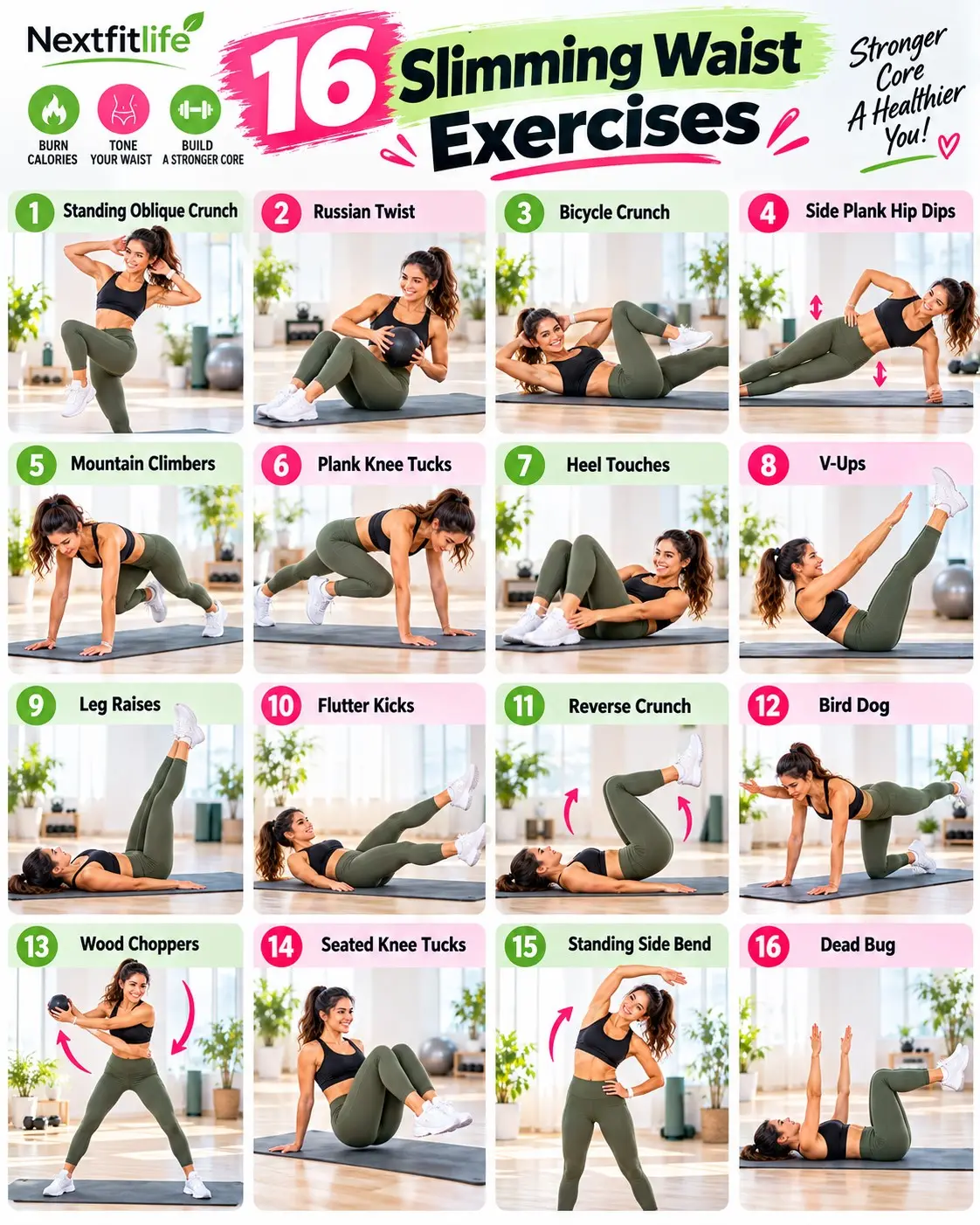
1. Dead Bug
The dead bug is one of the best beginner exercises for trunk stability.
How to Do It
- Lie on your back with your knees bent above your hips.
- Raise your arms toward the ceiling.
- Brace your abdomen gently.
- Slowly extend one leg and the opposite arm.
- Return to the start and switch sides.
Start with: 6 to 10 controlled repetitions per side.
Keep the movement small enough that you can control your trunk.
2. Bird Dog
Bird dogs train the core, hips, shoulders, and spinal control without requiring a crunch.
How to Do It
- Begin on your hands and knees.
- Brace your core gently.
- Extend one leg behind you.
- Reach the opposite arm forward.
- Pause, return, and switch sides.
Start with: 6 to 10 repetitions per side.
3. Forearm Plank
A plank trains the abdomen to resist extension rather than repeatedly bending the spine.
How to Do It
- Place your forearms on the floor.
- Extend your legs behind you.
- Keep your ribs, hips, and shoulders controlled.
- Breathe normally while holding the position.
Start with: 15 to 30 seconds.
Use an elevated surface if the floor version is too hard.
4. Side Plank
The side plank challenges the obliques and lateral core without fast twisting.
How to Do It
- Lie on your side with your elbow under your shoulder.
- Bend your knees for the easier version or straighten your legs for more challenge.
- Lift your hips.
- Hold while breathing normally.
Start with: 15 to 25 seconds per side.
5. Reverse Crunch
The reverse crunch trains the rectus abdominis while using controlled pelvic movement.
How to Do It
- Lie on your back with your knees bent.
- Bring your knees toward your torso.
- Gently curl your pelvis upward.
- Lower slowly rather than swinging the legs.
Start with: 8 to 12 repetitions.
For a fuller core progression, see Lower Ab Exercises.
6. Heel Tap
Heel taps are a simple way to challenge abdominal control without using straight leg raises.
- Lie on your back with your knees bent above your hips.
- Keep your abdomen gently braced.
- Lower one heel toward the floor.
- Return and switch sides.
Start with: 8 to 12 repetitions per side.
7. Bicycle Crunch
Bicycle crunches work the front and sides of the trunk.
- Lie on your back.
- Bring one knee toward you while rotating the opposite shoulder toward it.
- Switch sides slowly.
- Avoid pulling on your neck.
Start with: 6 to 10 repetitions per side.
Control beats speed.
8. Slow Mountain Climber
Mountain climbers combine core control with movement at the hips and shoulders.
- Begin in a high plank.
- Bring one knee toward the chest.
- Return it to the floor.
- Switch sides.
Start with 10 to 20 total repetitions.
Keep them slow before adding speed.
9. Pallof Press
The Pallof press is an anti-rotation exercise that teaches the trunk to resist twisting.
You need a resistance band or cable.
- Stand sideways to the anchor point.
- Hold the band at chest level.
- Press your hands straight forward.
- Do not let your torso rotate toward the band.
- Return slowly.
Start with: 8 to 12 repetitions per side.
10. Glute Bridge
The bridge is mainly a hip exercise, not a direct belly fat exercise.
That is exactly why it belongs in a balanced waist programme.
Strong hips help the trunk control movement.
- Lie on your back with knees bent.
- Press your feet into the floor.
- Lift your hips.
- Pause briefly.
- Lower with control.
Start with: 10 to 15 repetitions.
11. Bodyweight Squat
Squats train large muscle groups and make a waist routine more useful than an ab only workout.
- Stand with feet at a comfortable width.
- Sit your hips down and back.
- Keep your whole foot connected to the floor.
- Stand back up.
Start with: 8 to 15 repetitions.
12. Reverse Lunge
Reverse lunges train the legs and hips while your core keeps the torso stable.
- Stand tall.
- Step one foot backward.
- Lower only as far as you can control.
- Press through the front foot to return.
Start with: 6 to 10 repetitions per side.
13. Incline Push Up
A push up trains more than your arms.
Your core has to resist sagging while your upper body works.
- Place your hands on a wall, countertop, or sturdy bench.
- Keep your body in a straight line.
- Lower your chest toward the surface.
- Press away.
Start with: 6 to 12 repetitions.
14. Suitcase Carry
A suitcase carry trains the side of the core to resist leaning.
You need one dumbbell, kettlebell, or another safely held load.
- Hold the weight at one side.
- Stand tall.
- Walk slowly without leaning.
- Switch sides.
Start with: 20 to 40 seconds per side.
15. Brisk Walking
Walking may look less impressive than a viral ab workout, but it can do more for your total weekly activity.
Brisk walking adds aerobic exercise, increases energy use, and is easy to repeat often.
The CDC recommends at least 150 minutes of moderate activity each week for adults, plus two days of muscle strengthening work.
Start with 10 to 30 minutes at a pace that makes you breathe faster while still allowing conversation.
16. Walk and Jog Intervals
If your joints and fitness allow it, short walk and jog intervals can raise the aerobic demand without requiring a long run.
Try:
- 2 minutes brisk walking
- 1 minute easy jogging
- Repeat 6 to 10 times
Walking alone is completely fine if jogging is not appropriate for you.
Which Slimming Waist Exercises Are Best?
| Goal | Good Choices | Main Benefit |
|---|---|---|
| Beginner core | Dead bug, bird dog | Control and stability |
| Side core | Side plank, Pallof press | Lateral and rotational control |
| Front abs | Reverse crunch, bicycle crunch | Abdominal strength |
| Whole body | Squats, lunges, push ups | More muscle groups trained |
| Cardio | Brisk walking, walk jog intervals | Aerobic fitness and energy use |
| Home workout | Dead bug, plank, squat, bridge | Little or no equipment |
A 15 Minute Slimming Waist Workout
This routine combines core and whole body work.
Complete two or three rounds.
| Exercise | Amount |
|---|---|
| Dead bug | 8 each side |
| Bodyweight squat | 12 reps |
| Forearm plank | 20 to 30 seconds |
| Reverse lunge | 8 each side |
| Side plank | 15 to 20 seconds each side |
| Mountain climber | 20 total |
Rest as needed.
Quality matters more than finishing quickly.
How Often Should You Do Slimming Waist Exercises?
You do not need hard abdominal training every day.
For many people, two to four focused core sessions per week is enough when core work is also included in full body training.
The wider weekly plan matters more:
- At least 150 minutes of moderate aerobic activity per week
- Muscle strengthening work on at least 2 days
- Core training within those strength sessions
- Daily movement when possible
If you are new, start with less.
How Do You Make Waist Exercises Harder?
Use progressive overload.
You can progress by:
- Adding a few repetitions
- Holding a plank slightly longer
- Using a stronger resistance band
- Adding a manageable weight
- Using a harder exercise variation
- Adding another set
- Improving control and range
Do not make every variable harder at once.
The 2026 ACSM resistance training guidance puts consistency and goal based progression ahead of complicated programming.
What Actually Helps Reduce Abdominal Fat?
Research increasingly supports several forms of exercise.
A 2026 network meta analysis of 60 randomized trials found that aerobic exercise, resistance training, combined exercise, and interval training all reduced visceral abdominal fat compared with control conditions in adults with overweight or obesity.
Another large recent analysis involving 61 randomized trials also found reductions in visceral fat across exercise types, with vigorous interval training ranking highly in that specific analysis.
This does not mean everyone needs HIIT.
Walking and other moderate aerobic activity remain useful, especially when they are easier to repeat consistently.
The best programme is one that matches your health, ability, and preferences.
Do You Need HIIT to Lose Belly Fat?
No.
Recent reviews suggest that HIIT can reduce visceral fat, but it is not the only exercise that works.
Aerobic exercise, resistance training, and combined programmes also reduce abdominal fat.
If high intensity exercise causes joint pain, poor recovery, or makes you avoid training, it is not automatically the best choice for you.
Brisk walking plus strength training is a strong starting combination.
Does Strength Training Make Your Waist Bigger?
Normal core and strength training does not automatically create a bulky waist.
Muscle size changes depend on training volume, resistance, genetics, nutrition, and time.
For most recreational trainees, core work improves strength and control long before it causes dramatic changes in muscle size.
If your goal is core strength, do not avoid useful exercises because of a fear that one set of side planks will make your waist large.
Can Core Training Improve Posture?
Core strength can help you control your trunk during standing, walking, lifting, and exercise.
But posture is not controlled by one abdominal muscle.
Your hips, back, shoulders, strength, mobility, habits, comfort, and anatomy all contribute.
That is another reason a balanced programme beats endless crunches.
Does Drinking More Water Burn Belly Fat?
Water supports normal hydration, but it does not directly melt abdominal fat.
Replacing high calorie drinks with water can reduce calorie intake for some people, which may help with weight management.
Do not force excessive amounts of water in an attempt to speed fat loss.
How Long Does It Take to See a Smaller Waist?
There is no honest universal four week or eight week promise.
The time depends on:
- Your starting body composition
- Your nutrition
- Your activity level
- Your training programme
- Genetics
- Sleep
- Medications
- Hormonal and health factors
- How consistently you follow the plan
You may feel stronger before your waist measurement changes.
That is still progress.
10 Common Waist Training Mistakes
1. Expecting Crunches to Melt Belly Fat
Core exercises train muscle. Fat loss requires a wider plan.
2. Training Only the Abs
Whole body strength training gives you a more complete programme.
3. Doing Hundreds of Fast Repetitions
More repetitions are not automatically better. Use controlled movement.
4. Ignoring Cardio
Aerobic activity contributes to fitness, energy use, and reductions in visceral fat.
5. Assuming HIIT Is Required
It is one option, not the only option.
6. Holding Your Breath
Breathe normally during controlled core work unless a qualified professional has given you a specific technique.
7. Adding Weight Before Learning Control
Make the basic movement stable first.
8. Measuring Your Waist Every Day
Food, digestion, fluid balance, and bloating can change waist measurements from day to day.
9. Using Pain as Proof the Exercise Works
Muscle effort is different from sharp or worsening pain.
10. Expecting an Hourglass Shape From Exercise Alone
Body shape also reflects bone structure, genetics, fat distribution, muscle mass, and anatomy.
When Should You Stop an Exercise?
Stop if you develop:
- Sharp back pain
- Severe abdominal pain
- Chest pain or pressure
- Fainting
- Severe dizziness
- Severe or unusual shortness of breath
- Pain that changes how you move
If you have a hernia, recent abdominal surgery, pregnancy related concerns, osteoporosis, significant back problems, or another condition affecting exercise safety, ask an appropriate healthcare professional which core exercises are suitable.
Conclusion: Slimming Waist Exercises
Slimming Waist Exercises work best when you stop asking them to do a job they cannot reliably do alone.
Use dead bugs, planks, side planks, reverse crunches, squats, lunges, carries, and other strength moves to build a stronger core. Then combine that work with regular aerobic activity and sustainable nutrition habits if reducing waist size is part of your goal.
Your next step is simple: choose four exercises from this guide, complete two controlled rounds today, and add a brisk walk when it fits your day.
References and Sources
- Centers for Disease Control and Prevention. Adult Physical Activity Guidelines.
https://www.cdc.gov/physical-activity-basics/guidelines/adults.html - American College of Sports Medicine. Resistance Training Guidelines Update. 2026.
https://acsm.org/resistance-training-guidelines-update-2026/ - Optimal Exercise Modality and Dose for Reducing Visceral Adipose Tissue in Overweight or Obese Adults: Network Meta Analysis and Dose Response Study. 2026.
https://pubmed.ncbi.nlm.nih.gov/42260656/ - An Exercise Program to Reduce Abdominal Visceral and Subcutaneous Fat in Adults With Overweight and Obesity: Systematic Review and Meta Analysis of Randomized Controlled Trials.
https://pubmed.ncbi.nlm.nih.gov/41109785/ - Brobakken MF, et al. Abdominal Aerobic Endurance Exercise Reveals Spot Reduction Exists: A Randomized Controlled Trial. 2023.
https://pubmed.ncbi.nlm.nih.gov/38010201/ - Effect of an Endurance and Strength Mixed Circuit Training on Regional Fat Thickness: The Quest for Spot Reduction.
https://pubmed.ncbi.nlm.nih.gov/33917584/ - Unveiling the Perfect Workout: Exercise Modalities and Dosages to Combat Visceral Adipose Tissue in Individuals With Overweight and Obesity.
https://pubmed.ncbi.nlm.nih.gov/42098808/
Internal Links + Hub
- NextFitLife Fitness Hub for cardio, strength, core, mobility, and home workouts.
- Exercises to Slim Waist for more waist focused exercise ideas.
- Exercises to Lose Belly Fat for a wider exercise approach to abdominal fat.
- Abs Workout at Home for equipment free core training.
- Lower Ab Exercises for abdominal control and progression.
- Lower Abs Workout for structured core sessions.
- Strength Training and Muscle Building for full body resistance training.
- Effective Workout Routines at Home for practical home programmes.
- Cardio and Endurance Guide for aerobic exercise ideas.
- Walking for Weight Loss for a simple lower impact cardio option.
- Benefits of Physical Activity for the wider health benefits of regular movement.
- Healthy and Active Lifestyle for sustainable movement, food, sleep, and recovery habits.
- Physical Fitness and Mental Health for the relationship between activity and wellbeing.
About the Author
Adel Galal is a father of four, three sons and a daughter, and a grandfather of four, with 33 years of hands on parenting experience. He is the founder of Parnthub.com, based in Cairo, Egypt, where he shares practical guidance on feeding, development and family life from newborns to teenagers.
Adel is not a medical professional. Health articles cite trusted sources and are for general information only.
On NextFitLife, Adel researches and writes about fitness, core training, strength, cardio, weight management, nutrition, healthy aging, and practical wellness habits. His approach focuses on realistic exercise, current evidence, and sustainable progress rather than miracle fat loss claims.
Learn more about Adel and NextFitLife on the About Us page.
Slimming Waist Exercises: Frequently Asked Questions
Do Slimming Waist Exercises actually make your waist smaller?
They can strengthen and firm the muscles around your waist. A smaller waist measurement usually also requires changes in total or abdominal fat, which depend on your wider activity, nutrition, genetics, and other factors.
Can ab exercises burn belly fat?
Ab exercises use energy and strengthen abdominal muscles, but ordinary ab workouts cannot reliably guarantee fat loss only from the belly.
Does spot reduction exist?
Two small randomized studies reported some localized abdominal fat reduction with specific high volume training protocols. The evidence is interesting but too limited to promise spot reduction from normal waist exercises.
What are the best Slimming Waist Exercises for beginners?
Dead bugs, bird dogs, elevated planks, glute bridges, bodyweight squats, and brisk walking are good starting options because they are easy to scale.
Are Russian twists necessary for a slim waist?
No. You can build strong obliques and trunk control with side planks, Pallof presses, bird dogs, carries, and other exercises without Russian twists.
Do side planks make the waist bigger?
For most recreational exercisers, normal side plank training improves strength and control without producing a dramatic increase in waist size.
Can planks burn belly fat?
Planks strengthen the core but do not burn large amounts of energy by themselves. Combine them with whole body activity if fat loss is your goal.
What exercise burns the most visceral fat?
Recent reviews support aerobic exercise, resistance training, combined training, and interval exercise for reducing visceral fat. Some analyses rank HIIT highly, but it is not required for everyone.
Is walking good for losing waist fat?
Walking adds aerobic activity and energy expenditure and can contribute to reductions in body and abdominal fat when performed consistently as part of a wider weight management plan.
Do I need HIIT for a smaller waist?
No. HIIT can be effective, but moderate aerobic exercise and strength training also reduce visceral fat. Choose an intensity you can perform safely and consistently.
How often should I train my core?
Two to four focused sessions per week is enough for many people, especially when core work is also included in full body strength training.
Can I do waist exercises every day?
Light core movement may be fine often, but hard core training does not need to be performed every day. Muscles also need recovery.
How many waist exercises should I do in one workout?
Four to six well chosen exercises are enough for many sessions. You do not need to perform every exercise in this guide at once.
How long should a waist workout last?
A focused core session can last 10 to 20 minutes when combined with a wider strength and aerobic programme.
How long does it take to slim the waist?
There is no fixed timeline. Changes depend on starting body composition, activity, nutrition, sleep, genetics, health, medications, and consistency.
Can core exercise improve posture?
Core strength can improve trunk control, but posture also depends on the hips, back, shoulders, mobility, habits, comfort, and anatomy.
Will drinking water make my waist smaller?
Water supports hydration but does not directly burn belly fat. Replacing calorie rich drinks with water may help reduce calorie intake for some people.
Should I use weights for Slimming Waist Exercises?
You can. Add resistance after you can perform the basic movement with control. More weight is not automatically better.
What is better for the waist, cardio or strength training?
You do not need to choose only one. Cardio supports aerobic fitness and energy use, while strength training builds muscle and function. Combining them is practical for many people.
Can I get an hourglass waist from exercise?
Exercise can change muscle development and body composition, but body shape also depends on bone structure, genetics, fat distribution, and anatomy. No workout can guarantee one specific body shape.

Health & wellness writer with 30+ years of experience in nutrition, fitness, and healthy aging. Founder of NextFitLife.com — evidence-based health guidance.

