
Published on: September 3, 2023
Updated on: October 23, 2026
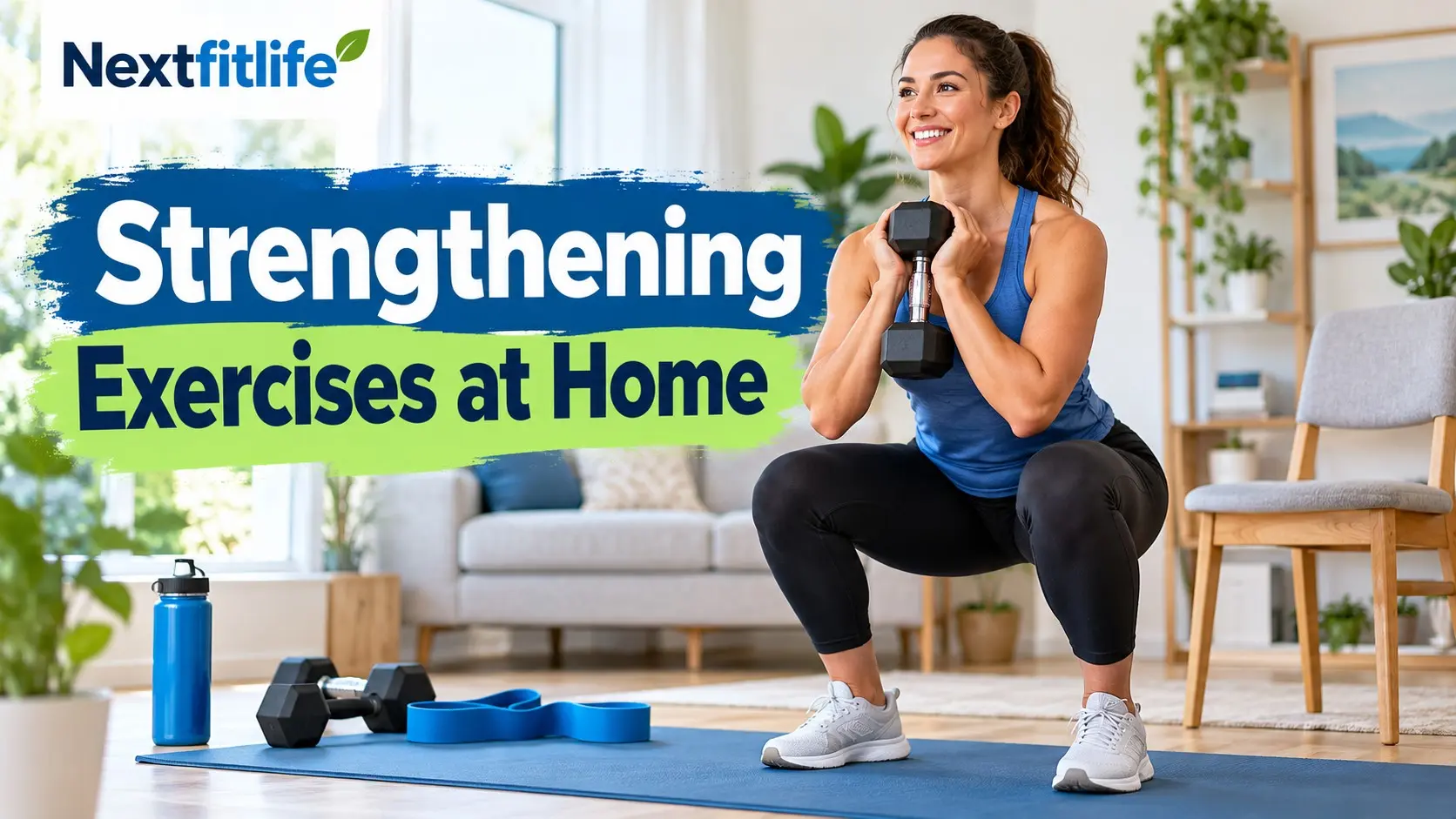
Strengthening Exercises at Home can build real strength without a large gym, expensive machines, or a complicated workout plan. Your body weight, a chair, resistance bands, or a pair of dumbbells can provide enough resistance to get started.
The key is progression. Your muscles need a challenge that becomes gradually harder as you get stronger.
The latest 2026 resistance training guidance also makes one point very clear: consistency matters more than creating a perfect program. Simple training that you repeat and gradually progress can work very well.
Important: This article is for general information and education. It does not replace medical advice, diagnosis, or treatment.
I am not a dermatologist or a doctor, and this content does not replace professional medical advice. What I share comes from real life experience, extensive research, and consultation with healthcare providers. Always consult qualified medical professionals for diagnosis and treatment of any health condition.
Table of Contents
- Quick Answer
- Can Home Training Build Strength?
- What Equipment You Need
- 13 Strengthening Exercises
- Chair squat
- Goblet squat
- Romanian deadlift
- Glute bridge
- Reverse lunge
- Step up
- Incline push up
- Dumbbell floor press
- Resistance band row
- One arm dumbbell row
- Overhead press
- Calf raise
- Loaded carry
- Beginner Workout
- Intermediate Workout
- How to Progress
- How Often to Train
- Common Mistakes
- When to Stop
- Frequently Asked Questions
- References and Sources
Strengthening Exercises at Home: Quick Answer
A good home strength routine should train the major muscles of your legs, hips, back, abdomen, chest, shoulders, and arms.
You can do that with movements such as:
- Squats
- Hip hinges
- Lunges
- Push ups
- Rows
- Presses
- Loaded carries
Start with exercises that you can control. Perform about one to three sets, use a repetition range that feels manageable, and gradually increase the challenge.
CDC recommends muscle strengthening activity on at least two days each week for adults.
If you are completely new to exercise, begin with How to Start Fitness.
Can You Really Build Strength at Home?
Yes.
The latest 2026 American College of Sports Medicine position stand reviewed 137 systematic reviews involving more than 30,000 people.
Resistance training improved:
- Muscle strength
- Muscle size
- Power
- Muscular endurance
- Balance
- Walking speed
- Physical function
Importantly, ACSM also reports that elastic bands, bodyweight exercise, and home strength training can be effective.
You do not need a commercial gym for your muscles to adapt.
For more training guidance, visit the NextFitLife Fitness Hub.
What Equipment Do You Need?
You can begin with almost nothing.
| Equipment | Useful For | Alternative |
|---|---|---|
| Your body | Squats, bridges, push ups | No equipment needed |
| Chair | Squats, support, incline push ups | Stable bench |
| Resistance band | Rows and other pulling exercises | Dumbbells |
| Dumbbells | Squats, hinges, presses, rows | Loaded backpack when appropriate |
| Exercise mat | Comfort during floor work | Carpeted floor |
If you want to build a larger home setup, read Home Exercise Workout Equipment.
13 Proven Strengthening Exercises at Home
1. Chair Squat
The chair squat is a useful starting movement for the thighs and glutes.
How to do it:
- Stand in front of a sturdy chair.
- Keep your feet at a comfortable width.
- Bend your knees and hips.
- Lower until you gently touch the chair.
- Push through your feet and stand.
Start with: 1 to 3 sets of 8 to 12 repetitions.
Your knees do not have to stay behind your toes. Some forward knee movement is normal. Focus on stable feet, comfortable depth, and control.
2. Goblet Squat
Once bodyweight squats feel easy, hold a dumbbell close to your chest.
This adds resistance without changing the basic movement.
Keep your feet stable and descend only as far as you can control comfortably.
Start with: 2 sets of 8 to 12 repetitions.
For more squat and leg options, see Leg Exercises with Dumbbells.
3. Romanian Deadlift
The Romanian deadlift trains the glutes, hamstrings, grip, and back muscles.
How to do it:
- Hold dumbbells near your thighs.
- Keep a small natural bend in your knees.
- Push your hips backward.
- Let the weights travel near your legs.
- Stop when you feel a comfortable stretch through the back of your thighs.
- Push your hips forward to stand.
Do not force the dumbbells to touch the floor.
Start with: 2 sets of 8 to 12 repetitions.
4. Glute Bridge
The glute bridge trains your hips and glutes without requiring equipment.
- Lie on your back.
- Bend your knees.
- Place your feet on the floor.
- Lift your hips while keeping your ribs controlled.
- Lower slowly.
Start with: 2 sets of 10 to 15 repetitions.
If this becomes easy, add resistance carefully across the hips.
5. Reverse Lunge
A reverse lunge trains the thighs, glutes, and balance.
Step one foot backward and lower with control, then push through your front foot to stand.
Your knees do not need to form two perfect 90 degree angles. Use a stance and depth that feel stable.
Hold a chair for balance if needed.
Start with: 1 to 2 sets of 6 to 10 repetitions per side.
6. Step Up
Use a low, sturdy step.
- Place one foot fully on the step.
- Push through that foot.
- Stand tall on the step.
- Lower slowly.
Start with a low height before increasing the challenge.
Start with: 2 sets of 6 to 10 repetitions per leg.
7. Incline Push Up
You do not have to begin with floor push ups.
Place your hands on a stable wall, countertop, or bench.
Keep your body controlled as you lower your chest toward the surface, then press away.
The higher the surface, the easier the movement usually becomes.
Start with: 2 sets of 6 to 12 repetitions.
8. Dumbbell Floor Press
The floor press trains the chest, shoulders, and triceps.
- Lie on your back with a dumbbell in each hand.
- Bend your knees.
- Press the weights upward.
- Lower until your upper arms gently contact the floor.
- Press again.
The floor naturally limits the lower range, which some beginners find comfortable.
Start with: 2 sets of 8 to 12 repetitions.
For more options, read Chest Dumbbell Exercises.
9. Resistance Band Row
Rows strengthen your upper back and arms.
Use a secure attachment point that is designed to hold the band. Never attach a band to something unstable.
Pull your elbows backward while keeping your shoulders controlled.
Start with: 2 sets of 8 to 15 repetitions.
10. One Arm Dumbbell Row
Place one hand on a sturdy chair or bench for support.
Hold a dumbbell in the opposite hand and pull it toward the side of your body.
Keep the movement controlled instead of twisting your torso to move a heavier weight.
Start with: 2 sets of 8 to 12 repetitions per side.
11. Dumbbell Overhead Press
The overhead press trains the shoulders and arms.
You can perform it sitting or standing.
Press the dumbbells upward through a comfortable path without forcing your shoulders into painful positions.
Start with: 1 to 2 sets of 8 to 12 repetitions.
If overhead pressing causes pain, use another pressing exercise and seek guidance if the problem persists.
12. Calf Raise
Stand near a wall or chair if you need support.
Rise onto the balls of your feet, pause briefly, then lower with control.
Start with: 2 sets of 10 to 15 repetitions.
Progress by adding weight or eventually working one leg at a time if appropriate.
13. Loaded Carry
A loaded carry is simple but useful.
Hold one or two dumbbells and walk slowly through a clear space.
This trains:
- Grip
- Core stability
- Shoulders
- Legs
- Posture
Start with: 20 to 40 seconds for 2 rounds.
A single dumbbell held on one side becomes a suitcase carry and increases the challenge to your trunk.
Beginner Full Body Home Workout
You do not need all 13 exercises in one session.
Start with six movements that cover the major patterns.
| Exercise | Sets | Target |
|---|---|---|
| Chair squat | 2 | 8 to 12 reps |
| Glute bridge | 2 | 10 to 15 reps |
| Incline push up | 2 | 6 to 12 reps |
| Band row | 2 | 8 to 15 reps |
| Calf raise | 2 | 10 to 15 reps |
| Loaded carry | 2 | 20 to 40 seconds |
Rest long enough to begin the next set with control. For many beginners, one to two minutes is reasonable, but the exact rest period can vary.
Intermediate Home Strength Workout
Once the beginner routine becomes comfortable, use more resistance and slightly more volume.
| Exercise | Sets | Target |
|---|---|---|
| Goblet squat | 3 | 8 to 12 reps |
| Romanian deadlift | 3 | 8 to 12 reps |
| Floor press | 3 | 8 to 12 reps |
| One arm row | 3 | 8 to 12 reps per side |
| Reverse lunge | 2 | 8 to 10 reps per side |
| Loaded carry | 3 | 30 to 60 seconds |
How Do You Get Stronger Without Buying Heavier Weights?
This is where progressive overload becomes useful.
You can increase difficulty by:
- Adding repetitions
- Adding a set
- Using a stronger resistance band
- Using a heavier backpack when appropriate
- Increasing comfortable range of motion
- Progressing to a harder exercise variation
- Using one leg or one arm when the movement can be performed safely
For example, an incline push up can progress from a wall to a counter, then to a lower bench, and eventually to the floor.
You do not have to change the entire workout each week.
How Many Reps Should You Do?
There is no single perfect repetition number.
Different resistance loads and repetition ranges can build strength and muscle when training is challenging enough and performed consistently.
For many home exercisers, ranges such as 6 to 15 repetitions are easy to use.
What matters is that the set becomes challenging while your technique stays controlled.
If you finish 15 repetitions easily every time, increase the challenge.
Do You Need to Train to Failure?
No.
You do not need to reach the point where another repetition is physically impossible.
The 2026 ACSM position stand found that training to momentary muscle failure did not consistently improve outcomes for the average healthy adult.
You can stop while you still feel capable of performing another good repetition or two.
This can make home training safer and easier to recover from.
How Often Should You Do Strengthening Exercises at Home?
CDC recommends muscle strengthening exercise on at least two days per week for adults.
The exercises should collectively train the major muscle groups:
- Legs
- Hips
- Back
- Abdomen
- Chest
- Shoulders
- Arms
A simple schedule is:
| Day | Plan |
|---|---|
| Monday | Full body strength |
| Tuesday | Walking or other aerobic activity |
| Wednesday | Easy movement or rest |
| Thursday | Full body strength |
| Friday | Walking or cardio |
| Weekend | Enjoyable activity and recovery |
Adults also need aerobic activity. Current CDC guidance recommends at least 150 minutes of moderate intensity aerobic activity each week in addition to the two strength days.
Do You Need a Warm Up?
A short warm up can help you prepare for the movements ahead.
Try:
- Walk around for two to three minutes.
- Do several easy bodyweight squats.
- Practice the first exercise without resistance.
- Use a lighter first set before harder working sets.
You do not need to exhaust yourself during the warm up.
How Long Should a Home Strength Workout Last?
There is no required duration.
A beginner can complete a useful full body workout in around 20 to 40 minutes, depending on the number of exercises, sets, and rest periods.
Longer does not automatically mean better.
A short workout that you repeat consistently is more useful than an exhausting 90 minute session you avoid next week.
Can You Build Muscle With Bodyweight Exercises?
Yes, especially when you are new to resistance training.
The challenge is making the exercise harder as you improve.
You can progress from:
- Wall push up to incline push up to floor push up
- Chair squat to bodyweight squat to loaded squat
- Two leg bridge to harder bridge variations
- Supported split squat to loaded split squat
At some point, weights or stronger bands may make progression easier, but you do not need them on day one.
Can Strength Training Help With Weight Loss?
Resistance training is useful during weight loss because it helps protect muscle and maintain physical function.
Exercise alone does not guarantee fat loss, because nutrition and total energy balance also matter.
If fat loss is one of your goals, combine strength work with regular activity and an appropriate eating pattern.
See Healthy Weight Loss Techniques for the wider strategy.
What Should You Eat for Home Strength Training?
You do not need a special bodybuilding diet.
Build your overall diet around nutrient dense foods such as:
- Protein foods
- Vegetables
- Fruit
- Whole grains
- Beans and lentils
- Healthy fats
Protein supports muscle maintenance and repair, but more is not always better.
For practical food guidance, visit the NextFitLife Foods and Nutrition Hub.
You can also see Healthy Savory Breakfast for Weight Loss for balanced morning meal ideas.
7 Home Strength Training Mistakes
Using the Same Easy Resistance Forever
Your muscles eventually need a greater challenge if you want continued progress.
Changing Exercises Every Workout
Repeat useful movements long enough to learn them and measure progress.
Forcing Squat Depth
Use a controlled range that fits your mobility and comfort.
Keeping the Knees Behind the Toes at All Costs
Normal squatting can include forward knee movement. Stable feet and controlled movement matter more than this old rule.
Taking Every Set to Failure
Complete failure is not required for good results.
Ignoring Pulling Exercises
Include rows or another safe pulling movement so the back is trained along with the chest.
Training Through Sharp Pain
Muscular effort is normal. Sharp or severe pain deserves more caution.
How to Track Strength Progress
Use a small notebook or phone note.
Record:
- Exercise
- Resistance used
- Sets
- Repetitions
- How difficult the final set felt
You are progressing if you can gradually:
- Lift more resistance
- Perform more controlled repetitions
- Use a harder variation
- Move through a larger comfortable range
- Complete the same workout with better control
For more guidance on building a long term routine, read Your Fitness Journey.
When Should You Stop Exercising?
Stop the exercise if you develop sharp or severe pain.
Stop the workout and seek appropriate medical attention for concerning symptoms such as:
- Chest pain or pressure
- Fainting
- Severe unusual shortness of breath
- Sudden weakness
- Severe dizziness
- A new irregular heartbeat with concerning symptoms
If you have a chronic health condition, major injury, or recent surgery, ask a qualified healthcare professional what type of strength training is suitable for you.
Conclusion
Strengthening Exercises at Home can build real strength without expensive equipment. Squats, hinges, pushes, pulls, lunges, carries, and other simple movements can train your whole body when the challenge increases gradually.
You do not need complicated workouts or complete muscle failure. Start with a routine you can control, train the major muscle groups at least twice each week, and make one small progression when the workout becomes easier.
Your first step is simple: choose six exercises from this guide and complete one controlled full body session this week.
Internal Links + Hub
- NextFitLife Fitness Hub for strength, cardio, walking, exercise, and recovery guides.
- How to Start Fitness for complete beginners.
- Home Exercise Workout Equipment for building a simple home gym.
- Leg Exercises with Dumbbells for more lower body strength exercises.
- Chest Dumbbell Exercises for pressing and upper body training.
- Best Exercises to Achieve Lifetime Fitness for long term exercise planning.
- Exercise Benefits for the wider health effects of physical activity.
- Healthy and Active Lifestyle for sustainable everyday wellness habits.
- Physical Fitness and Mental Health for the connection between exercise and emotional health.
- Healthy Weight Loss Techniques if fat loss is part of your goal.
- Foods and Nutrition Hub for practical nutrition support.
About the Author
Adel Galal is a father of four, three sons and a daughter, and a grandfather of four, with 33 years of hands on parenting experience. He is the founder of Parnthub.com, based in Cairo, Egypt, where he shares practical guidance on feeding, development and family life from newborns to teenagers.
Adel is not a medical professional. Health articles cite trusted sources and are for general information only.
For NextFitLife fitness content, the focus is on practical, sustainable, evidence based exercise guidance rather than complicated programs or exaggerated promises.
Learn more about Adel and NextFitLife on the About Us page.
Frequently Asked Questions
What are the best Strengthening Exercises at Home?
Useful home exercises include squats, Romanian deadlifts, glute bridges, lunges, step ups, incline push ups, rows, presses, calf raises, and loaded carries. A balanced routine should train all major muscle groups.
Can I build strength at home without a gym?
Yes. Current ACSM guidance supports bodyweight exercise, elastic bands, and home based resistance training as effective options for improving strength and physical function.
Can I build muscle without weights?
Yes, especially as a beginner. Bodyweight exercises can build muscle when they provide enough resistance and become progressively more challenging over time.
How many days a week should I strength train?
CDC recommends muscle strengthening activity involving all major muscle groups on at least two days per week for adults.
How many sets should beginners do?
Beginners can often start with one or two controlled sets per exercise and add more as training becomes familiar. You do not need three sets of every exercise from your first workout.
How many repetitions should I do?
There is no single required repetition number. A practical home range is often 6 to 15 controlled repetitions, depending on the exercise and resistance.
Do I need to train to failure?
No. The 2026 ACSM position stand found that training to complete momentary muscle failure does not consistently improve results for the average healthy adult.
Do my knees have to stay behind my toes during squats?
No. Some forward knee movement is normal during squatting. Focus on stable feet, controlled movement, a comfortable range, and pain free technique.
How long should a home strength workout take?
There is no required length. Many beginners can complete a useful full body workout in about 20 to 40 minutes depending on exercises, sets, and rest periods.
When should I increase the weight?
Increase resistance when you can repeatedly complete your target repetitions with good control and the current weight no longer feels challenging.
Are resistance bands good for strength training?
Yes. Elastic bands can provide useful resistance and are supported by current evidence as a practical home training option.
Can Strengthening Exercises at Home help with weight loss?
Resistance training can support weight management and help preserve muscle, but fat loss also depends on overall food intake, activity, sleep, health, and energy balance.
References and Sources
- American College of Sports Medicine. Resistance Training Prescription for Muscle Function, Hypertrophy, and Physical Performance in Healthy Adults. 2026.
https://pubmed.ncbi.nlm.nih.gov/41843416/ - American College of Sports Medicine. New Position Stand on Resistance Training. 2026.
https://acsm.org/science-spotlight-acsm-releases-new-position-stand-on-resistance-training/ - Centers for Disease Control and Prevention. Physical Activity Guidelines.
https://www.cdc.gov/physical-activity-basics/guidelines/index.html - Centers for Disease Control and Prevention. Adult Activity: An Overview.
https://www.cdc.gov/physical-activity-basics/guidelines/adults.html - Centers for Disease Control and Prevention. Adding Physical Activity as an Adult.
https://www.cdc.gov/physical-activity-basics/adding-adults/ - World Health Organization. Physical Activity Recommendations.
https://www.who.int/initiatives/behealthy/physical-activity/

Health & wellness writer with 30+ years of experience in nutrition, fitness, and healthy aging. Founder of NextFitLife.com — evidence-based health guidance.

