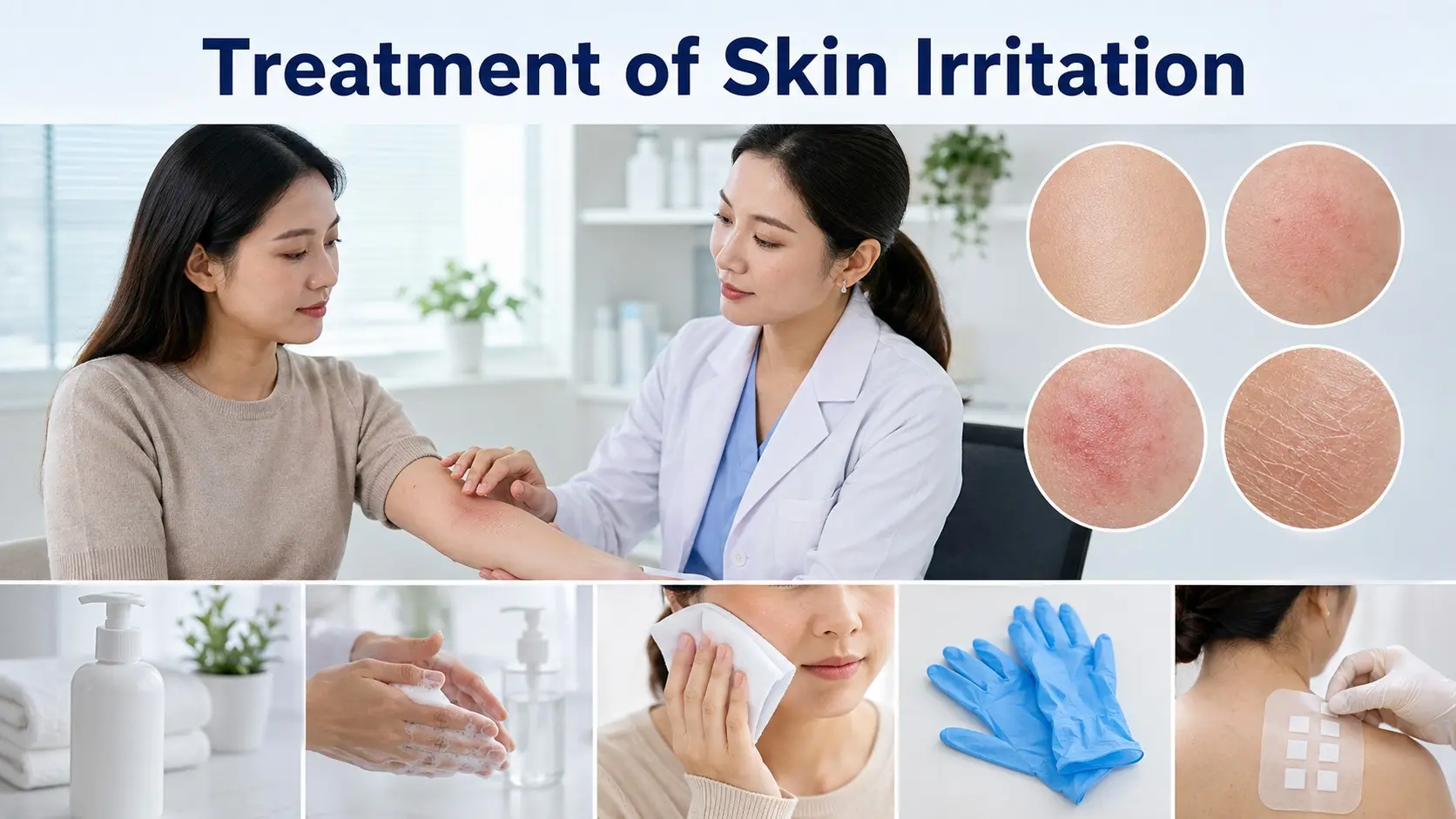
Treatment of skin irritation starts with finding out what is upsetting your skin.
Skin can become red, itchy, dry, rough, swollen, sore, or sensitive for many reasons.
A new skincare product may be the cause.
Soap may be the cause.
Cleaning chemicals may be the cause.
Heat, sweat, shaving, friction, or repeated hand washing may also irritate skin.
Sometimes the problem is contact dermatitis.
Sometimes it is eczema, hives, infection, herpes, heat rash, or another skin condition.
This difference matters.
The correct treatment depends on the cause.
For mild irritation, simple care often works best.
Stop the suspected trigger.
Clean the skin gently.
Apply a simple fragrance-free moisturizer.
Avoid scrubbing.
Give the skin barrier time to recover.
If your skin keeps reacting to normal products, our Healthy Skin 101 guide explains how to build a simple cleanser, moisturizer, and sunscreen routine.
When Skin Irritation Needs Fast Medical Care
Most mild skin irritation is not dangerous.
Some rashes are different.
Get prompt medical help if a rash:
- Spreads quickly
- Covers much of your body
- Forms large blisters
- Causes raw or peeling skin
- Is very painful
- Comes with fever
- Involves your eyes
- Involves your lips or mouth
- Involves genital skin
- Looks infected
Seek emergency care for trouble breathing, trouble swallowing, fainting, or swelling of the tongue, throat, mouth, or face.
What Is the Best Treatment of Skin Irritation?
The best Treatment of Skin Irritation depends on the cause.
For mild irritation, start by removing anything that may have triggered the reaction.
Then keep your routine simple.
- Stop the suspected irritating product.
- Wash the area gently.
- Use lukewarm water.
- Do not scrub.
- Apply a simple fragrance-free moisturizer.
- Use a cool compress if the skin burns or itches.
- Stop strong acids and exfoliating products.
- Avoid scratching.
If your rash keeps returning, the cause may be allergic contact dermatitis.
A dermatologist may recommend patch testing to identify the allergen.
A severe rash, infected, blistering, rapidly spreading, or associated with serious illness needs medical care.
What Is Skin Irritation?
Skin irritation is a broad term.
It is not one diagnosis.
Your skin has an outer protective layer.
This is often called the skin barrier.
It helps hold water inside your skin.
It also helps protect you from chemicals, germs, allergens, and physical damage.
When that barrier becomes damaged, the skin can lose water more easily.
It can also become more sensitive to products and the environment.
What Does a Damaged Skin Barrier Feel Like?
It may feel:
- Dry
- Tight
- Rough
- Itchy
- Burning
- Stinging
- Sore
- More sensitive than usual
If your main problem is dryness and sensitivity rather than a clear rash, see our Healthy Skin 101 guide for simple skin barrier care.
What Are the Symptoms of Skin Irritation?
Skin irritation symptoms can vary.
You may notice:
- Itchy skin
- Burning
- Stinging
- Redness
- Darker color than nearby skin
- Dryness
- Flaking
- Scaling
- Roughness
- Cracks
- Swelling
- Tenderness
- Small bumps
- Blisters in some cases
Does Skin Irritation Always Look Red?
No.
Inflammation can look different on different skin tones.
It may look red, pink, purple, grey, brown, or darker than the surrounding skin.
How the skin feels can be just as useful as its color.
Is Burning Normal?
Mild temporary tingling can happen with some products.
Strong burning is different.
Do not assume strong burning means a treatment is working.
It may mean your skin is becoming irritated.
What Causes Skin Irritation?
Many things can damage or inflame skin.
Common skin irritants include:
- Soap
- Detergent
- Bleach
- Cleaning products
- Hand sanitizer
- Disinfectants
- Fragrance
- Cosmetics
- Hair products
- Frequent washing
- Repeated water exposure
- Very hot water
- Friction
- Shaving
- Sweat
- Cold dry weather
- Retinoids
- Exfoliating acids
- Strong acne treatments
- Some metals
- Plants
- Workplace chemicals
Can Water Irritate Skin?
Yes.
Normal water is not toxic to your skin.
But repeated wet work can damage the barrier.
This is common in people who wash their hands very often.
It can also affect cleaners, healthcare workers, cooks, hair professionals, and other workers.
Can Natural Products Irritate Skin?
Yes.
Natural does not mean harmless.
Plant extracts, essential oils, citrus juice, fragrance, and herbal products can irritate skin.
Some can also cause a skin allergy.
Irritant Contact Dermatitis
Irritant contact dermatitis happens when something directly damages the skin.
It is not an allergy.
Anyone can develop it if exposure is strong enough or happens often enough.
Common Irritants
- Soap
- Detergent
- Bleach
- Solvents
- Cleaning chemicals
- Disinfectants
- Hand sanitizer
- Repeated water exposure
- Friction
What Does Irritant Contact Dermatitis Feel Like?
Burning and stinging may be noticeable.
The skin may become:
- Dry
- Rough
- Cracked
- Inflamed
- Itchy
- Sore
Can It Become Chronic?
Yes.
If the exposure continues, the skin may not have time to heal.
Repeated irritation can lead to thick, cracked, painful skin.
Hand Irritation at Work
Work can be a major source of exposure.
People who often handle water, cleaners, chemicals, food, gloves, oils, or solvents may have a higher risk.
CDC and NIOSH recognize contact dermatitis as an important form of occupational skin disease.
Allergic Contact Dermatitis
Allergic contact dermatitis is different.
It happens when your immune system reacts to an allergen.
You must first become sensitive to that substance.
After this happens, even a small exposure may cause a rash.
Common Contact Allergens
Examples include:
- Nickel
- Fragrance
- Preservatives
- Hair dye ingredients
- Some cosmetics
- Rubber ingredients
- Some topical medicines
- Some plant oils
Can a Reaction Be Delayed?
Yes.
A rash may not appear immediately.
Allergic contact dermatitis can appear hours or days after contact.
This makes the trigger harder to identify.
Can You Suddenly Become Allergic to an Old Product?
Yes.
You may use a product for years without a problem.
Then your immune system may become sensitive to an ingredient.
This is why an old cosmetic cannot always be ruled out as the cause of a new rash.
Skin Irritation, Allergy, Eczema or Infection?
Several skin problems can look alike.
| Possible Cause | Common Clues |
|---|---|
| Irritant contact dermatitis | Burning, stinging, dryness or cracking after soap, cleaning products, water, friction or chemicals |
| Allergic contact dermatitis | Very itchy rash after contact with an allergen such as fragrance, nickel or preservatives |
| Eczema | Dry, itchy, inflamed skin that may come and go over time |
| Hives | Raised itchy welts that may appear and disappear quickly |
| Fungal infection | Persistent rash that may have a distinct edge or scaling |
| Bacterial infection | Increasing warmth, pain, swelling, pus, crusting or fever |
| Herpes simplex | Grouped painful blisters or sores |
| Heat rash | Small bumps after sweating or heat exposure |
| Shaving irritation | Burning, redness or bumps in shaved areas |
If the rash has grouped painful blisters, see our Herpes Skin Rash guide.
If the irritation mainly affects the lips, our Lip Eczema guide</a explains common triggers and treatment options.
Treatment of Skin Irritation: 8 Simple Steps
The following steps can help many mild cases.
They do not replace medical care for a severe or unexplained rash.
1. Stop the Suspected Trigger
This is often the most important part of Treatment of Skin Irritation.
Think about what changed before the problem began.
It may be a new:
- Cleanser
- Serum
- Moisturizer
- Sunscreen
- Makeup product
- Fragrance
- Hair product
- Detergent
- Cleaning product
- Aftershave
- Topical medicine
If several products are new, stop all nonessential products.
Let your skin settle.
2. Rinse Off a Recent Irritant
If a mild irritant has just touched the skin, rinse the area.
Use plenty of clean water.
Do not scrub.
Follow product safety instructions for chemical exposures.
Serious chemical burns need urgent medical advice.
3. Clean the Skin Gently
Use lukewarm water.
Use a mild cleanser if needed.
Apply it with your fingertips.
Do not scrub with a rough cloth or brush.
Pat dry.
4. Moisturize
A simple emollient or moisturizer can help the damaged barrier hold water.
Apply it soon after washing.
Reapply when the skin feels dry.
5. Use a Cool Compress
A cool damp cloth can reduce itching and discomfort.
Do not place ice directly on the skin.
6. Stop Strong Skin Care Ingredients
Pause irritating active ingredients while the skin heals.
These can include:
- Retinoids
- Strong exfoliating acids
- Peels
- Scrubs
- High strength acne products
You can rebuild your routine later.
7. Avoid Scratching
Scratching can damage the barrier further.
It can also raise the risk of infection.
8. Get Help if It Does Not Improve
Persistent skin irritation needs a diagnosis.
Repeatedly trying new creams can make the problem harder to understand.
How Do You Repair an Irritated Skin Barrier?
A damaged skin barrier needs less irritation, not more treatment.
Keep your routine basic.
Simple Skin Barrier Routine
Morning:
- Gentle rinse or cleanser
- Fragrance free moisturizer
- Sunscreen if your skin tolerates it
Evening:
- Gentle cleanser
- Fragrance free moisturizer
What Should You Stop?
For now, avoid:
- Scrubs
- Peels
- Strong acids
- Retinoids if they are irritating you
- Multiple new serums
- Essential oils
- Strong fragrance
Read Healthy Skin 101 for a complete simple routine once the irritation improves.
What Is the Best Moisturizer for Irritated Skin?
There is no single best brand.
Simple formulas are often easier for irritated skin.
Look for a fragrance free moisturizer.
A cream or ointment can be useful when skin is very dry.
A lighter lotion may feel better on some areas.
Useful Moisturizer Ingredients
Depending on the formula, useful ingredients may include:
- Ceramides
- Glycerin
- Petrolatum
- Dimethicone
- Hyaluronic acid
You do not need all of them.
What matters is finding a product your skin can tolerate.
Does Hypoallergenic Mean Allergy-Free?
No.
FDA notes that cosmetic allergy claims can be difficult to interpret.
A product can still cause a reaction in a sensitive person.
Read the ingredient list when you know your allergen.
Can a Cool Compress Help Skin Irritation?
Yes.
A cool compress may reduce:
- Itching
- Burning
- Warmth
- Discomfort
Wet a clean soft cloth with cool water.
Place it gently on the irritated area.
Do not rub.
Do not place frozen ice directly on your skin.
Can Hydrocortisone Help Skin Irritation?
Hydrocortisone may help some mild inflammatory rashes.
Low strength hydrocortisone is available without prescription in some countries.
Follow the product directions.
Do not use more than recommended.
When Should You Ask a Professional First?
Talk with a doctor or pharmacist before using steroid cream when:
- The diagnosis is unclear
- The rash is close to your eyes
- The rash is on your eyelids
- The rash is on genital skin
- The skin looks infected
- The skin is badly broken
- You think the rash may be fungal
- You think the rash may be herpes
- The person is a young child
- You are unsure about use during pregnancy or breastfeeding
Why Not Put Steroid Cream on Every Rash?
Different skin conditions need different treatment.
A topical steroid can hide or worsen some infections.
Some body areas are also more sensitive to steroid side effects.
Use it for the right reason.
What Helps Itchy Irritated Skin?
Itchy skin can be hard to ignore.
Try:
- Cool compresses
- Moisturizer
- Loose soft clothing
- A cool oatmeal bath for some widespread itchy rashes
- Calamine for some itchy or oozing reactions
A pharmacist can advise whether an antihistamine may help your symptoms.
Do Antihistamines Treat Contact Dermatitis?
They do not remove the cause.
They may help some people with itching or other allergic symptoms.
Some antihistamines can make you sleepy.
Ask a pharmacist if you take other medicines.
Treatment of Skin Irritation on the Face
Facial skin can react quickly to products.
The best first step is often to simplify your routine.
Stop New Products
Pause anything you started shortly before the irritation.
This may include:
- Retinol
- Vitamin C serum
- Acids
- Peels
- New sunscreen
- Makeup
- Fragrance
Use a Simple Routine
Use a gentle cleanser.
Use a plain moisturizer.
Use sun protection that does not sting.
Do not exfoliate irritated facial skin.
What if the Rash Is Around Your Eyes?
Eyelid skin is thin.
A reaction around the eyes may come from:
- Eye makeup
- Skin care
- Fragrance
- Hair products
- Nail products transferred by your fingers
- Metal in glasses
Repeated eyelid dermatitis is a good reason to ask about professional patch testing.
Treatment of Skin Irritation on the Lips
Lip irritation can cause dryness, cracking, burning, scaling, and itching.
Possible triggers include:
- Lip products
- Toothpaste
- Flavoring
- Fragrance
- Saliva
- Weather
- Allergic contact dermatitis
- Eczema
Do not assume every irritated lip is simply dry.
Our Lip Eczema guide explains how eczema, contact allergy, irritants, and infection can differ.
Treatment of Skin Irritation on the Hands
Hands are exposed to many irritants every day.
Soap and water are common causes.
Cleaning chemicals can add more damage.
Simple Hand Care
- Wash only when needed
- Use lukewarm water
- Use a gentle cleanser
- Dry your hands carefully
- Apply moisturizer after washing
- Wear suitable protective gloves for wet work
- Change wet gloves
Can Gloves Cause a Rash?
Yes.
Sweat trapped inside gloves can irritate skin.
Some people also react to materials or chemicals used in gloves.
If hand dermatitis keeps returning at work, ask about occupational skin assessment.
Treatment of Skin Irritation After Shaving
Shaving can cause friction.
It can also irritate hair follicles.
Give irritated skin time to settle.
Reduce Shaving Irritation
- Use warm water before shaving
- Use a gentle shaving product
- Use a clean sharp razor
- Shave in the direction of hair growth
- Do not press hard
- Moisturize afterward
- Avoid strongly fragranced aftershave if it burns
If bumps contain pus or keep returning, you may have folliculitis or ingrown hairs rather than simple irritation.
What Should You Do if a Skin Care Product Causes Irritation?
Stop using it.
Do not try to force your skin to adapt to severe burning.
Use a Skin Care Reset
For several days, use only the basics.
- Gentle cleanser
- Fragrance-free moisturizer
- Sunscreen if tolerated
Wait until your skin feels normal.
Then add one product at a time.
Keep a Product List
Write down:
- Skin care products
- Makeup
- Hair products
- Nail products
- Fragrance
- Detergent
- Topical medicine
This can help you find a pattern.
Can Cosmetics Cause Allergic Contact Dermatitis?
Yes.
The FDA lists fragrance, preservatives, dyes, metals, and natural rubber among important groups of cosmetic allergens.
A reaction may cause itching, rash, flaking, swelling, or other symptoms.
What Is Patch Testing?
Patch testing can help diagnose allergic contact dermatitis.
It is not the same as a skin prick allergy test.
A clinician places small amounts of allergens on your skin.
The allergens remain under patches for a set period.
Your skin is checked later for reactions.
When Can Patch Testing Help?
It may be useful when:
- The rash keeps coming back
- The cause is unclear
- Your hands stay inflamed
- Your eyelids keep reacting
- Your face repeatedly reacts to cosmetics
- You may have a workplace allergy
- You react to many products
Can You Do the Same Test at Home?
No.
Trying a cosmetic on a small area can sometimes reveal obvious irritation.
It cannot replace formal medical patch testing.
Can Irritated Skin Become Infected?
Yes.
Cracked or scratched skin is easier for germs to enter.
Signs of Skin Infection
Look for:
- Increasing pain
- Increasing warmth
- Swelling
- Pus
- Yellow or golden crust
- Bad smell
- Spreading redness or darker discoloration
- Fever
- Feeling very unwell
Do not rely on moisturizer alone if you think the skin is infected.
Get medical care.
What About Painful Blisters?
Painful grouped blisters can have causes other than dermatitis.
Herpes simplex is one example.
Read our Herpes Skin Rash guide if you have grouped painful blisters or recurring sores.
For herpes near the nostril, see our Cold Sores in Nose guide.
How Can You Prevent Skin Irritation?
Prevention depends on your trigger.
Use Fewer Products
A complicated routine gives your skin more things to react to.
Simple skin care can be enough.
Add One Product at a Time
If a reaction appears, it is easier to identify the cause.
Avoid Known Allergens
Once an allergy is confirmed, learn the ingredient names.
Check product labels.
Your dermatologist may give you a safe product list.
Protect Your Hands
Use suitable gloves for cleaning or chemical work.
Not every glove blocks every chemical.
Follow workplace safety instructions.
Moisturize After Washing
This can help support the skin barrier.
Use Fragrance-Free Products When Fragrance Is a Problem
Fragrance is a common source of cosmetic allergy.
Check ingredient lists when you know you are sensitive.
Avoid Harsh DIY Remedies
Do not put these on irritated skin:
- Lemon juice
- Baking soda
- Toothpaste
- Household bleach
- Strong alcohol
- Undiluted essential oils
- Salt scrubs
- Sugar scrubs
They can increase irritation.
Common Treatment of Skin Irritation Mistakes
Using More Products
An irritated skin barrier usually needs a simpler routine.
Adding five soothing products can expose the skin to five new triggers.
Scrubbing the Rash
Scrubbing does not remove inflammation.
It can make the barrier weaker.
Using Essential Oils
Essential oils can irritate skin.
They can also cause allergic contact dermatitis.
Putting Steroid Cream on Every Rash
A steroid is not the correct treatment for every skin condition.
Ignoring an Infection
Increasing pain, warmth, swelling, pus, crusting, or fever needs medical assessment.
Continuing a Product That Burns
Strong ongoing burning is not a goal.
Stop the product and let the skin recover.
Changing Several Products at Once
This makes it difficult to identify what caused the reaction.
When Should You See a Doctor for Skin Irritation?
Arrange medical care if:
- The rash keeps returning
- The cause is unclear
- The rash is severe
- It is very painful
- It affects sleep
- It affects work or daily life
- It does not improve with simple care
- Your eyelids repeatedly become inflamed
- You think you have a cosmetic allergy
- You have signs of infection
When Should You See a Dermatologist?
A dermatologist can help when the diagnosis is unclear.
They can also help identify allergens.
Formal patch testing may be useful for persistent or recurrent contact dermatitis.
When Does a Rash Need Prompt Care?
Get medical attention for a rash that:
- Spreads rapidly
- Covers most of your body
- Blisters widely
- Creates open or raw skin
- Is very painful
- Comes with fever
- Involves the eyes
- Involves the lips or mouth
- Involves genital skin
When Is a Skin Reaction an Emergency?
Seek emergency medical care for:
- Trouble breathing
- Trouble swallowing
- Swelling of the tongue
- Swelling of the throat
- Severe facial swelling
- Loss of consciousness
- Severe faintness with an allergic reaction
Quick Answers About Treatment of Skin Irritation
What can calm irritated skin quickly?
Remove the trigger.
Use gentle cleansing.
Apply moisturizer.
A cool compress may reduce burning and itching.
What should I stop using when my skin is irritated?
Pause new products, scrubs, peels, strong acids, irritating retinoids, essential oils, and anything that causes burning.
How do I repair my skin barrier?
Wash gently.
Use a fragrance-free moisturizer.
Avoid strong active ingredients until the skin becomes comfortable again.
Can skin irritation heal on its own?
Mild irritation may improve when the trigger is removed.
Persistent, severe, or recurrent irritation needs assessment.
Why does my skin keep getting irritated?
You may still be exposed to an irritant or allergen.
You may also have eczema or another skin condition.
Patch testing can help in some recurrent cases.
References and Sources
The health information in this guide was checked against these open and trusted medical, dermatology, occupational health, and consumer safety sources.
- American Academy of Dermatology: Contact Dermatitis Diagnosis and TreatmentDermatologist guidance on finding and avoiding triggers, treating contact dermatitis, cool compresses, patch testing, and professional treatment.
- MedlinePlus: Contact DermatitisNational Library of Medicine guidance on irritant and allergic contact dermatitis, avoiding triggers, moisturizers, topical treatment, and diagnosis.
- NHS: Contact DermatitisOpen medical guidance on contact dermatitis symptoms, common causes, emollients, topical treatment, trigger avoidance, and when to seek care.
- Centers for Disease Control and Prevention and NIOSH: Skin Exposures and EffectsOccupational health guidance on skin exposure, irritant contact dermatitis, allergic contact dermatitis, workplace chemicals, and skin protection.
- United States Food and Drug Administration: Allergens in CosmeticsConsumer safety information on cosmetic allergies, fragrance, preservatives, dyes, metals, natural rubber, product labels, reactions, and patch testing.
Conclusion
Treatment of Skin Irritation works best when you find the cause instead of treating redness alone.
Stop likely triggers.
Clean your skin gently.
Use a simple fragrance-free moisturizer.
Protect your skin barrier.
Avoid scrubbing.
Pause products that burn.
If irritation keeps returning, ask whether allergic contact dermatitis or another skin condition may be responsible.
A dermatologist can sometimes use patch testing to identify hidden allergens.
Do not keep treating severe, blistering, painful, spreading, or infected skin at home.
Take action today: Remove one possible trigger and simplify your routine. If your Treatment of Skin Irritation is not helping, or the rash keeps returning, arrange an assessment with a qualified healthcare professional.
Continue Reading on NextFitLife
Use these related guides to understand skin irritation and conditions that can look similar.
- NextFitLife Health Hub
- Skin Health Guide
- Healthy Skin 101
- Lip Eczema Guide
- Herpes Skin Rash Guide
- Cold Sores in Nose Guide
Main Health Hub: Return to the NextFitLife Health Hub for symptoms, prevention, medical conditions, testing, nutrition, and healthy living.
Skin Health Sub Hub: Use the Skin Health Guide for sensitive skin, eczema, acne, skin barrier health, sun protection, rashes, and warning signs.
Simple Skin Care: Read Healthy Skin 101 for a simple cleanser, moisturizer, and sunscreen routine.
Lip Irritation: Read the Lip Eczema Guide if dryness, burning, itching, or scaling mainly affects your lips.
Painful Blisters: Use our Herpes Skin Rash Guide when painful grouped blisters may be involved.
Medical Disclaimer
I am not a dermatologist or a doctor, and this content does not replace professional medical advice.
This article explains published guidance and does not provide a personal clinical assessment.
Always consult qualified medical professionals for diagnosis and treatment of any health condition.
I am also not an allergy specialist, pharmacist, infectious disease specialist, occupational medicine specialist, pediatrician, or other licensed healthcare professional.
This article provides general education only.
It does not diagnose contact dermatitis, eczema, allergy, fungal infection, bacterial infection, herpes, psoriasis, rosacea, or another skin condition.
It does not prescribe steroid treatment.
It does not tell you which steroid strength is safe for a specific area of your body.
Age, pregnancy, breastfeeding, allergies, medicines, and medical conditions can change which treatments are safe.
Frequently Asked Questions About Treatment of Skin Irritation
What is the best Treatment of Skin Irritation?
The best treatment depends on the cause. Mild irritation may improve when you remove the trigger, wash gently, apply a fragrance-free moisturizer, and avoid irritating products.
What causes skin irritation?
Common causes include soap, detergents, cleaning products, fragrance, cosmetics, repeated water exposure, friction, shaving, sweat, weather, retinoids, acids, and allergens.
What is irritant contact dermatitis?
Irritant contact dermatitis happens when a substance or repeated exposure directly damages the skin barrier. It is not an allergy.
What is allergic contact dermatitis?
Allergic contact dermatitis is an immune reaction to something that touches your skin, such as fragrance, nickel, preservatives, or another allergen.
How can I tell skin irritation from an allergy?
The conditions can look similar. Irritant dermatitis often burns or stings. Allergic dermatitis is often very itchy and may appear hours or days after exposure. A dermatologist can help identify the cause.
Can I suddenly become allergic to a product I have used for years?
Yes. A person can become sensitized after repeated exposure and later develop allergic contact dermatitis.
What is the fastest way to calm irritated skin?
Stop the likely trigger, wash gently, use a simple fragrance free moisturizer, and apply a cool compress. Avoid scrubs and strong active ingredients.
Is moisturizer good for irritated skin?
Yes. Moisturizer can help the skin hold water and support repair of the damaged skin barrier.
What moisturizer is best for sensitive irritated skin?
A simple fragrance-free cream or ointment is often a useful starting point. Choose a product that your own skin tolerates.
Can hydrocortisone help irritated skin?
Low-strength hydrocortisone can help some inflammatory rashes. It is not appropriate for every rash or body area, so follow product directions and ask a healthcare professional when unsure.
Can I put hydrocortisone on my face?
Facial skin is sensitive to steroid side effects. Ask a doctor or pharmacist before using steroid treatment on the face, eyelids, or around the mouth.
Can a cool compress help a skin rash?
Yes. A cool damp cloth may reduce itching, burning, warmth, and discomfort in some mild irritated rashes.
Should I exfoliate irritated skin?
No. Scrubs and strong exfoliating acids can further damage an irritated skin barrier.
Can retinol cause skin irritation?
Yes. Retinoids can cause dryness, redness, burning, peeling, and sensitivity, especially when used too often or combined with other strong products.
Can vitamin C irritate sensitive skin?
Yes. Some vitamin C products can sting or irritate sensitive skin depending on the formula and concentration.
Can essential oils irritate skin?
Yes. Essential oils can cause irritation and allergic contact dermatitis in some people.
Does natural mean safe for sensitive skin?
No. Natural ingredients can still irritate the skin or cause an allergy.
What is patch testing?
Patch testing is a professional test used to identify substances that may cause allergic contact dermatitis.
When should I get patch testing?
Patch testing may help when dermatitis keeps returning, the trigger is unclear, or the face, eyelids, hands, or other areas repeatedly react to products or workplace exposures.
Can irritated skin become infected?
Yes. Scratching, cracks, and damaged skin can make it easier for germs to enter.
How can I tell if irritated skin is infected?
Possible signs include increasing pain, warmth, swelling, pus, yellow crusting, bad smell, spreading discoloration, fever, or feeling unwell.
How long does skin irritation take to heal?
Mild irritation may start improving after the trigger is removed. More severe or repeated dermatitis can take longer. A rash that does not improve should be assessed.
Why does my skin irritation keep coming back?
You may still be exposed to the trigger. You may also have an allergy, eczema, or another skin condition that needs diagnosis.
When should I see a dermatologist?
See a dermatologist or doctor if the rash is severe, painful, recurrent, infected, difficult to explain, or not improving with simple care.
When is skin irritation an emergency?
Seek emergency care for trouble breathing, trouble swallowing, severe facial or throat swelling, fainting, or another severe allergic reaction. Widespread blistering or peeling skin also needs urgent medical assessment.

Health & wellness writer with 30+ years of experience in nutrition, fitness, and healthy aging. Founder of NextFitLife.com — evidence-based health guidance.