
Updated on: October 15, 2026
Written and source checked by: Adel Galal, Founder and Lead Writer at NextFitLife
Medical review status: This article has not been medically reviewed by a dermatologist, infectious disease specialist, pharmacist, or other licensed healthcare professional.
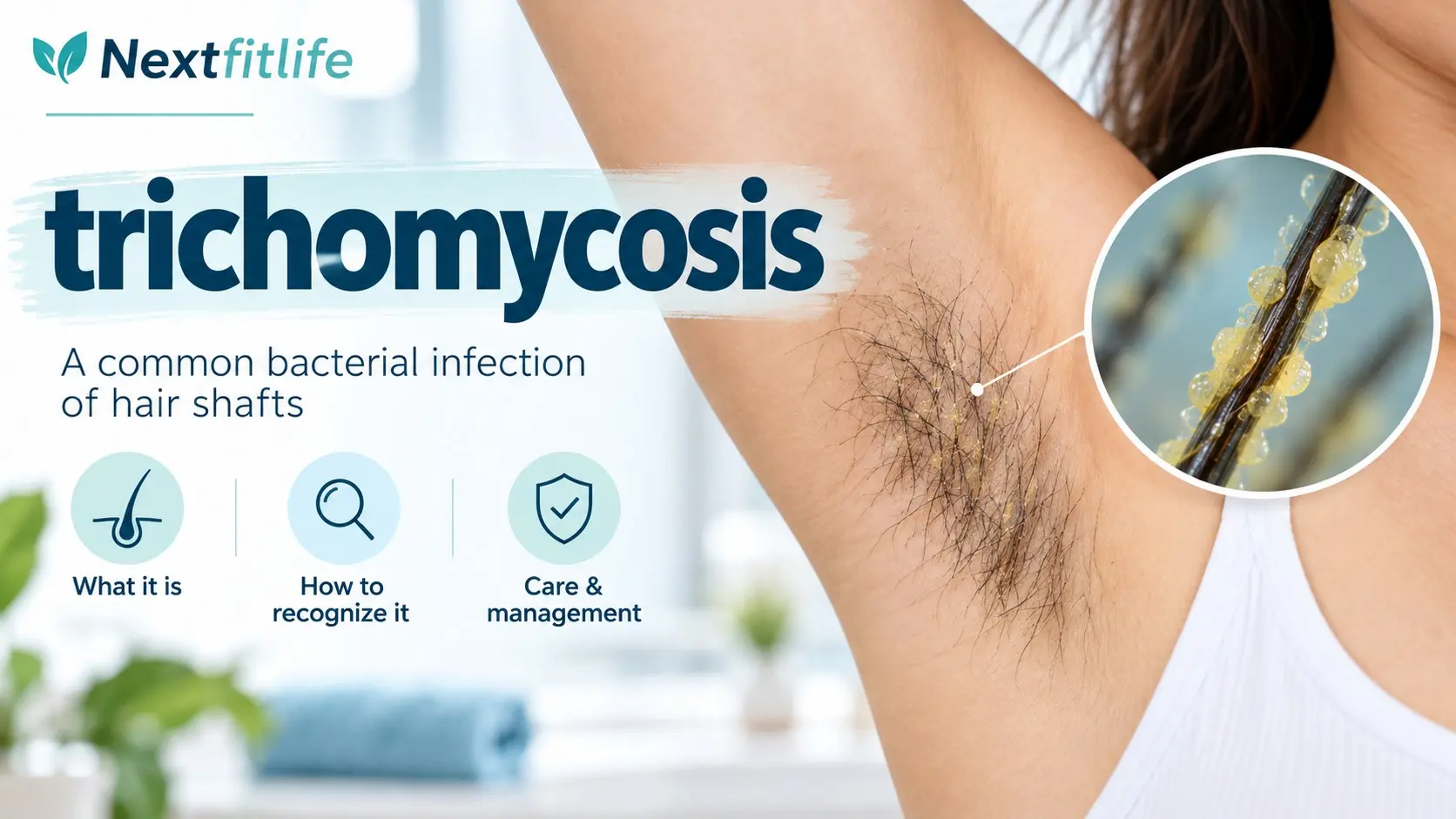
Trichomycosis sounds like a fungal infection, but that name is misleading. It is usually a superficial bacterial hair shaft infection caused by Corynebacterium species, most often affecting underarm hair.
The usual clues are yellow, white, red, or black deposits stuck around the hair shaft, unusual body odor, and heavy sweating. The condition is usually harmless and responds well to shaving or clipping the affected hair, keeping the area dry, and using suitable antibacterial treatment when needed.
This article is for general information and education. It does not replace medical advice, diagnosis, or treatment.
If you want a wider guide to maintaining comfortable skin and spotting conditions that need professional care, visit the NextFitLife Skin Health Hub.
Table of Contents
- What trichomycosis really is
- Why the name is misleading
- Which bacteria cause it
- 9 clear signs
- Yellow concretions
- Hair shaft coating
- Body odor
- Heavy sweating
- Sticky hair
- Color changes
- Clothing stains
- Rare hair breakage
- Little or no skin pain
- Where it occurs
- Main risk factors
- How it differs from fungal infection and lice
- How it is diagnosed
- Effective treatment
- What home care helps
- How to prevent recurrence
- Related bacterial skin conditions
- When to see a dermatologist
- Frequently asked questions
What Is Trichomycosis?
Trichomycosis axillaris is a superficial infection of the hair shaft.
The name is old and confusing because “mycosis” suggests fungus. Modern dermatology literature makes clear that this condition is bacterial, so the term trichobacteriosis is more accurate.
The bacteria form sticky deposits, called concretions, around the outside of the hair shaft.
Underarm hair is affected most often.
Pubic hair and nearby body hair can be affected less often.
The scalp is not the usual location, and scalp fungal infections are a different problem.
What Causes Trichomycosis?
The condition is mainly linked with Corynebacterium species.
DermNet lists Corynebacterium tenuis, Corynebacterium propinquum, Corynebacterium flavescens, and sometimes Serratia marcescens among organisms associated with the condition.
The bacteria grow well where there is:
- Warmth
- Moisture
- Hair
- Sweat
- Limited airflow
That explains why the underarm is such a common site.
9 Clear Signs of Trichomycosis
1. Yellow or White Material Around the Hair
The most typical sign is a sticky material wrapped around the hair shaft.
It can look yellow, cream, or white.
These deposits are not dandruff. They cling to the hair rather than falling off easily.
2. Hair That Looks Beaded or Coated
The affected hairs can look thicker than normal.
You may see small nodules or a sleeve like coating around the hair.
This is one of the most useful clues because the bacteria live on the hair shaft itself.
3. Strong Underarm Odor
Bromhidrosis, or strong body odor, is common.
Bacteria break down sweat components into compounds that smell unpleasant.
DermNet specifically notes malodor as a common feature.
4. Heavy Sweating
Hyperhidrosis, meaning excessive sweating, is strongly associated with trichomycosis.
More sweat keeps the hair moist for longer, which creates a better environment for bacteria.
5. Sticky or Rough Hair Texture
The hair may feel coated, rough, or sticky rather than smooth.
In published case series, texture change is a common complaint.
6. Yellow, Red, or Black Color Changes
Yellow concretions are by far the most common.
Red or black variants are much less common and have been reported more often in tropical climates.
7. Colored Sweat or Clothing Stains
Some people notice yellow, red, or dark staining on clothing around the affected area.
This can happen when colored bacterial deposits mix with sweat.
8. Rare Hair Weakness or Breakage
Hair damage is unusual, but severe bacterial coating can sometimes weaken the shaft.
DermNet notes that hair loss is rare.
9. Very Little Pain or Itching
This is one reason the condition gets missed.
Many people have no pain at all.
A 2023 review found that some patients were completely asymptomatic, while others mainly noticed odor, sweating, or changes in hair texture.
Where Does Trichomycosis Occur?
The underarms are the main site.
Recent reviews report that around 90% of documented cases involve axillary hair.
Other less common areas include:
- Pubic hair
- Scrotal hair
- Perianal hair
- Other coarse body hair
If the scalp is your main problem, do not assume this diagnosis.
Scalp fungal infections, dandruff, psoriasis, hair casts, and lice are different conditions.
Who Is More Likely to Get Trichomycosis?
Anyone can develop it, but several factors make bacterial growth easier.
Heavy Sweating
Hyperhidrosis creates the moist environment the bacteria prefer.
Hot and Humid Weather
The condition appears more often in warm climates and during hot seasons.
Dense Underarm Hair
The bacteria attach to hair shafts, so more hair gives them more surface area.
This also helps explain why the condition is reported more often in men in published studies.
Obesity
Skin folds can stay warmer and more moist.
DermNet lists obesity among contributing factors.
Poor Moisture Control
Clothing that traps sweat, not drying the skin well, or staying in wet clothes for long periods can support bacterial growth.
Limited Hygiene
Poor hygiene can contribute, but it is too simplistic to say trichomycosis means someone is dirty.
People who shower regularly can still develop it if sweating and moisture are persistent.
Is Trichomycosis a Fungus?
No.
This is the most important correction to the older version of this article.
Trichomycosis is bacterial, not fungal.
The name survived from older medical terminology, but current literature supports the term trichobacteriosis.
This distinction matters because antifungal creams may fail when the true problem is bacterial.
A 2024 case report described a patient who did not improve with an antifungal cream but cleared after bacterial treatment.
Trichomycosis vs Fungal Hair Infection vs Lice
| Condition | Main Cause | Typical Clue |
|---|---|---|
| Trichomycosis | Bacteria | Sticky yellow or white concretions around underarm hair |
| White piedra | Fungus | Soft white fungal nodules on hair |
| Head or pubic lice | Parasite | Nits attached to hair plus itching and possible visible lice |
| Hair casts | Keratin sleeves | White tubes that can slide along the hair shaft |
| Contact dermatitis | Irritation or allergy | Red, itchy or burning skin rather than bacterial concretions on hair |
A 2019 review of pseudonits describes trichobacteriosis as sticky, yellowish or whitish aggregates surrounding axillary or pubic hair shafts, helping distinguish it from true lice eggs and other hair shaft material.
Is Trichomycosis Contagious?
It is not considered highly contagious in the way ringworm, scabies, or lice can be.
The bacteria involved can normally live on human skin.
The condition develops when local conditions allow them to overgrow on the hair shaft.
Good hygiene and keeping the area dry remain useful, but there is usually no need to isolate from family members.
How Is Trichomycosis Diagnosed?
A dermatologist can often recognize the condition from its appearance.
DermNet notes that diagnosis is usually clinical.
Visual Examination
The clinician looks for concretions attached to hair shafts.
Wood Lamp
A Wood lamp can help show fluorescence from affected hairs.
Published reports describe pale, white, or yellow fluorescence depending on the case and organism.
Dermoscopy
Dermoscopy can magnify the hair and show yellow or white sleeve like deposits.
Microscopy or Gram Stain
A sample can show bacteria attached to the hair.
Bacterial Culture
Culture may be useful when the appearance is unusual or treatment has failed.
Fungal testing can also help if a fungal hair infection is part of the differential diagnosis.
What Is the Best Treatment for Trichomycosis?
Treatment is usually simple because the bacteria sit mainly on the hair shaft.
| Treatment Step | What It Does | When It Helps |
|---|---|---|
| Shaving or clipping | Removes the colonized hair shaft | Often the fastest first step |
| Topical antibacterial treatment | Reduces Corynebacterium | Persistent or confirmed infection |
| Benzoyl peroxide wash or gel | Reduces bacterial colonization | Treatment or recurrence control when suitable |
| Antiperspirant | Reduces sweat and moisture | People with heavy sweating or repeated infection |
| Moisture control | Makes the area less favorable for bacteria | Everyone |
Why Shaving Works So Well
The infection sits around the hair shaft.
Removing that hair physically removes much of the bacterial coating.
DermNet describes clipping or shaving as the fastest way to clear trichomycosis.
Shaving alone may be enough in very mild cases, especially when sweat and moisture are controlled afterward.
If you shave, avoid doing it over broken, inflamed, or infected skin.
Which Antibiotics Are Used?
Dermatology sources describe topical antibiotics such as:
- Clindamycin
- Erythromycin
- Fusidic acid where available
A 2024 peer reviewed case resolved after topical clindamycin treatment.
Do not use leftover prescription antibiotics or another person's medication.
A clinician should decide whether an antibiotic is needed, especially if the diagnosis is not clear.
Does Benzoyl Peroxide Help?
It can.
DermNet lists benzoyl peroxide as one option to reduce bacterial colonization and help prevent recurrence.
It can also irritate sensitive skin and bleach towels or clothing.
Start carefully and follow product or clinician instructions.
Do You Need Antifungal Cream?
Usually not if the diagnosis is true trichomycosis.
This is a bacterial infection.
A fungal medicine makes more sense only when the diagnosis is actually fungal or uncertain.
In a 2024 case report, prior antifungal treatment failed before trichobacteriosis was correctly diagnosed.
That is why correct diagnosis comes before treatment.
Can Soap Alone Cure It?
Regular washing helps reduce sweat, odor, and bacterial buildup.
But washing alone may not remove mature concretions stuck around the hair shafts.
Clipping or shaving plus moisture control is usually more effective.
Do not scrub hard enough to irritate the skin.
What Should You Avoid?
Do Not Treat It Like Ringworm
Trichomycosis is not ringworm.
Using antifungal creams without confirming the diagnosis can waste time.
Do Not Scrub Aggressively
Hard scrubbing can damage the underarm skin without removing the bacterial problem effectively.
Do Not Apply Harsh Household Chemicals
Bleach, vinegar, undiluted essential oils, alcohol, and strong disinfectants can irritate or burn skin.
Do Not Hide Persistent Odor With Fragrance Alone
Deodorant can cover smell, but it does not remove bacterial concretions.
Treat the underlying problem.
How Can You Keep the Area Dry?
Moisture control is a major part of both treatment and prevention.
Useful steps include:
- Dry the underarms well after washing
- Change sweat soaked clothing promptly
- Wear breathable clothing
- Use an appropriate antiperspirant if needed
- Address persistent excessive sweating
DermNet specifically notes that aluminum chloride antiperspirants can reduce sweating and help prevent recurrence.
What If You Sweat Excessively?
If you soak shirts frequently even when it is not hot or when you are not exercising, you may have hyperhidrosis.
Heavy sweating can make trichomycosis come back because the underarm stays moist.
A dermatologist can discuss stronger antiperspirants and other sweat control options if normal products are not enough.
How Long Does Trichomycosis Take to Clear?
Many cases improve quickly once affected hair is removed and the bacteria are treated.
Published cases have cleared within one to two weeks with topical antibacterial treatment, but the exact timeline varies.
Recurrence can happen if heavy sweating and moisture continue.
Do not assume one exact treatment time fits everyone.
Can Trichomycosis Come Back?
Yes.
The bacteria can recolonize new hair if the local environment stays warm and wet.
Recurrence prevention focuses on controlling the conditions that support bacterial growth.
- Wash the area regularly.
- Dry it fully.
- Clip or shave affected hair if recurrence is frequent.
- Control excessive sweating.
- Change damp clothing quickly.
- Use breathable fabrics.
- Use antibacterial or benzoyl peroxide products only when appropriate.
What Is the Corynebacterial Triad?
This is a useful detail that many articles leave out.
Trichomycosis can sometimes occur alongside two other superficial bacterial conditions:
- Erythrasma
- Pitted keratolysis
Together, these three conditions are sometimes called the corynebacterial triad. DermNet and clinical literature both describe this association.
What is erythrasma?
Erythrasma causes brownish or reddish patches in warm skin folds such as the groin or underarms.
It is also linked with Corynebacterium.
What is pitted keratolysis?
Pitted keratolysis causes small pits on the soles of the feet, often with strong foot odor.
It is common in people whose feet stay sweaty for long periods.
If you have underarm concretions plus groin patches or smelly pitted feet, mention all three symptoms to your dermatologist.
Can Trichomycosis Affect Pubic Hair?
Yes.
Pubic involvement is less common than underarm disease, but it can occur.
Because pubic hair nodules can also be confused with lice or fungal hair infection, self diagnosis is less reliable in this location.
If you see deposits attached to pubic hair, especially with itching or visible insects, get the diagnosis confirmed.
Can It Affect the Scalp?
Scalp involvement has been reported but is uncommon.
Most scalp hair problems that look similar are caused by something else.
If the scalp is flaky, itchy, patchy, or losing hair, a fungal infection, seborrheic dermatitis, psoriasis, lice, hair casts, or another scalp condition may be more likely.
Do not use underarm trichomycosis treatment automatically on the scalp.
Does Trichomycosis Cause Hair Loss?
Usually not.
The condition mainly coats the outside of the hair shaft.
DermNet notes that hair loss is rare and may happen only when bacteria damage the shaft.
Significant underarm hair loss, scarring, pain, lumps, or drainage should make you think beyond uncomplicated trichomycosis.
Can Trichomycosis Cause Hidradenitis Suppurativa?
No evidence shows that trichomycosis itself causes hidradenitis suppurativa.
These are different conditions.
Hidradenitis causes painful recurring lumps, abscesses, tunnels, and scarring, usually in areas such as the underarms and groin.
Trichomycosis coats hair shafts and is usually painless.
If you have painful underarm lumps rather than hair shaft concretions, seek a dermatologist's assessment.
When Should You See a Dermatologist?
Most mild cases are not dangerous.
Still, professional assessment makes sense when:
- You are not sure what is coating the hair
- The condition does not improve after clipping or shaving
- It keeps returning
- You have severe sweating
- The skin is painful or very inflamed
- You have pus, drainage, or abscesses
- You are losing hair
- Pubic hair is affected and lice are possible
- You also have groin patches or pitted, smelly feet
- An antifungal treatment has failed
A dermatologist can tell whether the problem is bacterial, fungal, parasitic, inflammatory, or something else.
Conclusion: Treat the Bacteria, Not a Fungus
The biggest lesson about trichomycosis is simple: despite its name, it is usually a bacterial condition of the hair shaft.
If you see yellow or white concretions around underarm hair, especially with heavy sweating or odor, start by keeping the area clean and dry and consider clipping or shaving the affected hair.
If it does not clear, keeps returning, or the diagnosis is uncertain, see a dermatologist. Using the right treatment from the start is better than cycling through antifungal creams for a condition that is not fungal.
References and Sources
- DermNet. Trichomycosis Axillaris.
Covers Corynebacterium causes, yellow concretions, bromhidrosis, diagnosis, shaving, topical antibacterial treatment, antiperspirants, and recurrence prevention.
https://dermnetnz.org/topics/trichomycosis-axillaris - Bian K, Ma Y, Hu W. Trichomycosis Axillaris. CMAJ. 2024.
Open access peer reviewed clinical report confirming Corynebacterium infection, Wood lamp findings, fungal culture negativity, and successful topical antibacterial treatment.
https://pmc.ncbi.nlm.nih.gov/articles/PMC11482653/ - Montes de Oca Loyola ML and colleagues. An Overview of Trichobacteriosis: An Underdiagnosed Disease.
Open access review covering 365 reported patients, common locations, odor, hyperhidrosis, hair changes, and bacterial causes.
https://pmc.ncbi.nlm.nih.gov/articles/PMC10600505/ - Bonifaz A and colleagues. Trichomycosis: Clinical and Microbiological Experience With 56 Cases.
Open access clinical series describing axillary involvement, hyperhidrosis, bacterial concretions, and treatment outcomes.
https://pmc.ncbi.nlm.nih.gov/articles/PMC3746219/ - Liñán Barroso JM, Sánchez Rodríguez N. Trichomycosis Axillaris: An Underdiagnosed Hair Shaft Condition.
Open access dermatology report showing characteristic dermoscopy, negative fungal culture, and response to topical clindamycin.
https://pmc.ncbi.nlm.nih.gov/articles/PMC11135939/ - Trichoscopy in the Differential Diagnosis of Pseudonits.
Open access review comparing bacterial concretions with lice eggs, hair casts, psoriasis, seborrheic dermatitis, and other hair shaft findings.
https://pmc.ncbi.nlm.nih.gov/articles/PMC6489062/
Internal Links and Helpful NextFitLife Guides
- Skin Health: Complete Guide to Healthy Skin
- Healthy Skin 101: 10 Simple Daily Habits
- Damaged Skin Barrier: Signs and Recovery
- Skin Care Tips for Healthier Skin
About the Author
Adel Galal is the Founder and Lead Writer at NextFitLife. He researches health, fitness, dermatology topics, hygiene, nutrition, wellness, and healthy aging and turns current medical guidance into clear information for everyday readers.
I am not a dermatologist or a doctor, and this content does not replace professional medical advice. What I share comes from real life experience, extensive research, and consultation with healthcare providers. Always consult qualified medical professionals for diagnosis and treatment of any health condition.
Learn more about Adel, the NextFitLife editorial approach, and how health information is researched on the About Us page.
Frequently Asked Questions
Is trichomycosis a fungal infection?
No. Despite its name, trichomycosis is usually a superficial bacterial infection of the hair shaft caused mainly by Corynebacterium species. Trichobacteriosis is the more accurate term.
What does trichomycosis look like?
It usually causes yellow, white, red, or black concretions wrapped around hair shafts. The affected hair may look thicker, rough, sticky, or beaded.
Where does trichomycosis usually occur?
The underarms are the most common site. Pubic, scrotal, or perianal hair can be involved less often.
Does trichomycosis smell?
Yes. Many people notice stronger body odor because bacteria break down components of sweat into odor producing compounds.
Is trichomycosis contagious?
It is not considered highly contagious. The bacteria involved can normally live on human skin, and the condition develops when moisture, sweat, and hair allow bacterial overgrowth.
How do you get rid of trichomycosis?
Shaving or clipping the affected hair is often the fastest first step. Keeping the area dry and using topical antibacterial treatment such as clindamycin or other clinician recommended products can help persistent cases.
Does benzoyl peroxide help trichomycosis?
Yes. Benzoyl peroxide can reduce bacterial colonization and may help treatment or recurrence prevention, although it can irritate sensitive skin.
Do antifungal creams work for trichomycosis?
Usually not, because true trichomycosis is bacterial rather than fungal. Antifungals make sense only if the diagnosis is a fungal hair infection or remains uncertain.
Can trichomycosis come back?
Yes. Recurrence can happen when heavy sweating, moisture, and hair allow bacteria to colonize the area again. Keeping the area dry and controlling excessive sweating can help.
Does trichomycosis cause hair loss?
Hair loss is uncommon. Rarely, heavy bacterial involvement can weaken or damage the hair shaft.
Can trichomycosis affect pubic hair?
Yes, although underarm hair is affected much more often. Pubic hair involvement should be distinguished from pubic lice and fungal hair infections.
When should I see a dermatologist?
See a dermatologist if the diagnosis is unclear, the condition keeps returning, treatment fails, you have severe sweating, painful skin, drainage, hair loss, or another rash in the underarms or groin.

Health & wellness writer with 30+ years of experience in nutrition, fitness, and healthy aging. Founder of NextFitLife.com — evidence-based health guidance.

