
Published on: Apr 19, 2024
Last Updated: October 29, 2026
Upper Glute Exercises can help build the top and outer part of your glutes, but there is no single move that does everything.
The upper glute area gets much of its shape from the upper fibers of the gluteus maximus and from the gluteus medius. These muscles do different jobs, so a good workout should include more than one movement pattern.
Hip extension exercises such as hip thrusts and Romanian deadlifts train the gluteus maximus. Hip abduction exercises such as resisted side steps and standing hip abduction add more direct work for the gluteus medius and upper glute region.
The best results come from combining both.
This article is for general information and education. It does not replace medical advice, diagnosis, or treatment.
Quick answer: The best Upper Glute Exercises include hip abduction, hip extension, and single leg movements. Good options include standing hip abduction, resisted side steps, lateral step ups, single leg bridges, hip thrusts, Romanian deadlifts, split squats, and cable kickbacks. Train consistently, add resistance over time, and give the muscles enough recovery.
Table of Contents
- What the upper glutes really are
- Can you isolate the upper glutes?
- 12 effective upper glute exercises
- Standing hip abduction
- Resisted side step
- Side lying hip abduction
- Lateral step up
- Single leg bridge
- Hip thrust
- Romanian deadlift
- Bulgarian split squat
- Reverse lunge
- Cable kickback
- Single leg Romanian deadlift
- Hip hitch
- Best upper glute workout
- Sets and reps
- How hard to train
- How often to train glutes
- Progressive overload
- Common mistakes
- Home workout options
- When pain means stop
- Frequently asked questions
What Are the Upper Glutes?
The phrase upper glutes is a fitness term, not the name of one separate muscle.
The area usually refers to the top and outer part of the buttocks.
Two muscles matter most here.
Gluteus Maximus
The gluteus maximus is the largest glute muscle.
Its main job is hip extension, which happens when you drive the hip forward from a bent position.
This is why movements such as hip thrusts, deadlifts, squats, lunges, and bridges can train it.
Gluteus Medius
The gluteus medius sits higher and more toward the outside of the hip.
It helps move the leg away from the body and helps control the pelvis during walking, running, and single leg movement.
This is why gluteus medius exercises often include side steps, hip abduction, lateral step ups, and single leg work.
A complete upper glute program trains both muscles rather than relying on one type of exercise.
Can You Isolate the Upper Glutes?
Not perfectly.
You cannot switch off every other glute fiber while training only one small region.
However, exercise choice can change where the training stress is placed.
A 2026 study compared hip extension with hip abduction training. Hip extension produced greater overall gluteus maximus growth, while hip abduction produced more growth in the upper, or proximal, area of the gluteus maximus and also trained the gluteus medius and minimus.
This gives us a useful practical lesson.
Use both hip extension and hip abduction if upper glute development is your goal.
12 Effective Upper Glute Exercises
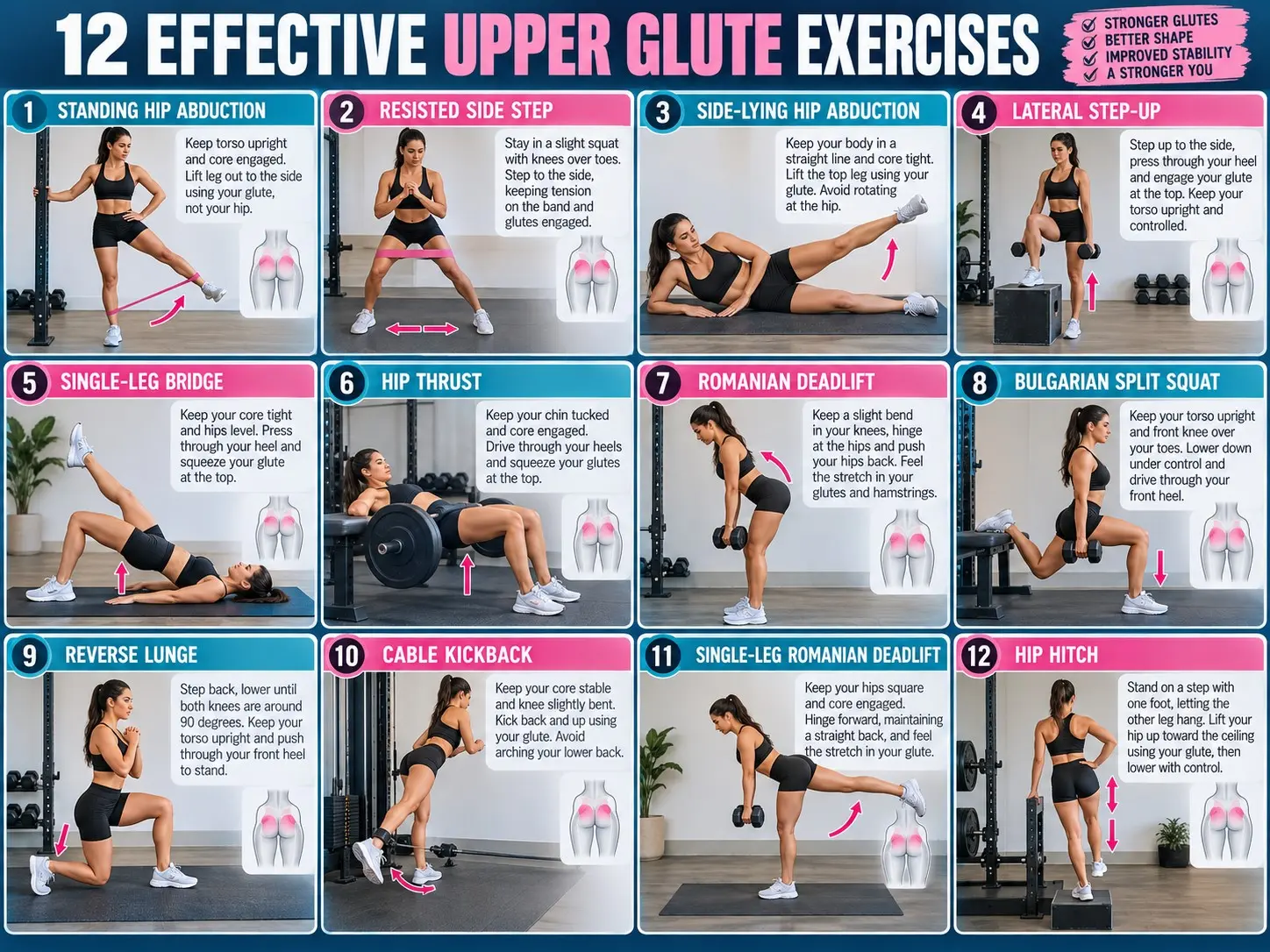
1. Standing Hip Abduction
Standing hip abduction directly trains the muscles that move the leg out to the side.
You can use a cable, resistance band, or ankle weight.
How to do it:
- Stand tall and hold a stable support.
- Keep your pelvis facing forward.
- Move one leg out to the side.
- Keep the movement small and controlled.
- Return slowly.
Do not lean your whole body in the opposite direction just to move the leg farther.
Start with: 2 to 3 sets of 10 to 20 reps each side.
2. Resisted Side Step
Resisted side steps are a simple way to add hip abduction work.
Place a resistance band around your thighs, ankles, or feet depending on your level.
How to do it:
- Stand with your feet around hip width.
- Bend your knees slightly.
- Keep tension on the band.
- Step sideways with control.
- Bring the other foot in without letting the band go completely slack.
Move both directions so each side works.
Start with: 2 to 3 sets of 8 to 15 steps each direction.
3. Side Lying Hip Abduction
This is one of the most studied gluteus medius exercises.
A systematic review found side lying hip abduction can create moderate to high gluteus medius activity, with resistance increasing the demand.
How to do it:
- Lie on your side.
- Keep the lower knee bent if that feels more stable.
- Keep the top leg straight.
- Lift it upward without rolling your pelvis backward.
- Lower it slowly.
Do not chase a huge range.
A smaller controlled lift is often better than twisting your whole body.
Start with: 2 to 3 sets of 10 to 20 reps.
4. Lateral Step Up
The lateral step up adds resistance while you control the pelvis on one leg.
How to do it:
- Stand beside a stable step.
- Place the inside foot fully on the step.
- Push through that leg and stand up.
- Keep the pelvis controlled.
- Lower slowly.
Start with a low step.
Raise the step or add dumbbells only when the movement feels stable.
Start with: 2 to 3 sets of 6 to 12 reps each side.
For more dumbbell based leg work, see our Leg Exercises With Dumbbells guide.
5. Single Leg Bridge
A single leg bridge combines hip extension with pelvic control.
How to do it:
- Lie on your back.
- Bend one knee and place that foot on the floor.
- Lift the other foot.
- Push through the planted foot.
- Raise your hips.
- Lower with control.
If your pelvis twists sharply, return to a two leg bridge first.
Start with: 2 to 3 sets of 6 to 12 reps each side.
6. Hip Thrust
The hip thrust is a strong hip extension exercise.
Research shows it can increase gluteus maximus size when used consistently.
How to do it:
- Place your upper back against a stable bench.
- Keep your feet planted.
- Lower your hips under control.
- Drive your hips upward.
- Pause near the top.
- Lower again.
Do not turn the top position into a large lower back arch.
The movement should come mainly from the hips.
Start with: 2 to 4 sets of 6 to 15 reps.
7. Romanian Deadlift
The Romanian deadlift trains the glutes and hamstrings as the hips move through a large hip hinge.
How to do it:
- Stand tall with the weights close to your thighs.
- Soften your knees.
- Push your hips backward.
- Lower only as far as you can control.
- Drive your hips forward to stand.
The goal is not to touch the floor.
Your range ends where your controlled hinge ends.
If the hinge is new to you, start with our Hip Hinge Exercises guide before adding heavy weight.
Start with: 2 to 4 sets of 6 to 12 reps.
8. Bulgarian Split Squat
The Bulgarian split squat trains the glutes, thighs, and hips one side at a time.
A slightly longer stance can increase the hip demand.
How to do it:
- Place one foot behind you on a stable bench.
- Keep the front foot firmly planted.
- Lower under control.
- Let the front hip and knee bend.
- Push through the front foot to stand.
Use a regular split squat if the rear foot elevation makes balance difficult.
Start with: 2 to 3 sets of 6 to 12 reps each side.
9. Reverse Lunge
Reverse lunges are another simple single leg strength option.
How to do it:
- Stand tall.
- Step one foot backward.
- Lower both knees with control.
- Push through the front leg.
- Return to standing.
Hold dumbbells when bodyweight becomes easy.
Start with: 2 to 3 sets of 6 to 12 reps each leg.
10. Cable Kickback
The cable kickback trains hip extension while allowing each leg to work separately.
How to do it:
- Attach an ankle strap.
- Stand facing the cable machine.
- Hold the frame for support.
- Move one leg backward.
- Keep your trunk controlled.
- Return slowly.
You do not need to kick the leg very high.
Stop before the movement turns into lower back extension.
Start with: 2 to 3 sets of 10 to 15 reps each side.
11. Single Leg Romanian Deadlift
This exercise adds balance and single leg control to the hip hinge.
How to do it:
- Stand on one leg.
- Keep the standing knee softly bent.
- Push the hips backward.
- Let the free leg move behind you.
- Keep your pelvis controlled.
- Return to standing.
Hold a wall lightly if balance limits you more than strength.
Start with: 2 to 3 sets of 6 to 10 reps each side.
12. Hip Hitch
The hip hitch, sometimes called a pelvic drop exercise, trains the side hip muscles while one leg supports the body.
Research reviews have found strong gluteus medius activity during several versions of this movement.
How to do it:
- Stand on one leg on a low step.
- Let the free side of the pelvis lower a small amount.
- Use the standing side hip muscles to lift the pelvis again.
- Keep the movement slow.
This is a small movement.
Do not turn it into a side bend through your whole torso.
Start with: 2 to 3 sets of 8 to 15 reps each side.
Which Upper Glute Exercises Should You Choose?
You do not need all 12 exercises in one workout.
Pick exercises that cover different jobs.
| Training Job | Good Exercise Choices | Main Focus |
|---|---|---|
| Hip extension | Hip thrust, Romanian deadlift, cable kickback | Gluteus maximus |
| Hip abduction | Standing abduction, side lying abduction, side steps | Upper glute and gluteus medius |
| Single leg strength | Split squat, reverse lunge, lateral step up | Glutes, legs, pelvic control |
| Pelvic control | Hip hitch, single leg bridge | Gluteus medius and hip stability |
Best Upper Glute Workout for Beginners
Use this workout twice per week with at least one recovery day between sessions.
| Exercise | Sets | Reps | Main Job |
|---|---|---|---|
| Hip thrust | 3 | 8 to 12 | Hip extension |
| Romanian deadlift | 3 | 8 to 10 | Glutes and hamstrings |
| Lateral step up | 2 | 8 to 12 each side | Single leg strength |
| Standing hip abduction | 2 | 12 to 20 each side | Upper glute isolation |
This gives you about ten working sets for the glute region in one session, although several exercises also train other muscles.
You do not need to add every possible glute movement after this.
How Many Sets Do You Need for Glute Growth?
The 2026 American College of Sports Medicine resistance training review gives a useful general target for muscle growth.
For hypertrophy, around 10 weekly sets per muscle group is a reasonable evidence based target for many healthy adults.
That does not mean everyone needs exactly ten.
A beginner may grow with less.
An experienced lifter may need more.
The useful question is whether your current training is producing progress.
If it is, you do not need to add volume just because someone online performs twenty sets.
Our Minimum Effective Dose Strength Training guide explains how to start with enough work to improve without adding pointless volume.
What Rep Range Builds Upper Glutes?
Muscles can grow across a wide range of repetitions when the resistance is challenging enough.
You do not need one magic rep range.
A practical setup is:
- 6 to 10 reps for heavier hip extension exercises
- 8 to 15 reps for single leg exercises
- 10 to 20 reps for hip abduction exercises
This makes exercise selection easier, but it is not a strict rule.
How Hard Should Your Sets Feel?
If every set feels easy, your muscles have little reason to adapt.
You also do not need to fail every set.
A practical target for many sets is to finish knowing you could perform about one to three more good repetitions.
This is called reps in reserve.
For a full explanation, see our Reps in Reserve guide.
Current ACSM guidance also notes that training to complete muscular failure is not required for most healthy adults to gain muscle and strength.
How Often Should You Train Upper Glutes?
Two sessions per week works well for many people.
This gives you repeated training exposure without forcing all your weekly work into one huge session.
A simple schedule could be:
- Monday: glute and leg workout
- Thursday: glute and leg workout
More advanced lifters may train the glutes three times weekly if volume and recovery are managed well.
You do not need to train them hard every day.
How to Use Progressive Overload
Progressive overload means gradually asking your muscles to do more.
You can progress by:
- Adding weight
- Adding repetitions
- Adding a set when needed
- Using a stronger resistance band
- Improving controlled range of motion
- Using a harder exercise variation
Here is a simple example.
You perform hip thrusts with the same weight for three sets:
- Week 1: 8, 8, 8 reps
- Week 2: 10, 9, 9 reps
- Week 3: 12, 11, 10 reps
- Week 4: 12, 12, 12 reps
If all three sets feel controlled, add a small amount of resistance and build the reps again.
That is real training.
Do Squats Grow the Upper Glutes?
Squats can grow the gluteus maximus.
A recent systematic review found that full or parallel squats can increase gluteus maximus size.
Research comparing squats with hip thrusts also found similar overall glute growth after nine weeks when training volume was matched.
However, a squat is not a complete upper glute program.
It does not replace direct hip abduction work.
Use squats as one part of the plan rather than the only glute exercise.
Are Hip Thrusts Better Than Squats?
Not in every way.
Hip thrusts and squats both train the glutes.
A 2023 trial found similar glute growth between the two exercises when set volume was matched.
The squat produced more thigh growth, while each group became stronger in the exercise it practiced.
The lesson is simple.
Choose exercises based on the job you want them to do.
Hip thrusts are useful for direct hip extension. Squats train the hips and knees together.
Are Hip Abduction Exercises Worth Doing?
Yes, especially when upper glute development is the goal.
The gluteus medius plays a major role in hip abduction and pelvic control.
Research reviews have identified several useful choices, including:
- Standing hip abduction
- Side lying hip abduction
- Resisted side steps
- Lateral step ups
- Single leg bridges
- Hip hitch variations
The newest regional hypertrophy evidence also suggests that hip abduction may create more growth in the proximal, or upper, region of the gluteus maximus than hip extension alone.
Do Resistance Bands Build Upper Glutes?
They can.
A resistance band is still resistance.
ACSM's current guidance confirms that bands, bodyweight exercises, free weights, and machines can all improve strength and muscle when used with enough effort.
Bands work especially well for:
- Side steps
- Standing hip abduction
- Side lying hip abduction
- Glute bridges
The limitation is progression.
If the same band becomes easy, you need more resistance, more reps, better range, or a harder exercise.
Can You Build Upper Glutes at Home?
Yes.
You can build a useful home workout with dumbbells and resistance bands.
Try:
- Dumbbell Romanian deadlift
- Dumbbell reverse lunge
- Weighted glute bridge
- Resisted side step
- Side lying hip abduction
If you only have dumbbells, use our Leg Exercises With Dumbbells guide for more lower body options.
Common Upper Glute Training Mistakes
Doing Only Band Exercises
Band work can be useful, but stronger glute development also benefits from heavier hip extension and single leg exercises.
Doing Only Squats
Squats train the glutes, but they do not replace direct hip abduction.
Never Increasing Resistance
The same easy workout will eventually stop creating much new stimulus.
Track your repetitions and resistance.
Using Too Many Exercises
More exercises do not automatically mean more growth.
Four useful movements that you can progress may work better than twelve random moves performed once.
Chasing the Burn
A burning feeling does not prove that an exercise will build more muscle.
Track performance instead.
Changing the Workout Every Week
You need enough repetition to measure progress.
Keep useful exercises in your program long enough to see whether you are becoming stronger.
How Long Does It Take to Grow Upper Glutes?
There is no honest universal timeline.
Visible changes depend on:
- Training history
- Genetics
- Exercise selection
- Weekly volume
- Training effort
- Protein and total food intake
- Sleep
- Body fat level
- Consistency
Strength may improve before you can see a large visual change.
Think in months of consistent training rather than days.
Do You Need Heavy Weights?
No, but resistance must eventually become challenging enough.
Heavy weights can work.
Moderate weights can work.
Lighter loads can also build muscle when the set becomes difficult enough.
You do not need to lift the heaviest possible weight.
Choose a resistance that lets you train hard without losing control.
If you are over 40 or returning to lifting after a long break, our Strength Training After 40 guide explains how to progress without treating age as a reason to avoid challenging resistance.
Do You Need to Feel the Glutes Working?
Feeling a muscle work can be useful feedback, but it is not proof of muscle growth.
Some exercises create a strong burn.
Others may feel less dramatic while still producing useful tension.
Research comparing squats and hip thrusts found that hip thrusts produced higher glute electrical activity during the first training session, but that difference did not lead to clearly greater glute growth.
This is why exercise selection should not be based on EMG or muscle burn alone.
What About the Upper Glute Shelf?
The phrase upper glute shelf describes the visible fullness near the top of the glutes.
Training can increase muscle size in that area, but your final shape also depends on:
- Pelvic anatomy
- Muscle attachment points
- Genetics
- Body fat distribution
You can improve the muscle you have.
You cannot choose a completely new body structure through exercise.
When Should You Stop an Exercise?
Muscle fatigue is normal.
Sharp or worsening pain is different.
Stop and seek appropriate guidance if you develop:
- Sharp hip pain
- Severe back pain
- New numbness
- New tingling
- Unexplained weakness
- Pain that travels down the leg
- Severe dizziness
- Chest pain
If a clinician has given you exercise restrictions because of surgery, arthritis, injury, pregnancy, osteoporosis, or another condition, follow those restrictions.
Upper Glute Training Checklist
- Use at least one hip extension exercise.
- Use at least one hip abduction exercise.
- Add one single leg movement.
- Train the glutes about twice each week to start.
- Track weight and repetitions.
- Use progressive overload.
- Keep most sets challenging but controlled.
- Do not change every exercise each week.
- Give the muscles time to recover.
- Build the program over months, not days.
Conclusion
The best Upper Glute Exercises do more than create a temporary burn.
Use hip extension to train the gluteus maximus, hip abduction to give the upper glute region and gluteus medius direct work, and single leg exercises to add useful strength and control.
Then make those exercises harder over time.
You do not need all twelve moves in every session. Choose four or five that cover the main movement patterns, train them consistently, and track your progress.
Your next step: start with the beginner workout above twice this week. Record your sets, repetitions, and resistance, then aim for a small improvement over the next few sessions.
References and Sources
- American College of Sports Medicine. Resistance Training Prescription for Muscle Function, Hypertrophy, and Physical Performance in Healthy Adults. 2026.
https://acsm.org/resistance-training-guidelines-update-2026/ - Jorquera Aguilera C, et al. The Impact of Resistance Training on Gluteus Maximus Hypertrophy: A Systematic Review and Meta Analysis.
https://pubmed.ncbi.nlm.nih.gov/40276368/ - Regional Hypertrophy of the Gluteal Muscles Is Task Specific: Differential Responses to 10 Weeks of Hip Extension Versus Hip Abduction Training. 2026.
https://pubmed.ncbi.nlm.nih.gov/42842490/ - Moore D, et al. A Systematic Review and Meta Analysis of Common Therapeutic Exercises That Generate Highest Muscle Activity in the Gluteus Medius and Gluteus Minimus Segments.
https://pmc.ncbi.nlm.nih.gov/articles/PMC7727410/ - Plotkin DL, et al. Hip Thrust and Back Squat Training Elicit Similar Gluteus Muscle Hypertrophy and Transfer Similarly to the Deadlift. 2023.
https://pubmed.ncbi.nlm.nih.gov/37877099/
Internal Links + Hub
- NextFitLife Fitness Hub
- Fitness Program Guide
- Hip Hinge Exercises
- Leg Exercises With Dumbbells
- Minimum Effective Dose Strength Training
- Reps in Reserve
- Strength Training After 40
About the Author
Adel Galal is the founder and lead writer of NextFitLife.com. He has maintained a personal interest in health, fitness, nutrition, sleep, wellness, and healthy aging for more than 30 years and has more than 15 years of health and wellness writing experience.
Adel is a father of four, three sons and a daughter, and a grandfather of four. He is based in Egypt and is also the founder of Parnthub.com.
His work at NextFitLife focuses on comparing credible sources, separating established guidance from uncertain evidence, and explaining fitness and health topics in clear, practical language.
Adel is not a doctor, physical therapist, exercise physiologist, or certified personal trainer. NextFitLife fitness content is educational and does not replace individual medical or professional exercise advice.
Learn more about Adel and NextFitLife on the About Us page.
Frequently Asked Questions
What are the best Upper Glute Exercises?
The best Upper Glute Exercises combine hip abduction and hip extension. Useful choices include standing hip abduction, resisted side steps, lateral step ups, hip thrusts, Romanian deadlifts, cable kickbacks, split squats, and single leg bridges.
Which muscle creates the upper glute shape?
The upper glute shape comes mainly from the upper fibers of the gluteus maximus and the gluteus medius. Genetics, pelvic structure, and body fat distribution also affect appearance.
Does hip abduction grow the upper glutes?
Yes. Hip abduction trains the gluteus medius and can also train the upper region of the gluteus maximus. Newer research suggests hip abduction may produce more proximal gluteus maximus growth than hip extension alone.
Do hip thrusts work the upper glutes?
Hip thrusts train the gluteus maximus and can increase overall glute muscle size. They are useful for hip extension, but combining them with hip abduction exercises provides a more complete upper glute program.
Are squats enough to build upper glutes?
Squats can grow the gluteus maximus, but they do not fully replace direct hip abduction work. A more complete plan combines squats or other leg exercises with hip extension and abduction movements.
How often should I train upper glutes?
Two sessions per week is a practical starting point for many people. More experienced lifters may train them more often if total weekly volume and recovery are managed well.
How many sets should I do for glute growth?
Current ACSM guidance suggests that around 10 weekly sets per muscle group is a useful general target for hypertrophy. Beginners may grow with less, while experienced lifters may need more.
Can resistance bands build upper glutes?
Yes. Bands can provide useful resistance for side steps, standing hip abduction, side lying hip abduction, and bridges. Progress to stronger bands or harder variations when the exercise becomes easy.
How long does it take to grow upper glutes?
There is no fixed timeline. Visible muscle growth depends on genetics, training history, weekly volume, effort, food intake, sleep, and consistency. Think in months of steady training rather than days.
Should I train upper glutes every day?
No. Daily hard training is not required. Muscles also need recovery. Two well planned sessions each week can be enough for many beginners.
Do I need heavy weights to grow my glutes?
No. Different resistance levels can build muscle when sets are challenging enough. Choose a load you can control, then increase resistance or repetitions as you become stronger.
Why do I not feel my glutes during squats?
Muscle sensation varies and does not prove whether an exercise is effective. Track your technique, resistance, repetitions, and progress rather than using muscle burn as your only measure.

Health & wellness writer with 30+ years of experience in nutrition, fitness, and healthy aging. Founder of NextFitLife.com — evidence-based health guidance.

