Published on: Sep 23, 2022
Last updated: September 16, 2026
Next review: September 2027, or sooner if major physical activity or resistance training guidance changes
Written and source-checked by: Adel Galal, Founder and Lead Writer at NextFitLife
Review status: This article is educational and source-checked. It has not been medically reviewed by a doctor, physiotherapist, sports medicine physician, or certified personal trainer.
And several short sessions throughout the day can add up.
You do not need to turn every five-minute session into an all-out sprint.
You do not need burpees every morning.
You do not need to finish breathless on the floor.
A 5-minute workout can focus on walking, strength, mobility, balance, core control, cardio, or recovery.
This guide gives you 25 different routines so you can choose the type of movement that fits your body and your day.
Exercise Safety Notice
I am not a dermatologist or A doctor, and this content does not replace professional medical advice. What I share comes from real-life experience, extensive research, and consultation with healthcare providers. Always consult qualified medical professionals for diagnosis and treatment of any health condition.
I am also not a physiotherapist, sports medicine physician, certified personal trainer, or strength coach.
Exercise needs to match your health, fitness level, symptoms, injuries, age, and physical ability.
Talk with a healthcare professional before starting vigorous exercise if you have heart disease, unexplained chest symptoms, severe joint problems, fainting, uncontrolled blood pressure, or another condition that may affect exercise safety.
Stop exercise and seek urgent care for chest pain, fainting, severe breathing trouble, sudden weakness, or another serious new symptom.
Quick Answer: Is 5 Minutes of exercise worth it?
Yes. Five minutes of physical activity is better than none and can contribute to your weekly activity total. Short sessions are especially useful for beginners, busy days, long periods of sitting, and building consistency. But one five-minute workout each day gives only 35 minutes a week, so most adults still need more activity to reach general health targets.
CDC guidance says any amount of physical activity can provide some health benefit.
Adults should still work toward at least 150 minutes of moderate aerobic activity each week and muscle strengthening on at least two days.
What Old 5 Minutes Fitness Advice Got Wrong
The previous version of this article treated maximum intensity as the secret.
It told readers to perform the five minutes at maximum effort.
That is not necessary.
It is also not appropriate for every beginner.
Five minutes can serve different purposes.
A brisk walk can help with aerobic activity.
Squats and wall push-ups can build a strength habit.
Mobility work can help you move after sitting.
Balance work can be useful as you age.
A short routine can also be repeated later in the day.
The goal is useful movement.
Not maximum suffering.
Can short workouts really count?
Yes.
Modern physical activity guidance does not require exercise to happen in long blocks before it counts.
CDC says adults can break activity into smaller pieces across the week.
Research on brief vigorous activity is also interesting.
A 2026 wearables study in adults who did not report structured exercise found that several very short bursts of vigorous daily activity were associated with lower mortality risk.
That study was observational.
It does not prove that five minutes replaces the standard activity recommendations.
The researchers specifically warned against making that conclusion.
The practical message is simpler.
Small bouts can contribute.
More total movement still matters.
25 Five- Minute Workouts at a Glance
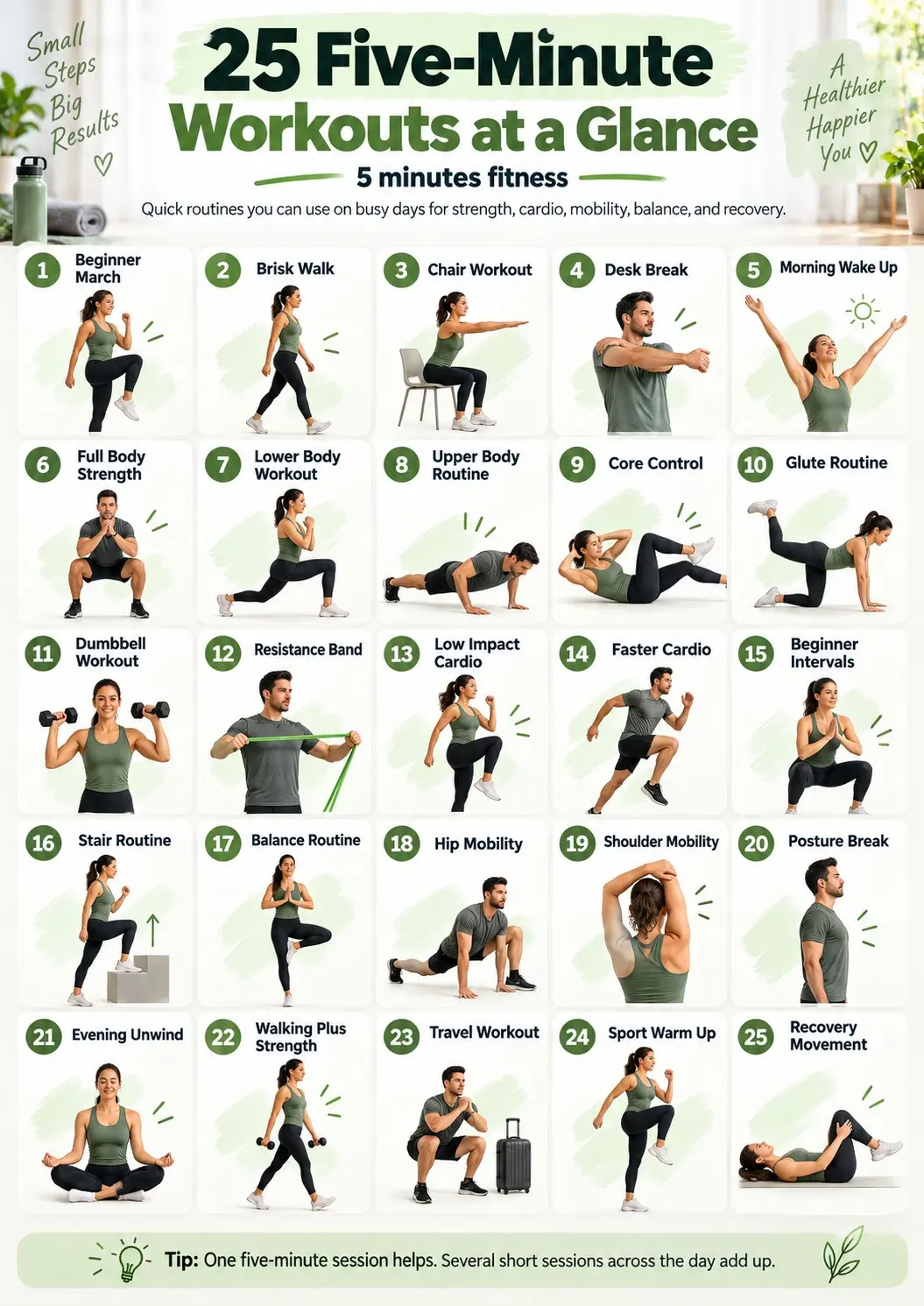
| Number | Routine | Main focus | Level |
|---|---|---|---|
| 1 | Beginner march | Starting movement | Beginner |
| 2 | Brisk walk | Cardio | Beginner |
| 3 | Chair movement | Seated movement | Easy |
| 4 | Desk break | Break up sitting | Easy |
| 5 | Morning wake up | Mobility and movement | Easy |
| 6 | Full body strength | Strength | Beginner |
| 7 | Lower body strength | Legs and hips | Beginner |
| 8 | Upper body strength | Push and pull | Beginner |
| 9 | Core control | Trunk strength | Beginner |
| 10 | Glute routine | Hips and glutes | Beginner |
| 11 | Dumbbell mini workout | Strength | Intermediate |
| 12 | Resistance band routine | Strength | Beginner |
| 13 | Low-impact cardio | Aerobic movement | Beginner |
| 14 | Faster cardio | Cardio fitness | Intermediate |
| 15 | Beginner intervals | Paced intensity | Beginner |
| 16 | Stair routine | Legs and cardio | Intermediate |
| 17 | Balance routine | Stability | Easy |
| 18 | Hip mobility | Mobility | Easy |
| 19 | Shoulder mobility | Upper body movement | Easy |
| 20 | Posture break | Movement after sitting | Easy |
| 21 | Evening unwind | Gentle mobility | Easy |
| 22 | Walking plus strength | Mixed training | Beginner |
| 23 | Travel workout | No equipment | Beginner |
| 24 | Sport warm up | Preparation | Variable |
| 25 | Recovery movement | Easy movement | Easy |
1. Five Minute Beginner March
This is the easiest place to start.
Move at a comfortable pace.
- Minute 1: March slowly in place.
- Minute 2: March while gently moving your arms.
- Minute 3: Step side to side.
- Minute 4: March a little faster if comfortable.
- Minute 5: Slow down gradually.
You should still be able to talk.
This is a good workout for beginners who have been inactive.
2. Five Minute Brisk Walk
Walk outside, through your building, or on a treadmill.
- Minute 1: Comfortable walk.
- Minute 2: Brisk walk.
- Minute 3: Brisk walk.
- Minute 4: Brisk walk.
- Minute 5: Easy walk.
Do this several times across the day and the minutes start adding up.
3. Five Minute Chair Workout
This is a simple seated option.
- Minute 1: Seated marching.
- Minute 2: Alternating knee extensions.
- Minute 3: Seated arm reaches.
- Minute 4: Seated heel and toe raises.
- Minute 5: Seated marching again.
Use a stable chair.
Stop if movement causes pain or unusual symptoms.
4. Five Minute Desk Break
Sitting for hours can make your body feel stiff.
Try this between meetings.
- Minute 1: Walk around the room.
- Minute 2: Sit to stand from your chair.
- Minute 3: Wall push ups.
- Minute 4: Gentle standing reaches.
- Minute 5: Walk again.
A short break can also help you remember to move more during the rest of the workday.
5. Five Minute Morning Wake Up Routine
- Minute 1: Easy marching.
- Minute 2: Shoulder circles and arm reaches.
- Minute 3: Slow bodyweight squats or chair stands.
- Minute 4: Gentle hip hinges.
- Minute 5: Comfortable walking.
You do not need to start the morning with maximum intensity.
Movement is enough.
6. Five Minute Full Body Strength Routine
This bodyweight workout covers several major movement patterns.
Move for about 40 seconds.
Use the remaining time to change positions.
- Chair squats
- Wall push ups
- Hip hinges
- Supported reverse lunges or extra squats
- Bird dogs or standing carries
Slow repetitions are fine.
Good form matters more than speed.
7. Five Minute Lower Body Workout
- Minute 1: Chair squats.
- Minute 2: Supported reverse lunges.
- Minute 3: Glute bridges.
- Minute 4: Calf raises.
- Minute 5: Sit-to-stands.
Use support when balance is uncertain.
8. Five Minute Upper Body Routine
You can do this with bodyweight and a resistance band if available.
- Minute 1: Wall push-ups.
- Minute 2: Band rows or standing shoulder blade squeezes.
- Minute 3: Elevated push-ups.
- Minute 4: Band pull-apart or controlled arm pulls.
- Minute 5: Light overhead reach or press if appropriate.
Shoulder pain is not something to push through.
9. Five -Minute Core Control Routine
Your core does more than create visible abs.
It helps control your trunk.
- Minute 1: Dead bug.
- Minute 2: Bird dog.
- Minute 3: Elevated plank.
- Minute 4: Side plank from knees or standing side brace.
- Minute 5: Slow dead bug.
For more, use the NextFitLife Core Workouts at Home Guide.
10. Five Minute Glute Routine
- Minute 1: Glute bridges.
- Minute 2: Chair squats.
- Minute 3: Standing hip extensions.
- Minute 4: Side steps.
- Minute 5: Glute bridges.
Keep the movements controlled.
11. Five -Minute Dumbbell Workout
Use weights you can control comfortably.
- Minute 1: Goblet squat.
- Minute 2: Dumbbell row.
- Minute 3: Romanian deadlift.
- Minute 4: Dumbbell floor or standing press if suitable.
- Minute 5: Farmer carry.
This is a simple strength training option.
Do not rush the repetitions because the clock is short.
12. Five -Minute Resistance Band Routine
- Minute 1: Band row.
- Minute 2: Band squat if the setup is safe.
- Minute 3: Band chest press or wall push-up.
- Minute 4: Band pull apart.
- Minute 5: Band hip hinge or side step.
Check the band for damage before using it.
13. Five Minute Low Impact Cardio Workout
- Minute 1: March.
- Minute 2: Step touches.
- Minute 3: Alternating knee lifts.
- Minute 4: Side steps with arm movements.
- Minute 5: Brisk march.
This quick cardio workout avoids jumping.
14. Five- Minute Faster Cardio Routine
This option is for people who are already comfortable with exercise.
- Minute 1: Fast march or light jog.
- Minute 2: Step jacks or jumping jacks.
- Minute 3: Fast bodyweight squats.
- Minute 4: Mountain climbers using a wall or floor.
- Minute 5: Easy walking recovery.
Use low impact versions when needed.
You do not need to work at maximum effort.
15. Five Minute Beginner Interval Workout
Alternate moderate movement with easier movement.
- 30 seconds brisk walking.
- 30 seconds easy walking.
- Repeat for 5 minutes.
That gives you five short work periods without turning the routine into an extreme HIIT session.
16. Five -Minute Stair Routine
Use stairs only if balance and joint health make this appropriate.
- Minute 1: Walk on flat ground.
- Minute 2: Walk up and down one safe flight.
- Minute 3: Easy walk.
- Minute 4: Repeat the stairs.
- Minute 5: Easy walk.
Hold the rail when needed.
17. Five Minute Balance Routine
Stand near a stable counter or chair.
- Minute 1: Feet together standing balance.
- Minute 2: Tandem stance with one foot in front of the other.
- Minute 3: Supported single-leg balance.
- Minute 4: Slow side stepping.
- Minute 5: Heel-to-toe walking with support nearby.
Balance exercise becomes especially useful as people age.
18. Five -Minute Hip Mobility Routine
- Minute 1: Gentle hip circles.
- Minute 2: Supported knee lifts.
- Minute 3: Controlled hip hinges.
- Minute 4: Supported side lunges or side weight shifts.
- Minute 5: Easy walking.
Mobility exercises should feel controlled.
Do not force a painful range.
19. Five -Minute Shoulder Mobility Routine
- Minute 1: Shoulder rolls.
- Minute 2: Gentle arm circles.
- Minute 3: Wall slides.
- Minute 4: Shoulder blade squeezes.
- Minute 5: Comfortable overhead reaches.
Stop or reduce the range if shoulder pain appears.
20. Five -Minute Posture Break
This is for people who spend long periods at a desk.
- Minute 1: Stand and walk.
- Minute 2: Wall slides.
- Minute 3: Hip hinges.
- Minute 4: Gentle upper back rotations.
- Minute 5: Walk again.
You do not need perfect posture all day.
You need movement and position changes.
21. Five Minute Evening Unwind Routine
Keep this gentle.
- Minute 1: Slow walking around the room.
- Minute 2: Gentle calf stretch.
- Minute 3: Comfortable hip stretch.
- Minute 4: Shoulder and upper back movement.
- Minute 5: Slow breathing.
This is not meant to be a hard workout.
It is a transition from a busy day.
22. Five Minute Walking Plus Strength Routine
- Minute 1: Brisk walk.
- Minute 2: Chair squats.
- Minute 3: Brisk walk.
- Minute 4: Wall push-ups.
- Minute 5: Brisk walk.
This gives you a small mix of aerobic and muscle activity.
23. Five- Minute Travel Workout
No gym required.
- Minute 1: March around the hotel room.
- Minute 2: Chair squats.
- Minute 3: Wall push-ups.
- Minute 4: Hip hinges.
- Minute 5: Walking.
This is one reason micro workouts can be useful.
They need very little setup.
24. Five Minute Sport Warm Up
A warm-up should match the activity that follows.
A simple general version can include:
- Minute 1: Easy walking or jogging.
- Minute 2: Side stepping.
- Minute 3: Controlled squats.
- Minute 4: Arm and shoulder movements.
- Minute 5: Gradually faster sport specific movement.
Some sports need longer preparation.
Five minutes is not automatically enough for every event.
25. Five Minute Recovery Movement Routine
Recovery does not always mean lying still.
- Minute 1: Gentle walking.
- Minute 2: Shoulder movements.
- Minute 3: Slow hip hinges.
- Minute 4: Calf raises and ankle movement.
- Minute 5: Easy walking.
Keep the intensity low.
This is movement, not another hard training session.
How Many Five Minute Workouts Should You Do?
There is no magic number.
One five-minute session is useful when the alternative is doing nothing.
But look at the weekly math.
| Daily routine | Weekly total |
|---|---|
| 5 minutes once daily | 35 minutes |
| 5 minutes twice daily | 70 minutes |
| 5 minutes three times daily | 105 minutes |
| 5 minutes four times daily | 140 minutes |
That shows why exercise snacks can be useful.
Several short sessions can build a meaningful weekly total.
You can also combine them with longer workouts.
Five Minutes Is a Starting Point, Not a Fitness Ceiling
This distinction matters.
If five minutes is all you have today, use it.
If you have twenty minutes tomorrow, use twenty.
If you enjoy a 40-minute walk on Saturday, take the walk.
Do not stop exercising at minute five just because the article is called 5 Minute Fitness.
The five-minute format is a tool.
It is not a rule.
Can five minutes build strength?
Five minutes can contain useful resistance exercise.
But strength improvement depends on the challenge, the exercises, progression, total weekly training, and your starting level.
The 2026 American College of Sports Medicine position statement recommends progressive resistance training involving all major muscle groups at least twice weekly for healthy adults.
Home exercise, bodyweight work, bands, and free weights can all be useful.
A single five-minute routine may not train every muscle group well enough.
You can solve that by rotating routines or stacking sessions.
For more structured training, use Strength Training Exercises at Home for Beginners.
Can Five- Minute Workouts Help With Weight Loss?
They can contribute to activity.
That differs from saying five minutes melts body fat.
Weight loss depends on the wider energy balance over time.
Food intake matters.
Total movement matters.
Sleep and health conditions matter too.
A short workout can be one piece of a weight management plan.
Do not believe claims that a five-minute routine burns fat for the rest of the day in a way that guarantees weight loss.
The so-called afterburn effect exists after some exercise.
Its practical size is often exaggerated in fitness marketing.
Do Five Minute Workouts Need to Be HIIT?
No.
This is one of the biggest myths about short workouts.
You can spend five minutes:
- Walking
- Lifting
- Practicing mobility
- Training balance
- Doing gentle cardio
- Practicing core control
HIIT is only one option.
It is not required.
When Five-Minute Workouts Are Especially Useful
- When you are starting exercise.
- During a busy workday.
- Between meetings.
- While traveling.
- When motivation is low.
- When you want to break up sitting.
- When you want to add activity without changing your whole schedule.
This is why the format works well as a workout for busy people.
The time barrier is very small.
A Simple 7 Day Five-Minute Fitness Plan
| Day | Routine | Goal |
|---|---|---|
| Monday | Brisk walk | Start moving |
| Tuesday | Full body strength | Muscle activity |
| Wednesday | Desk break | Break up sitting |
| Thursday | Low-impact cardio | Aerobic movement |
| Friday | Full body strength | Second strength session |
| Saturday | Walking plus strength | Mixed movement |
| Sunday | Recovery movement | Easy activity |
Five minutes can also be the beginning.
If you feel good and have more time, keep walking.
7 Mistakes to Avoid With Five-Minute Workouts
1. Going at Maximum Effort Every Time
Not every short workout needs to be intense.
2. Sacrificing Form for Speed
Five minutes is still enough time to get hurt.
3. Doing Only Jumping Exercises
Low impact movement can also be effective.
4. Training the Same Muscles Every Day
Rotate your focus.
5. Assuming Five Minutes Meets Every Fitness Goal
Total weekly activity still matters.
6. Using Exercise Only to Burn Calories
Exercise also supports heart health, muscle function, brain health, sleep, and healthy aging.
7. Believing Five Minutes Must Transform Your Body
It does not.
It can help transform your routine.
That is more realistic.
Conclusion: Five Minutes Is Enough to Start
5 minute fitness works best when you use it as a practical way to move more.
You can walk.
Strength train.
Work on mobility.
Practice balance.
Break up sitting.
Or stack several sessions throughout the day.
Your next step: choose one of the 25 workouts and do it today. If you have more time when the five minutes end, keep moving.
You do not need the perfect workout.
You need a place to start.
References and Sources
- Centers for Disease Control and Prevention. Adding Physical Activity as an Adult.CDC Adult Physical Activity Guidance. Updated December 2025. Used for the 150-minute weekly target, two muscle strengthening days, smaller activity chunks, and the principle that any amount of activity can provide benefits.
- World Health Organization. Physical Activity.WHO Physical Activity Fact Sheet. Used for aerobic activity, muscle strengthening, health benefits, sedentary behaviour, and healthy aging.
- American College of Sports Medicine. Resistance Training Prescription for Muscle Function, Hypertrophy, and Physical Performance in Healthy Adults. 2026. Read the full open-access ACSM position stand. Used for strength training, training frequency, home exercise, bodyweight exercise, progression, and muscle function.
- Vigorous Intermittent Lifestyle Physical Activity and Mortality Risk Among United States Adults. 2026. Read the full open access studyUsed for current research on brief vigorous lifestyle activity. The study is observational and does not show that brief activity replaces standard exercise recommendations.
- UChicago Medicine AdventHealth. The 5 Minute Movement Challenge.UChicago Medicine Advent health 5 Minute Movement GuidePublished January 2026. Used for practical examples of short exercise sessions and the role of short movement blocks in building a more active routine.
Continue Reading on NextFitLife
Use these NextFitLife guides to turn five-minute sessions into a broader fitness routine.
- Fitness, Home Workouts and Equipment Hub for cardio, strength, home exercise, dumbbells, resistance bands, and fitness equipment.
- Benefits of Exercises for heart, brain, muscle, bone, sleep, mood, balance, and healthy aging.
- Strength Training Exercises at Home for Beginners for a more complete beginner strength plan.
- Core Workouts at Home for trunk strength and control.
- Leg Exercises With Dumbbells for lower body strength.
- How to Get Fit Fast for a practical beginner fitness plan.
- Fitness Man Guide for strength, cardio, mobility, nutrition, sleep, and recovery.
- Exercise Benefits for Mental Health for stress, sleep, anxiety, and mood.
- Physical Fitness and Mental Health for the wider connection between movement and emotional wellbeing.
About the Author
Adel Galal is the founder and lead writer of NextFitLife.
He has maintained a personal interest in health, fitness, nutrition, sleep, wellness, and healthy aging for more than 30 years.
His health and wellness writing and research communication experience spans more than 15 years.
Adel is not a physician, physiotherapist, sports medicine physician, certified personal trainer, registered dietitian, or other licensed healthcare professional.
His role is research communication.
He compares reputable scientific and public health sources, checks claims, identifies evidence limits, and explains fitness information in simple, practical language.
Before founding NextFitLife, Adel spent 29 years working as an IT Manager for the Nestlé Egypt Region.
His professional work involved data, information systems, planning, structured review, problem solving, and information management.
Those skills support his research process.
They are not medical or fitness credentials.
For this article, the main claims about brief physical activity, strength training, exercise intensity, short workouts, and weekly activity targets were checked against CDC, WHO, ACSM, current peer-reviewed research, and a current clinical health system guide.
Learn more about Adel, NextFitLife's research methods, editorial standards, medical review policy, and corrections process on the About NextFitLife page.
Frequently Asked Questions About 5 Minute Fitness
Does a 5-minute workout count?
Yes. Any amount of moderate or vigorous physical activity can contribute to your overall activity. Five minutes is better than none.
Can five minutes of exercise improve fitness?
It can contribute, especially for inactive beginners or when several short sessions are accumulated. Larger fitness gains usually require enough total activity and progressive training over time.
Is five minutes of exercise every day enough?
Five minutes each day equals 35 minutes a week. That is useful, but it is below the general adult target of at least 150 minutes of moderate aerobic activity plus two muscle strengthening days.
Can I split exercise into five -minute sessions?
Yes. Current guidance allows physical activity to be accumulated in shorter periods across the day and week.
Do five -minute workouts have to be intense?
No. A five-minute session can be walking, strength work, balance, mobility, gentle cardio, or recovery movement.
Can I lose weight with five-minute workouts?
Five-minute workouts can contribute to physical activity and energy use, but weight loss depends on your wider energy balance over time. Short exercise alone does not guarantee weight loss.
Can five minutes build muscle?
Five minutes can contain useful resistance exercise. Muscle growth depends on total weekly training, resistance, progression, nutrition, recovery, and your starting level.
How many five-minute workouts should I do each day?
There is no required number. Start with one if you are inactive. You can add more sessions or combine them with longer exercise as your fitness and schedule allow.
Is a five -minute walk useful?
Yes. A five-minute walk contributes to daily movement. Repeating short walks throughout the day can create a meaningful amount of activity.
Are five-minute HIIT workouts safe?
They can be appropriate for some trained people, but HIIT is not required. Beginners and people with health concerns should start at a suitable intensity and may need professional advice before vigorous exercise.
Can older adults do five-minute workouts?
Yes, when exercises are matched to ability. Walking, chair exercise, strength, mobility, and balance can all be adapted for older adults.
What is an exercise snack?
An exercise snack is a short period of physical activity done during the day rather than as one long workout. Examples include brief walks, stair climbing, or a few minutes of strength work.
Can I do five-minute workouts at work?
Yes. Walking, chair stands, wall push-ups, and short mobility breaks can fit into many work settings.
Should I warm up for a five-minute workout?
If the workout is gentle, the first minute can often be an easy version of the activity. Vigorous or complex exercise may need more preparation than a five-minute session allows.
Can I repeat the same five-minute workout every day?
You can repeat gentle activities such as walking frequently. For harder strength or impact routines, rotating exercises and allowing recovery may be more appropriate.
What is the best five-minute workout?
The best one depends on your goal. Walking works well for simple aerobic movement, full-body resistance work helps strength, and mobility or balance routines serve different needs.

Health & wellness writer with 30+ years of experience in nutrition, fitness, and healthy aging. Founder of NextFitLife.com — evidence-based health guidance.