First published: July 7, 2023
Last updated: July 30, 2026
Written and source checked by: Adel Galal
Clinical review status: This article has not been reviewed by a dermatologist or cosmetic chemist.
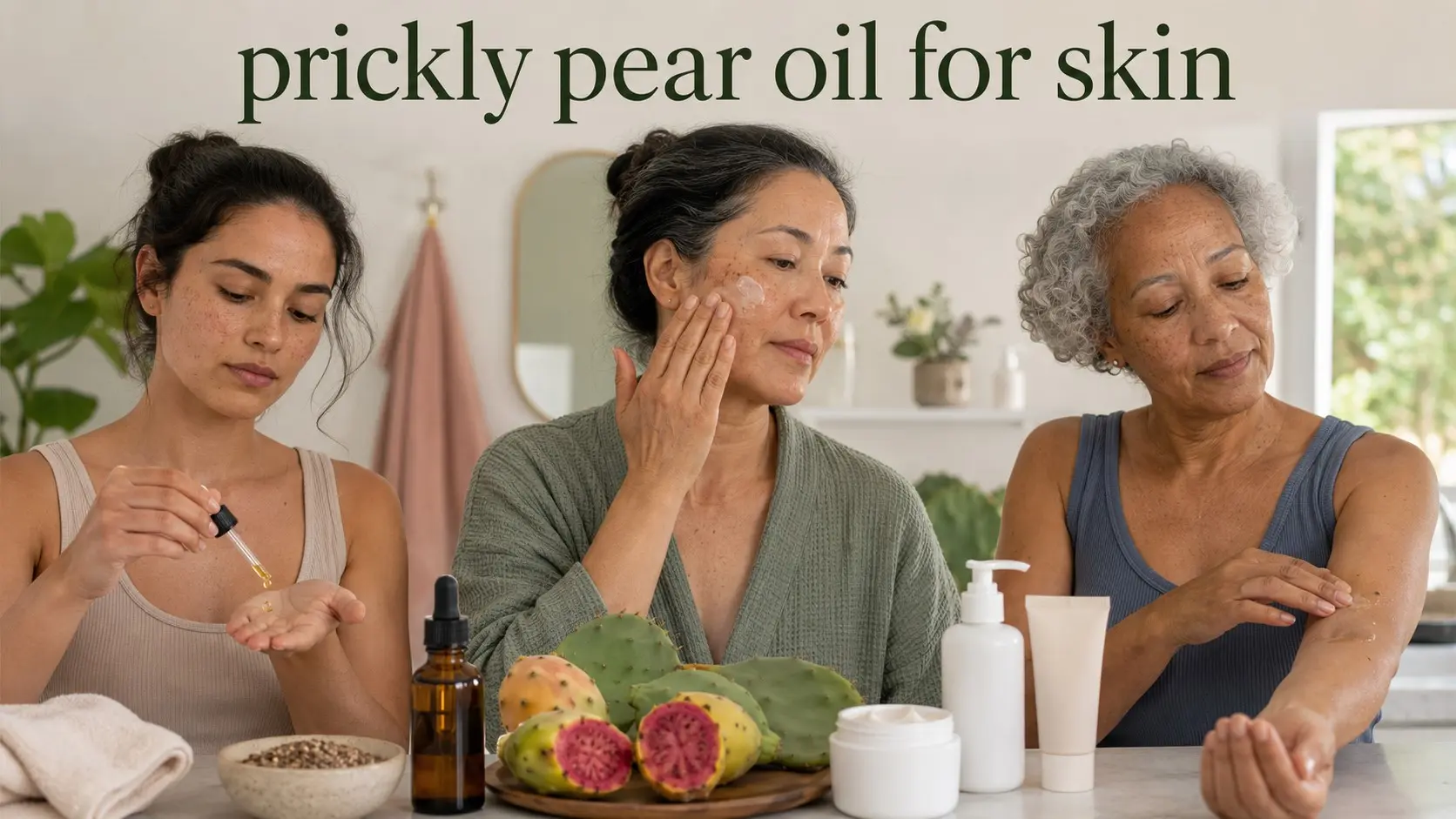
Prickly pear oil for skin is a light plant oil pressed from the seeds of prickly pear fruit.
The plant is also called cactus pear or *Opuntia ficus indica*.
The oil contains a high amount of linoleic acid.
It also contains smaller amounts of vitamin E compounds, plant sterols, and other natural substances.
These ingredients may help soften dry skin and reduce moisture loss.
They do not prove that the oil can erase wrinkles, cure acne, remove scars, or lighten dark spots.
Most current research studies the oil in laboratories, analyzes its chemical content, or tests it in animals.
Strong human evidence for many popular beauty claims is still limited.
This guide explains what prickly pear seed oil may do, what it cannot do, how to choose it, how to use it safely, and when to stop.
For a complete routine, visit the Healthy Skin Guide, the Natural Skin Care Guide, and the Skincare Basics Guide.
Important: Natural oils can still cause acne, irritation, or an allergic skin reaction. Patch test the finished product before putting it over the whole face.
Quick Answer
Prickly pear oil is mainly an emollient.
This means it can coat and soften the outer skin.
It may help:
- Reduce a dry or rough feeling
- Support a simple moisturizing routine
- Add softness to hair ends
- Reduce friction around dry cuticles
It has not been proven to:
- Cure acne
- Remove acne scars
- Erase wrinkles
- Remove pigmentation
- Replace sunscreen
- Treat eczema or psoriasis
Use one or two drops over moisturizer and stop if the skin becomes itchy, sore, swollen, or more congested.
What Is Prickly Pear Oil?
Prickly pear oil is usually extracted from the small seeds inside the cactus pear fruit.
The fruit grows on plants in the *Opuntia* group.
It may be sold as:
- Prickly pear seed oil
- Cactus seed oil
- Barbary fig seed oil
- Indian fig seed oil
- Opuntia ficus indica oil
Seed oil is different from fruit extract, cactus water, flower extract, and essential oil.
Read the ingredient list to see what the product actually contains.
What Does Prickly Pear Seed Oil Contain?
The exact composition changes with plant variety, climate, seed quality, extraction, storage, and testing method.
Common components include:
- Linoleic acid
- Oleic acid
- Palmitic acid
- Tocopherols
- Plant sterols
- Phenolic compounds
Linoleic acid is an unsaturated fat found in many plant oils.
It helps form part of the skin surface lipids.
Tocopherols are members of the vitamin E family.
Laboratory tests may show antioxidant activity, but this does not prove a visible anti aging result in people.
Possible Prickly Pear Oil Benefits
Softens Dry Skin
The oil can work as an emollient and reduce a rough skin feel.
Slows Moisture Loss
An oil layer may reduce some water loss from the skin surface.
Adds Slip
A few drops may reduce friction during gentle facial massage.
Softens Cuticles
The oil may make dry nail edges and cuticles feel smoother.
Conditions Hair Ends
A small amount may add shine and reduce a dry feeling on hair ends.
Supports Simple Skin Care
It may be used after moisturizer when a cream alone does not feel rich enough.
What Does the Research Show?
Research has established the chemical profile of prickly pear seed oil more clearly than its cosmetic results in humans.
Studies report a high proportion of polyunsaturated fats, especially linoleic acid.
Laboratory studies also report antioxidant activity.
Animal research has examined inflammation and wound healing.
These results are early.
Animal and laboratory findings cannot be treated as proof that the oil will treat a human skin condition.
More controlled studies in people are needed.
Prickly Pear Oil for Dry Skin
A dry skin oil may help seal moisture into the skin.
Oil works best after water and moisturizer have already been added.
Use this order:
- Wash gently.
- Leave the skin slightly damp.
- Apply a fragrance free moisturizer.
- Press one or two drops of oil over it.
Oil alone may not be enough because it does not provide all the water attracting and barrier ingredients found in a complete moisturizer.
For more help, read the Daily Dry Skin Care Guide.
Can Oily Skin Use Prickly Pear Oil?
Some oily skin can tolerate a small amount.
Other oily skin may feel greasy or develop more clogged pores.
There is no reliable rule that one oil is noncomedogenic for every person.
Try one drop over moisturizer two or three nights each week.
Stop if you notice:
- More blackheads
- More whiteheads
- New inflamed pimples
- Greasy discomfort
Does Prickly Pear Oil Help Acne?
There is not enough strong human evidence to call it an acne treatment.
Linoleic acid content does not prove that the whole oil will clear acne.
Prickly pear oil for acne cannot replace:
- Benzoyl peroxide
- Salicylic acid
- Adapalene
- Azelaic acid
- Prescription treatment
Some people may tolerate the oil.
Others may break out.
Deep, painful, widespread, or scarring acne needs a dermatologist.
Visit the Acne, Whiteheads and Pores Guide.
Can It Remove Wrinkles?
No oil can rebuild lost facial structure or erase established wrinkles.
Oil may soften dryness.
This can make fine dry lines look less obvious for a short time.
That is not the same as reversing skin aging.
Prickly pear oil for wrinkles has not been proven to work like:
- Daily sunscreen
- Retinoids
- Professional chemical peels
- Laser treatment
- Injectable procedures
Read the Anti Aging and Wrinkles Guide for realistic options.
Can It Fade Dark Spots?
Current evidence does not show that prickly pear oil reliably removes pigmentation.
Prickly pear oil for dark spots should not replace sunscreen or proven treatment.
Dark mark care may include:
- Broad spectrum sunscreen
- Azelaic acid
- Retinoids
- Vitamin C
- Hydroquinone where medically suitable
- Professional treatment
A new, changing, uneven, bleeding, or painful dark mark needs medical assessment.
Can It Remove Scars?
No strong evidence shows that the oil removes acne scars, surgery scars, or stretch marks.
It may soften dry skin around a healed scar.
Do not put it on:
- An open wound
- A fresh surgical wound
- An infected area
- A burn
- Weeping skin
Prickly pear oil for scars cannot rebuild deep scar tissue.
A dermatologist may recommend silicone gel, injections, laser treatment, microneedling, surgery, or another option based on the scar.
Is It Safe for Sensitive Skin?
Sensitive skin may tolerate a plain oil.
It may also react to the oil, fragrance, preservatives, or other plant extracts in the product.
Choose:
- Fragrance free products
- Short ingredient lists
- Plain formulas
- Protected packaging
Do not assume that botanical means gentle.
People with eczema, rosacea, or repeated allergies should speak with a dermatologist when products often cause reactions.
How to Use Prickly Pear Oil on the Face
Morning
- Wash gently.
- Apply any water based treatment.
- Apply moisturizer.
- Use one drop of oil when needed.
- Apply sunscreen.
Do not mix oil into sunscreen.
This may change how evenly the sunscreen forms a protective layer.
Evening
- Remove makeup and sunscreen.
- Wash with a gentle cleanser.
- Apply treatment products.
- Apply moisturizer.
- Press one or two drops of oil over dry areas.
More oil does not create better results.
How to Patch Test Prickly Pear Oil
- Apply a small amount to the inner arm.
- Use it twice daily for seven to ten days.
- Use the same amount each time.
- Do not test several products together.
- Stop for itching, burning, swelling, bumps, or a rash.
A home patch test skin care method cannot rule out every future allergy.
A dermatologist can perform formal patch testing when reactions keep returning.
How to Choose a Good Product
Look for the botanical name in the ingredient list.
It may appear as:
Opuntia ficus indica seed oil
Useful buying checks include:
- Clear ingredient list
- Named manufacturer
- Batch information
- Expiration information
- Dark glass or protective packaging
- No strong added fragrance
- Clear storage directions
- No medical cure claims
Terms such as premium, pure, luxury, natural, organic, and miracle do not prove quality.
Does Cold Pressed Oil Matter?
Cold pressed oil is produced without intense heat during pressing.
This may help preserve some compounds.
It does not guarantee:
- Purity
- Freshness
- Safety
- Better skin results
- No contamination
Storage and testing remain important.
Pure Oil or Formulated Product?
| Product | Possible benefit | Possible limit |
|---|---|---|
| Pure prickly pear seed oil | Short ingredient list and simple emollient use | May feel greasy and may oxidize |
| Oil blend | Can combine several textures and fatty acid profiles | Harder to identify which oil causes a reaction |
| Moisturizer containing the oil | May provide water, humectants, and barrier ingredients | May include fragrance or other irritants |
| Serum containing prickly pear extract | May offer a light texture | May contain very little seed oil |
A complete moisturizer is often more useful than pure oil for very dry skin.
How to Store Prickly Pear Oil
Unsaturated oils can react with heat, air, and light.
Store the bottle:
- Closed tightly
- Away from direct sunlight
- Away from heat
- In a clean dry place
- According to the label
Do not touch the dropper to the skin.
Throw the oil away if it develops:
- A sharp stale smell
- A paint like smell
- An unusual color
- Unexpected cloudiness
- A major texture change
An oxidized face oil may smell unpleasant and can be more irritating.
Prickly Pear Oil for Hair
Prickly pear oil for hair may work as a light finishing oil.
Use one or two drops on the ends.
It may:
- Add shine
- Reduce a dry feel
- Reduce friction
- Help control flyaway hair
It does not treat:
- Genetic hair loss
- Alopecia areata
- Scalp infection
- Severe dandruff
- Hair shaft damage inside the strand
Do not apply oil to an inflamed or infected scalp.
Prickly Pear Oil for Nails and Cuticles
Apply a tiny amount around dry cuticles.
It may reduce a rough feel.
It does not cure:
- Nail fungus
- Nail psoriasis
- Ingrown nails
- Infection
- Unexplained nail color changes
Visit the Nail Care Guide for safer nail guidance.
Pregnancy and Breastfeeding
Plain cosmetic plant oils used on intact skin may have low absorption.
This does not mean every product is suitable during pregnancy.
A prickly pear product may also contain:
- Retinoids
- Essential oils
- Fragrance
- Salicylic acid
- Other active ingredients
Read the full label.
Ask a qualified professional about products used over large areas, on broken skin, or with strong active ingredients.
Possible Side Effects
Possible reactions include:
- Burning
- Itching
- Redness
- Darkening after irritation
- Small bumps
- Whiteheads
- Inflamed acne
- Swelling
- Contact dermatitis
Stop the product and wash it off when a reaction begins.
Use a plain fragrance free moisturizer while the skin settles.
When a Reaction Is Urgent
Seek urgent medical help for:
- Trouble breathing
- Swelling of the lips, tongue, or throat
- Fast facial swelling
- Fainting
- Widespread blistering
- Severe eye pain
- Skin peeling with fever
Do not continue testing a product after a severe reaction. Bring the bottle or a photograph of the full ingredient list to the healthcare appointment.
Simple Routine With Prickly Pear Oil
Morning
- Gentle cleanser or water rinse
- Moisturizer
- One drop of oil when needed
- Broad spectrum sunscreen
Evening
- Gentle cleanser
- Suitable treatment product
- Moisturizer
- One or two drops of oil
Introduce one product at a time.
Give the skin time to show whether it tolerates the product.
What Not to Mix Into the Oil
Do not add:
- Lemon juice
- Vinegar
- Essential oils
- Household peroxide
- Raw garlic
- Baking soda
- Crushed tablets
- Sunscreen powder
- Prescription medicine
Home mixing can create irritation, uneven dosing, contamination, and unstable products.
Marketing Claims to Question
Be careful when a product claims to:
- Erase wrinkles
- Remove scars
- Cure acne
- Reverse aging
- Remove every dark spot
- Close pores
- Detox skin
- Work overnight
- Suit every skin type
- Cause no reactions
A cosmetic oil can moisturize and improve feel.
It should not be marketed as a cure for disease.
Common Prickly Pear Oil Myths
Myth: It Is the Same as Cactus Gel
Seed oil, cactus gel, fruit extract, and cactus water are different ingredients.
Myth: Natural Means Allergy Free
Botanical products can cause irritation and allergy.
Myth: Vitamin E Erases Scars
Vitamin E content does not prove that the oil removes scars.
Myth: Linoleic Acid Cures Acne
The oil has not been proven to treat acne in people.
Myth: Antioxidants Reverse Aging
Laboratory antioxidant activity does not prove visible wrinkle reversal.
Myth: Pure Oil Is Always Better
A well made moisturizer may support dry skin more completely.
Myth: Expensive Oil Must Be Stronger
Price does not prove purity, freshness, or better results.
Myth: More Drops Work Faster
Extra oil may only feel greasy or clog the skin.
Myth: It Can Replace Sunscreen
Prickly pear oil does not provide reliable tested sun protection.
Myth: It Treats Every Skin Type
Some people tolerate it and others develop irritation or acne.
When to See a Dermatologist
Arrange professional care for:
- Severe or scarring acne
- Repeated product allergies
- A painful rash
- Infection
- Persistent eczema
- Strong facial redness
- A changing dark mark
- A sore that does not heal
- Hair loss
- Sudden nail changes
A facial oil should not delay diagnosis or effective treatment.
Five High Authority References and Sources
Prickly Pear Seed Oil Extraction, Chemical Characterization and Potential Health Benefits
An open scientific review of extraction methods, fatty acids, tocopherols, plant sterols, chemical composition, and research limits.
Fatty Acid Profile and Biological Aspects of Selected Plant Oils
A 2025 open study reporting that prickly pear oil contained a high proportion of polyunsaturated fat, mainly linoleic acid.
American Academy of Dermatology: How to Test Skin Care Products
Open dermatologist guidance for testing a new cosmetic on a small skin area before wider use.
United States Food and Drug Administration: Using Cosmetics Safely
Official guidance explaining that natural, organic, and hypoallergenic labels do not guarantee cosmetic safety.
American Academy of Dermatology: Tips for Relieving Dry Skin
Open guidance on gentle cleansing, fragrance free products, moisturizers, and applying barrier products while skin is damp.
Conclusion
Prickly pear oil for skin is a lightweight plant oil that may soften dryness and add a smooth feel.
Its linoleic acid and tocopherol content make it interesting as a cosmetic ingredient.
They do not prove that it can cure acne, erase wrinkles, remove scars, or treat pigmentation.
Use a small amount over moisturizer.
Patch test it first.
Store it away from heat and light.
Stop if it causes irritation or clogged pores.
Call to action: Check the ingredient list on your product today, patch test it on the inner arm, and use only one or two drops after moisturizer if your skin remains comfortable.
Related NextFitLife Guides and Hubs
Medical and Cosmetic Disclaimer
This article provides general education about a cosmetic plant oil.
It does not diagnose acne, eczema, allergy, infection, pigmentation, hair loss, nail disease, or another medical condition.
It does not replace a skin examination, diagnosis, prescription, pregnancy assessment, treatment plan, or emergency medical care.
This content is for general educational purposes and does not replace professional medical advice, diagnosis, or treatment. Consult an appropriately qualified healthcare professional for personal medical concerns. This article explains published guidance and does not provide a personal clinical assessment. Always consult qualified medical professionals for diagnosis and treatment of any health condition.
About the Author
Frequently Asked Questions
What is prickly pear oil?
It is a plant oil usually pressed from the seeds of the prickly pear cactus fruit.
What does prickly pear oil do for skin?
It works mainly as an emollient. It may soften dry skin and reduce a rough feeling.
Is prickly pear oil good for dry skin?
It may help seal moisture into dry skin when applied over a complete moisturizer.
Can oily skin use prickly pear oil?
Some oily skin can tolerate one drop. Other people may develop grease, whiteheads, or inflamed acne.
Does prickly pear oil cure acne?
No. There is not enough strong human evidence to use it as an acne treatment.
Does prickly pear oil remove wrinkles?
No. It may soften dry fine lines for a short time but cannot rebuild lost skin structure or erase wrinkles.
Can prickly pear oil fade dark spots?
It has not been proven to remove pigmentation. Sunscreen and suitable treatments are more important.
Does prickly pear oil remove scars?
No strong evidence shows that it removes acne, injury, or surgery scars.
Is prickly pear oil safe for sensitive skin?
It may be tolerated, but botanical oils can still cause irritation or allergy. Patch test it first.
How many drops should I use?
One or two drops are usually enough for the face. Apply them over moisturizer.
Can I use prickly pear oil every day?
You can use it daily when your skin tolerates it, but daily use is not required.
Does prickly pear oil replace moisturizer?
Not always. A complete moisturizer also provides water attracting and barrier supporting ingredients.
Can prickly pear oil replace sunscreen?
No. It does not provide reliable tested protection from ultraviolet radiation.
How should prickly pear oil be stored?
Keep it closed, away from heat and direct light, and follow the storage directions on the label.
When should I stop using it?
Stop for burning, itching, swelling, a rash, whiteheads, worsening acne, or another uncomfortable reaction.

Health & wellness writer with 30+ years of experience in nutrition, fitness, and healthy aging. Founder of NextFitLife.com — evidence-based health guidance.