
Published on: January 28, 2024
Updated on: October 25, 2026
Single Leg Exercises can build strength, balance, hip control, and confidence on each side of your body, but they are not automatically better than squats and deadlifts performed with both legs.
The smart approach is to use both. Bilateral exercises let you develop high levels of total strength, while unilateral training lets each leg work more independently and gives you more practice controlling one side at a time.
This updated guide gives you 18 useful movements, beginner progressions, strength options, runner friendly exercises, balance work, sets and reps, and a clear way to move from supported exercises to advanced single leg training.
This article is for general information and education. It does not replace medical advice, diagnosis, or treatment.
For broader lower body training, visit the NextFitLife Fitness Hub, Strength Training and Muscle Building Guide, and Leg Exercises at Home.
Table of Contents
- Single Leg Exercises: Quick Answer
- What Single Leg Training Really Means
- What Current Research Says
- 18 Single Leg Exercises
- Beginner movements
- Strength movements
- Balance movements
- Power movements
- Best Exercises by Goal
- Beginner Single Leg Workout
- Strength Workout
- Runner Workout
- Balance Progression
- Sets, Reps, and Frequency
- Common Mistakes
- Frequently Asked Questions
- References and Sources
Single Leg Exercises: Quick Answer
The most useful Single Leg Exercises for most people are:
- Supported split squat
- Reverse lunge
- Step up
- Bulgarian split squat
- Single leg Romanian deadlift
- Single leg glute bridge
- Single leg calf raise
- Supported single leg squat
A beginner does not need pistol squats or jumping drills.
Start with exercises that give you enough stability to train the leg hard. Add harder balance demands only after you can control the basic movement.
What Counts as Single Leg Training?
Not every useful unilateral exercise literally has only one foot touching the floor.
A split squat uses two points of contact, but most of the work can be placed through the front leg. A Bulgarian split squat also keeps the rear foot supported.
A true single leg Romanian deadlift, single leg squat, or single leg calf raise uses one main stance leg.
For practical training, both groups are useful.
Single Leg Exercises Versus Two Leg Exercises
Neither is universally superior.
A 2026 systematic review and meta analysis compared unilateral and bilateral resistance training across 24 randomized trials.
Unilateral training produced greater improvements in unilateral strength and single leg jump performance. Bilateral training had a small advantage for bilateral strength.
There was no clear overall difference in muscle growth, sprint performance, bilateral jumping, or change of direction.
The lesson is simple: train according to the task you want to improve.
Can Single Leg Exercises Fix Muscle Imbalances?
They can help you train each side independently, which makes them useful when one leg consistently does more work than the other.
Recent research suggests that unilateral and asymmetry focused programs can reduce some interlimb asymmetry, especially in single limb tasks.
However, small differences between legs are normal.
You do not need to make both sides mathematically identical.
Do Single Leg Exercises Improve Balance?
They can, especially when the exercise actually challenges balance.
A 2026 systematic review found that unilateral balance training improved proactive balance in healthy people and found evidence of some transfer to the opposite leg.
Strength work and balance work overlap, but they are not identical.
If balance is your goal, include some exercises where balance itself is challenged.
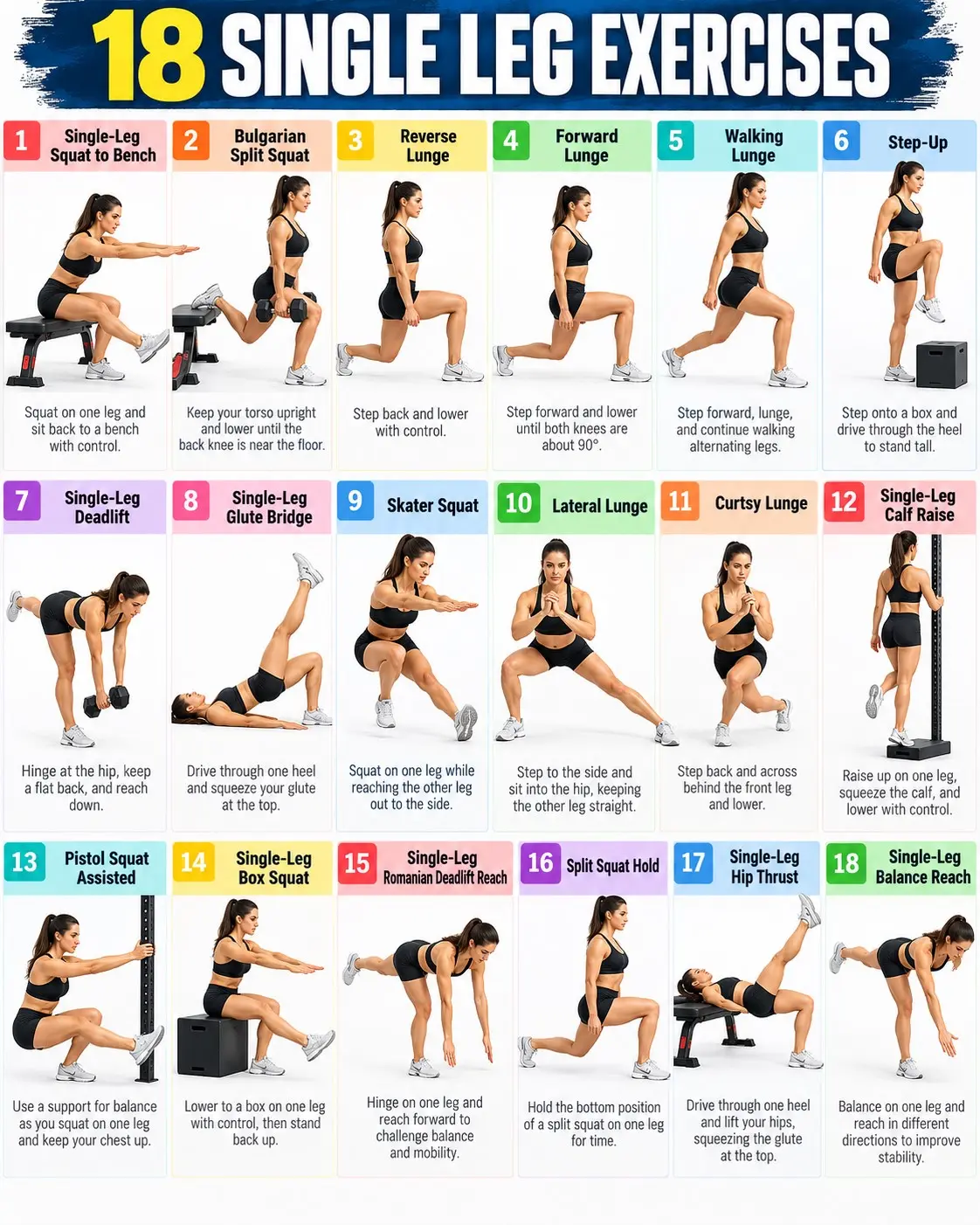
1. Supported Split Squat
This is one of the best starting Single Leg Exercises.
Use a wall, rail, or stable rack for light fingertip support.
- Place one foot forward and one foot behind you.
- Keep most of your pressure through the front leg.
- Lower your body toward the floor.
- Let the front knee bend naturally.
- Push through the front foot to stand.
Support reduces the balance demand, which lets you focus on leg strength.
2. Split Squat
Remove the hand support when you can control the movement.
The split squat trains the quads, glutes, adductors, and other muscles around the hip and knee.
Your front knee does not need to stay directly behind your toes. Allow it to travel forward naturally if the movement is comfortable and controlled.
3. Reverse Lunge
Stand tall and step one leg backward.
Lower both knees, then drive through the front leg to return to standing.
The reverse lunge is easy to scale because you can adjust step length, depth, support, and external weight.
4. Forward Lunge
Step forward and lower under control.
Push through the front foot to return.
A forward lunge adds more deceleration demand than a reverse lunge, so learn the reverse version first if you are new to lunging.
5. Step Up
Choose a stable step or box.
- Place the whole working foot on the step.
- Lean forward slightly if comfortable.
- Drive through the working leg.
- Stand tall on the box.
- Lower with control.
Avoid pushing hard from the trailing leg if your goal is to make the top leg do most of the work.
6. Low Step Down
Stand on a low step with one foot near the edge.
Slowly bend the stance leg and lower the opposite heel toward the floor.
Return to standing without bouncing.
This trains controlled lowering and can help you practice knee control.
7. Bulgarian Split Squat
The Bulgarian split squat elevates the rear foot and lets the front leg work through a large range.
- Stand a comfortable distance in front of a bench.
- Place your rear foot on the bench.
- Lower through the front hip and knee.
- Keep the front foot planted.
- Drive back up.
Do not force a bench height or stance that feels awkward.
Research continues to support the Bulgarian split squat as an effective unilateral resistance exercise capable of improving strength and muscle size when progressively loaded.
8. Kickstand Romanian Deadlift
The kickstand Romanian deadlift is a useful bridge between a regular Romanian deadlift and a true single leg version.
Place most of your weight through the front leg while the toes of the rear foot provide light support.
Push your hips backward, keep your spine controlled, and return by extending the hips.
This lets you load the glutes and hamstrings without making balance the limiting factor.
9. Single Leg Romanian Deadlift
The single leg Romanian deadlift trains the glutes and hamstrings while challenging hip and foot stability.
- Stand on one leg with a small knee bend.
- Push your hips backward.
- Let the free leg travel behind you.
- Keep your hips reasonably square.
- Stop before you lose your back position.
- Return to standing.
Hold a wall lightly if balance prevents you from training the muscles properly.
10. Single Leg Glute Bridge
Lie on your back with one foot planted.
Lift your hips by driving through the stance foot and squeezing the glute.
Keep your pelvis controlled rather than twisting as you rise.
This is a useful home exercise when you have no equipment.
For more posterior chain work, see Hamstring Exercises and Dumbbell Glute Exercises.
11. Single Leg Hip Thrust
Support your upper back on a stable bench and place one foot on the floor.
Lower your hips under control, then extend the hip until your torso and thigh are aligned comfortably.
Avoid excessive lower back arching at the top.
12. Single Leg Calf Raise
Stand near a wall or rail for light support.
Rise onto the ball of one foot, pause briefly, then lower under control.
This trains the calf and ankle on one side.
Use a flat floor first, then progress to a step if you want a larger range and it feels comfortable.
13. Supported Single Leg Squat to Box
Stand in front of a bench or box and shift your weight onto one leg.
Use a rail or suspension trainer if needed.
Lower until you lightly touch the box, then stand again.
Change the box height to scale difficulty.
14. Single Leg Sit to Stand
Sit on a firm chair.
Place one foot on the floor and use the other leg only as much as needed.
Stand up, then sit back down slowly.
This is a practical progression toward a free single leg squat.
15. Lateral Lunge
A lateral lunge is technically a unilateral dominant movement rather than a pure one leg exercise.
Step sideways, sit into one hip, and keep the opposite leg longer.
Push back toward the starting position.
This trains movement in a different plane and places useful demand on the adductors and glutes.
16. Hip Airplane
The hip airplane is primarily a hip control and balance drill.
Stand on one leg, hinge slightly, then slowly rotate your pelvis open and closed without losing control of the stance foot.
Use a wall for support at first.
This is not an exercise where more weight is automatically better.
17. Skater Hop
Hop laterally from one leg to the other and land softly.
Pause long enough to control each landing before jumping again.
This adds single leg power, lateral movement, and landing control.
Do not start here if you are still struggling with basic lunges and step downs.
18. Assisted Pistol Squat
The pistol squat is an advanced deep single leg squat.
There is no reason to force the full version immediately.
Hold a stable post, rail, or suspension trainer and lower only as far as you can control.
Gradually use less assistance or a lower target as strength and mobility improve.
Best Single Leg Exercises by Goal
| Goal | Good Choice | Main Focus |
|---|---|---|
| Beginner strength | Supported split squat | Leg strength without excessive balance demand |
| Quads | Bulgarian split squat | Knee and hip extension |
| Glutes and hamstrings | Single leg Romanian deadlift | Hip hinge strength |
| Balance | Hip airplane | Hip and pelvic control |
| Knee control | Low step down | Controlled lowering |
| Calf and ankle | Single leg calf raise | Calf strength |
| Athletic power | Skater hop | Lateral power and landing control |
| Advanced control | Assisted pistol squat | Deep unilateral squat strength |
Beginner Single Leg Exercises Workout
Beginners can start with four exercises.
| Exercise | Sets | Target |
|---|---|---|
| Supported split squat | 2 | 6 to 10 each leg |
| Low step up | 2 | 6 to 10 each leg |
| Single leg glute bridge | 2 | 8 to 12 each leg |
| Supported calf raise | 2 | 10 to 15 each leg |
Train once or twice each week at first.
Single Leg Strength Workout
If strength is the main goal, do not make every exercise unstable.
Use support when it lets you train the working leg harder.
- Bulgarian split squat: 3 sets of 6 to 10 each leg
- Kickstand Romanian deadlift: 3 sets of 6 to 10 each leg
- Step up: 2 to 3 sets of 8 to 12 each leg
- Single leg calf raise: 3 sets of 10 to 15 each leg
Add resistance gradually when you can complete the upper end of the range with clean form.
Single Leg Exercises for Runners
Running repeatedly puts you on one leg, so unilateral strength work is a logical complement to running.
A useful runner session can include:
- Step up
- Single leg Romanian deadlift
- Split squat
- Single leg calf raise
- Low step down
Single leg training is not a guarantee against running injuries, but it can improve the strength and control used during one leg support.
For running specific programming, see Strength Training for Runners and Running Tips for Beginners.
Single Leg Balance Progression
You do not need to begin on a wobble board.
- Stand on one leg near a wall.
- Stand without touching the wall.
- Add a small knee bend.
- Add a hip hinge.
- Add a controlled reach.
- Add light external weight.
- Add a hop and stable landing if appropriate.
Make only one part harder at a time.
Should You Hold Onto Something?
Yes, if support improves the exercise.
Holding a rack during a split squat or Romanian deadlift is not cheating.
If balance is limiting your ability to challenge the working leg, light support may produce a better strength exercise.
Remove the support when balance itself becomes the training goal.
How Many Single Leg Exercises Should You Do?
Two or three unilateral movements are enough in many lower body workouts.
For example:
- One squat or lunge pattern
- One hip hinge pattern
- One calf, balance, or lateral movement
You do not need 18 movements in the same session.
How Many Sets and Reps Should You Use?
There is no special single leg rep range.
Use the same general resistance training principles you use elsewhere.
| Goal | Practical Starting Range |
|---|---|
| Learning | 5 to 8 controlled reps |
| General strength and muscle | 6 to 15 reps |
| Calf work | 8 to 20 reps |
| Balance | Quality repetitions or timed holds |
| Power | Low rep explosive sets with full control |
How Often Should You Train Single Leg Exercises?
One to three weekly exposures can work depending on your total program.
You may already perform unilateral work during sport, running, stairs, lunges, and other exercise.
If your lower body is very sore or performance keeps dropping, adding more single leg volume is not automatically better.
Should the Weaker Leg Do More Reps?
Not automatically.
A simple starting approach is to begin with the weaker or less coordinated side, then match the same number of good repetitions with the stronger side.
If a large difference persists, targeted programming can sometimes help. Recent asymmetry research suggests that giving the weaker limb greater attention may reduce some interlimb differences, but there is no universal correction formula.
Do Single Leg Exercises Build Muscle?
Yes.
Muscles respond to sufficient resistance and progressive training whether the exercise is unilateral or bilateral.
A 2026 meta analysis found no significant overall hypertrophy advantage for unilateral training compared with bilateral training.
Use whichever movement lets you train the target muscles effectively and progress over time.
Do Single Leg Exercises Burn More Calories?
Do not choose them because of a promised calorie burning advantage.
Energy use depends on load, repetitions, total muscle work, rest, body size, and workout duration.
The main reason to use single leg training is strength, movement specificity, control, and variety.
Are Single Leg Exercises Better for Knee Health?
There is no single exercise that is best for every knee.
Split squats, step ups, step downs, and other unilateral exercises can strengthen muscles around the knee when they are comfortable and appropriately loaded.
But knee pain can come from many conditions.
If an exercise causes increasing pain, swelling, locking, giving way, or loss of function, stop and get appropriate assessment.
Do Single Leg Exercises Prevent Injuries?
Not by themselves.
Injury prevention programs with the best evidence usually combine several elements such as strength, balance, agility, landing practice, and sport specific movement.
A 2025 systematic review of female athletes found that multicomponent neuromuscular programs reduced ACL injury risk, but that evidence should not be turned into a claim that one split squat or balance drill prevents injury.
10 Single Leg Exercises Mistakes
1. Starting With Pistol Squats
Build split squat, step up, and supported squat strength first.
2. Making Every Exercise a Balance Test
Use support when your goal is strength.
3. Using a Bench That Is Too High
Choose a step or rear foot height that lets you control the movement.
4. Forcing the Knee Behind the Toes
The knee can move forward naturally when the foot stays controlled and the position is comfortable.
5. Letting the Trailing Leg Do the Step Up
Drive through the leg on the box instead of bouncing off the floor.
6. Twisting During a Single Leg Deadlift
Slow down and use support if you cannot control your pelvis.
7. Treating Normal Side Differences as a Disease
Small strength differences between sides are common.
8. Training Only One Leg Movements
Squats, deadlifts, and other bilateral exercises still have value.
9. Adding Jumps Before Landing Control
Build strength and stable landings before repeated explosive hopping.
10. Training Through Sharp Pain
Muscular effort is expected. Sharp or worsening joint pain is not a target.
When Should You Stop a Single Leg Exercise?
Stop and seek appropriate medical assessment if you develop:
- Sudden severe pain
- A pop followed by swelling or major weakness
- A knee that locks
- Repeated giving way
- New numbness
- Major swelling
- Loss of normal walking ability
- Severe pain after a fall or impact
Conclusion: Single Leg Exercises
Single Leg Exercises are useful because they let you train one side more independently, build unilateral strength, practice balance, and challenge the hips, knees, ankles, glutes, hamstrings, and calves in ways that complement regular squats and deadlifts.
Start with supported split squats, reverse lunges, step ups, and kickstand deadlifts. Add true single leg hinges, squats, balance drills, and hops only when you can control the simpler versions.
Your next step is simple: choose three exercises from this guide and add them to one lower body workout this week.
References and Sources
- Comparative Effects of Unilateral Versus Bilateral Training on Performance Adaptations: A Systematic Review and Multilevel Meta Analysis. 2026.
https://pubmed.ncbi.nlm.nih.gov/42458613/ - Effects of Unilateral Balance Training on Balance Abilities of the Untrained Leg in Healthy People and Patients With Musculoskeletal Disorders: Systematic Review and Meta Analysis. 2026.
https://pubmed.ncbi.nlm.nih.gov/41818293/ - Are Asymmetry Focused Training Interventions More Effective Than General Programs in Reducing Interlimb Asymmetries and Improving Athletic Performance? Systematic Review. 2026.
https://pubmed.ncbi.nlm.nih.gov/42870065/ - Unilateral Low Load Blood Flow Restriction Versus High Load Bulgarian Split Squat Training: Strength, Hypertrophy, and Performance. 2026.
https://pubmed.ncbi.nlm.nih.gov/41983008/ - Effects of Single Versus Multicomponent Neuromuscular Training on Balance Performance in Recreational Athletes: Systematic Review and Network Meta Analysis. 2026.
https://pubmed.ncbi.nlm.nih.gov/41110466/ - A Biomechanical Review of the Squat Exercise: Implications for Clinical Practice. 2024.
https://pubmed.ncbi.nlm.nih.gov/38576836/ - Prevention Strategies for Lower Extremity Injury: Systematic Review and Meta Analyses for the FAIR Consensus. 2025.
https://pubmed.ncbi.nlm.nih.gov/40645751/
Internal Links + Hub
- NextFitLife Fitness Hub for strength, cardio, mobility, and training guidance.
- Strength Training and Muscle Building for resistance training and progressive overload.
- Leg Exercises at Home for lower body training without a gym.
- Leg Workout with Dumbbells for loaded squats, lunges, and hinges.
- Dumbbell Glute Exercises for hip strength and glute development.
- Hamstring Exercises for posterior chain strength.
- Strength Training for Runners for running specific strength programming.
- Running Tips for Beginners for building a safe running routine.
- Balance Exercises for stability and coordination practice.
- Dumbbell Workouts at Home for complete home resistance workouts.
- Strength Training Exercises at Home for Beginners for simple starting movements.
- Recovery and Injury Prevention for training recovery and pain awareness.
- Benefits of Exercise for the wider effects of regular physical activity.
- Healthy and Active Lifestyle for sustainable exercise, nutrition, sleep, and recovery habits.
About the Author
Adel Galal is a father of four, three sons and a daughter, and a grandfather of four, with 33 years of hands on parenting experience. He is the founder of Parnthub.com, based in Cairo, Egypt, where he shares practical guidance on feeding, development and family life from newborns to teenagers.
Adel is not a medical professional. Health articles cite trusted sources and are for general information only.
On NextFitLife, Adel researches and writes about fitness, strength training, lower body workouts, running, healthy aging, nutrition, and practical wellness habits with a focus on current evidence, safe progression, and realistic expectations.
Learn more about Adel and NextFitLife on the About Us page.
Single Leg Exercises: Frequently Asked Questions
What are the best Single Leg Exercises?
The best Single Leg Exercises for most people include split squats, reverse lunges, step ups, Bulgarian split squats, single leg Romanian deadlifts, single leg bridges, calf raises, and supported single leg squats.
Are Single Leg Exercises better than squats?
No. They train different qualities. Unilateral training is especially useful for unilateral strength and single leg performance, while bilateral training can be better for developing bilateral strength. Both can belong in the same program.
Do Single Leg Exercises improve balance?
Yes, especially when the exercise challenges balance directly. Unilateral balance training can improve balance ability, but strength exercises with heavy support may provide less balance practice.
What is the easiest single leg exercise for beginners?
A supported split squat is a good starting choice because the hand support and staggered stance reduce balance demands while the front leg still performs substantial work.
What is the best single leg exercise for glutes?
Bulgarian split squats, single leg Romanian deadlifts, single leg hip thrusts, and single leg bridges can all train the glutes effectively. The best choice depends on your equipment, comfort, and training goal.
What is the best single leg exercise for hamstrings?
The single leg Romanian deadlift is a strong choice because it trains hip extension and loads the hamstrings in a hip hinge pattern.
Are Bulgarian split squats true Single Leg Exercises?
They are better described as unilateral dominant exercises because the rear foot remains supported. Most of the training demand can still be placed through the front leg.
Are pistol squats necessary?
No. Pistol squats are one advanced option. Split squats, step ups, lunges, and single leg deadlifts can build excellent unilateral strength without ever performing a full pistol squat.
How often should I do Single Leg Exercises?
One to three weekly exposures can work depending on your program. Many people need only two or three unilateral movements within their normal lower body training.
Should I train the weaker leg first?
Starting with the weaker or less coordinated side is a practical strategy. You can then match the same number of controlled repetitions with the stronger leg.
Do Single Leg Exercises fix imbalances?
They can help reduce some strength and performance differences by training each leg independently, but small differences between sides are normal and do not always need correction.
Do Single Leg Exercises build muscle?
Yes. Unilateral exercises can build muscle when they provide enough resistance and progressive overload. Research does not show a universal hypertrophy advantage over bilateral exercises.
Are Single Leg Exercises good for runners?
Yes. Running repeatedly involves one leg support, so step ups, split squats, single leg deadlifts, calf raises, and other unilateral movements can complement a running program.
Do Single Leg Exercises prevent injuries?
No single exercise guarantees injury prevention. Strength and balance work can be useful parts of broader neuromuscular programs that also include agility, landing skills, and sport specific training.
Should I hold onto something during Single Leg Exercises?
Yes when support helps you train the target muscles more effectively. Use less support when balance itself becomes the training goal.
When should I stop a single leg exercise?
Stop for sudden severe pain, major swelling, locking, repeated giving way, a pop followed by weakness, new numbness, or loss of normal walking ability.

Health & wellness writer with 30+ years of experience in nutrition, fitness, and healthy aging. Founder of NextFitLife.com — evidence-based health guidance.

