
Published on: January 29, 2024
Updated on: October 25, 2026
Arm Workouts for Women do not need tiny pink dumbbells, hundreds of repetitions, or a special female training method. Women build stronger arms through the same basic process that works across adulthood: train the muscles with enough resistance, recover, and gradually make the work harder.
A complete arm routine should also train more than the biceps. Your triceps, shoulders, upper back, forearms, and grip all contribute to stronger arms and better daily function.
This updated guide gives you 20 useful exercises, home options, dumbbell and band variations, beginner programming, progression rules, and a clear explanation of what “toning” really means.
This article is for general information and education. It does not replace medical advice, diagnosis, or treatment.
I am not a dermatologist or a doctor, and this content does not replace professional medical advice. What I share comes from real-life experience, extensive research, and consultation with healthcare providers. Always consult qualified medical professionals for diagnosis and treatment of any health condition.
For broader training guidance, visit the NextFitLife Fitness Hub, Strength Training and Muscle Building Guide, and Upper Body Workout for Women.
Table of Contents
- Arm Workouts for Women: Quick Answer
- What Muscles Should You Train?
- Do Women Need Different Strength Training?
- What Toned Arms Really Mean
- How Heavy Should You Lift?
- 20 Arm Exercises for Women
- Biceps exercises
- Triceps exercises
- Shoulder exercises
- Back and arm exercises
- Grip and forearm exercises
- Beginner Arm Workout
- Dumbbell Arm Workout
- 10 Minute Home Workout
- Sets, Reps, and Frequency
- How to Progress
- Common Mistakes
- Frequently Asked Questions
- References and Sources
Arm Workouts for Women: Quick Answer
The best Arm Workouts for Women combine pushing, pulling, curling, extending, raising, and carrying movements.
A simple balanced routine can include:
- Dumbbell biceps curl
- Hammer curl
- One-arm dumbbell row
- Wall or incline push-up
- Overhead triceps extension
- Dumbbell shoulder press
- Lateral raise
- Farmer carry
You do not need to perform all 20 exercises in one workout.
Choose about five to eight movements that cover the main upper body patterns, then improve them gradually over time.
Why Arm Workouts for Women Matter Beyond Appearance
Stronger arms make everyday tasks easier.
You use your upper body when you carry shopping, lift a suitcase, put something on a shelf, push a heavy door, move furniture, carry a child, or support yourself while getting up.
Resistance training also improves much more than the appearance of one body part.
The 2026 American College of Sports Medicine position stand reviewed 137 systematic reviews covering more than 30,000 people. Resistance training improved strength, muscle size, power, muscular endurance, balance, gait speed, and several measures of physical function.
A separate 2026 systematic review of 126 studies involving 4,019 women found meaningful improvements in strength across both premenopausal and postmenopausal women.
That is why upper body strength deserves a place in a complete fitness plan at every adult age.
Do Women Need a Different Strength Training Method?
Not in the way fitness marketing often suggests.
Women do not need endless repetitions with tiny weights because they are women.
A 2026 meta analysis concluded that general resistance training guidelines appear applicable to women across the lifespan, with individualization more useful than rigid sex specific rules.
Earlier research comparing men and women also found similar relative muscle growth responses to resistance training, while women showed strong relative gains in upper body strength.
The better questions are:
- What is your current training level?
- What movements can you perform comfortably?
- What equipment do you have?
- Is your goal strength, muscle growth, endurance, or general function?
- How much training can you recover from?
Your answers should determine the program more than your sex.
What Does “Toning” Your Arms Really Mean?
There is no special toning mode inside a muscle.
The visible look usually described as muscle definition or “toned arms” comes from some combination of:
- Developing arm and shoulder muscle
- Having enough overall body fat reduction for that muscle to become visible
- Genetics and normal body fat distribution
Curls can strengthen your biceps.
Triceps exercises can strengthen the back of your arms.
Neither exercise gets to choose exactly where stored body fat leaves first.
A strong plan therefore combines resistance training with appropriate nutrition, daily activity, sleep, and cardio if fat loss is also a goal.
Do You Need Light Weights?
No.
You need a resistance that fits the exercise and your current strength.
A lateral raise normally uses much less weight than a row because the movement and muscles are different.
Likewise, a beginner may need a lighter dumbbell than someone who has trained for five years.
The correct weight is the one you can control while the set becomes meaningfully challenging.
If you can perform every repetition easily and could keep going for many more, the exercise may be too easy to drive much progress.
If you need to swing, twist, shrug, or lose your normal position just to lift the weight, reduce it.
Is 8 to 12 Reps the Best Range?
It is useful, but it is not magic.
Research comparing resistance training prescriptions shows that many rep and load combinations can build muscle.
Heavier resistance has a clearer advantage when maximal strength is the main goal. For muscle hypertrophy, multiple training approaches can work when the muscles receive enough total training.
For a home workout, practical rep ranges might look like this:
| Goal | Practical Range | Main Focus |
|---|---|---|
| Learning form | 6 to 10 controlled reps | Movement quality |
| General muscle and strength | 6 to 15 reps | Progressive resistance |
| Lighter band or raise work | 10 to 20 reps | Control and local fatigue |
| Strength emphasis | Lower reps with heavier resistance | High force production |
You do not need to take every set to complete failure.
The 2026 ACSM position stand found that training to momentary muscular failure did not consistently improve outcomes for the average healthy adult.
What Equipment Do You Need?
Very little.
Useful options include:
- Dumbbells
- Resistance bands
- A stable chair or bench
- A wall or countertop
- Body weight
The 2026 ACSM guidance specifically notes that resistance bands, bodyweight exercise, and home-based training can produce meaningful improvements in strength, muscle size, and physical function.
You do not need a commercial gym to get stronger.
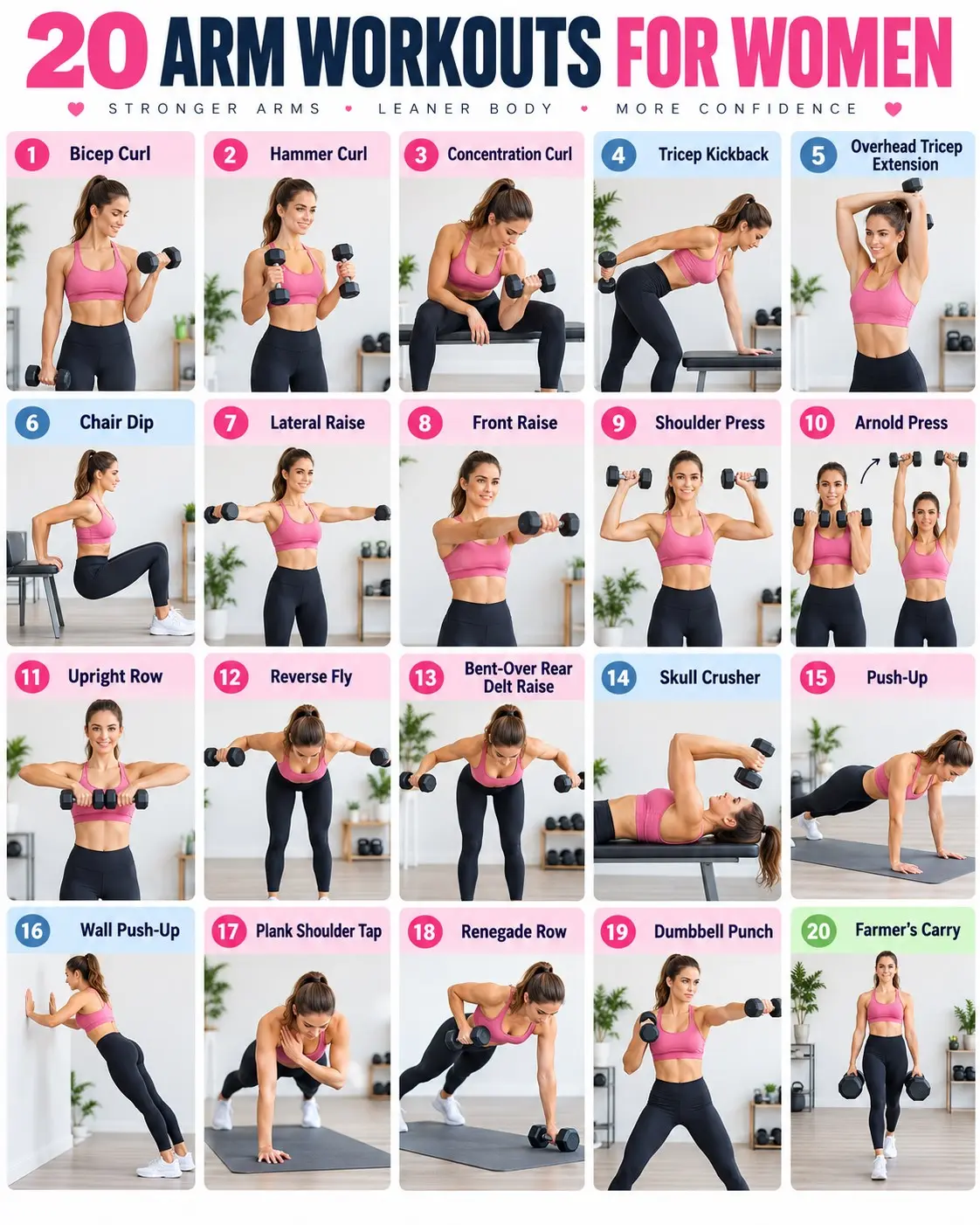
20 Arm Workouts for Women should train the biceps, triceps, shoulders, back, forearms, and grip with progressive resistance rather than endless light curls.
1. Dumbbell Biceps Curl
This classic curl trains the biceps at the front of the upper arm.
- Stand tall with a dumbbell in each hand.
- Keep your elbows close to your sides.
- Turn your palms forward.
- Curl the weights without swinging your body.
- Lower them under control.
Start with 8 to 15 controlled repetitions.
2. Hammer Curl
The hammer curl trains the elbow flexors with a neutral grip and places useful demand on the brachialis and brachioradialis as well as the biceps.
- Hold the dumbbells with your palms facing each other.
- Keep your elbows near your ribs.
- Curl upward.
- Lower slowly.
For more biceps variations, see Bicep Workouts with Dumbbells.
3. Incline or Supported Curl
Sit against a supportive chair or bench if available.
Keeping the torso stable can reduce the temptation to swing the weights.
Curl smoothly, then lower through a comfortable range.
4. Concentration Curl
This unilateral curl makes it easy to focus on one arm at a time.
- Sit on a stable chair.
- Hold one dumbbell.
- Support the upper arm near the inner thigh.
- Curl without moving the shoulder forward.
- Lower with control.
5. Reverse Curl
A reverse curl uses a palms down grip and increases the contribution of the forearms and brachioradialis.
Use less weight than you would for a standard curl.
Keep your wrists controlled rather than letting them fold backward.
6. Overhead Triceps Extension
This movement trains the triceps, including the long head in a lengthened overhead position.
- Hold one dumbbell securely with both hands.
- Bring it overhead.
- Bend your elbows to lower the weight behind your head.
- Extend your elbows to return.
Use a range that is comfortable for your shoulders.
7. One Arm Overhead Triceps Extension
The one arm version lets you train each side separately.
Use a light enough dumbbell to control the elbow position throughout the set.
Do not force the movement if overhead positions aggravate your shoulder.
8. Triceps Kickback
A kickback works the triceps with the arm extended behind the body.
- Hinge forward slightly.
- Keep your upper arm near your torso.
- Straighten the elbow.
- Pause briefly.
- Return under control.
This usually requires a lighter dumbbell than an overhead extension.
9. Close Grip Incline Push Up
Use a wall, countertop, bench, or another stable raised surface.
A narrower hand position can increase the contribution from the triceps while the chest and shoulders still work.
- Place your hands on the stable surface.
- Keep your body in a straight comfortable line.
- Lower under control.
- Press back up.
10. Dumbbell Shoulder Press
The shoulder press trains the shoulders and triceps while teaching you to press resistance overhead.
Stand or sit tall, press the dumbbells overhead, then lower them under control.
Avoid turning the movement into a large backward lean.
11. Dumbbell Lateral Raise
Lateral raises train the side of the shoulders.
Use light resistance and move with control.
Lift the arms outward through a comfortable range, then lower slowly.
You do not need to force the dumbbells far above shoulder level.
12. Rear Delt Raise
Training the back of the shoulders balances the pressing and curling in an arm workout.
Hinge forward slightly and raise light dumbbells outward without jerking.
For more options, see Rear Delt Exercises with Dumbbells.
13. Band Pull Apart
This is a simple resistance band exercise for the upper back and rear shoulders.
- Hold the band in front of you.
- Keep a small bend in your elbows.
- Pull your hands apart.
- Bring the shoulder blades back gently.
- Return under control.
Do not let the band snap back.
14. One Arm Dumbbell Row
A row belongs in a good arm workout because your biceps work with the muscles of the upper back.
- Support one hand on a stable chair or bench.
- Hold the dumbbell in the opposite hand.
- Keep your torso controlled.
- Pull the weight toward your hip or lower ribs.
- Lower smoothly.
This is one of the most useful dumbbell exercises for building pulling strength at home.
15. Resistance Band Row
A band row provides a home friendly alternative when dumbbells are limited.
Anchor the band securely according to its instructions.
Pull your elbows back, pause briefly, and return slowly.
Never attach a band to an unstable object.
16. Dumbbell Floor Press
The floor press trains the chest and triceps without requiring a bench.
- Lie on the floor with your knees bent.
- Hold the dumbbells above your chest.
- Lower until your upper arms contact the floor gently.
- Press the weights upward.
For more chest work, see Chest Exercises with Dumbbells.
17. Wall or Incline Push Up
This is an excellent bodyweight option.
Use a wall for the easiest version, then progress toward a countertop, lower bench, and eventually the floor if appropriate.
The chest, shoulders, triceps, and core all contribute.
18. Farmer Carry
The farmer carry builds grip strength, forearms, shoulder stability, posture, and trunk control.
- Hold one dumbbell in each hand.
- Stand tall.
- Walk normally for 20 to 60 seconds.
- Keep breathing rather than holding your breath.
If space is limited, march slowly in place.
19. Suitcase Carry
Hold one dumbbell on one side instead of two.
Your arm, grip, shoulder, and trunk all have to manage the uneven load.
Walk for a short controlled distance, then change sides.
20. Wrist Extension and Flexion
Direct forearm training can complement curls, rows, and carries.
Support your forearm and move the wrist slowly through a comfortable range using a light dumbbell.
Train both the palm up and palm down positions if they feel comfortable.
For additional grip and forearm work, see Best Forearm Exercises.
Best Arm Exercises by Goal
| Goal | Good Choices | Main Focus |
|---|---|---|
| Biceps | Curl, hammer curl, concentration curl | Elbow flexion strength |
| Triceps | Overhead extension, incline push up, floor press | Elbow extension strength |
| Shoulders | Shoulder press, lateral raise, rear delt raise | Shoulder strength and muscle |
| Upper back | Dumbbell row, band row, pull apart | Pulling strength |
| Grip | Farmer carry, suitcase carry | Hands and forearms |
| Home training | Push up, band row, curls, carries | Minimal equipment |
Beginner Arm Workouts for Women
Start with one or two sets of each exercise.
| Exercise | Sets | Reps |
|---|---|---|
| Wall or incline push up | 1 to 2 | 6 to 12 |
| One arm dumbbell row | 1 to 2 | 8 to 12 each arm |
| Biceps curl | 1 to 2 | 8 to 15 |
| Overhead triceps extension | 1 to 2 | 8 to 15 |
| Lateral raise | 1 to 2 | 10 to 15 |
| Farmer carry | 2 | 20 to 40 seconds |
Use this routine about twice per week at first.
Leave enough recovery between sessions for your arms and shoulders to feel ready again.
Dumbbell Arm Workout for Women
If you already know the basic movements, use this slightly larger session:
- Dumbbell floor press: 3 sets of 6 to 12 reps
- One arm dumbbell row: 3 sets of 8 to 12 each side
- Shoulder press: 2 to 3 sets of 6 to 12 reps
- Hammer curl: 2 to 3 sets of 8 to 15 reps
- Overhead triceps extension: 2 to 3 sets of 8 to 15 reps
- Lateral raise: 2 sets of 10 to 20 reps
- Farmer carry: 2 to 3 controlled carries
Do not turn every set into a maximal effort.
Use loads that challenge you while your form remains controlled.
10 Minute Arm Workout for Busy Days
Short sessions still count.
| Minute | Exercise |
|---|---|
| 1 | Gentle warm up |
| 2 | Incline push ups |
| 3 | Dumbbell rows |
| 4 | Biceps curls |
| 5 | Rest or easy movement |
| 6 | Overhead triceps extensions |
| 7 | Lateral raises |
| 8 | Hammer curls |
| 9 | Farmer carry or march |
| 10 | Easy cool down |
Work at your own pace rather than racing the clock.
How Often Should Women Train Their Arms?
Two upper body sessions each week is a practical starting point for many people.
CDC guidance recommends muscle strengthening activity involving all major muscle groups on at least two days each week.
Your arms also work indirectly during:
- Rows
- Push ups
- Chest presses
- Shoulder presses
- Pulling exercises
- Carries
You therefore do not need a separate arm day every day.
How Much Training Volume Do You Need?
More is not endlessly better.
The 2026 ACSM position stand found that greater weekly training volume can support muscle growth, with around 10 weekly sets per muscle group used as a practical reference for maximizing hypertrophy.
A separate 2026 dose response meta analysis also found that strength and muscle gains tend to increase with greater weekly volume, but the benefit shows diminishing returns.
Beginners do not need to start at the high end.
A few good sets, repeated consistently, are more useful than a huge workout that leaves you too sore to train again.
How to Use Progressive Overload
Progressive overload simply means making training gradually more demanding as your body adapts.
You can progress by:
- Adding a little weight
- Performing another repetition
- Adding a set
- Using a stronger resistance band
- Moving through a larger comfortable range
- Progressing from wall push ups to a lower surface
You do not need to change everything at once.
For example, if you perform three sets of 10 curls with good control and the weight becomes easy, try 11 or 12 repetitions. When that also becomes comfortable, increase the dumbbell slightly and return to a lower rep count.
Should Women Train to Failure?
No.
You can build strength and muscle without forcing every set until another repetition is physically impossible.
The 2026 ACSM evidence review found that training to momentary muscular failure did not consistently improve outcomes.
Stopping a set while you still have one or several good repetitions available can be a sensible approach, especially for beginners.
Can Arm Workouts Reduce Arm Fat?
Arm exercises strengthen and build the muscles underneath the fat layer.
They do not reliably tell your body to remove fat from the exact area being exercised.
Body fat changes are influenced by overall energy balance, genetics, hormones, diet, physical activity, and time.
There is some emerging research suggesting localized exercise might affect nearby fat tissue under specific experimental conditions, but this evidence is limited and should not be turned into a promise that curls will selectively remove arm fat.
For practical fitness advice, build the arm muscle while managing overall body composition through a complete plan.
Arm Workouts for Women After Menopause
Resistance training remains useful after menopause.
A 2026 systematic review and meta analysis covering 4,019 women found substantial strength improvements in both premenopausal and postmenopausal groups.
A separate 2026 meta analysis of 60 studies in postmenopausal women found favorable changes in several cardiovascular measures following resistance training.
The lesson is simple: age does not make upper body strength work pointless.
It makes preserving strength and physical function increasingly useful.
Do You Need Special Arm Workouts After 50?
You need appropriate training, not a completely different biological rulebook.
The exercises can remain familiar:
- Rows
- Presses
- Curls
- Triceps extensions
- Raises
- Carries
What may change is how you select resistance, recover, manage joint symptoms, or work around medical conditions.
Individualization matters more than an arbitrary age cutoff.
Should You Warm Up Your Arms First?
A warm up does not need to take 15 minutes.
Start with a few minutes of easy movement, then perform lighter versions of the first exercises you plan to train.
For example, before a heavier shoulder press, perform an easy set with lighter dumbbells.
This prepares you more specifically than doing endless arm circles.
10 Common Arm Workout Mistakes
1. Using Weights That Are Always Too Light
Light resistance can work when the set becomes challenging, but endlessly repeating an easy weight gives the muscles little reason to adapt.
2. Using Weights That Are Too Heavy
If you need to throw the dumbbells upward or twist your body, reduce the load.
3. Training Only the Biceps
Your triceps, shoulders, back, and forearms matter too.
4. Skipping Pulling Exercises
Rows and rear shoulder exercises balance pressing and curling movements.
5. Chasing the Burn Instead of Progress
A burning sensation does not tell you whether your program is improving over time.
6. Training Arms Every Day
More sessions are not automatically better. Muscles need recovery too.
7. Treating 8 to 12 Reps as a Law
Useful training occurs across a broader range of repetitions and loads.
8. Believing Sweating Means Fat Is Leaving Your Arms
Sweating regulates body temperature. It does not show which fat store is being used.
9. Changing the Routine Every Week
You need enough consistency to improve the exercises you are doing.
10. Training Through Sharp Pain
Muscular effort is expected. Sharp or worsening joint pain is not a training goal.
When Should You Stop Exercising?
Stop the workout and seek appropriate medical advice if you develop:
- Chest pain or pressure
- Fainting
- Severe or unusual shortness of breath
- Sudden weakness
- Severe dizziness
- Persistent numbness or tingling
- Sudden severe shoulder, elbow, or wrist pain
- A joint that suddenly loses normal function
If you have recent surgery, significant cardiovascular disease, an active injury, or another health condition affecting exercise, ask an appropriate healthcare professional about individual restrictions.
Conclusion: Arm Workouts for Women
Arm Workouts for Women work best when they stop being treated as a special category of tiny weights and endless repetitions.
Train your biceps, triceps, shoulders, back, forearms, and grip. Choose resistance that challenges you, improve it gradually, and give yourself time to recover.
Your next step is simple: choose six exercises from this guide, perform one or two controlled sets today, and write down the weight and repetitions so you have something real to improve next time.
References and Sources
- American College of Sports Medicine Position Stand. Resistance Training Prescription for Muscle Function, Hypertrophy, and Physical Performance in Healthy Adults. 2026.
https://pubmed.ncbi.nlm.nih.gov/41843416/ - American College of Sports Medicine. Updated Resistance Training Guidelines. 2026.
https://acsm.org/resistance-training-guidelines-update-2026/ - It's Never Too Late: The Impact of Resistance Training on Strength and Body Composition in Females Across the Lifespan. Systematic Review and Meta Analysis. 2026.
https://pubmed.ncbi.nlm.nih.gov/41963141/ - Resistance Training Prescription for Muscle Strength and Hypertrophy in Healthy Adults: Systematic Review and Bayesian Network Meta Analysis.
https://pubmed.ncbi.nlm.nih.gov/37414459/ - The Resistance Training Dose Response: Effects of Weekly Volume and Frequency on Muscle Hypertrophy and Strength Gains. 2026.
https://pubmed.ncbi.nlm.nih.gov/41343037/ - The Effect of Resistance Training in Women on Dynamic Strength and Muscular Hypertrophy: Systematic Review With Meta Analysis.
https://pubmed.ncbi.nlm.nih.gov/31820374/ - Centers for Disease Control and Prevention. Physical Activity Recommendations for Adults.
https://www.cdc.gov/physical-activity-basics/guidelines/adults.html
Internal Links + Hub
- NextFitLife Fitness Hub for strength, cardio, mobility, and workout guidance.
- Strength Training and Muscle Building Guide for progressive resistance training.
- Home Workouts and Equipment Guide for training outside a commercial gym.
- Fitness for Beginners for simple ways to start exercising.
- Upper Body Workout for Women for complete upper body training.
- Bicep Workouts with Dumbbells for focused elbow flexor training.
- Arm Workouts with Weights for additional weighted arm exercises.
- Arm Workouts for a larger exercise library covering biceps, triceps, shoulders, and grip.
- Best Forearm Exercises for grip and forearm development.
- Chest Exercises with Dumbbells for pressing strength.
- Rear Delt Exercises with Dumbbells for rear shoulder strength.
- Effective Workout Routines for Women for full body programming.
- Effective Workout Routines at Home for simple home strength plans.
- Healthy and Active Lifestyle for sustainable movement, recovery, sleep, and nutrition habits.
- Physical Fitness and Mental Health for the wider effects of regular activity.
About the Author
Adel Galal is a father of four, three sons and a daughter, and a grandfather of four, with 33 years of hands on parenting experience. He is the founder of Parnthub.com, based in Cairo, Egypt, where he shares practical guidance on feeding, development and family life from newborns to teenagers.
Adel is not a medical professional. Health articles cite trusted sources and are for general information only.
On NextFitLife, Adel researches and writes about strength training, home workouts, fitness, nutrition, healthy aging, and practical wellness habits with a focus on current evidence, realistic expectations, and sustainable progress.
Learn more about Adel and NextFitLife on the About Us page.
Arm Workouts for Women: Frequently Asked Questions
What are the best Arm Workouts for Women?
The best Arm Workouts for Women include both direct arm exercises and larger upper body movements. Useful choices include curls, rows, push ups, shoulder presses, triceps extensions, lateral raises, rear delt raises, and farmer carries.
Can women build strong arms at home?
Yes. Dumbbells, resistance bands, bodyweight exercises, and home based resistance training can all build strength and muscle when the exercises become progressively more challenging.
How often should women train their arms?
Two upper body sessions each week is a useful starting point for many women. Your arms also work during rows, presses, push ups, and carries, so direct arm training every day is unnecessary.
How many exercises should an arm workout contain?
Most people do not need 20 exercises in one session. About five to eight well chosen movements can cover pressing, pulling, biceps, triceps, shoulders, and grip.
What weight should women use for arm exercises?
Use a resistance you can control while the set becomes meaningfully challenging. Increase the weight gradually when your current load becomes easy at the target repetition range.
Do women need to use light weights?
No. The appropriate weight depends on your strength, the exercise, your goal, and your ability to control the movement. Women can train with light, moderate, or heavy resistance when appropriate.
Will heavy weights make women bulky?
Resistance training can build muscle, but substantial muscle growth takes consistent training, sufficient volume, nutrition, and time. Accidentally becoming dramatically muscular from normal strength training is not a realistic concern for most women.
Are 8 to 12 reps best for women?
No single repetition range is mandatory. Eight to twelve reps is practical, but muscle and strength can improve across several repetition and loading ranges. Heavier loads have a clearer advantage when maximal strength is the main goal.
Do Arm Workouts for Women reduce arm fat?
Arm exercises strengthen and build arm muscles but do not reliably control where body fat is lost first. Overall body composition depends on energy balance, nutrition, activity, genetics, and other factors.
What does toning the arms mean?
Toned arms are not a separate type of muscle adaptation. The appearance usually reflects developed arm and shoulder muscles combined with a body fat level that allows some muscle definition to show.
Should women train arms every day?
No. Your muscles need recovery between challenging sessions. Most people can make good progress with two or three weekly upper body exposures depending on total training volume.
Do I need to train to failure?
No. The 2026 ACSM evidence review found that training to complete momentary muscular failure did not consistently improve results. Challenging sets that stop before technique breaks down can work very well.
Are resistance bands good for Arm Workouts for Women?
Yes. Current resistance training guidance supports elastic bands as an effective home training tool when they provide enough resistance and are progressed over time.
Are Arm Workouts for Women useful after menopause?
Yes. A 2026 meta analysis found substantial strength improvements in both premenopausal and postmenopausal women. Resistance training remains valuable for muscle, strength, and physical function across adulthood.
How long does it take to get stronger arms?
There is no universal timeline. Progress depends on your starting level, training quality, resistance, weekly volume, nutrition, recovery, and consistency. Track improvements in repetitions, resistance, and exercise control instead of relying on a fixed deadline.
When should I stop an arm workout?
Stop for chest pain, fainting, severe or unusual shortness of breath, sudden weakness, persistent numbness, severe dizziness, or sudden sharp joint pain. Seek appropriate medical advice when symptoms are concerning or persistent.

Health & wellness writer with 30+ years of experience in nutrition, fitness, and healthy aging. Founder of NextFitLife.com — evidence-based health guidance.

