
Published on: Jul 17, 2024
Updated: November 1, 2026
Grip Strength Exercises can make your hands, fingers, wrists, and forearms stronger, but a good grip program is about more than squeezing a hand gripper.
Your grip works in different ways.
You squeeze. You hold. You pinch. You carry. You hang. You also need strong wrist and finger muscles to keep the hand stable.
That is why the best grip workout trains several types of grip instead of doing the same squeeze hundreds of times.
This article is for general information and education. It does not replace medical advice, diagnosis, or treatment.
Quick answer: Good Grip Strength Exercises include farmer carries, bar holds, dead hangs, plate pinches, hand grippers, thick handle holds, wrist rollers, wrist curls, wrist extensions, hammer rotations, finger extensions, towel holds, suitcase carries, and ball squeezes. Train two or three times per week, start with manageable resistance, and increase load or time slowly.
Hand and wrist safety: Stop training if you feel sharp pain, sudden weakness, numbness, tingling, finger locking, or pain that keeps getting worse. Seek medical assessment after a hand or wrist injury, or if numbness and weakness affect daily tasks. Grip training should feel challenging in the muscles, not painful in the joints or tendons.
Table of Contents
- Why grip strength matters
- The five types of grip strength
- 14 Grip Strength Exercises
- Farmer carry
- Barbell or dumbbell hold
- Dead hang
- Plate pinch
- Hand gripper squeeze
- Thick handle hold
- Towel hold
- Suitcase carry
- Wrist roller
- Wrist curl
- Wrist extension
- Hammer rotation
- Finger extension
- Ball squeeze
- Beginner grip workout
- Six week grip strength plan
- How often to train grip
- How to progress safely
- Dead hangs and pull ups
- Grip training for athletes
- Grip strength after 50
- Common mistakes
- Frequently asked questions
Why Grip Strength Matters
Your hands connect your body to almost every weight you lift.
A stronger grip can make it easier to hold:
- Dumbbells
- Barbells
- Pull up bars
- Kettlebells
- Grocery bags
- Tools
- Sports equipment
Grip strength also matters during normal daily tasks such as opening containers, carrying bags, gardening, and moving objects around the home.
In sport, grip can be important for climbing, gymnastics, grappling, racquet sports, weightlifting, powerlifting, strongman events, and many field sports.
However, stronger grip should not be described as a guarantee against hand, wrist, or elbow injury.
Injuries depend on many factors, including training load, technique, tissue health, previous injury, sport demands, and recovery.
What Does the Research Say About Grip Training?
A 2025 systematic review included 22 randomized trials and more than 1,000 adults.
Focused hand strength and proprioceptive training produced a small to moderate average improvement in hand grip strength.
Benefits were especially clear in older adults, although the researchers noted that the studies used many different training methods.
That means one “perfect” grip exercise has not been proven.
The better lesson is simple.
Train the type of grip you want to improve, use progressive resistance, and practice often enough to adapt without irritating the hands or forearms.
The Five Types of Grip Strength
You do not use your hands in only one way.
1. Crush Grip
Crush grip is the action of closing your fingers toward your palm.
Examples include:
- Squeezing a hand gripper
- Crushing a soft ball
- Gripping a dumbbell handle
2. Support Grip
Support grip means holding an object for time.
Examples include:
- Farmer carries
- Dead hangs
- Heavy bar holds
This type matters when your grip fails before your back or legs during pulling exercises.
3. Pinch Grip
Pinch grip uses your thumb against the fingers.
Plate pinches are the classic example.
This grip is different from wrapping your whole hand around a handle.
4. Open Hand Grip
Open hand grip challenges you to hold an object without being able to close your fingers completely.
Thick handles and large objects are common examples.
5. Wrist and Forearm Strength
Your grip is supported by the muscles that control your wrist and forearm.
Training only finger flexion while ignoring wrist extension and rotation can leave your program incomplete.
14 Proven Grip Strength Exercises
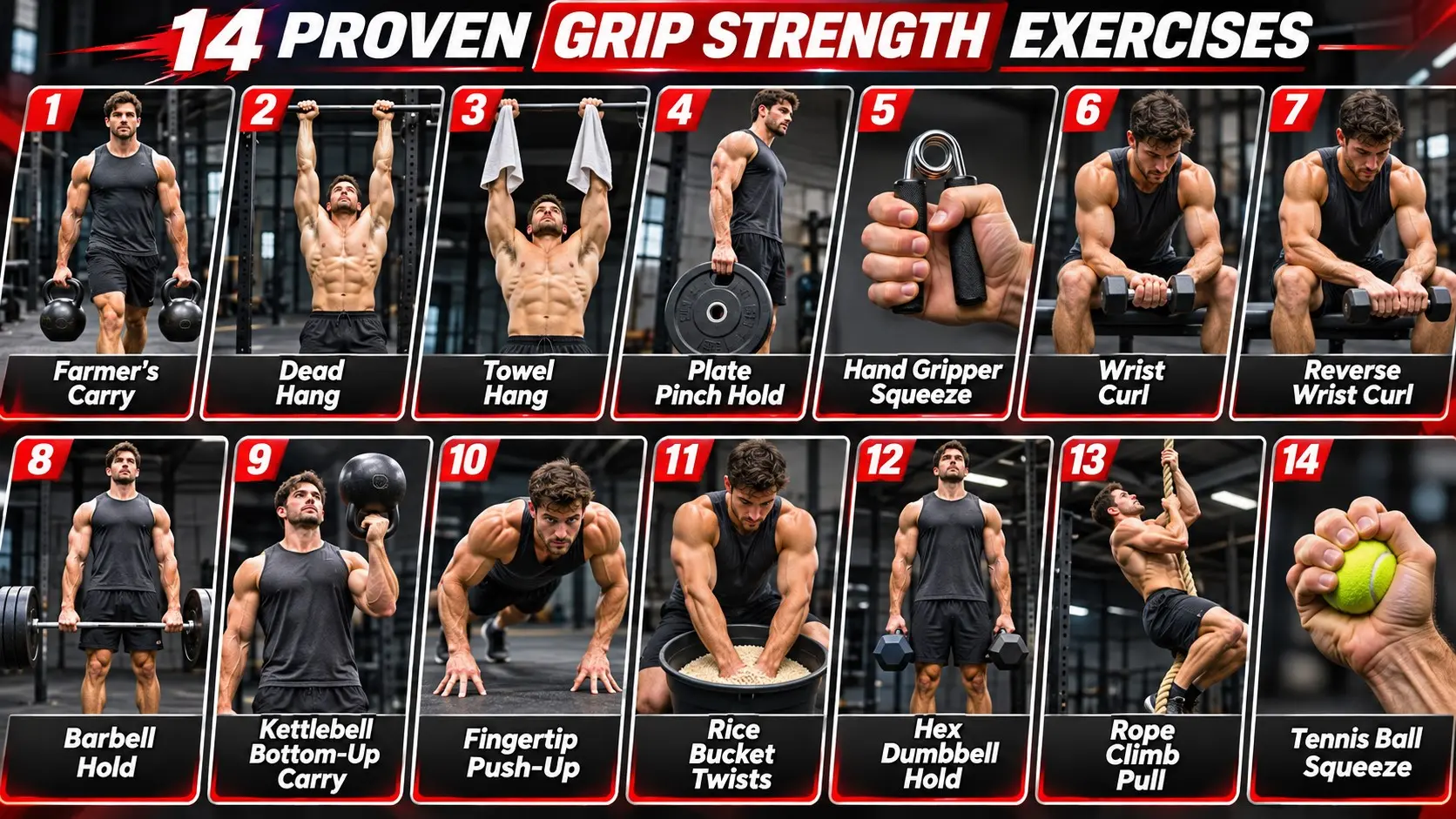
1. Farmer Carry
The farmer carry is one of the simplest ways to train support grip.
It also trains your trunk, shoulders, and legs.
How to do it:
- Stand between two dumbbells or kettlebells.
- Pick them up using good lifting form.
- Stand tall.
- Walk through a clear space.
- Keep the weights under control.
- Set them down carefully.
Beginner target: 20 to 30 seconds.
Sets: 2 to 3.
When you can carry the load comfortably, increase either the weight or the time.
Do not increase both at once.
2. Barbell or Dumbbell Hold
This is a simple way to train static grip strength.
You can hold a loaded barbell in a rack or use heavy dumbbells.
How to do it:
- Pick up the load safely.
- Stand tall.
- Hold the weight without letting your fingers open.
- Set it down before your form breaks.
Beginner target: 15 to 30 seconds.
This exercise is useful if your hands often fail during deadlifts or heavy rows.
3. Dead Hang
A dead hang trains support grip while your body hangs from a pull up bar.
It is more demanding than holding dumbbells because you are supporting much of your body weight.
Beginner version:
- Use a stable pull up bar.
- Grip the bar with both hands.
- Keep your feet lightly on a box or the floor.
- Allow only as much body weight as you can control.
Start with: 10 to 20 seconds.
Progress to a full hang only when your shoulders, elbows, hands, and grip tolerate the supported version.
Do not force long hangs through shoulder pain.
4. Plate Pinch
The plate pinch is a classic pinch grip exercise.
How to do it:
- Stand two weight plates together if needed.
- Pinch them between your thumb and fingers.
- Keep your arm by your side.
- Hold for time.
- Switch hands.
Start with: 10 to 20 seconds.
Use light plates until you understand the grip.
Do not let plates fall onto your feet.
5. Hand Gripper Squeeze
A hand gripper mainly trains crush grip.
It can be useful, but it should not be your entire grip program.
How to do it:
- Place the gripper correctly in your palm.
- Close it using your fingers.
- Pause briefly.
- Open under control.
Start with: 8 to 15 controlled repetitions.
Use a resistance you can close cleanly.
A gripper that barely moves is usually too hard for normal training.
6. Thick Handle Hold
A thick handle challenges open hand grip because your fingers cannot wrap as tightly around it.
You can use:
- Thick grip attachments
- A thick bar
- A suitably sized dumbbell handle attachment
Hold a moderate weight for 10 to 30 seconds.
Thick grip work can become difficult quickly, so reduce the load compared with your normal bar hold.
7. Towel Hold
A towel creates a different grip challenge because the material compresses.
A safer beginner version does not require towel pull ups.
Try this:
- Wrap a strong towel around a cable handle or other safe anchor.
- Hold one end in each hand.
- Pull or hold with controlled tension.
You can later progress to supported towel hangs.
Full towel pull ups are advanced and are not required for strong hands.
8. Suitcase Carry
The suitcase carry is like a farmer carry with weight on only one side.
This trains your grip while your trunk works to keep you upright.
How to do it:
- Hold one dumbbell or kettlebell.
- Stand tall.
- Walk without leaning toward the weight.
- Switch sides.
Start with: 20 seconds per side.
9. Wrist Roller
A wrist roller trains the forearms through repeated wrist movement.
How to do it:
- Hold the roller with both hands.
- Keep the weight light at first.
- Roll the rope upward using the wrists.
- Lower it slowly.
One complete trip up and down can be enough for a beginner set.
The forearms can fatigue quickly.
10. Wrist Curl
Wrist curls train the wrist flexor muscles on the palm side of the forearm.
How to do it:
- Rest your forearm on a bench or thigh.
- Hold a light dumbbell with your palm facing upward.
- Move the wrist through a comfortable range.
- Lower slowly.
Start with: 10 to 15 repetitions.
A light dumbbell is usually enough.
11. Wrist Extension
Do not train only the muscles that close the hand.
Wrist extensors help control the opposite side of the forearm.
How to do it:
- Support your forearm.
- Hold a very light dumbbell with your palm facing down.
- Lift the back of the hand gently.
- Lower under control.
Start with: 10 to 15 repetitions.
You will usually need much less weight than you use for a wrist curl.
12. Hammer Rotation
Your forearm also rotates.
This movement is called pronation and supination.
A hammer, light club, or adjustable dumbbell can provide resistance.
How to do it:
- Hold the handle upright.
- Keep your elbow close to your body.
- Rotate slowly inward.
- Return to center.
- Rotate slowly outward.
Start with: 6 to 10 controlled repetitions each direction.
Move slowly because a small weight can create a large amount of leverage.
13. Finger Extension
Most grip exercises train the muscles that close your fingers.
This exercise trains the opposite action.
Place a light elastic band around your fingertips.
Open your fingers against the band.
Then return slowly.
Start with: 10 to 20 repetitions.
This is not a magic injury prevention exercise, but it adds useful balance to a hand focused program.
14. Ball Squeeze
A soft ball squeeze is one of the easiest hand strength exercises.
It is not as heavy as a strong gripper, but it can work well for beginners.
How to do it:
- Hold a soft exercise ball.
- Squeeze firmly but without pain.
- Hold for 2 to 3 seconds.
- Release slowly.
Start with: 10 repetitions per hand.
14 Grip Strength Exercises at a Glance
| Exercise | Grip Type | Beginner Target |
|---|---|---|
| Farmer carry | Support | 20 to 30 sec |
| Bar hold | Support | 15 to 30 sec |
| Dead hang | Support | 10 to 20 sec |
| Plate pinch | Pinch | 10 to 20 sec |
| Hand gripper | Crush | 8 to 15 reps |
| Thick handle hold | Open hand | 10 to 30 sec |
| Towel hold | Support | 10 to 20 sec |
| Suitcase carry | Support | 20 sec each side |
| Wrist roller | Wrist | 1 trip |
| Wrist curl | Wrist flexion | 10 to 15 reps |
| Wrist extension | Wrist extension | 10 to 15 reps |
| Hammer rotation | Rotation | 6 to 10 reps |
| Finger extension | Finger opening | 10 to 20 reps |
| Ball squeeze | Crush | 10 reps |
The Best Beginner Grip Workout
You do not need all 14 exercises in one session.
Start with four movements that train different actions.
| Exercise | Sets | Target |
|---|---|---|
| Farmer carry | 2 | 20 sec |
| Plate pinch | 2 | 15 sec |
| Hand gripper | 2 | 10 reps |
| Finger extension | 2 | 15 reps |
Rest about one to two minutes when needed.
Do this after your main workout so tired hands do not limit your bigger lifts.
A 6 Week Grip Strength Plan
Weeks 1 and 2: Learn the Movements
Train grip twice each week.
- Farmer carry: 2 sets of 20 seconds
- Plate pinch: 2 sets of 10 to 15 seconds
- Ball squeeze or light gripper: 2 sets of 10
- Finger extension: 2 sets of 15
Use easy resistance.
Weeks 3 and 4: Build Capacity
Add a little time or resistance.
- Farmer carry: 3 sets of 20 to 30 seconds
- Plate pinch: 3 sets of 15 seconds
- Gripper: 3 sets of 8 to 12
- Wrist extension: 2 sets of 12
You can add a supported dead hang if your shoulders tolerate hanging.
Weeks 5 and 6: Add Variety
Use one support exercise, one pinch exercise, one crush exercise, and one wrist exercise.
For example:
- Farmer carry
- Plate pinch
- Hand gripper
- Hammer rotation
- Finger extension
Do not turn every exercise into a maximum effort test.
How Often Should You Train Grip?
Two or three sessions per week works well for many people.
You may already train grip during:
- Deadlifts
- Rows
- Pull ups
- Heavy carries
- Kettlebell work
That means you may need less direct grip work than you think.
If your fingers and forearms stay sore for several days, reduce the amount.
Can You Train Grip Every Day?
You can use your hands every day, but hard grip training every day is usually unnecessary.
Tendons and finger structures can become irritated when training volume rises too quickly.
High effort grippers, hangs, and pinches deserve recovery just like other resistance exercises.
How Many Sets Should You Do?
Beginners can start with one or two sets per exercise.
Later, two or three sets are enough for many people.
More sets are not automatically better.
The 2026 ACSM position stand emphasizes regular progressive resistance training rather than complicated training formulas.
How Hard Should Grip Training Feel?
Most sets should end before your form fails completely.
For timed holds, stop before the object begins sliding out of your hand.
For repetitions, stop when you can no longer close or control the resistance cleanly.
You do not need to train to complete failure every session.
How to Use Progressive Overload for Grip
Progressive overload means gradually making training more challenging.
You can progress grip training in several ways.
- Use slightly more weight.
- Hold the weight longer.
- Add a repetition.
- Use a thicker handle.
- Add one set.
- Use a harder gripper.
Change one variable at a time.
Should You Measure Grip Strength?
You can.
A hand dynamometer measures how hard you squeeze.
It can be useful for tracking crush grip strength.
However, one dynamometer number does not measure every type of grip.
Someone may have a strong squeeze but weak support grip during a dead hang.
Track both tests and real exercises.
Simple Grip Tests You Can Track
You might record:
- Dynamometer reading
- Farmer carry weight and time
- Dead hang time
- Plate pinch weight and time
- Gripper resistance and repetitions
Retest every few weeks rather than testing your maximum every day.
Do Dead Hangs Improve Grip Strength?
Dead hangs train support grip.
Research in climbers shows that structured hang training can improve grip endurance.
However, climbing studies often use advanced athletes and specific finger holds.
That does not mean beginners should copy maximal fingerboard programs.
A normal pull up bar is enough for most general fitness goals.
What About Hangboards?
Hangboards are designed mainly for climbing specific finger strength.
They are not needed for general grip training.
Maximal hangs on small edges can place large loads on the fingers.
If you are a climber, follow a climbing specific program that matches your experience.
Beginners should not jump directly into maximal finger hangs.
Do Pull Ups Improve Grip?
Yes.
You must hold the bar during a pull up, so your support grip works throughout the set.
If your grip fails before your back muscles, separate grip training may help.
For more pulling work, see Pull Workout Exercises.
Are Towel Pull Ups Better?
They are harder, not automatically better.
A towel increases the hand and forearm demand because you must squeeze the material.
If normal pull ups are already challenging, there is no need to add a towel.
Use towel holds or supported towel hangs first.
Are Fingertip Push Ups Good for Grip?
They are not necessary.
Fingertip push ups place a large load through the fingers.
They may be used by advanced athletes with specific goals, but they are a poor default recommendation for beginners.
Plate pinches, carries, grippers, and controlled hangs provide easier progression.
Are Rope Climbs Good for Grip?
Yes, rope climbing can challenge the hands and forearms strongly.
It is also a full body skill.
But rope climbing requires technique and carries a fall risk.
It should not be the first exercise in a general grip program.
Are Hand Grippers Enough?
No.
Hand grippers are useful for crush grip.
They do not train pinch grip, open hand grip, wrist rotation, or loaded carrying in the same way.
Use them as one tool inside a broader plan.
What Resistance Hand Gripper Should You Use?
Choose one you can close with controlled repetitions.
If you can perform only one partial repetition, it is probably too hard for routine training.
If you can do dozens of easy repetitions, move to a stronger gripper.
Do Stress Balls Build Grip Strength?
A soft ball can provide light crush grip training.
It is useful for beginners and easy training.
It may become too light for stronger people.
At that point, progress to a harder ball or gripper.
Do Wrist Curls Improve Grip Strength?
They strengthen part of the forearm, but they are not a complete grip exercise.
Use wrist curls alongside holds, pinches, carries, and finger work.
Do Reverse Wrist Curls Matter?
Yes.
Wrist extension trains muscles that are often ignored when people focus only on squeezing.
You usually need very light resistance.
Do Farmer Carries Build Grip?
Yes.
Farmer carries are one of the simplest ways to load support grip while also training the rest of the body.
They are easy to progress by adding weight, distance, or time.
Can Grip Strength Improve Your Deadlift?
It can help if your hands are the limiting factor.
If your grip opens before your legs and back are tired, stronger support grip may allow you to hold the bar longer.
However, grip training will not fix poor deadlift technique or weak leg and back muscles.
Should You Use Lifting Straps?
Straps are a tool.
They can help you continue training your back or posterior chain when grip fatigue would end the set early.
You can still train your grip separately.
Using straps does not automatically make your grip weak.
Grip Strength for Bench Press
A firm grip can help you control the bar during a bench press.
But grip strength is usually not the main factor limiting bench press performance.
Bench strength depends more on your chest, shoulders, triceps, technique, and specific pressing strength.
For a bench program, see How to Increase Bench Press in 2 Weeks.
Grip Training for Climbers
Climbing places very high demands on the fingers and forearms.
Research on advanced climbers shows that structured dead hang training can improve grip endurance.
Different grip positions also change which forearm muscles are stressed.
But climbers should not assume that more fingerboard training is always better.
Training history matters.
Grip Training for Racquet Sports
Tennis, squash, badminton, and similar sports require repeated gripping and wrist control.
General grip training can support hand and forearm strength, but sport technique remains important.
Do not squeeze a racquet as hard as possible during every stroke just because you trained your grip.
Grip Training for Martial Arts and Grappling
Grappling sports can require prolonged grip endurance.
Towel holds, carries, rows, and controlled hangs can complement sport practice.
Sport specific gripping still needs to be trained through the sport itself.
Grip Strength After 50
Hand strength often becomes more important with age because it supports daily tasks and independence.
A 2026 review of exercise interventions in older adults found that structured exercise can improve hand grip strength.
A separate 2026 analysis of resistance exercise in older adults with sarcopenia also found significant improvements in handgrip strength.
Older adults do not need extreme grippers or heavy hangs.
Useful choices include:
- Light farmer carries
- Ball squeezes
- Light grippers
- Wrist extensions
- Resistance bands
For a broader strength plan, read Strength Training Exercises for Seniors.
Does Grip Strength Predict Health?
Grip strength is often used in research and clinical screening as one marker of overall muscle function.
Lower grip strength is associated with frailty and poorer health outcomes in many populations.
That does not mean squeezing a gripper alone prevents disease.
Grip strength is partly a marker of broader strength and health.
A complete program should still train your legs, hips, back, chest, and shoulders.
Can Grip Training Prevent Arthritis?
No exercise has been proven to guarantee that you will not develop arthritis.
Grip training can strengthen muscles, but joint disease has many causes.
If finger or thumb joints are swollen, painful, or stiff, use exercise that matches the condition.
What If You Have Carpal Tunnel Symptoms?
Numbness, tingling, burning, or weakness in the hand should not be treated by simply squeezing harder.
Carpal tunnel syndrome and other nerve problems may need medical assessment.
Grip exercises should not reproduce numbness.
What If Your Elbow Hurts During Grip Training?
Grip training loads muscles that attach around the elbow.
Too much volume can irritate these tissues.
Reduce training if pain appears.
Avoid repeatedly testing your maximum.
Persistent elbow pain deserves assessment.
What If Your Fingers Hurt?
Finger pain is different from forearm muscle fatigue.
Stop if you feel sharp pain in a joint, tendon, or pulley area.
Do not continue maximal pinches or hangs through finger pain.
Should Grip Work Come Before or After Your Workout?
For most general strength programs, grip work fits well near the end.
If you exhaust your hands first, your grip may limit rows, deadlifts, pull ups, and carries.
If grip is your main sport goal, you may sometimes train it earlier when fresh.
Grip Strength Training at Home
You do not need a full gym.
At home you can use:
- A hand gripper
- A soft ball
- Resistance bands
- Safe loaded bags
- Dumbbells
- A stable pull up bar
For full body home training, see Strength Training Exercises at Home for Beginners.
Common Grip Training Mistakes
1. Training Only Hand Grippers
Grippers mainly train crush grip.
Add support, pinch, and wrist work.
2. Testing Your Maximum Every Day
Testing is not the same as training.
Use repeatable working sets.
3. Starting With Advanced Finger Exercises
Fingertip push ups and maximal hangboard work are not beginner exercises.
4. Ignoring the Wrist Extensors
Train both sides of the forearm.
5. Adding Too Much Volume
The hands are already used during many pulling and lifting exercises.
6. Training Through Pain
Muscle fatigue is normal. Sharp joint or tendon pain is not.
7. Never Progressing the Exercise
Once a hold or resistance becomes easy, add a small challenge.
8. Using Poor Carry Posture
Do not lean heavily or let the weights swing.
9. Ignoring Your Main Strength Program
Grip training should support full body strength, not replace it.
10. Assuming Bigger Forearms Equal Better Grip
Muscle size can help, but grip also depends on training specificity, hand position, coordination, and endurance.
Grip Strength Checklist
- Train more than one type of grip.
- Use carries for support grip.
- Use pinches for thumb and finger strength.
- Use grippers for crush grip.
- Add thick handle work for open hand grip.
- Train wrist flexion and extension.
- Add rotation work for the forearms.
- Train finger opening as well as closing.
- Use progressive overload.
- Train two or three times weekly.
- Stop painful exercises.
- Retest strength every few weeks.
Conclusion
The best Grip Strength Exercises do more than make you squeeze harder.
A complete plan trains crush grip, support grip, pinch grip, open hand strength, wrist control, and finger balance.
Start with farmer carries, plate pinches, a light hand gripper, and finger extensions. Add dead hangs, thicker handles, wrist work, and more resistance only when your hands are ready.
You do not need secret exercises or extreme grip challenges.
Your next step: choose four grip exercises from this guide and train them twice this week. Record your weight, repetitions, or hold time so you have a clear number to improve next week.
References and Sources
- Akbaş A. Hand Focused Strength and Proprioceptive Training for Improving Grip Strength and Manual Dexterity in Healthy Adults: A Systematic Review and Meta Analysis, 2025.
https://pmc.ncbi.nlm.nih.gov/articles/PMC12524766/ - American College of Sports Medicine. Resistance Training Prescription for Muscle Function, Hypertrophy, and Physical Performance in Healthy Adults, 2026.
https://pmc.ncbi.nlm.nih.gov/articles/PMC12965823/ - Effect of Exercise Interventions on Hand Grip and Functional Mobility in Older Adults. Network Meta Analysis of Randomized Controlled Trials, 2026.
https://pubmed.ncbi.nlm.nih.gov/42241794/ - The Intervention Effects of Resistance Exercise on Sarcopenia in Older Adults. Systematic Review and Meta Analysis, 2026.
https://pubmed.ncbi.nlm.nih.gov/42304276/ - Comparison of Three Hangboard Strength and Endurance Training Programs on Grip Endurance in Sport Climbers.
https://pubmed.ncbi.nlm.nih.gov/30988852/ - Exploring Forearm Muscle Coordination and Training Applications of Various Grip Positions During Maximal Finger Dead Hangs.
https://pubmed.ncbi.nlm.nih.gov/37304875/
Explore More Health and Wellness Guides
- NextFitLife Fitness Hub
- Fitness Program Guide
- Strength Training Exercises at Home for Beginners
- Simple Strength Training Exercises at Home
- Strength Training Exercises for Seniors
- How to Maintain Muscle Mass
- Pull Workout Exercises
- How to Increase Your Bench Press Fast
- How to Increase Bench Press in 2 Weeks
- Effective Workout Routines for Men
- Workout Routines for Women
- Quick Effective Workout Routines
Frequently Asked Questions
What are the best Grip Strength Exercises?
Useful Grip Strength Exercises include farmer carries, bar holds, dead hangs, plate pinches, hand grippers, thick handle holds, wrist work, finger extensions, and suitcase carries.
How often should I train grip strength?
Two or three grip sessions per week works well for many people. Remember that rows, deadlifts, pull ups, and carries also train your grip.
Can I train grip every day?
Hard grip training every day is usually unnecessary. Your hands, fingers, and forearms need recovery from demanding sessions.
How long does it take to improve grip strength?
You may notice improvement within several weeks, but the rate depends on your starting strength, training, recovery, and exercise selection.
Are hand grippers effective?
Yes. Hand grippers can improve crush grip, but they should not be your only grip exercise.
What resistance gripper should a beginner use?
Choose a gripper you can close for about 8 to 15 controlled repetitions without pain.
Do dead hangs increase grip strength?
Dead hangs challenge support grip and can improve your ability to hold a bar. Beginners can start with supported hangs.
How long should I dead hang?
Beginners can start with about 10 to 20 seconds using support if needed. Stop if shoulder, elbow, hand, or finger pain appears.
Do farmer carries improve grip?
Yes. Farmer carries are an effective way to train support grip while also challenging the trunk, shoulders, and legs.
Are plate pinches good for grip?
Yes. Plate pinches train pinch grip, which places greater emphasis on the thumb and fingers.
Do pull ups improve grip?
Yes. Holding a pull up bar trains support grip throughout the exercise.
Are towel pull ups better for grip?
Towel pull ups are harder, but not necessary. Towel holds and supported towel hangs are easier ways to start.
Are fingertip push ups good for grip strength?
They can challenge the fingers but are advanced and are not needed for general grip development.
Do stress balls improve grip?
Soft ball squeezes can provide light crush grip training. Stronger people may need more resistance to continue progressing.
Do wrist curls improve grip strength?
Wrist curls strengthen part of the forearm but should be combined with holds, carries, pinches, and other hand exercises.
Should I train wrist extension too?
Yes. Wrist extension strengthens the muscles on the opposite side of the forearm and helps create a more balanced program.
What is crush grip?
Crush grip is the action of closing your fingers toward your palm, such as when using a hand gripper.
What is support grip?
Support grip is your ability to hold an object for time, such as during a farmer carry, dead hang, or bar hold.
What is pinch grip?
Pinch grip uses the thumb against the fingers. Holding weight plates between the thumb and fingertips is a common example.
What is open hand grip?
Open hand grip occurs when you hold a thick object and cannot close your fingers fully around it.
Can better grip improve my deadlift?
It can help when your hands are the limiting factor. Grip training will not replace proper deadlift technique or back and leg strength.
Should I use lifting straps?
Straps can help you train larger muscles when grip fatigue limits the set. You can still train your grip separately.
Does grip strength matter after age 50?
Yes. Hand strength supports daily tasks and is often used as a marker of overall physical function in older adults.
Can grip exercises prevent arthritis?
No exercise can guarantee arthritis prevention. Grip exercises strengthen muscles, but joint disease has many causes.
Should I train grip if I have carpal tunnel symptoms?
Numbness, tingling, or weakness should be medically assessed. Do not keep squeezing harder if an exercise reproduces nerve symptoms.
Why does my elbow hurt during grip training?
Grip work loads muscles and tendons around the elbow. Too much volume can irritate them, so reduce training and seek assessment if pain persists.
Should grip exercises come before or after lifting?
Most people should place direct grip exercises near the end of a workout so tired hands do not limit larger pulling exercises.
Can I train grip at home?
Yes. Hand grippers, soft balls, resistance bands, dumbbells, safe carries, and a stable pull up bar provide many home training options.
How can I make my grip stronger without equipment?
You can use towel holds, supported hangs, finger extensions with a light elastic band, and isometric squeezes using a soft ball or rolled towel.

