
Published on: Jun 15, 2024
Updated: October 31, 2026
You do not need a large gym to become stronger.
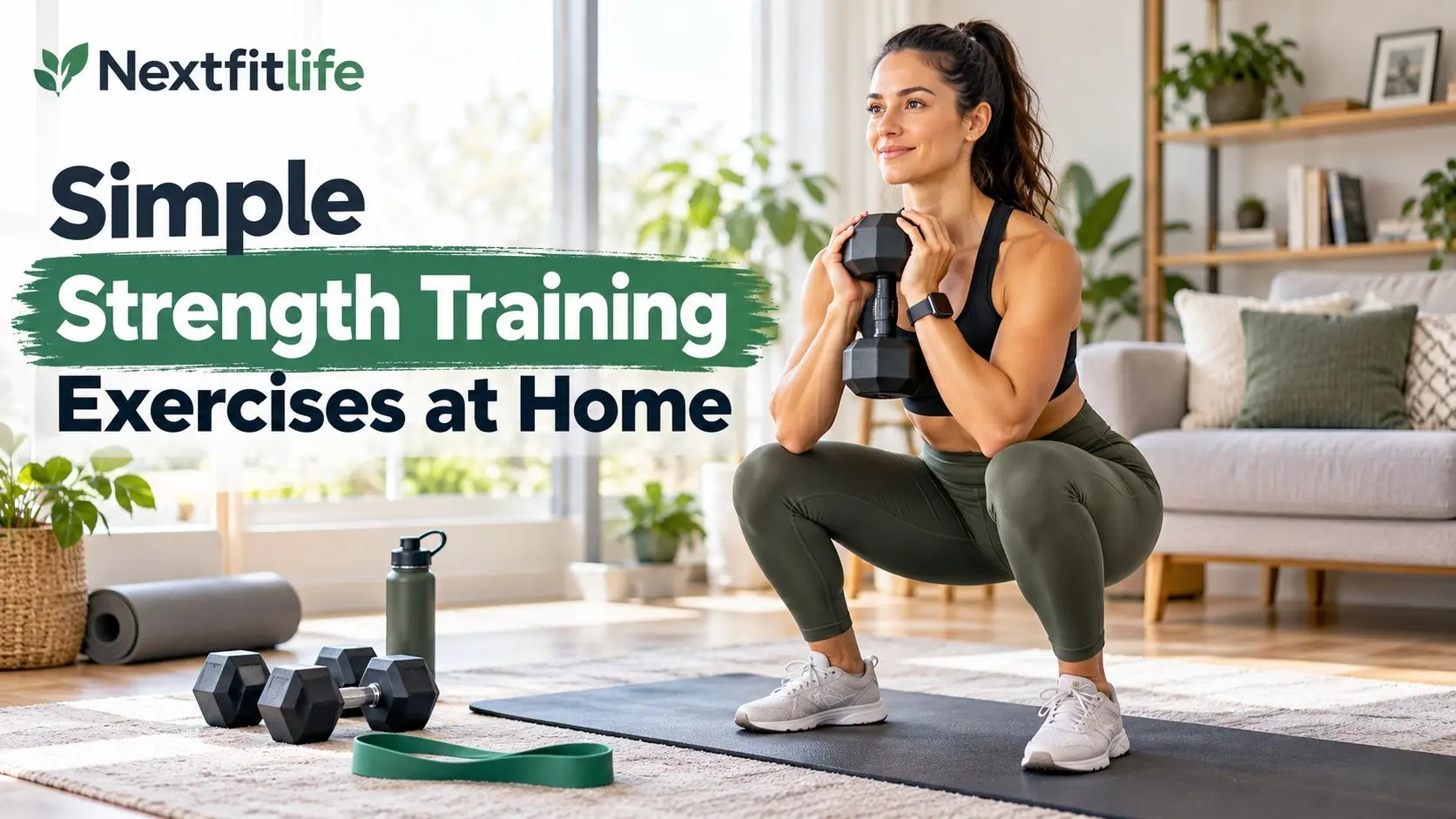
Simple Strength Training Exercises at Home can train your legs, hips, back, chest, shoulders, arms, and core with bodyweight, resistance bands, dumbbells, or a few basic household items.
The secret is not finding a perfect exercise.
You need movements that challenge your muscles, good form, regular practice, and a simple way to make the exercises harder as you improve.
That is what builds strength.
This article is for general information and education. It does not replace medical advice, diagnosis, or treatment.
Quick answer: A good home strength workout can include a squat, hip hinge, single leg move, push, pull, overhead press, carry, and core exercise. Train the major muscle groups at least twice each week. Start with one or two sets if needed, then gradually add repetitions, resistance, range of motion, or harder exercise versions.
Safety note: Stop exercising if you develop chest pain, fainting, sudden severe shortness of breath, or sharp pain. If you have heart disease, uncontrolled blood pressure, a major joint problem, recent surgery, or another condition that affects exercise, ask a qualified healthcare professional what level of training is suitable for you.
Table of Contents
- Can home strength training really work?
- How often should you strength train?
- What equipment do you need?
- 16 strong home exercises
- Chair squat
- Goblet squat
- Reverse lunge
- Step up
- Romanian deadlift
- Glute bridge
- Push up
- Dumbbell floor press
- One arm row
- Resistance band row
- Overhead press
- Lateral raise
- Farmer carry
- Dead bug
- Side plank
- Bird dog
- Beginner home workout
- Dumbbell home workout
- No equipment home workout
- How to progress
- How hard should sets feel?
- How long should a workout take?
- Common mistakes
- Frequently asked questions
Can Strength Training at Home Really Work?
Yes.
Home workouts can build meaningful strength and muscle.
Current American College of Sports Medicine guidance shows that resistance training improves:
- Muscle strength
- Muscle size
- Power
- Muscular endurance
- Balance
- Walking ability
- Physical function
Another useful finding is that the type of equipment did not consistently determine the results.
This means barbells are not the only way to get stronger.
You can use:
- Your bodyweight
- Dumbbells
- Resistance bands
- Kettlebells
- Weighted backpacks when safely loaded
The important part is that your muscles face enough resistance and that the challenge increases as you become stronger.
For a broader plan, visit the NextFitLife Fitness Hub.
How Often Should You Strength Train at Home?
For most beginners, two or three full body sessions each week work very well.
CDC recommends muscle strengthening activity on at least two days each week.
Current ACSM guidance also supports training major muscle groups at least twice weekly for strength.
A simple schedule could be:
- Monday: Full body strength
- Wednesday: Full body strength
- Friday: Full body strength
You could also train only Monday and Thursday.
Two good workouts every week are better than planning six and doing none.
Do You Need Equipment?
No.
A beginner can make progress with bodyweight alone.
Useful no equipment moves include:
- Chair squats
- Split squats
- Push ups
- Glute bridges
- Single leg bridges
- Planks
- Bird dogs
The limitation comes later.
As you get stronger, some bodyweight exercises may become too easy.
At that point you can:
- Add repetitions
- Slow the lowering phase
- Increase range of motion
- Use a harder variation
- Add bands
- Add dumbbells
What Equipment Is Worth Buying?
You do not need much.
If you want a simple home setup, consider:
- A pair of adjustable dumbbells
- A set of resistance bands
- A sturdy exercise mat
- A stable chair or bench
That is enough for a large number of exercises.
Buy more equipment only when your training actually needs it.
16 Simple Strength Training Exercises at Home
1. Chair Squat
The chair squat is one of the easiest ways to learn the squat pattern.
Stand in front of a stable chair.
Push your hips back, bend your knees, touch the chair gently, and stand again.
Main muscles: thighs, glutes, and core.
Make it easier: use a higher chair.
Make it harder: hold a dumbbell at your chest.
2. Goblet Squat
Hold one dumbbell close to your chest.
Squat as low as you can while staying controlled and comfortable.
Stand tall again.
Main muscles: thighs, glutes, and trunk.
The goblet squat is useful because adding resistance is simple.
3. Reverse Lunge
Step one leg backward and lower your body under control.
Push through the front leg to return.
Main muscles: thighs and glutes.
Beginner option: hold a wall or chair for balance.
Progression: hold dumbbells.
4. Step Up
Use a strong, stable step.
Place one foot on top and stand up without pushing hard from the lower foot.
Step down with control.
Main muscles: thighs, glutes, and calves.
Start with a low step.
5. Romanian Deadlift
Hold dumbbells in front of your thighs.
Push your hips backward while keeping the weights close to your legs.
Stop when you feel tension in your hamstrings, then stand tall.
Main muscles: hamstrings and glutes.
Think about moving your hips rather than turning the exercise into a squat.
6. Glute Bridge
Lie on your back with your knees bent.
Push through your feet and lift your hips.
Pause briefly, then lower with control.
Main muscles: glutes and hamstrings.
Progression: add a dumbbell over the hips or move toward a single leg version.
7. Push Up
Push ups train the chest, shoulders, arms, and trunk.
You do not need to start on the floor.
Progress through:
- Wall push up
- Counter push up
- Bench push up
- Floor push up
- Weighted or band resisted push up
Choose a level that lets you use good form.
8. Dumbbell Floor Press
Lie on the floor with one dumbbell in each hand.
Lower your upper arms until they gently touch the floor, then press the weights upward.
Main muscles: chest, shoulders, and triceps.
The floor limits how far your upper arms can move behind your body, which some people find comfortable.
9. One Arm Dumbbell Row
Support yourself with one hand on a stable chair or bench.
Pull the dumbbell toward your side, then lower it slowly.
Main muscles: upper back, lats, and arms.
Avoid twisting your whole body to move the weight.
10. Resistance Band Row
Secure the band to a proper anchor that cannot move.
Pull the handles toward your body and squeeze your upper back gently.
Return under control.
Main muscles: back and arms.
Never attach a band to unstable furniture or a weak door fitting.
11. Dumbbell Overhead Press
Hold the dumbbells around shoulder height.
Press them overhead while keeping your trunk controlled.
Lower slowly.
Main muscles: shoulders and triceps.
You can perform the movement standing or seated.
12. Lateral Raise
Hold light dumbbells beside your body.
Raise your arms out to the sides, then lower under control.
Main muscles: shoulders.
This is an accessory exercise.
You do not need heavy weights.
13. Farmer Carry
Hold a weight in each hand and walk with a tall posture.
Main muscles: grip, shoulders, trunk, hips, and legs.
Walk in a clear area without obstacles.
A farmer carry is simple, but it trains many muscles at once.
14. Dead Bug
Lie on your back with your arms up and your hips and knees bent.
Slowly extend one arm and the opposite leg.
Return and switch sides.
Main area: trunk control.
Move only as far as you can while keeping control.
15. Side Plank
Support your body on one forearm and the side of your foot or knee.
Keep your body steady.
Main area: side of the trunk.
Beginner option: use bent knees.
16. Bird Dog
Start on your hands and knees.
Reach one arm forward and the opposite leg backward.
Pause, return, and switch sides.
Main area: core, hips, and trunk control.
Keep the movement slow.
16 Exercises at a Glance
| Exercise | Main Area | Equipment | Beginner Option |
|---|---|---|---|
| Chair squat | Legs and hips | Chair | Higher chair |
| Goblet squat | Legs and hips | Dumbbell | Bodyweight squat |
| Reverse lunge | Legs | Optional dumbbells | Supported lunge |
| Step up | Legs and balance | Stable step | Low step |
| Romanian deadlift | Hamstrings and glutes | Dumbbells | Hip hinge drill |
| Glute bridge | Glutes | None | Standard bridge |
| Push up | Chest and arms | None | Wall push up |
| Floor press | Chest and arms | Dumbbells | Light dumbbells |
| One arm row | Back and arms | Dumbbell | Light weight |
| Band row | Back and arms | Band | Light band |
| Overhead press | Shoulders and arms | Dumbbells | Seated press |
| Lateral raise | Shoulders | Light dumbbells | Very light load |
| Farmer carry | Grip and whole body | Dumbbells | Light carry |
| Dead bug | Core | None | Move one limb |
| Side plank | Core | None | Bent knee |
| Bird dog | Core and hips | None | One limb at a time |
Simple Beginner Home Strength Workout
You do not need all 16 exercises in one session.
Start with six movements.
| Exercise | Sets | Target |
|---|---|---|
| Chair squat | 2 | 8 to 12 reps |
| Push up variation | 2 | 6 to 12 reps |
| Band or dumbbell row | 2 | 8 to 12 reps |
| Glute bridge | 2 | 10 to 15 reps |
| Overhead press | 2 | 8 to 12 reps |
| Dead bug | 2 | 6 to 10 per side |
Perform this workout two times per week at first.
If you recover well, add a third session later.
No Equipment Home Strength Workout
If you have no weights or bands, use this routine.
- Chair squat: 10 to 15 reps
- Reverse lunge: 6 to 10 per side
- Push up variation: 6 to 15 reps
- Single leg glute bridge: 6 to 12 per side
- Bird dog: 6 to 10 per side
- Side plank: 15 to 30 seconds per side
Rest as needed.
Complete one to three rounds depending on your experience.
Do not turn it into a race.
Simple Dumbbell Home Workout
If you own a pair of dumbbells, use this full body plan.
- Goblet squat: 3 sets of 6 to 12
- Romanian deadlift: 3 sets of 8 to 12
- Dumbbell floor press: 3 sets of 6 to 12
- One arm row: 3 sets of 8 to 12
- Overhead press: 2 sets of 8 to 12
- Farmer carry: 2 to 4 walks
That is enough to train most major muscle groups.
You do not need 20 exercises in one workout.
How Hard Should Each Set Feel?
Your sets need to be challenging enough to make the muscles work.
They do not need to end in complete failure.
Current evidence shows that strength gains do not require you to reach the point where another repetition is impossible.
A useful target is to stop most sets when you feel that you could still complete about one to three good repetitions.
This is called repetitions in reserve.
A 2026 systematic review even found non failure training produced slightly better dynamic strength gains than failure training across the included studies.
You can work hard without making every set a test of survival.
How Many Sets Should Beginners Do?
You do not need a large number.
Start with one or two sets per exercise if you are completely new.
Move toward two or three sets as training becomes easier.
Current ACSM guidance found that two to three sets are especially useful for maximizing strength.
For muscle growth, higher weekly volume can help, but beginners do not need to start with bodybuilding level volume.
How Many Reps Should You Do?
There is no single perfect repetition range.
For simple home training, a practical range is often:
- Big exercises: about 6 to 12 reps
- Smaller exercises: about 8 to 20 reps
- Core holds: short controlled holds
The number itself is less important than whether the set becomes challenging.
If you can perform 30 easy repetitions, the exercise may be too light for efficient strength training.
Do You Need Heavy Weights?
It depends on your goal.
Heavier loads are especially useful for maximizing strength.
Current ACSM guidance found strength improved most with loads around 80% of one repetition maximum or higher.
But lighter loads can still build muscle and strength, especially for beginners.
At home, you can make a lighter weight harder by:
- Using one arm or one leg
- Increasing range of motion
- Adding repetitions
- Using a stronger band
- Moving to a harder exercise
What Is Progressive Overload?
Progressive overload means slowly increasing the training challenge as you improve.
You can do this without buying a new dumbbell every week.
Progress can mean:
- One more repetition
- A little more weight
- A stronger resistance band
- An extra set
- A larger range of motion
- A harder variation
- Better control with the same load
Recent dose response research shows that more training can produce more strength and muscle growth, but the extra benefit gets smaller as volume rises.
More is not always better.
A Simple Progression Rule
Use a repetition range such as 8 to 12.
- Choose a resistance that lets you do about 8 good reps.
- Keep the same resistance next session.
- Gradually build toward 12 reps.
- When 12 reps feel controlled across all sets, increase the resistance slightly.
- Return to about 8 reps and build again.
This method is simple and works well at home.
How Long Should a Home Strength Workout Take?
You do not need an hour.
A useful full body workout can take 20 to 40 minutes.
If you have only 15 minutes, choose four movements:
- Squat
- Push
- Pull
- Hip hinge
Do two controlled sets of each.
For more ideas, see Quick Effective Workout Routines.
How Long Should You Rest Between Sets?
Rest long enough to perform the next set well.
For challenging compound exercises, one to three minutes may be useful.
Heavy strength work can need longer.
Small exercises may need less rest.
You do not get bonus points for being breathless during strength training.
Should Home Workouts Be Circuits?
They can be, but they do not have to be.
Circuits save time and increase breathing and heart rate.
Traditional sets with more rest may be better when your main goal is strength.
You can combine both styles.
For example:
- Do squats and presses with normal rest.
- Pair smaller exercises afterward.
Can You Build Muscle at Home?
Yes.
Muscle growth depends on enough resistance, enough weekly training, food, and recovery.
A gym makes loading easy, but it is not required.
Dumbbells, bands, and harder bodyweight movements can provide strong resistance.
ACSM's 2026 review found that equipment type did not consistently change results.
For muscle growth, weekly volume matters more.
Can You Get Strong Using Only Bodyweight?
Yes, especially at first.
You can progress from:
- Wall push ups to floor push ups
- Chair squats to split squats
- Two leg bridges to single leg bridges
- Basic planks to harder plank versions
Eventually, extra resistance can make continued progression easier.
Are Resistance Bands Effective?
Yes.
Bands can challenge the muscles and are easy to store.
They work well for:
- Rows
- Pulldowns
- Presses
- Shoulder exercises
- Hip exercises
The main problem is measuring resistance precisely.
Use the same band and setup when tracking progress.
Can You Get Fit With 20 Minutes a Day?
Twenty minutes can be very useful.
You do not need a long workout every day.
Strength can be trained on two or three days while walking, cycling, or other aerobic activity happens on other days.
CDC recommends adults work toward at least 150 minutes of moderate aerobic activity each week plus muscle strengthening on at least two days.
That aerobic activity can be divided into smaller sessions.
Strength Training Is Not the Same as Cardio
Strength training makes muscles work against resistance.
Cardio mainly challenges your heart and lungs over time.
Both are useful.
Do not make every strength session so fast that your breathing becomes the main thing limiting your exercises.
Give your muscles enough recovery between challenging sets.
Does Strength Training Help With Weight Loss?
It can support weight management.
Strength training helps preserve or build lean tissue and improves fitness.
It does not replace nutrition when your goal is fat loss.
The main driver of fat loss is still an appropriate calorie deficit.
For a complete approach, read How to Weight Lose Fast at Home.
Will Strength Training Make Women Bulky?
No exercise automatically creates a large bodybuilding physique.
Large muscle gains require time, progressive training, enough food, and individual genetic potential.
Women can use the same basic strength principles as men.
See Workout Routines for Women for a broader plan.
Can Older Adults Strength Train at Home?
Yes.
Resistance training is useful across adulthood and can support physical function, balance, and strength.
Older adults may benefit from:
- Chair based variations
- Lower starting resistance
- More balance support
- Slower progression
- Longer recovery
CDC also recommends balance activities for adults aged 65 and older.
See Getting Fit at 60.
Do You Need Protein After a Workout?
You need enough protein across the whole day.
You do not have to drink a shake immediately after the final repetition.
Useful protein foods include:
- Eggs
- Greek yogurt
- Milk
- Fish
- Chicken
- Lean meat
- Beans
- Lentils
- Tofu
A normal meal after training is fine.
For simple food ideas, see High Protein Foods.
Do You Need Soreness to Know a Workout Worked?
No.
Muscle soreness is not a score for workout quality.
You can become stronger without becoming sore after every session.
Progress is better measured by:
- More repetitions
- More resistance
- Better control
- Harder exercise versions
- Improved balance
Should You Change Exercises Every Week?
No.
Keep your main movements long enough to become good at them.
If you change everything constantly, it becomes harder to see whether you are improving.
Use the same core exercises for several weeks.
Change them when they become unsuitable, painful, boring, or difficult to progress.
Common Home Strength Training Mistakes
1. Doing Random Exercises Every Day
Use a repeatable plan so you can measure improvement.
2. Making Every Workout a Circuit
Rest enough when strength is your goal.
3. Training Only Legs or Abs
Include pushing and pulling for the upper body too.
4. Never Increasing the Challenge
Your body needs progressive resistance to keep adapting.
5. Training Every Set to Failure
You can make excellent progress without failing every set.
6. Using Unstable Furniture
Do not attach resistance bands to weak furniture or perform step ups on unstable chairs.
7. Using Bad Form to Add Weight
More resistance is useful only when you can control it.
8. Ignoring Pulling Exercises
Rows and pulldowns help train your back and arms.
9. Expecting Results in Seven Days
You can feel more confident quickly, but meaningful strength and muscle changes take repeated training.
10. Buying Equipment Before Building the Habit
Start with the basics.
Your first goal is regular training.
Four Week Beginner Home Plan
| Week | Sessions | Main Goal |
|---|---|---|
| 1 | 2 | Learn each movement |
| 2 | 2 | Add a few reps where easy |
| 3 | 2 or 3 | Add resistance where needed |
| 4 | 2 or 3 | Repeat with better control |
Do not test a maximum lift after four weeks.
Simply compare how many controlled repetitions you can do with the same exercise and resistance.
A Balanced Weekly Fitness Plan
| Day | Training |
|---|---|
| Monday | Full body strength |
| Tuesday | Brisk walk |
| Wednesday | Easy movement or rest |
| Thursday | Full body strength |
| Friday | Brisk walk or cycling |
| Saturday | Optional activity you enjoy |
| Sunday | Rest or gentle movement |
Home Strength Progress Checklist
- Train at least twice each week.
- Include a squat or lunge.
- Include a hip hinge.
- Include a pushing exercise.
- Include a pulling exercise.
- Train your core.
- Use controlled range of motion.
- Stop most sets before form breaks down.
- Add resistance or reps gradually.
- Repeat the same plan long enough to improve.
- Sleep and eat enough to recover.
- Track progress every few weeks.
Conclusion
Simple Strength Training Exercises at Home can build real strength without an expensive gym.
You can start with chair squats, push ups, bridges, rows, presses, carries, and core work. Bodyweight is enough at first, while bands and dumbbells make progression easier later.
The most important rule is simple: make the exercises challenging, keep your form controlled, and slowly increase the work as you get stronger.
You do not need to train every day, reach failure on every set, or buy a room full of equipment.
Your next step: choose six exercises from this guide and schedule two 20 to 30 minute full body sessions for the coming week. Write down your reps so you have something real to improve next time.
References and Sources
- American College of Sports Medicine. Resistance Training Prescription for Muscle Function, Hypertrophy, and Physical Performance in Healthy Adults, 2026.
https://pubmed.ncbi.nlm.nih.gov/41843416/ - American College of Sports Medicine. Updated Resistance Training Guidelines, 2026.
https://acsm.org/resistance-training-guidelines-update-2026/ - Centers for Disease Control and Prevention. Physical Activity Guidelines for Adults.
https://www.cdc.gov/physical-activity-basics/guidelines/adults.html - The Resistance Training Dose Response: Weekly Volume and Frequency for Muscle Hypertrophy and Strength Gains. Sports Medicine, 2026.
https://pubmed.ncbi.nlm.nih.gov/41343037/ - The Influence of Individual Resistance Training Variables on Muscle Strength. Systematic Review and Meta Analysis, 2026.
https://pubmed.ncbi.nlm.nih.gov/41995957/ - Resistance Training Prescription for Muscle Strength and Hypertrophy in Healthy Adults. Systematic Review and Network Meta Analysis.
https://pubmed.ncbi.nlm.nih.gov/37414459/ - Effects of Resistance Training Performed to Repetition Non Failure on Exercise Performance in Healthy Adults. Systematic Review and Meta Analysis, 2026.
https://pubmed.ncbi.nlm.nih.gov/42410632/ - Exploring the Dose Response Relationship Between Proximity to Failure, Strength Gain, and Muscle Hypertrophy.
https://pubmed.ncbi.nlm.nih.gov/38970765/
Internal Links + Hub
- NextFitLife Fitness Hub
- Fitness Program Guide
- Minimum Effective Dose Strength Training
- Quick Effective Workout Routines
- Effective Workout Routines for Men
- Workout Routines for Women
- Best Compound Leg Exercises
- Ab Workouts for Men
- How to Increase Your Bench Press Fast
- Getting Fit at 60
- High Protein Foods
About the Author
Adel Galal is the founder and lead writer of NextFitLife.com and the founder of Parnthub.com.
He is a father of four, three sons and a daughter, and a grandfather of four, with more than 33 years of hands on family experience. Adel is based in Cairo, Egypt.
He has maintained a personal interest in health, fitness, nutrition, sleep, wellness, and healthy aging for more than 30 years and has more than 15 years of health and wellness writing experience.
His work focuses on reviewing trusted fitness and nutrition sources, separating useful exercise principles from exaggerated fitness claims, and turning research into simple guidance readers can use at home.
Adel is not a doctor, physical therapist, exercise physiologist, certified personal trainer, strength coach, or other licensed healthcare professional. NextFitLife content is for general information and education and does not replace individual medical or exercise advice.
Learn more about Adel and NextFitLife on the About Us page.
Frequently Asked Questions
What are the best Simple Strength Training Exercises at Home?
Good choices include squats, lunges, hip hinges, glute bridges, push ups, rows, overhead presses, carries, dead bugs, side planks, and bird dogs.
Can I build strength at home without a gym?
Yes. Bodyweight, resistance bands, and dumbbells can provide enough resistance to improve strength when exercises become gradually more challenging.
Can I build muscle at home?
Yes. Muscle can grow at home when you train with enough resistance, perform enough weekly work, eat well, and recover properly.
Can bodyweight exercises build muscle?
Yes, especially for beginners. As you become stronger, harder variations or added resistance may be needed to keep progressing.
How often should I strength train at home?
Two or three full body workouts per week work well for many people. Adults should train the major muscle groups on at least two days each week.
How long should a home strength workout be?
A useful workout can take about 20 to 40 minutes. Even shorter sessions can work when you focus on a few major movements.
Can I strength train for only 15 minutes?
Yes. Choose a squat, push, pull, and hip hinge and perform two controlled sets of each.
How many exercises do I need per workout?
About four to eight exercises can cover a full body workout. You do not need to perform every exercise you know.
How many sets should a beginner do?
One or two sets per exercise can be enough to start. Move toward two or three sets as your fitness and recovery improve.
How many repetitions should I do?
Many home exercises work well in a range of about 6 to 15 repetitions, but the exact number depends on resistance and the movement.
Do I need to train to failure?
No. Strength gains do not require every set to reach complete failure. Stopping with one to three good repetitions left is practical for many exercises.
Are dumbbells enough to get strong?
Yes. Dumbbells can train nearly every major muscle group and can support substantial strength and muscle gains when resistance increases over time.
Are resistance bands effective?
Yes. Resistance bands can provide useful resistance for rows, presses, pulldowns, shoulder work, and lower body exercises.
What is progressive overload?
Progressive overload means gradually making training harder by adding resistance, repetitions, sets, range of motion, or a harder exercise variation.
Do I need heavy weights at home?
Not when you begin. Heavier resistance becomes more useful as you get stronger, especially when maximal strength is the main goal.
Can I strength train every day?
You can train frequently if sessions are planned carefully, but beginners usually do not need daily strength workouts. Two or three full body sessions are enough for a strong start.
Should I be sore after strength training?
No. Soreness is not required for progress. Track strength, repetitions, resistance, and exercise quality instead.
Is home strength training good for weight loss?
It can support weight management by maintaining or building lean tissue, but fat loss still depends mainly on an appropriate calorie deficit.
Can women use the same home strength exercises?
Yes. The same basic strength movements work for women and men. Resistance and exercise versions should be matched to the individual.
Can people over 60 strength train at home?
Yes. Older adults can improve strength and physical function with appropriately scaled resistance training. Balance work can also be useful.
What is the best first exercise for a beginner?
A chair squat is a useful starting lower body exercise, while a wall or counter push up is a good starting upper body movement.
How do I know when to increase the weight?
Increase resistance when you can reach the top of your target repetition range across all sets with controlled form and some effort still required.
Should I change my workout every week?
No. Repeat the same main exercises for several weeks so you can learn them and measure progress.
Do I need protein powder after a home workout?
No. Protein powder is optional. Normal foods such as eggs, yogurt, fish, chicken, milk, beans, lentils, and tofu can provide protein.
What equipment should I buy first?
Adjustable dumbbells and resistance bands are two of the most useful additions to a simple home strength setup.

Health & wellness writer with 30+ years of experience in nutrition, fitness, and healthy aging. Founder of NextFitLife.com — evidence-based health guidance.

