
Published on: Jul 27, 2024
Updated: November 1, 2026
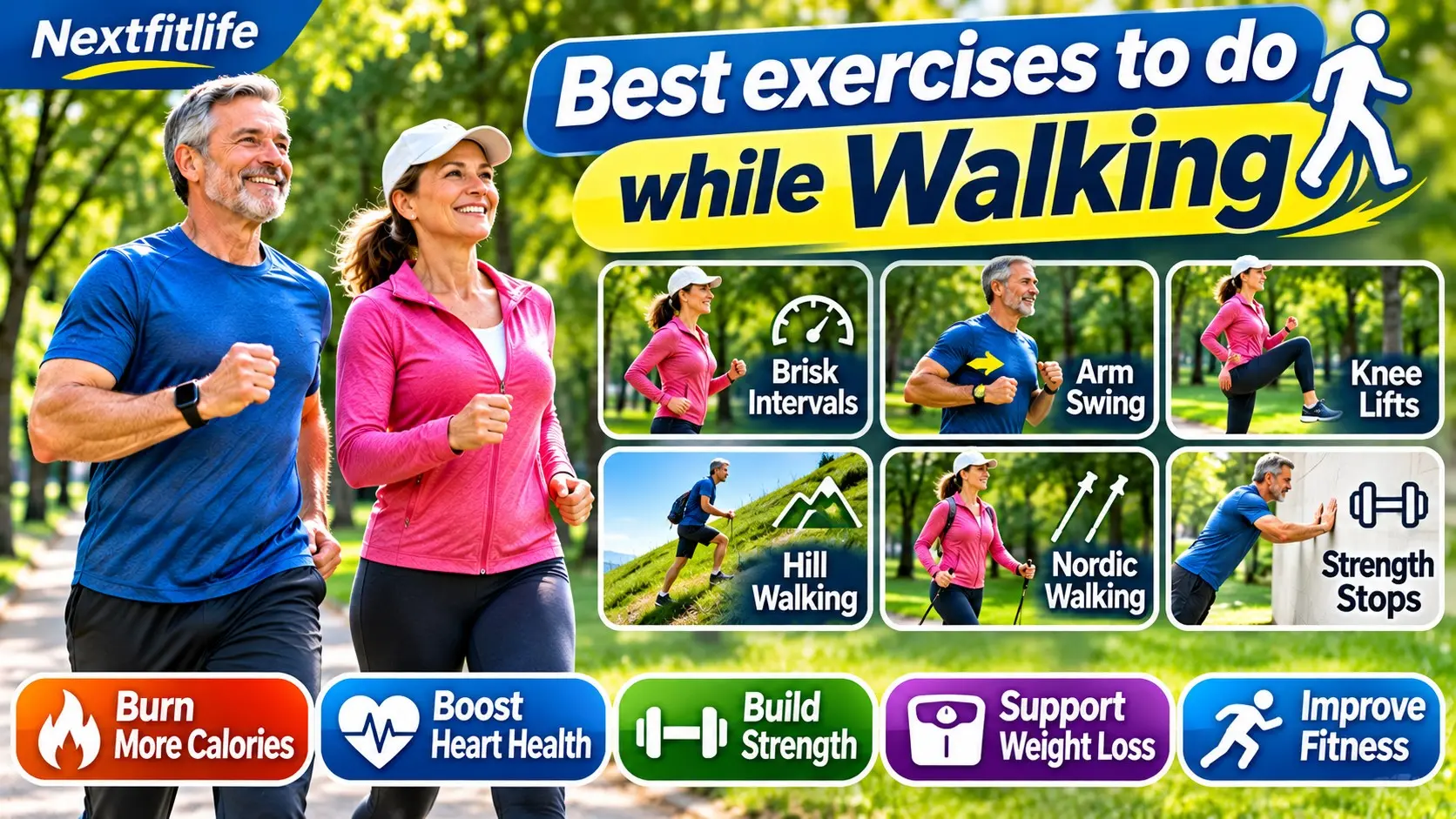
The best exercises to do while walking do not need to turn your walk into a jumping-, twisting-, or lunge-filled obstacle course.
The safest ways to make walking harder are often much simpler. Walk faster for short periods, use hills, move your arms with purpose, add gentle marching bursts, or stop in a safe place for a few strength exercises.
This can raise your effort while keeping walking at the center of the workout.
This article is for general information and education. It does not replace medical advice, diagnosis, or treatment.
Quick answer: The best exercises to do while walking include brisk walking intervals, cadence pick ups, hills, purposeful arm swing, gentle knee lifts, side steps, Nordic walking, and short strength stops such as sit-to-stands, wall push-ups, and calf raises. You do not need ankle hops, deep lunges, or twisting moves while walking to get a harder workout.
Safety first: Keep normal walking as your base. Perform strength moves only after you stop in a clear, stable area. Avoid quick side shuffles, deep lunges, hopping, backward walking, or strong twisting if your balance is uncertain. Stop and seek urgent medical care for chest pain, fainting, sudden weakness, severe dizziness, confusion, or unusual severe shortness of breath.
Table of Contents
- Can you exercise while walking?
- What really increases walking intensity?
- 16 smart exercises to add to a walk
- Brisk walking intervals
- Cadence pick ups
- Purposeful arm swing
- Hill walking
- Incline walking
- Gentle marching bursts
- Low knee lifts
- Side steps
- Step touch
- Nordic walking
- Stair intervals
- Calf raises at a stop
- Sit-to-stands at a stop
- Wall push-ups at a stop
- Supported split squats at a stop
- Easy recovery walking
- 20-minute walking workout
- 30-minute full-body walking workout
- Walking for weight loss
- How many calories do the moves burn?
- Walking versus strength training
- Common mistakes
- Frequently asked questions
Can You Exercise While Walking?
Yes.
Walking itself is exercise, and you can change how hard it feels without stopping.
You can adjust:
- Your pace
- Your step rhythm
- The slope
- Your arm swing
- The length of brisk intervals
You can also pause the walk and add a simple strength move.
That last point matters.
Some movements are safer when you stop walking first.
A wall push up or sit to stand can strengthen muscles without asking you to balance, twist, or lunge while moving forward.
What Really Makes Walking Harder?
There are several reliable ways to raise walking intensity.
Walk Faster
A faster pace usually raises your heart rate and breathing.
Current research continues to link faster habitual walking speed with better health outcomes, although those studies show associations rather than proving that speed alone causes the benefit.
Walk Uphill
Going uphill asks your muscles to do more work.
It can raise effort without requiring you to run.
Use More of Your Upper Body
A natural, purposeful arm swing can make a brisk walk feel more athletic.
Nordic walking takes this further by using poles and more upper body muscle.
Use Intervals
Walking intervals alternate easier and harder walking.
This lets you spend short periods at a higher effort without making the whole walk hard.
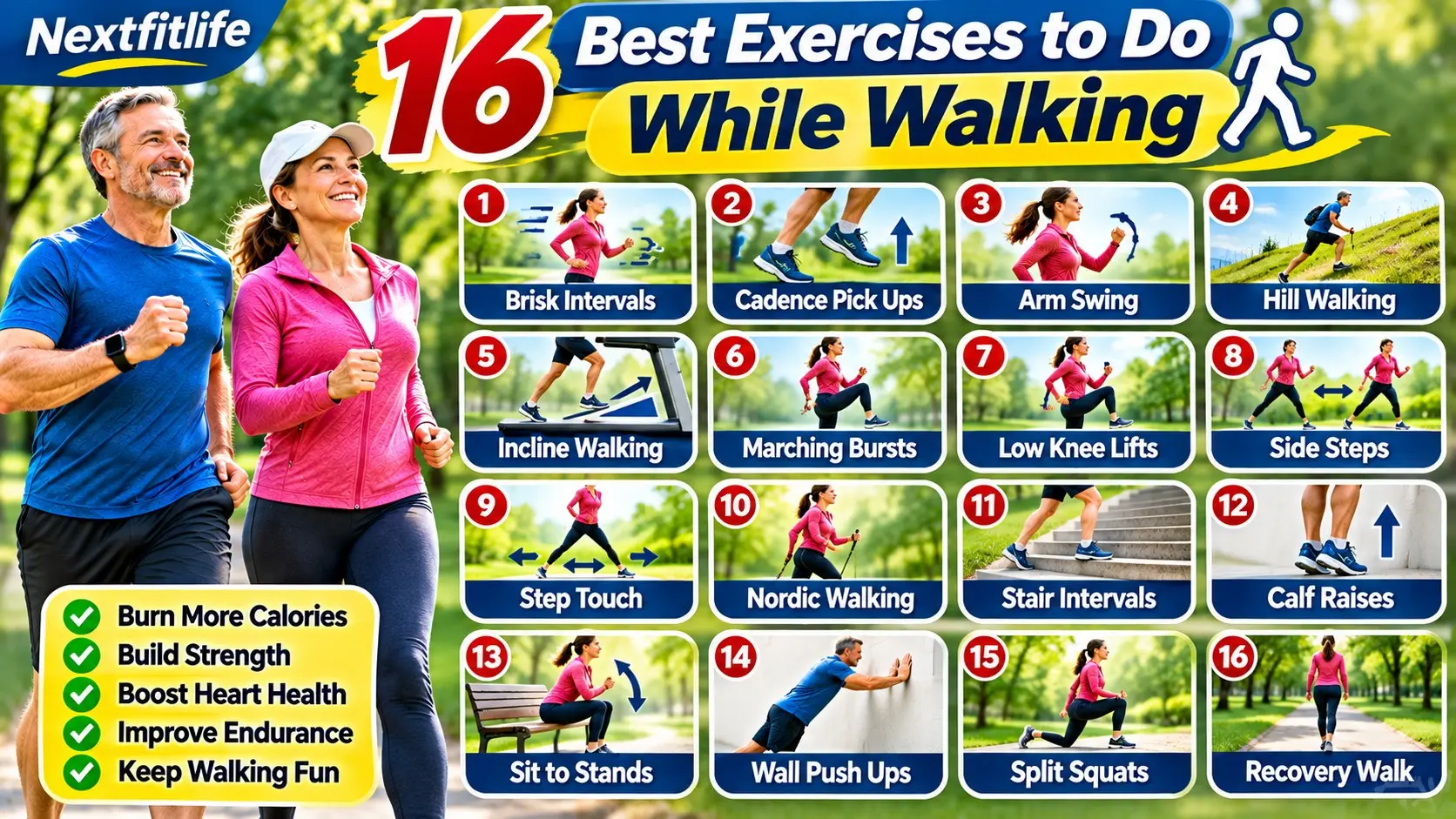
16 Best Exercises to Do While Walking
1. Brisk Walking Intervals
This is one of the simplest upgrades you can make.
How to do it:
- Walk easily for 2 to 3 minutes.
- Increase your pace for 30 to 60 seconds.
- Return to easy walking.
- Repeat several times.
Your brisk pace should make you breathe faster while still allowing you to talk.
You do not need to sprint.
2. Cadence Pick Ups
Walking cadence means how quickly your steps occur.
For a short interval, take slightly quicker steps without turning them into giant strides.
Keep your posture relaxed and your feet under your body.
Try: 20 to 40 seconds quicker, followed by 1 to 2 minutes easy.
3. Purposeful Arm Swing
Your arms already move when you walk.
You can make that movement slightly more active during brisk periods.
- Bend your elbows comfortably.
- Swing from the shoulders.
- Move the arms forward and back.
- Keep your hands relaxed.
Avoid large circles or punching across your body while walking.
4. Hill Walking
Hills can increase effort without adding special exercises.
Start with a gentle incline.
Shorten your stride slightly and keep your pace controlled.
Walk easily after the hill to recover.
5. Treadmill Incline Walking
If you walk indoors, a treadmill incline gives you another way to raise effort.
Increase the incline gradually.
You do not need a steep slope.
A modest incline may be enough to make your walk feel much harder.
Avoid holding the front rail tightly unless you need it for safety.
6. Gentle Marching Bursts
Marching can raise your effort for a short period.
Keep the knees at a comfortable height.
You do not need extreme high knees.
Try: 20 to 30 seconds of marching, then return to normal walking.
7. Low Knee Lifts
Low knee lifts add hip movement without turning the walk into a sprint drill.
- Slow your walking pace slightly.
- Lift one knee a little higher.
- Step normally.
- Repeat on the other side.
Keep the range small if balance is a concern.
8. Controlled Side Steps
Side steps can add movement in a different direction.
Use them only on a flat, clear surface.
- Slow down or stop your forward walk.
- Step sideways several times.
- Keep your feet facing forward.
- Switch directions.
Do not turn this into a fast side shuffle on a public walking path.
9. Step Touch
Step touch is a simple low impact movement.
It works well indoors or during a safe walking break.
- Step to the right.
- Bring the left foot toward it.
- Step left.
- Bring the right foot toward it.
Continue for 20 to 40 seconds.
10. Nordic Walking
Nordic walking uses specially designed walking poles.
The poles increase upper body involvement and can make walking more demanding at the same general pace.
Research has found benefits for cardiorespiratory fitness and several health measures in different populations.
Technique matters.
Learn how to plant and push the poles rather than simply carrying them.
11. Stair Walking Intervals
Stairs can raise effort quickly.
They are optional.
If you use stairs:
- Hold the rail when needed.
- Move at a controlled pace.
- Use good lighting.
- Stop if your balance feels poor.
One short stair climb can be enough before returning to flat walking.
12. Calf Raises at a Walking Stop
This is better done while standing still.
- Stop near a wall or rail.
- Stand tall.
- Rise onto the balls of your feet.
- Lower slowly.
Try: 8 to 15 repetitions.
Then continue walking.
13. Sit to Stands at a Bench
If your route has a safe bench, you can add a functional strength stop.
- Sit near the front of the bench.
- Place your feet firmly on the ground.
- Stand up.
- Sit down with control.
Try: 5 to 10 repetitions.
This trains a movement you use every day.
14. Wall or Bench Push Ups
Walking mainly trains the lower body and cardiovascular system.
A short push up stop adds upper body work.
- Face a sturdy wall or high bench.
- Place your hands on it.
- Bend your elbows.
- Bring your chest closer.
- Press back.
Try: 6 to 12 repetitions.
15. Supported Split Squats at a Stop
This is safer than doing repeated deep walking lunges while moving.
Use a rail, wall, or stable support if needed.
- Place one foot forward.
- Keep the other foot behind.
- Bend both knees slightly.
- Lower only as far as comfortable.
- Rise again.
Try: 4 to 8 repetitions per side.
Skip this if you have knee pain or poor balance.
16. Easy Recovery Walking
This may sound too simple to make the list, but recovery is part of a good workout.
After a brisk interval, hill, stair climb, or strength stop, return to easy walking.
This helps you control the total effort and continue the session safely.
16 Walking Moves at a Glance
| Move | Main Goal | Do It While Moving? |
|---|---|---|
| Brisk intervals | Raise aerobic effort | Yes |
| Cadence pick ups | Increase step rhythm | Yes |
| Arm swing | Upper body involvement | Yes |
| Hill walking | Raise effort | Yes |
| Incline walking | Raise effort | Yes |
| Marching | Short intensity burst | Yes |
| Low knee lifts | Hip movement | Yes, slowly |
| Side steps | Direction change | Slow or stop first |
| Step touch | Coordination | Slow or stop first |
| Nordic walking | Whole body walking | Yes |
| Stairs | Higher effort | Yes, with care |
| Calf raises | Lower leg strength | No |
| Sit to stands | Leg strength | No |
| Wall push ups | Upper body strength | No |
| Split squats | Leg strength | No |
| Recovery walk | Control fatigue | Yes |
Which Moves Burn the Most Calories?
There is no reliable fixed answer such as “this move burns 150 extra calories.”
Calorie burn changes with:
- Body size
- Walking speed
- Walking duration
- Incline
- Movement efficiency
- Fitness level
A 2026 laboratory study confirmed that walking energy use changes with speed and individual characteristics.
That is why exact bonus calorie numbers for one move are misleading.
What Usually Raises Calorie Use the Most?
Instead of focusing on one trick, use the big levers.
Walk Longer
More walking time usually means more total energy use.
Walk Briskly
A higher speed generally requires more work.
Add an Incline
Walking uphill increases the demand on your muscles and cardiovascular system.
Use Poles Correctly
Some studies have found that pole walking increases oxygen use and heart rate compared with normal walking at the same speed.
Does Faster Walking Matter for Health?
Walking pace appears to matter.
A 2025 systematic review found that faster habitual walking speed was linked with lower risks of several major health outcomes.
A separate large U.S. study found that even 15 minutes of fast walking per day was associated with lower mortality risk.
These are observational results, so they do not prove that simply forcing yourself to walk faster will prevent disease.
Still, they support adding some brisk walking when it is safe for you.
20 Minute Walking Workout
This routine keeps the movements simple.
| Time | Activity |
|---|---|
| 0 to 3 min | Easy walking |
| 3 to 5 min | Brisk walking |
| 5 to 7 min | Easy walking |
| 7 to 8 min | Marching burst |
| 8 to 11 min | Normal walking |
| 11 to 12 min | 5 to 10 wall push ups at a safe stop |
| 12 to 15 min | Brisk walking |
| 15 to 16 min | 8 calf raises at a safe stop |
| 16 to 20 min | Easy cool down walking |
30 Minute Full Body Walking Workout
- 5 min easy walking
- 2 min brisk walking
- 2 min easy walking
- 1 min marching
- 3 min normal walking
- 8 to 12 wall push ups at a safe stop
- 3 min brisk walking
- 2 min easy walking
- 8 to 12 calf raises at a safe stop
- 3 min walking
- 5 to 8 sit to stands at a bench
- 4 min easy walking to finish
If that feels too difficult, remove the strength stops or shorten the brisk periods.
Should You Do Walking Lunges?
Walking lunges can be useful strength exercises for people who already have good control.
But they are not necessary during a normal walk.
Deep lunges can:
- Reduce stability
- Increase knee demand
- Take up path space
- Create collision risk around other walkers
A supported split squat performed while standing still is often easier to control.
Are High Knees Good While Walking?
Gentle knee lifts can raise effort.
Extreme high knees are not required.
If you have balance problems, hip pain, or knee pain, keep the lift small or skip it.
Should You Do Ankle Hops?
Most walkers do not need them.
Hopping adds impact and requires good calf strength and balance.
If you want more intensity, brisk walking or hills are simpler options.
Are Arm Circles Good While Walking?
Small arm movements may be fine, but large circles can change your balance and annoy other walkers on a narrow path.
A strong natural arm swing is usually more practical.
Is Shadow Boxing While Walking a Good Idea?
It can make a workout feel fun, but it is easy to lose awareness of your path.
If you enjoy boxing movements, stop in a clear space or do them indoors rather than throwing hooks while walking through traffic or crowds.
Should You Twist Your Torso While Walking?
Normal walking already includes natural trunk rotation.
You do not need exaggerated twists.
Large deliberate twists while moving can reduce control, especially for people with back pain or poor balance.
Can You Carry Hand Weights While Walking?
You can, but it is usually not necessary.
Adding weights changes your arm mechanics and can make walking less comfortable.
For most people, it is cleaner to walk first and strength train separately.
A short wall push up, row, or squat session gives you more control.
What About a Weighted Vest?
A weighted vest increases load, but it also increases stress on the body.
It is not a beginner tool.
People with joint pain, balance issues, osteoporosis, heart disease, or back problems should get individual guidance before adding external load.
Can Nordic Walking Burn More Energy?
It can increase exercise demand compared with ordinary walking in some settings.
Nordic walking uses the arms, shoulders, trunk, and legs together.
Studies have reported higher oxygen use and heart rate during pole walking at similar speeds.
A 2025 systematic review also found benefits for several cardiovascular risk factors in older adults.
Use real Nordic walking poles and learn proper technique.
What Is Better: Faster Walking or More Exercises?
For most people, start with faster walking.
A simple brisk interval is easier to control than combining lunges, hops, punches, and twists.
Once walking itself feels solid, add variety.
Best Order for Progression
| Stage | Add |
|---|---|
| 1 | More walking time |
| 2 | Brisk intervals |
| 3 | Gentle hills |
| 4 | Simple strength stops |
| 5 | More advanced options if needed |
Walking for Weight Loss
Walking for weight loss can work because walking adds energy use and physical activity.
But extra exercises do not guarantee fat loss.
Body weight also depends on:
- Food intake
- Walking time
- Walking pace
- Body size
- Strength training
- Sleep
- Medications
- Health conditions
For a structured plan, see Walking Routine to Lose Weight.
Can These Exercises Burn Belly Fat?
No exercise can choose where your body removes fat.
A harder walk may increase overall energy use, which can support total fat loss.
But high knees, arm swings, or lunges do not selectively melt belly fat.
Read Best Exercise for Belly Fat.
Should You Track Steps or Intensity?
Both can be useful, but they tell you different things.
Daily steps measure movement volume.
Pace and breathing tell you more about intensity.
A 2025 meta analysis found meaningful health benefits around 7,000 daily steps compared with very low step counts.
You do not need 10,000 steps before pace starts to matter.
Should Every Walk Be Hard?
No.
A useful week can include:
- Easy walks
- One or two brisk walks
- One longer walk
- Two strength sessions
More intensity is not always better.
Walking Plus Strength Training
A walking workout can include some strength stops, but walking still does not replace a full strength program.
CDC recommends muscle strengthening exercise on at least two days each week.
For a complete plan, visit Strength Training Exercises at Home for Beginners.
Can Short Walking Breaks Help Too?
Yes.
You do not need every walk to be a formal workout.
A 2026 systematic review found that short walking breaks during prolonged sitting improved short term glucose and insulin responses compared with uninterrupted sitting.
That makes a two or three minute walk useful even when it does not include special exercises.
Best Exercises to Do While Walking for Beginners
Start with four:
- Brisk walking intervals
- Purposeful arm swing
- Gentle marching bursts
- Calf raises at a stop
That is enough.
Best Exercises for Older Adults
Older adults can often use:
- Brisk walking within their ability
- Gentle hills
- Nordic poles if trained
- Calf raises near support
- Bench sit to stands
Avoid quick sideways movements or unsupported lunges if balance is poor.
See Walking Exercise for Seniors.
Best Indoor Options
If you are walking indoors, try:
- Brisk marching
- Step touch
- Side steps
- Cadence intervals
- Wall push ups
- Chair sit to stands
Read Indoor Walking Exercise for a full routine.
Common Walking Workout Mistakes
1. Adding Too Many Moves
Your walk does not need to look like a fitness class.
2. Trusting Fixed Calorie Claims
Energy use varies from person to person.
3. Doing Deep Lunges While Moving
Stop first if you want to perform a strength exercise.
4. Using Ankle Hops for Extra Burn
Hopping adds impact that most walkers do not need.
5. Twisting While Walking
Normal trunk rotation is enough.
6. Ignoring Your Path
Traffic, curbs, bikes, people, and uneven ground need your attention.
7. Making Every Walk Brisk
Easy walking helps recovery.
8. Skipping Strength Training
Walking is not a full muscle strengthening program.
9. Carrying Heavy Weights
More load is not always safer or better.
10. Changing Everything at Once
Add pace, time, hills, or exercises one step at a time.
Smart Walking Workout Checklist
- Make regular walking your base.
- Add brisk intervals before complex exercises.
- Use the talk test for moderate effort.
- Add gentle hills when ready.
- Use purposeful arm swing instead of large arm circles.
- Keep knee lifts low and controlled.
- Do strength moves while standing still.
- Skip hops if impact is not needed.
- Use Nordic poles only with good technique.
- Keep easy recovery walking in the session.
- Do full strength training at least twice each week.
- Stop for serious warning symptoms.
Conclusion
The best exercises to do while walking are usually the ones that make your walk more effective without making it less safe.
Start with brisk intervals, quicker cadence, a purposeful arm swing, or gentle hills. Add Nordic walking if you enjoy it, and use safe stops for calf raises, wall push ups, sit to stands, or split squats.
You do not need ankle hops, exaggerated twisting, deep moving lunges, or invented calorie burn numbers.
Your next step: during your next walk, add three 60 second brisk intervals. If that feels comfortable, choose one strength stop from this guide and add it next time.
References and Sources
- Centers for Disease Control and Prevention. Adult Activity: An Overview.
https://www.cdc.gov/physical-activity-basics/guidelines/adults.html - Centers for Disease Control and Prevention. What Counts as Physical Activity for Adults.
https://www.cdc.gov/physical-activity-basics/adding-adults/what-counts.html - Wu Q, et al. Systematic Review and Meta Analysis of the Association Between Usual Walking Speed and All Cause Mortality and Major Non Communicable Diseases, 2025.
https://pubmed.ncbi.nlm.nih.gov/40266699/ - Daily Walking and Mortality in Racially and Socioeconomically Diverse U.S. Adults, 2025.
https://pubmed.ncbi.nlm.nih.gov/40744164/ - Ding D, et al. Daily Steps and Health Outcomes in Adults: Systematic Review and Dose Response Meta Analysis, 2025.
https://pubmed.ncbi.nlm.nih.gov/40713949/ - Beaumont JS, et al. Energy Expenditure During Walking in Adults: Impact of Body Mass Index and Sex, 2026.
https://pubmed.ncbi.nlm.nih.gov/42704768/ - Liu J, Kim JH. The Effects of Nordic Walking on Cardiovascular Risk Factors in Older Adults: Systematic Review and Meta Analysis, 2025.
https://pubmed.ncbi.nlm.nih.gov/39476525/ - Gale JT, et al. The Acute Effects of Interrupting Prolonged Sitting With Regular Activity Breaks on Postprandial Glucose and Insulin in Adults, 2026.
https://pubmed.ncbi.nlm.nih.gov/42070794/
Internal Links + Hub
- NextFitLife Fitness Hub
- Fitness Program Guide
- Walking Routine to Lose Weight
- Walking Workout Plan for Weight Loss
- Daily Walking Challenge
- Indoor Walking Exercise
- Walking Exercise for Seniors
- Walking 10 Minutes After Meals
- How Many Steps a Day to Lose Weight for a Woman
- Simple Strength Training Exercises at Home
- Strength Training Exercises at Home for Beginners
- Best Exercise for Belly Fat
- Complete Weight Loss Guide
About the Author
Adel Galal is the founder and lead writer of NextFitLife.com and the founder of Parnthub.com.
He is a father of four, three sons and a daughter, and a grandfather of four, with more than 33 years of hands on family experience. Adel is based in Cairo, Egypt.
He has maintained a personal interest in health, fitness, nutrition, sleep, mobility, wellness, and healthy aging for more than 30 years and has more than 15 years of health and wellness writing experience.
His work focuses on reviewing trusted sources, separating practical fitness guidance from exaggerated calorie and fat loss claims, and turning research into simple actions readers can use safely.
Adel is not a doctor, physical therapist, exercise physiologist, certified personal trainer, or other licensed healthcare professional. NextFitLife content is for general information and education and does not replace individual medical or exercise advice.
Learn more about Adel and NextFitLife on the About Us page.
Frequently Asked Questions
What are the best exercises to do while walking?
The best exercises to do while walking include brisk intervals, quicker cadence, purposeful arm swing, gentle hills, low knee lifts, Nordic walking, and safe strength stops such as calf raises or wall push ups.
How can I burn more calories while walking?
Walk longer, increase your pace, use gentle hills, or add short brisk intervals. Energy use varies, so avoid relying on fixed calorie numbers.
Does faster walking burn more calories?
In general, faster walking requires more energy per unit of time, although individual calorie use depends on body size, speed, fitness, and terrain.
Is brisk walking better than doing exercises while walking?
For most beginners, brisk walking is the simplest way to increase intensity before adding extra movements.
Are walking lunges good during a walk?
Walking lunges can be useful for trained people, but they reduce stability. A supported split squat performed while standing still is easier to control.
Are high knees good while walking?
Gentle knee lifts can increase effort. Extreme high knees are not necessary.
Do arm circles burn more calories while walking?
Arm circles add movement, but there is no reliable fixed calorie bonus. A purposeful natural arm swing is usually more practical.
Does swinging your arms make walking harder?
A stronger natural arm swing can increase upper body involvement and may make brisk walking feel more active.
Is shadow boxing while walking safe?
It can distract you from the path. If you want to box, stop in a clear space or perform it indoors.
Should I twist while walking?
Normal walking already includes natural trunk rotation. Exaggerated twists are not needed.
Are ankle hops useful during walking?
Most people do not need them. Hopping adds impact and requires more balance than brisk walking or hills.
Can Nordic walking burn more energy?
Studies suggest Nordic walking can increase oxygen use and upper body involvement compared with normal walking at similar speeds.
Do walking poles help fitness?
They can. Nordic walking has been studied for cardiorespiratory fitness and several health outcomes, but proper technique matters.
Is hill walking good exercise?
Yes. Walking uphill raises muscular and cardiovascular demand without requiring you to run.
Is treadmill incline walking good exercise?
Yes. A modest incline can raise exercise intensity while keeping the movement low impact.
Can I do strength training during a walk?
Yes, but it is safer to stop first. Wall push ups, sit to stands, calf raises, and supported split squats can be added at safe stops.
Should I carry dumbbells while walking?
You usually do not need to. Separate walking and strength training gives you better control of both activities.
Does a weighted vest make walking better?
A weighted vest raises load but is not necessary for most walkers. It can increase joint, balance, and back demands.
Can walking exercises tone the whole body?
Walking trains many muscles, but a complete strength program is better for building or maintaining muscle throughout the body.
Can walking exercises burn belly fat?
No exercise selectively burns belly fat. A more demanding walk can support overall fat loss when it contributes to a calorie deficit.
How often should I add walking intervals?
Beginners can start with one or two interval walks per week and keep other walks easy.
How long should a brisk interval last?
Start with about 30 to 60 seconds, then recover with easy walking.
Should every walk be brisk?
No. Easy walks support movement, recovery, and consistency.
Should I track calories during walking?
You can, but tracker calorie estimates are not exact. Walking time, pace, and consistency are often more useful.
Are these walking exercises safe for seniors?
Many can be adapted for older adults. Brisk walking, gentle hills, Nordic walking, calf raises, and bench sit to stands may work well, while quick side movements and unsupported lunges may not.

Health & wellness writer with 30+ years of experience in nutrition, fitness, and healthy aging. Founder of NextFitLife.com — evidence-based health guidance.

