
Published on: Jul 26, 2024
Updated: November 1, 2026
A Daily Walking Challenge can make exercise feel simple again.
You do not need to run. You do not need a gym, and you do not need to force yourself to reach 10,000 steps by the end of the month.
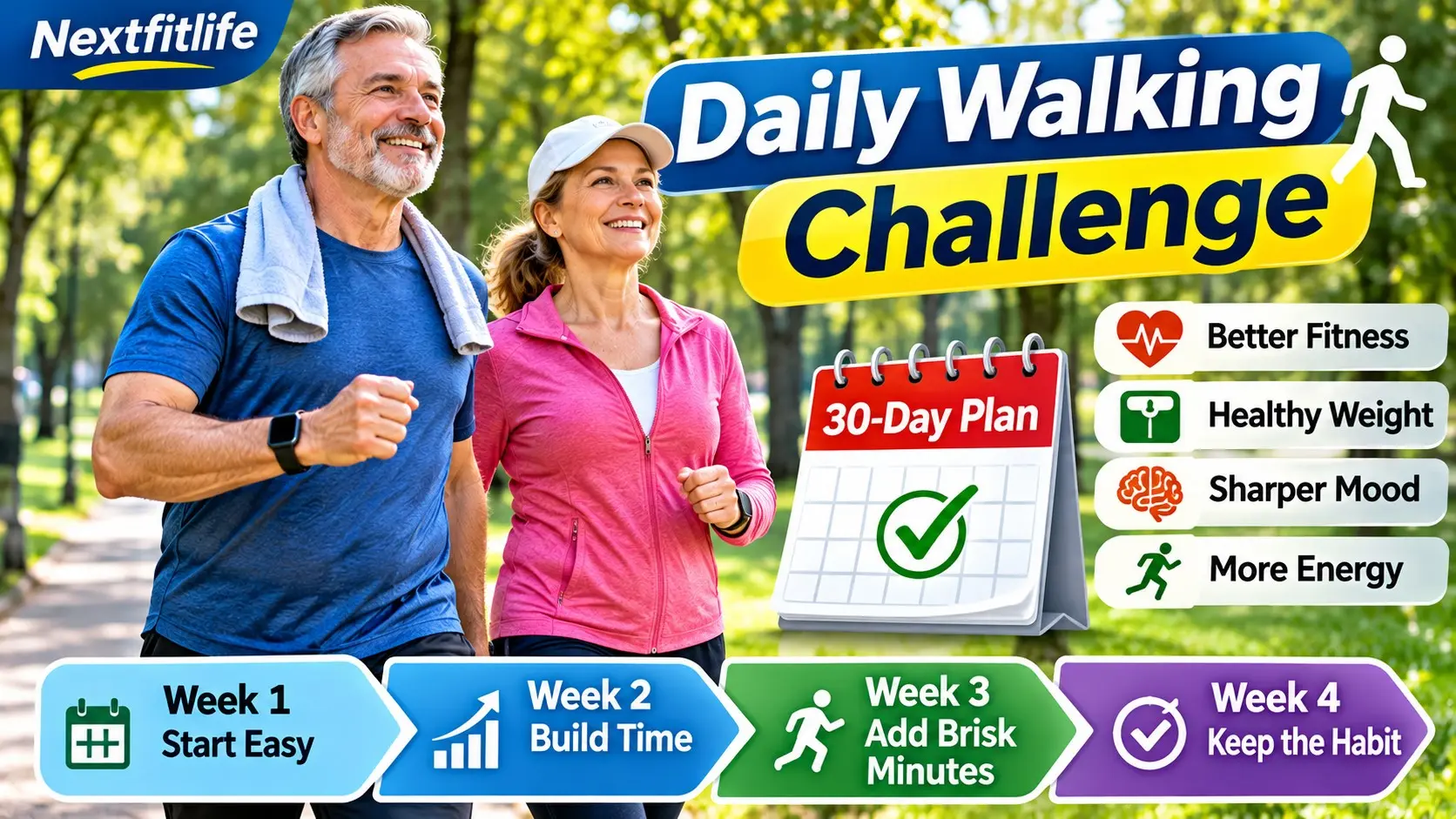
The goal of this 30 day plan is different. You start from your own level, walk a little more over time, add some brisk minutes when ready, and finish with a routine you can keep after Day 30.
This article is for general information and education. It does not replace medical advice, diagnosis, or treatment.
Quick answer: A Daily Walking Challenge can help you build a regular activity habit, improve aerobic fitness, and increase your daily movement. Beginners can start with 10 to 15 minutes and gradually build toward longer walks. You do not need 10,000 steps. Your own starting point matters more than a fixed number.
Safety first: Stop walking and seek urgent medical care for chest pain, fainting, sudden weakness, severe dizziness, confusion, or unusual severe shortness of breath. Ask a healthcare professional before increasing activity if you have unstable heart disease, recent surgery, severe balance problems, a major joint injury, diabetic foot wounds, or repeated falls.
Table of Contents
- What is a Daily Walking Challenge?
- Why 30 days can work well
- Do you need 10,000 steps?
- How to choose your starting point
- The 30 day walking plan
- Days 1 to 7: Build the habit
- Days 8 to 14: Add time
- Days 15 to 21: Add brisk walking
- Days 22 to 30: Build your routine
- Walking intensity
- Walking for weight loss
- Walking after meals
- Breaking up sitting
- Strength training
- Rest and recovery
- Common mistakes
- Frequently asked questions
What Is a Daily Walking Challenge?
A Daily Walking Challenge is a simple plan that gives you a reason to walk regularly for a set period.
In this plan, the goal is 30 days.
That does not mean you must perform a hard workout every single day. Some days are longer. Some are easy, and a few use gentle recovery walking.
The real goal is to create a repeatable walking habit.
Why Use a 30 Day Walking Challenge?
Thirty days is long enough to practice a routine many times without making the plan feel endless.
During the month, you can learn:
- What walking time feels comfortable
- Which pace feels moderate
- When you need rest
- Which routes you enjoy
- How your body responds to more activity
The month is not a magic biological deadline.
You will not transform every part of your health in exactly 30 days, but you can build a much stronger activity routine.
Why Walking Is Worth Doing
Walking is a form of aerobic exercise.
Regular walking can help you:
- Improve aerobic fitness
- Increase daily movement
- Build walking endurance
- Break up long sitting periods
- Support weight management
- Build a regular exercise habit
CDC recommends that adults work toward at least 150 minutes of moderate aerobic activity each week.
Brisk walking can count toward that target.
Do You Need 10,000 Steps a Day?
No.
The old article pushed readers toward 10,000 steps by Day 30.
Current research gives us a better answer.
A major 2025 systematic review found that about 7,000 daily steps were linked with meaningful health benefits compared with roughly 2,000 steps.
For several outcomes, the biggest gains appeared as people moved from very low step counts toward moderate amounts.
This does not make 7,000 a magic number either.
The better approach is to start from your own baseline.
How to Find Your Starting Step Count
Use your phone, watch, or pedometer for three normal days.
Do not walk extra just because you are measuring.
Find your rough daily average.
That is your baseline.
A Better Step Goal
| Baseline | Possible Next Goal | Main Focus |
|---|---|---|
| Under 3,000 steps | Add 300 to 500 | Build the habit |
| 3,000 to 4,999 | Add about 500 | Increase movement |
| 5,000 to 6,999 | Add 300 to 500 | Build pace or time |
| 7,000 or more | No automatic increase | Review fitness, pace, and recovery |
These are examples, not medical prescriptions.
Daily Walking Challenge: Days 1 to 7
Week 1 Goal: Build the Habit
Do not chase distance yet.
Your goal is to prove that walking can fit into your day.
| Day | Walking Plan |
|---|---|
| 1 | 10 min easy walk |
| 2 | 10 min easy walk |
| 3 | 12 min comfortable walk |
| 4 | 8 to 10 min recovery walk |
| 5 | 12 to 15 min walk |
| 6 | 15 min comfortable walk |
| 7 | 10 min easy walk and review your week |
If 10 minutes feels too hard, start with 5.
Days 8 to 14
Week 2 Goal: Add Time
Now add a few minutes while keeping most walks comfortable.
| Day | Walking Plan |
|---|---|
| 8 | 15 min walk |
| 9 | 15 min walk |
| 10 | 18 min walk |
| 11 | 10 min easy recovery walk |
| 12 | 18 to 20 min walk |
| 13 | 20 min walk |
| 14 | 15 min easy walk |
Days 15 to 21
Week 3 Goal: Add Brisk Walking
Now some walks include short periods at a moderate pace.
Use the talk test.
You should breathe faster but still be able to speak in short sentences.
| Day | Walking Plan |
|---|---|
| 15 | 20 min with 3 brisk min |
| 16 | 15 min easy walk |
| 17 | 22 min with 5 brisk min |
| 18 | 10 to 15 min recovery walk |
| 19 | 25 min comfortable walk |
| 20 | 20 min with 5 to 7 brisk min |
| 21 | 15 min easy walk |
Days 22 to 30
Week 4 Goal: Build a Routine You Can Keep
The final nine days are not about pushing to exhaustion.
They are about finding the amount you can continue next month.
| Day | Walking Plan |
|---|---|
| 22 | 25 min walk |
| 23 | 20 min easy walk |
| 24 | 25 min with 7 brisk min |
| 25 | 15 min recovery walk |
| 26 | 30 min comfortable walk |
| 27 | 20 min easy walk |
| 28 | 30 min with 8 to 10 brisk min |
| 29 | 15 to 20 min recovery walk |
| 30 | 30 min celebration walk at a comfortable pace |
30 Day Progression at a Glance
| Week | Typical Walk | Main Goal |
|---|---|---|
| 1 | 10 to 15 min | Build the habit |
| 2 | 15 to 20 min | Build time |
| 3 | 20 to 25 min | Add brisk minutes |
| 4 | 20 to 30 min | Build a lasting routine |
How Hard Should You Walk?
Most walks do not need to feel hard.
For moderate intensity exercise, use the talk test.
You should:
- Breathe faster
- Feel warmer
- Still be able to talk
- Find singing more difficult
If you cannot speak comfortably, slow down.
Easy Walking Still Counts
Not every walk must be brisk.
Easy walking helps you:
- Add movement
- Recover
- Build consistency
- Break up sitting
That is why this challenge includes recovery days.
Can You Lose Weight With a Daily Walking Challenge?
Walking can support weight loss, but it cannot guarantee a specific result.
The old article claimed an 8 pound personal loss during the challenge.
A safer answer is that weight change depends on:
- Food intake
- Walking time
- Walking pace
- Body size
- Other physical activity
- Sleep
- Medications
- Health conditions
Walking helps increase energy use, but diet still matters.
For a complete plan, visit the NextFitLife Weight Loss Guide.
Does a 30 Minute Walk Burn 150 Calories?
Maybe for some people, but not for everyone.
There is no universal calorie number.
Energy use changes with body weight, pace, terrain, fitness, and time.
Fitness watches also provide estimates rather than exact measurements.
Track minutes and consistency instead.
Can Walking Burn Belly Fat?
Walking cannot select fat from one body area.
It can support overall fat loss when it contributes to a calorie deficit.
Over time, that can reduce abdominal fat too.
Read Best Exercise for Belly Fat for a fuller explanation.
Walking After Meals
Short walks after meals can be useful.
Research on activity breaks shows that brief walking periods can improve short term glucose and insulin responses compared with prolonged sitting.
You do not have to make these walks hard.
A gentle 5 to 10 minute walk can be enough to add movement.
A Simple Post Meal Option
- Walk 5 to 10 minutes after lunch.
- Keep the pace comfortable.
- Add a second short walk after dinner if it suits your day.
If you take insulin or medicines that can cause low blood sugar, ask your healthcare team about exercise timing.
Why Breaking Up Sitting Matters
A walking challenge should not only focus on one workout.
Long periods of sitting can also be interrupted with short movement breaks.
A 2026 systematic review and meta analysis found that activity breaks reduced post meal glucose and insulin responses compared with prolonged sitting.
Walking breaks performed particularly well.
This is an acute effect, not proof that walking breaks alone prevent disease.
Try a Two Minute Walking Break
If you work at a desk:
- Stand up.
- Walk around your home or office.
- Return after two or three minutes.
Repeat during long sitting periods when practical.
Can You Do the Challenge Indoors?
Yes.
Your walking can include:
- Hallway laps
- Walking in place
- Room loops
- Mall walking
- Treadmill walking
Try Indoor Walking Exercise for a complete home routine.
Can Seniors Do the Challenge?
Yes, but the starting point may need to be lower.
An older adult who is inactive may begin with five minutes instead of ten.
Adults age 65 and older should also include strength and balance work.
See Walking Exercise for Seniors.
Can Beginners Do the Challenge?
Yes.
This plan is designed to be adjusted.
If one week feels difficult, repeat it instead of moving forward.
You do not fail because you need more time.
What If You Already Walk 30 Minutes?
You do not need to start at Day 1.
You can begin with Week 3 or Week 4.
You might focus on:
- Adding brisk minutes
- Improving consistency
- Walking a new route
- Adding strength training
Why Strength Training Belongs in the Challenge
Walking is mainly aerobic.
It does not provide a complete muscle strengthening program.
CDC recommends muscle strengthening work on at least two days each week.
Simple options include:
- Chair squats
- Wall push ups
- Rows
- Hip hinges
- Calf raises
Try Simple Strength Training Exercises at Home.
A Better Weekly Challenge Structure
| Day Type | Purpose |
|---|---|
| Easy walk | Movement and recovery |
| Brisk walk | Aerobic fitness |
| Longer walk | Endurance |
| Strength day | Maintain muscle |
| Recovery day | Reduce fatigue |
Do You Need to Walk Every Day?
No.
The challenge includes daily movement, but some days are intentionally easier.
If you are sore, exhausted, or ill, rest.
One missed day will not destroy your progress.
Should You Stretch Before Walking?
You do not need a long static stretching routine.
Start your walk slowly for several minutes.
This is a simple warm up.
If you enjoy stretching, gentle stretching after the walk is fine.
What Shoes Should You Use?
Choose shoes that feel comfortable and stable.
Look for:
- A secure fit
- Enough room for your toes
- Good grip
- No painful pressure points
The most expensive shoe is not automatically the best one.
Should You Carry Water?
For a short walk in mild weather, many people do not need to carry a bottle.
For longer walks, hot weather, or people with higher fluid needs, bringing water can be useful.
Drink according to thirst and individual needs unless your healthcare team has given you specific fluid instructions.
Walking in Hot Weather
Use extra care in heat.
- Walk early or indoors.
- Use shade.
- Wear light clothing.
- Slow your pace.
Stop if you feel faint, confused, unusually weak, or severely dizzy.
Walking in Rain or Ice
Do not follow the old advice to “walk in all weather” if the conditions are unsafe.
Wet surfaces, ice, poor visibility, and storms can raise injury risk.
Move the challenge indoors instead.
How to Stay Motivated for 30 Days
1. Mark Each Walk
Use a calendar and mark each completed day.
2. Walk With Someone
A friend can make walking more social.
3. Use a Regular Time
Attach the walk to breakfast, lunch, or the end of work.
4. Keep an Indoor Backup
Bad weather should not end the challenge.
5. Track One Metric
Choose minutes or steps.
You do not need to track everything.
6. Reward Consistency
Celebrate finishing a week rather than chasing a perfect calorie number.
What If You Miss a Day?
Continue the next day.
Do not double your walking time to “make up” for it.
Consistency over 30 days matters more than perfection.
What If Your Feet Hurt?
Reduce the walking load.
Check your shoes and walking surface.
Persistent pain, swelling, numbness, or a skin wound deserves attention.
People with diabetes should take new foot wounds seriously.
What If Your Knees Hurt?
Try a shorter walk and a flatter route.
Slow the pace.
If your knee swells, locks, gives way, or causes severe pain, get it assessed.
What Happens After Day 30?
Do not automatically double the plan.
Review what worked.
Ask yourself:
- Which walking time felt sustainable?
- Which days worked best?
- Did brisk walking feel comfortable?
- Do I enjoy tracking steps?
- What made me skip a walk?
Then build your next month around those answers.
Common Daily Walking Challenge Mistakes
1. Forcing 10,000 Steps
Your own baseline matters more.
2. Increasing Too Fast
Add time or pace slowly.
3. Making Every Walk Hard
Easy walking has value.
4. Expecting Rapid Weight Loss
Walking does not guarantee a fixed number of pounds lost.
5. Trusting Calorie Trackers Too Much
Treat calorie numbers as estimates.
6. Ignoring Strength Training
Walking is not a complete strength program.
7. Walking Through Sharp Pain
Pain is not proof that the challenge is working.
8. Walking Outside in Unsafe Weather
Use an indoor backup.
9. Doubling Up After a Missed Day
Simply continue the plan.
10. Stopping After Day 30
The real goal is the habit you keep.
Daily Walking Challenge Checklist
- Measure your normal walking level first.
- Start with 5 to 15 minutes if needed.
- Add walking time gradually.
- Use brisk walking only when comfortable.
- Do not force 10,000 steps.
- Keep easy days in the plan.
- Add strength work twice each week.
- Use short walking breaks during long sitting periods.
- Move indoors when the weather is unsafe.
- Track minutes or steps, not every possible number.
- Stop for serious warning symptoms.
- Build a routine you can continue after Day 30.
Conclusion
A Daily Walking Challenge works best when the goal is not perfection.
You do not need to reach 10,000 steps, walk for an hour, or lose a fixed amount of weight by Day 30.
Start from your real activity level. Build time gradually, add some brisk walking, use easy days for recovery, and combine walking with strength training.
The biggest success is not reaching one number on Day 30. It is reaching Day 31 with a walking habit you still want to keep.
Your next step: check your current walking level and complete Day 1 today with a comfortable 10 minute walk, or five minutes if that suits you better.
References and Sources
- Centers for Disease Control and Prevention. What You Can Do to Meet Physical Activity Recommendations.
https://www.cdc.gov/physical-activity-basics/guidelines/index.html - Centers for Disease Control and Prevention. Adult Activity: An Overview.
https://www.cdc.gov/physical-activity-basics/guidelines/adults.html - Ding D, et al. Daily Steps and Health Outcomes in Adults: A Systematic Review and Dose Response Meta Analysis, 2025.
https://pubmed.ncbi.nlm.nih.gov/40713949/ - Gale JT, et al. The Acute Effects of Interrupting Prolonged Sitting With Regular Activity Breaks on Postprandial Glucose and Insulin in Adults, 2026.
https://pubmed.ncbi.nlm.nih.gov/42070794/ - Objectively Measured Daily Steps and Health Outcomes. Umbrella Review of Systematic Reviews and Meta Analyses.
https://pubmed.ncbi.nlm.nih.gov/39384238/ - National Institute of Diabetes and Digestive and Kidney Diseases. Eating and Physical Activity to Lose or Maintain Weight.
https://www.niddk.nih.gov/health-information/weight-management/adult-overweight-obesity/eating-physical-activity - Vanherle J, et al. Optimizing Physical Activity Bouts to Interrupt Sedentary Behaviour for Cardiometabolic Health, 2026.
https://pubmed.ncbi.nlm.nih.gov/41920954/
Internal Links + Hub
- NextFitLife Fitness Hub
- Fitness Program Guide
- Walking Routine to Lose Weight
- Walking Workout Plan for Weight Loss
- Indoor Walking Exercise
- Walking Exercise for Seniors
- Walking 10 Minutes After Meals
- How Many Steps a Day to Lose Weight for a Woman
- Simple Strength Training Exercises at Home
- Strength Training Exercises at Home for Beginners
- Complete Weight Loss Guide
- How to Maintain Muscle Mass
About the Author
Adel Galal is the founder and lead writer of NextFitLife.com and the founder of Parnthub.com.
He is a father of four, three sons and a daughter, and a grandfather of four, with more than 33 years of hands on family experience. Adel is based in Cairo, Egypt.
He has maintained a personal interest in health, fitness, nutrition, sleep, mobility, wellness, and healthy aging for more than 30 years and has more than 15 years of health and wellness writing experience.
His work focuses on reviewing trusted sources, separating practical fitness guidance from exaggerated claims, and turning research into simple actions readers can use in daily life.
Adel is not a doctor, physical therapist, exercise physiologist, certified personal trainer, or other licensed healthcare professional. NextFitLife content is for general information and education and does not replace individual medical or exercise advice.
Learn more about Adel and NextFitLife on the About Us page.
Frequently Asked Questions
Does a Daily Walking Challenge work?
It can help you build a regular walking habit, increase daily movement, and improve aerobic fitness. Results depend on your starting level and how consistently you follow the plan.
Do I need to walk every day for 30 days?
You can move daily, but some days should be easier. Recovery walking or rest may be appropriate when you are sore, tired, or unwell.
Do I need 10,000 steps during the challenge?
No. Research shows health benefits at lower step counts. Start from your own baseline instead of chasing a fixed number.
Is 7,000 steps enough?
For many adults, around 7,000 daily steps is associated with meaningful health benefits compared with very low step counts, but it is not a mandatory target.
How many steps should a beginner start with?
Measure your normal daily steps first. A small increase of a few hundred steps may be a better starting point than choosing an arbitrary number.
Can I start with only five minutes of walking?
Yes. Five minutes is a useful starting point if you are inactive or have low endurance.
Can I lose weight during a 30 day walking challenge?
Walking can support weight loss, but no exact amount is guaranteed. Food intake, activity, sleep, medications, health, and body size all matter.
Can I lose 8 pounds in 30 days by walking?
Do not use a fixed weight loss target based on walking alone. Results vary greatly, and rapid weight loss is not appropriate for everyone.
How many calories does a 30 minute walk burn?
There is no universal number. Calorie use depends on body size, pace, terrain, fitness, and walking time.
Can walking reduce belly fat?
Walking cannot target belly fat directly, but it can support overall fat loss when it contributes to a calorie deficit.
How fast should I walk?
For a moderate pace, walk fast enough that your breathing increases while you can still talk.
Can I split my walking into shorter sessions?
Yes. Several short walks through the day can contribute to your total physical activity.
Can walking after meals help?
Short post meal walks may help improve short term glucose responses in some people.
Should I walk when I am sore?
A gentle walk may feel fine with mild muscle soreness, but sharp pain, swelling, or worsening joint pain is a reason to reduce activity.
Do I need strength training too?
Yes. Walking is mainly aerobic exercise. Adults should also include muscle strengthening exercise on at least two days each week.
Can beginners do this Daily Walking Challenge?
Yes. Reduce the starting time to five minutes if needed and repeat a week before progressing.
Can seniors do this challenge?
Many can, but older adults may need shorter starting walks and should also include balance and strength activities.
Can I do the challenge indoors?
Yes. Walking in place, hallway laps, treadmill walking, and mall walking can all count.
What if it rains?
Move the walk indoors rather than using an unsafe wet or slippery route.
What if I miss a day?
Continue the next day. Do not double your walking time to compensate.
Should I stretch before every walk?
You do not need a long static stretching routine. Starting with several minutes of easy walking is a simple warm up.
Should I track steps or minutes?
Either works. Choose the measure that helps you stay consistent without creating unnecessary stress.
Can walking breaks help if I sit all day?
Yes. Research suggests short walking breaks can improve acute glucose and insulin responses compared with prolonged uninterrupted sitting.
What should I do after Day 30?
Keep the walking amount that feels sustainable and gradually adjust your pace, time, or strength training based on your goals.
When should I stop walking?
Stop for chest pain, fainting, sudden weakness, severe dizziness, confusion, unusual severe shortness of breath, or severe worsening pain.

Health & wellness writer with 30+ years of experience in nutrition, fitness, and healthy aging. Founder of NextFitLife.com — evidence-based health guidance.

