

Published on: August 28, 2024
Updated on: November 3, 2026
The best injury prevention exercises build the qualities your body needs to handle movement: strength, balance, coordination, joint control, and enough physical capacity for the activity you want to do.
No exercise can guarantee that you will never get hurt. Injuries can happen because of falls, contact, sudden changes in training, previous injuries, sport demands, fatigue, health conditions, and simple bad luck.
What exercise can do is improve your ability to handle physical stress. Research on sports injury prevention and fall prevention shows that well-designed strength, balance, and neuromuscular training programs can lower injury risk in several groups, especially when people follow the program consistently.
This guide gives you 12 practical exercises plus warm-up, progression, recovery, and training load advice so you can build a stronger and more resilient body.
Important: This article is for general information and education. It does not replace medical advice, diagnosis, or treatment.
Table of Contents
- Quick Answer
- Can Exercise Prevent Injuries?
- What Makes an Injury Prevention Program Work?
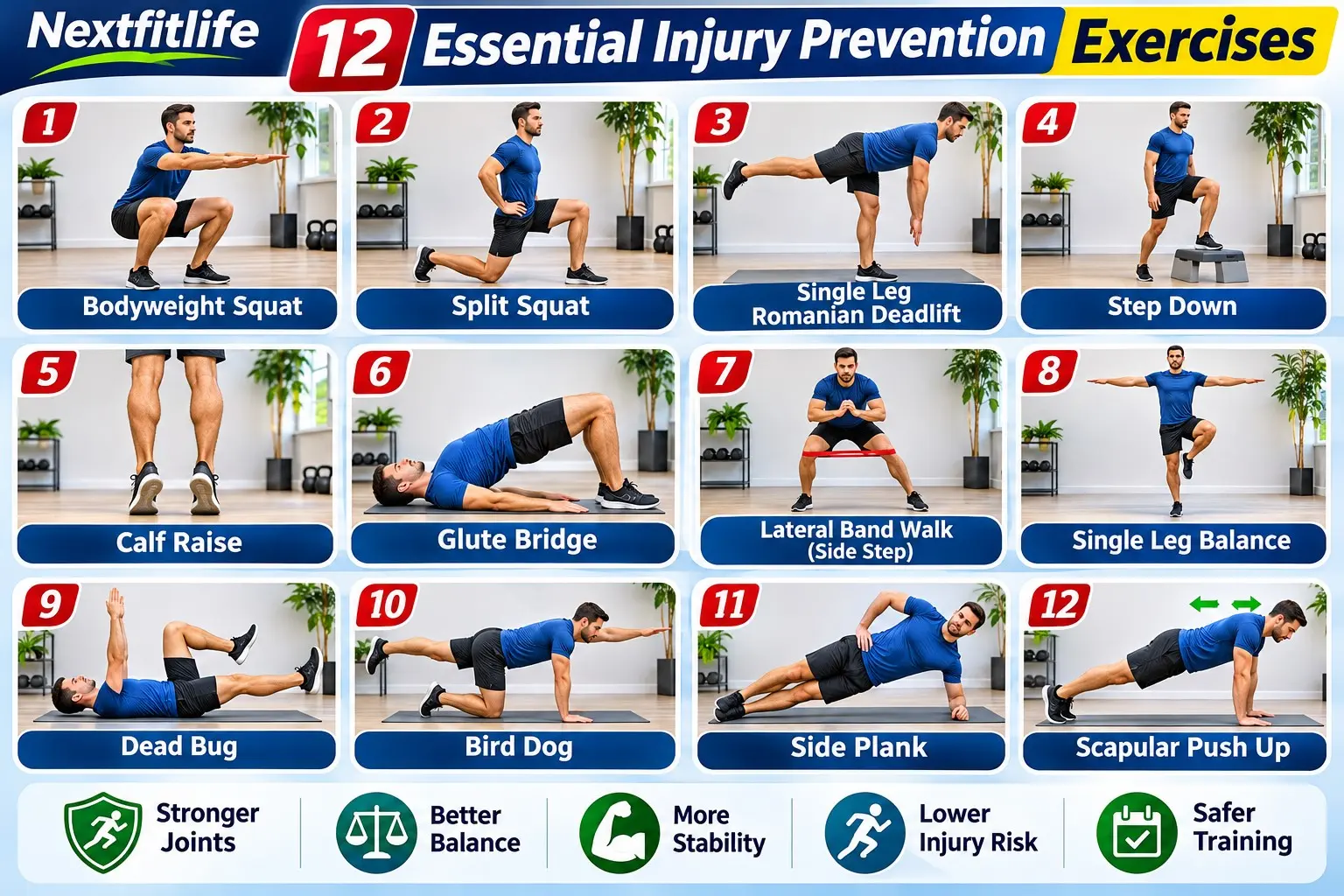
- 12 Essential Injury Prevention Exercises
- Best Exercises by Goal
- Beginner Injury Prevention Workout
- Weekly Training Plan
- Warm Up Before Exercise
- Progressive Loading
- Balance and Fall Prevention
- Mobility and Flexibility
- Recovery and Sleep
- Common Prevention Mistakes
- When Pain Needs Medical Attention
- Conclusion
- References and Sources
- Internal Links and Fitness Hub
- About the Author
- Frequently Asked Questions
Quick Answer: Which Injury Prevention Exercises Matter Most?
A useful injury prevention exercise program should train more than one part of your body. Strength matters, but so do balance, coordination, trunk control, ankle strength, hip strength, and your ability to move on one leg.
A practical whole-body list is:
- Bodyweight squat
- Split squat
- Single leg Romanian deadlift
- Step down
- Calf raise
- Glute bridge
- Lateral band walk or side step
- Single-leg balance
- Dead bug
- Bird dog
- Side plank
- Scapular push-up
You do not need to perform all 12 every day. Choose several that match your activity and current ability, then build them gradually.
If you want a complete strength plan around these exercises, visit the NextFitLife Strength Training and Muscle Building Guide.
Can Exercise Really Prevent Injuries?
Exercise can reduce injury risk, but the wording matters.
It is more accurate to say that certain programs can reduce risk rather than prevent every injury.
Recent reviews of neuromuscular exercise programs have found meaningful reductions in lower limb sports injuries. A 2025 meta analysis of young athletes found that neuromuscular training reduced overall lower extremity injury risk.
Research also shows that adherence matters. Programs work poorly when people rarely perform them.
This gives us a simple lesson: the best prevention program is not the most complicated one. It is one that trains useful qualities and is simple enough to repeat.
What Makes an Injury Prevention Program Work?
Good programs usually include several of the following:
- Progressive resistance training
- Balance training
- Single leg control
- Jumping and landing practice when appropriate
- Hip and ankle strength
- Trunk control
- Sport specific movement practice
- Gradual increases in training load
- Consistent practice
The exact mix should match the person.
A runner, football player, older adult, office worker, and new gym member do not have identical injury risks.
12 Essential Injury Prevention Exercises
1. Bodyweight Squat
The squat develops lower body strength through the hips, knees, and ankles.
- Stand with your feet in a comfortable position.
- Keep your chest relaxed and tall.
- Move your hips down and back.
- Bend your knees naturally.
- Lower only as far as you can control.
- Push through your feet to stand.
Starting target: 2 sets of 8 to 12 repetitions.
If a full squat feels difficult, squat to a chair and stand again.
2. Split Squat
A split squat trains each leg in a different position and can build hip, thigh, and single-leg control.
- Place one foot in front of the other.
- Keep both feet stable.
- Lower your body slowly.
- Bend both knees to a comfortable depth.
- Push through the front foot to rise.
Starting target: 2 sets of 6 to 10 repetitions per side.
Hold a wall or chair for balance if needed.
3. Single Leg Romanian Deadlift
This exercise challenges the glutes, hamstrings, feet, and balance system at the same time.
- Stand on one leg.
- Keep a small bend in the standing knee.
- Push your hips backward.
- Allow the other leg to travel behind you.
- Keep your pelvis controlled.
- Return to standing.
Starting target: 2 sets of 6 to 10 repetitions per side.
Hold a wall lightly if balance is difficult.
4. Controlled Step Down
The step down trains the hip and knee to control your body while one leg carries most of the load.
- Stand on a low stable step.
- Keep one foot planted.
- Slowly lower the opposite heel toward the floor.
- Keep the standing knee controlled.
- Press back to the starting position.
Starting target: 2 sets of 6 to 10 repetitions per side.
Start with a low step. Increase height only when you can control the movement.
5. Calf Raise
Your calves help manage repeated loads during walking, running, jumping, and stair climbing.
- Stand near a wall or chair.
- Keep your feet facing forward naturally.
- Rise onto the balls of your feet.
- Pause briefly.
- Lower slowly.
Starting target: 2 sets of 10 to 15 repetitions.
When two-leg calf raises become easy, progress toward one leg at a time.
6. Glute Bridge
The bridge trains hip extension and is an easy way to begin strengthening your glutes.
- Lie on your back.
- Bend your knees.
- Place your feet flat on the floor.
- Press through your feet.
- Lift your hips.
- Lower slowly.
Starting target: 2 sets of 10 to 15 repetitions.
For more hip strengthening exercises, see our hip and glute exercise guide.
7. Lateral Band Walk or Side Step
This movement trains the muscles around the outer hips and asks you to control your knees and pelvis while moving sideways.
If you have a resistance band:
- Place the band above your knees.
- Bend your knees slightly.
- Step sideways with control.
- Keep gentle tension on the band.
- Repeat in both directions.
Starting target: 8 to 12 controlled steps each way.
If you have no band, perform slow side steps while keeping a slight squat position.
8. Single Leg Balance
Balance training matters because many daily and sport movements place your weight on one leg.
- Stand near a stable support.
- Lift one foot slightly from the floor.
- Keep the standing foot relaxed.
- Stay tall.
- Hold for 15 to 30 seconds.
- Switch sides.
Make the exercise harder by turning your head slowly or reaching one hand in different directions.
Do not close your eyes unless you are in a safe environment and have appropriate support.
9. Dead Bug
The dead bug trains core stability while your arms and legs move.
- Lie on your back.
- Raise your arms.
- Bring your hips and knees into a comfortable bent position.
- Brace your middle gently.
- Lower one arm and the opposite leg.
- Return and switch sides.
Starting target: 6 to 10 repetitions per side.
Use a smaller movement if your lower back begins to arch strongly.
For more trunk exercises, visit our Core Workouts at Home guide.
10. Bird Dog
The bird dog trains trunk control while opposite limbs move away from your base of support.
- Start on your hands and knees.
- Keep your spine comfortable.
- Extend one leg behind you.
- Reach the opposite arm forward.
- Pause briefly.
- Return slowly.
- Switch sides.
Starting target: 6 to 10 repetitions per side.
Do not lift your arm or leg higher than you can control.
11. Side Plank
The side plank trains the muscles along the side of your trunk and can help develop whole body control.
- Lie on one side.
- Support yourself on your forearm.
- Bend your knees for the easier version.
- Lift your hips.
- Keep your body controlled.
Starting target: 10 to 30 seconds per side.
Progress to straight legs when the bent knee version becomes easy.
12. Scapular Push-Up
This exercise trains movement and control around the shoulder blades without requiring large elbow movement.
- Begin in a wall, incline, kneeling, or full plank position.
- Keep your elbows mostly straight.
- Let your chest move slightly toward the floor as your shoulder blades come together.
- Push the floor or wall away.
- Allow your shoulder blades to move apart.
Starting target: 8 to 15 repetitions.
Choose the body angle that lets you move smoothly.
Best Injury Prevention Exercises by Goal
| Goal | Useful Exercises | Main Focus |
|---|---|---|
| Knee Control | Split squat, step down, squat | Strength and movement control |
| Ankle and Foot Strength | Calf raise, single-leg balance | Lower leg strength and balance |
| Hip Strength | Bridge, split squat, lateral walk | Hip control and strength |
| Balance | Single-leg balance, single-leg deadlift | Postural control |
| Core Control | Dead bug, bird dog, side plank | Trunk stability |
| Shoulder Control | Scapular push-up | Shoulder blade control |
A Simple Beginner Injury Prevention Workout
You do not need a 60-minute prevention routine.
Start with six movements.
| Exercise | Sets | Reps or Time |
|---|---|---|
| Bodyweight Squat | 2 | 8 to 12 |
| Split Squat | 2 | 6 to 8 each side |
| Calf Raise | 2 | 10 to 15 |
| Single Leg Balance | 2 | 20 seconds each side |
| Dead Bug | 2 | 6 each side |
| Scapular Push Up | 2 | 8 to 12 |
Perform the workout two or three times per week if it fits your wider training plan.
A Practical Weekly Plan
| Day | Activity | Goal |
|---|---|---|
| Monday | Strength and balance | Build capacity |
| Tuesday | Walking or easy cardio | General fitness |
| Wednesday | Rest or light activity | Recovery |
| Thursday | Strength and balance | Repeat useful movement patterns |
| Friday | Easy cardio | Aerobic fitness |
| Weekend | Normal recreation and recovery | Stay active |
Adapt the schedule to your sport and current training.
Warm Up Before Hard Exercise
A warm-up should prepare you for the activity you are about to do.
For strength training, that may include:
- Several minutes of easy movement
- Controlled bodyweight versions of the exercises
- Lighter warm-up sets
- Gradually increasing the load
For running or sport, you can add movements that resemble what you are about to do.
A warm-up does not have to be long or exhausting.
The goal is preparation.
Strength Matters More Than Endless Stretching
Stretching can improve flexibility, but injury prevention is more complex than simply becoming more flexible.
Your body also needs enough strength to control the ranges you use.
That is why a useful prevention plan combines mobility with functional strength.
If you can reach a position but cannot control it under load, more stretching alone may not solve the problem.
Progressive Loading Is Part of Injury Prevention
Your body adapts to the work you expose it to.
Progressive overload means slowly increasing that work as your capacity improves.
You can progress by:
- Adding a repetition
- Adding a small amount of resistance
- Increasing your range gradually
- Adding another set
- Moving to a harder exercise
- Adding sport-specific practice
The key word is gradually.
Sudden jumps in workload can create a mismatch between what your body can currently tolerate and what you are asking it to do.
Do Not Use a Fixed 10 Percent Rule
You may have heard that training should never increase by more than 10 percent per week.
That number is easy to remember, but it is not a universal safety rule.
Different people tolerate different amounts of progression depending on their training history, activity, sleep, previous injuries, age, and current fitness.
Instead of chasing one percentage, increase training in manageable steps and watch how your body responds.
Balance Training Becomes More Important With Age
For older adults, balance is not only a sports performance skill. It can be part of fall prevention.
The CDC recommends that adults aged 65 and older include aerobic activity, muscle strengthening, and activities that improve balance.
Recent systematic reviews also support structured balance and strength programs for reducing falls in community-dwelling older adults.
Useful activities include:
- Single-leg standing with support nearby
- Heel-to-toe walking
- Controlled sit-to-stands
- Step training
- Strength exercises
The safest choice depends on the person's fall risk and health.
Should Runners Use Injury Prevention Exercises?
Yes, but runners need more than a generic five-minute mobility routine.
Running places repeated load through the feet, calves, knees, hips, and trunk.
Useful strength exercises include:
- Calf raises
- Split squats
- Single-leg deadlifts
- Step downs
- Squats
You also need a sensible running progression.
For endurance programming, read our guide on how to increase stamina for running.
What About Sports Injury Prevention?
Sports such as football, basketball, handball, and volleyball can involve sprinting, cutting, jumping, landing, and sudden changes in direction.
For those athletes, prevention programs may need additional exercises such as:
- Jump and landing drills
- Deceleration practice
- Change of direction work
- Hamstring strength
- Single leg strength
- Sport specific neuromuscular drills
Recent evidence in young athletes supports multicomponent neuromuscular training for reducing lower extremity injury risk.
Consistency Matters More Than the Perfect Exercise
A prevention exercise only helps when you actually perform it.
A 2026 systematic review found that adherence to exercise-based injury prevention programs was strongly linked with lower sports injury rates.
This is a useful reminder.
A simple 15-minute program performed regularly can be more valuable than a perfect 45-minute routine that you rarely do.
Recovery Is Part of Training
Your body needs recovery time to adapt to exercise.
Useful recovery habits include:
- Enough sleep
- Enough food
- Protein and other nutrients
- Hydration
- Easier training days
- Rest when needed
Recovery does not mean avoiding all movement. Easy walking or light activity can fit between harder training days.
Common Injury Prevention Mistakes
Trying to Prevent Every Injury
No program can remove all risk.
A realistic goal is to improve physical capacity and reduce avoidable risks.
Stretching but Never Getting Stronger
Mobility is useful, but strength gives you the ability to control movement under load.
Doing Random Corrective Exercises Forever
Small drills can be useful at first, but your program should progress when you become stronger.
Ignoring Single Leg Training
Walking, running, stairs, and many sports repeatedly place your weight on one leg.
Ignoring Balance
Balance becomes especially important for older adults and activities that involve rapid changes of direction.
Doing Too Much Too Soon
A sudden increase in exercise difficulty, duration, frequency, or intensity can be harder to recover from.
Training Through Significant Pain
Pain that keeps worsening is not something to solve by adding more exercise blindly.
Copying Someone Else's Program Exactly
Your training history, age, sport, injuries, and goals may be different.
Pain Does Not Always Mean Injury
Pain and tissue damage are not exactly the same thing.
Muscle soreness after unfamiliar exercise can be normal. A mild temporary ache may also occur during training.
At the same time, pain should not be ignored when it is severe, sudden, worsening, or associated with major loss of function.
If you are unsure, a qualified healthcare professional can assess your symptoms rather than guessing from an online article.
When Should You Stop Exercise and Get Medical Help?
Stop training and seek appropriate medical care if you develop:
- Severe sudden pain
- A joint that looks deformed
- Major swelling after an injury
- Inability to put weight on a leg
- Loss of normal movement after trauma
- New numbness or significant weakness
- Chest pain
- Fainting
- Severe unusual shortness of breath
Urgent symptoms require appropriate medical care rather than an injury prevention workout.
A Better Way to Think About Injury Prevention
Do not think of the body as fragile.
Think of it as adaptable.
Training gives your muscles, tendons, bones, balance system, heart, and nervous system a reason to adapt. The challenge needs to be large enough to create change but manageable enough that you can recover.
This is why consistency and gradual progression matter so much.
If you are building a complete routine from scratch, see the NextFitLife Fitness Program Guide.
Conclusion
The best injury prevention exercises are not magic movements that make injuries impossible. They are exercises that improve strength, balance, control, and physical capacity so your body is better prepared for the activities you ask it to perform.
Start with basic squats, split squats, calf raises, single leg balance, core work, and hip strengthening. Then progress those movements as you get stronger.
Your next step: choose six exercises from this guide and perform them twice this week. Keep the movements controlled, record your repetitions, and increase the challenge gradually instead of changing your entire routine every session.
References and Sources
- American College of Sports Medicine. Updated Resistance Training Guidelines, 2026. ACSM emphasizes simple, consistent and progressive resistance training for strength and physical function.
https://acsm.org/resistance-training-guidelines-update-2026/ - Centers for Disease Control and Prevention. Adult Physical Activity Guidelines. Adults should include muscle strengthening activity on at least two days each week.
https://www.cdc.gov/physical-activity-basics/guidelines/adults.html - Centers for Disease Control and Prevention. Older Adult Physical Activity Guidelines. Older adults should include aerobic, strength, and balance activity.
https://www.cdc.gov/physical-activity-basics/guidelines/older-adults.html - Systematic Review and Meta Analysis. Preventive Effects of Neuromuscular Training on Lower Extremity Sports Injuries in Adolescent and Young Athletes.
https://pubmed.ncbi.nlm.nih.gov/40618548/ - Systematic Review and Meta Analysis. Effect of Adherence to Exercise Based Injury Prevention Programmes on Sports Injury Risk.
https://pubmed.ncbi.nlm.nih.gov/40764021/
Internal Links + Fitness Hub
- NextFitLife Fitness Hub
- Strength Training and Muscle Building Guide
- Fitness Program Guide
- Core Workouts at Home
- How to Increase Stamina for Running
- Home Workouts and Equipment Hub
- Minimum Effective Dose Strength Training
- Leg Exercises With Dumbbells
About the Author
Adel Galal is a father of four, three sons and a daughter, and a grandfather of four, with 33 years of hands on parenting experience. He is the founder of Parnthub.com, based in Cairo, Egypt, where he shares practical guidance on feeding, development and family life from newborns to teenagers.
Adel is not a medical professional. Health articles cite trusted sources and are for general information only.
Learn more on the NextFitLife About Us page.
Frequently Asked Questions
What are the best injury prevention exercises?
Useful injury prevention exercises include squats, split squats, single-leg deadlifts, step-downs, calf raises, glute bridges, balance exercises, dead bugs, bird dogs, side planks, and shoulder control exercises. The best choices depend on your activity and needs.
Can exercise prevent all injuries?
No. No exercise routine can prevent every injury. Strength, balance, neuromuscular training, and gradual progression can reduce risk in several populations, but injuries can still occur.
How often should I do injury prevention exercises?
Two or three short sessions each week can work well for many people. Sport-specific programs may use some prevention exercises more often. Consistency is more important than doing a very long session occasionally.
Does strength training reduce injury risk?
Strength training can improve the physical capacity of muscles and other tissues. It is commonly included in injury prevention programs and should be progressed gradually.
Are balance exercises useful for injury prevention?
Yes. Balance training can be useful for sports and is especially important for older adults. Current guidelines recommend balance activity as part of weekly exercise for adults aged 65 and older.
Does stretching prevent injuries?
Stretching can improve flexibility, but injury prevention is not based on stretching alone. Strength, balance, coordination, training load, recovery, and activity-specific preparation also matter.
Should runners do injury prevention exercises?
Yes. Calf raises, split squats, step downs, single-leg deadlifts, and other strength exercises can complement a sensible running program. Running volume and intensity should also progress gradually.
What injury prevention exercises are good for older adults?
Strength and balance movements such as sit-to-stands, calf raises, supported single-leg standing, controlled stepping, and other ability-appropriate exercises can be useful. People at high fall risk may need professional supervision.
Should injury prevention exercises hurt?
They should not cause severe or worsening pain. Muscle effort can be normal, but sharp pain, major swelling, new weakness, or loss of function should be assessed appropriately.
How long does an injury prevention workout need to be?
It does not need to be long. A focused 10- to 20-minute routine performed consistently can train several useful qualities. The right amount depends on your main workout, sport, ability, and goals.

Health & wellness writer with 30+ years of experience in nutrition, fitness, and healthy aging. Founder of NextFitLife.com — evidence-based health guidance.

