Published: February 3, 2025
Last Updated: August 1, 2026
Next Review: August 2027, or earlier if important eye-examination, contact-lens, myopia, nutrition, supplement, or vision-emergency guidance changes
Written and Source Checked by: Adel Galal, Founder and Lead Writer at NextFitLife
Review Status: Editorially source checked against current National Eye Institute, CDC, American Academy of Ophthalmology, and MedlinePlus information. It has not been medically reviewed by an ophthalmologist, optometrist, orthoptist, pharmacist, registered dietitian, or emergency clinician.
Many people search for how to improve eyesight naturally because they want clearer vision, less screen fatigue, healthier eyes, or freedom from glasses.
Healthy habits can protect eye health, reduce digital eye strain, support tear-film comfort, lower the risk of injury, and help manage health conditions that threaten vision.
However, natural habits usually cannot change the physical length of the eye, reshape the cornea, reverse age-related stiffening of the lens, remove a cataract, lower dangerously high eye pressure, or repair retinal damage.
This means that food, blinking, eye exercises, screen breaks, outdoor time, or supplements generally cannot cure:
- Nearsightedness
- Farsightedness
- Astigmatism
- Presbyopia
- Cataracts
- Glaucoma
- Macular degeneration
- Diabetic eye disease
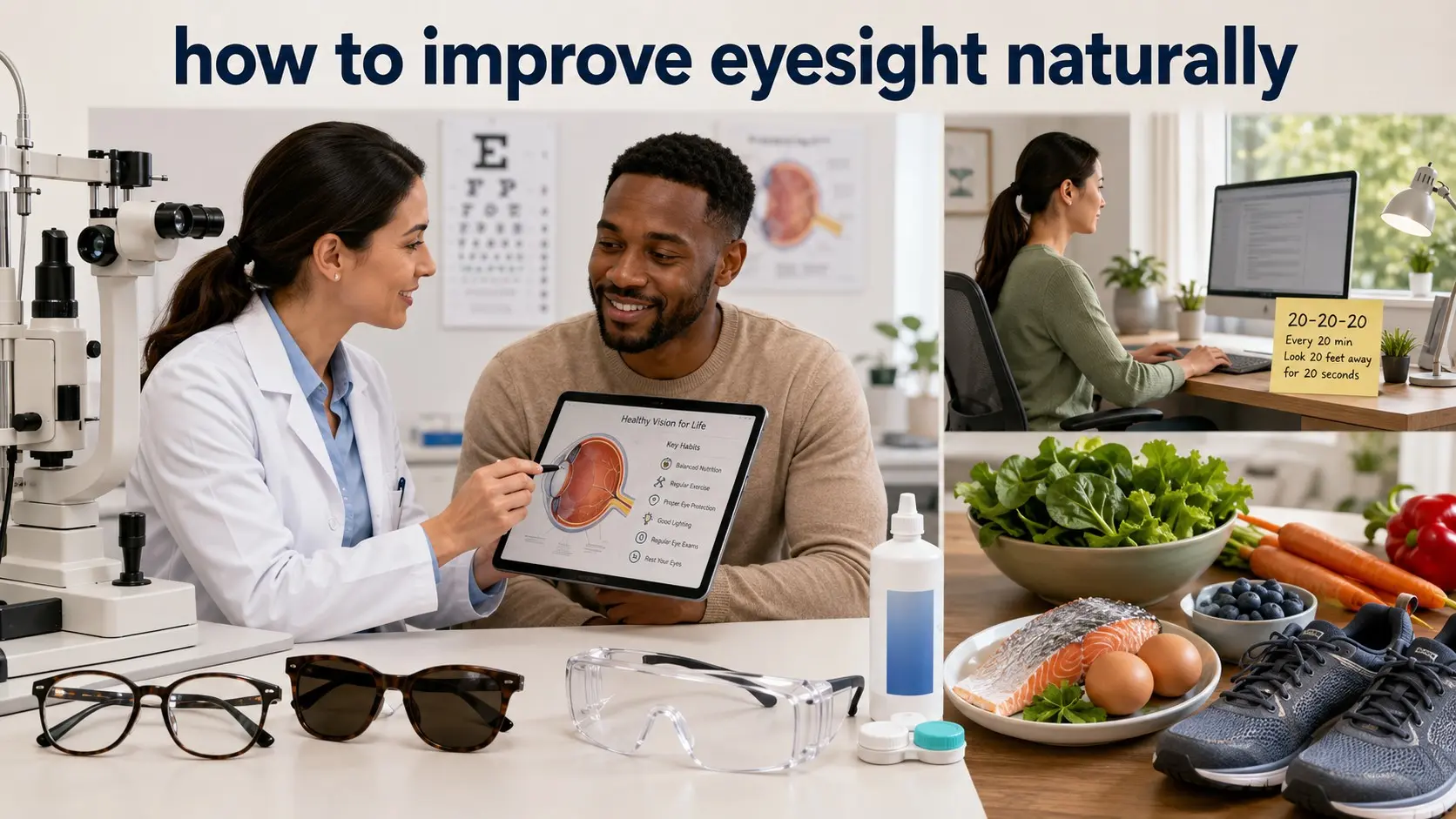
The strongest plan combines healthy daily habits with regular eye examinations, the correct glasses or contact lenses, management of diabetes and blood pressure, and timely treatment of eye disease.
Quick Answer: How to Improve Your Eyesight Naturally
You can support eye health naturally, but most refractive errors cannot be reversed with lifestyle changes alone.
Healthy habits may reduce digital eye strain, improve dry-eye comfort, protect the eyes from ultraviolet light and injury, and lower some risks associated with smoking, diabetes, high blood pressure, and poor contact-lens hygiene.
Nearsightedness, farsightedness, astigmatism, and presbyopia normally require glasses, contact lenses, or refractive surgery when appropriate. General eye exercises rarely change a glasses prescription.
The most useful habits include regular eye examinations, the correct vision prescription, screen breaks, full blinking, verified UV protection, safety eyewear, careful contact-lens hygiene, balanced nutrition, physical activity, not smoking, and management of blood sugar, blood pressure, and cholesterol.
Vision Symptoms That Need Urgent Medical Care
Seek urgent or emergency assessment for:
- Sudden loss of vision in one or both eyes
- Sudden new double vision
- Sudden severe blurring, especially in one eye
- Severe eye pain
- Eye pain with headache, nausea, or vomiting
- A chemical splash
- A penetrating or major eye injury
- Sudden flashes of light
- Many new floaters
- A curtain, shadow, or missing area of vision
- A red eye with severe pain or reduced vision
- Light sensitivity with significant pain
- A vision change with facial drooping, weakness, confusion, or trouble speaking
Do not wait for rest, food, eye exercises, or drops to correct a sudden vision change.
Chemical exposure: Begin rinsing the eye immediately with clean water for at least 15 minutes while arranging urgent medical help. Do not try to neutralize one chemical with another.
Embedded object: Do not pull out an object stuck in the eye and do not place pressure over it. Protect the area loosely and seek emergency care.
What Does “Improve Your Eyesight Naturally” Really Mean?
The phrase can describe several different goals.
Goals Healthy Habits May Support
- Less digital eye strain
- Less dryness or burning during screen use
- Better contact-lens comfort
- Reduced ultraviolet exposure
- Lower risk of eye injury
- Better management of diabetes and blood pressure
- Earlier detection of eye disease
- Better daily visual comfort
Goals Healthy Habits Usually Cannot Achieve
- Shorten an eye that has grown too long
- Lengthen an eye that is too short
- Reshape an irregular cornea naturally
- Restore the flexibility of an aging lens
- Remove an established cataract
- Reverse glaucoma damage
- Regrow damaged retinal tissue
- Remove the need for prescribed glasses in most people
Natural eye care is valuable, but the claims must match what the habits can realistically do.
Eye Comfort Is Not the Same as Visual Acuity
Visual acuity describes how clearly you can see detail, often measured using an eye chart.
Eye comfort refers to symptoms such as:
- Dryness
- Burning
- Grittiness
- Temporary focusing fatigue
- Headache during screen work
- Tired or heavy eyes
Screen breaks and blinking may improve comfort without changing the optical prescription.
Likewise, a person may feel comfortable but still have glaucoma, diabetic retinopathy, or another eye disease with few early symptoms. Comfort alone does not prove that the eyes are healthy.
Why Do Refractive Errors Cause Blurry Vision?
For clear vision, the cornea and lens must focus light precisely on the retina at the back of the eye.
Refractive error occurs when the shape of the eye prevents light from focusing correctly.
Nearsightedness
Nearsightedness, or myopia, commonly occurs when the eye is too long from front to back or when the cornea or lens focuses light too strong.
Distant objects appear blurry.
Farsightedness
Farsightedness, or hyperopia, may occur when the eye is too short or does not focus light strongly enough.
Near vision may be difficult, although younger people may compensate temporarily by focusing harder.
Astigmatism
Astigmatism occurs when the cornea or lens has an irregular curvature.
It may make near and distant objects look blurred or distorted.
Presbyopia
Presbyopia develops as the eye's natural lens becomes less flexible with age.
Near focusing becomes more difficult, commonly beginning in middle age.
How Refractive Errors Are Corrected
- Eyeglasses
- Contact lenses
- Refractive surgery for selected adults
These options change how light focuses. General exercises, carrots, or supplements do not usually correct the underlying optical problem.
Does Wearing Glasses Improve Eyesight?
Glasses improve clarity while you wear them by correcting how light enters the eyes.
They may help with:
- Nearsightedness
- Farsightedness
- Astigmatism
- Presbyopia
- Squinting
- Headaches caused by uncorrected blur
- Reading difficulty
- Driving clarity
- Work or school performance
Do Glasses Make the Eyes Weak?
No.
Wearing the correct prescription does not make the eyes lazy or physically weaker.
A prescription can change because of:
- Growth during childhood
- Myopia progression
- Normal aging
- Presbyopia
- Diabetes-related fluctuations
- Cataracts
- Other eye changes
The glasses did not cause those changes.
Can the Wrong Glasses Damage the Eyes?
An inaccurate prescription may cause blur, headache, or eyestrain, but it usually does not permanently damage an adult eye.
Children require appropriate professional evaluation because clear, balanced visual input is important during visual development.
Do Eye Exercises Improve Eyesight?
General eye exercises do not normally change the length of the eye, reshape the cornea, reverse presbyopia, or remove a refractive prescription.
They do not generally cure:
- Myopia
- Hyperopia
- Astigmatism
- Presbyopia
- Cataracts
- Glaucoma
- Retinal disease
When Professionally Directed Exercises May Be Used
Selected people may receive exercises or vision therapy for a diagnosed problem involving:
- Eye alignment
- Convergence
- Binocular coordination
- Eye movements
- Focusing function
These programs should be prescribed for a specific diagnosis. They should not be marketed as universal ways to throw away glasses.
Eye Exercise Myth
Repeatedly rolling the eyes, staring at a small object, rapidly changing focus, or using an online vision-training program does not normally alter the physical cause of refractive error.
Stop any exercise that causes pain, dizziness, double vision, nausea, or worsening symptoms, and arrange an eye assessment.
Tip 1: Schedule Eye Examinations Based on Your Risks
A comprehensive eye examination can detect problems that may not cause pain or obvious symptoms early on.
An Eye Examination May Assess:
- Visual acuity
- Glasses or contact-lens prescription
- Eye alignment and movement
- Eye pressure
- Cornea and lens health
- Optic nerve health
- Retinal health
- Cataracts
- Glaucoma risk
- Diabetes-related changes
- Dry-eye signs
Who May Need More Frequent Care?
- People with diabetes
- People with high blood pressure
- People with a family history of glaucoma or retinal disease
- People with high myopia
- People who wear contact lenses
- People with previous eye surgery or injury
- People taking medicines that can affect the eyes
- People with a diagnosed eye condition
- People with new or changing symptoms
There is no single examination schedule for everyone. Ask an eye-care professional how often you should return based on age, health, family history, symptoms, and previous findings.
Read the Medical Tests and Screenings Hub for more preventive-care guidance.
Tip 2: Wear the Correct Glasses or Contact-Lens Prescription
Clear vision improves safety, communication, learning, work, and driving.
Uncorrected blur may contribute to:
- Squinting
- Eye strain
- Headaches
- Reading difficulty
- Reduced school or work performance
- Night-driving problems
- Falls or accidents
Signs Your Prescription May Need Review
- New blur
- Frequent squinting
- Headaches during visual tasks
- Difficulty switching between near and distance vision
- Halos or glare
- Reduced night-driving confidence
- Difficulty reading familiar print
Do not buy stronger reading glasses repeatedly without an examination when symptoms change significantly or affect one eye more than the other.
Tip 3: Improve Screen Comfort With Breaks, Blinking, and Better Setup
Long screen sessions may cause temporary dryness, focusing fatigue, headache, neck tension, or blurred vision.
Digital eye strain rarely means the screen has permanently damaged the eyes.
Use the 20-20-20 Rule
- Every 20 minutes
- Look at something about 20 feet away
- For at least 20 seconds
This gives the focusing system a brief rest. It does not cure refractive error.
Complete Gentle Blinks
People often blink less completely during concentrated screen work.
Occasionally:
- Close the eyelids gently.
- Pause briefly.
- Open them normally.
- Repeat several comfortable times.
Do not squeeze the eyelids forcefully.
Improve Your Workstation
- Keep the screen about an arm's length away when practical.
- Place the top of the screen near or slightly below eye level.
- Increase text size rather than leaning forward.
- Reduce glare from windows and lights.
- Match screen brightness reasonably to the room.
- Use appropriate reading or computer glasses when prescribed.
- Keep frequently used material close to the screen.
- Take movement breaks for the neck, shoulders, and back.
When Screen Symptoms Need Assessment
Arrange an examination for:
- Persistent blur
- Significant eye pain
- New double vision
- Ongoing redness
- Light sensitivity
- Symptoms mainly affecting one eye
- Symptoms that continue away from screens
Tip 4: Protect Your Eyes From Ultraviolet Light
Ultraviolet radiation can contribute to eye damage over time.
Choose Sunglasses Labelled:
- 99% to 100% UVA and UVB protection
- 100% UV protection
- UV400 from a reliable manufacturer
Lens darkness alone does not prove that sunglasses block ultraviolet radiation.
Additional Protection
- Use a brimmed hat in strong sun.
- Consider wraparound frames for more side coverage.
- Wear protection near water, sand, snow, and reflective roads.
- Protect children's eyes with appropriately fitted sunglasses.
- Use UV protection on cloudy days when exposure remains significant.
Never Stare at the Sun
Do not stare directly at the sun, including during a solar eclipse, without certified eclipse viewers designed for that purpose.
Ordinary sunglasses are not safe eclipse protection.
Tip 5: Use Proper Safety Glasses or Goggles
Many eye injuries can be prevented with correctly designed protective eyewear.
Use Protection During:
- Yard work
- Home repairs
- Drilling or grinding
- Woodworking
- Metalwork
- Chemical cleaning
- Laboratory work
- Construction
- Sports with eye-injury risk
- Workplace tasks involving particles, chemicals, or radiation
Ordinary Glasses May Not Be Enough
Regular prescription glasses are not always impact-resistant and may leave the sides of the eyes exposed.
Use safety glasses or goggles designed for the specific activity. Prescription protective eyewear is available for people who need vision correction.
Basic Eye-Injury First Aid
- Do not rub an eye containing dust or particles.
- Rinse loose particles with clean water.
- Do not remove an embedded object.
- Do not apply pressure over a penetrating injury.
- Flush chemical exposure immediately and seek urgent care.
- Seek assessment after significant blunt trauma, even when vision initially seems normal.
Tip 6: Follow Strict Contact-Lens Hygiene
Contact lenses are medical devices. Poor care can cause corneal infection, scarring, vision loss, or other serious complications.
Safe Contact-Lens Habits
- Wash hands with soap and water before handling lenses.
- Dry hands fully with a clean cloth.
- Use the recommended disinfecting solution.
- Rub and rinse reusable lenses as instructed.
- Use fresh solution every time.
- Never top off old solution.
- Replace lenses on schedule.
- Clean the case with solution rather than tap water.
- Allow the case to air-dry upside down with caps removed.
- Replace the case regularly.
- Keep current backup glasses available.
Keep Contact Lenses Away From Water
Remove contact lenses before:
- Showering
- Swimming
- Using a hot tub
Do not rinse or store lenses in tap, bottled, distilled, lake, pool, or ocean water.
Sleeping in Contact Lenses
Avoid sleeping in lenses unless an eye-care professional has specifically prescribed that schedule and continues to monitor your eyes.
Remove Lenses and seek care for:
- Eye pain
- Significant redness
- Light sensitivity
- Discharge
- Reduced vision
- Persistent foreign-body sensation
Do not put the lenses back in until an eye-care professional says it is safe.
Tip 7: Manage Diabetes, blood pressure, and Cholesterol
Eye health is closely connected to whole-body vascular and metabolic health.
Diabetes
Over time, high blood glucose can damage retinal blood vessels and contribute to:
- Diabetic retinopathy
- Macular edema
- Cataracts
- Glaucoma risk
- Temporary changes in lens shape and blurry vision
People with diabetes should follow the eye-examination schedule recommended by their diabetes and eye-care teams.
Blood Pressure
High blood pressure can damage retinal blood vessels and may worsen other eye conditions.
Cholesterol
Healthy cholesterol management supports cardiovascular health and may reduce vascular risks affecting the eyes.
Practical Steps
- Take prescribed medicines as directed.
- Attend recommended blood and eye checks.
- Monitor blood glucose when instructed.
- Follow an appropriate eating pattern.
- Stay active within your abilities.
- Do not smoke.
Read Type 2 Diabetes: Symptoms, Treatment, and Prevention.
Tip 8: Eat a Balanced Diet That Supports Eye Health
A balanced eating pattern supplies nutrients used by the retina, tear film, blood vessels, and other tissues.
No single food provides perfect eyesight or reverses a refractive error.
Useful Food Groups
- Dark leafy greens
- Other colorful vegetables
- Beans and lentils
- Fruit
- Eggs
- Fish
- Nuts and seeds
- Whole grains
- Appropriate sources of healthy fats
Examples of Eye-Supportive Foods
- Spinach
- Kale
- Collard greens
- Broccoli
- Carrots
- Sweet potatoes
- Bell peppers
- Citrus fruit
- Beans
- Eggs
- Salmon
- Tuna
- Nuts and seeds
Why the Overall Eating Pattern Matters?
A balanced diet may help manage:
- Blood glucose
- Blood pressure
- Cholesterol
- Body weight
- Inflammatory and vascular risks
These broader benefits matter for long term eye health.
Read Foods for Eye Health and Better Vision.
Tip 9: Stay Active, Avoid Smoking, and Support Healthy Sleep
Physical Activity
Regular movement does not sharpen a refractive prescription directly.
It may support eye health indirectly by helping manage:
- Blood glucose
- Blood pressure
- Cholesterol
- Body weight
- Cardiovascular health
Choose Appropriate Activities
- Walking
- Cycling
- Dancing
- Swimming after removing contact lenses
- Strength training
- Active household or garden work
Start at a level suitable for your health and ability.
Smoking
Smoking increases the risk of several eye conditions, including cataracts and age-related macular degeneration, and can harm the optic nerve.
Ask a healthcare professional for evidence based quitting support.
Sleep
Adequate sleep may improve general wellbeing and reduce symptoms such as tired, dry, or heavy-feeling eyes.
Sleep does not reverse refractive error or cure eye disease.
Persistent redness, pain, dryness, or blurry vision should not automatically be blamed on poor sleep.
Read the Healthy Lifestyle Roadmap.
Tip 10: Support Children's Outdoor Time and Professional Myopia Care
Children who spend more time outdoors appear less likely to develop nearsightedness.
Outdoor time does not reverse established myopia or replace professional care.
Signs a child may need an eye examination
- Squinting
- Sitting very close to screens
- Difficulty seeing the board
- Holding books unusually close
- Frequent headaches
- Closing one eye
- Eye turning
- Declining school performance
Myopia Management
Children with progressing myopia may be offered professionally monitored options designed to slow progression.
The correct approach depends on:
- Age
- Prescription
- Rate of progression
- Eye health
- Family history
- Ability to follow treatment safely
Outdoor time is supportive, but it is not a substitute for prescribed glasses or myopia-control treatment.
Can Carrots Improve Eyesight?
Carrots contain beta-carotene, which the body can convert into vitamin A.
Vitamin A is essential for normal vision, especially low-light vision.
However, extra carrots do not:
- Cure myopia
- Correct astigmatism
- Reverse presbyopia
- Remove cataracts
- Replace glasses
Carrots are a nutritious food, not a natural substitute for optical correction or eye treatment.
Can Vitamins Improve Eyesight Naturally?
Vitamin or mineral treatment may help when a true deficiency is causing or contributing to eye problems.
More is not always better.
Potential Problems With High-Dose Supplements
- Medicine interactions
- Liver or kidney effects
- Bleeding risk
- Excessive vitamin intake
- False reassurance
- Delay of appropriate eye care
Ask for Professional Advice Before High-Dose Supplements If You:
- Smoke or previously smoked
- Are pregnant or breastfeeding
- Take prescription medicines
- Have kidney or liver disease
- Have a diagnosed eye condition
- Already take other supplements
A balanced diet is generally safer than buying a high-dose “vision” formula without knowing whether it is appropriate.
Who may benefit from AREDS2 Supplements?
AREDS2 is a specific high-dose supplement formula studied for selected stages of age-related macular degeneration.
It is not a general eyesight vitamin.
AREDS2 may be considered when an eye doctor confirms:
- Intermediate AMD in one or both eyes
- Late AMD in one eye with a potentially beneficial pattern in the other eye
AREDS2 Does Not:
- Prevent early AMD from always progressing
- Prevent AMD in people without the disease
- Correct myopia or astigmatism
- Replace glasses
- Restore normal vision already lost
The formula contains large amounts of vitamins and minerals and may interact with medicines. Use it only after an eye-care professional confirms that the benefits are relevant to your AMD stage.
Do Blue-Light Glasses Improve Eyesight?
Blue-light-blocking glasses are widely marketed for screen use.
They have not been proven to:
- Prevent eye disease caused by ordinary digital-device use
- Reverse refractive error
- Reliably eliminate digital eye strain
- Protect the retina from normal screen exposure
More Useful Screen Strategies
- Use the correct prescription.
- Take regular distance-viewing breaks.
- Blink fully.
- Reduce glare.
- Increase text size.
- Adjust screen distance and position.
- Treat dry eye when diagnosed.
Some people prefer tinted lenses for comfort or sleep-related reasons, but they should not be sold as necessary protection against routine screen damage.
Simple Strategies for Dry-Eye Comfort
Dry-eye symptoms may include:
- Burning
- Grittiness
- Redness
- Watery eyes
- Fluctuating blur
- Contact-lens discomfort
Low-Risk Comfort Steps
- Take screen breaks.
- Complete gentle blinks.
- Avoid air blowing directly toward the eyes.
- Consider a humidifier in a very dry environment.
- Remove contact lenses when they become uncomfortable.
- Use artificial tears recommended for your circumstances.
When Dry Eye Needs Assessment
Seek professional advice for:
- Persistent symptoms
- Eye pain
- Reduced vision
- Significant light sensitivity
- Discharge
- Symptoms mainly affecting one eye
- Contact-lens-related redness or pain
Do not use redness-relief or steroid eye drops repeatedly without professional guidance.
A Simple Seven-Day Eye-Health Reset
This plan cannot reverse refractive errors. It can help you build safer habits.
| Day | Focus | Action |
|---|---|---|
| Day 1 | Review your vision | Note blur, squinting, headaches, glare, or difficulty seeing at night. Arrange an examination if needed. |
| Day 2 | Improve screen habits | Begin 20-20-20 breaks and enlarge text to a comfortable size. |
| Day 3 | Check UV protection | Confirm that sunglasses state 99% to 100% UVA and UVB protection or equivalent. |
| Day 4 | Improve nutrition | Add a dark leafy vegetable, colorful produce, beans, eggs, fish, nuts, or seeds. |
| Day 5 | Review contact-lens habits | Use fresh solution, replace the case when due, and keep lenses away from water. |
| Day 6 | Prevent injury | Obtain proper safety eyewear for home, work, or sports risks. |
| Day 7 | Review systemic health | Check whether diabetes, blood pressure, cholesterol, smoking, or medicine monitoring needs attention. |
Daily Eye-Health Checklist
- I used my prescribed glasses or contact lenses correctly.
- I took regular breaks during prolonged screen work.
- I completed several gentle, full blinks.
- I kept the screen at a comfortable distance and height.
- I used verified UV-protective sunglasses outside.
- I used safety eyewear during risky activities.
- I handled contact lenses with clean, dry hands.
- I kept contact lenses away from water.
- I included varied, nutrient-rich foods.
- I supported blood glucose, blood pressure, and cardiovascular health.
- I watched for urgent warning signs.
What Not to Do
- Do not stop wearing glasses to train the eyes.
- Do not stare at the sun.
- Do not trust programs promising that exercises will eliminate every prescription.
- Do not use steroid eye drops without professional supervision.
- Do not use someone else's eye drops.
- Do not use expired eye products.
- Do not sleep, shower, swim, or enter a hot tub in contact lenses unless specifically directed.
- Do not clean contact lenses with water.
- Do not wear contact lenses through pain, redness, discharge, or reduced vision.
- Do not take high-dose eye supplements without confirming that they are appropriate.
- Do not ignore sudden flashes, many new floaters, or a curtain-like shadow.
- Do not delay care after a chemical splash or penetrating injury.
- Do not skip recommended eye examinations when you have diabetes.
Questions to Ask an Ophthalmologist or Optometrist
- What is causing my blurry vision?
- Do I have a refractive error?
- Has my prescription changed?
- Do I need glasses, contacts, or another option?
- Do I need a dilated eye examination?
- How often should I return based on my risks?
- Do I have dry eye?
- Could diabetes, blood pressure, or cholesterol affect my eyes?
- Do I have glaucoma risk factors?
- Are my contact lenses and care routine safe?
- Are any supplements appropriate for my diagnosed condition?
- Would AREDS2 benefit my stage of AMD?
- Does my child need myopia-control treatment?
- Which sunglasses or protective eyewear should I use?
- Which symptoms require urgent care?
Conclusion: How to Improve Your Eyesight Naturally
Learning how to improve your eyesight naturally begins with an honest distinction:
Healthy habits can protect the eyes, improve comfort, reduce screen strain, lower injury risk, and support the health conditions that affect vision.
They usually cannot reverse nearsightedness, farsightedness, astigmatism, or presbyopia.
Ten useful strategies are:
- Schedule eye examinations based on your risks.
- Wear the correct glasses or contacts.
- Use screen breaks, full blinking, and a better workstation.
- Protect your eyes from ultraviolet light.
- Use proper safety eyewear.
- Follow strict contact-lens hygiene.
- Manage diabetes, blood pressure, and cholesterol.
- Eat a balanced, nutrient-rich diet.
- Stay active, avoid smoking, and support healthy sleep.
- Support children's outdoor time and professional myopia care.
Glasses help you see clearly and do not make the eyes weak.
Recommended next step: Arrange an eye examination when vision is blurry, your prescription seems wrong, you have persistent discomfort, or you have risk factors such as diabetes, high blood pressure, high myopia, contact-lens use, or a family history of eye disease.
References and Sources
National Eye Institute: Keep Your Eyes Healthy
National Eye Institute: Refractive Errors
National Eye Institute: Nearsightedness
National Eye Institute: Retinal Detachment
National Eye Institute: AREDS2 Supplements for Age-Related Macular Degeneration
Centers for Disease Control and Prevention: Preventing Vision Loss
Centers for Disease Control and Prevention: Preventing Contact-Lens Eye Infections
Centers for Disease Control and Prevention: Diabetes and Vision Loss
American Academy of Ophthalmology: Common Eye and Vision Myths
American Academy of Ophthalmology: Digital Devices and Your Eyes
MedlinePlus: Blindness and Vision Loss
MedlinePlus: Eye Emergencies
Medical review note: Because this article discusses refractive errors, sudden vision loss, retinal detachment, contact-lens infections, glaucoma, diabetes, supplements, and eye emergencies, it should be prioritized for review by an ophthalmologist, optometrist, or qualified medical reviewer.
Related NextFitLife Guides and Topic Hubs
Related Eye, Nutrition, Lifestyle, and Screening Guides
- Simple Eye Care Tips: 12 Daily Habits for Clearer, More Comfortable Vision
- Foods for Eye Health and Better Vision
- Medical Tests and Screenings Hub
- Health Screening 101: A Simple Guide to Medical Tests
- Type 2 Diabetes: Symptoms, Treatment, and Prevention
- Healthy Lifestyle Roadmap
- Self-Care Habits for Better Daily Health
NextFitLife Topic Hubs
Frequently Asked Questions About Improving Eyesight Naturally
Can you improve your eyesight naturally?
You can support eye comfort and long term eye health through examinations, UV protection, screen breaks, safe contact-lens care, nutrition, activity, and management of health conditions. These habits usually do not reverse refractive errors.
Can natural habits remove the need for glasses?
Usually not. Nearsightedness, farsightedness, astigmatism, and presbyopia generally require glasses, contact lenses, or appropriate refractive surgery.
Does wearing glasses improve eyesight?
Glasses improve clarity while worn by correcting how light focuses. They do not usually change the underlying shape of the eye.
Do glasses make eyes weaker?
No. Prescriptions may change because of growth, aging, diabetes, cataracts, or other eye changes, but wearing glasses does not make the eyes weak.
Can eye exercises correct blurry vision?
General eye exercises rarely correct myopia, hyperopia, astigmatism, or presbyopia. Selected diagnosed coordination problems may require professionally directed therapy.
Can eye exercises cure myopia?
No. Myopia is usually related to eye length or focusing shape and is corrected with glasses, contacts, surgery, or professionally monitored myopia-control treatment.
Does the 20-20-20 rule improve eyesight?
It can reduce temporary screen-related focusing fatigue and discomfort. It does not permanently change a refractive prescription.
Can screens permanently damage adult eyes?
Ordinary screen use commonly causes temporary dryness or strain rather than permanent adult eye damage. Persistent or one-sided symptoms still need assessment.
Do blue-light glasses protect eyesight?
Blue-light-blocking glasses have not been proven necessary to prevent eye disease from normal screen use or to reliably eliminate digital eye strain.
How often should you get an eye examination?
The schedule depends on age, symptoms, family history, diabetes, blood pressure, contact-lens use, previous injury, and diagnosed eye disease. Ask an eye-care professional for an individual schedule.
What foods support eye health?
Useful choices include dark leafy greens, colourful vegetables, fruit, beans, eggs, fish, nuts, seeds, and other foods that support metabolic and cardiovascular health.
Can carrots improve eyesight?
Carrots provide beta-carotene used to make vitamin A, but they do not correct myopia, astigmatism, presbyopia, or an ordinary glasses prescription.
Do eye vitamins improve normal vision?
High-dose supplements rarely improve normal refractive vision. Deficiencies and selected diagnosed eye conditions require individualized treatment.
Who should take AREDS2 supplements?
AREDS2 may help selected people with intermediate AMD or certain late-AMD patterns. An eye doctor should confirm whether the person's disease stage qualifies.
Can outdoor time prevent myopia in children?
Children who spend more time outdoors appear less likely to develop myopia. Outdoor time should be combined with eye examinations and appropriate sun protection.
Can outdoor time reverse myopia?
No. It does not shorten an eye that has already become myopic or replace prescribed glasses and myopia-control care.
Can exercise improve vision?
Exercise does not directly sharpen a prescription, but it may support eye health by helping manage diabetes, blood pressure, cholesterol, weight, and cardiovascular health.
Does sleep improve eyesight?
Sleep may reduce tired or dry-eye symptoms and support wellbeing. It does not reverse refractive error or cure eye disease.
What sunglasses protect the eyes?
Choose sunglasses labeled to block 99% to 100% of UVA and UVB radiation, 100% UV, or an equivalent UV400 standard from a reliable manufacturer.
Are dark sunglasses always UV protective?
No. Lens darkness does not prove UV protection. Check the product label.
Can you shower or swim in contact lenses?
Contact lenses should be removed before showering, swimming, or entering a hot tub because water can expose the eyes to harmful microorganisms.
Is sleeping in contact lenses safe?
Avoid sleeping in lenses unless an eye-care professional specifically prescribes and monitors that schedule.
What symptoms suggest a contact-lens infection?
Eye pain, significant redness, discharge, light sensitivity, blurred or reduced vision, and a persistent foreign-body sensation require prompt assessment.
How does diabetes affect eyesight?
High blood glucose can damage retinal blood vessels and change the lens, contributing to diabetic retinopathy, macular edema, cataracts, glaucoma risk, and blurred vision.
Can high blood pressure damage the eyes?
Yes. High blood pressure can damage retinal blood vessels and increase the risk of vision problems.
When are new floaters dangerous?
A sudden increase in floaters, especially with flashes or a shadow, may indicate a retinal tear or detachment and requires urgent care.
What does a curtain over vision mean?
A dark curtain or shadow may be a retinal-detachment warning sign and requires immediate eye or emergency assessment.
What should you do after a chemical eye splash?
Begin rinsing immediately with clean water for at least 15 minutes and arrange urgent medical help. Do not attempt to neutralize the chemical.
Which vision symptoms need emergency care?
Sudden vision loss, severe eye pain, new double vision, major injury, chemical exposure, flashes with many new floaters, or a curtain-like shadow require urgent assessment.
Medical Disclaimer
All health content on NextFitLife is provided for general educational and informational purposes only. It does not diagnose or treat refractive error, dry eye, cataracts, glaucoma, macular degeneration, diabetic eye disease, retinal disease, infection, contact-lens complications, or eye injury.
Healthy habits can support eye comfort and long term eye health, but they do not usually reverse nearsightedness, farsightedness, astigmatism, or presbyopia. Do not stop wearing prescribed glasses or contact lenses to train the eyes.
Do not use steroid eye drops, another person's drops, expired products, high-dose eye supplements, or unapproved vision-training devices without professional guidance. Remove contact lenses before sleeping, showering, swimming, or using a hot tub unless your eye-care professional gives specific instructions.
Seek urgent medical care for sudden vision loss, new double vision, severe eye pain, chemical exposure, major eye injury, flashes, many sudden floaters, a curtain or shadow across vision, or a vision change with weakness, facial drooping, or trouble speaking.

Health & wellness writer with 30+ years of experience in nutrition, fitness, and healthy aging. Founder of NextFitLife.com — evidence-based health guidance.