Published: July 22, 2026
Last updated: July 22, 2026
Next review: July 2027, or earlier if chest-pain or emergency-care guidance changes
Written by: Adel Galal, Founder and Lead Writer at NextFitLife
Review status: Written and source checked by Adel Galal. Not medically reviewed by a doctor, cardiologist, emergency physician, pulmonologist, gastroenterologist, hepatologist, pharmacist, paramedic, or registered nurse.
Reading time: About 19 minutes
Heart attack and angina discomfort may spread to the left or right arm, shoulders, back, neck, jaw, or upper stomach.
Lung conditions such as pulmonary embolism, pneumothorax, pneumonia, and pleurisy can cause sharp one-sided chest pain.
Gallbladder pain is usually felt under the right ribs or in the upper abdomen and may travel toward the right shoulder or shoulder blade.
Muscle strain, costochondritis, reflux, shingles, and panic can also cause pain, but these should not be diagnosed from location alone.
Call emergency services for new, sudden, severe, persistent, spreading, or unexplained chest pain, especially when it occurs with shortness of breath, sweating, nausea, fainting, weakness, a rapid or irregular heartbeat, coughing blood, or one swollen leg.
Do not drive yourself.
Do not rely on antacids, pain medicine, heat, breathing exercises, or passing gas to prove the pain is safe.
Right Side Chest Pain: What to Do Now
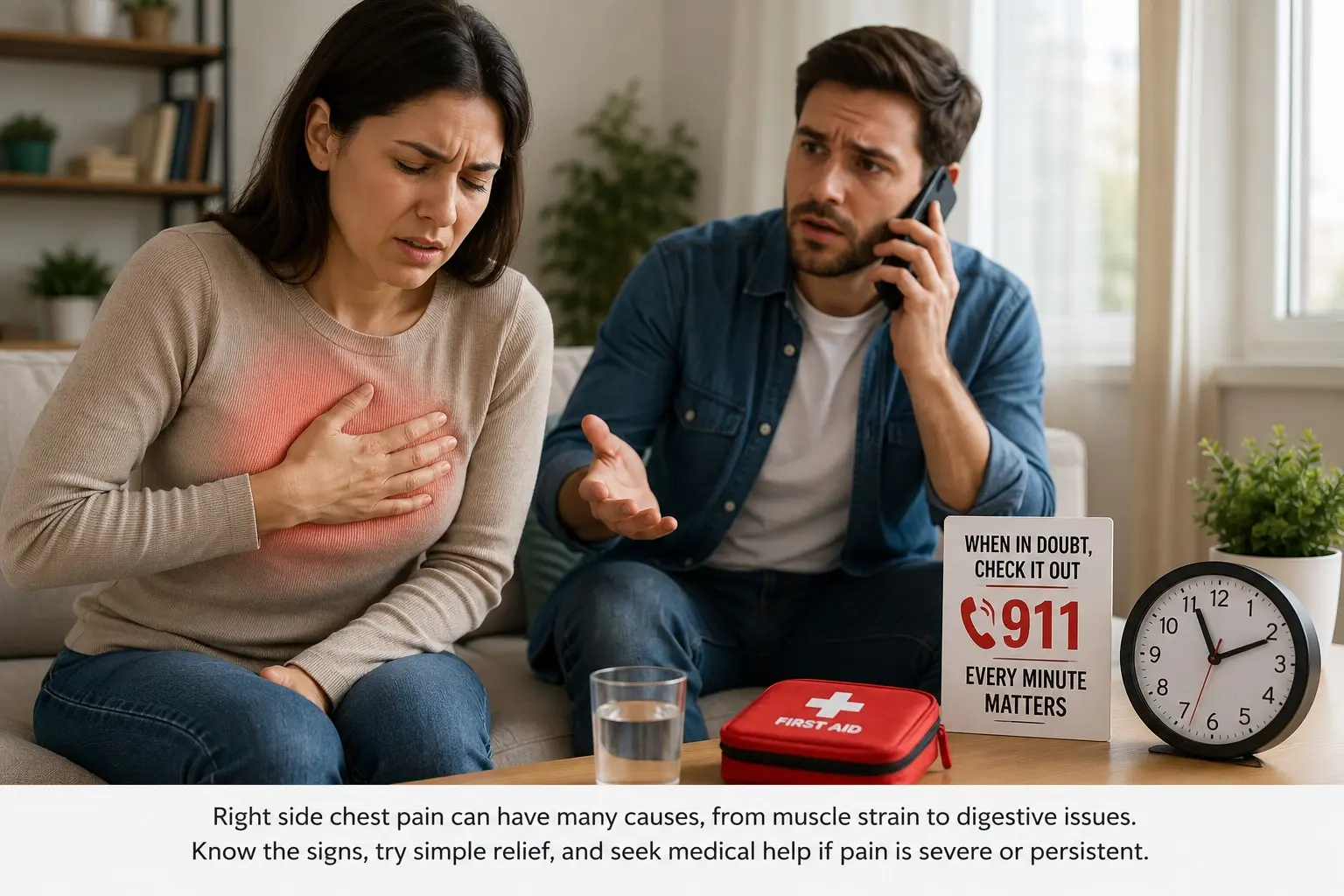
Call emergency services immediately when right-side chest pain:
- Feels like pressure, squeezing, tightness, heaviness, fullness, burning, or crushing
- Starts suddenly or feels severe
- Lasts more than a few minutes or goes away and returns
- Spreads to the arm, shoulder, back, neck, jaw, or upper stomach
- Occurs with shortness of breath
- Occurs with sweating, nausea, vomiting, dizziness, weakness, or fainting
- Worsens with breathing and occurs with sudden breathlessness
- Occurs with coughing blood, a very fast heartbeat, or one swollen leg
- Follows a chest injury and causes breathing difficulty
While waiting:
- Stop activity and sit in a safe position.
- Do not drive yourself.
- Follow the emergency dispatcher’s instructions.
- Use prescribed nitroglycerin only as directed for you.
- Call before taking aspirin. Take it only when the dispatcher or a qualified professional says it is appropriate.
- If the person becomes unresponsive and is not breathing normally, begin CPR and use an AED.
Review and Emergency Notice
This article was written and source-checked by Adel Galal.
Adel is a health and wellness writer. He is not a doctor, cardiologist, emergency physician, pulmonologist, gastroenterologist, hepatologist, pharmacist, paramedic, registered nurse, or licensed medical professional.
This page cannot diagnose chest pain, rule out heart attack, pulmonary embolism, collapsed lung, gallbladder infection, aortic disease, or another urgent condition.
NextFitLife uses display advertising to support the website. Advertising does not determine the emergency advice, causes, sources, treatment information, or conclusions on this page.
Read the Editorial Policy, Medical Review Policy, and Corrections Policy.
Critical Chest-Pain Warning
Call your local emergency number when a heart attack, pulmonary embolism, collapsed lung, aortic emergency, or another serious cause is possible.
In the United States, call 911.
In the United Kingdom, call 999.
In many European countries, call 112.
Do not:
- Drive yourself
- Wait for the pain to move to the left side
- Exercise or stretch to test it
- Use an antacid to prove it is reflux
- Take pain medicine and wait for it to pass
- Use heat on unexplained severe pain
- Assume anxiety is the cause
- Take another person’s nitroglycerin
- Take aspirin before calling emergency services
If you are uncertain whether the symptoms are serious assessment is safer than waiting.
When Right-Side Chest Pain Is an Emergency
Possible Heart Attack or Acute Coronary Syndrome
Call emergency services for chest discomfort that:
- Feels like pressure, heaviness, squeezing, burning, or fullness
- Persists for more than a few minutes
- Goes away and returns
- Begins during exertion or stress
- Occurs at rest
- Spreads to an arm, shoulder, back, neck, jaw, or stomach
Other symptoms may include:
- Shortness of breath
- Cold sweat
- Nausea or vomiting
- Dizziness
- Fainting
- Unusual weakness or fatigue
- A racing, slow, skipping, or irregular heartbeat
Do not assume a heart problem must cause left-side pain.
Possible Pulmonary Embolism
Call emergency services for:
- Sudden shortness of breath
- Sharp chest pain that worsens when breathing in
- Coughing blood
- A fast or irregular heartbeat
- Fainting or collapse
- Chest pain with one swollen, painful, red, or warm leg
Possible Collapsed Lung
Call for urgent help when sudden one-sided chest pain occurs with breathlessness, faintness, rapid worsening, or recent injury.
Possible Aortic Emergency
Call emergency services for sudden severe chest, back, neck, or abdominal pain, especially when described as tearing or ripping or accompanied by fainting or stroke-like symptoms.
Severe Infection or Abdominal Emergency
Urgent care is also needed for chest or right-upper-abdominal pain with:
- Severe breathing difficulty
- Blue, gray, or very pale lips
- Confusion or collapse
- High fever and rapid deterioration
- Yellow skin or eyes
- Persistent vomiting
- A rigid or very tender abdomen
Why Right-Side Location Does Not Reveal the Cause
Chest and upper-abdominal organs share nerve pathways.
Pain may be felt away from the structure causing it.
Right-side discomfort can come from:
- The heart
- The right or left lung
- The aorta
- The esophagus
- The diaphragm
- The gallbladder
- The liver or bile ducts
- Ribs, cartilage, and muscles
- Nerves or skin
Doctors assess:
- How suddenly the pain began
- Its quality and intensity
- Duration and pattern
- Breathing, movement, meal, and exercise triggers
- Associated symptoms
- Clot and cardiovascular risk
- Pregnancy or postpartum status
- Examination, ECG, blood tests, and imaging
The side of the pain is one clue, not a diagnosis.
Heart-Related Causes of Right-Side Chest Pain
Heart Attack
A heart attack occurs when blood flow through a coronary artery is severely reduced or blocked.
Discomfort can occur in the center, left, or right side of the chest or spread elsewhere.
Symptoms can be mild, severe, intermittent, or resemble indigestion.
Call emergency services immediately.
Angina
Angina is discomfort caused by inadequate blood flow to the heart muscle.
It may occur in the chest, arms, shoulders, neck, jaw, back, or upper abdomen.
A new pattern, pain at rest, longer episodes, or pain that does not improve as expected is an emergency.
Pericarditis
Pericarditis is inflammation of the sac around the heart.
Pain may:
- Feel sharp
- Worsen with deep breathing or lying down
- Improve when sitting forward
Because pulmonary embolism, heart attack, and other conditions can feel similar, medical evaluation is needed.
Myocarditis
Heart-muscle inflammation can cause:
- Chest pain
- Breathlessness
- Fatigue
- Palpitations
- Fainting
It may follow an infection but cannot be diagnosed from symptoms alone.
Pulmonary Embolism
A pulmonary embolism is a blood clot blocking an artery in the lung.
The first joint AHA and ACC guideline for acute pulmonary embolism was published in 2026.
It emphasizes rapid diagnosis, severity assessment, and treatment.
Possible symptoms include:
- Sudden shortness of breath
- Chest pain that worsens with breathing or coughing
- Rapid breathing
- A fast or irregular heartbeat
- Coughing blood
- Dizziness, fainting, or collapse
Possible risk factors include:
- Recent surgery or hospital admission
- Long immobility or travel
- Pregnancy and the postpartum period
- Estrogen-containing medicine
- Active cancer
- Previous DVT or pulmonary embolism
- Inherited clotting disorders
- Major injury
A person may have few obvious risk factors.
Call emergency services when pulmonary embolism is possible.
Collapsed Lung or Pneumothorax
A pneumothorax occurs when air collects between the lung and chest wall.
It can cause the lung to partly or fully collapse.
Symptoms commonly include:
- Sudden sharp one-sided chest pain
- Shortness of breath
- Pain worse with breathing or coughing
- Dry cough
- Lightheadedness in larger cases
It may follow:
- Chest injury
- A medical procedure
- Underlying lung disease
It can also happen without an obvious trigger.
Treatment may involve observation, oxygen, needle aspiration, or a chest drain.
Severe breathlessness is an emergency.
Pneumonia, Pleurisy, and Other Lung Inflammation
Pneumonia
Pneumonia may cause:
- Chest pain that worsens with breathing or coughing
- Fever or chills
- Cough
- Mucus
- Breathlessness
- Weakness or confusion
Emergency assessment is needed for severe breathing difficulty, blue lips, confusion, collapse, coughing blood, or rapid deterioration.
Pleurisy
Pleurisy is inflammation of the tissue surrounding the lungs.
Pain is often sharp and worsens with deep breathing, coughing, or movement.
Pleurisy is a symptom pattern, not a final cause.
It may be related to infection, pulmonary embolism, autoimmune disease, or another condition.
Other Lung Causes
Asthma, chronic lung disease, pulmonary hypertension, tumours, and other conditions can also cause chest discomfort or breathlessness.
Aortic Dissection and Other Aortic Disease
The aorta is the main artery carrying blood from the heart.
A dissection is a tear within its wall.
Possible signs include:
- Sudden severe chest or upper-back pain
- Pain spreading to the neck, abdomen, or lower back
- Fainting
- Weakness or numbness
- Speech or vision changes
- A cold, painful, or weak limb
Call emergency services immediately.
Do not take extra blood-pressure medicine at home unless an emergency professional instructs you.
Gallbladder, Liver, and Upper-Abdominal Causes
Not every sensation near the lower right chest comes from the chest.
Gallstones and Biliary Colic
Gallstones may cause sudden, intense, constant pain:
- In the upper abdomen
- Under the right ribs
- Traveling toward the right side or shoulder blade
The pain may follow a fatty meal, but it can occur at any time.
Passing gas or using the toilet usually does not relieve true biliary colic.
Acute Cholecystitis
Acute cholecystitis is inflammation of the gallbladder.
Possible signs include:
- Persistent severe pain under the right ribs
- Pain traveling toward the right shoulder
- Fever
- Nausea or vomiting
- Tenderness
- Yellow skin or eyes in some cases
It needs prompt medical care and may require hospital treatment and surgery.
Bile-Duct Infection or Blockage
Pain with fever, chills, jaundice, dark urine, pale stools, confusion, or low blood pressure can indicate a serious biliary infection or obstruction.
Seek urgent care.
Liver Conditions
The liver itself often does not cause sharp chest pain.
Liver swelling, inflammation, abscess, congestion, tumour, or capsule stretching may cause right-upper-abdominal discomfort.
Evaluation may include blood tests and imaging.
Do not use a detox or supplement to treat unexplained liver-area pain.
Reflux, Gas, and Esophageal Causes
GERD and Heartburn
GERD commonly causes:
- Burning behind the breastbone
- Regurgitation
- A sour taste
- Nausea
- Chest pain
Heartburn usually occurs in the center of the chest, but sensations can spread.
Heart attack can also feel like indigestion.
Relief from an antacid does not prove the cause is reflux.
Gas and Bloating
Gas can cause upper-abdominal pressure or discomfort beneath the ribs.
However, unexplained chest pain should not automatically be labeled as trapped gas.
Passing gas or burping does not rule out another condition.
Esophageal Spasm or Inflammation
Esophageal conditions can cause severe squeezing or burning chest pain.
Seek prompt care for:
- Difficulty or pain when swallowing
- Food becoming stuck
- Vomiting blood
- Black stools
- Severe pain after forceful vomiting
Muscle, Rib, Cartilage, Nerve, and Skin Causes
Muscle Strain
Muscle strain can follow:
- Heavy lifting
- New exercise
- Repeated coughing
- Awkward movement
- Sports or work injury
The pain may worsen with movement or pressure.
This suggests a chest-wall cause but does not fully exclude heart or lung disease.
Costochondritis
Costochondritis is inflammation where a rib joins the breastbone.
It may cause:
- Sharp front-of-chest pain
- Tenderness
- More pain with coughing or deep breathing
- Less pain with quiet rest
A clinician may diagnose it after considering more serious causes.
Rib Bruise or Fracture
Pain may follow a fall, impact, or severe coughing.
Breathing difficulty after chest injury requires urgent assessment.
Shingles
Shingles may begin with burning, tingling, or skin sensitivity on one side before a blistering rash appears.
Early medical advice may be useful because antiviral treatment is time-sensitive.
Neck or Back Nerve Irritation
Nerve compression or inflammation may cause burning, electric, or shooting pain into the chest.
Weakness, numbness, fever, trauma, or loss of bladder or bowel control requires urgent evaluation.
Anxiety and Panic
Anxiety and panic can cause real chest symptoms, including:
- Pain or tightness
- Rapid heartbeat
- Breathlessness
- Sweating
- Dizziness
- Tingling
- Fear or a sense of doom
These symptoms overlap with heart and lung emergencies.
Do not assume anxiety is the cause of a first, severe, or unusual episode without assessment.
After urgent causes are excluded, treatment may include therapy, breathing skills, sleep support, physical activity, and medicine when appropriate.
What Pain Patterns Can and Cannot Tell You
Pain After Eating
This may suggest reflux, gallbladder disease, or bloating.
It does not rule out heart disease.
Pain After Exercise
It may result from muscle strain.
Pressure, heaviness, breathlessness, or pain that repeatedly occurs with activity may be angina.
Stop exercising and seek urgent assessment.
Pain That Worsens With Breathing
Possible causes include pulmonary embolism, pneumothorax, pleurisy, pneumonia, pericarditis, rib injury, and chest-wall inflammation.
Pain That Hurts When Pressed
Tenderness makes a chest-wall cause more likely.
It does not guarantee that no serious condition is present.
Pain That Improves After Burping or an Antacid
Improvement may occur with digestive causes.
It does not safely exclude heart disease.
Brief Pain
Pain lasting only seconds is less typical of heart attack, but duration alone cannot identify the cause.
Recurring Pain
Repeated episodes need assessment, especially when caused by exertion, associated with breathlessness, or becoming more frequent.
Special Considerations
Pregnancy and Postpartum
Pregnancy and the weeks after birth increase the risk of:
- Pulmonary embolism
- Preeclampsia-related complications
- Peripartum cardiomyopathy
- Spontaneous coronary artery dissection
- Aortic problems
Call emergency services for chest pain with sudden breathlessness, fainting, coughing blood, severe headache, vision change, weakness, or rapid deterioration.
Do not assume symptoms are caused by posture, reflux, or normal pregnancy changes.
Women
Heart-attack symptoms can include chest discomfort, shortness of breath, nausea, sweating, lightheadedness, fatigue, and pain in the arms, back, neck, jaw, or stomach.
Heart pain is not limited to the left side.
Older Adults and People With Diabetes
Symptoms may be less obvious.
Breathlessness, weakness, nausea, confusion, fainting, or sudden decline may be prominent.
Young and Fit Adults
Serious causes can still occur, including myocarditis, pericarditis, pulmonary embolism, pneumothorax, inherited heart disease, SCAD, and stimulant-related problems.
How Doctors Diagnose Right-Side Chest Pain
The first goal is to identify dangerous causes.
Evaluation may include:
- Symptoms and timing
- Heart rate, blood pressure, oxygen level, and temperature
- Heart, lung, abdomen, leg, and chest-wall examination
- Pregnancy and clot-risk assessment
- Medicine and substance history
Electrocardiogram
An ECG checks heart rhythm and may show signs of heart attack, reduced blood flow, or pericarditis.
One normal ECG does not always exclude a heart attack.
Troponin Blood Tests
Troponin helps identify heart-muscle injury.
Repeat testing may be needed.
Chest X-Ray
A chest X-ray may help identify pneumonia, pneumothorax, fluid, injury, or other problems.
CT Imaging
CT pulmonary angiography may be used for suspected pulmonary embolism.
CT angiography may be used for suspected aortic disease.
Clinical probability and testing guide whether CT is needed.
D-Dimer
D-dimer may help rule out a clot in selected lower-risk patients.
It can be elevated for many reasons and is not appropriate for every person.
Ultrasound
Ultrasound may assess:
- The gallbladder and bile ducts
- The liver
- Leg veins for DVT
- The heart
Other Tests
Testing may include:
- Blood count
- Kidney and liver function
- Electrolytes
- Inflammation markers
- Lipase for pancreatic disease
- Pregnancy testing when relevant
- Coronary CT or stress testing after immediate emergencies are assessed
The current AHA and ACC chest-pain guideline recommends structured risk assessment and targeted testing rather than guessing from symptoms alone.
Treatment and Safe Home Care
Treatment depends on the confirmed cause.
Heart Attack or Acute Coronary Syndrome
Emergency care may include antiplatelet or anticoagulant medicine, coronary angiography, stenting, or bypass surgery.
Call emergency services before taking aspirin.
Pulmonary Embolism
Treatment commonly includes anticoagulants.
Higher-risk cases may need advanced clot treatment, procedures, surgery, oxygen, or intensive care.
Pneumothorax
Treatment may involve observation, oxygen, aspiration, or a chest drain.
Pneumonia
Treatment depends on the cause and severity.
Antibiotics treat bacterial pneumonia but not every respiratory infection.
Gallbladder Disease
Treatment may include pain control, fluids, antibiotics for infection, and gallbladder surgery.
Home dietary changes do not treat an infected or obstructed gallbladder.
GERD
After serious causes are excluded, treatment may include:
- Smaller meals
- Not lying down soon after eating
- Avoiding personal triggers
- Clinician-recommended acid-reducing medicine
Muscle Strain or Costochondritis
After professional assessment or when the cause is already clear and mild, care may include:
- Temporary rest from the triggering activity
- Gentle movement
- Heat or cold protected by a cloth
- Clinician-approved pain medicine
Do not apply heat to a new unexplained severe pain and wait for improvement.
NSAIDs are not suitable for everyone, including some people with kidney disease, ulcers, anticoagulant use, pregnancy, heart failure, or uncontrolled blood pressure.
Anxiety or Panic
Breathing or grounding exercises may help after urgent medical causes have been excluded.
They should never delay emergency care.
When Home Care Is Not Appropriate
Do not manage chest pain at home when it is:
- New or unexplained
- Severe or worsening
- Associated with breathlessness or fainting
- Caused by exertion
- Recurring frequently
- Present during pregnancy or postpartum
- Associated with fever, jaundice, coughing blood, or one swollen leg
Reducing Future Risk
Not every cause can be prevented.
Risk reduction may include:
- Do not smoke or vape.
- Control blood pressure, cholesterol, and diabetes.
- Use prescribed medicines consistently.
- Exercise according to medical guidance.
- Warm up and increase exercise gradually.
- Use safe lifting technique.
- Use a heart-healthy eating pattern.
- Treat sleep apnea.
- Limit or avoid alcohol.
- Avoid cocaine, amphetamines, and stimulant supplements.
- Follow clot-prevention advice after surgery, hospitalization, or long immobility.
- Seek care for persistent reflux, gallbladder symptoms, or recurring chest pain.
Do not start daily aspirin without professional advice.
Common Right-Side Chest Pain Myths
Myth: Right-Side Pain Cannot Be a Heart Attack
False. Heart-related discomfort can be felt on the right, in the center, or in other upper-body areas.
Myth: Most Right-Side Chest Pain Is Gas
False. Gas is one possibility, but lung, heart, blood-vessel, gallbladder, and chest-wall causes must also be considered.
Myth: Sharp Pain Is Harmless
False. Pulmonary embolism, pneumothorax, pleurisy, pericarditis, and other serious conditions may cause sharp pain.
Myth: Pain That Changes With Breathing Is Only a Muscle
False. Serious lung and heart conditions can worsen with breathing.
Myth: Tenderness Proves It Is Costochondritis
False. Tenderness suggests chest-wall pain but does not exclude another problem.
Myth: An Antacid Response Proves Reflux
False. Symptom relief does not reliably identify the cause.
Myth: Passing Gas Means the Chest Pain Was Safe
False. Temporary improvement does not rule out another condition.
Myth: Young People Do Not Get Serious Chest Pain
False. Clots, collapsed lung, heart inflammation, inherited conditions, and stimulant-related emergencies can occur at any age.
Myth: Breathing Exercises Are a Safe First Treatment
False. They may help anxiety only after urgent causes are excluded.
Myth: Driving Is Faster Than Calling an Ambulance
False. Emergency teams can assess, monitor, treat, and alert the hospital.
Conclusion
Right side chest pain can arise from the heart, lungs, aorta, gallbladder, liver area, esophagus, muscles, ribs, nerves, skin, or anxiety.
The side of the pain cannot identify whether it is safe.
Call emergency services for new, severe, sudden, persistent, spreading, exertional, or unexplained pain, especially with shortness of breath, sweating, nausea, fainting, weakness, coughing blood, a rapid or irregular heartbeat, or one swollen leg.
Do not drive yourself.
Call before taking aspirin.
Do not use antacids, heat, pain medicine, breathing exercises, tenderness, burping, age, or temporary improvement to rule out an emergency.
Doctors may use an ECG, repeated troponin tests, chest imaging, clot assessment, CT angiography, ultrasound, and laboratory tests to identify the cause.
When right-side chest pain is new or uncertain, prompt medical assessment is safer than quick home relief.
References and Sources
- NHS. Chest Pain. Emergency symptoms, possible causes, and advice not to self-diagnose.
- NHS. Heart Attack. Current warning signs, emergency action, and advice not to drive yourself.
- American Heart Association. Warning Signs of a Heart Attack. Chest discomfort, spreading pain, shortness of breath, sweating, nausea, and lightheadedness.
- American Heart Association. Aspirin and Heart Disease. Guidance to call emergency services before taking aspirin.
- American Heart Association and American College of Cardiology. 2021 Chest Pain Guideline. Current structured risk assessment and targeted diagnostic testing guidance.
- NHS. Pulmonary Embolism. Sudden breathlessness, breathing-related chest pain, coughing blood, and DVT signs.
- American Heart Association and American College of Cardiology. 2026 Acute Pulmonary Embolism Guideline. Current evaluation, severity, and treatment framework.
- North Tees and Hartlepool NHS Foundation Trust. Pneumothorax. Sudden one-sided chest pain, breathlessness, cough, and faintness.
- NHS. Pleurisy. Sharp breathing-related chest pain and urgent respiratory warning signs.
- NHS. Pericarditis. Positional and breathing-related chest pain and heart-attack warning signs.
- NHS. Acute Cholecystitis. Persistent right-upper-abdominal pain, shoulder radiation, fever, jaundice, and treatment.
- National Institute of Diabetes and Digestive and Kidney Diseases. GERD Symptoms and Causes. Heartburn, regurgitation, chest pain, and swallowing symptoms.
- MedlinePlus. Costochondritis. Chest-wall tenderness and pain that worsens with movement, coughing, or deep breathing.
- MedlinePlus. Chest Pain. Heart, lung, digestive, muscle, and nerve causes and urgent symptoms.
- MedlinePlus Medical Encyclopedia. Chest Pain. Aortic dissection, pleurisy, shingles, muscle strain, and other causes.
Continue Reading on NextFitLife
Frequently Asked Questions
What can cause pain on the right side of the chest?
Possible causes include heart attack, angina, pulmonary embolism, collapsed lung, pneumonia, pleurisy, reflux, gallbladder disease, muscle strain, costochondritis, shingles, and anxiety.
Can right-side chest pain be a heart attack?
Yes. Heart-attack discomfort may occur in the center, left, or right side of the chest and may spread to either arm, the back, neck, jaw, or upper stomach.
When is right-side chest pain an emergency?
Call emergency services for new, sudden, severe, persistent, spreading, or unexplained pain, especially with shortness of breath, sweating, nausea, fainting, weakness, coughing blood, or a rapid or irregular heartbeat.
Can trapped gas cause right-side chest pain?
Gas may cause upper-abdominal or rib-area discomfort, but unexplained chest pain should not be assumed to be gas because serious heart, lung, and blood-vessel conditions can feel similar.
Can gallbladder pain feel like right-side chest pain?
Yes. Gallbladder pain is usually under the right ribs or in the upper abdomen and may spread toward the right shoulder or shoulder blade.
What does pulmonary embolism pain feel like?
It may cause sudden chest pain that worsens with breathing, sudden shortness of breath, a fast heartbeat, coughing blood, dizziness, or fainting.
Can a collapsed lung cause right-side pain?
Yes. A collapsed lung commonly causes sudden sharp one-sided chest pain and shortness of breath, sometimes with cough or lightheadedness.
Does pain that hurts when pressed mean it is only a muscle problem?
Tenderness makes a chest-wall cause more likely, but it does not completely exclude heart, lung, or other serious disease.
Should I take aspirin for right-side chest pain?
Call emergency services first. Take aspirin only when the dispatcher or a qualified health professional says it is safe and appropriate.
How is right-side chest pain diagnosed?
Evaluation may include an ECG, repeated troponin tests, chest X-ray, CT imaging, clot assessment, ultrasound, examination, and other tests selected according to risk.
Can anxiety cause right-side chest pain?
Yes. Anxiety and panic can cause chest pain, tightness, breathlessness, sweating, and dizziness, but a first or unusual episode still needs assessment for medical causes.
Is this article medically reviewed?
No. It was written and source checked using authoritative references, but it has not been medically reviewed by a doctor or cardiologist.
Right-Side Chest Pain Medical Disclaimer
All content on NextFitLife is for educational and informational purposes only.
It does not replace emergency assessment, ECG testing, blood tests, chest imaging, clot evaluation, abdominal imaging, diagnosis, prescription medicine, procedures, or professional medical advice.
Call emergency services for new, severe, sudden, persistent, spreading, exertional, or unexplained chest pain, especially with shortness of breath, sweating, nausea, fainting, weakness, coughing blood, a rapid or irregular heartbeat, or one swollen leg.
Do not drive yourself.
Call before taking aspirin.
If the person becomes unresponsive and is not breathing normally, begin CPR and use an AED according to emergency instructions.

Health & wellness writer with 30+ years of experience in nutrition, fitness, and healthy aging. Founder of NextFitLife.com — evidence-based health guidance.