Last Updated: June 2026
You ask a friend what colour that car is. They say red. To you, it looks brown. This kind of moment is how many people first discover they may have colour blindness. It is not dramatic. It is just quietly different from how everyone else sees the world.
Colour vision deficiency, the more accurate term, affects around 1 in 12 men and 1 in 200 women. Most people who have it were born with it. Most also go undiagnosed for years. Some discover it as children. Others only find out as adults when a routine test reveals it.
This guide explains what Color vision deficiency is, the different types, how it is tested, what it is like to live with, and the practical tools and strategies that genuinely help. I have researched this topic carefully and spoken with people who live with colour vision deficiency every day.
Complete eye health guide: vision care, prevention and wellness
| KEY FACTS | Colour blindness affects approximately 300 million people worldwide 1 in 12 men and 1 in 200 women have a colour vision deficiency The most common type is red-green colour blindness, affecting 8% of males Most colour blindness is inherited — passed through the X chromosome There is no cure, but special lenses and apps significantly help daily life Defective colour perception rarely causes total inability to see colour — it is usually a deficiency Many careers screen for colour vision — early diagnosis helps with planning |
What Is Colour Blindness? The Simple Science
Your retina contains two types of light-sensitive cells. Rod cells work in dim light. Cone cells detect colour in bright light. You have three types of cone cells — each sensitive to red, green, or blue light. Your brain combines the signals from all three to create the full range of colours you see.
It happens when one or more types of cone cells are missing, reduced in number, or working abnormally. Your brain receives incomplete or altered colour signals. Certain colours that most people see as distinctly different appear similar to you.
The term Defective color perception is misleading. Very few people are truly blind to all colours. Most people with colour vision deficiency can see colour, just not the full range, or not with the same accuracy as people with normal colour vision.
The Types of Colour Blindness: From Common to Rare
There are several distinct types of colour vision deficiency. They range from mild and barely noticeable to a complete absence of colour perception.
| Type | What is missing or Abnormal? | What You See Differently | How Common? |
| Deuteranomaly | Green cone cells work weakly | Greens, yellows, and oranges look similar | Most common — 5% of males |
| Protanomaly | Red cone cells work weakly | Reds look darker, hard to tell from green | 1% of males |
| Deuteranopia | Green cone cells absent | Red and green very similar | 1% of males |
| Protanopia | Red cone cells absent | Reds appear very dark | 1% of males |
| Tritanomaly | Blue cone cells work weakly | Blue-green confusion, yellow-violet confusion | Very rare — less than 0.01% |
| Tritanopia | Blue cone cells absent | Blue looks green, yellow looks violet or grey | Very rare — less than 0.01% |
| Achromatopsia | All three cone types are absent or non-functional | Sees only black, white, and grey shades | Extremely rare — 1 in 30,000 |
Red-Green Colour Blindness - The Most Common Type
Red-green colour perception disorder is an umbrella term covering protanopia, protanomaly, deuteranopia, and deuteranomaly. All involve difficulty distinguishing between red and green shades. This is by far the most common form, affecting around 8 percent of men and 0.5 percent of women in populations of Northern European descent.
I would like to explain it this way: imagine a world where red traffic lights look the same as some yellow-green lights on a dark, wet road. That is the practical daily challenge for many people with this condition: navigation.
Blue-Yellow Colour Blindness - Less Known But Real
Trit anomaly and tritanopia affect the ability to distinguish blue from green and yellow from violet. Unlike red-green colour perception disorder, which is genetic and X-linked, blue-yellow colour-deficient recognition can develop later in life because of aging, glaucoma, diabetes, or certain medications. It is worth knowing this if you notice colour perception changing as you get older.
Eye health and diabetes complete management guide
What do people with Colour blindness actually see?
This is the question I hear most often. The honest answer is: it depends on the type and severity.
| Everyday Situation | Normal Vision | Red-green colour blindness | Blue-yellow Colour Blindness |
| Traffic lights | Clearly red, yellow, green | Position matters more than colour | Green and blue may look similar |
| Ripe vs unripe fruit | Red ripe vs green unripe is obvious | Both may appear similar shades of yellow-brown | Usually manageable |
| Maps and charts with colour coding | Easy to follow | Very difficult — colours blend | Blue labels difficult to read |
| Clothing colours | Easy to match | Reds, browns, and greens may look alike | Blues and greens may conflict |
| Sports — ball on grass | Clear contrast | A green ball on green grass difficult | Usually manageable |
| Reading coloured text | Easy | Red text on a green background is invisible | Blue on white can be difficult |
What Causes Colour Blindness?
Most deficient colour recognition is inherited. The genes that produce red and green cone cells sit on the X chromosome. Men have one X chromosome. Women have two. This is why deficient colour recognition is much more common in men — they only need one faulty X chromosome for the condition to show. Women need both X chromosomes to carry the faulty gene before they are affected.
Can colour vision deficiency Be Acquired Later in Life?
Yes. This surprises many people. Acquired colour vision deficiency can develop due to:
- Glaucoma — damage to the optic nerve, affects colour signal transmission Glaucoma prevention and early detection tips
- Macular degeneration — central retina damage affects cone cell function
- Diabetic retinopathy — retinal vessel damage disrupts colour perception
- Multiple sclerosis — optic neuritis can alter colour vision, often temporarily
- Parkinson's disease — dopamine changes in the retina affect colour processing
- Certain medications — some heart drugs, erectile dysfunction medications, and antibiotics can temporarily affect colour vision
- Age — the lens yellows with age, subtly shifting how colours are perceived after 60
Eye health after 40 and the vision changes to expect
How is colour blindness tested? The Main Tests Explained
Several well-validated tests exist for colour vision deficiency. Some are quick screening tools. Others give detailed diagnostic information about the type and severity.
| Test | How It Works | What It Detects | Where to Get It |
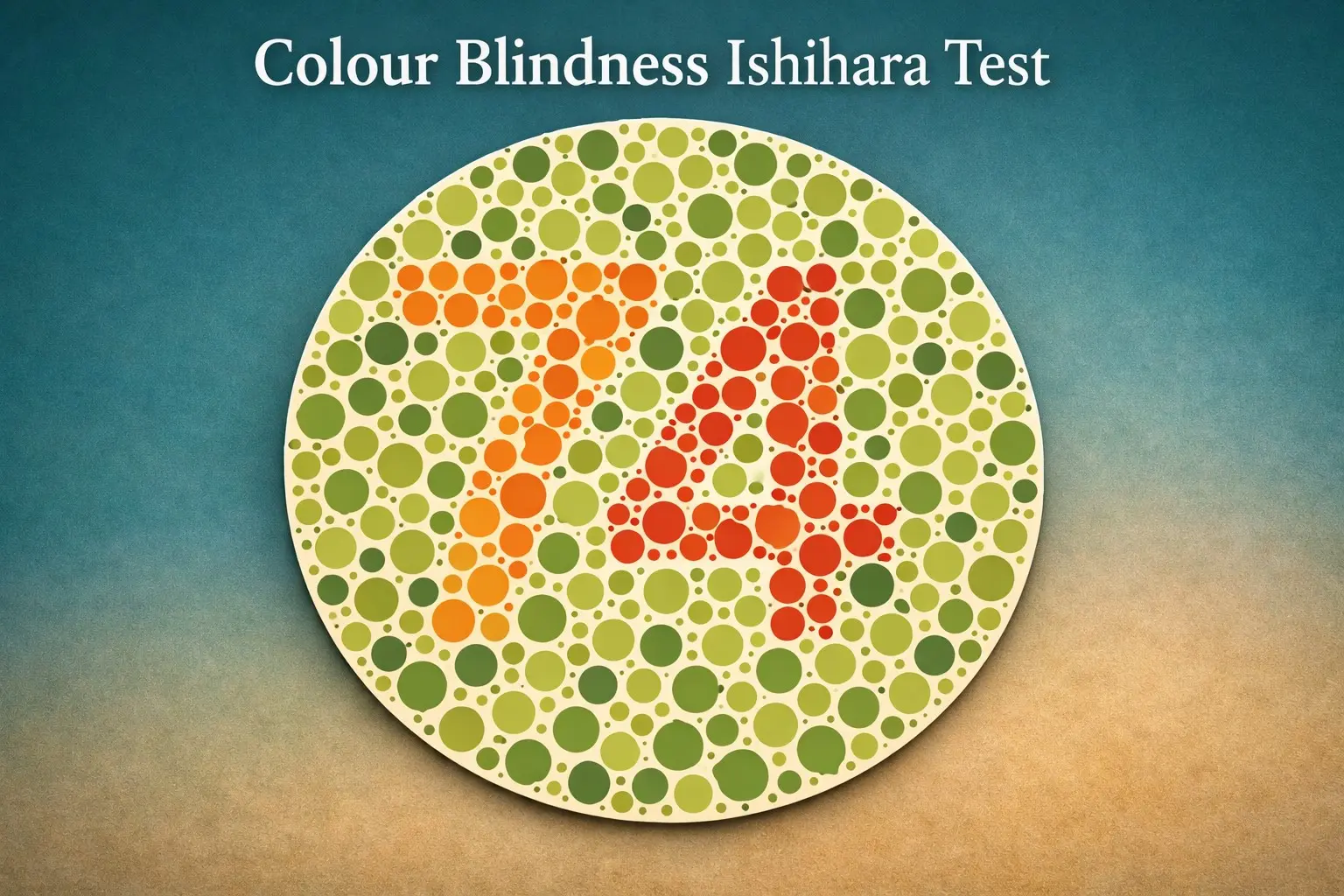
| Ishihara Plates | Coloured dot patterns containing hidden numbers | Red-green colour vision deficiency — quick screen | Optician online screening versions |
| Farnsworth-Munsell 100 Hue Test | Arrange coloured discs in order of hue | All types — detailed severity mapping | Specialist eye clinic |
| Cambridge Colour Test | Computer-based — identify Landolt C shapes in colour | All types — research and clinical use | Specialist only |
| Anomaloscope | Match coloured light mixtures | Precise type and severity of red-green deficiency | Hospital eye departments |
| City University Colour Vision Test | Book of coloured circles, pick the matching colour | All types — good for acquired deficiency | Optician or specialist |
Can I test myself at Home?
Online Ishihara plate tests give a rough indication but are not diagnostic. Screen calibration and ambient lighting significantly affect results. If you suspect colour blindness — especially if it is newly developed or you need it documented for work — see an optician for a proper test. A full colour vision assessment takes about 15 minutes and is usually available at most opticians.
Living With Colour Blindness: Practical Strategies That Actually Help
It is a permanent condition for most people. But it is very manageable. Millions of people with colour vision deficiency live full, successful lives — including in careers that require colour awareness. The key is knowing your specific deficiency and using the right tools and strategies.
EnChroma and Colour Correcting Lenses
EnChroma glasses are the most well-known tool for colour vision deficiency. They use special optical filters to shift the wavelengths of light reaching each type of cone cell. People with red-green colour blindness can significantly improve colour distinction. I have seen the reaction videos — people seeing autumn leaves or their partner's outfit in full colour for the first time. It is genuinely moving.
Important caveat: EnChroma lenses do not work for everyone. They are most effective for anomalous trichromacy (deuteranomaly, protanomaly) where cone cells are present but working abnormally. They do not help with dichromacy (deuteranopia, protanopia) where cone cells are absent. Results vary significantly between individuals.
Apps and Digital Tools
| Tool | Platform | What It Does | Cost |
| Colour Blind Pal | iOS and Android | Identifies colours in real time using a camera | Free |
| Microsoft Seeing AI | iOS and Android | Narrates colours, reads text, describes scenes | Free |
| Colorblindly Chrome extension | Chrome browser | Simulates or corrects colour blindness on web pages | Free |
| Color Oracle | Windows, Mac, Linux | A desktop tool that simulates how your screen looks with CVD | Free |
| Chromatic Vision Simulator | iOS and Android | Shows how scenes appear across different CVD types | Free |
| EnChroma colour blind test | Online | Free test based on the Ishihara methodology | Free |
Practical Daily Strategies
- Label your clothes — small colour-coded tags inside clothing help you match outfits independently
- Ask for colour-coded documents in accessible formats — most workplaces are legally required to accommodate colour vision needs
- Tell your doctor if colour vision changes — acquired changes in colour perception can be an early sign of glaucoma, macular degeneration, or other treatable conditions
- Use pattern and texture alongside colour — choose materials that use shape and pattern rather than colour alone to convey information
- Inform your optician at every exam — your colour vision status should be on your permanent eye health record
How to read your eye prescription — every number explained
Colour Blindness and Careers: What You Need to Know
Some careers have colour vision requirements. Knowing about your condition early allows you to plan, prepare, or seek accommodations where possible.
| Career Area | Colour Vision Requirement | Notes |
| Commercial pilot | Strict — normal colour vision required | Civil Aviation Authority standards apply |
| Electrician | Important — wire colour coding critical | Risk assessment often required |
| Military (some roles) | Varies by role and branch | Many roles accessible with CVD |
| Police and fire service | Varies — colour tests often required | Many forces accept mild CVD |
| Graphic design and art | Helpful, but not always required | Many artists with CVD work successfully |
| Medicine and nursing | Colour vision tested — not excluded | Accommodations often available for mild CVD |
| Driving | No restriction in most countries | Traffic light position used alongside colour |
Early diagnosis matters here. If you are a young person considering a career in aviation or electrical work, knowing your colour vision status helps you make informed choices and seek proper guidance early.
What I Have Learned From People Living With Colour Blindness
| Adel Galal | I have a close friend who has deuteranomaly, moderate red-green colour vision deficiency. He was diagnosed at age 8 during a school screening. He is now 52. He is a successful architect. He has never let his colour vision hold him back. He told me the most useful thing was knowing exactly what his deficiency was. Once you know, you can plan around it. He uses the Colour Blind Pal app on his phone regularly. He buys clothes online using descriptions rather than colour swatches. He always tells project collaborators about his CVD at the start of a project so they know to use patterns and labels alongside colour coding. He also tried EnChroma glasses last year. For him, the effect was moderate. Some colours became more distinct. Others did not change much. He said it was worth trying — but managing your expectations. His biggest message: colour blindness is a difference, not a disability. The world is designed for full colour vision. But with the right tools and communication, you can navigate it very well. |
Key Takeaways - Colour Blindness at a Glance
| SUMMARY | Colour vision deficiency is a deficiency in colour perception, not a total inability to see colour 1 in 12 men and 1 in 200 women are affected, making it very common Red-green colour blindness is the most common type, affecting around 8% of males Most is inherited via the X chromosome. It can also be acquired through eye disease or medication Proper diagnosis requires a clinical test — online tools are screening only EnChroma lenses help some people significantly, but do not work for everyone Free apps like Colour Blind Pal and Microsoft Seeing AI are genuinely useful daily tools Some careers have colour vision requirements — early diagnosis helps with planning New changes in colour perception at any age should be reported to your eye doctor Millions of people live and work successfully with colour vision deficiency |
References and Sources
1- Colour Vision Deficiency — American Academy of Ophthalmology
https://www.aao.org/eye-health/diseases/what-is-color-blindness
AAO authority. Use for: types, inheritance, prevalence, and clinical definition.
2- Colour Blindness — NHS UK
https://www.nhs.uk/conditions/colour-vision-deficiency/
NHS authority. Use for: UK prevalence data, causes, testing, living with CVD, and career guidance.
3- Colour Vision — National Eye Institute (NIH)
https://www.nei.nih.gov/learn-about-eye-health/eye-conditions-and-diseases/color-blindness
NIH/NEI authority. Use for: cone cell mechanism, types, acquired colour blindness, and research.
4- EnChroma Lens Technology — Clinical Evidence Review
https://enchroma.com/pages/science
EnChroma science page. Use for: filter mechanism explanation and clinical study references for lens effectiveness.
5 - Farnsworth-Munsell 100 Hue Test — Colour Blindness Awareness
https://www.colourblindawareness.org/
UK colour blindness charity. Use for: testing methods, career impact, statistics, and practical living strategies.
Part of Our Eye Health Series
This article is part of our complete eye health resource.
Read all topics in our Complete Eye Health Guide or browse our
Eye Health and Vision Resource Directory.
Adel Galal
Health and Wellness Writer | 30+ Years Personal Practice | Founder, NextFitLife.com
Adel Galal has studied
health, vision care, and natural aging for over 30 years. At 58, he writes from genuine
lived experience and careful research — including close friendships with people who live
with colour vision deficiency. He is not a doctor or ophthalmologist. Everything shared
reflects personal research, experience, and published health guidance.
Always consult a qualified eye care professional for diagnosis and advice.

Health & wellness writer with 30+ years of experience in nutrition, fitness, and healthy aging. Founder of NextFitLife.com — evidence-based health guidance.