Last Updated: June 2026
- Updated with 2026 AAO and TFOS research
Your eyelids feel crusty when you wake up. Your eyes are red along the edges. They burn a little, especially in the morning. You have tried allergy drops. You have tried artificial tears. Nothing fully clears it up.
This pattern describes blepharitis - one of the most common eyelid conditions, and one of the most chronically mismanaged. It is not an infection you cure once. It is a condition you manage, much like managing oily skin or dandruff. The good news is that with the right daily routine, Eyelid inflammation becomes very controllable.
I have managed mild Eyelid inflammation myself for several years. This guide covers exactly what it is, what causes it, how to tell it apart from other eyelid problems, and the daily routine that keeps it under control.
complete eye health guide: vision care, prevention and wellness
| KEY FACTS | Blepharitis affects an estimated 37 to 47% of adults in some studies It is a chronic condition - there is no permanent cure, but it is very manageable There are two main types: anterior (affecting eyelash follicles) and posterior (affecting Meibomian glands) Eyelid inflammation is strongly linked to rosacea, dandruff (seborrhoeic dermatitis), and dry eye disease dry eye syndrome: causes, symptoms and natural remedies Daily eyelid hygiene is the single most effective management strategy Demodex mites - microscopic organisms living at the base of eyelashes - contribute to many cases Flare-ups are common and normal - the goal is control, not permanent elimination |
What Is Blepharitis? Understanding the Two Types
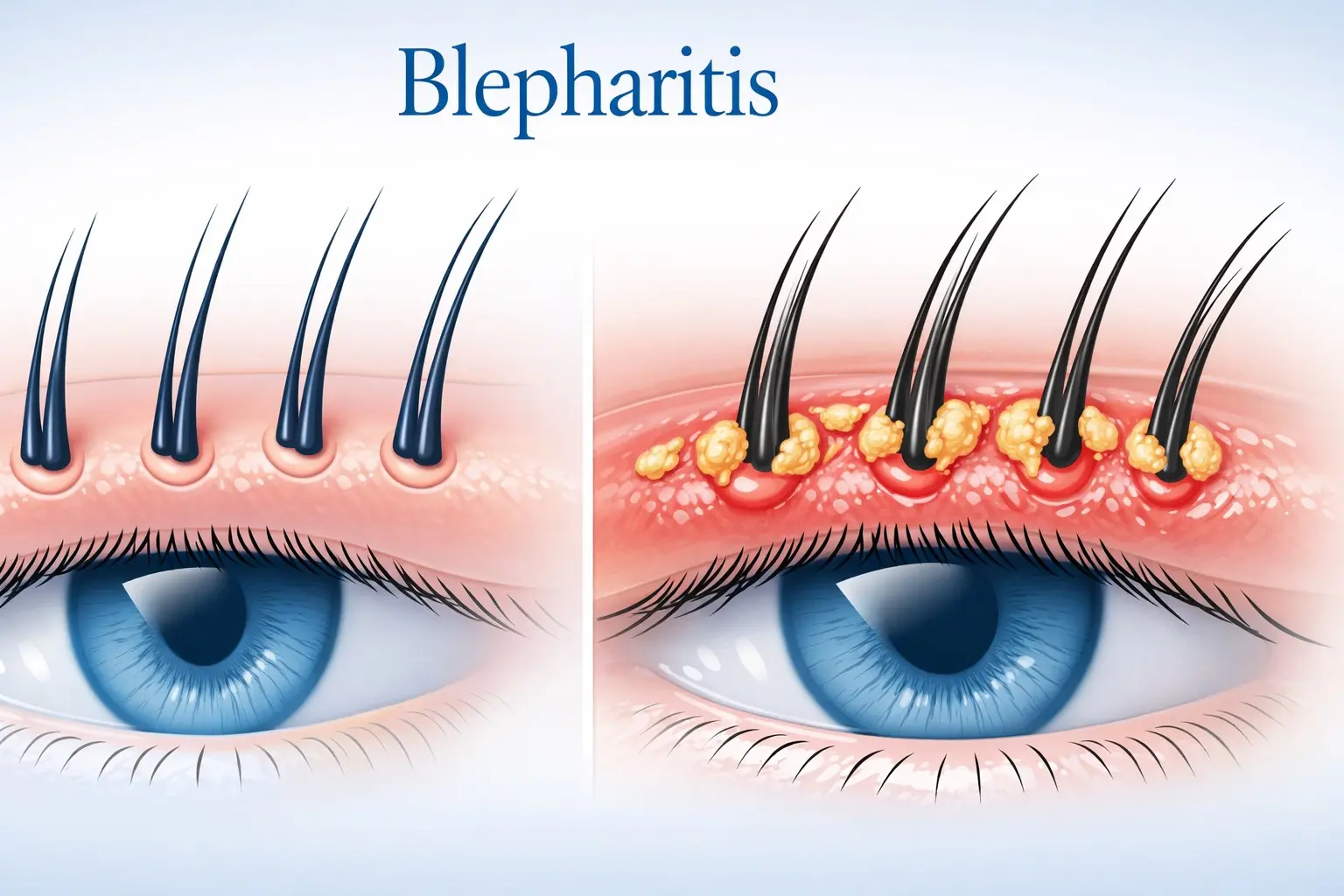
It means inflammation of the eyelid margins - the edges of your eyelids where the eyelashes grow and where the Meibomian gland openings sit. There are two primary forms, and many individuals experience a mix of both.
| Type | What It Affects | Main Cause | Typical Appearance |
| Anterior blepharitis | Eyelash follicles and skin at the front edge of the lid | Bacteria (often Staphylococcus) or Demodex mites | Crusty flakes around the base of eyelashes, redness |
| Posterior blepharitis | Meibomian glands at the inner edge of the lid | Meibomian gland dysfunction (MGD) | Red lid margins, foamy tear film, oily debris at gland openings |
| Mixed blepharitis | Both areas | A combination of the above | Symptoms of both types together - very common |
If you have read our article on Meibomian gland dysfunction, you already know about posterior Eyelid inflammation - they significantly overlap. Anterior blepharitis is the more classic presentation people picture: crusty, flaky eyelashes, particularly noticeable upon waking.
What Causes Blepharitis?
| Cause | How It Contributes | Associated With |
| Bacterial overgrowth (Staphylococcus) | Bacteria colonize the eyelash follicles and produce toxins that irritate the lid margin | Anterior blepharitis - most common bacterial type |
| Demodex mites | Microscopic mites that live at the base of eyelashes - present in everyone, but overpopulate in some people | Found in up to 100% of people over 70 in some studies |
| Seborrhoeic dermatitis | The same condition that causes dandruff also affects oily skin around the eyelids | Often presents with greasy, yellowish scales on lashes |
| Meibomian gland dysfunction | Blocked oil glands lead to posterior blepharitis and unstable tear film | Strongly overlaps - see our MGD guide |
| Rosacea | Skin inflammation extends to the eyelid margin (ocular rosacea) | Up to 60% of rosacea patients have ocular involvement |
| Allergies | Allergic reactions to makeup, contact lens solution, or environmental allergens | Often presents with itching as the dominant symptom |
| Dry eye disease | Reduced tear film allows bacteria and debris to accumulate on the lid margins | Bidirectional relationship - each worsens the other |
Symptoms of Blepharitis: How to Recognize It
- Crusty or flaky debris at the base of eyelashes, especially noticeable upon waking
- Red, inflamed eyelid margins - the edge of the eyelid appears pink or red rather than its normal colour
- Burning or stinging sensation along the lid margins
- Itchy eyelids - particularly prominent if allergy or Demodex is a factor itchy eyes: causes and cures
- Eyes that feel dry and gritty - Eyelid inflammation frequently coexists with dry eyes
- On waking, the lashes may be stuck together, sometimes lightly crusted, so the lids remain sealed.
- Foamy or bubbly tears - a classic sign of posterior Lid margin disease with MGD
- Eyelash loss or misdirected lashes in long-standing or severe cases
- Recurrent styes or chalaza - Lid margin disease increases the frequency of these stye vs chalazion: how to tell the difference and treat each
How is blepharitis diagnosed?
An optometrist or ophthalmologist diagnoses Bacterial eyelid infection through examination of the eyelid margins with a slit lamp. They look at the base of the eyelashes for crusting, the lid margin for redness and thickening, and the Meibomian gland openings for blockage and abnormal secretions.
They may also look specifically for Demodex mites. Cylindrical dandruff (collarettes) wrapped around the base of eyelashes is a characteristic sign of Demodex involvement. This finding changes the treatment approach significantly, as standard hygiene alone may not be sufficient.
The Daily Blepharitis Management Routine
Bacterial eyelid infection management is built around one core principle: consistent daily eyelid hygiene. This is not a one-week treatment. It is an ongoing routine, much like brushing your teeth. Skip it for a few days, and symptoms typically return.
| THE CORE DAILY ROUTINE - DO THIS EVERY MORNING | STEP 1: WARM COMPRESS (5 to 10 minutes) Apply a clean, warm compress to closed eyes. This softens crusted debris and any thickened oil at the Meibomian gland openings, making the next step easier. STEP 2: EYELID CLEANSING Use a dedicated eyelid cleanser - foam cleansers (like Blephaclean or Ocusoft), or a dilute solution on a clean cotton pad. Carefully clean along the lash line of both upper and lower lids, where the lashes meet the skin. Always use a separate fresh pad for each eye to prevent cross‑contamination.. STEP 3: GENTLE LID MASSAGE (if posterior Eyelid irritation or MGD present) While the lids are still warm from the compress, gently massage along the lid margin to express any built-up oil from the Meibomian glands.
Do this routine every morning without exception. Many people benefit from repeating the cleansing step in the evening, too, particularly if eye makeup is worn. |
Choosing the Right Eyelid Cleanser
| Cleanser Type | How to Use? | Best For | Notes |
| Diluted baby shampoo | A few drops in warm water, apply with a cotton pad | Budget option, mild cases | Tear-free formulas only. Rinse thoroughly |
| Foam eyelid cleansers (Blephaclean, Ocusoft) | Apply foam directly to the closed lid, and wipe gently | Most users - convenient and gentle | Designed specifically for eyelid skin pH |
| Tea tree oil-based products | Diluted formulations applied to the lid margin | Demodex-related Eyelid irritation | Tea tree oil has a documented anti-Demodex effect - use diluted products only |
| Pre-moistened eyelid wipes | Single-use wipes, wipe along the lash line | Travel, convenience | Good for maintaining routine away from home |
Demodex Mites and Blepharitis: When Standard Hygiene Is Not Enough
Demodex mites are microscopic organisms that live in hair follicles - including eyelash follicles - in virtually everyone. In most people, they cause no problems. In some, particularly older adults, their population grows excessively, and they contribute significantly to anterior blepharitis.
The telltale sign is cylindrical dandruff - small tube-shaped sleeves of debris wrapped around the base of individual eyelashes, distinct from the more diffuse flaking of seborrhoeic
Bacterial eyelid infection. If your optometrist detects this issue, treatments containing tea tree oil are usually advised, as the oil has proven effectiveness against Demodex mites. These treatments require more diligence - often twice daily for several weeks - but can make a substantial difference for Demodex-driven cases.
Treatment Options Beyond Daily Hygiene
| Treatment | When It Is Used | How It Helps | Notes |
| Daily eyelid hygiene | First line for all types | Removes debris, bacteria, and excess oil | Foundation of management - needed indefinitely |
| Warm compresses | First line, especially the posterior type | Softens debris, supports Meibomian gland function | Combining with a hygiene routine |
| Topical antibiotic ointment | Moderate to severe anterior blepharitis | Reduces bacterial load on lid margins | Short courses, prescription only |
| Oral antibiotics (doxycycline, azithromycin) | Severe or rosacea-associated Bacterial eyelid infection | Anti-inflammatory effect, reduces gland inflammation | Prescription only - longer courses at low dose |
| Tea tree oil treatments | Demodex-confirmed Eyelid inflammation | Reduces the Demodex mite population | Use products formulated for eyelid use only |
| Topical steroids (short term) | Significant flare-ups | Rapidly reduces inflammation | Short-term use only - prescription required, monitor eye pressure |
| Omega-3 supplements omega-3 fatty acids and eye health: benefits and best sources | Posterior Lid margin disease with MGD component | Improves Meibomian gland secretion quality | 1 to 3g EPA/DHA daily, allow 8 to 12 weeks |
| Lubricating eye drops | Associated dry eye symptoms | Symptom relief alongside other treatments | Preservative-free preferred for frequent use |
Lifestyle Adjustments That Help Manage Blepharitis
- Remove eye makeup completely every night - residue at the lash line is a common contributor to flare-ups
- Replace eye makeup regularly - mascara every 3 months, never share products
- Wash pillowcases more frequently - twice weekly reduces bacteria and Demodex transfer
- Avoid eyeliner on the inner lid margin (waterline) - this can block Meibomian gland openings directly
- Manage related skin conditions - treating rosacea or seborrhoeic dermatitis on the face often improves eyelid symptoms
- Stay consistent even when symptoms improve - stopping the routine when you feel better is the most common reason for flare-ups returning
When to See a Doctor About Blepharitis
| SEE AN EYE DOCTOR IF YOU HAVE | Symptoms that do not improve after 4 to 6 weeks of consistent daily hygiene Frequent styes or chalaza - occurring more than two or three times within a short span. Significant pain, not just irritation or burning Vision changes alongside eyelid symptoms Eyelashes growing in an abnormal direction or significant lash loss Suspected Demodex (cylindrical dandruff at lash base) needing targeted treatment Symptoms alongside known rosacea that may benefit from coordinated treatment |
My Personal Experience Managing Blepharitis
| ADEL GALAL | I started noticing crusty eyelashes on waking around age 50. I assumed it was just a sign of getting older and ignored it for a while. When I mentioned it during a routine eye exam, my optometrist examined me Lid margins under the slit lamp. Mild anterior Lid margin disease with some Meibomian gland involvement - mixed type, common, she said. She recommended a foam eyelid cleanser every morning, combined with warm Compress routine I already do for my MGD. I added the lid cleaning step, Meibomian gland dysfunction: causes and the daily routine that clears it Within 2 weeks, the morning crusting was gone. I have kept the routine going For years now. The few times I have travelled and skipped it for several days, the crusting comes back within a few days. That consistency point is the most important thing I can tell you. Blepharitis is not something you cure and forget. It is something you manage Treat it like any other daily self‑care routine. Once it becomes a habit, it takes little effort yet makes a big difference. |
Key Takeaways: Blepharitis
| SUMMARY | Lid margin disease is a chronic, manageable eyelid condition - not a one-time infection to cure Two main types exist: anterior (eyelash follicles) and posterior (Meibomian glands) - many people have both Daily eyelid hygiene with a warm compress and a dedicated cleanser is the core treatment Demodex mites cause cylindrical dandruff at the lash base - needs targeted tea tree treatment Eyelid inflammation is strongly linked to rosacea, dandruff, and dry eye disease Recurrent styes and chalaza are a sign that Eyelid irritation needs better management Stopping the routine when symptoms improve is the most common cause of flare-ups returning See a doctor if symptoms persist beyond 4 to 6 weeks of consistent hygiene |
References and Sources
1- Blepharitis - American Academy of Ophthalmology
https://www.aao.org/eye-health/diseases/what-is-blepharitis
AAO authority. Use for: definition, types, symptoms, and treatment overview.
2- TFOS DEWS II - Meibomian Gland Dysfunction and Blepharitis Report
https://www.tfosdewsreport.org/
International expert consensus. Use for: posterior blepharitis, MGD overlap, and management evidence.
3- Demodex Blepharitis - Cornea Journal Review
https://pubmed.ncbi.nlm.nih.gov/32649372/
Peer-reviewed review. Use for: Demodex prevalence, cylindrical dandruff sign, and tea tree oil treatment evidence.
4- Blepharitis Prevalence and Risk Factors - Survey of Ophthalmology
https://pubmed.ncbi.nlm.nih.gov/19651300/
Peer-reviewed survey. Use for: 37 to 47% prevalence statistic and rosacea/seborrhoeic dermatitis associations.
5- Eyelid Hygiene Practices - Cochrane Review
https://www.cochranelibrary.com/cdsr/doi/10.1002/14651858.CD013333.pub2/full
Cochrane review. Use for: evidence on eyelid hygiene effectiveness for blepharitis management.
Part of Our Eye Health Series
This article is part of our complete eye health resource.
Read all topics in our Complete Eye Health Guide or browse our
Eye Health and Vision Resource Directory.
Adel Galal
Health and Wellness Writer | 30+ Years Personal Practice | Founder, NextFitLife.com
Adel Galal has studied
health, vision care, and natural aging for over 30 years. At 58, he manages his own mild
blepharitis with the daily routine described in this article. He is not a doctor or
ophthalmologist. Everything shared reflects personal research, experience, and consultation
with healthcare providers. Always consult a qualified eye care professional for diagnosis
and treatment of blepharitis.

Health & wellness writer with 30+ years of experience in nutrition, fitness, and healthy aging. Founder of NextFitLife.com — evidence-based health guidance.