Last Updated: June 2026
- Updated with 2026 AAO and refractive surgery research
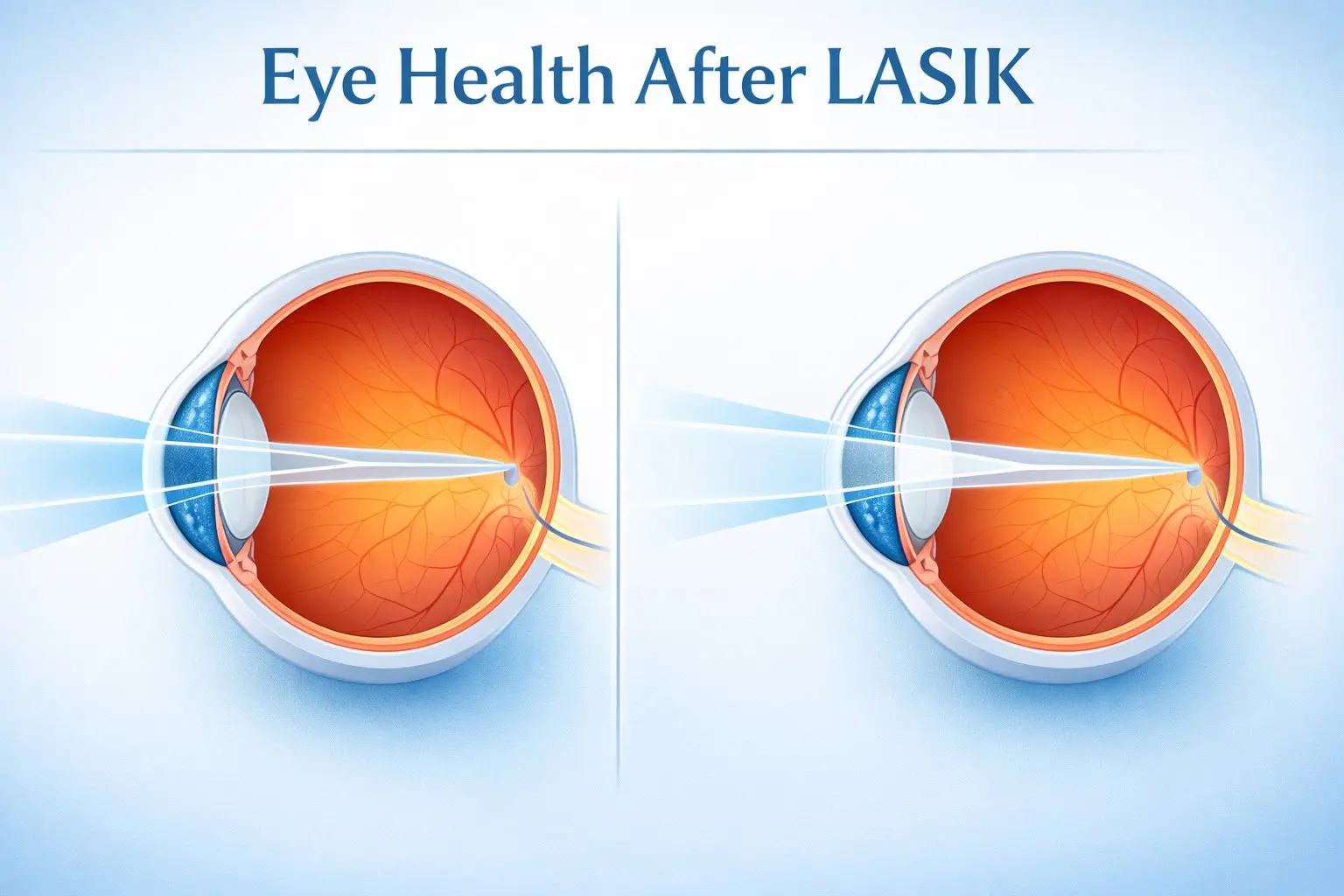
Eye health after LASIK Surgery changes your vision almost instantly. You walk in wearing glasses and walk out, able to read the alarm clock across the room. The first few days felt almost magical. Then the questions begin - why are my eyes so dry?
Why do halos appear around lights at night? When can I return to the gym? Should I keep using these drops? And will my vision stay this sharp forever?
Most LASIK patients receive detailed pre-surgery information. The post-surgery care instructions are often less thorough. This guide fills that gap. It covers what to expect in the weeks, months, and years after LASIK surgery - and how to protect your results for life. Complete eye health guide: vision care, prevention and wellness
| KEY FACTS | Over 98% of LASIK patients achieve 20/40 vision or better - the legal driving standard Over 90% achieve 20/20 or better immediately after surgery Dry eye is the most common post-LASIK side effect - affecting up to 50% of patients Most dry eye after LASIK resolves within 6 to 12 months as corneal nerves regenerate Halos and starbursts around lights at night are common and usually improve within 3 to 6 months Over time, vision may slightly decline, and up to one in ten patients eventually require corrective enhancement. LASIK does not prevent age-related vision changes - reading glasses are still likely after age 40 |
Your Host-LASIK Recovery Timeline: Week by Week and Month by Month
Understanding what is normal at each stage reduces anxiety significantly. Most post-LASIK experiences follow a predictable pattern.
| Time After Surgery | What Is Happening | What You May Experience | What to Do |
| Day 1 | Corneal healing begins. Epithelium starts closing over the flap | Blurry vision, light sensitivity, tearing, gritty feeling | Rest. Use all prescribed drops. Wear eye shields for sleep |
| Days 2 to 7 | Rapid visual improvement. Flap adhesion strengthening | Vision improves daily. Mild dryness and halos at night | Continue drops. No rubbing. No swimming. Avoid dusty environments |
| Weeks 2 to 4 | Corneal nerves begin to regenerate. Tear film stabilizing | Dry eye peaks for many patients. Vision fluctuates slightly | Lubricating drops frequently. Avoid contact sports |
| Months 1 to 3 | Continued nerve regeneration. Corneal surface stabilizing | Halos and starbursts may still be present. Dryness improving | Monthly check-up. Can usually return to most activities |
| Months 3 to 6 | Vision is stabilizing significantly. Dry eye improves for most | Night vision is improving. Eyes are feeling more comfortable | Annual or 6-month check-up. UV protection essential outdoors |
| Year 1 and beyond | Full corneal nerve regeneration. Vision stable for most | Excellent vision for most patients. Mild presbyopia may begin after 40 | Annual eye exams. Protect eyes from UV and injury |
Dry Eye After LASIK: The Most Common Side Effect Explained
Post-LASIK dry eye affects up to half of all patients. It is the result of cutting corneal nerves during LASIK flap creation. These nerves signal the brain to produce tears. When they are cut, tear production drops temporarily.
The good news is that corneal nerves regenerate. For most patients, dry eye after LASIK peaks in the first 1 to 3 months and then gradually improves as nerves grow back. The process is usually complete within 6 to 12 months.
A minority of patients - particularly those with pre-existing dry eye, women over 40, and those with certain genetic predispositions - experience more persistent dry eye that requires ongoing management. Dry eye syndrome: causes, symptoms and natural remedies
How to Manage Post-LASIK Dry Eye
- Use preservative-free lubricating drops - use them before you feel dry, not after. Apply every 1 to 2 hours during the first 3 months, then as needed
- Apply thicker gel drops or an ointment before bedtime — they shield the eye’s surface overnight when blinking ceases.
- Take omega-3 supplements - 1 to 2g EPA and DHA daily, which improves tear film quality and speeds Meibomian gland recovery omega-3 fatty acids and eye health: benefits and best sources
- Warm compresses daily - keeps Meibomian glands functioning during the recovery period
- Avoid environments that worsen dryness - air-conditioned rooms, airplane cabins, wind, and heated car vents all accelerate tear evaporation
- Drink 2 litres of water daily - hydration directly supports tear production
- If severe dryness is detected, inform your surgeon — tiny silicone punctual plugs can be inserted to slow tear drainage when drops alone aren’t sufficient.
Halos, Starbursts, and Night Vision After LASIK: What Is Normal
Halos and starbursts around lights at night are one of the most reported post-LASIK experiences. They occur because the reshaped central cornea has a different optical profile than the peripheral cornea. In dim light, when your pupil expands, light passing through the edge of the treated zone creates these visual artifacts.
For most patients, halos and starbursts are most noticeable in the first 1 to 3 months and gradually diminish as the cornea heals and the brain adapts. By 6 months, most patients report significant improvement.
A small percentage of patients experience persistent night vision issues. Risk factors include: very large pupil size, high prescriptions treated, and thin corneas. Modern LASIK technology with wavefront-guided treatment and larger optical zones has significantly reduced this side effect compared to older procedures.
When Night Vision Side Effects Need Attention
- Halos worsening after 3 months rather than improving - see your surgeon
- Significant impact on driving safety at night - tell your surgeon promptly
- Halos are still significant at 12 months, which may indicate residual prescription or corneal irregularity
- Any sudden change in vision quality at any stage - same-day contact with your surgeon
When Can You Return to Normal Activities After LASIK?
| Activity | When to Return? | Why the Wait? | Notes |
| Driving in daylight | Day 2 (if vision meets legal standard) | Vision must be stable and clear | Have your surgeon confirm on the day-1 check |
| Driving at night | 2 to 4 weeks | Halos can impair night driving initially | Return when halos are manageable |
| Screens and reading | Day 2 to 3 | Eyes tire quickly in the first days | Use drops before screens. Take breaks |
| Light exercise (walking) | Day 2 to 3 | Low-risk activity | Avoid getting sweat in your eyes. No face washing with tap water initially |
| Gym and weights | 1 to 2 weeks | Straining raises eye pressure transiently | Avoid heavy straining for 2 weeks |
| Swimming (pool) | 4 weeks | Infection risk from pool water | Goggles after 4 weeks for extra protection |
| Swimming (sea or lake) | 8 weeks | Higher infection risk than pools | Goggles recommended for 3 months |
| Contact sports | 4 to 6 weeks | Risk of eye impact and flap dislodgement | Protective eyewear is recommended long-term |
| Flying | 2 to 3 days | The cabin air is very dry | Use drops frequently during flight |
| Makeup (eye area) | 1 week | Risk of infection and contamination | New Mascara. No eyeliner on the inner rim |
Long-Term Eye Health After LASIK Surgery - What Stays the Same and What Changes
LASIK ranks among the most reliable and effective elective surgeries available today. But it is important to understand what it does and does not protect you from in the long term.
Eye health after 40: what changes and how to protect your vision
What LASIK Changes Permanently
LASIK permanently reshapes your corneal tissue. The correction to your prescription is permanent. The tissue that is removed does not regenerate. This is why LASIK results typically last for decades for most patients.
What LASIK Does Not Protect You From
| Condition | Does LASIK protect against it? | What You Still Need |
| Presbyopia (reading difficulty after 40) | No | Reading glasses or miniversion correction after 40 |
| Cataracts | No | LASIK history changes the calculation for cataract surgery IOL power - tell every future eye surgeon |
| Glaucoma | No | Annual eye exams remain essential after LASIK |
| Macular degeneration | No | Diet, UV protection, and annual exams are still needed |
| Myopia regression | Partial protection | Up to 10% of patients need improvement over 10 years |
| Retinal detachment | No - may be at slightly higher risk if very myopic pre-LASIK | Report any new floaters or flashes immediately |
| Dry eye | May worsen pre-existing dry eye | Ongoing management if Meibomian glands was affected |
The Most Important Long-Term Fact About LASIK and Cataracts
This is something every LASIK patient must know. When you need cataract surgery decades after LASIK - and most people do eventually - the surgeon must know about your LASIK. LASIK changes the curvature of your cornea. This alters the calculation used to choose the power of the artificial lens that replaces your cataract-affected lens.
If the cataract surgeon does not know you had LASIK, the lens calculation will be wrong. You may end up with an unexpected residual prescription after cataract surgery that is very difficult to correct. Always carry a note of your pre-LASIK prescription and tell every future eye surgeon you have had LASIK.
UV Protection After LASIK: More Important Than Before
After LASIK, your cornea is thinner than before. UV radiation is more directly transmitted to the crystalline lens beneath. This makes UV protection after LASIK more important, not less. Cumulative UV exposure drives cataract formation - exactly the condition LASIK patients need to be aware of for their future cataract surgery calculations.
Always wear UV400 sunglasses outdoors, every single day without exception. This is one of the simplest long-term protections for your LASIK result and your overall eye health. UV protection for eyes: ultimate sun safety guide
LASIK Enhancement: What It Is and When You Might Need One
An enhancement is a second LASIK procedure performed if vision has regressed significantly over time. Regression means the eye gradually returns toward its original prescription - more common in people who started with high prescriptions.
Studies show that around 10 percent of patients need an enhancement within 10 years of their original procedure. Enhancements are safe and effective. However, each procedure removes more corneal tissue. There is a limit to how many enhancements are possible based on the remaining corneal thickness.
| Enhancement Criteria | What Your Surgeon Checks | What Affects Eligibility? |
| Residual vision change | New prescription vs original post-LASIK prescription | Enhancement is worth it if the change is more than 0.50 to 0.75 diopters |
| Corneal thickness | How much tissue remains from the original LASIK | Must have sufficient tissue remaining for safe re-treatment |
| Stability | Prescription must be stable for at least 12 months | Regression must have stabilized before enhancement |
| Corneal health | No irregular astigmatism or ectasia developing | Some conditions rule out further corneal laser treatment |
Warning Signs After LASIK That Need Prompt Attention
| CONTACT YOUR SURGEON SAME DAY IF YOU EXPERIENCE | Sudden loss of vision or a significant change in vision quality Severe pain - mild discomfort is normal, but severe pain is not Seeing flashes of light or a sudden shower of floaters Eye floaters: when are they dangerous A curtain or shadow across part of your visual field Significant redness with discharge, suggesting infection Double vision that appears suddenly Any trauma or impact to the eye - LASIK flaps can dislodge with direct impact |
My Observations on Eye Health After LASIK Surgery Outcomes
| ADEL GALAL | I have watched several people close to me go through LASIK over the years. The experiences have been almost universally positive, but the aftercare The quality has varied enormously between clinics. The people who did best had three things in common. First: they used their drops religiously for the first 3 months. Not just when their eyes felt dry. Before they felt dry. Every hour. The ones who skimped on drops had longer-lasting dry eye issues. Second: they attended every follow-up appointment without skipping. One person I know skipped their 3-month appointment. At their 12-month appointment, a mild regression was found that could have been caught and monitored earlier. Third: they protected their eyes from UV every single day afterward. Not just on holiday. Every day. This is a long-term investment in their vision. LASIK is genuinely remarkable surgery. But the result you protect is the result you keep. The care you give your eyes in the years after surgery matters enormously. |
Key Takeaways: Eye Health After LASIK Surgery
| SUMMARY | Dry eye is the most common post-LASIK side effect - use preservative-free drops every 1 to 2 hours for 3 months Halos and starbursts at night are normal and usually improve significantly within 3 to 6 months Vision stabilizes fully by 3 to 6 months for most patients Annual comprehensive eye exams remain essential after LASIK - LASIK does not prevent glaucoma, AMD or cataracts Always tell future eye surgeons you have had LASIK - it changes cataract surgery lens calculations UV400 sunglasses every day outdoors - UV protection is more important after LASIK, not less Up to 10% of patients need an enhancement within 10 years - most are safe if enough corneal tissue remains Any sudden change in vision, pain, or flashes after LASIK needs to be reported to your surgeon LASIK does not prevent presbyopia - reading glasses are likely after age 40, regardless of LASIK |
References and Sources
1- LASIK Outcomes and Safety - American Academy of Ophthalmology
https://www.aao.org/eye-health/treatments/lasik
AAO authority. Use for: LASIK outcome statistics, safety profile, and long-term considerations.
2- Post-LASIK Dry Eye - Cornea Journal Review
https://pubmed.ncbi.nlm.nih.gov/17220701/
Peer-reviewed review. Use for: dry eye mechanism after LASIK, corneal nerve regeneration timeline, and management.
3- LASIK Long-Term Safety - FDA Summary Report
https://www.fda.gov/medical-devices/lasik/lasik-eye-surgery
FDA regulatory authority. Use for: LASIK approval, long-term safety data, and patient information.
4- LASIK Enhancement Rates - Journal of Refractive Surgery
https://pubmed.ncbi.nlm.nih.gov/26447884/
Peer-reviewed journal. Use for: 10% enhancement rate, regression predictors, and enhancement eligibility criteria.
5- Post-LASIK Cataract Surgery Considerations - Ophthalmology Journal
https://pubmed.ncbi.nlm.nih.gov/12106748/
Peer-reviewed journal. Use for: LASIK effect on cataract surgery, IOL calculations and disclosure importance.
Part of Our Eye Health Series
This article is part of our complete eye health resource.
Read all topics in our Complete Eye Health Guide or browse our
Eye Health and Vision Resource Directory.
Adel Galal
Health and Wellness Writer | 30+ Years Personal Practice | Founder, NextFitLife.com
Adel Galal has studied
Health, vision care, and natural aging for over 30 years. At 58, he writes from genuine
research and lived experience - including observing multiple people navigate LASIK
Recovery and long-term aftercare. He is not a doctor or ophthalmologist. Everything
shared reflects personal research, experience, and published health guidance.
Always consult your refractive surgeon for any concerns after LASIK surgery.

Health & wellness writer with 30+ years of experience in nutrition, fitness, and healthy aging. Founder of NextFitLife.com — evidence-based health guidance.