Published on: June 2026
Updated on: October 20, 2026
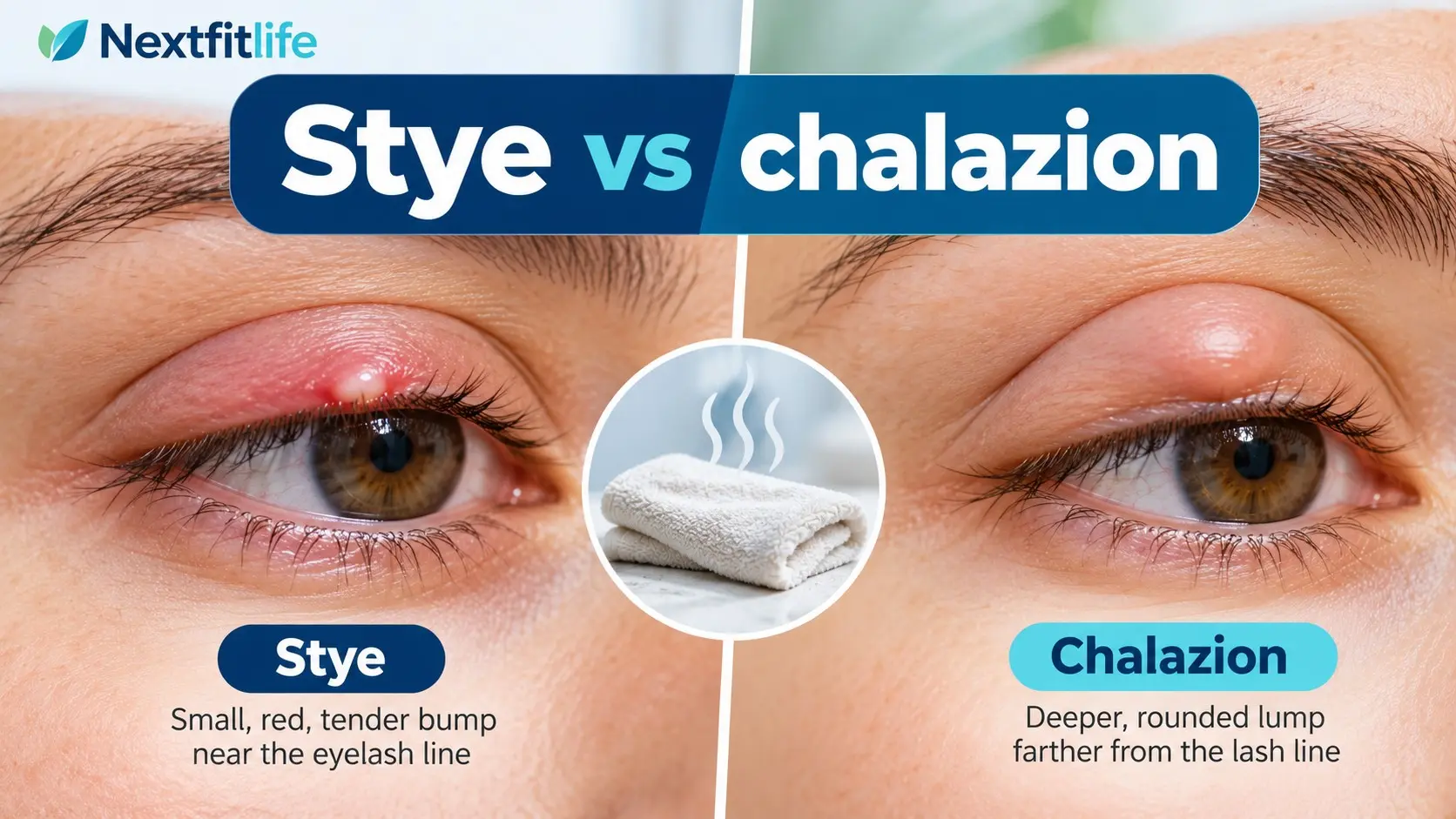
Stye vs chalazion can be confusing because both can start as a red swollen eyelid bump. During the first day or two, they may even look almost identical.
The difference usually becomes clearer with time. A stye, also called a hordeolum, is usually an acute infection of an eyelash follicle or eyelid gland. It tends to stay sore and often sits close to the eyelid edge.
A chalazion forms when an oil gland becomes blocked. It can be tender and red at first, but it usually develops into a deeper, firmer, less painful lump inside the eyelid.
Quick answer: A stye is usually a painful infected eyelid gland that appears quickly and often sits near the lashes. A chalazion is usually a blocked meibomian gland that becomes a firm lump deeper in the eyelid. Warm compresses can help both. Do not squeeze either lump. A persistent, recurrent, unusual, or vision affecting eyelid lump needs professional assessment.
Medical note: This article is for general information and education. It does not replace medical advice, diagnosis, or treatment.
I am not a dermatologist or a doctor, and this content does not replace professional medical advice. What I share comes from real life experience, extensive research, and consultation with healthcare providers. Always consult qualified medical professionals for diagnosis and treatment of any health condition.
When an Eyelid Lump Needs Urgent Care
A simple stye or chalazion usually stays limited to the eyelid. Widespread swelling, severe pain, fever, or eye movement problems are different.
Seek urgent medical or eye care if you develop:
- Reduced or suddenly blurred vision
- Severe eye pain
- Pain when moving the eye
- Double vision
- An eye that appears to bulge forward
- Redness or swelling spreading widely around the eye
- Fever with increasing eyelid swelling
- Severe headache or vomiting with eye swelling
- Marked light sensitivity
Pain with eye movement, restricted eye movement, double vision, bulging of the eye, or reduced vision can be warning signs of deeper orbital infection and need urgent assessment.
Important: A localized stye usually causes tenderness in one small part of the eyelid. Redness and swelling that spread around the eye, especially with fever or pain when moving the eye, should not be managed as an ordinary stye at home.
Table of Contents
- What a stye is
- What a chalazion is
- 9 critical differences
- External and internal styes
- Why the two can look alike
- How to treat a stye safely
- How to treat a chalazion safely
- Warm compress technique
- When antibiotics help
- When a chalazion needs drainage
- Recurrent eyelid lumps
- Blepharitis, MGD, and rosacea
- Contact lenses and makeup
- Warning signs of another condition
- Common myths
- Frequently asked questions
- References and Sources
What Is a Stye?
A stye is medically called a hordeolum.
It is an acute inflamed or infected eyelid gland.
A stye usually develops fairly quickly and causes:
- Localized eyelid pain
- Tenderness
- Redness
- Swelling
- Watering
- A small yellow or white point in some cases
A stye often feels like a sore pimple on the eyelid.
Most are linked with bacteria that normally live on the skin, commonly Staphylococcus species.
What Is a Chalazion?
A chalazion is different.
It develops when oil cannot leave an eyelid gland normally.
The backed up oil triggers inflammation inside the eyelid and forms a lump.
The glands most often involved are the meibomian glands.
A chalazion may begin with redness and tenderness. As time passes, it usually becomes:
- Firmer
- Rounder
- Less painful
- Deeper inside the eyelid
A chalazion is usually not a bacterial infection.
Stye vs Chalazion: 9 Critical Differences
| Feature | Stye | Chalazion |
|---|---|---|
| 1. Main cause | Usually infection and acute inflammation | Blocked oil gland with inflammatory reaction |
| 2. Pain | Usually painful and tender | Can be tender early but usually becomes less painful |
| 3. Speed | Often develops quickly | Often becomes noticeable more gradually |
| 4. Location | Often near the eyelid margin or eyelash | Often deeper within the eyelid |
| 5. Pus point | May develop a visible yellow or white point | Usually no pimple like pus point |
| 6. Texture | Tender inflamed swelling | Firm rounded nodule |
| 7. Antibiotics | Sometimes useful when infection spreads or specific disease is present | Usually unnecessary because it is normally not an infection |
| 8. Procedure | Drainage occasionally needed | Injection or incision may help persistent large lesions |
| 9. Recurrence | Can recur with chronic eyelid disease | Often linked with MGD, blepharitis, or rosacea |
Can a Stye and Chalazion Look the Same?
Yes.
This is an important correction to the simple online rule that “pain means stye and no pain means chalazion.”
During the first few days, both conditions can cause:
- Redness
- Swelling
- Tenderness
- A visible eyelid lump
As the lesion evolves, the pattern becomes clearer.
A stye usually stays painful and becomes localized near an eyelid gland or lash.
A chalazion usually becomes a firmer and less tender nodule.
External Stye vs Internal Stye
There are two main forms of hordeolum.
External Stye
An external stye forms close to the eyelid edge.
It commonly involves an eyelash follicle or nearby gland.
It may look like a tiny painful pimple with a yellow center.
External styes often open and drain naturally.
Internal Stye
An internal stye forms deeper inside the eyelid, usually from an infected meibomian gland.
It can be more painful and cause more widespread swelling than an external stye.
The yellow area may be visible only when the eyelid is turned over.
Internal hordeola can sometimes need oral antibiotics or professional drainage, especially when infection is more severe.
Can a Stye Turn Into a Chalazion?
Yes.
An internal stye can settle while leaving behind a blocked gland and retained oily material.
The painful acute stage may disappear, but a firm painless lump remains.
At that point the lesion behaves more like a chalazion.
This explains why some people say their “stye stopped hurting but the lump never went away.”
How to Treat a Stye Safely
Most uncomplicated styes improve without surgery.
1. Apply a Warm Compress
Place a comfortably warm clean cloth over the closed eyelid.
A typical routine is around 5 to 10 minutes several times a day.
The warmth may help the blocked or infected gland drain naturally.
Keep the compress warm, but never use heat that can burn the eyelid.
2. Keep the Eyelid Clean
Wash your hands before touching the eye.
Gently remove discharge from the eyelid surface when needed.
Avoid aggressive scrubbing of the sore lump.
3. Let It Drain Naturally
Do not squeeze, lance, pop, or puncture a stye at home.
Pressure can push infected material into surrounding eyelid tissue.
4. Pause Contact Lens Wear
Contact lenses can add irritation and may become contaminated.
Use glasses while the eye is actively inflamed unless your eye professional advises otherwise.
Read our Contact Lens Safety Guide for safe lens hygiene.
5. Pause Eye Makeup
Mascara, eyeliner, and other eye cosmetics can irritate the area and complicate eyelid cleaning.
Wait until inflammation has settled before restarting makeup.
How to Treat a Chalazion Safely
Most chalazia improve without surgery, although they can take longer than styes.
1. Use Warm Compresses
Warmth can soften the trapped meibomian oil and encourage the gland to drain.
A clean warm compress for several minutes a few times per day is a common first step.
2. Use Gentle Massage
After warming the lid, gentle massage toward the eyelid edge may help gland contents move toward the normal opening.
Do not squeeze the lump hard.
3. Be Patient
A chalazion often resolves more slowly than a stye.
Some clear within a few weeks. Others take longer.
Merck Manual notes that many chalazia disappear within about 2 to 8 weeks.
4. Treat Underlying Eyelid Disease
Repeated chalazia often occur with:
- Meibomian gland dysfunction
- Blepharitis
- Ocular rosacea
- Demodex related eyelid disease
Treating each lump without managing the eyelid problem behind it may lead to repeated episodes.
The Best Warm Compress Technique
Warm compresses are one of the few home treatments consistently recommended for both conditions.
A safe routine is:
- Wash your hands.
- Close the affected eye.
- Place a comfortably warm clean compress over the eyelid.
- Keep gentle contact for about 5 to 10 minutes.
- Rewarm the cloth when it cools.
- For a chalazion, gently massage toward the lash line afterward if comfortable.
A dedicated reusable eye mask can also be used if it is designed to provide safe sustained warmth.
Warm does not mean painfully hot.
Should You Massage a Stye?
Avoid forceful massage of a painful infected stye.
The goal is not to squeeze pus out.
Warm compresses usually provide enough support for natural drainage.
Gentle massage is more commonly used with a chalazion after warming because the goal is to encourage blocked oil toward the gland opening.
Why You Should Never Pop a Stye or Chalazion
A stye may look like a skin pimple, but the eyelid is delicate tissue close to the eye.
Squeezing can:
- Increase inflammation
- Push infection deeper
- Cause bleeding
- Injure the eyelid
- Spread bacteria
- Lead to scarring
A chalazion should not be punctured either.
Persistent lesions can be drained safely by an eye professional using sterile technique.
Do Antibiotics Treat a Stye?
Sometimes, but not every stye needs them.
Many uncomplicated external styes resolve with warmth and time.
Topical antibiotic drops often have limited value for a simple internal hordeolum because the infection is deeper inside the eyelid gland.
An eye professional may consider antibiotics when:
- Infection spreads into surrounding eyelid tissue
- Preseptal cellulitis develops
- An internal hordeolum is severe
- Associated blepharitis needs treatment
- There are other clinical reasons
Do not use old antibiotic eye drops from a previous eye problem.
Do Antibiotics Treat a Chalazion?
Usually not.
A straightforward chalazion is normally a blocked gland rather than an infection.
This is why antibiotics do not routinely make an uncomplicated chalazion disappear.
Antibiotics may still be used when another condition is present, such as significant blepharitis, rosacea related inflammation, or infection of surrounding tissue.
When Does a Stye Need Professional Treatment?
Arrange an eye examination if:
- The lump keeps getting larger
- Pain is severe
- Vision is affected
- The eyelid becomes very swollen
- It is not improving with home care
- Styes keep returning
An external hordeolum that does not drain may occasionally need professional incision.
An internal hordeolum may need more active treatment because spontaneous drainage is less common.
When Does a Chalazion Need a Procedure?
A large or persistent chalazion may need treatment beyond warm compresses.
Options can include:
Steroid Injection
An ophthalmologist may inject a corticosteroid into selected chalazia to reduce the inflammatory lump.
This treatment has possible risks, including changes in skin color, thinning of tissue, incomplete resolution, and rare serious complications.
Incision and Curettage
Incision and curettage is a small procedure in which the ophthalmologist opens the chalazion and removes its contents.
Adults can often have this done using local anesthetic.
Children may need different anesthesia arrangements depending on age and cooperation.
Which Works Better: Steroid Injection or Surgery?
Both can be effective.
A 2024 review of chalazion clinical trials found that treatment choice depends on lesion size, duration, location, patient factors, and clinician preference.
Some persistent lesions respond well to steroid injection, while others are better treated with incision and curettage.
There is no reason to assume every chalazion should receive a procedure immediately.
Can a Chalazion Affect Vision?
Yes, especially when it is large.
A large chalazion can press against the cornea and temporarily change its shape.
This can cause:
- Blurred vision
- Induced astigmatism
- Visual distortion
This is more important in young children because persistent blur can interfere with visual development.
A large lesion affecting vision should be examined rather than simply watched for months.
Stye vs Chalazion in Children
Children can develop both.
A chalazion is often linked with blocked meibomian glands and may occur in one or both eyes.
Parents should arrange assessment when:
- The lump is very large
- It affects vision
- It keeps returning
- The eyelid becomes very swollen
- The child develops fever
- The eye itself becomes painful or very red
Do not try to pop or drain a child's eyelid lump at home.
Why Do Styes Keep Coming Back?
Repeated styes may be associated with:
- Chronic blepharitis
- Meibomian gland dysfunction
- Rosacea
- Eyelid hygiene problems
- Repeated touching or rubbing of the eyes
Rather than treating every new stye as an isolated problem, ask whether there is a chronic eyelid condition behind the pattern.
Our Blepharitis guide explains eyelid inflammation and daily care.
Why Do Chalazia Keep Coming Back?
Recurrent chalazia are especially associated with meibomian gland dysfunction and rosacea.
The meibomian glands make the oil that protects the tear film.
If the oil becomes thick or gland openings remain blocked, new chalazia can form.
Read our Meibomian Gland Dysfunction guide for more about preventing repeated blockages.
Can Blepharitis Cause Styes and Chalazia?
Yes.
Chronic inflammation around the eyelid margin can contribute to both problems.
Blepharitis may cause:
- Crusting
- Inflamed gland openings
- Poor meibomian oil flow
- Changes in eyelid bacteria
Managing blepharitis can therefore be part of preventing recurrence.
Can Rosacea Cause Chalazia?
Yes.
People with facial or ocular rosacea often have meibomian gland problems.
Possible clues include:
- Facial flushing
- Visible facial blood vessels
- Red eyelid margins
- Burning eyes
- Repeated chalazia
- Dry eye
Repeated chalazia plus rosacea symptoms deserve professional review because the best treatment may involve more than warm compresses.
Should You Take Omega 3 for Recurrent Chalazia?
Omega 3 supplements are sometimes suggested for meibomian gland disease.
Evidence for dry eye and MGD is mixed, and supplements should not be presented as a proven way to prevent chalazia.
A better first step is to confirm whether you actually have MGD, rosacea, or another eyelid condition.
Do not start high dose supplements simply because an eyelid lump has appeared.
Can You Wear Contact Lenses With a Stye or Chalazion?
It is usually sensible to pause contact lens wear while an eyelid lump is actively red, sore, draining, or irritating the eye.
This is particularly important with a stye because infection and discharge may contaminate the lens.
Use backup glasses until the eyelid has recovered and the eye feels normal again.
If redness, pain, light sensitivity, discharge, or blurred vision involves the eye itself, contact lens wearers should seek prompt assessment.
Can You Wear Eye Makeup?
It is better to avoid eye makeup while a stye or inflamed chalazion is active.
Makeup can:
- Add irritation
- Block eyelid gland openings
- Make cleaning harder
- Contaminate applicators
Never share mascara, eyeliner, or other eye cosmetics.
Should You Throw Away Mascara After a Stye?
If mascara or another eye product was used while an active infected stye was present, replacing it may reduce the chance of reintroducing bacteria.
Also replace products that are old, contaminated, or have been shared.
Keep applicators clean and avoid touching the eyelid lump directly with makeup tools.
How Long Does a Stye Last?
Many external styes improve within several days and resolve within roughly one or two weeks.
The exact timeline varies.
A stye that becomes more painful, more swollen, or fails to improve deserves assessment.
How Long Does a Chalazion Last?
A chalazion usually lasts longer.
Many disappear over several weeks.
Merck Manual notes that many resolve within about 2 to 8 weeks, although some persist longer.
A lump that remains despite good conservative treatment should be examined instead of receiving endless home treatment.
A Recurrent Chalazion in the Same Place Needs Attention
This is one of the most important points in this article.
A chalazion that repeatedly appears in the same location may still be benign, but persistent or atypical lesions can occasionally mimic another eyelid condition.
Professional examination is especially important when a lump:
- Returns repeatedly in exactly the same spot
- Does not respond to normal treatment
- Has an unusual appearance
- Bleeds
- Ulcerates
- Causes local eyelash loss
- Feels unusually hard or irregular
An ophthalmologist may recommend biopsy when necessary.
Why Would a Chalazion Need a Biopsy?
Most chalazia are harmless.
However, several benign and malignant eyelid lesions can sometimes look similar.
One important condition is sebaceous carcinoma, a rare eyelid cancer that can mimic a recurrent chalazion.
This does not mean a persistent chalazion is probably cancer.
It means a stubborn or atypical eyelid lump should be diagnosed properly rather than ignored indefinitely.
Stye, Chalazion, or Cellulitis?
| Feature | Stye | Chalazion | Possible Cellulitis |
|---|---|---|---|
| Localized lump | Usually | Usually | Swelling may be more diffuse |
| Pain | Common | Usually mild or absent later | Can be significant |
| Fever | Unusual in simple cases | Not expected | May occur |
| Pain with eye movement | Not expected | Not expected | Urgent warning sign |
| Vision loss | Not expected from a small uncomplicated stye | Large lesions can blur vision by pressing on the cornea | Needs urgent assessment |
Can a Stye Cause Preseptal Cellulitis?
Rarely, infection can spread into surrounding eyelid tissue.
Preseptal cellulitis causes more widespread eyelid redness and swelling than a small localized stye.
A healthcare professional may need to prescribe systemic antibiotics.
Do not try to distinguish preseptal from orbital cellulitis at home when swelling is severe or vision and eye movement are affected.
When Orbital Cellulitis Is a Concern
Orbital cellulitis is a deeper infection and is an emergency.
Warning signs include:
- Pain when moving the eye
- Restricted eye movements
- Double vision
- Bulging of the eye
- Reduced visual acuity
- Color vision changes
- Severe headache
- Increasing illness or fever
These symptoms require urgent medical assessment.
How to Help Prevent Future Styes and Chalazia
Keep Eyelid Disease Under Control
If you have MGD or blepharitis, follow your eye professional's maintenance plan rather than treating only new lumps.
Wash Your Hands Before Touching Your Eyes
This is especially important before inserting or removing contact lenses.
Remove Makeup Properly
Do not routinely sleep in eye makeup.
Replace old products and avoid sharing them.
Avoid Repeated Eye Rubbing
Rubbing can irritate the eyelids and introduce bacteria from the hands.
Manage Rosacea
Facial and ocular rosacea can affect meibomian gland function and increase recurrent eyelid inflammation.
Use Warm Eyelid Care When Appropriate
If your clinician has diagnosed MGD, regular eyelid warmth and gland care may help keep the oil flowing normally.
Stye vs Chalazion Myths Worth Dropping
Myth 1: Every Painful Eyelid Lump Is a Stye
No. A chalazion can be tender and inflamed early, so the two can look similar during the first few days.
Myth 2: Every Chalazion Is Completely Painless
No. Early inflammation can cause tenderness before the lesion becomes a firm, less painful nodule.
Myth 3: You Should Pop a Stye Like a Pimple
No. Squeezing can worsen inflammation and spread infection through eyelid tissue.
Myth 4: Chalazia Need Antibiotics
No. An uncomplicated chalazion is usually a blocked oil gland rather than a bacterial infection.
Myth 5: All Styes Need Antibiotic Drops
No. Many uncomplicated external styes improve with warm compresses and natural drainage.
Myth 6: A Chalazion Must Be Removed After One Month
No. Many continue to improve over several weeks. Procedures are considered when the lesion is persistent, large, visually significant, cosmetically troublesome, or atypical.
Myth 7: Recurrent Chalazia Are Always Harmless
No. Most are benign, but a persistent or recurrent lesion in the same spot should be examined and may occasionally require biopsy.
Myth 8: Omega 3 Supplements Prevent Chalazia
No. Evidence is not strong enough to promise that omega 3 supplements will prevent recurrent chalazia.
Myth 9: Fever and Spreading Eyelid Swelling Are Normal for a Stye
No. These symptoms can signal a spreading infection and need medical assessment.
A Simple Stye vs Chalazion Checklist
- Look at the location. A lash line bump favors an external stye, while a deeper lump favors a chalazion.
- Notice the pain. Persistent strong tenderness favors a stye, but a chalazion can hurt early.
- Use comfortable warmth. Warm compresses can help both.
- Never squeeze the lump. Let it drain naturally or have it treated professionally.
- Pause contact lenses if the eyelid is inflamed.
- Avoid eye makeup during the active phase.
- Treat blepharitis or MGD if lumps keep returning.
- Get persistent lesions checked. Especially if the same site keeps recurring.
- Act quickly for spreading infection signs. Fever, vision changes, severe swelling, or pain with eye movement need urgent care.
Conclusion: Stye vs Chalazion Becomes Clearer With Time
The most useful way to understand stye vs chalazion is to focus on the pattern rather than one symptom.
A stye usually appears quickly, stays tender, and often sits close to the eyelid margin. A chalazion forms from blocked oil and usually becomes a deeper, firmer, less painful lump.
Both can start with redness and tenderness, so they may be hard to distinguish during the first few days. Warm compresses are a sensible first step for both, while squeezing or popping either one should be avoided.
Persistent and recurrent eyelid lumps deserve more attention. They may point to blepharitis, meibomian gland dysfunction, rosacea, or, rarely, another eyelid condition that needs biopsy.
Your next step: use comfortable warm compresses for a typical small eyelid lump, but arrange an eye examination if it keeps returning, affects vision, has an unusual appearance, or does not improve. Seek urgent care for severe swelling, fever, vision loss, double vision, or pain when moving the eye.
Internal Links + Hub
- Eye Health and Vision Hub
- Blepharitis
- Meibomian Gland Dysfunction
- Dry Eye Syndrome Treatment
- Contact Lens Safety Guide
- Simple Eye Care Tips
- Eye Health and Diabetes
- Children's Eye Health
About the Author
Adel Galal is a father of four, three sons and a daughter, and a grandfather of four, with 33 years of hands on parenting experience. He is the founder of Parnthub.com, based in Cairo, Egypt, where he shares practical guidance on feeding, development and family life from newborns to teenagers.
Adel is not a medical professional. Health articles cite trusted sources and are for general information only.
For more information about NextFitLife, its editorial approach, and content standards, visit the NextFitLife About Us page.
Frequently Asked Questions About Stye vs Chalazion
What is the main difference between a stye and a chalazion?
A stye is usually an acute infected eyelid gland that stays painful and often forms near the eyelid margin. A chalazion is usually a blocked oil gland that becomes a deeper, firmer, and less painful lump.
Can a chalazion hurt?
Yes. A chalazion can be red, swollen, and tender when it first develops. Over time it usually becomes less painful and forms a firm nodule.
Can a stye turn into a chalazion?
Yes. An internal stye can settle while leaving behind a blocked gland. The pain and acute infection improve, but a firm chalazion may remain.
What is the best home treatment for a stye?
A comfortably warm compress applied for about 5 to 10 minutes several times per day can encourage natural drainage. Keep the eyelid clean and do not squeeze or puncture the stye.
What is the best home treatment for a chalazion?
Warm compresses followed by gentle eyelid massage can help soften blocked oil and encourage drainage. Chalazia often take several weeks to disappear.
Do styes need antibiotics?
Not always. Many uncomplicated external styes improve with warm compresses. Antibiotics may be needed when infection spreads, preseptal cellulitis develops, or an internal stye is severe.
Do chalazia need antibiotics?
Usually not. A chalazion is normally caused by a blocked oil gland rather than bacterial infection. Antibiotics may be considered when another infection or inflammatory eyelid condition is also present.
How long does a chalazion take to go away?
Many chalazia resolve within about 2 to 8 weeks, although some last longer. A persistent, large, vision affecting, or recurrent lesion should be assessed by an eye professional.
Should I pop a stye or chalazion?
No. Squeezing or puncturing an eyelid lump can worsen inflammation, spread infection, cause bleeding, and damage the eyelid.
When does a chalazion need surgery?
A persistent or large chalazion may be treated with a steroid injection or incision and curettage when conservative treatment has not worked or when the lesion affects vision or causes significant problems.
Why does my chalazion keep coming back in the same spot?
Repeated chalazia can occur with blepharitis, meibomian gland dysfunction, or rosacea. A lesion that repeatedly returns in exactly the same place should be examined because uncommon eyelid tumors can sometimes mimic a chalazion.
When is eyelid swelling an emergency?
Seek urgent care when swelling is associated with reduced vision, severe pain, pain when moving the eye, restricted eye movement, double vision, eye bulging, severe headache, or significant fever. These signs can point to a deeper infection such as orbital cellulitis.
References and Sources
- American Academy of Ophthalmology. Stye and Chalazion.https://store.aao.org/media/resources/051214/Stye-Chalazion_09-19.pdf
- American Academy of Ophthalmology EyeWiki. Stye.https://eyewiki.aao.org/Stye
- American Academy of Ophthalmology EyeWiki. Chalazion.https://eyewiki.aao.org/Chalazion
- Merck Manual Professional Edition. Chalazion and Hordeolum.https://www.merckmanuals.com/professional/eye-disorders/eyelid-and-lacrimal-disorders/chalazion-and-hordeolum-stye
- Moorfields Eye Hospital NHS Foundation Trust. Chalazion Diagnosis and Treatment.https://www.moorfields.nhs.uk/eye-conditions/chalazion/diagnosis-and-treatment
- American Association for Pediatric Ophthalmology and Strabismus. Chalazion.https://aapos.org/glossary/chalazion
- Tashbayev B, Chen X, Utheim TP. Chalazion Treatment: A Concise Review of Clinical Trials.https://pubmed.ncbi.nlm.nih.gov/37937798/
- National Center for Biotechnology Information. Orbital Cellulitis.https://www.ncbi.nlm.nih.gov/books/NBK507901/
Medical disclaimer: I am not a dermatologist or a doctor, and this content does not replace professional medical advice. What I share comes from real life experience, extensive research, and consultation with healthcare providers. Always consult qualified medical professionals for diagnosis and treatment of any health condition.

Health & wellness writer with 30+ years of experience in nutrition, fitness, and healthy aging. Founder of NextFitLife.com — evidence-based health guidance.