Last Updated: June 2026
- Updated with 2026 AAO and CDC research
Contact lenses are remarkably safe when used correctly. Millions of people wear them daily without any problems. But contact lens-related eye infections are also one of the most preventable causes of serious vision damage - and almost all of them come down to a few habits.
I have worn contact lenses on and off for years. I have also seen, through people close to me, what happens when contact lens safety rules are ignored - from minor irritation to a genuinely frightening corneal infection that nearly cost someone their vision in one eye. Complete eye health guide: vision care, prevention and wellness
This guide covers everything you need to know: cleaning and storage, where time, water exposure, sleeping in lenses, warning signs of infection, and the small habits that make the biggest difference to your long-term eye health.
| KEY FACTS | Around 45 million people in the US alone wear contact lenses Up to 1 in 3 contact lens wearers report at least one eye infection related to lens wear Sleeping in lenses not designed for overnight wear increases infection risk by 6 to 8 times Acanthamoeba keratitis - a severe infection - is strongly linked to tap water exposure on lenses Most contact lens complications come from poor hygiene, not the lenses themselves. Blepharitis: causes, symptoms and the daily management routine Daily disposable lenses have the lowest infection rates of any lens type A red, painful eye in a contact lens wearer should never be ignored - remove the lens immediately |
How Contact Lenses Affect Your Eyes: The Basics
Your cornea - the clear front surface of your eye - has no blood vessels. It receives its oxygen supply directly from the surrounding air. A contact lens sits directly on this surface, between the air and your cornea, which means it always reduces oxygen supply.
Modern silicone hydrogel lenses allow far more oxygen through than older materials, which is why overnight wear is possible with some lens types but not others. The lens also interacts with your tear film - the lens needs to adjust with each blink to allow tear exchange, which clears away debris and delivers oxygen and nutrients.
Understanding this helps explain why the rules exist. Every safety guideline - wear time, replacement schedule, cleaning, water avoidance - exists because it affects either oxygen supply, tear exchange, or microbial contamination of the lens surface.
Types of Contact Lenses and Their Safety Profiles
| Lens Type | Replacement Schedule | Infection Risk | Best For |
| Daily disposables | New lens every day - discard at night | Lowest risk of any lens type | Most wearers - especially those prone to dryness or allergies, |
| Bi-weekly lenses | Replace every 2 weeks | Moderate - requires daily cleaning | Wearers are comfortable with a cleaning routine |
| Monthly lenses | Replace every month | Higher - cumulative deposit buildup | Cost-conscious wearers are willing to follow strict cleaning |
| Extended wear (overnight approved) | Varies - check specific lens approval | Higher than the daily wear of the same lens | Specific cases approved by an eye doctor - not general use |
| Coloured or costume lenses | Varies by product | Higher if non-prescription/unregulated | Avoid unregulated costume lenses entirely - prescription only |
| Scleral and specialty lenses | As prescribed, often a longer life | Variable - requires specialist fitting | Specific corneal conditions under specialist care |
If you are unsure which type is right for you, daily disposables have the lowest infection rates in research consistently because there is no cleaning, no case, and no cumulative deposit buildup - the lens is fresh every single day.
Daily Habits for Contact Lens Safety
Most contact lens complications trace back to a handful of habits. Getting these rights does more for your eye health than any other single factor.
Hand-Washing Before Every Insertion and Removal
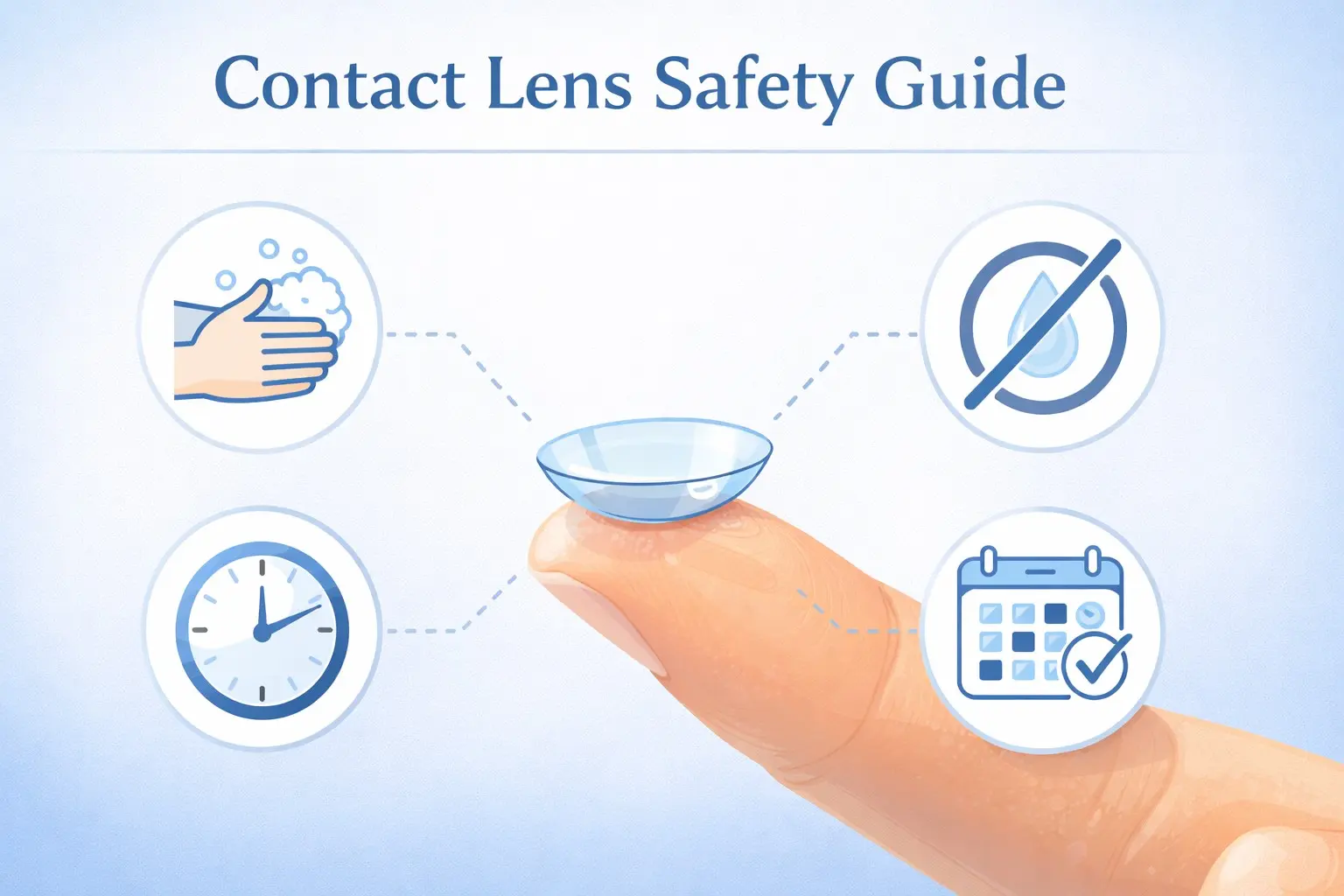
Wash your hands with soap and water and dry them with a lint-free towel before touching your lenses or your eyes. This is the single most important habit and the one most skipped, especially when in a hurry. Bacteria on your hands transfer directly to the lens surface and then sit against your cornea for hours.
Never use tap water on Lenses
This is one of the most important rules and one of the most broken. Tap water - even in countries with safe drinking water - can contain Acanthamoeba, a microorganism that causes a severe, sight-threatening corneal infection. Never rinse your lenses, your contact lens case, or your eyes with tap water. Never wear lenses while showering, swimming, or in a hot tub unless wearing tightly sealed swim goggles over them.
Acanthamoeba keratitis is rare, but it is also notoriously difficult to treat and can require months of intensive antimicrobial therapy, sometimes with permanent corneal scarring. The link to water exposure - particularly tap water, hot tubs, and lakes - is extremely well established in the research.
Replace your lens case regularly
Lens cases should be replaced every 1 to 3 months, even if they look clean. Bacterial biofilm can form on the case surface in ways that are not visible. Rinse the case with contact lens solution - never water - after each use and let it air dry upside down on a clean tissue.
Follow the replacement schedule exactly
If your lenses are prescribed as monthly, replace them every month from the date you open the package - not from when you first wear them, and not when they start to feel uncomfortable. Protein deposits build up on the lens surface over time, even with cleaning, and become a site for bacteria to adhere. Wearing lenses beyond their replacement schedule is one of the most common - and most avoidable - causes of complications.
Sleeping in Contact Lenses: Why It Matters So Much
Unless your eye doctor has specifically prescribed extended wear lenses approved for overnight use, sleeping in contact lenses significantly increases your infection risk.
During sleep, your eyes are closed, oxygen supply to the cornea drops further, tear exchange essentially stops, and your eyes are more vulnerable to bacteria multiplying against a warm, moist surface for many hours uninterrupted. Research consistently shows that sleeping in lenses not approved for overnight wear increases the risk of microbial keratitis by 6 to 8 times compared to daily wear with proper removal.
I understand the temptation - falling asleep on the sofa, being too tired after a long day, travelling without a solution. But this is precisely the habit most strongly linked to serious infections. If you find yourself regularly falling asleep in your lenses, daily disposables remove the temptation entirely - there is nothing to clean or store, just remove and discard before bed.
Warning Signs of a Contact Lens-Related Eye Infection
Knowing these signs - and acting on them immediately - is the difference between a minor irritation and a serious problem. Eye infection NHS: preventing common eye problems
| REMOVE YOUR LENSES IMMEDIATELY AND SEE A DOCTOR THE SAME DAY IF YOU HAVE | A painful red eye, not just irritated - pain is the key distinguishing feature Significant light sensitivity Blurred vision that does not clear when you remove the lens Excessive watering or discharge A feeling that something is stuck in your eye that does not resolve after removal Any of these symptoms after swimming, showering, or hot tub use while wearing lenses DO NOT put the lens back in. Do not wait to see if it improves overnight. Corneal infections can progress rapidly - hours matter. |
Common Contact Lens Mistakes and How to Fix Them
| Mistake | Why It Is Risky? | The Fix |
| Topping up the old solution instead of replacing it fully | The old solution loses disinfecting effectiveness and accumulates contaminants | Always empty the case and use a fresh solution every time |
| Using saliva to reset a dropped lens | Saliva contains bacteria that can cause serious infection | Use sterile saline or solution - never saliva, ever |
| Wearing lenses while unwell with a cold or fever | Reduced tear quality and immune changes increase infection risk | Switch to glasses until you feel better |
| Showering or swimming with lenses in (without goggles) | Tap water and pool water carry Acanthamoeba and bacteria | Remove lenses before water exposure, or wear sealed goggles over them |
| Wearing lenses longer than the prescribed daily hours | Reduces oxygen and tear exchange, increases deposit buildup | Follow your prescribed maximum wear time - usually 8 to 14 hours |
| Continue to wear the lens despite minor irritation or discomfort. | Even mild irritation may signal the early stages of an infection | Take the lens out and evaluate. Never try to push through discomfort. |
| Buying lenses without a valid prescription or eye exam | An incorrect fit or power can cause corneal damage over time | Have an annual contact lens fitting check with your optician |
Contact Lenses and Screen Use - A Common Combination Problem
Contact lens wearers who spend long hours in front of screens experience a double-dryness effect. Screens reduce blink rate, and contact lenses already reduce tear film stability slightly. The combination is a common reason people give up on lenses, assuming they are simply not suited to wearing them.
In most cases, this is manageable. Preservative-free lubricating drops specifically formulated for contact lens wearers can be used throughout the day. The 20-20-20 rule - looking away from the screen every 20 minutes - helps restore the tear film over the lens. If dryness with lenses persists despite these steps, daily disposables or a different lens material can make a significant difference - this is worth discussing at your next contact lens check. digital eye strain: symptoms, causes and relief strategies
When you should stop wearing contact lenses
- During and after any eye infection - until fully resolved and confirmed by your eye doctor
- If you develop dry eye or Meibomian gland dysfunction significant enough to cause persistent discomfort, discuss with your optician before continuing Dry eye syndrome: causes, symptoms and natural remedies
- During illness with fever or significant cold/flu symptoms, immune changes and reduced tear quality increase the risk temporarily
- If your prescription has not been checked in over a year, an outdated fit or power can cause problems even without symptoms How to read your eye prescription: every number explained
- If you experience any of the warning signs above, remove immediately and do not resume until assessed
What I Have Learned About Contact Lens Safety
| ADEL GALAL | I wore monthly contact lenses for several years in my 30s and 40s. I was careful, but I will admit - I occasionally fell asleep in them after long days, and I sometimes pushed the monthly replacement to five or six weeks if the lenses still felt comfortable. What changed my approach completely was watching someone close to me go Through Acanthamoeba keratitis. It started with what they described as just a slightly irritated eye after a swimming trip - they had worn their lenses in the pool without thinking twice about it. Within two days, the pain was severe. It took months of treatment, multiple specialist appointments and left some permanent scarring on the cornea. The ophthalmologist was very clear: this almost always traces back to water exposure to the lenses. After that, I switched to daily disposables. For me, the simplicity was removed every risky habit at once - no case, no solution, no replacement schedule to track and lenses out before bed every single night without exception. If there is one thing I would want every contact lens wearer to take from This article is this: water and contact lenses do not mix, ever. Everything else is manageable. That one rule has the highest stakes. |
Key Takeaways: Contact Lens Safety
| SUMMARY | Wash and dry your hands before every lens insertion and removal Never let tap water touch your lenses, case, or eyes while wearing lenses Replace your lens case every 1 to 3 months and use fresh solution every time Follow your replacement schedule exactly - from the date you open the package Do not sleep in lenses unless specifically approved for overnight wear by your eye doctor A painful red eye in a contact lens wearer means remove the lens and see a doctor the same day Daily disposables have the lowest infection risk and remove the most common mistakes entirely Have an annual contact lens fitting check, even if your eyes feel fine |
References and Sources
1- Contact Lens Health - Centers for Disease Control and Prevention (CDC)
https://www.cdc.gov/contact-lenses/about/index.html
CDC authority. Use for: infection statistics, hygiene guidelines, and water exposure risks.
2- Contact Lenses - American Academy of Ophthalmology
https://www.aao.org/eye-health/glasses-contacts/contact-lenses-101
AAO authority. Use for: lens types, safety profiles, wear schedules, and warning signs.
3- Acanthamoeba Keratitis and Water Exposure - Cornea Journal
https://pubmed.ncbi.nlm.nih.gov/29782458/
Peer-reviewed journal. Use for: Acanthamoeba keratitis mechanism, water exposure link, and treatment difficulty.
4- Overnight Contact Lens Wear and Microbial Keratitis Risk - Ophthalmology
https://pubmed.ncbi.nlm.nih.gov/19751340/
Peer-reviewed study. Use for: 6 to 8 times increased infection risk with overnight wear data.
5- Contact Lens Wear and Care - FDA
https://www.fda.gov/medical-devices/contact-lenses
FDA regulatory authority. Use for: lens regulation, coloured lens warnings, and replacement schedule guidance.
Part of Our Eye Health Series
This article is part of our complete eye health resource.
Read all topics in our Complete Eye Health Guide or browse our
Eye Health and Vision Resource Directory.
Adel Galal
Health and Wellness Writer | 30+ Years Personal Practice | Founder, NextFitLife.com
Adel Galal has studied
health, vision care, and natural aging for over 30 years. At 58, he has worn contact
lenses himself and has supported a family member through a serious contact lens
related eye infection. He is not a doctor or ophthalmologist. Everything shared reflects
personal research, experience, and published health guidance. Always
consult a qualified eye care professional for contact lens fitting and any eye concern.

Health & wellness writer with 30+ years of experience in nutrition, fitness, and healthy aging. Founder of NextFitLife.com — evidence-based health guidance.