Last updated: September 10, 2026
Next editorial review: September 2027 or sooner if major dermatology or travel health guidance changes
Written and source-checked by: Adel Galal, Founder and Lead Writer at NextFitLife
Medical review status: This article is educational and source-checked. It has not been medically reviewed by a dermatologist or doctor.
Your airplane skincare routine does not need ten products.
For most flights, prepare your skin before boarding, moisturize well, use sun protection during daylight travel, protect your lips, and touch your face as little as possible.
After landing, cleanse gently and return to your normal routine.
Simple works.
Quick Answer: What Is the Best Airplane Skincare Routine?
The best airplane skincare routine uses a gentle cleanser when needed, a familiar moisturizer, broad-spectrum SPF 30 or higher for daylight exposure, and lip balm. During the flight, avoid unnecessary face touching. Reapply moisturizer when skin feels dry. After landing, cleanse gently and moisturize again.
This approach focuses on the real issue.
Aircraft cabins are dry.
Current travel health guidance says cabin humidity is usually around 10 to 20 percent.
That low humidity can leave skin, eyes, lips, and other exposed surfaces feeling dry.
For a wider guide to keeping your skin healthy, visit the NextFitLife Skin Health Hub.
Why Does Your Skin Feel Dry on an Airplane?
The main reason is dry cabin air.
At cruising altitude, the outside air contains very little moisture.
Aircraft cabin systems bring in this dry air.
People inside the plane add some moisture by breathing and through normal body processes.
Even so, the cabin remains much drier than many indoor spaces.
The CDC Yellow Book says commercial aircraft cabins typically have about 10 to 20 percent humidity.
Your skin notices.
The outer layer of skin is called the stratum corneum.
It helps slow water loss.
A small study looked directly at skin during long distance flights.
Researchers followed eight healthy women.
Cabin humidity fell below 10 percent within two hours.
Skin hydration measurements dropped on the face and arms.
The cheeks showed the biggest change, reaching reductions of up to 37 percent in that small study.
That number should not be treated as applicable to every traveller.
There were only eight participants.
The useful message is simpler.
Long flights in very dry air can reduce surface skin hydration.
Does Flying Dehydrate Your Whole Body?
Do not confuse dry skin with severe whole body dehydration.
The cabin air is very dry.
That can dry your lips, nose, eyes, and skin surface.
It does not mean every healthy passenger becomes medically dehydrated simply from sitting on a plane.
Drink normally during your trip.
Use your thirst and normal health needs as a guide unless a healthcare professional has given you different fluid instructions.
And remember this:
Drinking an extra bottle of water does not replace moisturizer on dry facial skin.
7 Essential Steps for an Airplane Skincare Routine
1. Clean Gently Before the Flight
Start with comfortable skin.
If you have makeup, sweat, old sunscreen, or dirt on your face, cleanse before boarding.
Use a product your skin already knows.
Do not scrub.
Do not try to make the skin feel tight.
A tight face after washing does not mean you cleaned better.
It can mean the cleanser was too harsh.
If your face is already clean and comfortable, another wash may not be needed.
For the correct order of daily products, see the NextFitLife Skincare Routine Order Guide.
2. Apply Moisturizer Before Boarding
This is the step I would not skip.
A good moisturizer helps hold water in the skin.
The American Academy of Dermatology recommends creams or ointments rather than thin lotions when skin becomes very dry.
You do not need the thickest product in the shop.
Use the texture that suits your skin.
Dry skin may prefer a cream.
Oily skin may prefer a lighter moisturizer.
Sensitive skin may do better with a simple fragrance free product.
Useful moisturizer ingredients include glycerin, ceramides, hyaluronic acid, dimethicone, and petrolatum.
You do not need all of them.
Your goal is comfortable skin hydration, not ingredient collecting.
If your face is already dry, use our Face Care Routine for Dry Skin.
3. Protect Your Skin During Daylight Travel
Do not forget sun protection because you are sitting indoors.
The American Academy of Dermatology includes airplane travel in its sun protection advice.
For exposed skin, choose a broad spectrum, water resistant sunscreen with SPF 30 or higher.
If strong sunlight is entering through the window, closing the shade when permitted is another simple step.
I would not use frightening claims about passenger UV exposure.
Research involving pilots and cockpit windows does not directly tell us the exact dose that reaches every passenger.
A 2026 Ohio State dermatology review also points out that passenger exposure is likely lower than flight crew exposure.
So keep this simple.
Use airplane sunscreen during daylight travel just as you would for other meaningful daylight exposure.
4. Protect Your Lips
Lips dry quickly.
Put lip balm on before boarding.
Reapply it when needed.
If your lips are sensitive, choose a plain product you have already used.
Strong fragrance, flavor, or cooling ingredients can irritate some people.
For daylight exposure, an SPF lip product adds sun protection.
If dry or inflamed lips are a regular problem, read the NextFitLife Eczema Lips Guide.
5. Touch Your Face Less During the Flight
This is where my routine becomes less glamorous.
I would rather touch my face less than perform a full facial in the seat.
Think about what your hands touch while traveling.
Your bag.
The seat belt.
The overhead bin.
The screen.
Your phone.
The tray table.
Then the bathroom door.
You do not need to panic about germs.
Just be sensible.
Wash or clean your hands before applying skincare.
Skip unnecessary touching.
This keeps your in-flight skincare much simpler.
6. Reapply Moisturizer Only if Your Skin Needs It
You do not need to moisturize every hour.
If your face still feels comfortable, leave it alone.
If the cheeks or areas around your mouth begin to feel tight, clean your hands and apply a small amount of moisturizer.
Very dry spots may benefit from a little ointment over moisturizer.
This is especially useful for people prone to dry skin.
Do not coat oily or acne-prone skin in a heavy balm just because you are on a plane.
Use what works for your skin.
7. Reset Gently After Landing
Your face may look dull after a long trip.
Do not attack it.
Once you reach somewhere clean, remove makeup and sunscreen if needed.
Cleanse gently.
Apply moisturizer.
Then stop.
If the skin feels normal, return to your usual products.
If it burns, feels very tight, or looks irritated, give optional acids and strong treatments a break.
For more help, see the Damaged Skin Barrier Guide.
Do You Need a Hyaluronic Acid Serum on a Plane?
No.
A serum is optional.
If you already use hyaluronic acid and like it, you can apply it before your moisturizer.
The same applies to glycerin or another simple hydrating serum.
But do not mistake serum for the whole routine.
A good moisturizer may already contain humectants and ingredients that reduce water loss.
I would choose one familiar moisturizer before carrying several small serums.
Should You Use a Face Mist During a Flight?
You can use one if you enjoy it.
I would not call it essential.
A face mist can feel fresh.
It adds water to the skin surface for a short time.
But a mist alone is not the same as a moisturizer.
If your skin feels dry, I would apply moisturizer instead of spraying it again and again.
Do You Need a Sheet Mask on an Airplane?
No.
This is one of the easiest travel trends to skip.
A sheet mask can be relaxing.
But your skin does not need one because you reached cruising altitude.
It also creates more face-touching.
You need to open the package.
Put the mask on.
Adjust it.
Take it off.
Then deal with the remaining serum.
If you love sheet masks, use one in your hotel.
You will have clean hands, a mirror, and more room.
Should You Wear Makeup During a Long Flight?
You can.
There is no rule saying makeup must be removed before flying.
The better question is how your skin feels.
If foundation becomes dry and uncomfortable after several hours, wear less on long flights.
You might choose:
- Moisturizer
- Sunscreen
- Light makeup if wanted
If you plan to sleep during a very long flight, removing heavy makeup first may feel better.
That is preference.
It is not a medical requirement.
Should You Use Retinol Before Flying?
If your normal retinoid routine causes no dryness or irritation, a flight does not automatically mean you must stop it.
But use common sense.
If the skin is already peeling, burning, red, or sore, adding more irritation before several hours of dry air is a poor trade.
The American Academy of Dermatology advises people with very dry skin to avoid products that worsen irritation, including retinoids when they are contributing to dryness.
Do not start a new retinol or strong acid on the day before a long trip.
Your travel skincare routine should be predictable.
What Should Oily Skin Do on an Airplane?
Oily skin still needs water.
But it does not need a thick cream by default.
Use a gentle cleanser.
Choose a light moisturizer.
Use sunscreen.
Then leave the skin alone.
Do not wash your face repeatedly just because it looks shiny.
Overwashing can irritate the skin.
What Should Dry Skin Do?
Dry skin benefits most from planning.
Before boarding, apply moisturizer while your skin is comfortable.
Choose a cream rather than a very thin lotion if your skin is very dry.
Carry enough product for one or two small reapplications.
Use lip balm.
After landing, cleanse gently and moisturize again.
This is the heart of flight skincare for dry skin.
What Should Sensitive Skin Do?
Make the bag boring.
That is good advice.
Bring products you know.
Avoid mystery samples.
Avoid testing a new acid.
Avoid strong fragrance if fragrance irritates you.
A simple, sensitive skin travel routine might be:
- Gentle cleanser
- Fragrance free moisturizer
- Sunscreen you tolerate
- Plain lip balm
For a complete routine, read Fragrance Free Skincare Routine for Sensitive Skin.
What About Acne-Prone Skin?
Do less.
Travel already changes your sleep, food, stress, climate, makeup wear time, and normal routine.
Do not add five new acne products.
Keep your usual treatment if it is comfortable.
Use a moisturizer that suits acne-prone skin.
Do not pick.
Do not touch your face repeatedly.
If new bumps appear after travel, see our Skin Purging Versus Breakout Guide.
Does Airplane Air Cause Acne?
There is no good evidence that recycled aircraft air directly causes acne.
A breakout after travel can have many triggers.
These include:
- Long makeup wear
- Face touching
- Stress
- Poor sleep
- Different skincare products
- Climate changes
- Sweat
- Friction
This is why I would avoid calling cabin air an acne cause.
Keep the routine steady instead.
Does Flying Damage the Skin Barrier?
Very dry air affects the outer skin layer.
The direct long-flight study showed reduced surface hydration.
That supports talking about dryness and skin barrier stress.
But do not turn one flight into a dramatic injury.
There is no reason to tell every healthy traveller that their barrier has been destroyed.
If your face feels dry, moisturize.
If it feels irritated, simplify the routine.
If irritation is severe or does not improve, seek professional advice.
How Does a Short Flight Change the Routine?
For a short flight, I would do almost nothing onboard.
Prepare your skin before leaving.
Use moisturizer.
Use sun protection when needed.
Use lip balm.
Then fly.
You do not need to unpack a skincare bag for every two hour trip.
What About a Long Haul Flight?
Your long haul flight skincare can still be simple.
| Time | What to Do |
|---|---|
| Before boarding | Cleanse if needed, moisturize, use sunscreen during daylight travel, and apply lip balm |
| During the flight | Keep hands clean, touch the face less, and reapply moisturizer or lip balm when needed |
| After landing | Cleanse gently, moisturize, and return to your normal routine when the skin feels comfortable |
You do not need to schedule a skincare step every hour.
What Should You Pack in Your Carry-On?
Pack less than you think.
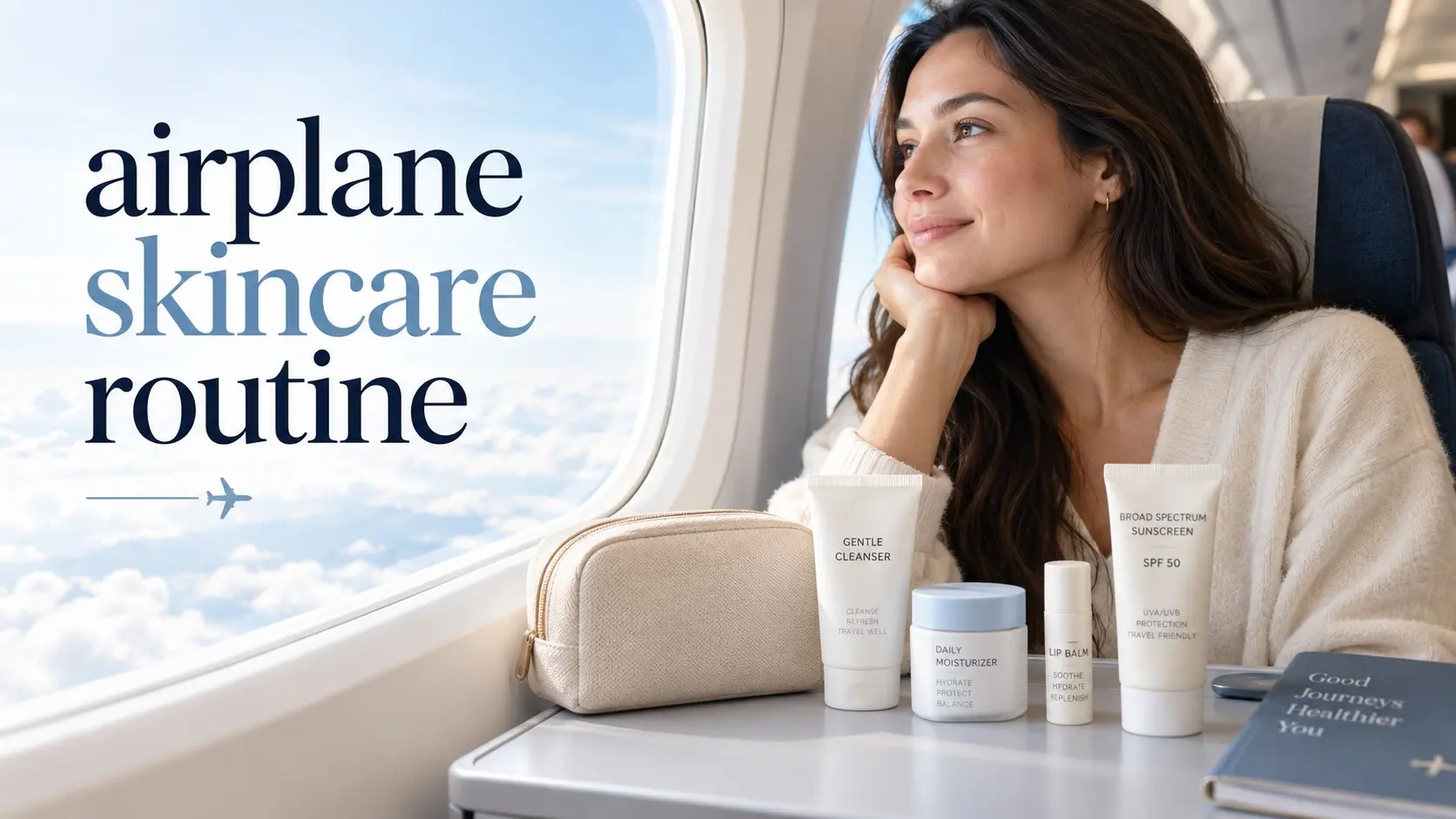
For most people, the core travel skincare essentials are:
- Gentle cleanser if you will need it
- Moisturizer
- Broad spectrum SPF 30 or higher sunscreen
- Lip balm
- Any prescribed skin medicine you need
Everything else is optional.
If one moisturizer already works well at home, travel is not a good reason to replace it.
Airplane Skincare Routine by Flight Type
| Flight | Simple Routine |
|---|---|
| Short daytime flight | Moisturizer, sunscreen, lip balm |
| Short night flight | Moisturizer and lip balm |
| Long daytime flight | Cleanse if needed, moisturize, sunscreen, lip balm, then reapply based on need |
| Long overnight flight | Cleanse before sleep if needed, moisturize, use lip balm, and keep the routine simple |
| Sensitive skin | Use only familiar gentle products and avoid new active ingredients |
Should You Drink Extra Water for Better Airplane Skin?
Drink enough fluid for normal health.
Do not force excessive amounts for your face.
Cabin air affects the skin surface directly.
A topical moisturizer addresses that surface dryness more directly than drinking huge amounts of water.
If a doctor has given you a fluid restriction, follow that medical plan.
What About Coffee and Alcohol During the Flight?
I would not make skincare depend on banning one cup of coffee.
The stronger and better-supported issue for your skin is the dry environment around it.
Large amounts of alcohol can also affect sleep and how you feel during travel.
Drink normally.
Do not use coffee or alcohol as the main explanation for every patch of dry skin.
Common Airplane Skincare Mistakes
| Mistake | Better Choice |
|---|---|
| Doing ten skincare steps at your seat | Prepare before boarding and touch your face less |
| Testing new products during travel | Pack familiar products |
| Using mist instead of moisturizer | Use moisturizer when skin feels dry |
| Scrubbing dull skin after landing | Cleanse gently and moisturize |
| Using strong acids on irritated skin | Wait until the skin feels comfortable |
| Assuming oily skin cannot become dehydrated | Use a light moisturizer if needed |
| Ignoring daylight protection | Use broad-spectrum SPF 30 or higher when exposure warrants it |
What I Look for in Travel Skin Advice
I have spent more than 30 years reading and applying practical information about health, nutrition, fitness, healthy aging, and skin care.
My approach is simple.
I separate a real skin problem from a marketing solution.
Aircraft cabins really are dry.
That does not mean you need a special airplane serum.
Surface skin hydration can drop during a long flight.
That does not mean every passenger needs a sheet mask.
Sun protection is sensible during daylight travel.
That does not mean a passenger window should be described as a tanning bed.
I prefer a routine that solves the problem without creating five new ones.
Conclusion: Keep Your Airplane Skincare Routine Simple
A good airplane skincare routine is mostly preparation.
Use a gentle cleanser when needed.
Moisturize before boarding.
Protect exposed skin during daylight travel.
Use lip balm.
Then touch your face less.
After landing, cleanse gently and moisturize again.
For your next flight, pack one moisturizer you trust, sunscreen, and lip balm. Leave the complicated facial routine at home and see how your skin feels with fewer steps.
References and Sources
- CDC Yellow Book 2026: Air Travel.
Current travel medicine guidance covering the aircraft cabin environment, including typical cabin humidity of about 10 to 20 percent.
CDC Yellow Book Air Travel - Lademann J and colleagues. Skin Surface Hydration Decreases Rapidly During Long Distance Flights.
Human study measuring facial and forearm skin hydration during long distance air travel.
PubMed: Skin Hydration During Flights - American Academy of Dermatology. 7 Travel Skin Care Tips From Dermatologists.
Dermatologist guidance covering travel skincare, sun protection while flying, window shades, and bringing familiar products for sensitive skin.
AAD Travel Skin Care Tips - American Academy of Dermatology. Dermatologists' Top Tips for Relieving Dry Skin.
Current guidance on gentle care, fragrance-free moisturizers, creams and ointments, lip care, and useful moisturizing ingredients.
AAD Dry Skin Tips - The Ohio State University Wexner Medical Center. Why Flying Puts Your Skin at Higher Risk of Sun Damage.
2026 dermatologist guidance discussing daylight air travel, passenger versus flight crew exposure, sunscreen, lip protection, and window shades.
Ohio State Air Travel and Sun Protection
Continue Reading on NextFitLife
- Skin Health Complete Guide
- Skincare Routine Order Guide
- Face Care Routine for Dry Skin
- Fragrance-Free Skincare Routine for Sensitive Skin
- Damaged Skin Barrier Guide
- Skin Purging Versus Breakout Guide
- Eczema Lips Guide
- Skincare for Humid Weather
About the Author
Frequently Asked Questions About an Airplane Skincare Routine
What is the best airplane skincare routine?
Keep it simple. Cleanse if needed, apply moisturizer before boarding, use broad spectrum SPF 30 or higher during daylight exposure, use lip balm, and touch your face as little as possible. Cleanse and moisturize after landing.
Why does skin get dry on airplanes?
Aircraft cabins have very low humidity. Current travel guidance says cabin humidity is commonly around 10 to 20 percent, which can make the skin, lips, eyes, and nose feel dry.
Should I moisturize before or during a flight?
Apply moisturizer before boarding. Reapply during the flight only if your skin starts to feel dry or tight.
Should I wear sunscreen on an airplane?
Use broad-spectrum SPF 30 or higher when meaningful daylight exposure is expected. The American Academy of Dermatology also recommends sun protection during airplane travel and suggests lowering the window shade when appropriate.
Do I need a sheet mask on a flight?
No. A sheet mask is optional. A familiar moisturizer is simpler and requires less handling while you are sitting in a public cabin.
Is hyaluronic acid good for airplane skin?
Hyaluronic acid is a useful hydrating ingredient for some people, but it is optional. Use moisturizer after a hydrating serum rather than treating the serum as a replacement for moisturizer.
Should I use a face mist during a flight?
You can use a face mist for comfort, but it is not essential. If your skin is truly dry, moisturizer usually makes more sense than repeated misting.
Should I stop retinol before flying?
Not automatically. If retinol is already making your skin dry, peeling, or irritated, it makes sense to simplify your routine before a long flight. Do not start a new strong active product just before travel.
What is the best long haul flight skincare routine?
Before boarding, cleanse if needed, moisturize, use sunscreen for daylight travel, and apply lip balm. During the flight, touch your face less and reapply moisturizer when needed. After landing, cleanse gently and moisturize.
Can airplane air cause acne?
There is no good evidence that recycled cabin air directly causes acne. Travel changes many things at once, including sleep, stress, makeup wear, face touching, climate, sweat, and skincare habits.
What should I pack for airplane skincare?
For most people, pack a gentle cleanser if needed, moisturizer, broad spectrum sunscreen with SPF 30 or higher, lip balm, and any prescribed skin medicine you need.
Does drinking more water stop airplane skin dryness?
Drink enough fluid for your normal needs, but extra water does not replace topical moisturizer. Very low cabin humidity acts directly on the skin surface.

Health & wellness writer with 30+ years of experience in nutrition, fitness, and healthy aging. Founder of NextFitLife.com — evidence-based health guidance.