Published: September 12, 2026
Last updated: September 12, 2026
Next review: September 2027, or sooner if important dermatology or cleansing guidance changes
Written and source-checked by: Adel Galal, Founder and Lead Writer at NextFitLife
Medical review status: This article has not been medically reviewed by a dermatologist.
If one gentle cleanser removes what is on your face, stop there.
That is my main rule for double cleansing for sensitive skin.
Two cleansers are not automatically better than one.
For reactive skin, more cleansing can mean more dryness, burning, tightness, and redness.
Double cleansing makes the most sense when one wash cannot easily remove something stubborn.
Think water-resistant sunscreen.
Think long-wear makeup.
Think several layers of cosmetics.
On an ordinary day, one mild cleanser may be all you need.
Important medical note: I am not a dermatologist or a doctor, and this content does not replace professional medical advice. What I share comes from real-life experience, extensive research, and consultation with healthcare providers. Always consult qualified medical professionals for diagnosis and treatment of any health condition.
Persistent burning, itching, swelling, eczema, rosacea, recurring rashes, or reactions to many products deserve professional evaluation. Sensitive skin is a description. It is not always the final diagnosis.
What is double cleansing for sensitive skin?
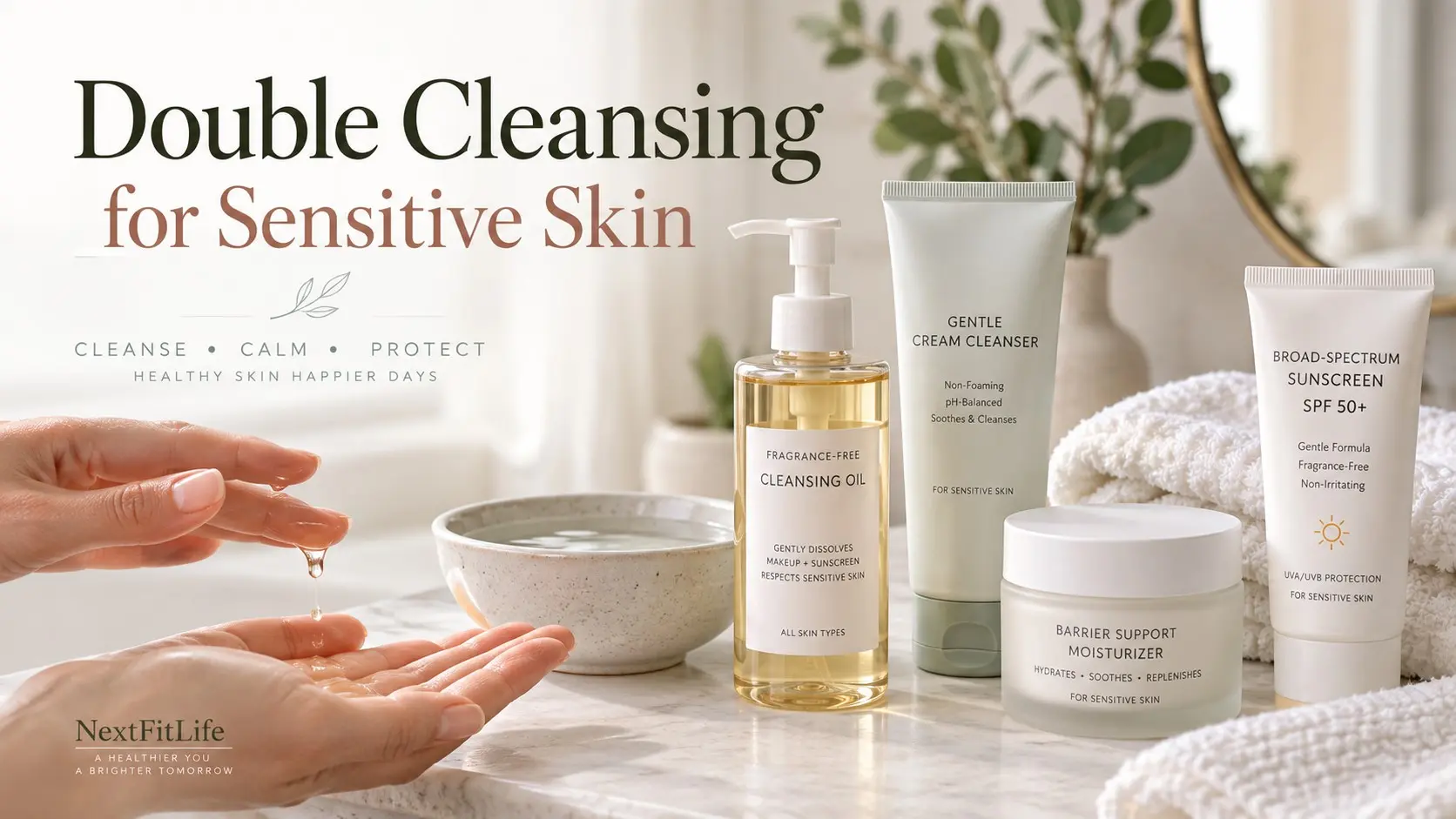
Quick answer: Double cleansing uses one product to loosen sunscreen, makeup, and oily residue, then a second gentle cleanser to wash the skin. Sensitive skin should use this method only when one cleanser does not remove the day easily. The goal is clean, comfortable skin, not a stripped or squeaky feeling.
The usual routine has two steps.
- A cleansing oil, balm, or suitable makeup remover.
- A mild water-based facial cleanser.
The first step handles material that is harder to rinse away.
The second step removes residue and finishes the wash.
Simple enough.
The problem starts when double cleansing becomes a rule instead of a tool.
Do sensitive skin types need to Double Cleanse?
Usually not.
Your skin does not know how many skincare steps are trending.
It only knows what touches it.
If one gentle cleanser removes your sunscreen, makeup, sweat, and daily grime without leaving your face tight or sore, there is no clear reason to add another wash.
The American Academy of Dermatology recommends gentle cleansing with lukewarm water, fingertips, and a nonabrasive cleanser. It also warns against scrubbing because friction itself irritates the skin.
A useful rule is this:
Use the fewest cleansing steps that get the job done.
That fits the wider approach in the NextFitLife Skin Health Guide, where simple barrier care comes before adding more products.
When Is a second cleanse actually useful?
The strongest case is stubborn sunscreen or makeup.
A small clinical study compared water, foaming cleanser, and cleansing oil for sunscreen removal.
Twenty participants took part.
For non-water-resistant sunscreen, the residue rates after cleansing were about 15.6 percent with the tested cleanser and 13.4 percent with the cleansing oil.
For water-resistant sunscreen, the difference was much larger.
Residue was about 36.8 percent after the tested foaming cleanser and about 5.8 percent after cleansing oil.
Eight participants using the cleanser reported dry skin, compared with one participant using cleansing oil.
The study was small.
It tested specific products.
It does not prove that every oil cleanser works better than every normal cleanser.
But it supports a practical point.
Water-resistant sunscreen is one situation where an oil cleansing step can have a real purpose.
You can read the study here: The Optimal Cleansing Method for the Removal of Sunscreen.
When Should You Skip Double Cleansing?
Skip the second cleanser when your skin is already asking for less.
Signs include:
- Burning
- Stinging
- Persistent tightness
- New flaking
- Unusual redness
- Raw areas
- A new itchy rash
- Cracks
- Products that suddenly sting
Do not respond to an irritated barrier by cleaning it harder.
That usually makes little sense.
DermNet explains that soaps and cleansers remove oil and surface material, but excessive or irritating cleansing can contribute to dryness and irritation.
If you already have eczema, rosacea, or dermatitis, your routine may need to be even simpler.
For a wider explanation of dryness and barrier care, see How to Care for Your Skin Daily to Prevent Dryness and Discomfort.
Why Can Too Much Cleansing Irritate the Skin Barrier?
Your outer skin is not just dead material waiting to be scrubbed away.
It is a barrier.
The outer layer contains skin cells, lipids, natural moisturizing factors, and other structures that help keep water inside and irritants outside.
Cleansers use surfactants.
Surfactants are useful.
They help oil, sunscreen, makeup, and dirt mix with water so they can be rinsed away.
But surfactants can also interact with the outer skin layer.
Open-access research on cleansing science describes how some surfactants can remove skin components, remain in the outer layer, and disturb barrier structure.
That is why cleanser formulation matters.
It is also why more washing is not automatically better.
A review of cleansing formulations and skin barrier integrity is available here: Cleansing Formulations That Respect Skin Barrier Integrity.
Rule 1: Make the first cleanse a removal step
The first cleanser has one job.
Loosen what your normal cleanser struggles to remove.
That may include:
- Water-resistant sunscreen
- Foundation
- Long-wear concealer
- Waterproof eye makeup
- Heavy cosmetic layers
You do not need the strongest oil cleanser on the shelf.
For reactive skin, I prefer a simple rinseable cleansing oil for sensitive skin or a mild cleansing balm for sensitive skin.
Fragrance-free is a sensible place to start.
Massage gently.
Give the cleanser time to loosen the product.
Then rinse according to the label.
Do not turn the first cleanse into a facial massage competition.
More rubbing is still more friction.
Rule 2: Keep the Second Cleanser Boring
Boring skincare is underrated.
Your second cleanser does not need ten active ingredients.
Look for a gentle face cleanser that rinses easily and does not leave your face painfully tight.
For sensitive skin, a simple fragrance-free cleanser is often a sensible choice.
Traditional soaps can be more drying and irritating than mild synthetic detergent cleansers.
These mild synthetic cleansers are sometimes called syndets.
DermNet notes that syndets can be formulated closer to normal skin pH and are less likely than traditional soap to irritate sensitive skin.
Read the open DermNet overview here: Soaps and Cleansers.
Rule 3: Use Fragrance Free, Not Just Unscented
The wording matters.
Unscented does not always mean fragrance-free.
A product can contain ingredients that mask another smell.
The American Academy of Dermatology advises people with reactive skin to look for products labelled fragrance-free rather than relying on the word unscented.
If fragrance has never bothered your skin, you do not need to become afraid of every scented product overnight.
But if your face burns, itches, or develops rashes easily, removing unnecessary fragrance is a simple variable to control.
I would also be careful with long botanical ingredient lists when your skin is actively reacting.
Natural does not guarantee gentle.
Rule 4: Use Your Fingertips and Lukewarm Water
This sounds almost too basic.
It is one of the most useful parts of the routine.
The American Academy of Dermatology recommends:
- A gentle cleanser
- Lukewarm water
- Clean fingertips
- No scrubbing
- Gentle rinsing
- Patting dry with a soft towel
Read the full dermatologist guidance here: American Academy of Dermatology Face Washing 101.
You do not need a cleansing brush.
You do not need a rough cloth.
You do not need a textured pad.
Your fingertips are enough.
For sensitive skin, friction is part of the irritation equation.
Rule 5: Stop Chasing the Squeaky Clean Feeling
Squeaky is not a skincare goal.
If your face feels stretched after washing, the routine may be too aggressive for you.
Your skin should feel clean.
It should also feel comfortable.
That is the better target.
A cleanser is not supposed to prove its strength by making your skin uncomfortable.
Rule 6: Double Cleanse at Night Only When Needed
This is where many routines become excessive.
Two cleanses in the morning.
Two cleanses at night.
Then exfoliating toner.
Then retinoid.
Then another acid.
Sensitive skin eventually sends a complaint.
If you use double cleansing, evening is the logical time.
That is when you may need to remove sunscreen, makeup, pollution, sweat, and daily residue.
Morning cleansing can be simpler.
Some sensitive or dry skin does well with one gentle morning cleanse.
Some people prefer only water in the morning.
Your response matters more than copying someone else's routine.
Rule 7: Moisturize After Cleansing
Do not finish cleansing and leave dry, reactive skin alone.
Pat the face gently.
Then use a moisturizer you already tolerate.
A simple moisturizer can help reduce water loss and improve comfort.
Useful ingredients can include:
- Ceramides
- Glycerin
- Petrolatum
- Dimethicone
- Hyaluronic acid
- Squalane
You do not need every ingredient in one jar.
If your current moisturizer works, there is no prize for replacing it.
Our Healthy Skin 101 Guide explains why cleansing, moisturizing, and sun protection form the basic routine.
Rule 8: Patch Test New Cleansers When Your Skin Reacts Easily
Buying something labeled sensitive skin does not guarantee your skin will like it.
The American Academy of Dermatology recommends testing new skincare on a small area before wider use.
For a cleanser, use it on the test area the way you normally would.
Wash it off after the normal contact time.
AAD suggests repeating the test twice daily for seven to ten days.
If the area stays clear, wider use is less likely to trigger a reaction.
This is not the same as formal medical patch testing.
If you react to many products, a dermatologist may recommend medical patch testing to look for allergic contact dermatitis.
Read the AAD instructions here: How to Test Skin Care Products.
Rule 9: Let Your Skin Decide Whether the Second Cleanse Stays
Your routine is not a contract.
If double cleansing works on makeup days, use it on makeup days.
If it makes your skin burn, stop.
If one cleanser removes your sunscreen, use one cleanser.
If winter makes your skin much drier, simplify.
If a dermatologist gives you a different routine for eczema, rosacea, acne, or dermatitis, follow that treatment plan.
The best sensitive skin cleansing routine changes when your skin changes.
Is Cleansing Oil Safe for Sensitive Skin?
It can be.
The word oil does not make a cleanser gentle or irritating by itself.
The full formula matters.
A rinseable cleansing oil can be useful because it loosens sunscreen and makeup without needing repeated rubbing.
That can be especially helpful around the eyes and cheeks, where friction may be uncomfortable.
Still, any product can cause irritation or allergy in the wrong person.
Stop using it if you develop:
- Persistent burning
- Itching
- Swelling
- Hives
- A spreading rash
Is a Cleansing Balm Better Than Cleansing Oil?
Not automatically.
The main difference is texture.
A balm starts thicker.
It melts as you massage it.
A cleansing oil starts liquid.
Both can dissolve oily residue.
Choose based on the formula and how your skin responds.
A heavily fragranced balm is not automatically better for sensitive skin because it feels luxurious.
A simple oil cleanser is not automatically better either.
Read the ingredient list.
Then judge the product on your face.
What About Micellar Water?
Micellar water can work well for light makeup or targeted removal.
The issue is sometimes the cotton pad, not the micellar liquid.
If you wipe repeatedly until your cheeks turn pink, the routine is no longer gentle.
Let the product loosen makeup first.
Use as little friction as possible.
If a rinse able oil or balm lets you remove makeup with less rubbing, that may be a better option for you.
Does Double Cleansing Cause Dry Skin?
It can.
That is especially true if both cleansers are aggressive or you wash for too long.
Over-cleansing can leave skin:
- Tight
- Dry
- Flaky
- Sore
- More reactive
- Red
Cleansers are designed to remove material from the skin surface.
That is useful.
But twice the cleansing does not mean twice the benefit.
If your barrier feels worse after adding a second cleanse, remove the extra step.
Can Double Cleansing Damage the Skin Barrier?
Yes, if your cleansing routine is too aggressive.
The skin barrier helps reduce water loss and limit entry of irritants.
Research on cleanser surfactants shows that harsher cleansing systems can disturb the outer skin structure.
Milder formulas are designed to reduce this interaction.
That is why the type of cleanser, water temperature, friction, and frequency all matter.
For more background on barrier care, visit the NextFitLife Skin Health Hub.
What If You Use Retinol, Benzoyl Peroxide, or Acids?
Then I would make cleansing even less exciting.
Retinoids, benzoyl peroxide, salicylic acid, glycolic acid, and other active ingredients can already irritate some skin.
You do not need an aggressive cleanser competing with your treatment.
A sensible order is:
- Remove stubborn makeup or sunscreen if needed.
- Wash gently.
- Pat dry.
- Apply treatment as directed.
- Moisturize.
Using too many irritating products together can make it difficult to know what caused a reaction.
What If You Have Rosacea?
Rosacea is not simply sensitive skin.
It is a medical skin condition.
Rosacea-prone skin can react strongly to heat, friction, fragrance, and some active products.
The American Academy of Dermatology recommends mild cleansing and gentle application with fingertips for rosacea-prone skin.
If your face is actively burning or flushing, simplify.
You do not need a complicated double cleansing routine to prove that your skin is clean.
What If You Have Eczema?
Eczema also needs more care than a generic sensitive skin label.
Eczema skin already has barrier problems.
During a flare, repeated washing and irritating products can feel much worse.
Use the routine your clinician recommends.
Choose mild, fragrance-free products.
Moisturize.
Do not experiment with several new cleansers while the skin is already inflamed.
For related barrier information, see our Lip Eczema Guide.
What About Acne and Sensitive Skin?
You can have acne and sensitive skin at the same time.
Do not try to scrub acne away.
Scrubbing can irritate the skin.
A gentle cleanser is still useful.
Use acne treatments for acne.
Use cleansers for cleansing.
Trying to make every skincare product treat breakouts can turn a simple routine into an irritation problem.
A Professional Double Cleansing Routine for Sensitive Skin
| Step | What to Do? | What to Avoid? |
|---|---|---|
| First cleanse | Use a small amount of gentle cleansing oil or balm when stubborn sunscreen or makeup needs removal | Long rubbing, rough cloths, strong fragrance |
| Rinse | Use lukewarm water and fingertips | Very hot water |
| Second cleanse | Use a mild fragrance-free facial cleanser | Scrubs, brushes, harsh soap |
| Dry | Pat gently with a soft, clean towel | Rubbing |
| Moisturize | Apply a moisturizer you already tolerate | Adding several new active products at once |
What If You Only Wore Light Sunscreen?
Try your normal cleanser first.
If it removes the sunscreen easily, stop.
There is no prize for adding another bottle to the routine.
If residue remains or your sunscreen is designed to resist water and sweat, an oil-based first step may help.
What If You Wore No Makeup?
You can still need to remove sunscreen.
But again, test the simplest option first.
Makeup is not the only reason to double cleanse.
It is also not a reason to double cleanse automatically.
What If Your Skin Starts Burning After Double Cleansing?
Stop.
Do not convince yourself that burning means the cleanser is working.
Rinse gently.
Use a simple moisturizer you already tolerate.
Pause unnecessary acids, scrubs, or other irritating products until your skin is comfortable.
If the burning is strong, persistent, associated with swelling or a rash, or keeps returning, see a dermatologist.
Can You Double Cleanse Every Day?
Some people tolerate it.
That does not mean every sensitive skin type should do it.
I would base frequency on what needs removal.
If you wear water-resistant sunscreen or heavy makeup every day and your skin remains comfortable, a gentle evening double cleanse may fit.
If you only need it twice a week, use it twice a week.
Routine frequency should follow need.
Can You Double Cleanse Morning and Night?
I would not recommend that as a default routine for sensitive skin.
The morning usually does not involve removing waterproof makeup or a full day of sunscreen.
Adding two cleansing steps morning and night creates more exposure to surfactants and more chances for friction.
Keep the morning simple unless your dermatologist has given you another plan.
How Do You Know You Are Over-Cleansing?
Look for a change from your normal skin.
Possible signs include:
- New tightness
- Peeling
- More redness
- Stinging when moisturizer is applied
- Rough texture
- Persistent dryness
- More sensitivity to products you normally tolerate
None of these signs proves that cleansing is the cause.
But if they started after adding more cleansing, simplify first.
Common Double Cleansing Mistakes
Using Two Strong Foaming Cleansers
That is not the point of double cleansing.
The first step should loosen difficult residue.
The second should gently finish the job.
Scrubbing to Remove Makeup Faster
Give the remover time to work.
Friction is not an active ingredient.
Using Hot Water
Lukewarm water is enough.
Adding an Exfoliating Scrub Afterward
Your face has already been cleaned twice.
It does not need punishment for surviving.
Changing Both Cleansers at Once
If a reaction appears, you will not know which product caused it.
Add one new product at a time.
Ignoring Burning
A strong burn is not a sign of deep cleansing.
It is a reason to stop.
Double Cleansing Myths
Myth: Everyone Needs to Double Cleanse
No.
One cleanser is enough for many people.
Myth: Oil Cleansers Make Every Oily Skin Type Break Out
No.
The complete formulation matters.
Skin response also differs from person to person.
Myth: Micellar Water Is Always Gentler
No.
The liquid may feel mild, but repeated wiping can still irritate reactive skin.
Myth: The Skin Should Feel Squeaky After Cleansing
No.
A clean face does not need to feel stripped.
Myth: Natural Cleansers Are Safer
No.
Plant ingredients and essential oils can irritate or cause allergies in some people.
Myth: Sensitive Skin Needs More Cleansing to Prevent Breakouts
No.
Overwashing can irritate skin.
Acne needs suitable acne treatment, not endless washing.
When Is Sensitive Skin Actually a Skin Condition?
Sometimes the label sensitive skin hides another problem.
DermNet notes that skin sensitivity can occur with:
- Irritant contact dermatitis
- Allergic contact dermatitis
- Rosacea
- Eczema
- Dry skin
- Other inflammatory skin problems
If almost every product burns, something more than product preference may be happening.
Get the diagnosis checked.
When Should You See a Dermatologist?
See a qualified dermatologist or doctor if you develop:
- A rash that keeps coming back
- Strong burning
- Persistent swelling
- Painful cracks
- Oozing
- Crusting
- Severe itching
- Repeated eyelid reactions
- Signs of infection
- Skin reactions to many unrelated products
Formal patch testing may help when allergic contact dermatitis is suspected.
My Practical Approach to Sensitive Skin Cleansing
At NextFitLife, I prefer the least complicated routine that works.
That matters even more with sensitive skin.
I do not see double cleansing as a badge of good skincare.
It is a removal method.
I look at what is actually on the skin.
I look at how hard it is to remove.
I look at how the skin feels afterward.
I also separate cosmetic sensitivity from real skin disease.
That is more useful than following a fixed number of steps.
Conclusion
Double Cleansing for Sensitive Skin should solve a removal problem, not create a barrier problem.
Start with one mild cleanser.
If stubborn water resistant sunscreen or makeup remains, add a gentle oil or balm first.
Use lukewarm water.
Use your fingertips.
Avoid scrubbing.
Moisturize afterward.
If your skin becomes tight, sore, flaky, or increasingly reactive, simplify.
Your next step: Tonight, try your normal gentle cleanser first. If your sunscreen or makeup comes off and your skin feels comfortable, stop there. Add a first cleansing step only when you can clearly see that you need it.
References and Sources
The following open or publicly accessible medical and dermatology sources were used to research and fact-check this guide:
- American Academy of Dermatology. Face Washing 101.Dermatologist guidance on mild cleanser use, lukewarm water, fingertips, avoiding scrubbing, rinsing, drying, and cleansing frequency.
- DermNet. Soaps and Cleansers.Dermatology guidance on cleansing, soap, synthetic detergents, sensitive skin, irritation, dryness, and cleanser selection.
- Chen W, He M, Xie L, Li L. The Optimal Cleansing Method for the Removal of Sunscreen: Water, Cleanser or Cleansing Oil? Journal of Cosmetic Dermatology. 2020;19(1):180 to 184.A clinical study of 20 participants comparing water, foaming cleanser, and cleansing oil for non-water-resistant and water-resistant sunscreen removal.
- Walters RM and colleagues. Cleansing Formulations That Respect Skin Barrier Integrity.An open access review explaining how surfactants interact with the outer skin barrier and how cleanser formulation can affect irritation and barrier disruption.
- American Academy of Dermatology. How to Test Skin Care Products.Dermatologist guidance on testing new cleansers and other skincare products on a small area before wider use and recognizing possible allergic contact dermatitis.
Continue Reading on NextFitLife
Use these related guides to build a simpler and more comfortable skincare routine:
- Skin Health Complete GuideExplore the skin barrier, sensitive skin, dry skin, oily skin, sunscreen, eczema, rosacea, acne, and simple daily care.
- Healthy Skin 101Build a basic routine using gentle cleansing, moisturizer, sunscreen, and only the treatments your skin actually needs.
- How to Care for Your Skin Daily to Prevent Dryness and DiscomfortLearn how cleansing, water temperature, moisturizer, and irritation affect dry and uncomfortable skin.
- Lip Eczema GuideLearn about eczema, irritant contact dermatitis, allergic contact dermatitis, fragrance, dryness, and when persistent irritation needs medical care.
Skin Health Hub: Visit the NextFitLife Skin Health Hub for more guides about sensitive skin, barrier care, eczema, rosacea, acne, sunscreen, dryness, and skincare routines.
About the Author
Adel Galal is the Founder and Lead Writer at NextFitLife.
He focuses on making health, fitness, nutrition, skincare, and wellness information easier to understand and use in real life.
His work combines real life experience, extensive research, and consultation with healthcare providers.
For skincare articles, he reviews guidance from dermatology organizations, medical references, peer reviewed research, and recognized healthcare sources before turning the evidence into practical daily steps.
Adel is not a dermatologist or a doctor.
This content does not replace professional medical advice.
Always consult qualified medical professionals for diagnosis and treatment of any health condition.
Learn more about Adel, NextFitLife, and the site's editorial approach on the About Us page.
Frequently Asked Questions
Is double cleansing good for sensitive skin?
It can be useful when sensitive skin needs help removing water resistant sunscreen or heavy makeup. It is not required every night. If one mild cleanser removes everything comfortably, one cleanse is enough.
Should sensitive skin double cleanse every day?
Not automatically. Use double cleansing when there is something difficult to remove. If daily double cleansing causes dryness, burning, or tightness, reduce the frequency.
What is the best first cleanser for sensitive skin?
A simple fragrance-free cleansing oil or balm that rinses easily can work well. The best product is one that removes sunscreen or makeup without causing burning, itching, or persistent redness.
Is cleansing oil good for sensitive skin?
It can be. A small clinical study found that the tested cleansing oil removed water-resistant sunscreen more effectively than the tested foaming cleanser. Individual products and skin reactions still vary.
Does double cleansing damage the skin barrier?
It can if the products are harsh, cleansing lasts too long, water is too hot, or the skin is scrubbed. Gentle formulas and minimal friction reduce unnecessary irritation.
Can I use micellar water instead of cleansing oil?
Yes. Micellar water can remove light makeup and sunscreen. Avoid repeated rubbing with cotton pads if friction makes your skin red or sore.
Should I double cleanse if I only wear sunscreen?
It depends on the sunscreen. Many non water resistant products may come off with one suitable cleanser. Water resistant sunscreen may be easier to remove with an oil cleansing step.
Do I need to double cleanse if I do not wear makeup?
No. Makeup is not the only reason to double cleanse, but double cleansing is unnecessary if one gentle cleanser removes your sunscreen and daily residue.
Can I double cleanse if I have rosacea?
Some people with rosacea can tolerate gentle double cleansing, but rosacea skin is easily irritated. Keep cleansing mild and stop if flushing, burning, or stinging becomes worse. Ask a dermatologist for help with persistent symptoms.
Can I double cleanse if I have eczema?
Eczema prone skin has a more fragile barrier. During a flare, simplify the routine and follow your healthcare professional's treatment plan. Repeated cleansing may worsen dryness and irritation in some people.
Why does my face burn after double cleansing?
Burning can happen when the skin is irritated, the barrier is damaged, a product contains something you do not tolerate, or there is an underlying skin condition. Stop products that cause strong or persistent burning.
Should my skin feel tight after cleansing?
No. Strong tightness is a sign that your current routine may be too drying for your skin. Try a milder cleanser, reduce cleansing frequency, and moisturize.
Is fragrance free better for sensitive skin?
It is a sensible choice for people who react easily to fragrance. Fragrance free and unscented do not mean exactly the same thing. Unscented products can still contain fragrance related ingredients.
How do I know if I am over cleansing?
New dryness, tightness, flaking, stinging, redness, roughness, or increasing product sensitivity after adding more cleansing can suggest the routine is too aggressive.
What should I apply after double cleansing?
Use any prescribed treatment as directed, then apply a moisturizer that your skin already tolerates. Keep the routine simple when your skin is sensitive.
When should sensitive skin be checked by a dermatologist?
Get professional care for persistent burning, recurring rashes, swelling, painful cracks, oozing, strong itching, repeated eyelid reactions, signs of infection, or reactions to many different products.

Health & wellness writer with 30+ years of experience in nutrition, fitness, and healthy aging. Founder of NextFitLife.com — evidence-based health guidance.