Published: September 12, 2026
Last updated: September 12, 2026
Next review: September 2027, or sooner if major resistance training guidance changes
Written and source checked by: Adel Galal, Founder and Lead Writer at NextFitLife
Medical review status: This article has not been medically reviewed by a doctor, physical therapist, or certified strength professional.
Beginners should build most of their routine around a few simple compound exercises.
Then add isolation work when it has a rational purpose.
That is the practical answer to Compound vs Isolation Exercises for Beginners.
You do not need a magic ratio.
You do not need to make every workout 70 percent compound.
You do not need to avoid curls.
And you definitely do not need to start with a barbell squat, bench press, and deadlift just because someone calls them essential.
Multi-joint exercises make a strong base because they train several muscles with fewer movements.
Single joint exercises are useful when you want extra work for a specific muscle.
Use both.
Just give them different jobs.
Important medical note: I am not a dermatologist or a doctor, and this content does not replace professional medical advice. What I share comes from real-life experience, extensive research, and consultation with healthcare providers. Always consult qualified medical professionals for diagnosis and treatment of any health condition.
Exercise choices should match your fitness level, health history, symptoms, injuries, and physical ability. If you have heart disease, uncontrolled high blood pressure, recent surgery, significant joint problems, unexplained chest pain, fainting, or another condition that changes exercise safety, speak with a qualified healthcare professional before starting a new strength program.
What Is the Difference Between Compound and Isolation Exercises?
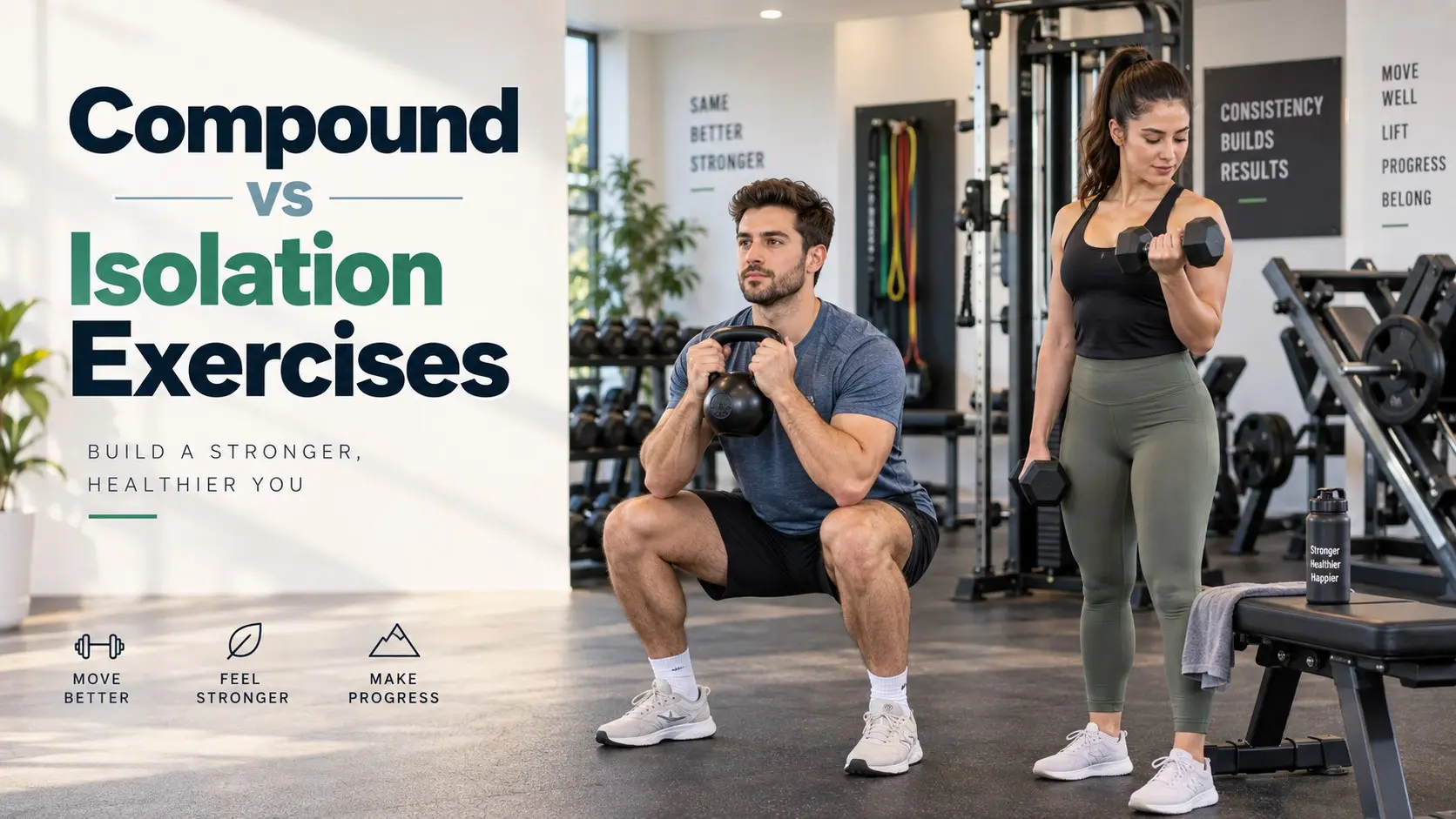
Quick answer: Compound exercises move more than one joint and train several muscle groups at the same time. Isolation exercises focus mainly on one joint action and a smaller group of muscles. Beginners should usually use compound movements for broad training coverage, then add isolation exercises for muscles they want to target more directly.
Here is the simple difference.
| Feature | Compound Exercise | Isolation Exercise |
|---|---|---|
| Joints moving | Usually more than one | Usually one main joint |
| Muscles involved | Several muscles | More targeted muscle emphasis |
| Examples | Squat, leg press, row, pull down, chest press, push-up | Curl, leg extension, leg curl, calf raise, lateral raise |
| Best beginner use | Build the main workout | Add targeted work where needed |
There is one misconception I would remove immediately.
Compound does not mean barbell.
Isolation does not mean machine.
A machine chest press is a compound movement.
Your shoulder and elbow joints both move.
A dumbbell curl is an isolation movement.
It mainly trains elbow flexion.
This matters because beginners do not need to earn the right to use machines.
Rule 1: Start With Compound Exercises Because They Save Time
This is the strongest reason to prioritize compounds.
Efficiency.
Take a row.
It trains muscles in the back while the elbow flexors also work.
A chest press trains the chest while the shoulders and triceps contribute.
A leg press trains several lower body muscles in one exercise.
You get broad coverage with no need one exercise for every individual muscle.
That is useful for a beginner.
You are still learning how to train.
You do not need twelve exercises.
You need a few movements you can repeat.
Current resistance training research supports this simple approach.
The American College of Sports Medicine published a major updated position statement in 2026.
It reviewed 137 systematic reviews involving more than 30,000 participants.
The main message is refreshingly practical.
Resistance training works.
Consistency matters.
Many types of equipment and training formats can improve strength and muscle.
Read the open access ACSM position stand here: Resistance Training Prescription for Muscle Function, Hypertrophy, and Physical Performance.
Rule 2: Do Not Confuse Compound Training With Barbell Training
You do not need the so called big three.
You can use them.
You do not have to.
A beginner can build an effective program with:
- Leg press
- Goblet squat
- Machine chest press
- Seated cable row
- Lat pulldown
- Dumbbell shoulder press
- Step ups
- Supported dumbbell rows
These are legitimate compound exercises for beginners.
The ACSM 2026 review found that equipment type and exercise complexity did not consistently determine training outcomes.
That means a technically difficult free weight movement is not automatically better because it looks more advanced.
Suppose a barbell squat feels unstable.
A leg press may let you train your legs with much less distraction.
That is not cheating.
It is exercise selection.
For a simple starting program, see the NextFitLife Safe Beginner Fitness Guide.
Rule 3: Add Isolation Exercises for a Reason
Isolation work becomes useful when you can explain why it is there.
Want more direct biceps work?
Add a curl.
Want more work for the side shoulders?
Add lateral raises.
Want direct hamstring knee flexion?
Add a leg curl.
Want more calf work?
Do calf raises.
This is where isolation exercises for beginners earn their place.
They target a smaller job without making the whole workout harder.
A 2023 systematic review and meta analysis compared muscle growth from single joint exercises and multi joint exercises.
It found similar whole muscle hypertrophy overall.
The authors also noted that single joint work might help target particular parts of a muscle, although this needs more research.
That is a much better reason to use isolation than calling it useless accessory work.
Are Compound Exercises Better for Muscle Growth?
Not automatically.
This is where old gym advice gets too confident.
The 2026 ACSM evidence review did not find enough evidence to conclude that single joint or multi joint training is universally superior for muscle hypertrophy.
Newer 2026 research makes the answer even more interesting.
A study published in Medicine and Science in Sports and Exercise compared knee extensions with leg presses in 17 untrained adults.
Each participant trained one leg with knee extensions and the other leg with leg presses for 12 weeks.
The study found different patterns of muscle growth between the exercises.
This supports a useful idea.
Different exercises can emphasize different muscles or regions.
One movement does not have to do everything.
Read the open study here: Hypertrophic Effects of Single Versus Multi Joint Exercise.
Can Isolation Exercises Build Muscle on Their Own?
Yes.
Isolation training is still resistance training.
A randomized study followed 29 young men with no previous resistance training experience.
One group trained the elbow flexors with lat pulldowns.
The other group used biceps curls.
They trained twice weekly for ten weeks.
Both groups increased elbow flexor muscle thickness and strength.
No significant difference appeared between the groups for those measured outcomes.
Read the full open access study here: Single vs Multi Joint Resistance Exercises.
Do not stretch that result too far.
A pulldown trains more than the biceps.
A curl does not replace back training.
The useful lesson is narrower.
Isolation exercises are real muscle building tools.
Rule 4: Put the Exercise You Most Want to Improve Earlier
For most beginners, compound exercises should go first.
But the reason is not that isolation work becomes useless later.
The reason is priority.
An exercise order systematic review included 11 studies.
Strength gains tended to be larger in exercises performed earlier in the workout.
When multi joint movements came first, strength gains in those movements were greater.
When single joint movements came first, those movements gained more strength.
The review did not find an important difference in hypertrophy from exercise order.
Read the PubMed review here: Exercise Order, Strength, and Muscle Hypertrophy.
So I use this rule:
Put the exercise you most care about improving near the beginning.
For a general beginner, that is usually a compound movement.
If your real priority is rehabilitating a specific movement under professional guidance, the order may change.
Why Strength Is More Specific Than People Think
If you want a stronger squat, practice squatting.
If you want a stronger curl, curl.
If you want to become stronger at a leg press, train the leg press.
This is called strength specificity.
A randomized controlled trial in physically active women compared leg press training with single joint leg extension and kickback training.
Both groups improved strength.
But improvements were greatest in the movements each group actually practiced.
Read the open access trial here: Training Specificity in Single and Multi Joint Exercises.
This is why a program should match the goal.
Exercise categories help.
The actual exercise still matters.
Rule 5: Keep the Beginner Program Small Enough to Learn
Beginners do not need exercise variety for its own sake.
Changing movements every workout makes it harder to see progress.
I would rather have a beginner learn six exercises well than perform twenty badly.
Keep the main movements stable for long enough to learn:
- Setup
- Range of motion
- Breathing
- Tempo
- What muscular effort feels like
- How to add resistance gradually
This makes progressive overload much easier to track.
You can see whether repetitions improve.
You can see whether load improves.
You can notice whether technique becomes easier.
For home training ideas, use the Strength Training Exercises at Home for Beginners Guide.
Rule 6: Use a Simple Full Body Structure
Do not build the workout muscle by muscle.
Build it by movement needs first.
For a general beginner strength training program, I like to cover:
- A knee focused lower body movement
- A hip focused lower body movement
- A press
- A pull
- Optional direct work for one or two muscles
That gives you broad coverage without turning the gym into a two hour project.
A Simple Two Day Beginner Strength Plan
This is an example.
It is not a personal exercise prescription.
| Exercise | Type | Sets | Repetitions |
|---|---|---|---|
| Session A | |||
| Leg press or goblet squat | Compound | 2 | 8 to 12 |
| Machine or dumbbell chest press | Compound | 2 | 8 to 12 |
| Seated row | Compound | 2 | 8 to 12 |
| Romanian deadlift or suitable hip hinge | Compound | 2 | 8 to 12 |
| Biceps curl | Isolation | 1 to 2 | 10 to 15 |
| Session B | |||
| Split squat, step-up, or leg press | Compound | 2 | 8 to 12 |
| Lat pull-down | Compound | 2 | 8 to 12 |
| Machine or dumbbell shoulder press | Compound | 2 | 8 to 12 |
| Glute bridge or another suitable hip movement | Compound | 2 | 8 to 12 |
| Leg curl or lateral raise | Isolation | 1 to 2 | 10 to 15 |
You can change the exercises.
Keep the structure.
If you want more lower body options, see our Leg Exercises With Dumbbells Guide.
Why Start With Two Sets?
You need enough training to improve.
You do not need a heroic first week.
The 2026 ACSM review found that multiple sets tend to produce greater gains than one set, while gains show diminishing returns as volume rises.
Two controlled sets give a beginner useful practice without making every workout enormous.
You can add more volume later.
First prove that you can repeat the program.
Rule 7: Train Hard, but Do Not Chase Failure
Every set does not need to end with a failed repetition.
The 2026 ACSM position stand found that training to complete muscular failure is not required for strength or hypertrophy.
For a beginner, I would rather see clean repetitions stop slightly early.
A simple target is finishing most sets with roughly two or three good repetitions still possible.
This is called repetitions in reserve.
The exact number does not need to be perfect.
You are learning effort.
Stop the set when the next repetitions would become messy.
That is a much better beginner skill than learning how to fail dramatically.
How Should Beginners Progress?
Do not change five things at once.
Use a simple progression.
Suppose your exercise target is 8 to 12 repetitions.
Week one:
You perform 9 and 8 clean repetitions.
Later:
You reach 12 and 12 with good control.
Then increase the resistance slightly.
Your repetitions may drop again.
Build them back up.
That is basic progressive overload.
No complicated spreadsheet required.
Should Beginners Train Twice or Three Times Per Week?
Both can work.
The ACSM 2026 position stand recommends training the major muscle groups at least twice per week for healthy adults.
Two full-body sessions are a clean starting point.
Three can work if you recover well and enjoy the schedule.
Do not choose three days because it sounds more serious.
Choose the schedule you will actually repeat.
For another simple beginner schedule, see How to Get Fit Fast: Safe Beginner Fitness Guide.
Are Compound Exercises Better for Strength?
For strength in a compound exercise, practice that compound exercise.
Strength is specific.
If you want a stronger chest press, train the chest press.
If you want a stronger squat, train a squat.
This does not mean isolation work cannot increase strength.
It means the largest gains in a specific skill usually require practicing that skill.
That is why strength athletes spend so much time practicing their competition movements.
Are Isolation Exercises Better for Targeting Muscles?
That is where they shine.
A compound exercise has several jobs.
An isolation movement can give one muscle more attention without adding another large full-body demand.
For example:
- A row trains the back and elbow flexors
- A curl gives the elbow flexors more direct work
- A chest press trains chest, shoulders, and triceps
- A triceps extension adds more direct triceps work
- A squat trains several lower body muscles
- A leg curl adds direct knee flexion work for the hamstrings
This is why both categories belong in a mature program.
Do Beginners Need Arm Isolation Exercises?
No.
But you can do them.
If bigger arms are one of your goals, direct work is reasonable.
Do not let anyone tell you curls are forbidden until you reach an arbitrary training age.
At the same time, do not perform five curl variations while skipping rows and pulldowns.
One curl and one triceps exercise can be plenty at first.
Do Beginners Need Lateral Raises?
No exercise is mandatory.
Lateral raises are useful if you want direct work for the side deltoids.
Pressing movements involve the shoulders but do not load every shoulder region in the same way.
A few controlled sets of lateral raises can make sense for a beginner interested in shoulder development.
Keep the load manageable.
This is not an exercise that needs to become a whole-body swing.
What About Core Isolation Work?
Your core already works during many compound exercises.
That does not mean direct core work is useless.
You may still benefit from simple movements that train trunk control.
Examples include:
- Dead bugs
- Bird dogs
- Wall planks
- Farmer carries
- Controlled side planks
Use the NextFitLife Core Workouts at Home Guide for beginner-friendly options.
Are Machines Worse Than Free Weights?
No.
That argument has wasted a lot of gym time.
Machines have advantages.
They can be easier to learn.
They provide more external stability.
They make some muscles easier to target.
Free weights have advantages too.
They allow different movement paths.
They may demand more balance and stabilization in some exercises.
The right choice depends on your goal.
The ACSM review found that machine exercises and free weight training can both build strength and muscle.
You do not get extra credit for choosing the option that looks harder.
Are Compound Exercises Better for Fat Loss?
No exercise burns fat from a specific body part.
Compound movements involve more muscle and can make training efficient.
That does not turn squats into a special fat loss tool.
Body weight change depends on the bigger picture.
Food intake matters.
Daily activity matters.
Training matters.
Sleep matters.
Health conditions matter.
Resistance training is useful because it supports strength and muscle while you work on body composition.
For a broader approach, visit the Natural Weight Loss Guide.
Do Compound Exercises Burn More Calories?
A large multi-joint movement can demand more total work than a small isolation movement.
But this is not a useful reason to choose your strength exercises.
The difference between a row and a curl is not what decides whether a long-term fat loss plan works.
Choose strength exercises for strength and muscle.
Use the full lifestyle plan for body weight goals.
Are Compound Exercises More Functional?
The word functional gets abused.
Function depends on the job.
A squat can help build strength for standing and lifting.
A row trains pulling strength.
A leg extension strengthens knee extension.
A calf raise strengthens the calves.
If someone needs direct quadriceps work after an injury under clinical supervision, a leg extension may be very functional for that person.
Judge the exercise by what you want it to do.
Not by whether someone on social media calls it functional.
Are Isolation Exercises Safer?
Not automatically.
Isolation movements can be easier to learn because fewer joints are moving.
But poor technique, excessive load, too much volume, or training through pain can still cause problems.
Compound exercises are not automatically dangerous either.
A properly chosen and coached compound movement can be very suitable for beginners.
Exercise safety depends on:
- Technique
- Load
- Fatigue
- Range of motion
- Exercise selection
- Training history
- Injury history
- Rate of progression
What If a Compound Exercise Hurts?
Do not treat pain as proof that the exercise works.
Change the movement.
If a barbell squat hurts, that does not automatically mean every squat pattern is wrong for you.
You might tolerate:
- Goblet squat
- Leg press
- Box squat
- Step up
- Split squat
If bench pressing hurts, another chest press variation may feel better.
If pain persists or you have a known injury, get appropriate professional assessment.
When Should Beginners Add More Isolation Work?
Add more when you have a reason.
Your Goal Becomes More Specific
You decide that shoulder, arm, calf, or hamstring development matters more to you.
Your Main Exercises Leave a Gap
Your current compounds do not give a muscle enough direct work for your goal.
You Can Recover From More Training
Your main lifts are still improving.
You sleep well.
Your sessions are manageable.
Your joints feel good.
Then extra work is easier to justify.
What Beginners Usually Get Wrong
They Collect Exercises Instead of Improving Them
More variety does not guarantee more progress.
Repeat useful movements.
They Assume Barbells Are Mandatory
They are not.
They Use Too Much Isolation Too Early
Your first arm day does not need nine exercises.
They Train Every Set to Failure
You can grow and get stronger without doing that.
They Judge Workouts by Soreness
Soreness is not a progress score.
They Change the Routine Every Week
Your body needs time to adapt.
They Ignore Technique
The exercise only helps if you can repeat it with control.
Compound vs Isolation for Muscle Gain
If your goal is muscle growth, use both.
Compounds let you train a lot of muscle efficiently.
Isolation work lets you give particular muscles more direct attention.
Current research does not support the claim that one category always produces more muscle hypertrophy.
The better question is:
Which combination covers the muscles I want to develop without adding useless work?
Compound vs Isolation for Strength
Specificity matters more here.
If you want to become strong in compound movements, practice those movements.
If you want stronger curls, curl.
The exercise order research adds one useful rule.
Put important strength exercises earlier while you are fresh.
That is why general beginners usually start with compound work.
What Should Your First Gym Workout Look Like?
Short.
Seriously.
Your first gym visit is for learning.
Try something like:
| Exercise | Sets | Repetitions |
|---|---|---|
| Leg press | 2 | 8 to 12 |
| Chest press | 2 | 8 to 12 |
| Seated row | 2 | 8 to 12 |
| Leg curl | 1 to 2 | 10 to 15 |
| Optional curl | 1 | 10 to 15 |
Write down the settings.
Write down the weights.
Come back.
Your first workout does not need to destroy you.
When Should You Ask for Professional Help?
Speak with a qualified healthcare professional before starting or significantly changing training if you have:
- Known heart disease
- Uncontrolled high blood pressure
- Recent surgery
- Serious joint problems
- Unexplained chest pain
- Fainting
- Severe shortness of breath
- A condition that limits exercise
A qualified trainer or physical therapist can also help when you are unsure how to perform a movement or need exercises adapted around an injury.
Pain is not part of the beginner curriculum.
My Practical Beginner Priority Order
This is the order I would use.
First: Train consistently.
Second: Cover all major muscle groups.
Third: Pick exercises you can perform with control.
Fourth: Use compound movements to keep the program efficient.
Fifth: Add isolation where it supports a specific goal.
Sixth: Progress slowly.
Seventh: Keep doing the plan long enough to learn whether it works.
This is much better than debating whether your routine should be exactly 63 percent compound.
Conclusion
For Compound vs Isolation Exercises for Beginners, compounds should usually form the base of the workout because they train more muscle with fewer movements.
Isolation work still belongs in the program.
Use it to target muscles that matter to your goal.
You do not need a fixed ratio.
You do not need complicated lifts.
You do need a routine you can repeat and improve.
Your next step: Choose one lower body compound exercise, one press, one pull, and one hip-focused movement. Train those consistently for several weeks. Add one or two isolation exercises only when you can explain exactly why they are there.
References and Sources
The following open or publicly accessible exercise science sources were used to research and fact-check this article:
- American College of Sports Medicine. Resistance Training Prescription for Muscle Function, Hypertrophy, and Physical Performance in Healthy Adults. 2026.This major updated position stand reviewed 137 systematic reviews involving more than 30,000 participants and covers resistance training frequency, volume, equipment, exercise selection, effort, failure training, strength, muscle growth, and physical function.
- Nunes JP and colleagues. What Influence Does Resistance Exercise Order Have on Muscular Strength Gains and Muscle Hypertrophy?A systematic review and meta-analysis of 11 studies showing that exercises performed earlier in a session tend to gain more strength, while exercise order showed little effect on hypertrophy.
- Gentil P and colleagues. Single vs Multi Joint Resistance Exercises: Effects on Muscle Strength and Hypertrophy.An open access randomized study of 29 previously untrained young men comparing lat pulldowns with biceps curls over ten weeks.
- Spiering BA and colleagues. Training Specificity: Performing Single Joint vs Multi Joint Resistance Exercises Among Physically Active Females.An open access randomized controlled trial showing that both exercise categories improved strength, while the largest dynamic strength gains tended to occur in the exercises that were actually trained.
- Kinoshita M and colleagues. Hypertrophic Effects of Single versus Multi Joint Exercise: A Direct Comparison Between Knee Extension and Leg Press. 2026.A recent open access study in untrained adults comparing muscle growth from knee extension and leg press training using detailed magnetic resonance imaging measurements.
Continue Reading on NextFitLife
Use these related NextFitLife guides to build a safer and more complete fitness routine:
- How to Get Fit Fast: Safe Beginner Fitness GuideBuild a beginner routine with walking, strength training, cardio, mobility, sleep, and realistic progress.
- Strength Training Exercises at Home for BeginnersLearn simple bodyweight and resistance exercises you can use without a full gym.
- Leg Exercises With DumbbellsUse goblet squats, Romanian deadlifts, step ups, lunges, glute bridges, and other lower body strength movements.
- Core Workouts at HomeAdd simple core stability work using dead bugs, bird dogs, carries, bridges, and beginner-friendly progressions.
- Natural Weight Loss GuideCombine strength training with nutrition, walking, sleep, and sustainable habits when body weight change is part of your goal.
- Physical Fitness and Mental HealthLearn how regular movement fits into mood, sleep, mental wellness, strength, and daily function.
About the Author
Adel Galal is the Founder and Lead Writer at NextFitLife.
He focuses on making health, fitness, nutrition, and wellness information easier to understand and use in real life.
His content combines real life experience, extensive research, and consultation with healthcare providers.
For fitness articles, he reviews current exercise science, professional position statements, systematic reviews, and peer-reviewed studies and turns them into practical training guidance for normal adults.
Adel is not a doctor, physical therapist, or licensed medical professional.
NextFitLife fitness content is educational and should be adapted to your fitness level, health history, symptoms, injuries, physical ability, and professional guidance when needed.
Learn more about Adel, NextFitLife, and the site's editorial approach on the About Us page.
Frequently Asked Questions
Should beginners do compound or isolation exercises?
Beginners should usually build most of their workout around compound exercises because they train several muscles efficiently. Isolation exercises can then add direct work for specific muscles such as the biceps, triceps, side shoulders, calves, or hamstrings.
What are the best compound exercises for beginners?
Useful options include leg presses, goblet squats, chest presses, rows, lat pulldowns, step ups, supported dumbbell rows, and suitable hip hinge movements. The best choice is one you can perform safely and improve over time.
Do beginners need isolation exercises?
No. A beginner can make progress with compound exercises alone. Isolation work becomes useful when you want extra training for a specific muscle or goal.
Can beginners do biceps curls?
Yes. Curls are a normal resistance exercise. They can be added after the main movements when direct arm development is part of your goal.
Are compound exercises better for building muscle?
Not automatically. Current evidence does not show a universal muscle growth advantage for compound over isolation exercises. Compounds are especially useful because they train several muscles efficiently.
Are isolation exercises good for muscle growth?
Yes. Isolation exercises can build muscle and are useful when you want to target a particular muscle more directly.
Should compound exercises always come first?
They are a good first choice for most general beginner programs. Exercise order research shows that strength tends to improve most in exercises performed earlier, so put your highest priority movement near the beginning.
Are machines good for beginners?
Yes. Machines can make movements easier to learn and provide useful stability. Current evidence does not show that free weights are required for effective strength or muscle gain.
Do beginners need to squat, bench press, and deadlift?
No. Those are useful exercises, but none is mandatory. Similar movement patterns can be trained with machines, dumbbells, cables, bodyweight exercises, and other variations.
How many exercises should a beginner do?
A simple full-body workout can begin with about four main movements plus one or two optional isolation exercises. More exercises are not automatically better.
How many sets should beginners do?
Two controlled sets per exercise are a practical starting point for many beginners. Training volume can be increased later as fitness, technique, and recovery improve.
How many repetitions should beginners do?
A moderate range such as 8 to 12 repetitions works well for many beginner exercises, but different repetition ranges can also build muscle and strength when the resistance and effort are appropriate.
Should beginners train to failure?
No. Training to complete muscular failure is not required for strength or muscle gain. Beginners can stop most sets while they could still perform a small number of clean repetitions.
How often should beginners strength train?
Current ACSM guidance recommends training the major muscle groups at least twice per week. Two full-body workouts are a simple beginner starting point.
Are compound exercises better for weight loss?
No exercise type causes weight loss by itself. Compound exercises are efficient and useful for strength and muscle, while body weight change depends on the wider pattern of food intake, activity, sleep, health, and consistency.
Are isolation exercises safer than compound exercises?
Not automatically. Safety depends on exercise selection, technique, resistance, fatigue, range of motion, injury history, and how quickly training progresses.
What should I do if an exercise causes pain?
Stop or change the exercise. Try another suitable variation and seek professional assessment if pain is strong, persistent, worsening, or linked with an injury.

Health & wellness writer with 30+ years of experience in nutrition, fitness, and healthy aging. Founder of NextFitLife.com — evidence-based health guidance.