Published: September 12, 2026
Last updated: September 12, 2026
Next review: September 2027, or sooner if major vitamin A or nutrition guidance changes
Written and source- checked by: Adel Galal, Founder and Lead Writer at NextFitLife
Medical review status: This article has not been medically reviewed by a doctor or registered dietitian.
You do not need an exotic supplement to get vitamin A.
Sweet potatoes, carrots, spinach, eggs, milk, fish, mango, and many other normal foods provide it.
The part that deserves more attention is the type of vitamin A are eating.
Animal foods provide preformed vitamin A.
Many colorful plant foods provide provitamin A carotenoids, including beta -carotene, which your body can convert into vitamin A.
Those two forms do not behave exactly the same way.
That matters for absorption.
It matters for food choices.
And it matters a lot for safety.
Important medical note: I am not a dermatologist or a doctor, and this content does not replace professional medical advice. What I share comes from real- life experience, extensive research, and consultation with healthcare providers. Always consult qualified medical professionals for diagnosis and treatment of any health condition.
If you have a diagnosed vitamin deficiency, liver disease, a condition that affects fat absorption, are pregnant, or use vitamin A supplements or retinoid medicines, get individual advice from a qualified healthcare professional.
What Are the best vitamin A Rich Foods?
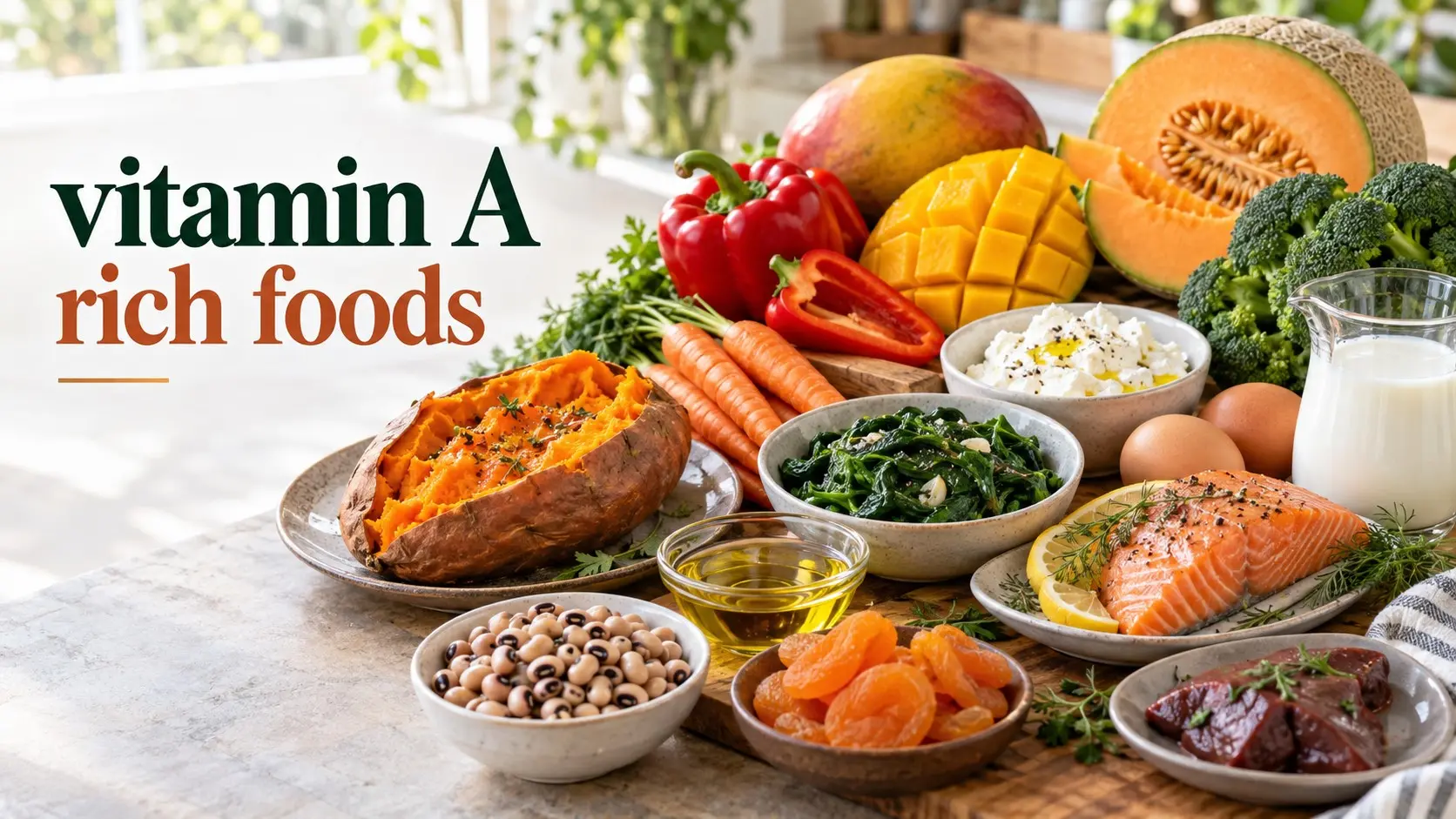
Quick answer: The best Vitamin A Rich Foods include sweet potatoes, carrots, spinach, red peppers, mango, cantaloupe, eggs, milk, cheese, fish, broccoli, black-eyed peas, dried apricots, fortified cereal, and liver. Plant foods mainly provide carotenoids. Animal foods mainly provide preformed vitamin A.
If you want a practical food-first approach, start with colourful vegetables.
Sweet potatoes are especially rich.
Carrots and spinach make easy daily choices.
Eggs, milk, cheese, and fish add smaller amounts of preformed vitamin A.
Liver is different.
It is extremely concentrated.
That makes it food to treat with more care, not a food you need every day.
Why does your body need vitamin A?
Vitamin A is a fat- soluble vitamin.
Your body uses it for several basic jobs.
It supports normal vision.
It helps the immune system work normally.
It supports reproduction.
It is involved in normal growth and development.
It also helps organs, and tissues function normally.
The eye connection is one reason vitamin A is so well known.
Your retina uses vitamin A in the process that allows you to see in low light.
A severe deficiency can lead to night blindness and other eye problems.
For a wider look at nutrition and vision, see the NextFitLife Foods for Eye Health Guide.
There are two main food forms of Vitamin A
This distinction makes the whole topic easier.
| Type | Where It Comes From | What Your Body Does |
|---|---|---|
| Preformed vitamin A | Liver, fish, dairy foods, eggs, fortified foods | Already in a form the body can use as vitamin A |
| Provitamin A carotenoids | Sweet potatoes, carrots, spinach, peppers, mango, cantaloupe, broccoli | The body converts selected carotenoids into vitamin A |
The best known plant form is beta -carotene.
Other provitamin A carotenoids include alpha- carotene and beta- cryptoxanthin.
This is why orange vegetables and dark leafy greens belong in the conversation, even though they do not contain retinol itself.
What Does RAE Mean?
Vitamin A labels and research often use retinol activity equivalents.
You will usually see this written as mcg RAE.
RAE helps compare the different forms of vitamin A.
The body does not convert every carotenoid into vitamin A with the same efficiency.
According to the NIH Office of Dietary Supplements:
- 1 mcg RAE equals 1 mcg retinol
- 1 mcg RAE equals 12 mcg dietary beta carotene
- 1 mcg RAE equals 24 mcg dietary alpha carotene
- 1 mcg RAE equals 24 mcg dietary beta cryptoxanthin
You do not need to calculate this at every meal.
The system simply explains why vitamin A value from plant foods are reported differently from the raw amount of carotenoids they contain.
How much vitamin A do adults need?
Needs differ by age, sex, pregnancy, and breastfeeding.
The current NIH recommendations for adults include:
| Life Stage | Recommended Daily Amount |
|---|---|
| Adult men | 900 mcg RAE |
| Adult women | 700 mcg RAE |
| Pregnancy, ages 19 to 50 | 770 mcg RAE |
| Breastfeeding, ages 19 to 50 | 1,300 mcg RAE |
The Daily Value used on United States food labels is 900 mcg RAE for adults and children age four and older.
15 Vitamin A Rich Foods Worth Knowing
These serving values come from the NIH Office of Dietary Supplements food table.
Amounts can vary with variety, brand, preparation, and serving size.
| Food | Serving | Vitamin A | Percent Daily Value | Main Form |
|---|---|---|---|---|
| 1. Beef liver | 3 ounces, pan-fried | 6,582 mcg RAE | 731% | Preformed vitamin A |
| 2. Sweet potato | 1 whole, baked in skin | 1,403 mcg RAE | 156% | Provitamin A carotenoids |
| 3. Spinach | 1 half cup, frozen and boiled | 573 mcg RAE | 64% | Provitamin A carotenoids |
| 4. Carrots | 1 half cup, raw | 459 mcg RAE | 51% | Provitamin A carotenoids |
| 5. Atlantic herring | 3 ounces, pickled | 219 mcg RAE | 24% | Preformed vitamin A |
| 6. Fortified skim milk | 1 cup | 149 mcg RAE | 17% | Preformed vitamin A |
| 7. Cantaloupe | 1 half cup, raw | 135 mcg RAE | 15% | Provitamin A carotenoids |
| 8. Part skim ricotta | 1 half cup | 133 mcg RAE | 15% | Preformed vitamin A |
| 9. Red sweet pepper | 1 half cup, raw | 117 mcg RAE | 13% | Provitamin A carotenoids |
| 10. Mango | 1 whole, raw | 112 mcg RAE | 12% | Provitamin A carotenoids |
| 11. Fortified breakfast cereal | 1 serving at 10% Daily Value | 90 mcg RAE | 10% | Varies by product |
| 12. Egg | 1 large, hard-boiled | 75 mcg RAE | 8% | Preformed vitamin A |
| 13. Black-eyed peas | 1 cup, boiled | 66 mcg RAE | 7% | Provitamin A carotenoids |
| 14. Dried apricots | 5 apricots | 63 mcg RAE | 7% | Provitamin A carotenoids |
| 15. Broccoli | 1 half cup, boiled | 60 mcg RAE | 7% | Provitamin A carotenoids |
1. Beef liver is extremely rich in Vitamin A
Liver wins the numbers contest.
That does not make it the best daily choice.
A 3-ounce serving of pan-fried beef liver provides 6,582 mcg RAE.
That is more than seven times the daily value.
It is also above the adult upper intake level of 3,000 mcg per day for preformed vitamin A.
This is why I treat liver as a concentrated food.
It is not something you need to eat every day to meet your vitamin A needs.
Pregnancy needs extra caution, which I cover below.
2. Sweet Potatoes Make Vitamin A Easy
For most people, sweet potatoes are a much easier first option.
One whole baked sweet potato listed by NIH provides 1,403 mcg RAE.
Its vitamin A activity comes mainly from provitamin A carotenoid.
Try sweet potato:
- Baked
- Mashed
- Roasted
- Added to soup
- Mixed with lentils
Add a little dietary fat to the meal.
Olive oil, tahini, yogurt, eggs, avocado, nuts, or seeds can work depending on the dish.
3. Spinach gives you carotenoids without orange color
Vitamin A food are not always orange.
Dark green vegetables count too.
Spinach contains carotenoids hidden by its green chlorophyll pigment.
A half cup of boiled frozen spinach provides 573 mcg RAE according to the NIH table.
Use spinach in:
- Egg dishes
- Soup
- Lentils
- Pasta
- Rice
- Warm salads
4. Carrots are good, but they are not magic
Carrots deserve their reputation.
A half cup of raw carrots provides 459 mcg RAE.
They are rich in beta- carotene.
What carrots cannot do is fix every vision problem.
Vitamin A support normal vision.
Eating extra carrots does not remove the need for glasses or treat an eye disease.
See the Foods for Eye Health Guide for a broader look at nutrition and vision.
5. Herring Adds Preformed Vitamin A
Herring provides vitamin A in a form the body can already use.
Three ounces of pickled Atlantic herring provide 219 mcg RAE in the NIH table.
Fish also brings other nutrients to the meal.
You do not need fish specifically for vitamin A if your diet already includes plenty of other excellent sources.
6. Fortified milk can make a quiet contribution
Fortified foods matter.
One cup of skim milk with added vitamins A and D provides 149 mcg RAE in the NIH table.
Check the nutrition label.
Fortification differs between countries and products.
7. Cantaloupe Is an Easy Fruit Option
A half cup of cantaloupe provides 135 mcg RAE.
It will not match a sweet potato.
It does not need to.
Nutrition works across the whole diet.
Use cantaloupe as part of a varied fruit intake rather than trying to make one food carry the entire nutrient load.
8. Ricotta Adds a smaller amount
Half a cup of part-skim ricotta provides 133 mcg RAE.
This is a good example of why you do not need every meal to contain an extremely rich source.
Smaller amounts from several foods add up.
9. Red Sweet Peppers Add Color and Carotenoids
A half cup of raw red sweet pepper provides 117 mcg RAE.
Slice it into salads.
Roast it.
Add it to eggs, beans, sandwiches, or rice.
Simple food still counts.
10. Mango Gives You a Fruit-Based Source
One whole raw mango provides 112 mcg RAE in the NIH table.
Mango works well with yogurt, oats, salads, or on its own.
It is another way to diversify your Vitamin A Rich Foods instead of eating carrots every day.
11. Fortified Cereal Can Help Fill Gaps
Fortified cereal can provide vitamin A.
The amount depends on the product.
The NIH example uses a cereal fortified with 10 percent of the Daily Value, providing 90 mcg RAE per serving.
Read the label.
Do not assume every cereal is fortified the same way.
12. Eggs Provide a modest amount
One large hard-boiled egg provides about 75 mcg RAE.
Eggs are not the richest source on this list.
They are practical.
Combine eggs with spinach, peppers, or sweet potato and the meal becomes much stronger in vitamin A.
13. Black-Eyed Peas Contribute Too
One cup of boiled black-eyed peas provides 66 mcg RAE.
That is not huge.
It still counts.
Beans and peas are useful because they can also bring fiber and plant protein into the meal.
14. Dried apricots offer a portable option
Five dried apricots provide 63 mcg RAE.
Dried fruit is concentrated.
Keep portions sensible and remember that fresh fruit, vegetables, beans, and other whole foods should still make up the wider diet.
15. Broccoli Adds Another Green Source
A half cup of boiled broccoli provides 60 mcg RAE.
That makes it a useful supporting food rather than the star of the list.
Broccoli works well beside fish, eggs, beans, grains, or other vegetables.
Plant Foods and Animal Foods Are Not Exactly the Same
Animal foods mainly provide retinol and other forms of preformed vitamin A.
Plant foods mainly provide carotenoids that the body converts.
The NIH reports that the body absorbs preformed retinol much more efficiently than beta carotene from food.
This difference is already built into the RAE measurement system.
You do not need to avoid plant foods because conversion is lower.
Sweet potatoes, carrots, spinach, and other colorful produce can still provide large amounts of vitamin A activity.
Can You Improve Vitamin A Absorption?
Yes.
Vitamin A is fat soluble.
Carotenoids from vegetables are better absorbed when the meal includes some fat.
That does not mean drowning carrots in oil.
A normal mixed meal is enough.
Examples include:
- Carrots with hummus or tahini
- Spinach cooked with a little olive oil
- Sweet potato beside eggs
- Mango with yogurt
- Vegetables with avocado
- Salad with nuts or seeds
MedlinePlus notes that absorption of plant beta carotene improves when these foods are eaten with some fat.
Does cooking destroy vitamin A?
Not necessarily.
Cooking can actually make some carotenoids easier for the body to access.
The NIH notes that cooking and heat treatment can increase beta carotene bioavailability from foods.
So raw carrots are good.
Cooked carrots are good too.
Raw spinach counts.
Cooked spinach counts.
You do not need to pick one.
A Simple Food First Vitamin A Day
You do not need to count every microgram.
A varied day could look like this:
| Meal | Simple Vitamin A Foods |
|---|---|
| Breakfast | Eggs with spinach and red pepper |
| Snack | Mango or cantaloupe |
| Lunch | Black eyed peas with vegetables and olive oil |
| Dinner | Baked sweet potato with fish and broccoli |
This is an example.
You do not need to eat every item in one day.
The goal is variety.
For broader meal planning help, use the NextFitLife Nutrition Tips Guide.
Can you get too much vitamin A from food?
You need to separate plant carotenoids from preformed vitamin A.
The adult upper intake level for preformed vitamin A is 3,000 mcg per day for adults age 19 and older.
This upper limit applies to preformed vitamin A from food and supplements.
It does not apply to beta-carotene and other provitamin A carotenoids from food.
That distinction matters.
Eating carrots is not the same safety issue as taking a very high dose retinol supplement.
Why Liver Needs Special Treatment?
Liver is so concentrated that an ordinary serving can exceed the adult upper limit for preformed vitamin A.
The NIH food table lists 6,582 mcg RAE in 3 ounces of pan-fried beef liver.
That is why I would not use liver as a daily vitamin A strategy.
Use the wider diet.
Sweet potato today.
Spinach tomorrow.
Eggs, dairy, fish, carrots, peppers, mango, or other foods across the week.
That is much easier to manage.
Pregnancy Changes the Safety Conversation
Vitamin A is needed during pregnancy.
Too much preformed vitamin A is a problem.
The NIH states that excessive preformed vitamin A during pregnancy can cause birth defects.
The NHS advises pregnant people to avoid liver and liver products because they are very high in vitamin A.
The NHS also advises avoiding supplements containing vitamin A as retinol and avoiding cod liver oil during pregnancy.
Plant sources such as sweet potatoes, carrots, spinach, peppers, and mango provide carotenoids instead.
If you are pregnant, planning pregnancy, or using a prenatal supplement, check the label and discuss vitamin A intake with your doctor, midwife, pharmacist, or registered dietitian.
Should You Take a Vitamin A Supplement?
Most healthy people should not start a high-dose vitamin A supplement simply because vitamin A is good for them.
Food gives you many ways to meet your needs.
Supplements become a different question when a clinician has identified a deficiency, malabsorption problem, or another medical reason.
Check supplement labels carefully.
Vitamin A can appear as:
- Retinol
- Retinyl acetate
- Retinyl palmitate
- Beta carotene
- A mixture of these forms
Do not assume two supplements are equivalent because both say vitamin A on the front.
Smokers Need Extra Caution With Beta- Carotene Supplements
Food and supplements are not always interchangeable.
The NIH reports that high-dose beta-carotene supplements increased lung cancer risk in studies involving current smokers, former smokers, and people exposed to asbestos.
That warning is about supplements.
It is not a reason to avoid carrots, sweet potatoes, spinach, peppers, or fruit.
What Happens if You Eat Huge Amounts of Carotene-Rich Foods?
Very high intakes of beta-carotene from foods can turn the skin yellow or orange.
This is called carotenemia.
NIH describes it as harmless and reversible when carotene intake drops.
That is very different from preformed vitamin A toxicity.
What Are Signs of Vitamin A Deficiency?
Vitamin A deficiency can affect the eyes first.
Classic signs include difficulty seeing in low light and, in severe deficiency, xerophthalmia and corneal damage.
Do not diagnose yourself from one symptom.
Night vision changes can have many causes.
See an eye professional or doctor if your vision changes.
The World Health Organization reports that vitamin A deficiency remains a public health problem in many lower-income countries, with young children and pregnant women among the groups most affected.
Who Has a Higher Risk of Deficiency?
Vitamin A deficiency is uncommon in many high-income countries.
Risk rises when someone cannot absorb nutrients normally.
Conditions that affect fat absorption can interfere with vitamin A absorption because vitamin A is fat-soluble.
MedlinePlus lists conditions such as cystic fibrosis and pancreatic problems among situations linked with poor absorption.
If you have a chronic digestive or absorption condition, food lists alone are not enough.
Your clinician may need to assess your individual nutrition status.
Are vegan diets able to provide vitamin A?
Yes.
Plant-based diets can provide provitamin A carotenoids.
Powerful sources include:
- Sweet potatoes
- Carrots
- Spinach
- Dark leafy greens
- Red peppers
- Mango
- Cantaloupe
- Broccoli
Include some dietary fat with meals to support carotenoid absorption.
You do not need animal retinol at every meal to maintain normal vitamin A nutrition.
Are orange foods always high in Vitamin A?
No.
Colour is a clue.
It is not a laboratory test.
Orange and yellow plant foods commonly contain carotenoids.
Dark green vegetables can contain plenty too.
Spinach is one of the strongest examples.
Its green pigment simply hides the orange carotenoid colour.
Does Vitamin A Improve Skin?
Vitamin A supports normal skin and epithelial tissues.
That does not mean eating huge amounts of vitamin A will clear acne, erase wrinkles, or treat a skin disease.
Nutrition supports normal body function.
Medical skin conditions still need the right diagnosis and treatment.
For broader food and skin guidance, explore the Top Healthy Foods Guide.
Does Vitamin A boost immunity?
Vitamin A supports normal immune function.
That differs from claiming that more vitamin A creates a supercharged immune system.
If you already meet your needs, taking more does not turn vitamin A into an infection shield.
The goal is adequacy.
Not excess.
Common Vitamin A Mistakes
Thinking More Is Always Better
It is not.
Preformed vitamin A can accumulate in the body.
Using Liver as a Daily Health Food
Liver is extremely concentrated.
It needs more caution than vegetables.
Ignoring Supplement Labels
Retinol and beta-carotene are not identical forms.
Assuming carrots can fix poor eyesight
Vitamin A deficiency can harm vision.
Carrots do not replace glasses or eye care.
Avoiding All Carotene-Rich Foods Because of Toxicity Fears
The adult upper limit applies to preformed vitamin A.
It does not apply to food-based beta-carotene.
Taking High-Dose Supplements Without a Reason
Food first is the better default for most healthy adults.
My Food First Approach
I prefer variety over megadoses.
One orange vegetable.
One dark green vegetable.
Fruit.
Eggs, dairy, fish, or suitable fortified foods when they fit your diet.
That is easier than chasing a supplement number.
It also gives you fibre, protein, minerals, and other nutrients at the same time.
That is what food first nutrition means to me.
Conclusion
Vitamin A-rich foods do not need to make your diet complicated.
Start with sweet potatoes, carrots, spinach, peppers, mango, eggs, dairy, fish, and other normal foods.
Use liver with more caution because it is extremely rich in preformed vitamin A.
And do not reach for a high-dose supplement unless there is an obvious reason.
Your next step: Add one orange or dark green vegetable to a meal today and include a minor source of dietary fat with it. That is a simple, food-first way to improve your vitamin A intake.
References and Sources
The following open and publicly accessible sources were used to research and fact-check this guide:
- National Institutes of Health Office of Dietary Supplements. Vitamin A and Carotenoids: Health Professional Fact Sheet.This is the main source for recommended intakes, RAE conversions, food serving values, absorption, deficiency, supplement safety, and upper intake limits.
- National Institutes of Health, Office of Dietary Supplements. Vitamin A and Carotenoids: Consumer Fact Sheet.A plain language NIH guide covering vitamin A function, food sources, daily needs, upper limits, carotenoids, supplements, and safety.
- World Health Organization. Vitamin A Deficiency.WHO information on vitamin A deficiency, xerophthalmia, night blindness, and the populations most affected worldwide.
- MedlinePlus. Vitamin A.United States National Library of Medicine guidance covering vitamin A forms, food sources, vision, immune function, absorption, deficiency, and excess intake.
- NHS. Pregnancy Vitamins and Supplements.NHS guidance on avoiding liver, liver products, cod liver oil, and supplements containing retinol during pregnancy because excess preformed vitamin A can harm fetal development.
Continue Reading on NextFitLife
Use these related NextFitLife guides to build a wider food first nutrition plan:
- Nutrition and Vitamins HubExplore vitamins, minerals, food sources, deficiencies, supplements, safety, and practical nutrition guidance.
- 10 Best Foods for Eye Health and Better VisionLearn how vitamin A, lutein, zeaxanthin, vitamin C, vitamin E, zinc, and omega-3 fats fit into eye nutrition.
- Top Healthy Foods GuideBuild meals around vegetables, fruit, beans, whole grains, fish, nuts, seeds, and other useful everyday foods.
- Nutrition Tips for Improving Your HealthUse practical food habits to build balanced meals and improve everyday nutrition.
- Healthy Fitness FoodsCombine nutrient-rich foods with protein, carbohydrates, and healthy fats to support an active lifestyle.
Nutrition Hub: Visit the NextFitLife Nutrition and Vitamins Hub for more food source guides, vitamin safety information, supplement questions, and practical meal ideas.
About the Author
Adel Galal is the Founder and Lead Writer at NextFitLife.
He focuses on making health, fitness, nutrition, and wellness information easier to understand and use in real life.
His work combines real-life experience, extensive research, and consultation with healthcare providers.
For nutrition articles, he checks recognized medical organizations, government nutrition references, current dietary guidance, and peer-reviewed research before turning the evidence into practical food choices.
Adel is not a doctor or registered dietitian.
This article provides general nutrition education and does not replace individualized medical or nutrition advice.
Learn more about Adel, NextFitLife, and the site's editorial approach on the About Us page.
Frequently Asked Questions
What foods are highest in vitamin A?
Beef liver is extremely high in preformed vitamin A. Strong plant sources include sweet potatoes, spinach, and carrots. Liver needs more caution because a normal serving can exceed the adult upper limit for preformed vitamin A.
What is the best vegetable for vitamin A?
Sweet potato is one of the richest practical vegetable sources. One whole baked sweet potato in the NIH food table provides 1,403 mcg RAE.
Are carrots high in vitamin A?
Yes. A half cup of raw carrots provides 459 mcg RAE in the NIH food table. Most of this vitamin A activity comes from beta-carotene.
How much vitamin A do adults need?
Adult men need 900 mcg RAE per day, and adult women need 700 mcg RAE. Needs increase during pregnancy and breastfeeding.
What does RAE mean?
RAE means retinol activity equivalents. It is a measurement that accounts for differences between preformed vitamin A and carotenoids that the body converts into vitamin A.
Is plant vitamin A same as animal vitamin A?
No. Animal foods mainly contain preformed vitamin A. Plant foods mainly provide provitamin A carotenoids such as beta-carotene, which the body converts into vitamin A.
Does eating fat help vitamin A absorption?
Yes. Vitamin A is fat-soluble. Eating carotenoid-rich vegetables with some dietary fat can improve absorption.
Is cooked carrot better than raw carrot?
Both are useful. Heat treatment can increase the bioavailability of beta carotene in some foods, so cooked vegetables can be an excellent choice.
Can you get too much vitamin A from carrots?
Food based beta carotene does not have the same upper limit as preformed vitamin A. Very high carotene intake can turn the skin yellow or orange, but NIH describes this as harmless and reversible.
Is liver safe to eat every day?
Liver is extremely concentrated in preformed vitamin A. A 3-ounce serving of beef liver in the NIH table provides 6,582 mcg RAE, so it is not a sensible daily vitamin A strategy.
Should pregnant people eat liver?
The NHS advises pregnant people to avoid liver and liver products because they are very high in vitamin A. It also advises avoiding supplements containing retinol and cod liver oil during pregnancy.
Do I need a vitamin A supplement?
Many people can meet their needs from food. Supplements may be appropriate when a healthcare professional identifies a deficiency, absorption problem, or another medical reason.
Can vegans get enough vitamin A?
Yes. Sweet potatoes, carrots, spinach, peppers, mango, cantaloupe, broccoli, and other plant foods provide carotenoids that the body can convert into vitamin A.
What are the signs of vitamin A deficiency?
Night blindness is a classic sign. Severe deficiency can cause xerophthalmia and damage to the eye. Vision changes need professional assessment because they can have many causes.
Does vitamin A improve eyesight?
Vitamin A supports normal vision, especially vision in low light. Extra vitamin A does not correct common refractive problems or replace glasses, eye examinations, or treatment for eye disease.
Does vitamin A support immunity?
Yes. Vitamin A is required for normal immune function. More is not automatically better, and excessive preformed vitamin A can be harmful.
Can smokers take beta carotene supplements?
High-dose beta-carotene supplements require caution. NIH reports increased lung cancer risk in trials involving current smokers, former smokers, and people exposed to asbestos. This warning does not mean they should avoid carotenoid-rich vegetables and fruit.

Health & wellness writer with 30+ years of experience in nutrition, fitness, and healthy aging. Founder of NextFitLife.com — evidence-based health guidance.