Published: September 26, 2026
Last updated: September 26, 2026
Next review: September 2027, or sooner if major resistance training guidance changes
Written and source checked by: Adel Galal, Founder and Lead Writer at NextFitLife
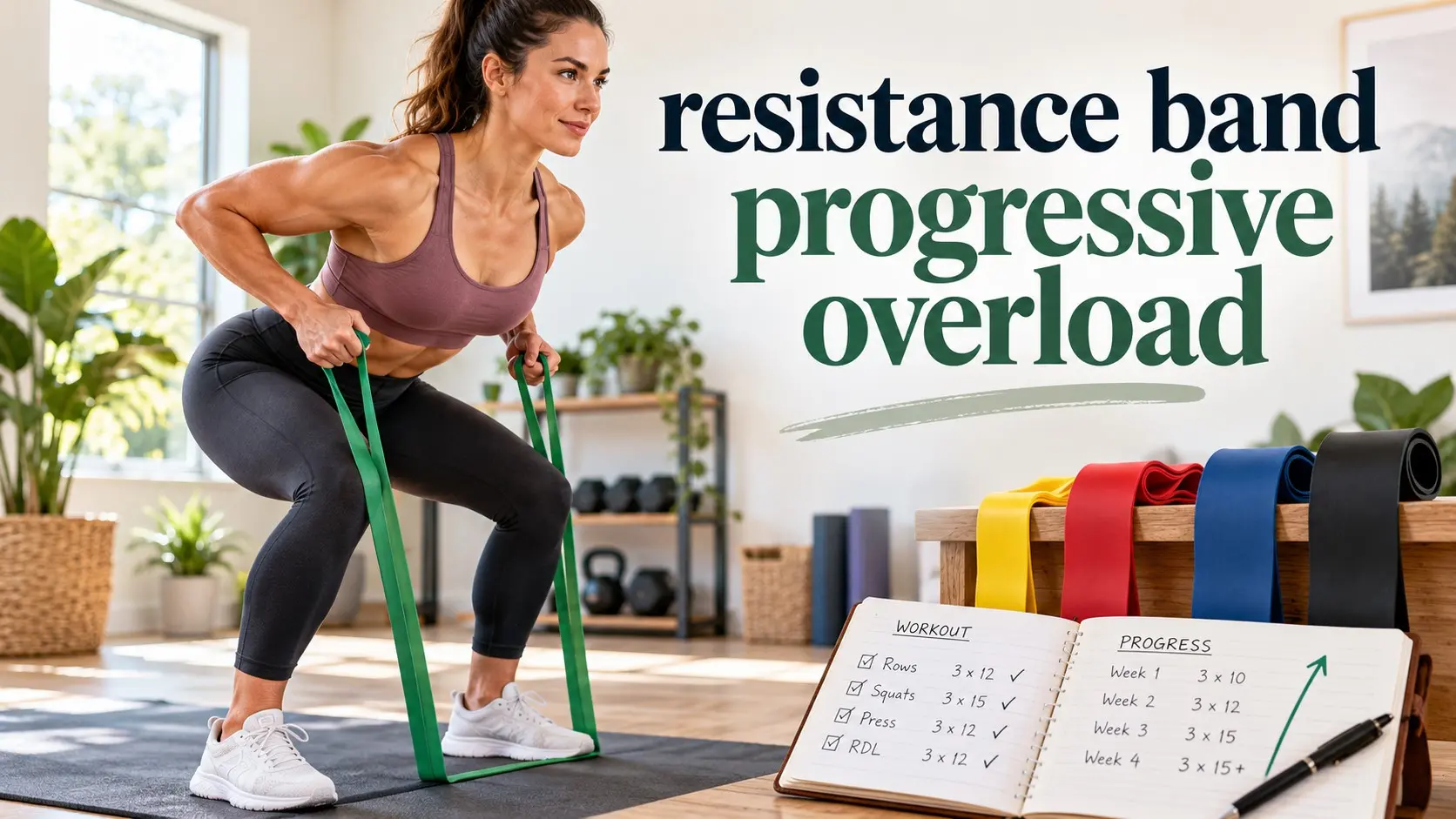
Yes, progressive overload works with resistance bands.
The major challenge is measurement. A dumbbell has a fixed mass, while an elastic band becomes harder to stretch as it lengthens. Good resistance band progressive overload therefore depends on repeating the same setup, tracking what you did, and increasing one meaningful training demand at a time.
You do not need a complicated system.
For most people, the cleanest progression is to build good technique first, add repetitions, increase effective band tension, rebuild the repetitions, and add more training volume only when there is a reason for it.
That turns band training from guesswork into real progressive resistance training.
Health and exercise notice: I am not a dermatologist or a doctor, and this content does not replace professional medical advice. What I share comes from actual life experience, extensive research, and consultation with healthcare providers. Always consult qualified medical professionals for diagnosis and treatment of any health condition. Stop exercising and seek appropriate medical care for chest pain, fainting, severe shortness of breath, sudden weakness, severe dizziness, or an acute injury.
Quick Answer: How Do You Progress With Resistance Bands?
Resistance band progressive overload means making the same movement gradually more demanding while keeping the setup and technique consistent enough to measure progress.
Start by building repetitions inside a chosen rep range. When you reach the top with clean form and the planned effort, increase band tension slightly and rebuild your repetitions.
You can also progress through more useful range of motion, extra sets, harder exercise variations, or less band assistance.
Record the band, anchor position, starting distance, grip, repetitions, and approximate reps in reserve. That makes your next workout comparable with your last one.
For broader home training advice, start with the NextFitLife Home Workouts & Equipment Guide.
Table of Contents
- What progressive overload means
- Can resistance bands build strength?
- Why band tension is different
- Create a repeatable setup
- Use reps in reserve
- Method 1: Add repetitions
- Method 2: Increase band tension
- Method 3: Increase range of motion
- Method 4: Add useful sets
- Method 5: Use harder exercise variations
- Method 6: Use tempo and pauses wisely
- Method 7: Reduce band assistance
- The best progression order
- Six week progression example
- Strength versus muscle growth
- Common band progression mistakes
- Band safety and replacement
- References and Sources
- Continue Reading on NextFitLife
- About the Author
- Frequently Asked Questions
What Does Progressive Overload Mean With Resistance Bands?
Progressive overload with bands means gradually increasing the challenge placed on your muscles as they adapt.
Imagine you start with three sets of ten band rows.
At first, the final few repetitions feel difficult. After several weeks, the same band, stance, anchor, and range of motion feel easier.
Your body adapted.
Repeating exactly the same easy workload forever gives the body less reason to keep adapting.
You now need to increase something meaningful.
That might be:
- More repetitions
- More effective resistance
- More useful range of motion
- More sets
- A harder exercise variation
- Less assistance
The key word is gradual.
Progress does not mean changing every variable every workout.
Can Resistance Bands Really Build Strength and Muscle?
Yes.
The strongest current evidence does not support treating bands as toys or rehabilitation equipment only.
The 2026 American College of Sports Medicine position stand concluded that resistance training improves muscle strength and hypertrophy, and its evidence base specifically includes elastic resistance training.
A separate systematic review and meta analysis that directly compared elastic resistance with conventional machines and dumbbells found no significant superiority of either method for upper or lower body strength gains.
That does not mean a resistance band and a barbell are identical.
They are not.
Traditional weights usually make external load easier to quantify, while bands create resistance that changes as the material stretches.
Still, your muscles can adapt to bands when the exercise is challenging, repeatable, and progressively loaded.
If you are new to resistance exercise, use the Strength Training Exercises at Home for Beginners Guide alongside this article.
Why Is Resistance Band Tension Harder to Track?
A dumbbell keeps the same mass from the start of a repetition to the end.
A band does something different.
As the band stretches, resistance rises.
This creates a variable resistance profile.
Imagine a standing curl.
The band may have relatively little tension at the bottom, then substantially more near the top because it has stretched farther.
Move your feet farther apart and the starting tension changes.
Grip the band lower and the tension changes again.
Step farther from an anchor and you have changed the exercise load without changing the band color.
Laboratory testing of elastic bands confirms that tension rises with elongation. The same research also found differences between measured tension and manufacturer reference values for several bands.
That is why I would treat printed pounds or kilograms as a rough reference rather than an exact equivalent to free weights.
Your Band Color Alone Is Not Enough Information
This workout log is too vague:
Row: blue band, 12 reps.
What was the anchor height?
How far were you from the anchor?
Was the band slack at the start?
Did you use full range?
Could you have done another six repetitions?
A better record looks like this:
Band row: medium tube, anchor at chest height, front foot 90 cm from door, 3 sets of 12, about 2 RIR, full controlled range.
Now you have something you can repeat.
Create a Setup Fingerprint for Every Band Exercise
I use the term setup fingerprint for the small group of details that make a resistance band exercise repeatable.
Record these six items.
| Item | What to Record | Why It Matters |
|---|---|---|
| 1. Band | Color, brand, level, or band combination | Band colors are not standardized across every manufacturer |
| 2. Anchor | Low, waist, chest, shoulder, or overhead position | Changing anchor position changes the movement |
| 3. Distance | Distance from feet to anchor | Greater starting stretch usually increases tension |
| 4. Grip | Handle, loop position, or shortened grip | A shorter working length can change resistance |
| 5. Reps | Repetitions completed in every working set | Lets you see whether performance is improving |
| 6. Effort | Approximate reps in reserve | Shows whether identical rep counts actually had similar difficulty |
This may sound overly detailed for a home workout.
It takes only a few seconds once you have done it twice.
Use Reps in Reserve to Track Effort
Reps in reserve, or RIR, means estimating how many more clean repetitions you could have completed when the set ended.
If you finish a set and could probably have performed five more good repetitions, you had about 5 RIR.
If you had only two good repetitions left, that is around 2 RIR.
The latest ACSM position stand specifically notes that proximity to failure measures such as RIR can translate well to training modes such as elastic bands and bodyweight exercise.
It also makes another useful point.
You do not need to take every set to absolute failure.
ACSM found no consistent advantage from training every set to failure for the major adaptations it reviewed.
For more detail, read the NextFitLife Reps in Reserve Guide.
Method 1: Add Repetitions First
This is the simplest form of resistance band progression.
Choose a practical rep range.
For example:
8 to 15 repetitions.
Your first workout might look like this:
- Set 1: 10 reps
- Set 2: 10 reps
- Set 3: 9 reps
A later workout might become:
- Set 1: 12 reps
- Set 2: 11 reps
- Set 3: 10 reps
Eventually you reach:
- Set 1: 15 reps
- Set 2: 15 reps
- Set 3: 15 reps
If technique stayed consistent and the final workout was still around the effort you intended, increase resistance.
Your repetitions may fall back to 8, 9, or 10.
Then build again.
This is often called double progression.
It is not a magical training method. It is simply an organized way to decide when to increase difficulty.
Method 2: Increase Effective Band Tension
Once the current setup becomes too easy, make the band harder to stretch.
There are several ways to do that.
Move to the Next Band
This is the most obvious option.
Keep everything else the same and use the next resistance level.
If your repetitions collapse from fifteen clean reps to three poor reps, the jump is probably too large for that exercise.
Stack Compatible Bands
A small band added to the existing band can create a more gradual increase.
Only stack equipment designed to work safely together.
A poorly secured band can release quickly and cause injury.
Move Farther From the Anchor
Stepping slightly farther from the anchor creates more starting stretch.
That usually increases effective resistance.
Measure the change.
“A little farther back” is hard to reproduce.
“Ten centimeters farther back” is useful data.
Shorten the Working Length
You can sometimes grip farther down a band or change its secure setup so less unstretched material remains.
This also changes tension.
Do not wrap bands around your hands in ways that compromise circulation or grip safety.
Method 3: Increase Useful Range of Motion
Full range of motion matters.
The 2026 ACSM review found complete range of motion was associated with better strength outcomes compared with incomplete range in the evidence it reviewed.
This creates a common band training trap.
Suppose your squat progresses like this:
- Week 1: full controlled squat
- Week 2: slightly heavier band and shallower squat
- Week 3: even heavier band and half squat
The band is getting stronger.
Your exercise may not be.
You have changed two variables at once and lost range.
If you can gradually perform a greater comfortable range while controlling the same resistance, that is meaningful progress.
Do not force painful ranges simply to tick a box.
Method 4: Add Useful Sets
Adding another working set increases training volume.
Volume matters most when your goal includes muscle hypertrophy.
The 2026 ACSM position stand found greater hypertrophy with higher weekly volume, with 10 or more sets per muscle group per week associated with more growth in the reviewed evidence.
That is not a command to perform ten sets for every muscle tomorrow.
Beginners often improve with less.
Volume should rise because your current training is no longer enough and your recovery supports more work.
Example:
| Stage | Band Chest Press | Reason |
|---|---|---|
| Starting | 3 working sets | Enough work to establish technique and progress |
| Later | 4 working sets | Adds volume after recovery and current workload justify it |
I would usually improve reps or resistance before turning every exercise into six sets.
Method 5: Choose a Harder Exercise Variation
Sometimes the current exercise has reached its practical limit.
You can make the movement mechanically harder.
| Current Exercise | Possible Progression |
|---|---|
| Band squat | Band split squat |
| Two arm row | Single arm row |
| Two leg hip hinge | Staggered stance hip hinge |
| Two leg glute bridge | Single leg variation when appropriate |
The important detail is that a new variation becomes a new exercise record.
Do not compare ten split squats directly with fifteen two leg squats as though the numbers describe the same task.
For lower body progression ideas, see Leg Exercises With Dumbbells. The resistance tool differs, but the principles of clean range, gradual progression, and controlled loading still apply.
Method 6: Use Tempo and Pauses Without Making Them the Scoreboard
A slower repetition feels harder.
So does pausing at the hardest part of a movement.
Both can be useful.
A pause can help you stop bouncing through a row.
A slow lowering phase can improve control.
Tempo can also make limited equipment feel more demanding.
But “slower every week” is not the strongest primary progression plan.
The 2026 ACSM review found that time under tension did not consistently improve strength or hypertrophy outcomes when different resistance training prescriptions were compared.
So use tempo to solve a problem.
Do not assume seven second repetitions are automatically better than controlled normal repetitions.
Method 7: Reduce Assistance on Assisted Exercises
Progression works in the opposite direction when the band is helping you.
Think about band assisted pull ups.
A thick band provides more assistance.
A thinner band forces you to lift more of your own body mass.
The progression can look like this:
- Heavy assistance band
- Medium assistance band
- Light assistance band
- Bodyweight repetition
This is still progressive overload.
You increased the amount of work your muscles perform by reducing help.
The Progression Order I Would Use
You have many ways to make a band exercise harder.
Do not use them all at once.
- Standardize the setup. Use the same band, anchor, stance, grip, and range.
- Build repetitions. Move toward the top of your chosen range.
- Increase effective resistance. Use a stronger band or a small setup change.
- Rebuild repetitions. Let the count fall after the resistance increases.
- Add volume when needed. Add another useful set if your goal and recovery support it.
- Change the exercise when needed. Start a new progression record for the new variation.
This is simple enough to follow and strict enough to measure.
A Real Resistance Band Row Progression Example
Suppose your target range is 8 to 15 repetitions.
Your setup is:
- Medium tube band
- Door anchor at chest height
- Feet 100 cm from the door
- Neutral grip
- Three working sets
| Week | Setup | Sets and Reps | Approx. RIR | Next Step |
|---|---|---|---|---|
| 1 | Medium, 100 cm | 11, 10, 10 | 2 to 3 | Keep setup |
| 2 | Medium, 100 cm | 12, 12, 11 | 2 | Build reps |
| 3 | Medium, 100 cm | 14, 13, 12 | 1 to 2 | Keep building |
| 4 | Medium, 100 cm | 15, 15, 15 | 2 | Increase resistance |
| 5 | Medium, 110 cm | 10, 9, 9 | 2 | Keep setup |
| 6 | Medium, 110 cm | 12, 11, 10 | 2 | Build reps again |
Now your progression is visible.
You did not simply “try harder.”
You changed a measurable variable after earning the progression.
What If the Next Band Is Too Hard?
This is common.
Your medium band gives you fifteen clean repetitions, but the heavy band gives you four poor ones.
Do not force the jump.
Try a smaller progression:
- Step slightly farther from the anchor.
- Shorten the working band length safely.
- Add a light compatible band.
- Improve range if the current range is incomplete.
- Add a useful set if volume is still modest.
- Use a slightly harder exercise variation.
The goal is progression, not punishment.
How Hard Should Your Sets Be?
You need enough effort to challenge the muscle.
You do not need to destroy every set.
The 2026 ACSM position stand describes near failure work and a target around 2 to 3 RIR as practical ways to achieve sufficient effort, while also noting that exact universal RIR targets are not yet established.
That is a useful distinction.
Two RIR is a tool.
It is not a law.
A beginner may need to stay farther from failure while learning technique.
A trained person may use harder sets on movements where failure is safe and predictable.
Can Resistance Bands Build Muscle as Well as Weights?
They can build muscle and strength.
The current ACSM review specifically found hypertrophy from elastic band resistance training.
A 2019 meta analysis also found similar strength gains when elastic resistance was compared directly with conventional machines and dumbbells.
There are limits.
A very strong trainee may find it easier to create precise heavy loading with barbells, machines, or dumbbells on some movements.
Traditional weights also make small load jumps easier to quantify.
But for home training, travel, general fitness, beginners, and many muscle building programs, bands are legitimate resistance equipment.
The muscle responds to the training challenge.
It does not care whether the resistance came from an expensive machine or an elastic band.
Strength and Muscle Growth Need Different Emphasis
Your progression method should match the goal.
| Goal | Main Priorities |
|---|---|
| Strength | Higher effective resistance, good technique, complete useful range, repeatable setup, enough recovery |
| Muscle growth | Hard sets, enough weekly volume, useful range, progression in reps or resistance, consistent target muscle loading |
ACSM found heavier conventional loads were more favorable for maximum strength, while hypertrophy occurred across a broad range of loads when resistance training was sufficiently challenging.
Do not try to convert a band's printed resistance into a fake exact one repetition maximum.
Band tension changes through the repetition.
A Simple Six Week Band Progression Plan
Week 1: Build the Baseline
Choose the band and exercise setup.
Record everything.
Use controlled repetitions and stop with several good reps available while you learn the movement.
Week 2: Repeat Before You Progress
Use the same setup.
Try to add a small number of total repetitions while keeping form the same.
Week 3: Build the Rep Range
Continue increasing clean repetitions.
Do not shorten the movement just to beat last week's number.
Week 4: Earn the Resistance Increase
If you reach the top of your target range with the planned effort, increase effective tension slightly.
Week 5: Accept Lower Reps
Your repetition count should usually fall after adding resistance.
That is normal.
Week 6: Build Again
Keep the harder setup and start adding repetitions again.
Six weeks is only an example.
Adaptation does not follow a calendar perfectly.
How Often Should You Progress?
There is no honest universal schedule.
A beginner may improve almost every session.
An experienced lifter may need several workouts before the same movement improves.
Your sleep, food intake, stress, recovery, exercise selection, and training history all affect performance.
Progressive overload does not mean:
Every workout must beat the last workout.
It means:
Your training demand should trend upward as your capacity improves.
That difference prevents every session from turning into a test.
What If Your Numbers Drop for One Workout?
Do not panic.
One session is noisy.
You may have slept badly.
You may be training at a different time.
A previous exercise may have fatigued the same muscles.
Your anchor position may have changed slightly.
Look at the trend across several sessions.
If progress has stopped for several weeks, review:
- Setup consistency
- Training effort
- Weekly volume
- Recovery
- Exercise selection
- Band resistance
- Sleep
- Protein and overall food intake
Do not solve every plateau by adding another workout.
Seven Resistance Band Progression Mistakes
1. Changing the Setup Every Session
Different stance, anchor, grip, and starting stretch make your numbers difficult to compare.
2. Trusting the Printed Resistance Number Too Much
Band tension changes with stretch, and measured force can differ from manufacturer reference values.
3. Adding Repetitions Forever
If strength or muscle growth is the goal, moving from forty easy reps to fifty may be more endurance training than useful overload.
4. Losing Range as the Band Gets Harder
A stronger band does not automatically mean better training if your movement becomes half as large.
5. Using Tempo as Your Only Progression
Slow reps can be useful, but current evidence does not support making ever slower repetitions the center of your overload plan.
6. Taking Every Set to Failure
Failure is optional, not mandatory.
Good hard sets can work without every final repetition becoming a form breakdown contest.
7. Changing Everything at Once
If you add reps, another set, a stronger band, slower tempo, and a new exercise at the same time, you no longer know what improved.
Change one main progression variable at a time.
Band Safety Matters More as Resistance Increases
A heavier band stores more elastic energy.
Inspect equipment before you load it aggressively.
Do not use a band with:
- Visible tears
- Cracks
- Thin damaged areas
- Loose handles
- Damaged clips
- Questionable door anchors
Check that the anchor cannot release toward your face or body.
Follow the manufacturer's setup instructions.
Do not attach bands to unstable furniture.
If you train at home regularly, review the safety section in the Home Workouts & Equipment Guide.
A Practical Resistance Band Progression Checklist
- Choose a repeatable exercise.
- Record your band.
- Record your anchor position.
- Measure your starting distance when relevant.
- Use the same useful range of motion.
- Track sets and repetitions.
- Estimate RIR.
- Add reps before changing several variables.
- Increase tension once the current setup is clearly easier.
- Rebuild reps after the resistance increases.
- Add sets only when more volume has a purpose.
- Replace damaged bands before they fail.
Conclusion
Resistance band progressive overload works when your training becomes gradually harder in a way you can actually measure.
The band color alone is not enough.
Track the anchor, distance, grip, range of motion, repetitions, sets, and effort. Build reps first, increase effective tension when the current setup becomes too easy, then rebuild the reps.
Add more volume or a harder exercise when there is a clear reason, not simply because you want the workout to feel brutal.
Your next step: choose one band exercise today and write down its setup fingerprint. Repeat that exact setup next time. Once the setup is repeatable, progressive overload becomes much easier to see.
References and Sources
- American College of Sports Medicine.
Currier BS, D'Souza AC, Fiatarone Singh MA, et al. Resistance Training Prescription for Muscle Function, Hypertrophy, and Physical Performance in Healthy Adults: An Overview of Reviews. Published in 2026. This position stand synthesized 137 systematic reviews involving more than 30,000 participants and includes elastic band resistance training, strength, hypertrophy, training volume, range of motion, RIR, failure, and time under tension.Source:
https://pmc.ncbi.nlm.nih.gov/articles/PMC12965823/
- Lopes JSS, Machado AF, Micheletti JK, et al.
Effects of Training With Elastic Resistance Versus Conventional Resistance on Muscular Strength: A Systematic Review and Meta Analysis. The analysis found no significant superiority between elastic resistance and conventional machines or free weights for upper or lower body strength gains.Source:
https://pmc.ncbi.nlm.nih.gov/articles/PMC6383082/
- Uchida MC, Nishida MM, Sampaio RAC, Moritani T, Arai H.
Thera Band Elastic Band Tension: Reference Values for Physical Activity. This laboratory study measured resistance across different elongation percentages and demonstrated that tension rises as bands stretch while also finding differences from manufacturer reference values.Source:
https://pmc.ncbi.nlm.nih.gov/articles/PMC4868225/
- Seguin RC, Cudlip AC, Holmes MWR.
The Efficacy of Upper Extremity Elastic Resistance Training on Shoulder Strength and Performance: A Systematic Review. The open access review included 24 studies and found improvements across several strength and performance measures following elastic resistance training.Source:
https://pmc.ncbi.nlm.nih.gov/articles/PMC8879764/
- Stanković D, Lazić A, Trajković N, et al.
Effects of Elastic Band Training on Physical Performance in Team Sports: A Systematic Review and Meta Analysis. Published in 2025, this open access analysis included 729 athletes and reported improvements in several physical performance outcomes following elastic band training.Source:
https://pmc.ncbi.nlm.nih.gov/articles/PMC12551113/
Continue Reading on NextFitLife
- Home Workouts & Equipment Guide
for resistance bands, dumbbells, kettlebells, bodyweight training, equipment setup, and home workout safety - Strength Training Exercises at Home for Beginners
for basic resistance movements, beginner progression, home equipment, and safe starting routines - Reps in Reserve
for RIR, proximity to failure, strength training effort, muscle growth, and practical workout tracking - Leg Exercises With Dumbbells
for lower body progression, squats, split squats, hinges, lunges, and strength training structure - Core Workouts at Home
for simple home strength exercises, weekly programming, recovery, and beginner friendly progression - How to Get Fit Fast Safely
for beginner strength training, cardio, recovery, home workouts, and realistic fitness progression
About the Author
Adel Galal is the founder and lead writer of NextFitLife. His personal interest in fitness, strength training, nutrition, wellness, and healthy aging spans more than 30 years, and his health and wellness writing experience spans more than 15 years.
Before focusing on NextFitLife, Adel spent 29 years working as an IT Manager for the Nestlé Egypt Region. His professional background includes information systems, data analysis, structured review, planning, problem solving, and information management.
He applies those research skills to fitness writing by comparing current exercise science, separating measurable progression from workout trends, checking claims about muscle growth and strength, and turning technical guidance into routines readers can actually track.
For this article, Adel reviewed the 2026 American College of Sports Medicine position stand on resistance training, open systematic reviews comparing elastic and conventional resistance, laboratory research on elastic band tension, and recent evidence on elastic resistance training and physical performance.
Adel is not a physician, physical therapist, sports medicine specialist, or other licensed healthcare professional. NextFitLife provides general educational information and does not replace individualized medical assessment, rehabilitation, injury diagnosis, or professionally prescribed exercise.
Learn more about Adel Galal, NextFitLife, sourcing standards, corrections, and the site's editorial approach on the About Us page.
Frequently Asked Questions
Can you do progressive overload with resistance bands?
Yes. Progressive overload with resistance bands can come from more repetitions, greater effective tension, more useful range of motion, additional sets, harder exercise variations, or less band assistance.
What is resistance band progressive overload?
Resistance band progressive overload means gradually increasing the training demand as your body adapts while keeping the exercise setup consistent enough to measure the change.
How do I know when to use a stronger resistance band?
Consider increasing resistance when you can reach the top of your planned repetition range with clean form and the set is no longer as challenging as intended.
Do more reps count as progressive overload?
Yes. Performing more clean repetitions with the same band, setup, range of motion, and similar effort is a measurable form of progression.
How many reps should I do with resistance bands?
There is no universal best number. A practical approach is to choose a rep range suited to the exercise and goal, then progress within that range before increasing resistance.
Can resistance bands build muscle?
Yes. Current resistance training evidence includes hypertrophy improvements from elastic band training when exercises are sufficiently challenging and progressive.
Can resistance bands build strength like weights?
Yes. A systematic review and meta analysis found similar strength improvements when elastic resistance was compared with conventional machines and free weights across the included studies.
Are resistance band pounds accurate?
Band resistance labels should be treated as approximate. Actual tension depends on how far the band is stretched, and laboratory measurements have found differences between measured force and some manufacturer reference values.
Why does a resistance band feel harder at the end of a rep?
Elastic resistance rises as the band stretches farther, so many band exercises provide less resistance near the start and more near the end of the movement.
Should I train resistance bands to failure?
You do not need to take every set to failure. Current resistance training evidence does not show that momentary failure is required to improve strength or muscle growth.
What is RIR in resistance band training?
RIR means reps in reserve. It is an estimate of how many more clean repetitions you could have completed when a set ended.
Is 2 RIR good for resistance bands?
Two RIR can be a useful effort target for many hard working sets, but there is no single exact RIR value proven best for every person, exercise, or training goal.
Does slowing resistance band reps build more muscle?
Slower repetitions can improve control and make light resistance feel harder, but current evidence does not show a consistent hypertrophy advantage from simply increasing time under tension.
How can I increase resistance without buying a new band?
You may be able to increase starting stretch, shorten the working band length safely, stack compatible bands, add repetitions, add useful sets, or progress to a harder exercise variation.
Is adding another set progressive overload?
Yes. Adding a working set increases training volume. It can be useful when greater weekly volume fits your goal and you can recover from it.
How do I progressively overload band assisted pull ups?
Use progressively less assistance. Move from a stronger assistance band to a medium band, then a lighter band, before progressing toward unassisted repetitions when appropriate.
Should I use the same band every workout?
Use the same setup long enough to measure improvement. Once repetitions or performance clearly improve, increase the challenge rather than staying with an easy resistance forever.
How often should I increase band resistance?
There is no fixed weekly schedule. Increase the challenge when your current setup has become easier at comparable technique and effort, rather than changing bands simply because another week passed.
What should I track in a resistance band workout?
Track the exercise, band or band combination, anchor position, starting distance, grip, sets, repetitions, range of motion, and approximate reps in reserve.
What is the biggest mistake with resistance band progressive overload?
One of the biggest mistakes is changing several setup variables at once. If your band, stance, anchor, range, and tempo all change, you cannot tell whether performance truly improved.

Health & wellness writer with 30+ years of experience in nutrition, fitness, and healthy aging. Founder of NextFitLife.com — evidence-based health guidance.