First published: October 1, 2026
Last updated: October 1, 2026
Written and source checked by: Adel Galal, Founder and Lead Writer at NextFitLife
Medical review status: This article has not been medically reviewed by a doctor, physical therapist, sports medicine physician, certified athletic trainer, or strength and conditioning professional.
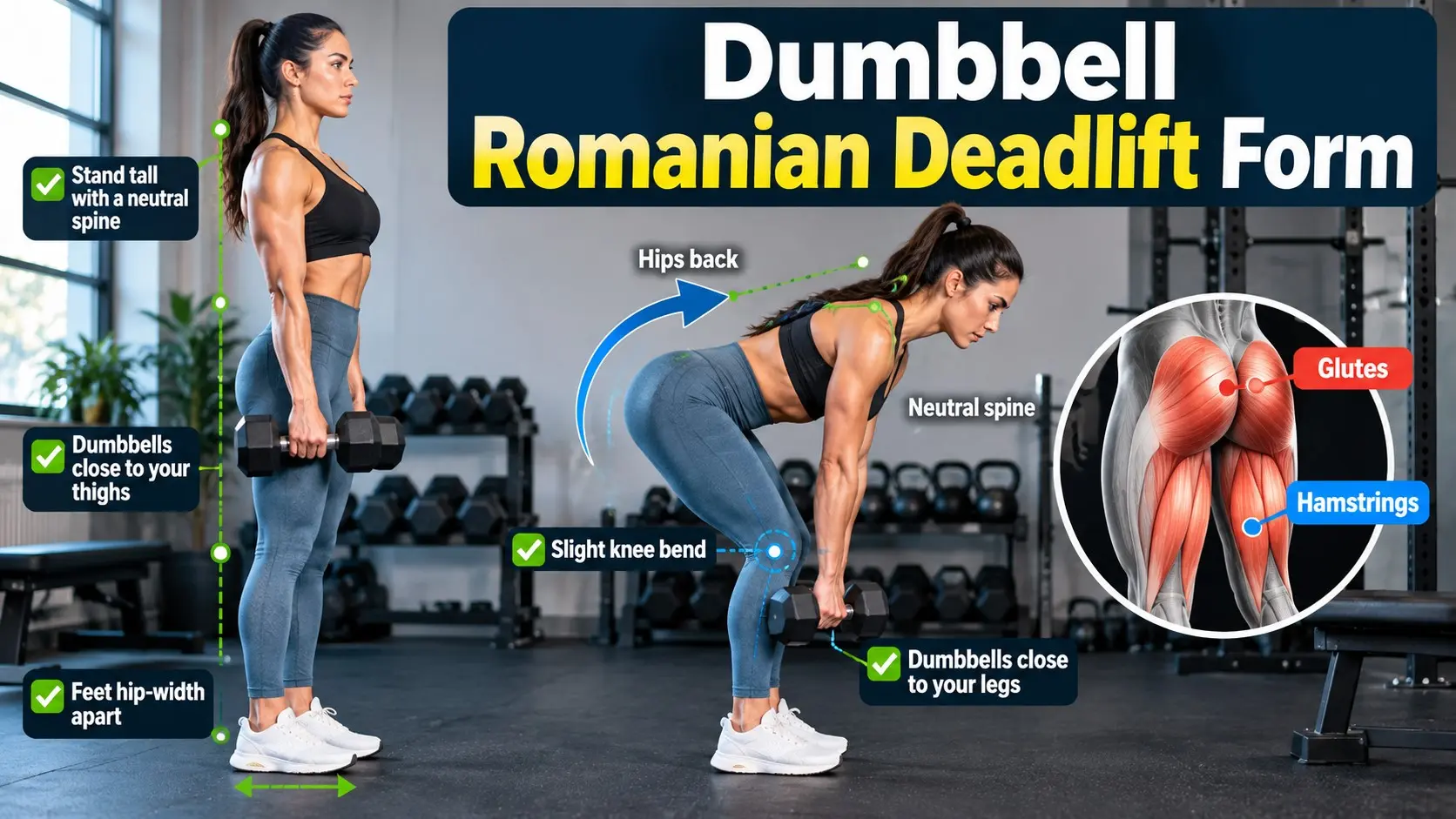
Good dumbbell Romanian deadlift form starts with one skill: move your hips backward while your knees stay softly bent and your spine stays steady.
Do not lower the dumbbells because you are trying to reach the floor. Lower them because your hips are travelling backward. Stop when the hamstrings feel strongly loaded and going farther would make your back round or your knees bend much more.
That is the hip hinge.
Quick Answer
For correct dumbbell Romanian deadlift form, stand about hip width with soft knees, brace gently, and keep the dumbbells close to your legs. Push your hips backward while your torso tips forward as one unit. Stop at your natural hamstring limit, then drive the hips forward to stand without leaning backward at the top.
Medical notice: I am not a dermatologist or A doctor, and this content does not replace professional medical advice. What I share comes from real-life experience, extensive research, and consultation with healthcare providers. Always consult qualified medical professionals for diagnosis and treatment of any health condition.
Table of Contents
- What a Dumbbell Romanian Deadlift Is
- 9 Smart Form Cues
- Side View Form Check
- How Low You Should Go
- Hamstring and Glute Feel
- Female Dumbbell RDL Form
- Wall and Dowel Hinge Drills
- Seven Common Mistakes
- Dumbbell RDL vs Stiff Leg Deadlift
- Dumbbell RDL vs Conventional Deadlift
- Beginner Progression
- When to Stop
- References and Sources
- Related NextFitLife Guides
- About the Author
- Frequently Asked Questions
What Is a Dumbbell Romanian Deadlift?
A dumbbell Romanian deadlift, often shortened to dumbbell RDL, is a loaded hip hinge.
The exercise starts from standing. You soften the knees, push the hips backward, lower the dumbbells while keeping them close to the legs, then extend the hips to stand again.
The main muscles involved include the hamstrings, gluteus maximus, erector spinae, adductor magnus, grip muscles, and other muscles that help keep the trunk stable.
The dumbbells provide resistance.
The hinge is the skill.
If you are building a broader lower body routine, see our Leg Exercises With Dumbbells Guide.
9 Smart Dumbbell Romanian Deadlift Form Cues
1. Start With Your Feet About Hip Width
Stand tall with your feet roughly hip width apart.
Hold one dumbbell in each hand. Let your arms hang naturally with the weights close to the front or sides of your thighs.
Keep the whole foot planted.
You do not need a very wide deadlift stance for a standard dumbbell RDL.
2. Soften Your Knees, Then Keep Them Quiet
Start with a small bend in the knees.
Once that bend is set, the knees should stay fairly quiet while the hips travel backward.
If your knees keep moving forward and your hips drop down, the movement is turning into a squat.
Think:
Soft knees. Moving hips.
Do not think about sitting down.
3. Push Your Hips Back Instead of Reaching Down
This is the cue that changes everything.
Imagine someone pulling your hips toward the wall behind you.
As your hips move back, your torso naturally tips forward.
Do not begin the rep by dropping your chest toward the floor.
The movement should come mainly from the hip joints while your trunk stays controlled.
4. Keep the Dumbbells Close to Your Legs
The weights should travel close to your thighs and shins.
They can lightly brush your legs, but you do not need to scrape your skin.
Letting the dumbbells float far forward makes the movement harder to control and increases the demand on your trunk and lower back.
Think of your arms as hooks.
The hips create the movement.
5. Keep Your Spine Stable
Your spine naturally has curves, so you do not need to force your back into a perfectly flat board.
The better goal is a neutral spine that keeps roughly the same shape during the hinge.
Brace your trunk gently before the rep begins.
Do not round your lower back just to make the dumbbells travel farther.
Your neck should follow your torso. As you hinge, let your eyes move toward the floor instead of lifting your chin to stare at a mirror.
6. Stop at Your Hamstring Limit
You do not need to reach the floor.
You do not even need to reach a fixed point on the shin.
Keep hinging until you feel strong tension through the back of your thighs while the spine stays stable.
Then stop.
For some people, the dumbbells finish just below the knees. Others reach the middle of the shins.
Your body proportions and mobility change the exact position.
The correct question is not “How low did the dumbbells go?”
Ask, “Could I go farther without changing my form?”
7. Feel the Hamstrings Load During the Descent
The lowering phase should produce growing tension through the hamstrings.
This is one of the clearest signs that your hinge is working.
Your lower back muscles also work because they help keep the trunk stable, but the exercise should not feel like repeated bending through the lumbar spine.
If you mainly feel your lower back, check your depth, load, hip movement, and dumbbell position.
For more hamstring training ideas, visit our Hamstring Exercises Guide.
8. Drive the Hips Forward to Stand
Reverse the movement by extending your hips.
Keep the weights close as you stand.
Finish tall with your ribs and pelvis stacked naturally.
Do not throw your hips far forward and lean your shoulders backward.
That extra lean does not give the glutes a better contraction.
It simply adds movement where you do not need it.
9. Use a Weight That Lets Every Rep Look the Same
A heavier dumbbell is not an upgrade if the exercise stops looking like an RDL.
Reduce the load if you begin:
- Rounding your back
- Bending your knees more with every rep
- Letting the dumbbells drift forward
- Jerking the weights upward
- Losing balance
- Cutting the hinge short because the weight is too heavy
Your last repetition should still look like your first.
Dumbbell Romanian Deadlift Form Side View: What Should You See?
A dumbbell Romanian deadlift form side view is one of the easiest ways to check the movement yourself.
Record a light set from directly beside you.
Do not film from a front corner. A true side view makes hip and knee movement much easier to see.
At the Start
Look for:
- Feet planted
- Knees softly bent
- Hips under the torso
- Ribs controlled
- Dumbbells close to the thighs
- Head in a relaxed position
Halfway Down
This is often the most useful frame.
Your hips should clearly be farther behind you than they were at the start.
Your torso should be leaning forward because the hips have folded.
The knee angle should still look similar to the bend you set near the top.
The dumbbells should remain close to your legs.
At the Bottom
Look for:
- Hips clearly pushed backward
- A stable spine
- Soft knees without a deep squat
- Dumbbells close to the shins
- No need to reach for the floor
The height of the dumbbell does not decide whether the rep is correct.
Your joint positions do.
How Low Should You Go?
Go as low as your hinge allows while the spine stays stable and the hamstrings remain loaded.
No lower.
NASM uses mid shin or slightly higher as a common reference point, while ACE describes stopping around knee level or mid shin depending on hamstring flexibility.
Those are examples, not rules.
If you reach mid shin only by rounding your back, your useful range ends higher.
If you have good hip range and can go farther without changing position, your dumbbells may travel lower.
The floor does not matter.
Where Should You Feel a Dumbbell RDL?
During the lowering phase, expect tension mainly through the back of your thighs.
As you return to standing, the hamstrings and glutes help extend the hips.
Your grip, abdominal muscles, upper back, and spinal muscles also work to hold the weights and keep your trunk controlled.
Feeling some muscular effort in the back does not automatically mean the exercise is wrong.
Sharp pain is different.
Does Dumbbell Romanian Deadlift Form Work the Hamstrings?
Yes.
The dumbbell Romanian deadlift form hamstrings relationship comes from the hip hinge itself.
The knees stay slightly bent while the hips travel backward. This lengthens the hamstrings across the hip while they are under load.
A systematic review of deadlift muscle activity research found strong involvement of the biceps femoris and semitendinosus during Romanian deadlifts.
The practical lesson is much simpler than an EMG graph.
You should feel tension building behind your thighs as you hinge.
Does Dumbbell Romanian Deadlift Form Work the Glutes?
Yes.
The dumbbell Romanian deadlift form glutes question usually comes from people who notice their hamstrings much more strongly.
That is normal.
The gluteus maximus is a major hip extensor and helps bring the hips forward as you return to standing.
The hamstrings are easier to feel because they receive a clear loaded stretch during the lowering phase.
Do not force a huge glute squeeze by leaning backward at the top.
Stand tall and finish the hip extension there.
Why Do I Feel the RDL More in My Hamstrings Than My Glutes?
Because the exercise places the hamstrings under a clear stretch as the hips move backward.
This does not mean your glutes are doing nothing.
If you want to make sure you are finishing with the hips rather than lifting your chest first, watch your side view.
The hips and torso should return together.
If your goal is more glute training overall, combine RDLs with exercises that challenge the glutes differently rather than trying to turn one movement into every exercise at once.
Why Do I Feel the RDL in My Lower Back?
Check these four things first:
- Are the dumbbells moving away from your legs?
- Are you rounding your back to reach extra depth?
- Are your hips actually travelling backward?
- Is the load too heavy?
Your spinal muscles must work during an RDL, but they should mainly stabilize your trunk.
If the movement feels dominated by lower back strain, stop and reduce the challenge.
Why Do I Not Feel My Hamstrings?
You Are Bending the Knees Too Much
If the knees keep bending, the hips often drop instead of moving backward.
Set a soft knee bend first, then keep it fairly steady.
Your Hips Are Not Moving Back
Your torso may be leaning forward while the pelvis barely moves.
Use the wall drill below.
The Weight Is Too Heavy
A heavy load can shorten the range or make you use whatever movement gets the dumbbells back up.
Reduce the weight until you can control the hinge.
You Are Moving Too Fast
Lower with enough control that you could stop the dumbbells at any point.
You do not need an exaggerated slow motion rep, but you should own the descent.
The Wall Drill Teaches the Hip Hinge Quickly
Remove the dumbbells.
Stand with your back facing a wall and your heels a short distance away.
Soften the knees, then push your hips backward until your backside touches the wall.
Do not squat down to find it.
When that becomes easy, step a little farther from the wall and repeat.
The drill gives you immediate feedback. Your hips either travelled backward or they did not.
The Dowel Test Shows Whether Your Spine Is Moving
Use a light dowel, broomstick, or similar straight object.
Hold it along your back so it touches near:
- The back of your head
- Your upper back
- Your pelvis
Now hinge.
If those contact points change because your spine rounds or overextends, shorten the range and practise again.
This turns “keep your back neutral” into something you can actually feel.
Dumbbell Romanian Deadlift Form Female: Is It Different?
No separate dumbbell Romanian deadlift form female technique is required.
The same main rules apply to women and men:
- Hips move backward
- Knees stay softly bent
- Spine stays controlled
- Weights stay close
- Range ends before form changes
What does change is the individual.
Two women can have different looking bottom positions because of differences in femur length, torso length, hip structure, hamstring mobility, training history, and dumbbell size.
The same variation exists between men.
Do not copy another person's exact depth.
Use your own side view.
Seven Common Dumbbell RDL Mistakes
1. Squatting the Hinge
What you see: the knees move forward and the hips drop.
Fix: soften the knees once, then push the hips backward.
2. Reaching for the Floor
What you see: the back begins to round near the bottom.
Fix: stop when the hamstrings limit the hinge.
3. Letting the Dumbbells Float Forward
What you see: the weights hang well in front of the knees.
Fix: guide the dumbbells close to your thighs and shins.
4. Looking Straight Ahead
What you see: the torso hinges but the neck stays lifted.
Fix: let your gaze move toward the floor as your torso lowers.
5. Leaning Back at the Top
What you see: the hips push far forward and the shoulders move behind them.
Fix: stand tall and stop.
6. Dropping Too Fast
What you see: the dumbbells fall toward the bottom and rebound upward.
Fix: control the lowering phase.
7. Using Too Much Weight
What you see: every repetition becomes shorter, rounder, or more squat like.
Fix: use lighter dumbbells until every repetition matches.
Dumbbell RDL vs Stiff Leg Deadlift
They are related, but they are not identical.
A standard RDL uses a slight knee bend and keeps that bend fairly stable while the hips move backward.
A stiff leg variation uses less knee flexion.
That changes the position of the hamstrings and the way the movement feels.
You do not need locked knees to perform a good Romanian deadlift.
| Feature | Romanian Deadlift | Stiff Leg Deadlift |
|---|---|---|
| Knee position | Soft bend | Straighter leg position |
| Main movement | Hip hinge | Hip hinge with less knee flexion |
| Beginner friendly | Better starting option | Usually better after hinge skill is established |
Dumbbell RDL vs Conventional Deadlift
The biggest difference is how the repetition begins and how much the knees move.
A conventional deadlift usually begins with the weight on the floor.
The RDL starts from standing.
A conventional deadlift normally uses more knee movement, while the RDL keeps the knees quieter and places greater emphasis on the hip hinge.
Both can be useful.
They are different tools rather than competing versions of the same rep.
Should Beginners Do Dumbbell Romanian Deadlifts?
Yes, once the hinge makes sense.
Dumbbells make it easy to start with a light load, but the equipment does not teach the movement for you.
Practice several bodyweight hip hinges first.
ACE recommends demonstrating 10 to 15 controlled hinges with a stable spine and suitable hip range before progressing to external resistance.
If the bodyweight hinge still turns into a squat or back bend, stay with the drill a little longer.
For more simple lower body options, use our Home Workouts and Equipment Guide.
How Heavy Should the Dumbbells Be?
There is no useful universal kilogram number.
Choose a weight you can control through your full useful range.
Start lighter than you think you need.
If the final reps still show:
- A stable spine
- Quiet knees
- Hips travelling backward
- Dumbbells staying close
- A controlled return
the load is probably suitable for that session.
If those features disappear, reduce the weight.
How Should You Progress the Dumbbell RDL?
Progress does not have to mean adding weight every workout.
You can improve by:
- Making the hinge cleaner
- Using a more consistent range
- Controlling the descent better
- Completing more quality repetitions
- Adding load when form remains stable
Once the two leg version is solid, you can explore kickstand and single leg variations.
Our Single Leg Exercises Guide includes unilateral deadlift progressions.
When Should You Stop the Exercise?
Muscle effort and a stretching sensation through the hamstrings are expected.
Sharp pain is not.
Stop the set if you develop:
- Sharp back pain
- Sharp hamstring pain
- Sudden hip pain
- Numbness
- Tingling
- Sudden weakness
- Loss of balance
- Pain that clearly worsens with each repetition
If symptoms continue, or if you already have a significant back, hip, or hamstring problem, seek individual guidance from a qualified healthcare or rehabilitation professional.
A 9 Point Form Checklist
- Feet feel stable.
- Knees stay softly bent.
- Trunk stays controlled.
- Hips move backward.
- Dumbbells stay close.
- Spine keeps the same general shape.
- Hamstrings load during the descent.
- Depth ends before form changes.
- You stand tall without leaning backward.
Conclusion
Better dumbbell Romanian deadlift form comes from learning the hip hinge, not from chasing the floor.
Film one light set from the side. Check whether your hips clearly travel backward, your knees stay softly bent, the dumbbells remain close to your legs, and your spine stays controlled.
Then look at the bottom position. If you have a strong hamstring stretch and going farther would change your form, you are deep enough.
Your next step is simple: practise the wall hinge without weight, then record one light dumbbell set from the side before adding more load.
References and Sources
- National Academy of Sports Medicine.
Dumbbell Romanian Deadlift.
Exercise guidance covering setup, hip hinging, knee position, neutral spine, dumbbell path, hamstring stretch, common errors, and range of motion.
https://www.nasm.org/resource-center/exercise-library/dumbbell-romanian-deadlift
- American Council on Exercise.
The ACE Do It Better Series: The Romanian Deadlift.
Detailed coaching guidance on hip flexion and extension, muscles involved, neutral spine, knee position, depth, neck position, progression, and using a dowel to learn the hinge.
https://www.acefitness.org/continuing-education/certified/may-2025/8865/the-ace-do-it-better-series-the-romanian-deadlift/
- American Council on Exercise.
Romanian Deadlift Exercise Library.
Exercise description covering slight knee bend, hip movement, hamstring tension, load position, and return to standing.
https://www.acefitness.org/resources/everyone/exercise-library/317/romanian-deadlift/
- American Council on Exercise.
Romanian Deadlift Technique Guide.
Coaching reference covering unloaded hinge progression, glutes and hamstrings, keeping the weight close, and dowel feedback for spinal control.
https://www.acefitness.org/continuing-education/prosource/january-2016/5767/ace-technique-series-romanian-deadlift/
- Martín Fuentes I, et al.
Electromyographic Activity in Deadlift Exercise and Its Variants: A Systematic Review.
Systematic review examining muscle activity during deadlift variations, including Romanian deadlifts and hamstring involvement.
https://pubmed.ncbi.nlm.nih.gov/32107499/
- Lee S, et al.
An Electromyographic and Kinetic Comparison of Conventional and Romanian Deadlifts.
Open access biomechanical study comparing muscle activity and joint mechanics during conventional and Romanian deadlifts.
https://pmc.ncbi.nlm.nih.gov/articles/PMC6323186/
- Coratella G, et al.
Posterior Chain Muscle Excitation During Different Deadlift Variations.
Open access study examining glute, hamstring, and spinal muscle excitation during Romanian and related deadlift variations.
https://pmc.ncbi.nlm.nih.gov/articles/PMC8835508/
Related NextFitLife Fitness Guides and Hubs
- Leg Exercises With Dumbbells
- Hamstring Exercises
- Single Leg Exercises
- Home Workouts and Equipment Guide
About the Author
Adel Galal is the founder and lead writer at NextFitLife. He writes educational health, fitness, nutrition, and healthy aging content using recognised exercise, sports medicine, medical, academic, and public health sources.
For strength training topics, his approach is to break a movement into simple positions that readers can see and check for themselves. He focuses on controlled form, realistic progression, sensible loading, and knowing when pain needs professional assessment.
He does not diagnose injuries, prescribe rehabilitation, provide individual strength programming, or replace care from a doctor, physical therapist, sports medicine professional, or qualified fitness professional.
I am not a dermatologist or A doctor, and this content does not replace professional medical advice. What I share comes from real-life experience, extensive research, and consultation with healthcare providers. Always consult qualified medical professionals for diagnosis and treatment of any health condition.
Learn more about Adel Galal and NextFitLife on the About Us page.
Frequently Asked Questions
What is correct dumbbell Romanian deadlift form?
Stand about hip width with soft knees, keep the dumbbells close to your legs, brace your trunk, and push your hips backward. Stop when you feel a strong hamstring stretch while your spine stays stable, then extend your hips to stand.
How low should dumbbells go during an RDL?
Lower only as far as your hip hinge allows without rounding your back or adding much more knee bend. For some people that is just below the knees, while others reach mid shin.
Should dumbbells touch your legs during an RDL?
Keep them very close to your thighs and shins. They can lightly brush your legs, but they do not need to scrape them.
Should your knees bend during a dumbbell RDL?
Yes. Use a small knee bend and keep it fairly stable during the hinge. Too much continued knee bending turns the movement toward a squat.
Should your back be completely flat during an RDL?
Your spine naturally has curves. The goal is a stable neutral position that does not noticeably round or overextend while you hinge.
Where should you feel a dumbbell Romanian deadlift?
You should feel strong tension through the hamstrings during the descent. The glutes help extend the hips as you return to standing, while trunk muscles help stabilize the movement.
Does the dumbbell Romanian deadlift work the hamstrings?
Yes. The RDL places the hamstrings under load as the hips move backward with only a small amount of knee bend.
Does the dumbbell Romanian deadlift work the glutes?
Yes. The gluteus maximus contributes to hip extension as you return from the hinged position to standing.
Why do I feel Romanian deadlifts more in my hamstrings than my glutes?
The hamstrings receive a strong loaded stretch during the lowering phase, so they can be easier to feel. The glutes still contribute to hip extension during the return.
Why do I feel RDLs in my lower back?
Check whether the dumbbells are drifting forward, you are rounding for extra depth, your hips are not travelling backward, or the weight is too heavy. Your back muscles stabilize the movement, but sharp or dominant lower back strain is a reason to stop and reassess.
Why do I not feel the RDL in my hamstrings?
You may be bending the knees too much, failing to push the hips backward, using too much weight, or moving too quickly. Practise the wall hinge without dumbbells first.
What does dumbbell Romanian deadlift form look like from the side?
The hips move backward as the torso inclines forward, the knees remain softly bent, the spine stays controlled, and the dumbbells track close to the legs. The bottom occurs before the back starts to round.
Is dumbbell Romanian deadlift form different for females?
No separate female technique is required. The same hinge principles apply. Individual limb length, hip structure, mobility, and training history change how the position looks from person to person.
Should you squeeze your glutes at the top of an RDL?
Finish by fully extending your hips and standing tall. You do not need to push the hips far forward or lean backward to create an exaggerated squeeze.
Should an RDL touch the floor?
No. The dumbbells only need to travel as low as your controlled hip hinge allows. Reaching the floor is not the goal.
Is a dumbbell RDL the same as a stiff leg deadlift?
No. A standard RDL keeps a slight knee bend, while a stiff leg variation uses less knee flexion. Both use a hip hinge but place the body in different positions.
What is the difference between an RDL and a conventional deadlift?
An RDL starts from standing and keeps the knees relatively quiet. A conventional deadlift normally starts from the floor and uses more knee movement.
Are dumbbell Romanian deadlifts good for beginners?
They can be once the beginner understands the hip hinge. Practise bodyweight hinges first and add light dumbbells only when you can keep your spine and hips controlled.
How heavy should dumbbells be for Romanian deadlifts?
Use a load that lets every rep keep the same hinge, knee position, spine control, and dumbbell path. There is no universal starting weight.
When should I stop doing dumbbell Romanian deadlifts?
Stop if you feel sharp back, hip, or hamstring pain, new numbness, tingling, weakness, loss of balance, or pain that gets worse with each repetition.

Health & wellness writer with 30+ years of experience in nutrition, fitness, and healthy aging. Founder of NextFitLife.com — evidence-based health guidance.