Published on: October 4, 2026
Next review: October 2027, or sooner if major exercise guidance changes.
Written and source checked by: Adel Galal, Founder and Lead Writer at NextFitLife
Review status: This article is educational and has not been medically reviewed by a doctor, physical therapist, or strength and conditioning professional.
A good functional strength training workout should help you move better outside the gym. Train squatting, lifting, pushing, pulling, stepping, carrying, and trunk control. Use resistance that feels challenging but controlled, then slowly add weight, reps, or range as the movements become easier.
That is the core idea.
You do not need to stand on a balance ball while pressing a weight over your head. You do not need to combine five exercises into one move. Useful strength training can be simple.
Think about normal life. You stand from a chair, lift bags, carry shopping, climb stairs, push doors, pull objects toward you, and place things on shelves.
Your workout should make those jobs feel easier.
Health and Safety Notice: I am not a dermatologist or a doctor, and this content does not replace professional medical advice. What I share comes from real life experience, extensive research, and consultation with healthcare providers. Always consult qualified medical professionals for diagnosis and treatment of any health condition.
For exercise topics, I am also not a physical therapist, certified athletic trainer, sports medicine physician, or certified strength and conditioning coach. Stop exercising if you have chest pain, fainting, severe shortness of breath, sudden weakness, severe dizziness, or a new serious injury.
Table of Contents
- Quick Answer
- What functional strength means
- How often to train
- The 9 Smart Moves
- Squat
- Hip hinge
- Incline push up
- Row
- Step up
- Reverse lunge
- Suitcase carry
- Pallof press
- Overhead press
- How to Progress
- Choosing resistance
- Adding reps
- Adding weight
- Making movements harder
- Real Life Tests
- Chair stand
- Carry test
- Step test
- Floor movement
- Safety and Common Mistakes
- FAQs and Next Steps
What is functional strength training?
Functional strength training builds strength for tasks you use in daily life.
A squat looks like sitting down and standing up. A hip hinge helps when you lift something from the floor. A carry trains you to walk while holding bags, boxes, or luggage.
This is why real life strength training focuses on useful movement patterns rather than one muscle at a time.
That does not mean machines or simple gym exercises are bad.
A machine row still builds pulling strength. A leg press still trains your legs. A dumbbell curl can help your arms.
The word functional should describe the goal, not the equipment.
If you want more beginner options, see the NextFitLife Strength Training at Home for Beginners Guide.
How often should you do functional strength training?
For most healthy beginners, two full body sessions each week is a good place to start.
Current CDC guidance recommends muscle strengthening activity on at least two days per week. The work should cover the main muscle groups, including the legs, hips, back, abdomen, chest, shoulders, and arms.
The 2026 American College of Sports Medicine update also puts consistency ahead of fancy programming. You can build strength with dumbbells, machines, resistance bands, bodyweight exercises, or home based training.
Use the tools you can control and repeat.
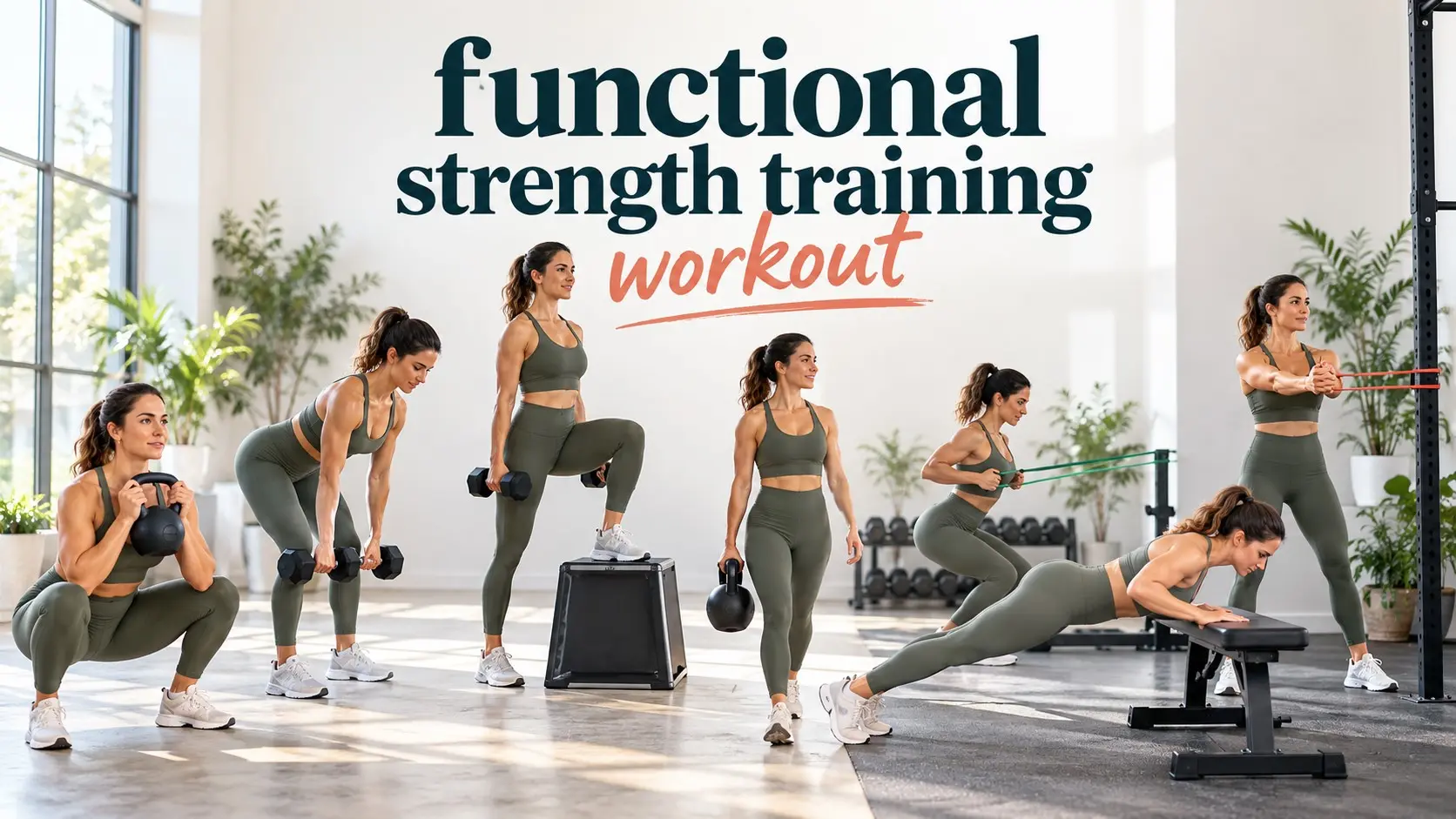
The 9 move functional strength training workout
This plan covers the main jobs your body performs in normal life.
| No. | Movement | Exercise | Sets | Reps or Time | Daily Life Skill |
|---|---|---|---|---|---|
| 1 | Squat | Chair squat or goblet squat | 2 to 3 | 8 to 12 | Sitting and standing |
| 2 | Hinge | Romanian deadlift or backpack hinge | 2 to 3 | 8 to 12 | Lifting from a low position |
| 3 | Push | Incline push up | 2 to 3 | 6 to 12 | Pushing doors and objects |
| 4 | Pull | One arm row or band row | 2 to 3 | 8 to 12 each side | Pulling things toward you |
| 5 | Step | Step up | 2 | 6 to 10 each leg | Stairs and curbs |
| 6 | Single leg control | Reverse lunge | 2 | 6 to 10 each leg | Stepping, kneeling, and balance |
| 7 | Carry | Suitcase carry | 2 to 3 | 20 to 40 seconds each side | Shopping bags and luggage |
| 8 | Trunk control | Pallof press | 2 | 8 to 12 each side | Controlling twisting forces |
| 9 | Overhead push | Dumbbell overhead press | 2 | 6 to 10 | Putting objects on shelves |
If nine exercises feel like too much at first, do the first seven and add the final two later.
The goal is repeatable training, not a perfect first session.
1. Start with a squat you can control
Squatting is one of the most useful functional strength exercises.
You use the same basic pattern when you sit on a chair, stand from a sofa, get onto a toilet, or lower yourself toward the floor.
Begin with a chair squat
Stand in front of a sturdy chair with your feet in a comfortable position. Move your hips back, bend your knees, and lower until you lightly touch the chair.
Stand again by pushing through your feet.
If you need support, use your hands at first. Over time, try to rely on them less.
Progress to a goblet squat
Hold one dumbbell or kettlebell close to your chest.
Squat with the same controlled movement, then stand tall. Choose a weight that makes the final few reps harder without making your form fall apart.
For more lower body options, see the NextFitLife Dumbbell Leg Exercise Guide.
2. Learn a hip hinge before making deadlifts heavy
The hinge teaches you to move through the hips.
You use this pattern when you reach down for a bag, laundry basket, tool, or box.
Practice with no weight
Stand a short distance in front of a wall with your back toward it. Push your hips backward until they touch the wall, then stand tall again.
Your knees can bend a little, but the main movement should come from the hips.
Add a Romanian deadlift
Hold dumbbells, a kettlebell, or a loaded backpack.
Push your hips back while keeping the weight close to your legs. Lower only as far as you can control, then stand tall again.
You do not need to touch the floor.
3. Use incline push ups before forcing floor push ups
A push trains the chest, shoulders, arms, and trunk.
You use pushing strength for doors, shopping carts, furniture, strollers, and getting yourself away from the floor or another surface.
Place your hands on a stable wall, kitchen counter, bench, or other solid surface.
Keep your body long as you bend your elbows and move your chest toward the support. Push away with control.
A higher surface makes the movement easier. A lower surface makes it harder.
You do not need to earn the right to do push ups by struggling on the floor.
4. Rows build useful pulling strength
Pulling is part of opening a heavy door, moving a chair, lifting luggage from a car, or bringing something toward your body.
A one arm dumbbell row is easy to understand and easy to progress.
Support one hand on a stable surface. Hold a dumbbell in the other hand, pull the weight toward your side, then lower it slowly.
If you do not have dumbbells, use a resistance band with a secure anchor.
The NextFitLife Arm Workouts With Weights Guide includes rows and carries that can fit into the same plan.
5. Step ups prepare you for stairs
Walking keeps you moving forward. Stairs ask for more.
A step up builds strength in one leg at a time while you practice balance and control.
Use a low and stable step.
Place one foot on it, push through that foot, and stand tall. Lower yourself slowly and repeat.
Start low.
A smaller step with good control gives you more value than a high step that turns into a jump.
6. Reverse lunges train single leg control
A reverse lunge trains the legs while your feet work in different positions.
That makes it useful for stepping, kneeling, moving around obstacles, and many everyday tasks.
Step one foot behind you. Lower only as far as you can control, then push through the front foot to stand again.
If the movement feels unstable, hold a sturdy support or use step ups instead.
The exercise should match your current ability.
7. Suitcase carries may be the most obvious real life exercise
Life gives you uneven loads all the time.
A bag of shopping is heavier on one side. A suitcase sits in one hand. A tool bag may pull your body sideways.
This is why I like loaded carries.
Hold one dumbbell, kettlebell, or safe heavy bag at your side. Stand tall and walk slowly.
Do not lean away from the weight.
Switch sides and repeat.
This trains grip, posture, walking, and core stability together without turning the exercise into a circus trick.
8. Pallof presses teach your trunk to resist twisting
Your trunk does more than perform crunches.
It also helps stop unwanted twisting and leaning while force moves through your body.
Attach a resistance band beside you at about chest height.
Hold it with both hands near your chest, then press your hands forward while keeping your body facing ahead.
The band will try to turn you.
Your job is to stay still.
That is useful trunk training.
9. Overhead presses prepare you to reach with load
Putting a box onto a shelf is different from pushing a shopping cart.
The arms need to work overhead while your trunk stays controlled.
Use light dumbbells at first.
Start with the weights near shoulder level, press them overhead through a comfortable range, then lower them slowly.
If overhead movement hurts your shoulder, do not force it. Use another pain free pushing movement and get persistent shoulder pain assessed.
How hard should each set feel?
The workout should not feel easy forever.
CDC guidance says muscle strengthening activity should reach a point where doing another rep becomes difficult without help. It also gives 8 to 12 reps as a useful general range and notes that two or three sets can provide added benefit.
You do not need to reach total failure on every set.
For a beginner, I would choose a resistance that becomes clearly harder near the end while still allowing clean movement.
If you finish 12 reps and feel as if you could easily do another 15, increase the challenge next time.
What did the 2026 ACSM update change?
The main lesson is refreshingly simple.
Regular resistance training matters more than finding a perfect program.
The 2026 American College of Sports Medicine position stand reports that many types of resistance exercise improve strength. Free weights, machines, resistance bands, bodyweight exercises, and home training can all work.
For people whose main goal is maximum strength, heavier loads around 80% of one repetition maximum and two or three sets can be useful.
A beginner does not need to test a true one repetition maximum to use this article.
Start with a safe load you can control and progress from there.
Progression turns exercise into training
Doing the same easy workout forever does not give your body much reason to adapt.
You need progressive overload. That simply means making the work a little harder over time.
Do not change everything at once.
| If This Happens | Try This Next | Example |
|---|---|---|
| You reach the top of the rep range easily | Add a little resistance | Use a slightly heavier dumbbell |
| The weight is still hard | Add one rep | Move from 8 reps to 9 |
| The movement is becoming easy | Use a harder version | Move from chair squat to goblet squat |
| Your range is small but comfortable | Increase range slowly | Use a slightly lower chair |
| Two sets feel comfortable | Add another set when useful | Move from 2 sets to 3 |
Small changes are enough.
A simple 8 week progression
Weeks 1 and 2
Learn the movements.
Use two sets for most exercises and choose easy versions. Stop each set while your movement still looks controlled.
Weeks 3 and 4
Build toward three sets on the squat, hinge, push, and row if recovery feels good.
Keep the carry and trunk exercises simple.
Weeks 5 and 6
If you reach the top of your rep range easily, add a little resistance.
After adding weight, your reps may drop again. That is fine.
Weeks 7 and 8
Keep progressing only the moves that are ready.
Your squat may need more weight while your reverse lunge still needs practice with the same load.
Different exercises improve at different speeds.
What does a simple two day plan look like?
| Day | Plan | Goal |
|---|---|---|
| Monday | 9 move workout | Main strength session |
| Tuesday | Easy walking or normal activity | Movement and recovery |
| Wednesday | Mobility or light activity | Comfortable movement |
| Thursday | 9 move workout | Second strength session |
| Weekend | Walking, cycling, hiking, or another activity you enjoy | General fitness |
You can adjust the days.
The important part is giving the same muscles some recovery before you challenge them hard again.
CDC also recommends at least 150 minutes of moderate aerobic activity each week for adults. Strength work and cardio do different jobs, so I would keep both in the bigger fitness plan.
If you are rebuilding your whole fitness routine, see the NextFitLife Beginner Fitness Guide.
Can you do this workout at home?
Yes.
A useful functional fitness workout does not need a large gym.
You can use:
- A sturdy chair
- A backpack
- Resistance bands
- Dumbbells
- A kettlebell
- A stable step
- Your own bodyweight
For home setup ideas, visit the NextFitLife Home Workouts and Equipment Hub.
Do you need kettlebells?
No.
Kettlebells are useful for squats, hinges, presses, and carries, but they are only one tool.
You can train the same basic skills with dumbbells, resistance bands, machines, a backpack, or bodyweight.
The best tool is one you can use safely and make harder over time.
What makes an exercise functional?
It does not need to look like a daily task in every detail.
A useful exercise should improve a quality you need, such as strength, balance, grip, trunk control, or the ability to move a load.
This means a normal row can be functional.
A simple squat can be functional.
A calf raise can also be useful if weak calves are limiting your movement.
Do not reject an exercise because it looks too basic.
Do isolation exercises belong in functional training?
Yes, when they solve a real problem.
A biceps curl builds elbow strength. A calf raise builds calf strength. A hamstring curl targets the back of the thigh.
I would simply avoid making small single muscle exercises the whole program if your goal is a full body strength workout.
Use the major movement patterns as the base, then add smaller exercises where they help.
How can you tell if the workout is helping real life?
This is where I think many functional training articles stop too early.
Do not judge the program only by the dumbbell number.
Look at normal life too.
Ask yourself:
- Is standing from a low chair easier?
- Can you carry shopping with better posture?
- Do stairs feel easier?
- Can you lift a bag from the floor with more control?
- Does walking with a load feel steadier?
- Can you move to and from the floor more easily?
Those are useful changes.
Use this simple Real Life Strength Scorecard
This is a personal tracking tool, not a medical test.
Check the same four tasks before you begin, then check again after several weeks.
| Task | What to Notice | Progress May Look Like |
|---|---|---|
| Chair stand | How much effort it takes to stand | Less hand support or better control |
| Carry | Grip, posture, and comfort with the same bag | Same load feels easier |
| Step | Balance and effort on the same stair | Smoother movement and less effort |
| Floor movement | How easy it is to lower and rise when safe | More control or less support |
Use the same setup each time so the comparison means something.
Does functional training work for older adults?
Yes, and daily function becomes an especially useful goal as we age.
A 2026 systematic review found that functional task exercise improved activities of daily living and mobility in community living older adults when compared with control groups.
The same review did not show that functional task exercise was better than normal strength training for every mobility outcome.
That is a useful reality check.
Functional training works, but normal strength training works too.
Older adults should also include balance work. Current public health guidance recommends strength activity at least twice per week, while balance focused activity becomes more important for older adults.
For gentle mobility and balance ideas, see the NextFitLife Yoga, Flexibility, and Mobility Hub.
What if you are starting from zero?
Make the movements easier.
You do not need a different type of training.
- Squat to a high chair.
- Push against a wall.
- Hinge with no weight.
- Use a light resistance band for rows.
- Step onto a very low platform.
- Carry a light bag.
- Use a gentle band for the Pallof press.
Then build from there.
This is what functional training for beginners should look like: the same useful movement patterns at an easier level.
What if you have no equipment?
You can still train most of the patterns.
Use chair squats, wall push ups, bodyweight hinges, stair step ups, supported lunges, and controlled floor movements.
A backpack filled with a safe amount of weight can add resistance for squats, hinges, and carries.
Do not overload household items that were not made to hold heavy weight.
Should functional training include balance work?
Yes, but balance does not need to turn every exercise into a wobble challenge.
Step ups, lunges, carries, and controlled single leg work already ask your body to manage balance.
Direct balance training can be added when it matches your needs.
For example, an older adult worried about falls may need more direct balance work than a younger adult training mainly for lifting and carrying.
Why I would not start on unstable surfaces
An unstable surface makes an exercise harder to control.
That does not always make it better.
If your goal is to build strength, a stable floor lets you produce force with less distraction.
Balance pads and unstable tools can have a place in some programs, but I would not use them just to make a basic squat look more advanced.
Simple is not the enemy.
Five mistakes that make functional training less useful
- Making every exercise complicated. One clear movement is usually easier to load and track.
- Moving too fast. Strength work needs enough control that the target muscles can do meaningful work.
- Never increasing the challenge. If the workout stays very easy, strength gains will slow.
- Copying an advanced athlete. Your workout should match your body and your goals.
- Ignoring pain. A useful exercise does not need to hurt.
How long does a functional strength workout take?
A full session does not need to take all evening.
For many people, two sets of the nine moves with sensible rest can fit into about 30 to 45 minutes. The exact time depends on your pace, setup, rest, and exercise choices.
If time is short, do six or seven main movements and come back to the smaller pieces later.
Consistency beats one giant workout followed by two weeks off.
Should you turn this into a circuit?
You can, but you do not have to.
Moving quickly between exercises can make the session feel more like conditioning. That is useful if fitness and time efficiency are major goals.
If strength is the main goal, give yourself enough rest that the next set still has good quality.
I would rather see a strong controlled set than a rushed set done with a weight that is too light to challenge you.
What if an exercise hurts?
Hard work and pain are not the same thing.
Muscles can feel tired and challenged. Sharp, sudden, or worsening pain is different.
Reduce the load, change the range, or choose another exercise.
If pain keeps returning, get individual advice from a qualified healthcare or exercise professional.
This matters even more if you have a recent injury, joint disease, surgery, osteoporosis, neurological problems, heart disease, pregnancy, fainting, or another condition that can change exercise safety.
Do you need a warm up?
A short warm up is useful before loaded movement.
You can walk for a few minutes, move your main joints through comfortable ranges, then practice the first exercise with little or no weight.
Your warm up should prepare you.
It does not need to become a second workout.
What I would do this week
Do not try to master all nine movements in one perfect session.
Pick a version of each exercise that you can control.
Train twice this week. Write down your reps, sets, and resistance. Next week, look for one movement that is ready for a small increase.
That is how a functional strength training workout becomes useful strength rather than another list of exercises you tried once.
Conclusion
A functional strength training workout should make daily movement easier. You do not need fancy equipment or complex combinations. Build your squat, hinge, push, pull, step, lunge, carry, trunk control, and overhead strength, then progress them slowly.
Start with two sessions this week. Record what you do, repeat the same basic movements, and make one small change when they become easier. That simple process is what turns exercise into strength you can use.
Related NextFitLife Guides and Hubs
- Home Workouts and Equipment Hub for bodyweight, dumbbell, kettlebell, resistance band, and small space training.
- Strength Training Exercises at Home for Beginners for simpler starting versions.
- Leg Exercises With Dumbbells for squats, lunges, step ups, hinges, and lower body strength.
- Arm Workouts With Weights for rows, carries, pressing, and arm strength.
- How to Get Fit Safely for a broader beginner fitness plan.
- Yoga, Flexibility, and Mobility Hub for mobility, balance, stretching, and recovery work.
References and Sources
- Centers for Disease Control and Prevention, Adult Activity: An Overview
https://www.cdc.gov/physical-activity-basics/guidelines/adults.html
- Centers for Disease Control and Prevention, What Counts as Physical Activity for Adults
https://www.cdc.gov/physical-activity-basics/adding-adults/what-counts.html
- American College of Sports Medicine, 2026 Resistance Training Position Stand
https://acsm.org/science-spotlight-acsm-releases-new-position-stand-on-resistance-training/
- World Health Organization, Physical Activity
https://www.who.int/initiatives/behealthy/physical-activity/
- van der Veen R, et al. Effectiveness of Functional Tasks Exercise on Functional Ability in Community Dwelling Older Adults, 2026
https://pubmed.ncbi.nlm.nih.gov/42107163/
About the Author
Adel Galal is the founder and lead writer at NextFitLife. He has more than 30 years of personal interest in health, fitness, nutrition, wellness, and healthy aging, along with more than 15 years of health and wellness writing and research communication experience.
His professional background includes information technology management, data analysis, structured research, planning, and information management. He uses those skills to compare fitness claims with current exercise and public health guidance, identify weak or exaggerated claims, and explain useful ideas in plain language.
Adel is not a doctor, physical therapist, certified athletic trainer, sports medicine physician, registered dietitian, certified personal trainer, strength and conditioning coach, or other licensed healthcare professional.
NextFitLife fitness content is for education. It does not replace medical care, physical therapy, rehabilitation, or an individual exercise program.
Learn more about Adel Galal, NextFitLife, and the site's editorial standards on the About Us page.
Frequently Asked Questions
What is a functional strength training workout?
It is a strength workout built around movements that support everyday tasks, such as squatting, lifting, pushing, pulling, stepping, carrying, and controlling your trunk.
How many days a week should I do functional strength training?
Two full body sessions each week is a good starting point for many healthy beginners. Current public health guidance recommends muscle strengthening activity on at least two days per week.
What are the best functional strength exercises?
Useful choices include squats, Romanian deadlifts, push ups, rows, step ups, lunges, suitcase carries, Pallof presses, and overhead presses.
Can beginners do functional strength training?
Yes. Beginners can use chair squats, wall push ups, bodyweight hinges, low step ups, light carries, and resistance band exercises before adding more load.
Can I do functional strength training at home?
Yes. A chair, resistance band, backpack, dumbbells, kettlebell, stable step, and bodyweight are enough for many useful exercises.
Is functional strength training better than normal strength training?
Not in every situation. Functional exercises can improve daily tasks, while traditional strength training also builds useful strength. A good program can use both.
How many sets and reps should I do?
A practical starting point is two sets of about 8 to 12 controlled reps for many exercises. Add another set or more resistance when the workout becomes easier.
How do I make functional exercises harder?
You can add a little weight, add a rep, use a harder version, increase the range of motion, or add another set. Change one thing at a time.
Does functional training build muscle?
It can. Muscles grow when they receive enough resistance, training volume, food, and recovery. A functional exercise does not stop working simply because it also helps a daily movement.
Is functional strength training good for older adults?
Yes. Strength and task based training can support daily function, mobility, and independence. Older adults may also benefit from direct balance work.
Do I need kettlebells for functional training?
No. Dumbbells, resistance bands, machines, bodyweight, barbells, and safe household loads can all be used.
How long should a functional strength workout take?
Many full body sessions can fit into about 30 to 45 minutes, but there is no required length. Exercise quality and steady progression matter more than stretching the workout to a fixed time.

Health & wellness writer with 30+ years of experience in nutrition, fitness, and healthy aging. Founder of NextFitLife.com — evidence-based health guidance.