Published on: October 6, 2026
Written and source-checked by: Adel Galal, Founder and Lead Writer at NextFitLife
Medical review status: This article has not been medically reviewed by a physician, physical therapist, certified athletic trainer, or other licensed healthcare professional.
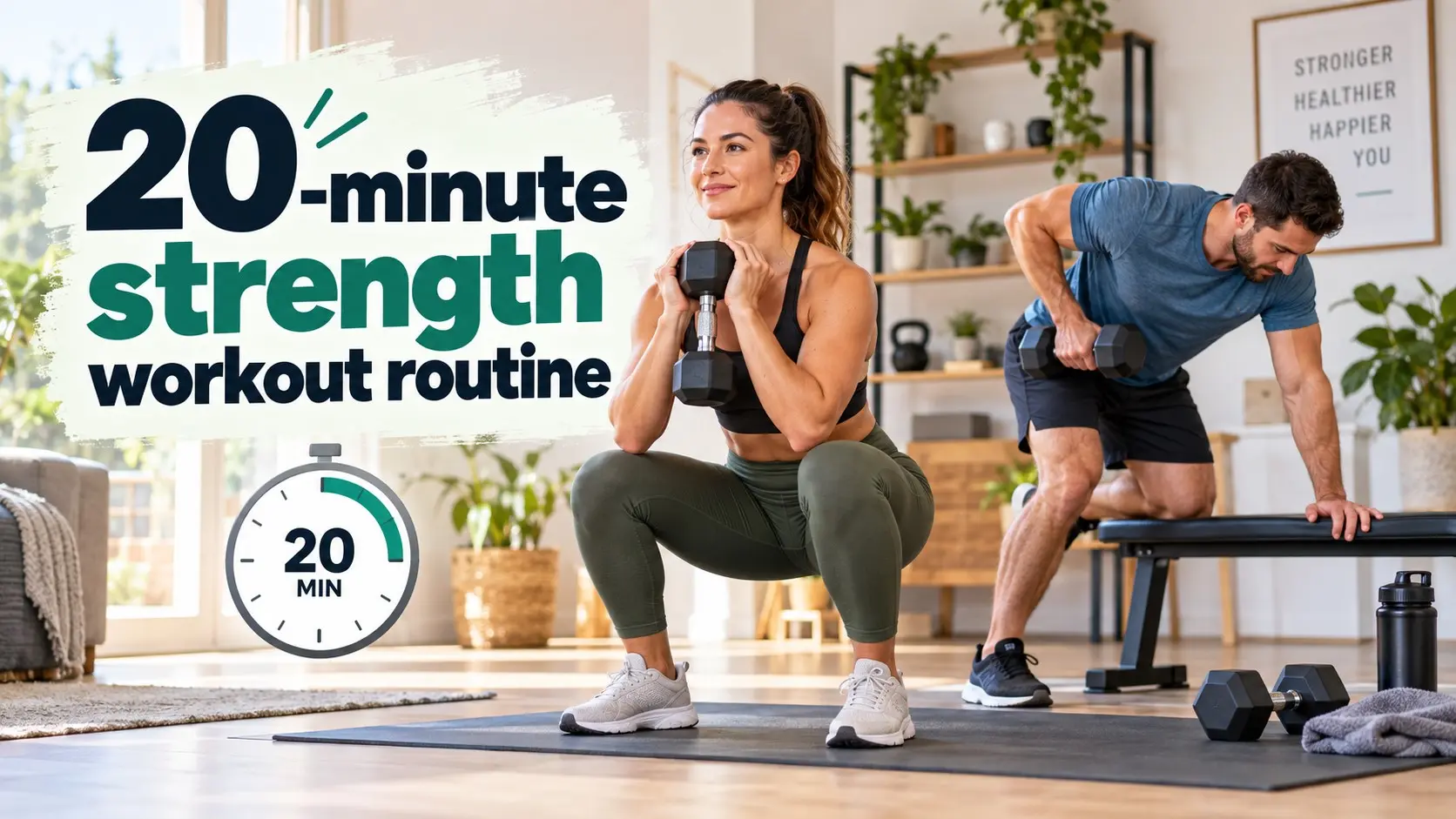
A good 20-minute strength workout routine does not need twenty exercises. Seven well-chosen movements can train your legs, hips, chest, back, shoulders, arms, grip, and core. Use resistance that feels challenging, keep your form controlled, rest when the set is finished, and make the routine gradually harder as you become stronger.
Twenty minutes is short, but it does not have to feel rushed. The goal is a focused full-body workout, not twenty minutes of random exercises that leave you tired without giving you a clear way to improve.
This article is for general information and education. It does not replace medical advice, diagnosis, or treatment.
Exercise safety: Stop exercising and seek prompt medical help for chest pain, fainting, severe dizziness, sudden weakness, or severe or unusual shortness of breath. Stop a specific exercise if it causes sharp or severe pain. If you have a chronic medical condition, recent surgery, significant joint problems, or a disability that affects exercise, ask a qualified healthcare or exercise professional what type and amount of activity are appropriate for you.
Table of Contents
- Can 20 Minutes Build Strength?
- Equipment You Need
- The Full 20 Minute Plan
- Three minute movement preparation
- Seven strength exercises
- Second round
- Three minute finish
- How Heavy Should You Lift?
- How to Progress
- Weekly Training Plan
- Beginner Options
- No Equipment Options
- Strength Versus Cardio
- Common Mistakes
- Frequently Asked Questions
Can a 20 minute strength workout really work?
Yes, if the twenty minutes contain real resistance training rather than endless rushed movement.
The current Centers for Disease Control and Prevention guidance recommends muscle strengthening activity on at least two days each week. The work should involve the major muscle groups of the legs, hips, back, chest, abdomen, shoulders, and arms.
The American College of Sports Medicine also released a major resistance training update in 2026. After reviewing 137 systematic reviews covering more than 30,000 participants, ACSM concluded that progressive resistance training improves strength, muscle size, power, endurance, balance, and several measures of physical function.
The message for everyday exercisers is reassuring: complicated programming is not required to make progress.
Consistency matters.
Effort matters.
Exercise progression matters.
A routine does not become better simply because it contains more exercises.
For a broader introduction to training at home, visit the NextFitLife Home Workouts and Equipment Guide.
What makes this a strength workout instead of cardio?
The difference is not whether you sweat.
You can sweat during strength training, and you can perform resistance exercises quickly enough to raise your heart rate. But the main purpose here is to challenge your muscles against resistance and improve what they can produce over time.
That means you need enough resistance to make the working repetitions meaningful.
It also means rest is allowed.
If you turn every break into jumping jacks, mountain climbers, or burpees, you may make the workout harder to breathe through while making it harder to use enough resistance for strength.
Harder is not always better.
More specific is better.
What equipment do you need?
The main routine uses a pair of dumbbells.
You also need:
- A stable chair, bench, or countertop for modifications
- A small clear workout area
- A timer
- Comfortable footwear if you prefer to train in shoes
One dumbbell can work for several movements, and a securely loaded backpack can replace weights for some exercises.
If you are building a simple training setup, the NextFitLife Home Workouts Guide covers useful equipment without requiring a full home gym.
The complete 20-minute strength workout
| Time | Exercise | Target | Main Focus |
|---|---|---|---|
| 0:00 to 3:00 | Movement preparation | Easy controlled movement | Prepare for the exercises |
| 3:00 to 4:00 | Goblet squat | 8 to 12 reps | Legs and hips |
| 4:00 to 5:00 | Romanian deadlift | 8 to 12 reps | Glutes and hamstrings |
| 5:00 to 6:00 | Push up | 6 to 12 reps | Chest, shoulders, triceps |
| 6:00 to 7:00 | Dumbbell row | 8 to 12 reps | Back and biceps |
| 7:00 to 8:00 | Reverse lunge | 5 to 6 reps each side | Legs, hips, balance |
| 8:00 to 9:00 | Overhead press | 6 to 10 reps | Shoulders and triceps |
| 9:00 to 10:00 | Suitcase march | 20 seconds each side | Core, grip, posture |
| 10:00 to 17:00 | Repeat all seven exercises | Second controlled round | Full body strength |
| 17:00 to 20:00 | Easy finish | Walk and move gently | Bring effort down gradually |
Each strength exercise gets one minute.
Perform the target repetitions with control, then rest for the remaining time before the next minute starts.
That rest is intentional.
Do not fill every spare second with another exercise.
Minutes 0 to 3: prepare without tiring yourself out
You do not need a separate fifteen-minute warm-up for a twenty-minute session.
You do need enough movement to make the first working set feel familiar.
Minute 1: easy march and arm movement
March in place at a comfortable pace.
Let your arms swing, then add several comfortable shoulder circles.
Minute 2: squat and hip hinge practice
Alternate a few controlled bodyweight squats with several slow hip hinges.
Keep the range comfortable.
Minute 3: reverse lunge and incline push up
Perform several easy supported reverse lunges or split squats, then finish the minute with a few wall or countertop push ups.
This is movement practice, not a fitness test.
1. Goblet squat: 8 to 12 repetitions
The goblet squat is the main knee dominant leg movement in this routine.
Hold one dumbbell close to your chest.
Stand with your feet in a comfortable position, brace your trunk gently, then bend your knees and hips to lower yourself.
Push through the floor and return to standing.
What does it train?
- Quadriceps
- Glutes
- Adductors
- Core muscles that help stabilize the trunk
Beginner option
Squat toward a stable chair.
Use the chair to help control your depth rather than dropping onto the seat.
How to progress
Once 12 controlled repetitions feel comfortable in both rounds, increase the resistance slightly rather than simply performing dozens of extra repetitions.
For more leg exercise options, see Leg Exercises With Dumbbells.
2. Romanian deadlift: 8 to 12 repetitions
The Romanian deadlift trains the hip hinge pattern.
Hold the dumbbells in front of your thighs.
Keep a small bend in your knees and push your hips backward while the weights travel close to your legs.
Stop when you reach a comfortable stretch through the hamstrings, then drive your hips forward and stand tall.
What does it train?
- Hamstrings
- Glutes
- Grip
- Trunk and back muscles that stabilize the movement
Do not turn the movement into a deep squat.
Your hips should move backward while your knees stay softly bent.
3. Push-up: 6 to 12 repetitions
Push-ups give this workout a horizontal pushing movement.
Use whichever version lets you control every repetition.
That could be:
- Wall push-up
- Countertop push-up
- Bench push-up
- Floor push-up
Keep your body controlled and lower yourself as one unit.
Press away without letting your hips sag.
What does it train?
- Chest
- Triceps
- Front of the shoulders
- Core
A higher incline is not cheating.
It is how you select the right resistance for your current strength.
4. Dumbbell row: 8 to 12 repetitions
A useful full-body workout needs pulling as well as pushing.
Hold a dumbbell in each hand and hinge forward with a stable trunk.
Let your arms hang beneath your shoulders, then pull your elbows toward your ribs.
Lower the weights under control.
What does it train?
- Upper back
- Lats
- Rear shoulders
- Biceps
- Grip
Keep your neck relaxed and avoid turning every repetition into a shoulder shrug.
This is one reason a pair of dumbbells or a resistance band makes home strength training more complete. Pulling movements are harder to load progressively with bodyweight alone.
5. Reverse lunge: 5 to 6 repetitions per side
The reverse lunge adds single-leg work and a balance challenge.
Stand tall, step one foot backward, and lower under control.
Push through the front foot to return to standing.
Switch sides.
What does it train?
- Quadriceps
- Glutes
- Hamstrings
- Core
- Balance
Beginner option
Hold a stable chair, countertop, or wall for support.
You can also use a stationary split squat and keep both feet planted.
If lunges do not feel good on your joints, choose a pain-free squat variation instead of forcing them.
6. Standing overhead press: 6 to 10 repetitions
The overhead press trains vertical pushing.
Hold the dumbbells near shoulder height, brace your trunk, then press the weights overhead.
Lower them with control.
Avoid leaning far backward to finish the repetition.
What does it train?
- Shoulders
- Triceps
- Upper chest
- Core stability
If overhead pressing causes shoulder pain, do not force the exact movement.
A comfortable incline push up or another pain free pressing variation is a better choice.
7. Suitcase march: 20 seconds per side
The suitcase march looks simple until the weight gets appropriately challenging.
Hold one dumbbell beside your body like a suitcase.
Stand tall and slowly march in place without leaning toward or away from the weight.
Switch hands after about 20 seconds.
What does it train?
- Core stability
- Grip
- Hips
- Balance
- Postural control
If you have safe walking space, turn it into a suitcase carry.
If you do not have a weight, a controlled dead bug is a good core alternative. The NextFitLife Core Workouts at Home Guide has more beginner-friendly core options.
Repeat the seven exercises once
Round two begins at minute 10.
Repeat the exercises in the same order.
The second round does not need more repetitions than the first.
Your target is repeatable quality.
If your second round turns into a race because you are tired, reduce the repetitions or weight enough to restore control.
Minutes 17 to 20: finish without making it a bonus workout
Use the final three minutes to let your effort come down.
Minute 18
Walk slowly around the room or march gently in place.
Minute 19
Move your shoulders, chest, and upper back through comfortable ranges.
Minute 20
Use easy hip and leg movement while your breathing settles.
Nothing needs to be forced.
Twenty minutes means twenty minutes.
You do not need a secret finisher.
How heavy should the dumbbells be?
This matters more than the color of your dumbbells or the number printed on somebody else's set.
The resistance should let you complete the planned repetitions with good control while making the final repetitions feel challenging.
CDC guidance suggests 8 to 12 repetitions as a useful general range for muscle strengthening activity and describes useful effort as reaching a point where another repetition becomes difficult.
Current ACSM guidance adds an important nuance: training all the way to momentary muscular failure is not required for most healthy adults to make progress.
Use a weight that makes you work.
Do not use a weight that makes every repetition a grind.
A practical load test
If you finish 12 repetitions and feel as though you could easily do many more, increase the resistance when practical.
If you cannot reach the bottom of the planned range without losing form, reduce the load or use an easier exercise variation.
The right resistance lives between those two extremes.
Do you need to train to failure?
No.
That is one of the useful takeaways from the updated 2026 ACSM position stand.
The evidence review found that training to momentary muscular fatigue did not consistently improve resistance training outcomes for healthy adults.
This does not mean sets should feel effortless.
It means you do not have to turn every squat, row, or press into the hardest repetition of your life.
Stop while your form is still controlled.
How do you make a 20-minute workout harder over time?
Use progressive overload.
The phrase sounds technical, but the idea is simple: as your body adapts, gradually increase the challenge.
For this routine, I would use a simple double progression method.
Step 1: build the repetitions
Imagine your goblet squat target is 8 to 12 repetitions.
Your first week may look like this:
- Round 1: 8 reps
- Round 2: 8 reps
Over the next few sessions, you gradually reach:
- Round 1: 12 reps
- Round 2: 12 reps
Step 2: increase resistance
Once the top of the range feels controlled and no longer very challenging, increase the weight slightly.
Your repetitions may fall back toward eight.
Build them up again.
That is progress.
What if you cannot increase the dumbbell weight?
You still have options.
You can:
- Add a repetition within the planned range
- Use a slightly harder exercise variation
- Increase your comfortable range of motion
- Use a heavier backpack
- Use a stronger resistance band
- Improve control and remove unnecessary momentum
Do not make every exercise slower and slower forever just to create difficulty.
The goal remains useful resistance training, not making one squat last a minute.
A simple four week progression plan
| Week | Main Goal | What to Change |
|---|---|---|
| Week 1 | Learn the routine | Find comfortable exercise variations and sensible starting weights |
| Week 2 | Add controlled work | Add a repetition where the current load feels manageable |
| Week 3 | Reach the top of the range | Work toward the upper rep target while form stays controlled |
| Week 4 | Increase selected loads | Add resistance only to exercises where the old load has become comfortable |
Write down the weights and repetitions you use.
Progress is much easier to see when you record it.
How often should you do this workout?
Twice each week is a practical starting point.
CDC recommends at least two days of muscle strengthening activity each week.
ACSM's current resistance training guidance also supports training the major muscle groups at least twice weekly.
A simple schedule could look like this:
- Monday: 20-minute strength routine
- Thursday: 20-minute strength routine
If you enjoy strength training and recover well, you can add another session.
Short workouts do not mean recovery stops mattering.
Why twice weekly instead of cramming everything into one day?
A twenty-minute session has limited training volume.
Repeating it later in the week gives the muscles another useful training exposure without requiring one long workout.
ACSM's 2026 position stand found that strength outcomes were enhanced when resistance training was performed at least twice weekly.
That fits the purpose of this routine well.
Is this enough exercise for the whole week?
It is a useful strength plan.
It is not the whole physical activity recommendation.
Current U.S. guidance recommends adults get at least 150 to 300 minutes of moderate-intensity aerobic activity each week, or 75 to 150 minutes of vigorous activity, plus muscle strengthening on at least two days.
Walking works very well alongside this routine.
A simple week could include two short strength sessions plus regular brisk walking, cycling, swimming, or another aerobic activity you enjoy.
For a wider fitness plan, see How to Get Fit Fast.
What should a complete strength routine train?
A practical full body workout should cover the important movement patterns rather than simply collect random exercises.
| Movement Pattern | Exercise in This Routine |
|---|---|
| Squat | Goblet squat |
| Hip hinge | Romanian deadlift |
| Horizontal push | Push up |
| Pull | Dumbbell row |
| Single leg | Reverse lunge |
| Vertical push | Overhead press |
| Carry and core | Suitcase march |
This is why seven movements are enough for the main plan.
Each one has a job.
What if you are a complete beginner?
Keep the structure and make the movements easier.
You do not need a separate beginner philosophy.
| Main Exercise | Beginner Option |
|---|---|
| Goblet squat | Chair squat with bodyweight or a light weight |
| Romanian deadlift | Bodyweight hip hinge or light dumbbells |
| Floor push up | Wall or countertop push up |
| Dumbbell row | Light dumbbells or resistance band row |
| Reverse lunge | Supported split squat or chair squat |
| Overhead press | Light dumbbells or comfortable incline push-up |
| Suitcase march | Unweighted standing march near a chair |
Use a smaller comfortable range of motion when needed.
Support your balance.
Stop the set before technique starts to fall apart.
The goal of the first few sessions is learning something you can repeat.
What if you do not own dumbbells?
You can still start a 20 minute full body workout at home.
Options include:
- Chair squats
- Bodyweight split squats
- Incline push-ups
- Bodyweight hip hinges
- Loaded backpack squats
- Loaded backpack Romanian deadlifts
- Backpack rows
- Resistance band rows
- Dead bugs
- Suitcase carries with a safe household load
ACSM's current guidance notes that bodyweight exercises, resistance bands, free weights, and home-based programs can all improve resistance training outcomes.
The biggest weakness in a completely equipment-free routine is usually pulling.
A resistance band or safely loaded object makes back training much easier to progress.
What if you are already experienced?
Do not assume the answer is adding fifteen more exercises.
Use heavier resistance.
Keep enough rest to maintain performance.
Track your loads.
Progress the exercises when they become too easy.
An experienced lifter may even prefer five movements rather than seven so the main exercises can be loaded more heavily.
The twenty-minute limit is a constraint, not a rule that every second must contain motion.
Can a 20-minute workout build muscle too?
Yes, it can contribute to muscle growth.
Resistance training can increase muscle size as well as strength.
However, a minimalist two-day routine may not provide the amount of weekly training volume someone wants when maximizing muscle growth is the main goal.
The 2026 ACSM position stand found greater hypertrophy with higher weekly training volumes, with roughly 10 or more weekly sets per muscle group highlighted in the evidence synthesis.
That does not make this routine too short.
It simply means goals matter.
For general strength, fitness, and a practical schedule, twenty focused minutes can be very useful.
For maximizing muscle size, you may eventually want more weekly sets.
Should you use heavier or lighter weights?
Both can train muscle, but the goal changes the best choice.
ACSM's 2026 evidence review found that heavier loads were especially helpful for maximizing strength.
You do not need to test your one-repetition maximum before starting this plan.
Use resistance that lets you stay within the suggested range with controlled technique.
As you become more experienced, you can gradually use heavier loads for selected exercises.
Why is the row so important?
Many short home workouts are full of pushing.
Push-ups.
Overhead presses.
Planks.
Then the back gets almost nothing.
The dumbbell row balances the routine by adding a clear pulling movement.
That is one reason I would rather use a pair of light dumbbells or a band than insist that a useful workout must be completely equipment-free.
Why I would not make every workout “no repeat”
A no-repeat workout can be fun.
It can also make progression harder to track.
If you perform a completely different set of movements every session, it becomes difficult to answer simple questions:
- Did my squat get stronger?
- Did my row weight increase?
- Can I now do a lower push-up angle?
- Did the same weight become easier?
Some repetition is useful.
You do not need boredom.
You do need enough consistency to measure progress.
Seven mistakes that weaken a short strength workout
1. Using resistance that is far too light
If every set feels like part of the warm-up, the workout may not provide enough challenge.
Increase resistance or use a harder variation.
2. Treating every rest period as wasted time
Rest helps you use meaningful resistance and maintain good technique.
You do not need to earn the next exercise with burpees.
3. Racing the timer
A minute is a time limit, not a command to move faster.
Complete the planned repetitions with control, then rest.
4. Forgetting pulling exercises
A useful routine should train the back as well as the chest and shoulders.
Keep the row.
5. Changing every exercise every week
Novelty is entertaining.
Progressive overload needs enough consistency for comparison.
6. Taking every set to complete failure
Challenging sets are useful.
Complete muscular failure is not required for the average healthy adult to make progress, according to current ACSM evidence.
7. Never recording what you did
Write down your weights and repetitions.
Your notebook does not need to be sophisticated.
It only needs to tell you what happened last time.
What if you only have ten minutes?
Do one round.
Keep the main movement patterns and move on with your day.
Current physical activity guidance makes an important point: some activity is better than none.
A missed twenty-minute session does not have to become zero minutes simply because your schedule changed.
Ten focused minutes can still be useful.
What if the routine feels easy after a month?
That is a good problem.
Do not automatically add more exercises.
Progress one variable.
You might:
- Increase the dumbbell weight
- Use a lower push-up surface
- Move from 8 reps toward 12
- Use a heavier backpack
- Use a stronger band
- Use a more challenging squat variation
- Carry a heavier weight during the suitcase movement
One clear progression is better than random difficulty.
When should you modify or stop an exercise?
Normal muscular effort, warmth, and fatigue are different from sharp pain.
Modify or stop the movement if you develop:
- Sharp or severe joint pain
- Sudden weakness
- Loss of control
- Dizziness
- Faintness
- Unusual severe shortness of breath
- Chest pain
For chest pain, fainting, sudden severe breathing problems, or other possible emergency symptoms, stop exercising and seek appropriate medical care.
If you live with heart disease, arthritis, diabetes, a disability, or another chronic condition that changes exercise tolerance, CDC recommends discussing suitable activity with a healthcare professional or physical activity specialist.
Is soreness required after the workout?
No.
Soreness is not the scorecard.
A good session can produce little next-day soreness, especially after your body becomes used to the movements.
Track performance instead.
Are you using more resistance?
Are your repetitions cleaner?
Can you use a harder exercise variation?
That tells you more about progress than how difficult stairs feel the next morning.
Can older adults use this routine?
Many of the movement patterns can be adapted for older adults, but the exercise version should match balance, joint comfort, health conditions, and current ability.
Useful modifications include:
- Chair squats
- Countertop push-ups
- Supported split squats
- Light rows
- Standing marches near a stable support
Adults age 65 and older are also advised to include balance activities alongside aerobic and muscle strengthening exercise.
If you are new to exercise or have health concerns, choose conservative starting options and get professional guidance when appropriate.
Conclusion
Use this 20-minute strength workout routine twice a week for the next four weeks before deciding that you need a longer or more complicated program.
Write down your weights and repetitions. When you can reach the top of a rep range with clean form and the set no longer feels meaningfully challenging, make that exercise slightly harder.
Do not measure a successful workout by how exhausted you feel afterward. Measure whether those same twenty minutes are gradually making you stronger.
Internal Links and NextFitLife Fitness Hub
Home Workouts and Equipment Guide
for bodyweight exercise, dumbbells, resistance bands, home workout setup, progression, and practical equipment choices.
Core Workouts at Home
for dead bugs, bird dogs, carries, standing core work, beginner modifications, and balance friendly options.
Leg Exercises With Dumbbells
For squats, lunges, hip-dominant exercises, lower body strength, and dumbbell progression.
How to Get Fit Fast
For realistic fitness planning, cardio, strength training, recovery, and building a consistent routine.
NextFitLife Fitness Hub
For home workouts, strength, core training, mobility, flexibility, cardio, and practical fitness guides.
References and Sources
- American College of Sports Medicine. ACSM Unveils Landmark 2026 Resistance Training Guidelines.
https://acsm.org/resistance-training-guidelines-update-2026/
- Currier BS, D'Souza AC, Fiatarone Singh MA, et al. American College of Sports Medicine Position Stand: Resistance Training Prescription for Muscle Function, Hypertrophy, and Physical Performance in Healthy Adults. 2026.
https://pmc.ncbi.nlm.nih.gov/articles/PMC12965823/
- Centers for Disease Control and Prevention. What You Can Do to Meet Physical Activity Recommendations.
https://www.cdc.gov/physical-activity-basics/guidelines/index.html
- Centers for Disease Control and Prevention. What Counts as Physical Activity for Adults.
https://www.cdc.gov/physical-activity-basics/adding-adults/what-counts.html
- U.S. Office of Disease Prevention and Health Promotion. Physical Activity Guidelines for Americans.
https://odphp.health.gov/our-work/nutrition-physical-activity/physical-activity-guidelines/current-guidelines
About the Author
Adel Galal is the Founder and Lead Writer at NextFitLife. He researches practical health, fitness, nutrition, home exercise, strength training, mobility, and healthy aging topics using government guidance, exercise science, and professional health and fitness sources.
His approach to workout content is practical: choose movements that have a clear purpose, make them suitable for the reader's current ability, explain how to progress them, and avoid promising that one short routine can replace every part of a complete fitness plan.
Adel is not a physician, physical therapist, certified athletic trainer, or other licensed healthcare professional. This article was researched, source-checked editorially and has not been independently medically reviewed by a licensed clinician.
Learn more about Adel Galal, NextFitLife, and its editorial approach on the About Us page.
Medical Disclaimer: I am not a dermatologist or A doctor, and this content does not replace professional medical advice. This article explains published guidance and does not provide a personal clinical assessment. Always consult qualified medical professionals for diagnosis and treatment of any health condition.
Frequently Asked Questions
Can a 20-minute strength workout build strength?
Yes. A short workout can build strength when the exercises challenge the major muscle groups, resistance increases as you improve, and you train consistently. A twenty-minute routine does not need many exercises to be useful.
How often should I do this 20-minute strength workout routine?
Two sessions each week are a practical starting point. Current CDC and ACSM guidance recommends muscle strengthening activity for the major muscle groups on at least two days each week.
What equipment do I need for the workout?
The main routine uses a pair of dumbbells, a stable chair or countertop for modifications, a timer, and a small clear exercise space. Resistance bands or a securely loaded backpack can replace dumbbells for some movements.
What are the seven exercises in the routine?
The seven movements are a goblet squat, Romanian deadlift, push-up, dumbbell row, reverse lunge, overhead press, and suitcase march. Together they cover squatting, hinging, pushing, pulling, single-leg work, overhead pressing, grip, and core stability.
How heavy should my dumbbells be?
Use resistance that lets you complete the planned repetitions with controlled form while making the final repetitions feel challenging. Increase the load when you can reach the top of the rep range comfortably in both rounds.
Do I need to train to failure?
No. Current ACSM evidence does not show that training every set to momentary muscular failure is required for the average healthy adult. Your sets should still feel challenging while your technique remains controlled.
Is 8 to 12 repetitions good for strength training?
CDC uses 8 to 12 repetitions as a practical general range for muscle strengthening activities. Different goals can use other ranges, but 8 to 12 works well for a simple general strength routine.
Can beginners do this 20-minute workout?
Yes. Beginners can use chair squats, wall or countertop push-ups, light dumbbells, supported split squats, and unweighted marches. Start with exercise versions you can control and make them harder gradually.
Can I do the routine without dumbbells?
Yes. Bodyweight exercises, resistance bands, and a securely loaded backpack can provide resistance. Pulling movements are harder to train without equipment, so a resistance band or loadable object is especially useful.
Does a 20-minute strength workout count as cardio?
The workout may raise your heart rate, but it should not replace your entire aerobic activity plan. Current U.S. guidance recommends aerobic activity in addition to muscle strengthening exercise.
Can this 20-minute routine build muscle?
Yes, it can contribute to muscle growth if the sets are challenging and resistance progresses. Someone trying to maximize muscle size may eventually need more weekly training volume than this minimalist routine provides.
What should I do when the workout becomes too easy?
Increase one variable at a time. You can add resistance, move toward the top of the rep range, use a harder exercise variation, or increase the load in a backpack or resistance band.
What if I only have ten minutes?
Do one round of the main exercises. Some physical activity is better than none, and a shortened session is more useful than skipping training simply because the full twenty minutes are unavailable.
Should I be sore after every strength workout?
No. Muscle soreness is not required for progress. Track strength, exercise control, repetitions, and resistance instead of judging a session by how sore you feel the next day.
When should I stop exercising?
Stop a movement if it causes sharp or severe pain. Stop exercising and seek appropriate medical care for chest pain, fainting, severe dizziness, sudden weakness, or severe or unusual breathing difficulty.