Published on: October 21, 2026
Updated on: October 21, 2026
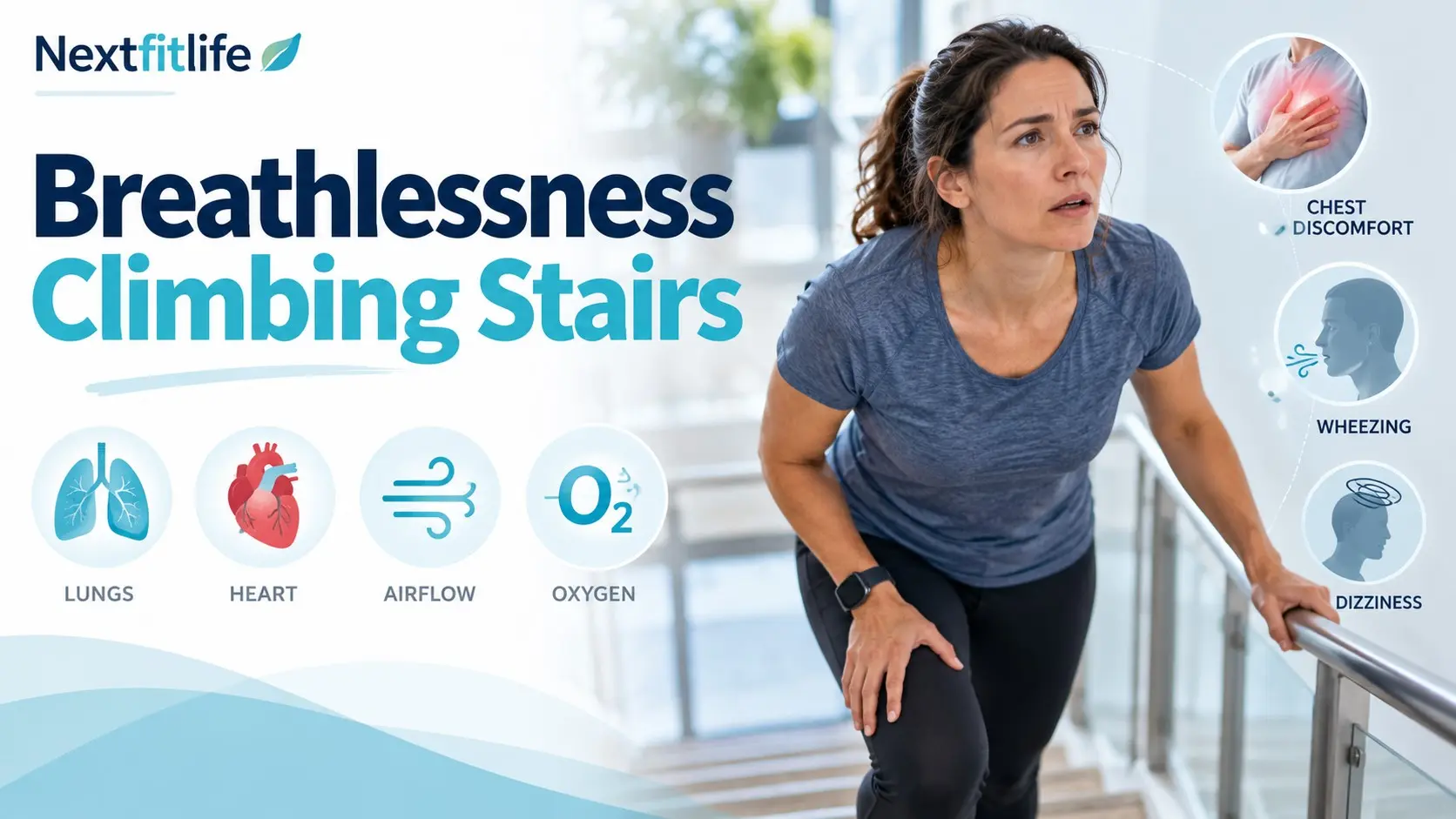
Breathlessness climbing stairs is not automatically a sign that something is wrong. Stairs demand much more work than flat walking because your legs are lifting your body against gravity.
The more useful question is this: Has the same staircase become harder than it used to be?
Quick answer: Breathlessness climbing stairs can come from low fitness, recent inactivity, asthma, anemia, excess body weight, heart disease, lung disease, or several other causes. Mild breathlessness after hard effort can be normal. New, worsening, or disproportionate symptoms, especially with chest pain, fainting, blue lips, coughing blood, palpitations, or one swollen leg, need medical attention.
Medical note: This article is for general information and education. It does not replace medical advice, diagnosis, or treatment.
I am not a dermatologist or a doctor, and this content does not replace professional medical advice. What I share comes from real life experience, extensive research, and consultation with healthcare providers. Always consult qualified medical professionals for diagnosis and treatment of any health condition.
Get Urgent Help for These Breathing Warning Signs
Do not wait to see whether the next staircase feels better if breathing suddenly becomes severe.
Seek emergency medical help if you have:
- Severe difficulty breathing
- Gasping or inability to speak normally
- A tight or heavy chest
- Chest pain spreading to the arm, back, neck, or jaw
- Blue, gray, or very pale lips or skin
- Fainting
- Sudden confusion
- Coughing up significant blood
- Sudden breathlessness with one swollen or painful leg
These symptoms can point to serious heart or lung problems and need prompt assessment.
Table of Contents
- Why stairs make breathing harder
- 12 critical clues
- Normal effort versus warning signs
- Fitness and deconditioning
- Asthma and airway narrowing
- Anemia and iron deficiency
- Heart causes
- Lung causes
- Blood clot warning signs
- What oxygen readings can and cannot tell you
- Questions for your clinician
- Tests that may be used
- Exercise and recovery
- Frequently asked questions
- References and Sources
Why Do Stairs Make You Breathe Harder?
Walking on a flat floor moves your body mainly forward.
Climbing stairs also moves it upward. Your thigh and hip muscles work harder, so they need more oxygen and energy.
Your heart responds by pumping more blood. Your lungs increase ventilation, and your breathing becomes faster and deeper.
Some increase in breathing is therefore expected.
MedlinePlus notes that some people feel breathless even with mild exercise such as climbing stairs without having a medical disorder. It also points out that breathlessness is subjective, which is why your own change over time matters so much.
12 Critical Clues That Help Explain Breathlessness on Stairs
1. The Same Staircase Is Harder Than Before
This is the clue I would pay attention to first.
Imagine you have climbed the same two flights to your office for three years.
You used to reach the top without stopping. Now you pause halfway and need a minute to recover.
That change from your normal exercise tolerance matters more than comparing yourself with another person.
New or steadily worsening breathlessness deserves assessment even if you still feel fine while sitting down.
2. You Have Been Much Less Active
Deconditioning is common after illness, surgery, injury, bed rest, or a long period of inactivity.
Your muscles become less efficient, and ordinary tasks cost more effort.
Stairs expose that quickly.
If the change began after months of reduced activity and improves as fitness returns, deconditioning becomes more likely.
Still, do not use poor fitness to explain a sudden unexplained decline.
3. You Wheeze or Cough During or After the Stairs
That shifts attention toward the airways.
Asthma can cause shortness of breath, cough, wheeze, and chest tightness.
Exercise, cold air, allergens, and respiratory infections can trigger symptoms.
You may notice that stairs feel worse outdoors in cold air, during pollen season, or after a recent cold.
If breathlessness comes without obvious wheezing, asthma can still be possible. Read our Silent Asthma guide for less typical patterns.
4. Exercise Itself Triggers Airway Narrowing
Some people mainly develop breathing symptoms during or shortly after physical effort.
This is called exercise induced bronchoconstriction.
Possible clues include:
- Cough after exercise
- Chest tightness
- Wheezing
- Shortness of breath
- A drop in exercise performance
Symptoms alone cannot confirm the diagnosis.
Lung function testing or exercise related breathing tests may be needed.
5. You Feel Tired, Weak, Dizzy, or Pale
Think about the blood as well as the lungs.
Anemia means there are too few healthy red blood cells or too little hemoglobin to carry oxygen normally.
Possible symptoms include:
- Shortness of breath
- Fatigue
- Weakness
- Dizziness
- Headache
- Palpitations
Iron deficiency becomes more relevant if you also have heavy menstrual bleeding, gastrointestinal blood loss, pregnancy, poor iron intake, or recent surgery.
A blood test is much more useful than trying to diagnose iron deficiency from stair symptoms alone.
6. You Have Chest Pressure or a Clear Drop in Exercise Capacity
The heart also has to work harder on stairs.
Possible cardiac causes of dyspnea on exertion include:
- Coronary artery disease
- Heart failure
- Heart valve disease
- Cardiomyopathy
- Abnormal heart rhythms
Breathlessness can sometimes be a heart symptom even when dramatic chest pain is absent.
If stairs produce chest pressure, heaviness, spreading pain, unusual sweating, nausea, or a sudden major drop in stamina, get medical advice.
Read our Chest Pain After Exercise guide for warning patterns that should not be pushed through.
7. Your Ankles Swell or You Are Breathless Lying Flat
This is a different pattern from simple poor fitness.
Heart failure can cause breathlessness during activity as well as:
- Ankle swelling
- Unusual fatigue
- Difficulty breathing while lying flat
- Waking during the night short of breath
- Palpitations
- Reduced ability to exercise
Breathlessness when lying flat is called orthopnea.
One symptom does not diagnose heart failure, but the combination deserves medical assessment.
8. Your Heart Races, Flutters, or Feels Irregular
Sometimes the strongest clue is your pulse.
A heart rhythm problem can reduce how efficiently the heart pumps during activity.
You might feel:
- Racing
- Fluttering
- Skipped beats
- Pounding
- Lightheadedness
- Sudden weakness
Palpitations with breathlessness, chest pain, dizziness, or fainting need prompt attention.
For normal pulse ranges and exercise patterns, see our Heart Rate Guide.
9. You Have a Chronic Cough, Phlegm, or Smoking History
That raises different lung questions.
COPD can cause progressive shortness of breath, chronic cough, sputum, wheezing, and reduced exercise capacity.
Other chronic lung diseases can also first show up as breathlessness during activity.
Interstitial lung disease, for example, may begin with shortness of breath during stairs or exercise and a persistent dry cough.
If breathing symptoms occur with cough, phlegm, or wheeze, our Lung Inflammation Symptoms guide gives a broader symptom overview.
10. You Are Recovering From a Chest Infection
Your usual capacity can fall after a respiratory illness.
Cough, airway irritation, fatigue, and several days of reduced activity can make stairs feel harder during recovery.
The important question is whether things are steadily improving.
New or worsening breathlessness after an infection deserves attention, especially with fever, chest pain, low oxygen readings, or a worsening cough.
If colored mucus is part of the picture, see our Green Phlegm Without Fever guide.
11. Your Body Is Doing More Mechanical Work
Moving more body mass upward requires more work.
That can make stairs more demanding.
But body weight should never become an automatic explanation for new symptoms.
A person with overweight can still have asthma, anemia, heart disease, lung disease, or another treatable condition.
If the change is new, “lose weight” is not a diagnosis.
12. Your Recovery Pattern Has Changed
What happens at the top of the stairs can tell you almost as much as the climb itself.
Do your breathing and heart rate start settling promptly?
Or do you remain very breathless for several minutes?
Do you need to sit down?
Do you become dizzy, wheezy, or develop chest pain?
Two people can both say, “I get breathless on stairs,” yet have very different patterns.
Recovery is part of the story.
When Is Breathlessness on Stairs Less Concerning?
Mild breathlessness is more reassuring when it:
- Appears only with harder effort
- Has not changed from your normal
- Settles quickly after you stop
- Does not come with chest pain
- Does not cause dizziness or fainting
- Does not come with wheezing
- Does not limit normal flat walking
There is no universal flight count that proves a person is healthy.
A young runner carrying groceries, an older adult after surgery, and someone with asthma are doing very different physiological work even if the staircase looks identical.
Could Breathlessness Climbing Stairs Be Heart Failure?
Yes, but stair breathlessness alone does not diagnose it.
The American Heart Association lists shortness of breath during everyday activity among the common symptoms of heart failure.
The possibility becomes more important when breathlessness comes with:
- Swelling of the feet or ankles
- Persistent fatigue
- Breathlessness while lying flat
- Waking up short of breath
- A persistent cough
- Palpitations
- A clear decline in exercise capacity
A clinician may use an examination, blood tests, ECG, chest imaging, echocardiography, or other testing depending on the situation.
Could It Be Coronary Artery Disease Without Obvious Chest Pain?
Yes.
Reduced blood flow to the heart can cause exertional symptoms, and not everybody describes classic chest pain.
Some people mainly notice:
- Breathlessness
- Unusual fatigue
- Chest heaviness
- Reduced exercise tolerance
The concern rises if you also have cardiovascular risk factors such as smoking, diabetes, high blood pressure, high cholesterol, known vascular disease, or a strong family history.
Could a Blood Clot Cause Sudden Breathlessness?
Yes.
A pulmonary embolism is a blood clot that blocks blood flow in the lungs.
It is much less common than simple deconditioning, but it can be dangerous.
Seek urgent medical help for sudden unexplained breathlessness, especially when it comes with:
- Chest pain
- Coughing blood
- A fast heartbeat
- Fainting
- Pain or swelling in one leg
Do not test yourself by repeatedly climbing stairs when these symptoms are present.
Can Anxiety Make Stair Breathlessness Worse?
Yes.
Anxiety can change breathing and make the feeling of breathlessness much stronger.
A common cycle looks like this:
You feel short of breath, become worried, start breathing faster and higher in the chest, then feel even more breathless.
But anxiety should not become the automatic explanation for a new decline in exercise capacity.
Medical and psychological causes can also exist together.
For the wider stress connection, see our Stress and Heart Health guide.
What If My Oxygen Reading Is Normal?
A normal resting oxygen saturation does not explain why you are breathless.
Several conditions can cause exertional breathlessness while resting oxygen still appears normal, including:
- Anemia
- Asthma
- Some heart rhythm problems
- Early cardiovascular disease
- Deconditioning
A pulse oximeter is one piece of information.
It is not a home test that rules out every heart or lung condition.
What If I Am Only Breathless on Stairs?
That pattern makes sense because stairs create a higher workload than flat walking.
It does not automatically mean disease.
But if stairs have become clearly harder while normal walking still feels easy, tell your clinician exactly that.
It helps define the point at which symptoms begin.
Clinicians sometimes call this your functional or exertional threshold.
Do Not Turn Stair Count Into a Home Stress Test
Concrete information is helpful.
Repeatedly pushing yourself until you are very breathless is not.
Instead of telling a clinician:
“I get breathless sometimes.”
Give a description such as:
“I can walk normally on level ground, but after one flight of about 15 stairs I have to stop. My breathing takes around two minutes to settle.”
That gives the clinician far more useful information.
Questions to Answer Before You See a Clinician
| Question | Why It Helps |
|---|---|
| When did it start? | Sudden and gradual breathlessness have different cause patterns |
| Is it getting worse? | Progression matters more than comparing yourself with someone else |
| What triggers it? | Stairs, hills, flat walking, carrying loads, and rest suggest different thresholds |
| How fast do you recover? | Recovery adds context to severity |
| Do you wheeze or cough? | This can shift attention toward airway or lung causes |
| Do you have chest pain? | Exertional chest discomfort needs careful assessment |
| Do you feel palpitations? | Rhythm problems can cause exertional symptoms |
| Are your ankles swollen? | This can be relevant to heart and fluid problems |
| Are you breathless lying flat? | Orthopnea is an important clinical clue |
| Have you been bleeding? | Heavy periods or gastrointestinal blood loss can contribute to anemia |
| Did any medicine change? | Some medicines affect heart rate, blood pressure, strength, or breathing |
| Do you smoke or vape? | Exposure history changes the lung and cardiovascular assessment |
What Tests Might a Clinician Use?
There is no single “breathlessness test.”
The history and examination guide the next step.
Assessment may include:
- Heart rate
- Blood pressure
- Oxygen saturation
- Heart and lung examination
- Complete blood count
- Iron studies when appropriate
- ECG
- Chest X ray
- Lung function testing
- Echocardiogram
- Selected exercise testing
Not everybody needs all these tests.
Someone with classic asthma symptoms has a different workup from someone with ankle swelling and orthopnea.
Can Exercise Testing Help?
Sometimes.
When ordinary heart and lung tests do not explain exertional symptoms, selected people may undergo exercise testing.
Cardiopulmonary exercise testing measures how the heart, lungs, muscles, and circulation respond while the workload increases.
It can help separate cardiovascular, respiratory, and fitness limitations in selected cases.
This is a clinical test, not something to reproduce by running up your staircase until you feel ill.
Should You Exercise More If You Get Winded on Stairs?
If deconditioning is the main problem, gradual activity can improve fitness.
But do not use this logic:
“I am breathless, so I need to push harder.”
First ask whether the symptom is stable and expected.
New, worsening, severe, or unexplained breathlessness needs evaluation before you train through it.
If exercise is appropriate, a gradual plan works better than sudden hard sessions.
Our Run Walk Method guide gives a simple way to build aerobic capacity without making every session hard.
A Familiar Staircase Can Track Progress After Assessment
Once a serious cause has been considered and exercise is appropriate, an ordinary daily task can show whether fitness is improving.
Use the same familiar flight of stairs.
Do not race it.
Notice:
- Whether you need to stop
- How hard the breathing feels
- How quickly you recover
- Whether you can speak comfortably afterward
Over several weeks of suitable training, the same task may feel easier.
That is a better sign than trying to beat a stair record every day.
Can Breathing Techniques Help on Stairs?
They can help some people control symptoms, especially when a chronic lung condition has already been diagnosed.
Paced breathing means coordinating the breath with the activity instead of holding your breath or rushing.
Pursed lip breathing is also used by some people with COPD to slow breathing and reduce air trapping.
These techniques can make movement easier.
They do not explain why unexplained breathlessness began.
Common Mistakes With Breathlessness on Stairs
Mistake 1: Blaming Age Automatically
Age affects fitness, but a clear new decline should not be dismissed as “just getting older.”
Mistake 2: Blaming Weight Automatically
Body weight changes the workload, but medical causes can exist at any body size.
Mistake 3: Assuming Normal Oxygen Means Everything Is Fine
A resting pulse oximeter cannot rule out every cause of exertional breathlessness.
Mistake 4: Calling Every Case Anxiety
Anxiety can worsen breathlessness but should not be used to dismiss a new physical change.
Mistake 5: Testing Yourself Repeatedly on Stairs
You do not need to provoke severe symptoms to prove they exist.
Mistake 6: Ignoring Recovery Time
How you feel after the climb matters.
Mistake 7: Forgetting Medication Changes
Bring an up to date medicine list to your appointment.
Mistake 8: Waiting for Chest Pain Before Thinking About the Heart
Some heart conditions can cause exertional breathlessness or unusual fatigue without classic pain.
Conclusion: Compare the Stairs With Your Own Baseline
The most useful way to judge breathlessness climbing stairs is not to count how many flights another person can climb.
Compare the activity with your own normal.
If the same stairs have become clearly harder, or symptoms now include chest discomfort, wheezing, palpitations, dizziness, swelling, unusual fatigue, coughing blood, or breathlessness at rest, arrange medical assessment.
Your next step: write down what triggers the breathlessness, when it began, whether it is worsening, how quickly you recover, and what other symptoms appear. Bring that pattern to your clinician. It is much more useful than simply saying, “I get winded on stairs.”
Internal Links + Hub
- Lung Inflammation Symptoms
- Silent Asthma
- Chest Pain After Exercise
- Green Phlegm Without Fever
- Heart Rate Guide
- Stress and Heart Health
- Run Walk Method
- Heart Health 101
About the Author
Adel Galal is a father of four, three sons and a daughter, and a grandfather of four, with 33 years of hands on parenting experience. He is the founder of Parnthub.com, based in Cairo, Egypt, where he shares practical guidance on feeding, development and family life from newborns to teenagers.
Adel is not a medical professional. Health articles cite trusted sources and are for general information only.
For more information about NextFitLife, its editorial approach, and content standards, visit the NextFitLife About Us page.
Frequently Asked Questions About Breathlessness Climbing Stairs
Is it normal to get breathless climbing stairs?
A mild increase in breathing can be normal because stairs require more work than flat walking. A new or worsening decline from your usual ability, especially with other symptoms, deserves medical assessment.
Why am I suddenly out of breath going upstairs?
Possible causes include recent inactivity, asthma, anemia, infection, heart or lung problems, abnormal heart rhythm, or other conditions. Sudden unexplained breathlessness needs more attention than a long standing stable pattern.
Can being unfit cause breathlessness on stairs?
Yes. Deconditioning makes your muscles and cardiovascular system less efficient, so stairs can feel harder. Do not assume poor fitness explains a new or rapidly worsening change without considering other causes.
Can anemia make me breathless climbing stairs?
Yes. Anemia reduces the blood's ability to carry oxygen and can cause shortness of breath, fatigue, weakness, dizziness, headache, and palpitations.
Can heart problems cause breathlessness without chest pain?
Yes. Some heart conditions can cause shortness of breath, unusual fatigue, palpitations, or reduced exercise tolerance without classic chest pain.
Can asthma cause breathlessness only when climbing stairs?
Yes. Exercise can trigger asthma symptoms or exercise induced bronchoconstriction. Cough, wheeze, chest tightness, cold air triggers, or symptoms after exercise are useful clues.
Why am I breathless on stairs but fine walking?
Stairs create a higher workload because your muscles must lift your body upward. Mild breathlessness may be normal, but a new change from your usual stair tolerance still deserves attention.
Does normal oxygen saturation mean my breathlessness is harmless?
No. Resting oxygen saturation can be normal with anemia, asthma, some heart problems, rhythm disorders, and deconditioning. A pulse oximeter does not identify every cause of shortness of breath.
When should breathlessness on stairs be checked by a doctor?
Arrange medical review when breathlessness is new, worsening, out of proportion to the effort, slow to settle, or associated with chest discomfort, wheezing, palpitations, swelling, dizziness, unusual fatigue, or reduced normal activity.
When is breathlessness an emergency?
Seek emergency help for severe breathing difficulty, inability to speak normally, a tight or heavy chest, spreading chest pain, blue or gray lips, fainting, sudden confusion, coughing significant blood, or sudden breathlessness with one painful swollen leg.
What should I tell my clinician about stair breathlessness?
Describe when it began, whether it is getting worse, how many stairs trigger it, whether flat walking is affected, how long recovery takes, and whether you have chest pain, wheeze, cough, palpitations, swelling, bleeding, or recent medicine changes.
Can exercise improve breathlessness caused by low fitness?
Yes. Gradual aerobic and strength training can improve deconditioning when exercise is medically appropriate. New or unexplained breathlessness should be assessed before you try to push through it.
References and Sources
- NHS. Shortness of Breath.https://www.nhs.uk/symptoms/shortness-of-breath/
- MedlinePlus. Breathing Difficulty.https://medlineplus.gov/ency/article/003075.htm
- American Heart Association. Heart Failure Signs and Symptoms.https://www.heart.org/en/health-topics/heart-failure/warning-signs-of-heart-failure
- American Heart Association. Diagnosing Heart Failure.https://www.heart.org/en/health-topics/heart-failure/diagnosing-heart-failure
- National Heart, Lung, and Blood Institute. Asthma Symptoms.https://www.nhlbi.nih.gov/health/asthma/symptoms
- National Heart, Lung, and Blood Institute. Anemia.https://www.nhlbi.nih.gov/health/anemia
- British Heart Foundation. Shortness of Breath: Why It Happens and Tips to Manage It.https://www.bhf.org.uk/informationsupport/heart-matters-magazine/medical/shortness-of-breath
Medical disclaimer: I am not a dermatologist or a doctor, and this content does not replace professional medical advice. What I share comes from real life experience, extensive research, and consultation with healthcare providers. Always consult qualified medical professionals for diagnosis and treatment of any health condition.

Health & wellness writer with 30+ years of experience in nutrition, fitness, and healthy aging. Founder of NextFitLife.com — evidence-based health guidance.