
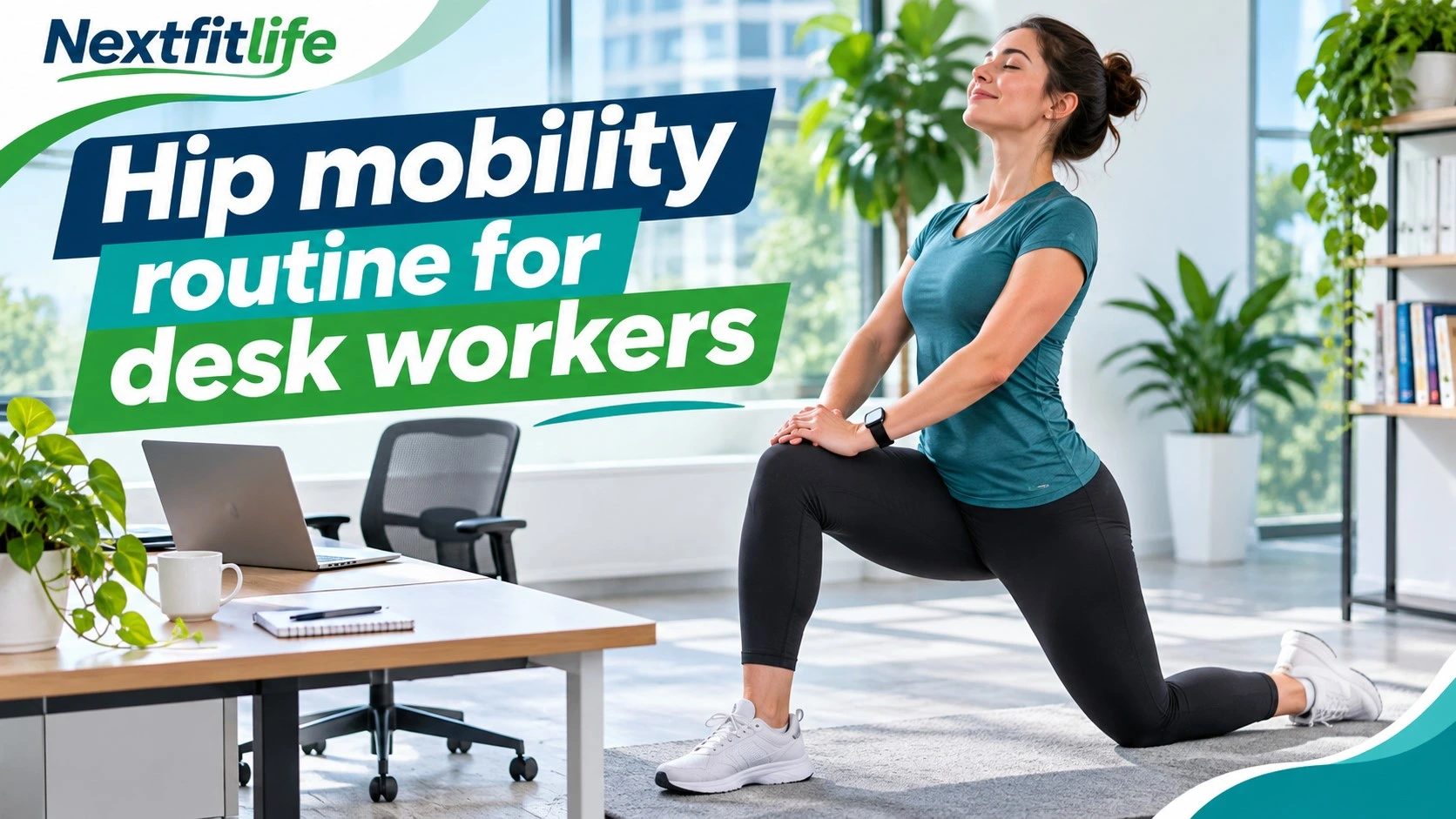
A useful hip mobility routine for desk workers should do more than stretch the front of your hips. Long hours in one position are better answered with movement variety, comfortable hip rotation, a little stretching, and enough strength to control the range you have.
You do not need extreme flexibility. You need hips that feel comfortable when you stand, walk, squat, climb stairs, and move after a long work block.
Quick Answer
A hip mobility routine for desk workers should combine walking breaks, hip flexor stretching, hip rotation, inner thigh mobility, glute work, and controlled sit to stands. Use the seven moves below after long periods of sitting, but stop for sharp pain, numbness, major weakness, or worsening symptoms.
Sitting itself is not the enemy. Staying almost completely still for hours is the bigger problem.
That is why this guide does not promise that one stretch will “undo” a desk job. The better plan is to interrupt long sitting, then train the hips through useful ranges.
This article is for general information and education. It does not replace medical advice, diagnosis, or treatment.
Do not stretch through serious symptoms
Get medical advice for severe or worsening hip pain, a hot or swollen joint, fever with hip pain, inability to bear weight after an injury, new numbness, or loss of feeling. Persistent pain that disrupts normal activity or sleep also deserves assessment.
If you want a wider plan for rebuilding fitness, use the How to Get Fit Guide. It covers cardio, strength, mobility, recovery, and gradual progression in one framework.
What You Will Learn
- Why hips often feel stiff after desk work
- Why hip flexor stretching alone is incomplete
- Seven simple mobility and strength moves
- How often to break up prolonged sitting
- Why strength belongs in a mobility plan
- How to modify the routine at the office
- How to tell stiffness from symptoms that need assessment
Table of Contents
- Why Hips Feel Stiff After Sitting
- 1. Walking Reset
- 2. Hip Flexor Stretch
- 3. 90/90 Hip Switches
- 4. Adductor Rock Back
- 5. Figure Four Stretch
- 6. Glute Bridge
- 7. Sit to Stand
- Full Routine
- How Often to Move
- Stretching vs Strength
- Two Minute Office Reset
- Weekly Desk Worker Plan
- Common Mistakes
- When to Seek Care
- Conclusion
- References and Sources
- Internal Links and Hub
- About the Author
- Frequently Asked Questions
Why Do Your Hips Feel Stiff After Sitting?
A desk keeps the hips in a similar position for a long time. Then you stand and immediately ask them to extend, rotate, stabilize the pelvis, and help you walk.
That first transition can feel stiff.
Research has found an association between high sitting time, low physical activity, and reduced passive hip extension. That research was observational, though, so it does not prove that sitting permanently shortened anyone's hip flexors.
The practical lesson:
Your hips are not automatically damaged because they feel stiff after work. In many cases they simply need more position changes, more movement variety, and enough strength to use that movement well.
Stop Blaming Every Stiff Hip on the Hip Flexors
This is where desk mobility advice becomes too simple.
You feel tight, so you stretch the hip flexors. That can feel good, but the hips also need hip rotation, inner thigh motion, glute strength, and general movement.
Sometimes what feels like tightness is also pain or guarding. Stretching harder is not automatically the right answer.
The routine below therefore moves through several directions instead of attacking one muscle for ten minutes.
1. Start With a Walking Reset
Before you get on the floor, walk for about two minutes.
Let your arms swing and use normal steps. You do not need to exaggerate your stride.
This matters because your first response to prolonged sitting should usually be movement, not an aggressive stretch.
Workplace research supports active breaks and changes of posture as practical ways to reduce long periods of sedentary behaviour.
Simple rule:
If you have been sitting for a long block, walk before you decide that every tight feeling needs stretching.
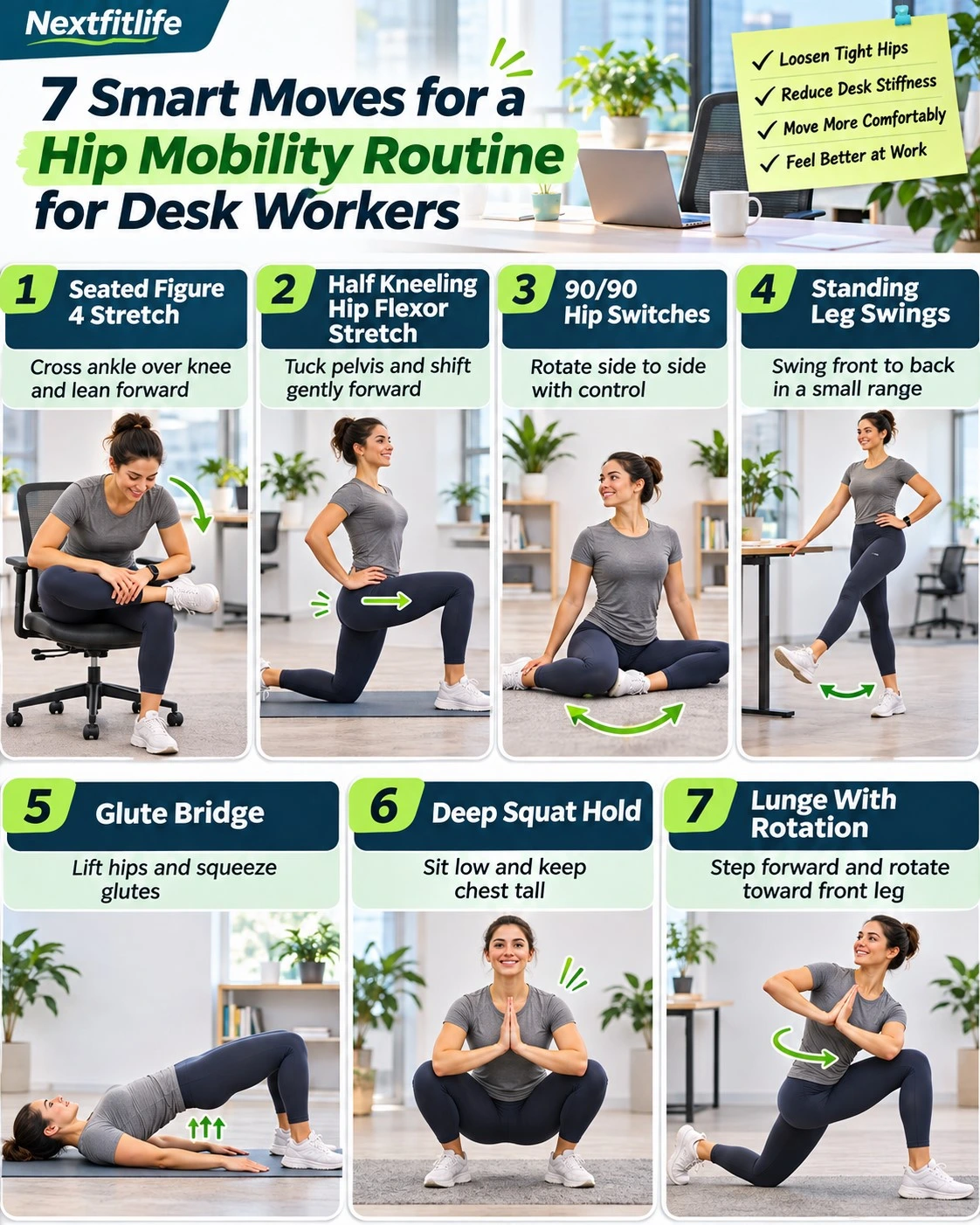
2. Half Kneeling Hip Flexor Stretch
Kneel on one knee with the other foot in front.
Keep your torso tall and gently tuck the pelvis. Then shift forward only far enough to feel a mild stretch at the front of the hip on the kneeling side.
Hold for about 20 to 30 seconds, switch sides, and repeat once if it feels comfortable.
What Not to Do
Do not create the movement by throwing the lower back into a deep arch.
You are trying to open the front of the hip, not bend farther through the spine.
3. Use 90/90 Hip Switches for Rotation
Sit on the floor with both knees bent and your feet wider than your hips.
Let both knees move gently toward one side, return through the middle, then move toward the other side.
Use your hands behind you for support if needed.
Try 6 to 10 controlled 90/90 hip switches.
This move matters because the hip is not simply a hinge that moves forward and backward. It also rotates, and desk work gives that motion very little variety.
If the floor position feels uncomfortable, sit on a cushion or keep more weight through your hands.
4. Add an Adductor Rock Back
Start on your hands and knees.
Extend one leg to the side with the foot supported. Slowly shift the hips backward until you feel mild tension through the inner thigh, then return forward.
Try 6 to 10 slow repetitions on each side.
This works the adductors, which many desk routines ignore completely.
You do not need a deep frog stretch. Controlled movement is enough.
5. Use a Seated Figure Four Stretch
Sit near the front of a stable chair.
Place one ankle across the opposite thigh. Stay tall, then hinge forward slightly until you feel a gentle stretch around the outer hip or buttock.
Hold for 20 to 30 seconds and switch sides.
Do not force the bent knee toward the floor.
If the position causes joint pain in the hip or knee, skip it rather than trying to “open” the joint by force.
6. Add Glute Bridges Instead of Stretching Everything
Lie on your back with your knees bent and feet supported.
Press through the feet and lift the hips into a comfortable bridge. Pause briefly, then lower under control.
Try 8 to 15 repetitions.
This introduces glute strength into the routine.
That matters because improving range of motion is only one piece of mobility. You also need enough control and strength to use the range.
Why strength belongs here:
Research comparing resistance training with stretching has found that both can improve range of motion. Mobility does not need to mean passive stretching only.
For a full strength plan, use the Strength Training for Desk Workers Guide. It trains the whole body rather than promising that one corrective move can undo a desk job.
7. Finish With Controlled Sit-to-Stands
Use a stable chair.
Plant both feet, lean forward slightly, stand up, then sit down under control.
Try 8 to 12 repetitions.
This movement looks ordinary because it is ordinary. That is exactly why it belongs here.
A sit-to-stand trains the hips through a task you already do every day, so the mobility work ends with useful movement rather than another passive stretch.
The Full Hip Mobility Routine at a Glance
| Move | Main Job | Starting Amount |
|---|---|---|
| 1. Walking reset | Break prolonged sitting | About 2 minutes |
| 2. Hip flexor stretch | Comfortable hip extension | 20 to 30 seconds each side |
| 3. 90/90 switches | Hip rotation | 6 to 10 controlled switches |
| 4. Adductor rock back | Inner thigh mobility | 6 to 10 each side |
| 5. Figure four stretch | Outer hip comfort | 20 to 30 seconds each side |
| 6. Glute bridge | Hip strength and control | 8 to 15 reps |
| 7. Sit to stand | Functional hip motion | 8 to 12 reps |
One round is enough to start.
If your hips feel better afterward, you do not need to keep stretching simply because more exercises are available.
How Long Should the Routine Take?
About 8 to 12 minutes for most people.
You can also split it across the day.
For example, use the walking reset and a standing hip movement during work, then complete the floor exercises later at home.
That may be more useful than waiting until the end of a long desk day to move for the first time.
How Often Should Desk Workers Move?
There is no single perfect timer for everyone.
The practical goal is to avoid sitting almost motionless for hours at a time.
Recent research on computer prompt programs shows that reminders can reduce workplace sitting and increase daily steps. That supports the use of reminders, but it does not prove that one exact break schedule prevents hip pain.
Use Natural Breaks
- Stand during some phone calls.
- Walk to get water.
- Take stairs when practical.
- Walk for a minute after a long meeting.
- Use one or two mobility moves after a long uninterrupted work block.
The goal is movement breaks, not obedience to a stopwatch.
Do Hip Flexors Need Stretching Every Day?
No universal rule says they do.
Static stretching can improve flexibility, but more stretching does not create unlimited gains. A large systematic review found benefits from static stretching while also showing that gains tend to plateau.
Use a hip flexor stretch when it feels useful and comfortable.
If you have stretched the same area for weeks and nothing changes, stop assuming the answer is simply to stretch harder.
Why Strength Belongs in a Mobility Plan
A desk routine that contains only stretches is incomplete.
Active mobility means being able to move through a useful range and control it.
Resistance training can improve range of motion while also making the muscles around the hip stronger.
For desk workers, useful lower body strength movements include squats, split squats, step ups, hip hinges, bridges, and hip thrusts.
You do not need all of those in this short routine. Two or more proper strength sessions each week can handle the bigger job.
The current Strength Training for Desk Workers: 9 Smart Moves guide gives you a complete two day framework.
Hip Mobility vs Hip Flexibility
These words overlap, but they are not identical.
| Term | Simple Meaning | Example |
|---|---|---|
| Flexibility | How far tissues and joints can move | Holding a hip flexor stretch |
| Mobility | Using a range with control | 90/90 switches or a controlled squat |
| Strength | Producing force through that range | Bridge, split squat, or step up |
That is why the best desk routine contains all three ideas instead of stretching alone.
Is Sitting Really Shortening Your Hip Flexors?
Be careful with this claim.
Sitting places the hip in flexion and long periods of low activity are associated with reduced hip extension in some research.
That does not prove every office worker has permanently shortened hip flexors.
So I would not diagnose yourself because a stretch feels tight.
If a stretch helps, use it. If weeks of stretching change nothing, reconsider the assumption.
What If One Hip Feels Much Tighter?
Small differences between sides are common.
Do not automatically double the stretching on the side that feels worse.
First ask whether the difference feels like simple stiffness, limited rotation, weakness, pinching, or actual pain.
A persistent difference that is painful or changes the way you walk deserves more attention.
Can Better Hip Mobility Fix Back Pain?
Sometimes hip movement feels helpful when the lower back is stiff, but that does not mean every case of back pain comes from tight hips.
Research on office workers shows a mixed relationship between sitting behavior and lower back pain. Static sitting and fewer posture changes may matter, but the problem is more complex than “desk equals tight hips equals back pain.”
If back pain persists, spreads down a leg, causes numbness or weakness, or keeps getting worse, get it assessed.
Do You Need a Standing Desk?
No.
A sit to stand desk can make position changes easier, but standing motionless for hours is still very little movement.
The real target is variety.
Sit for a while, stand when useful, walk, change position, then sit again if that feels comfortable.
Do You Need Deep Squat Holds?
No.
A supported deep squat can be a useful drill when your hips, knees, ankles, and back tolerate it.
It is not a universal mobility test.
If it creates hip pinching, knee pain, or back pain, skip it. You already have seven useful exercises that do not require an extreme squat position.
Can You Do the Routine at the Office?
Yes.
Use simple swaps instead of getting onto the floor beside your desk.
| Home Move | Office Swap |
|---|---|
| Half kneeling hip flexor stretch | Standing split stance stretch |
| 90/90 switches | Gentle seated figure four |
| Adductor rock back | Wide stance side weight shift |
| Glute bridge | Controlled sit to stands |
A Two Minute Desk Reset
When work is busy, use this shortened version.
- Stand and walk for about 45 seconds.
- Perform 5 slow sit to stands.
- Use a gentle standing hip flexor stretch for about 20 seconds on each side.
- Finish with a few comfortable side to side weight shifts.
This is not a complete workout.
It is simply a way to stop one sitting position from owning the whole afternoon.
A Simple Weekly Plan for Desk Workers
| Frequency | What to Do | Main Goal |
|---|---|---|
| During workdays | Break up long sitting with brief standing and walking | Movement variety |
| 3 to 5 days weekly | Complete one round of the seven move routine | Mobility practice |
| 2 or more days weekly | Whole body strength training | Build strength and capacity |
| Most days | Walk or do another comfortable aerobic activity | General activity and fitness |
For broader conditioning, the Cardio After 40 Guide shows how to build endurance without making every session exhausting.
Five Mistakes I Would Avoid
- Stretching harder because the hip feels tight. Tension is not permission to force a joint.
- Stretching only the front of the hips. Rotation, inner thigh motion, glute control, and general movement matter too.
- Ignoring strength. Useful mobility includes control, not just passive flexibility.
- Doing one long routine but never moving at work. The day still contains long blocks of uninterrupted sitting.
- Treating pain like normal stiffness. Mild muscular tension and sharp joint pain are different signals.
When Should You Get Medical Advice?
A mobility routine is not the right tool for every hip problem.
Arrange medical assessment if hip pain keeps returning, gets worse, interferes with sleep, or stops you from doing normal daily activities.
Seek urgent medical help for:
- Severe sudden hip pain
- A hot or swollen hip
- Hip pain with fever or serious illness
- Inability to walk or bear weight after an injury
- New numbness or loss of feeling after an injury
Those symptoms are not something to stretch through.
What Should Better Hip Mobility Feel Like?
Less dramatic than social media makes it look.
You stand from your chair more comfortably. Your first few steps feel less wooden, squats feel smoother, and you can rotate the hips without forcing the movement.
That is useful mobility.
You do not need extreme flexibility or advanced floor positions to have healthy, functional hips.
Conclusion
A useful hip mobility routine for desk workers is not a battle against sitting.
Break up long work blocks, move the hips in several directions, stretch without forcing the joint, and add enough strength to control the range you gain.
Your next step: complete one round of the seven move routine after work today. Tomorrow, add two or three short walking or standing breaks during your workday. That combination is more useful than repeatedly stretching one “tight” muscle.
References and Sources
- American College of Sports Medicine. Sit Less, Move More.
https://acsm.org/sit-less-move-more-rx-for-health/ - Harvard Health Publishing. Do You Spend Most of Your Day Sitting? These Hip Flexor Stretches Are for You.
https://www.health.harvard.edu/staying-healthy/do-you-spend-most-of-your-day-sitting-these-hip-flexor-stretches-are-for-you - PubMed. Prolonged Sitting, Physical Activity, and Passive Hip Extension Range of Motion.
https://pubmed.ncbi.nlm.nih.gov/33188982/ - PubMed. Static Stretching and Flexibility: Systematic Review and Meta Analysis.
https://pubmed.ncbi.nlm.nih.gov/39614059/ - PubMed. Strength Training vs Stretching for Range of Motion: Systematic Review and Meta Analysis.
https://pubmed.ncbi.nlm.nih.gov/33917036/ - NHS. Hip Pain in Adults.
https://www.nhs.uk/symptoms/hip-pain/
Internal Links and NextFitLife Hub
About the Author
Adel Galal is the founder and lead writer of NextFitLife.com. He has more than 15 years of health and wellness writing experience. He is not a licensed healthcare professional. Read the About page for sources and review rules.
Adel is not a medical professional; health articles cite trusted sources and are for general information only.
Frequently Asked Questions
What is a good hip mobility routine for desk workers?
A useful routine combines brief walking, a hip flexor stretch, 90/90 hip rotation, inner thigh mobility, a figure four stretch, glute bridges, and controlled sit to stands.
Why do my hips feel tight after sitting?
Long periods in one position reduce movement variety. When you stand, the hips suddenly need to extend, rotate, and stabilize again, which can feel stiff even when no injury is present.
Does sitting permanently shorten the hip flexors?
Research has linked prolonged sitting and low activity with reduced passive hip extension, but observational studies cannot prove that sitting permanently shortens the hip flexors in every desk worker.
How often should desk workers stretch their hips?
There is no mandatory daily schedule. Use gentle mobility regularly if it feels useful, but also break up long sitting and include strength work rather than relying on stretching alone.
How long should a desk worker hip routine take?
One round of this seven move routine usually takes about 8 to 12 minutes. You can also split the exercises across the workday and evening.
Is stretching enough for tight hips?
No. Stretching can improve flexibility, but useful mobility also needs controlled movement and strength. Glute bridges, sit to stands, squats, and other resistance exercises can complement stretching.
Do I need a standing desk for better hip mobility?
No. A standing desk can make position changes easier, but the main goal is movement variety. Standing still for hours is not the same as walking or actively moving the hips.
When should hip stiffness be checked by a doctor?
Get medical advice if pain keeps returning, worsens, disrupts sleep, or limits normal activity. Urgent assessment is appropriate for severe sudden pain, a hot swollen hip, fever, inability to bear weight after injury, or new numbness.

Health & wellness writer with 30+ years of experience in nutrition, fitness, and healthy aging. Founder of NextFitLife.com — evidence-based health guidance.

