Published on: October 5, 2026
Next review: October 2027, or sooner if major exercise or strength training guidance changes.
Written and source checked by: Adel Galal, Founder and Lead Writer at NextFitLife
Review status: This article is educational and source checked. It has not been medically reviewed by a doctor, physiotherapist, physical therapist, certified strength professional, or other licensed healthcare professional.
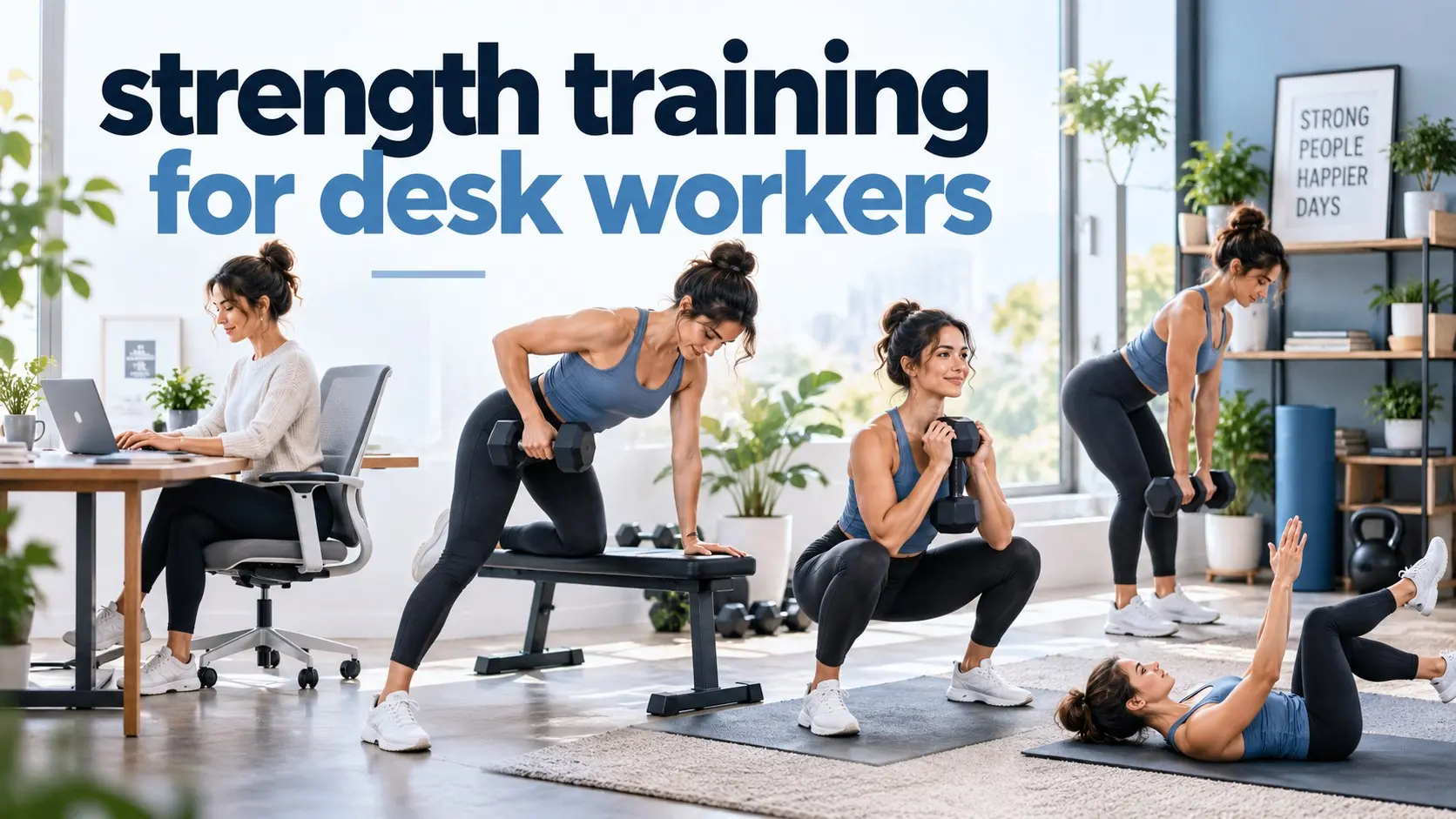
Strength training for desk workers should build the whole body, not just stretch the muscles that feel tight after sitting. A useful plan trains the back, hips, legs, core, chest, shoulders, and arms at least twice each week. Start with simple movements, use resistance you can control, and make the exercises harder as you become stronger.
You do not need a special exercise to “undo” a desk.
You need a body that can handle more than sitting.
That means squatting, hinging, pulling, pushing, carrying, and controlling your trunk under resistance.
Medical Notice: This content is for general educational purposes and does not replace professional medical advice, diagnosis, or treatment. Consult an appropriately qualified healthcare professional for personal medical concerns. This article explains published guidance and does not provide a personal clinical assessment. Always consult qualified medical professionals for diagnosis and treatment of any health condition.
This workout is for general education. Exercise should be adapted to your fitness level, medical history, injuries, symptoms, balance, equipment, pregnancy status, and professional guidance when needed. Stop if you develop chest pain, fainting, severe shortness of breath, sudden weakness, severe dizziness, new numbness, or severe or unusual pain.
Table of Contents
- Quick Answer
- How often to train
- Why desk workers need full body strength
- What Sitting Really Does
- Why sitting does not simply switch muscles off
- Why position changes still matter
- 9 Smart Strength Moves
- Goblet squat
- Romanian deadlift
- Dumbbell row
- Lat pulldown
- Reverse lunge
- Glute bridge or hip thrust
- Push up or chest press
- Dead bug
- Side plank or suitcase carry
- Two Day Workout Plan
- How to Progress
- Desk Movement Breaks
- Home and Band Options
- Back Pain and Red Flags
- Frequently Asked Questions
How often should desk workers strength train?
Two days each week is a strong starting point.
CDC guidance recommends muscle strengthening on at least two days each week, working all major muscle groups. That includes the legs, hips, back, abdomen, chest, shoulders, and arms.
The 2026 American College of Sports Medicine guidance sends the same basic message: regular resistance training matters more than making the program complicated.
You can train with:
- Dumbbells
- Barbells
- Machines
- Resistance bands
- Kettlebells
- Bodyweight
- Loaded backpacks at home
The equipment matters less than using enough resistance and progressing over time.
If you want more home training options, use the NextFitLife Home Workouts and Equipment Guide.
Does sitting all day switch off your glutes and core?
No.
This phrase sounds scientific, but it is too simple.
Your glutes do not stop existing because you sit at a desk.
Your abdominal muscles do not power down for eight hours.
The bigger issue is that long workdays can contain very little challenging physical activity.
If you rarely squat, lift, carry, climb, pull, or train against resistance, you are giving the body very little reason to maintain or improve strength.
That is different from saying the chair damaged your muscles.
Is sitting linked with lower back pain?
The research does not support one simple answer.
A 2025 review looked at 22 studies involving 7,814 office workers. Some studies linked more sitting time with low back pain, while others did not.
The stronger pattern involved how people sat.
Long periods with little movement and fewer changes in position showed a clearer association with low back pain than sitting time alone.
That means I would not spend your workday trying to hold one “perfect posture.”
I would change position.
Sit.
Stand sometimes.
Walk when practical.
Then train your body outside those low load positions.
What should strength training for desk workers focus on?
I would use basic movement patterns.
You need a squat for the legs and hips.
You need a hinge for the posterior chain.
You need pulling for upper back strength.
You need pushing for the chest and shoulders.
You need unilateral work for the legs and hips.
Then add trunk exercises for core strength.
That gives you a full body workout rather than a collection of posture drills.
1. Goblet squat builds useful leg and hip strength
The goblet squat is one of my preferred starting squats because the weight stays close to the body and the movement is easy to scale.
How to do it
- Stand with your feet in a comfortable position.
- Hold one dumbbell or kettlebell near your chest.
- Bend your knees and hips together.
- Lower to a depth you can control.
- Keep your feet supported on the floor.
- Stand back up with control.
Start with: 2 sets of 6 to 10 reps.
You do not need an extremely deep squat.
Use the range that feels stable and controlled.
No weight?
Use a chair.
Sit down with control, then stand without using your hands if that is comfortable.
When it becomes easy, hold a backpack or dumbbell.
For more lower body options, see Leg Exercises with Dumbbells.
2. Romanian deadlift trains the hip hinge
A good Romanian deadlift teaches you to load hip extension rather than turning every lift into a squat.
It trains the glutes, hamstrings, back extensors, grip, and trunk.
How to do it
- Stand tall while holding weights in front of your thighs.
- Keep a small bend in the knees.
- Push your hips backward.
- Let the weights travel close to your legs.
- Stop when you reach a range you can control.
- Drive the hips forward to stand.
Start with: 2 sets of 6 to 10 reps.
Do not chase the floor.
The purpose is the hip hinge, not how low the dumbbells travel.
3. Dumbbell rows give the upper back a real strength job
A dumbbell row is more useful than spending all day forcing your shoulder blades backward.
The back adapts to load.
How to do it
- Hold a dumbbell in one hand.
- Support the other hand on a bench or sturdy surface if needed.
- Keep your trunk controlled.
- Pull the dumbbell toward your side.
- Lower it with control.
Start with: 2 sets of 8 to 12 reps on each side.
Let your shoulder blade move naturally.
You do not need to pin it backward for the entire repetition.
4. Lat pulldowns build another pulling pattern
Rows are useful, but pulling only horizontally leaves a gap.
A lat pulldown adds vertical pulling strength.
How to do it
- Hold the bar or handles securely.
- Sit tall without forcing your chest upward.
- Pull your elbows toward your sides.
- Stop when the bar reaches a comfortable position.
- Return slowly.
Start with: 2 sets of 8 to 12 reps.
No machine?
Use a securely anchored band.
5. Reverse lunges build hip and single leg strength
Sitting does not require much single leg strength.
Walking, stairs, carrying, and many sports do.
That is why I like a reverse lunge or step up in an office worker strength training plan.
How to do a reverse lunge
- Stand tall near a wall or stable support if needed.
- Step one leg backward.
- Lower both knees through a comfortable range.
- Push through the front leg to return.
- Repeat on the other side.
Start with: 2 sets of 6 to 10 reps per leg.
If balance is difficult, hold a support.
If lunges bother your knees, try a low step up or another pain free leg exercise.
6. Glute bridges should eventually become harder
The glute bridge is useful.
The mistake is treating it as permanent “activation.”
If fifteen bodyweight reps are easy, your hips need a new challenge.
How to do it
- Lie on your back with knees bent.
- Keep both feet on the floor.
- Brace your trunk gently.
- Lift your hips.
- Pause briefly.
- Lower with control.
Start with: 2 sets of 8 to 15 reps.
Once it becomes easy, add weight across the hips, use a stronger band, progress toward a hip thrust, or use another harder hip extension exercise.
That is progressive overload.
The exercise grows with you.
7. Desk workers still need pushing strength
A program that trains only the back and glutes is incomplete.
Your chest, shoulders, and triceps are major muscle groups too.
Use:
- Incline push ups
- Floor push ups
- Dumbbell chest press
- Machine chest press
- Overhead press when comfortable
Beginner incline push up
- Place both hands on a sturdy raised surface.
- Walk your feet backward.
- Keep your body controlled.
- Lower your chest toward the surface.
- Press away.
Start with: 2 sets of 6 to 12 reps.
Lower the hand position over time as you become stronger.
8. Dead bugs train core control without endless crunches
The dead bug exercise trains your trunk while your arms and legs move.
That is a useful skill.
How to do it
- Lie on your back.
- Bring your arms upward.
- Bend your knees.
- Brace gently while breathing.
- Slowly move one arm and the opposite leg away.
- Return and switch sides.
Start with: 2 sets of 6 to 10 controlled reps per side.
Reduce the range if you cannot keep good control.
For more options, use the NextFitLife Core Workouts at Home Guide.
9. Side planks or suitcase carries build side core strength
Your core does more than bend your spine forward.
It also helps control side bending and rotation.
Option 1: Side plank
Start from bent knees if a full plank is too difficult.
Lift the hips and hold a straight controlled position.
Keep breathing.
Start with: 2 short controlled holds per side.
Option 2: Suitcase carry
Hold one dumbbell or kettlebell at your side.
Walk slowly while keeping your trunk controlled.
Do not lean dramatically away from the weight.
Switch hands.
This gives the core a very practical job.
The two day desk worker workout
You do not need nine exercises in one session.
Split them across two days.
| Workout A | Sets | Target | Main Job |
|---|---|---|---|
| Goblet squat | 2 | 6 to 10 reps | Leg and hip strength |
| Dumbbell row | 2 | 8 to 12 reps each side | Back strength |
| Romanian deadlift | 2 | 6 to 10 reps | Hip hinge and posterior chain |
| Incline push up | 2 | 6 to 12 reps | Chest and shoulders |
| Dead bug | 2 | 6 to 10 reps each side | Core control |
| Workout B | Sets | Target | Main Job |
|---|---|---|---|
| Reverse lunge or step up | 2 | 6 to 10 reps each leg | Single leg strength |
| Lat pulldown | 2 | 8 to 12 reps | Vertical pulling strength |
| Hip thrust or weighted bridge | 2 | 8 to 15 reps | Hip extension |
| Overhead press or chest press | 2 | 6 to 10 reps | Upper body pushing |
| Side plank or suitcase carry | 2 | Controlled hold or carry | Side core control |
How hard should each set feel?
The last few repetitions should require effort.
If you finish twelve reps and feel you could easily do twenty more, the resistance is probably too light for continued strength progress.
You also do not need to grind until the weight stops moving.
A practical approach is to finish most sets knowing you could still perform roughly two or three good repetitions.
This is sometimes called repetitions in reserve.
The 2026 ACSM review also found that training to complete muscular failure is not required for most healthy adults.
How do you make the workout harder over time?
This is where a workout becomes training.
Suppose your row target is 8 to 12 reps.
Your first session looks like this:
- Set 1: 9 reps
- Set 2: 8 reps
Keep the same load next time.
A few sessions later, you reach:
- Set 1: 12 reps
- Set 2: 12 reps
If both sets feel controlled and you still have a few good repetitions available, increase the weight slightly at the next workout.
Then start building through the range again.
This simple method is progressive overload.
What if you use bodyweight exercises?
You still need progression.
You can make bodyweight work harder by:
- Using a harder variation
- Increasing the range of motion
- Adding a backpack or dumbbell
- Changing from two legs to one leg where suitable
- Using a lower surface for incline push ups
- Adding a stronger resistance band
Do not change everything at once.
One clear progression is easier to measure.
Are resistance bands enough for desk workers?
Yes, provided the band challenges you.
ACSM's current guidance recognizes elastic bands and home based exercise as useful resistance training options.
A band is not automatically easy.
A weak band that stopped challenging you months ago is easy.
Progress toward stronger bands, larger ranges, or harder versions as your strength improves.
Can you do this workout at home?
Yes.
A simple home version could use:
- Chair squat or backpack squat
- Backpack Romanian deadlift
- Resistance band row
- Band pulldown
- Reverse lunge
- Weighted backpack bridge
- Incline push up
- Dead bug
- Side plank
A pair of adjustable dumbbells and one or two bands can give you even more options.
Before buying equipment, see the Home Workouts and Equipment Guide.
What if you only have 20 minutes?
Do four movements well.
Do not turn the session into rushed cardio.
20 minute Workout A
- Goblet squat
- Dumbbell row
- Romanian deadlift
- Dead bug
Perform two controlled sets of each.
20 minute Workout B
- Reverse lunge
- Lat pulldown
- Hip thrust
- Side plank
Then add a pushing exercise when your schedule allows.
A short session you repeat is better than a perfect 60 minute plan you never start.
Do desk workers need core training every day?
No.
Your core is already working during squats, hinges, rows, carries, presses, and many other movements.
A few direct exercises can still help.
Two or three short core blocks each week is enough for many beginners.
You do not need one hundred crunches every morning.
Use the Core Workouts at Home Guide if you want additional beginner friendly options.
Does strength training fix posture?
I would not promise that.
Posture changes all day.
You sit one way while typing, another while reading, and another while talking on the phone.
A stronger body gives you more capacity, but there is no single posture that every person should hold for eight hours.
Rather than chasing perfect posture, focus on:
- Strength
- Comfort
- Position changes
- Workstation fit
- Regular movement
- Normal breathing
If one work position repeatedly hurts, change it.
You do not need to force your shoulders backward all day.
Are movement breaks the same as strength training?
No.
A short walk or standing break helps break up long periods of stillness.
It does not replace progressive resistance training.
Likewise, two gym sessions do not mean you should stay motionless for every other waking hour.
You want both.
WHO guidance encourages adults to reduce sedentary behavior and be regularly active.
CDC uses a simpler phrase: move more and sit less.
How often should you stand during the workday?
There is no universal timer that every adult must follow.
I prefer movement linked to real events because it is easier to remember.
Stand or walk:
- After a long meeting
- When you refill water
- During a phone call when practical
- At lunch
- Between long work blocks
- When stiffness tells you that you have stayed still too long
A few minutes of movement is still movement.
It simply has a different purpose from your strength session.
Does a standing desk replace exercise?
No.
A standing desk gives you another work position.
That is useful.
Standing still does not create the same challenge as squats, rows, hinges, lunges, presses, or loaded carries.
Use a sit stand desk to vary your day, not as a replacement for training.
Do you still need cardio?
Yes.
Strength training for desk workers covers muscle strengthening.
Aerobic activity trains another part of fitness.
CDC guidance recommends at least 150 minutes of moderate intensity aerobic activity each week, or 75 minutes of vigorous activity, or an equivalent mix, alongside muscle strengthening.
Walking is an easy place to begin.
So are cycling, swimming, rowing, and other activities you enjoy.
If you are rebuilding your fitness from scratch, the NextFitLife Beginner Fitness Guide gives you a simple starting plan.
Can strength training reduce desk related pain?
Possibly, but this is where claims should stay modest.
A recent systematic review of resistance training in sedentary office workers found possible improvements in strength and reductions in some neck and shoulder discomfort.
The evidence was rated very uncertain because studies differed greatly and many had a high risk of bias.
That means resistance training is sensible for fitness.
It does not mean this exact workout is a treatment for every neck or back problem.
What if your lower back already hurts?
Back pain changes the decision.
Many people with ordinary low back pain stay active and eventually return to strengthening work.
But an internet article cannot determine why your back hurts.
If one exercise produces sharp, spreading, or worsening pain, stop treating the movement as a test of toughness.
A physiotherapist, physical therapist, sports medicine clinician, or other qualified professional can help choose exercises that fit the actual problem.
Which back pain symptoms need urgent care?
Seek urgent medical care for back pain with:
- New loss of bladder or bowel control
- Difficulty passing urine
- Loss of feeling around the genitals or anus
- Weakness, numbness, or tingling affecting both legs
- Severe pain that begins suddenly and is getting worse quickly
- Fever, chills, or feeling seriously unwell with back pain
- Serious symptoms after major trauma
These are not “weak core” problems.
Do not try to exercise through them.
A simple four week starting plan
| Week | Main Goal | What to Do |
|---|---|---|
| 1 | Learn | Complete both workouts with light manageable resistance and record your reps. |
| 2 | Repeat | Use the same movements and improve control rather than adding new exercises. |
| 3 | Progress | Add a small amount of resistance where the top of the rep range has become comfortable. |
| 4 | Compare | Compare your weights, reps, control, and comfort with Week 1, then continue the same basic plan. |
There is no prize for changing the routine every week.
Repeating the same useful movements makes progress easier to see.
How do you know you are getting stronger?
Track simple things.
- Your squat load
- Your row load
- Your Romanian deadlift load
- Your push up height or reps
- Your lunge load
- Your band resistance
- Your carry weight
- Your ability to control a harder dead bug or side plank
You can also record how normal daily tasks feel.
Do stairs feel easier?
Is lifting a bag less demanding?
Can you sit, stand, and move without feeling as physically fragile?
Those changes matter.
Seven mistakes desk workers make
1. Training only the core
Your abdomen is not the only muscle group affected by an inactive lifestyle.
Train the full body.
2. Stretching every problem
Stretching and strength are different qualities.
If you need more strength, apply resistance.
3. Doing “activation” forever
An easy bridge can teach a movement.
Once it stops being challenging, progress it.
4. Never adding resistance
A workout that felt hard in Month 1 should eventually feel easier.
That is when the training needs to grow.
5. Chasing failure on every set
You do not need to exhaust a muscle completely for a useful strength session.
6. Treating soreness as proof
Soreness is not the score.
Strength, control, consistency, and progression are better measures.
7. Trying to hold perfect posture all day
Humans move.
Change positions instead of treating one chair position like a medical prescription.
Conclusion
Strength training for desk workers should make you stronger, not more worried about sitting. Train the whole body twice each week, with useful extra attention to rows, hip hinges, squats, lunges, hip extension, and trunk control. Add resistance as the current challenge becomes easier, and keep changing position during your workday.
Your next step is concrete: put two workout appointments in your calendar for this week. Complete Workout A once and Workout B once, record every load and repetition, then repeat the same plan next week. That gives you a real baseline and something you can improve.
Internal Links and NextFitLife Fitness Hubs
Home Workouts and Equipment Guide
for dumbbells, resistance bands, kettlebells, bodyweight training, and safe home workout setup.
Core Workouts at Home
for dead bugs, bird dogs, bridges, carries, side planks, and beginner core progressions.
Leg Exercises with Dumbbells
for squats, step ups, Romanian deadlifts, reverse lunges, glute work, and lower body progression.
Beginner Fitness Guide
for walking, strength training, cardio, simple progression, and a repeatable four week start.
Yoga and Flexibility Guide
for mobility, flexibility, balance, and gentle movement that can complement strength training.
Physical Fitness and Mental Health
for the links between movement, sleep, mood, stress, and regular exercise.
References and Sources
- American College of Sports Medicine. Resistance Training Position Stand, 2026.
https://www.acsm.org/wp-content/uploads/2026/03/Resistance-Training-Position-Stand-infographic.pdf
- Centers for Disease Control and Prevention. Adult Physical Activity Guidelines.
https://www.cdc.gov/physical-activity-basics/guidelines/adults.html
- World Health Organization. Guidelines on Physical Activity and Sedentary Behaviour.
https://www.who.int/publications/i/item/9789240015128
- Journal of Occupational Rehabilitation. Resistance Exercise Training in Sedentary Office Workers: Systematic Review and Meta Analysis.
https://pmc.ncbi.nlm.nih.gov/articles/PMC12906527/
- NHS. Back Pain: Symptoms, Self Care, and Emergency Warning Signs.
https://www.nhs.uk/conditions/back-pain/
About the Author
Adel Galal is the Founder and Lead Writer at NextFitLife. He researches practical health, fitness, strength training, home exercise, weight management, nutrition, mobility, and healthy aging topics using recognized exercise science, medical, government, and public health sources.
His approach to desk worker fitness is simple: do not scare people about chairs, posture, or “inactive muscles.” Give the body a useful training stimulus, build strength gradually, stay active during the day, and respect symptoms that need professional assessment.
For this guide, Adel reviewed current ACSM resistance training guidance, CDC and WHO activity recommendations, office worker research, and NHS back pain safety guidance.
Adel is not a doctor, physiotherapist, physical therapist, certified strength and conditioning specialist, athletic trainer, or other licensed healthcare professional.
Learn more about Adel Galal, NextFitLife, and the site's editorial standards on the About Us page.
Medical Disclaimer: This content is for general educational purposes and does not replace professional medical advice, diagnosis, or treatment. Consult an appropriately qualified healthcare professional for personal medical concerns. This article explains published guidance and does not provide a personal clinical assessment. Always consult qualified medical professionals for diagnosis and treatment of any health condition.
Frequently Asked Questions
What is the best strength training for desk workers?
A good plan trains the full body at least twice weekly. Useful movements include squats, Romanian deadlifts, rows, pulldowns, lunges, hip thrusts, push ups or presses, dead bugs, side planks, and loaded carries.
How many days a week should desk workers lift weights?
Two days each week is a strong starting point. Current CDC and ACSM guidance recommends muscle strengthening for all major muscle groups at least twice weekly.
Do desk workers need to train their back more?
Rows and pulldowns are useful because many people with desk jobs do little loaded pulling during daily life. However, the program should still include legs, hips, chest, shoulders, arms, and core.
What are the best back exercises for desk workers?
Dumbbell rows, cable rows, resistance band rows, pulldowns, Romanian deadlifts, and suitable loaded carries can all build back strength. No single back exercise is required for everyone.
What are the best hip exercises for desk workers?
Useful options include goblet squats, Romanian deadlifts, reverse lunges, step ups, glute bridges, and hip thrusts. Choose exercises you can perform with control and progressively load.
What are the best core exercises for desk workers?
Dead bugs, bird dogs, side planks, suitcase carries, farmer carries, and Pallof presses are practical options. Your core also works during squats, hinges, rows, presses, and other compound exercises.
Does sitting weaken the glutes?
Sitting does not simply switch the glutes off. A low activity lifestyle can provide too little strength stimulus, which is one reason resistance training is useful.
Can strength training undo eight hours of sitting?
No exercise literally reverses a block of sitting. Strength training builds physical capacity, while movement breaks reduce long periods of stillness. Use both strategies.
Do I need to stretch my hip flexors every day?
No universal rule says every desk worker needs daily hip flexor stretching. Stretch if it feels useful, but do not use stretching as a replacement for strength training and regular movement.
Can resistance bands build strength for desk workers?
Yes. Current ACSM guidance recognizes elastic band and home based resistance training as effective approaches. The resistance still needs to become challenging enough as you improve.
Can I do strength training at my desk?
Light movements can be done near a desk, but meaningful strength training usually works better when you have enough space and resistance to challenge the major muscle groups safely.
Does a standing desk replace strength training?
No. A standing desk changes your work position. It does not provide the progressive resistance needed to build strength.
Should desk workers train core every day?
No. A few direct core sessions each week can be enough for many beginners, especially because the trunk also works during full body strength exercises.
How many sets should beginners do?
Two sets per exercise is a practical starting point for this program. As training experience grows, volume can be adjusted according to goals, recovery, time, and progress.
How many reps should desk workers do?
Many exercises in this beginner plan use about 6 to 12 controlled repetitions. The exact number matters less than using an appropriate load, good technique, and gradual progression.
How hard should strength training feel?
The last repetitions should require real effort, but complete muscular failure is not required. A practical approach is to finish many sets with roughly two or three good repetitions still possible.
Can strength training help desk related back pain?
Resistance exercise can improve strength and may help discomfort in some office workers, but the current office specific evidence is low certainty. Back pain has many causes, so persistent or severe symptoms deserve individual assessment.
When should I not exercise through back pain?
Seek urgent care for back pain with new bladder or bowel problems, numbness around the genitals or anus, neurological symptoms in both legs, severe rapidly worsening pain, or serious illness. Do not try to exercise through these warning signs.
What is a good weekly schedule for a desk worker?
A simple week can include two full body strength sessions, regular walking or other aerobic activity, and frequent position changes during work. Recovery days can include normal activity, walking, or gentle mobility.

Health & wellness writer with 30+ years of experience in nutrition, fitness, and healthy aging. Founder of NextFitLife.com — evidence-based health guidance.