
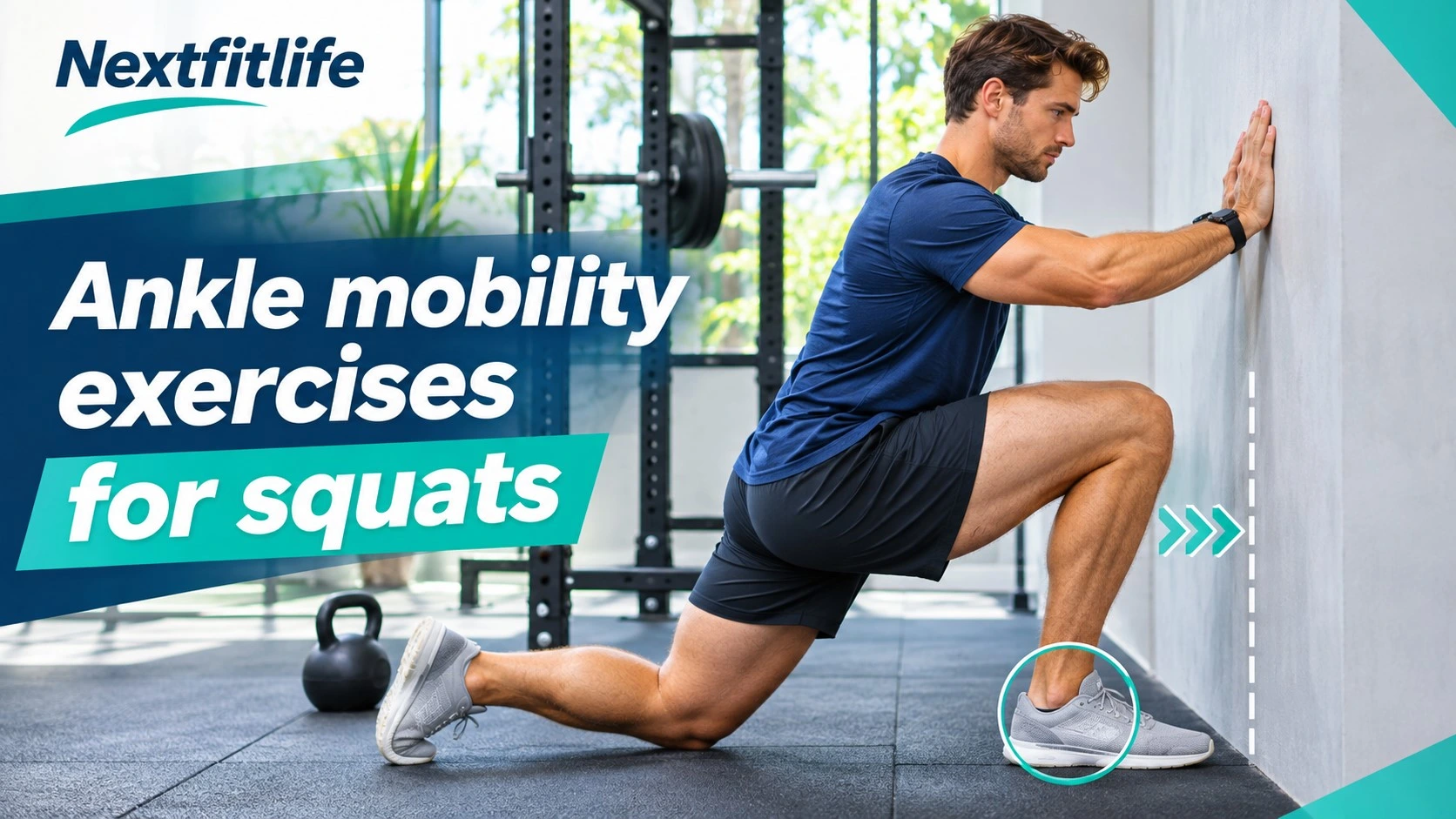
If your heels lift, your chest falls forward, or your squat stops early, limited ankle mobility may be the problem.
But do not force your knees farther forward just because you want more depth. First test whether your ankle is truly the limit, then improve the range you can control.
Quick Answer
The best ankle mobility exercises for squats combine a knee to wall test, bent knee calf work, ankle rocks, calf strength, and squat practice. Better dorsiflexion can support deeper squats, but hip motion, body shape, technique, balance, and pain also affect depth. Never force a sharp pinch or painful range.
The main ankle motion involved is ankle dorsiflexion. This happens when the shin moves forward over the foot while the heel stays on the floor.
Research links greater weight bearing dorsiflexion with deeper squatting, but the ankle is only one part of the movement.
This article is for general information and education. It does not replace medical advice, diagnosis, or treatment.
Do not force a painful ankle
Stop mobility work if you feel sharp pain, a strong joint pinch, new numbness, major swelling, or instability. Severe pain after injury, inability to walk, deformity, or a snapping sound needs prompt medical assessment.
If you are building your whole fitness plan, the How to Get Fit Guide explains how mobility fits with strength, cardio, and gradual progression.
What You Will Learn
- How to check ankle dorsiflexion before stretching
- How to tell calf tension from a hard ankle block
- Seven useful mobility and strength moves
- Why deeper is not always better
- When heel elevation helps
- Why hip motion and body shape still matter
- When ankle pain needs professional assessment
Table of Contents
- Test Your Ankle First
- Calf Tension vs Ankle Pinch
- 1. Knee to Wall Rocks
- 2. Bent Knee Calf Stretch
- 3. Straight Knee Calf Stretch
- 4. Loaded Ankle Rocks
- 5. Slow Calf Raises
- 6. Supported Squat Shifts
- 7. Goblet Squat Pause
- Full Routine
- Heel Elevation
- When the Ankle Is Not the Problem
- Common Mistakes
- When to Seek Care
- Conclusion
- References and Sources
- Internal Links and Hub
- About the Author
- Frequently Asked Questions
Test Your Ankle Before You Stretch It
Start with a simple weight bearing lunge test, also called the knee to wall test.
- Face a wall.
- Place one foot a short distance from it.
- Keep the whole heel down.
- Move the knee toward the wall over the middle toes.
- Move the foot farther back if the knee reaches the wall easily.
Stop when the heel starts to lift, the foot collapses, the knee twists, or you feel pain.
The test has shown good reliability in research and is useful for tracking your own ankle range of motion over time.
Do not chase one magic number.
Your own change matters more. Compare left with right, record the result, then see whether better ankle motion also improves your squat.
Calf Tension and a Hard Ankle Pinch Are Not the Same
A stretching feeling in the calf is different from a hard stop at the front of the ankle.
If you feel normal muscle tension through the calf or Achilles area, controlled mobility work may help.
If you feel a sharp pain or firm pinch at the front of the joint, pushing harder is not the answer.
A restriction can come from muscle, joint structure, a past injury, swelling, or another problem. One drill does not fit every ankle.
Mobility should create useful motion.
It should not feel like you are trying to crush the front of the ankle so the knee moves farther.
1. Controlled Knee to Wall Rocks
Use the same position as the test.
Keep the heel flat and move the knee forward over the middle toes. Return slowly, then repeat.
Start with 8 to 12 smooth repetitions on each side.
What You Should Feel
A mild stretch through the lower calf or ankle area is fine.
What You Should Not Feel
Sharp pain, a hard front ankle pinch, numbness, or instability means you should reduce the range or stop.
2. Bent Knee Calf Stretch
The soleus is a deep calf muscle that works while the knee is bent. That makes this position useful for squatting.
Face a wall, step one foot back, and bend both knees slightly while keeping the rear heel down.
Move forward until you feel a gentle stretch lower in the calf.
Hold for about 20 to 30 seconds, then switch sides.
Do not collapse the foot arch just to make the stretch look deeper.
3. Straight Knee Calf Stretch
Now keep the back knee straight.
This puts more stretch through the gastrocnemius, the larger calf muscle that crosses both the knee and ankle.
Hold for about 20 to 30 seconds on each side.
The straight knee and bent knee versions are not competing exercises. They simply place the calf in different positions.
4. Half Kneeling Loaded Ankle Rocks
Kneel with one foot in front.
Place a light weight on the front thigh or hold it close to the knee. Slowly move the knee forward while the heel remains down, then return.
Try 6 to 10 controlled repetitions.
The weight should guide the movement, not force the joint.
If the front of the ankle pinches, remove the load or skip the drill.
5. Slow Calf Raises Through a Comfortable Range
Mobility without strength is incomplete.
Stand near a wall or rack for support, rise slowly onto the toes, pause, then lower with control.
Try 8 to 15 repetitions.
If you use a step, lower the heel only as far as you can control comfortably.
This trains the calf through range instead of treating the ankle as something that only needs passive stretching.
For a broader strength plan, see Strength Training for Desk Workers: 9 Smart Moves. The same principle applies here: usable movement needs strength as well as flexibility.
6. Supported Squat Ankle Shifts
Hold a stable rack, post, or door frame.
Lower into a comfortable squat with both heels down. Shift gently toward one side while allowing that knee to move forward, then return to the center.
Repeat on the other side.
Try 5 to 8 controlled shifts per side.
This turns passive range into squat specific mobility.
7. Finish With a Controlled Goblet Squat
Hold a light dumbbell or kettlebell in front of the chest.
Squat only as deep as you can while keeping the whole foot supported and the movement controlled.
Pause briefly, then stand.
Try 6 to 10 repetitions.
The front load acts as a counterweight and often makes a deeper squat easier to balance.
Your goal is not maximum depth on the first repetition. Your goal is a better squat.
The Full 7 Move Routine
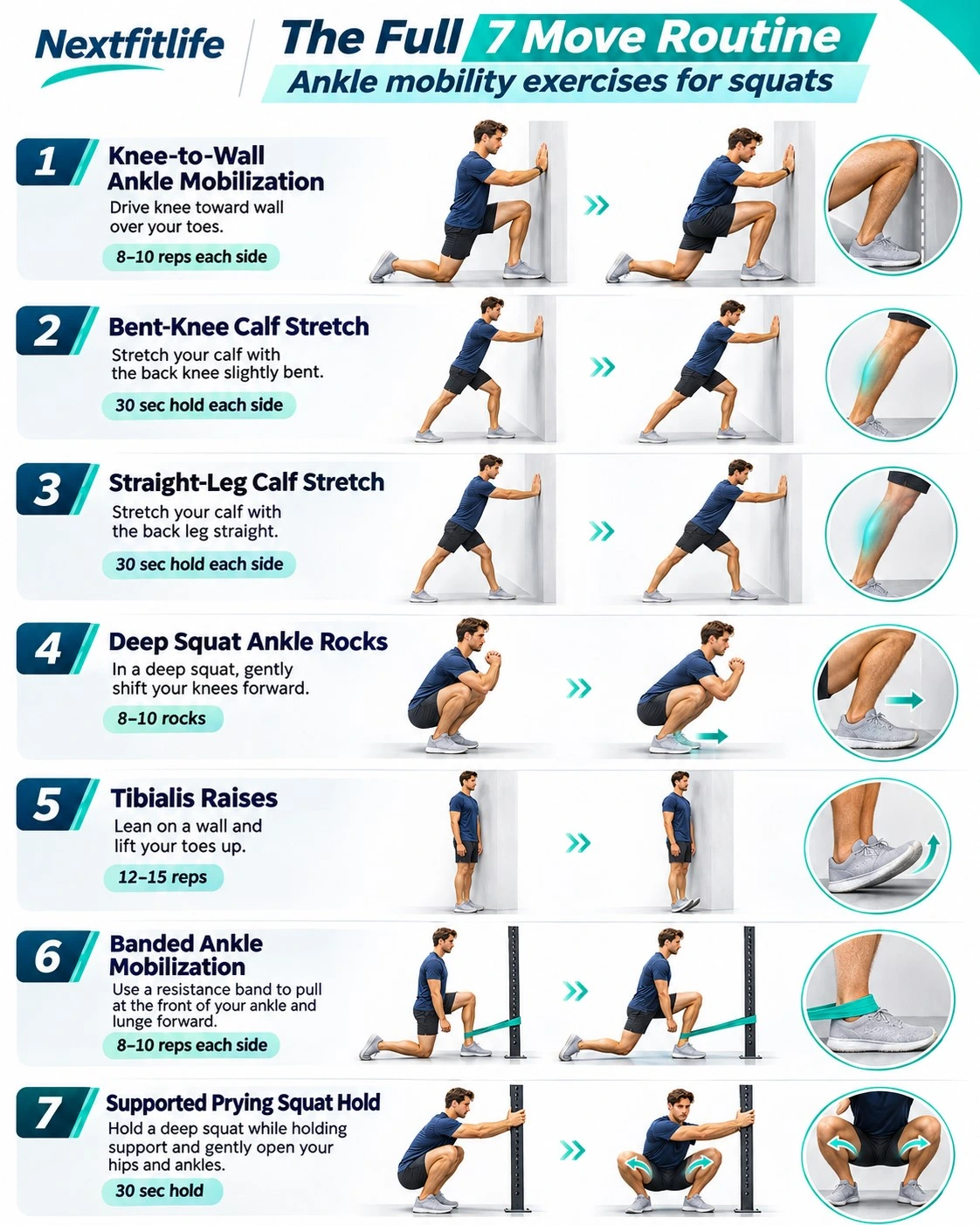
| Move | Main Job | Starting Amount |
|---|---|---|
| 1. Knee to wall rocks | Controlled dorsiflexion | 8 to 12 reps |
| 2. Bent knee calf stretch | Soleus mobility | 20 to 30 seconds |
| 3. Straight knee calf stretch | Gastrocnemius mobility | 20 to 30 seconds |
| 4. Loaded ankle rocks | Loaded ankle range | 6 to 10 reps |
| 5. Slow calf raises | Strength through range | 8 to 15 reps |
| 6. Supported squat shifts | Squat specific mobility | 5 to 8 each side |
| 7. Goblet squat pause | Use the new range | 6 to 10 reps |
You do not need all seven every day.
Use the test, choose the drills that match the restriction, then retest.
How Often Should You Work on Ankle Mobility?
Short, regular practice makes more sense than one long session that leaves the ankle irritated.
A useful approach is to do a few drills before squat training and repeat a short routine on other days if the ankles feel stiff.
Then retest.
If your ankle range improves but your squat depth does not, stop assuming the ankle is the main problem.
Retest Instead of Guessing
After your mobility work, repeat the knee to wall test and a bodyweight squat.
Ask three questions:
- Did the ankle move farther?
- Did the squat feel easier?
- Did the squat get deeper while the heel stayed down?
If the answer stays no, look at the hips, stance, balance, strength, and squat setup instead of adding more ankle stretches.
Why Limited Dorsiflexion Can Change the Squat
A deeper squat asks the knees to move forward while the feet remain supported.
That forward shin movement needs ankle dorsiflexion.
If the ankle stops early, the body may respond by leaning the trunk farther forward, changing hip motion, lifting the heel, changing the foot position, or simply stopping the squat higher.
That does not mean forward lean is always bad. Body proportions and squat style also change how much trunk lean is normal.
Why the Knees Need to Move Forward
The old rule that the knees should never move past the toes is too simple.
During a deep squat, some forward knee movement is normal.
Trying to keep the shin nearly vertical can force you to sit much farther back, lean the torso more, or stop early.
The goal is not to push the knees forward as far as possible. It is to use enough ankle range for your squat style while keeping the movement controlled.
Can Heel Elevation Help Your Squat?
Yes.
And using a raised heel is not cheating.
A 2026 systematic review found that heel elevation changes ankle and knee motion during squatting.
Another 2026 study found that greater heel elevation reduced the amount of ankle dorsiflexion needed and reduced forward trunk lean while increasing knee flexion and knee extensor demand.
| Heel Elevation Effect | What It Means |
|---|---|
| Less ankle dorsiflexion needed | Useful when ankle range limits the squat |
| More upright trunk | Can change the feel of the squat |
| More knee flexion | Can increase knee extensor demand |
| Different squat mechanics | It changes the exercise rather than simply fixing the ankle |
Weightlifting shoes use the same basic idea with a firm raised heel.
Heel Elevation Is a Tool, Not a Cure
A heel wedge changes the squat task.
That can be useful if your training goal suits a more upright squat or if ankle range limits your chosen squat style.
But if your ankle hurts during walking, stairs, or normal daily movement, hiding the problem under a wedge is not the same as fixing it.
Use the tool for the reason you chose it.
Do You Need a Resistance Band Around the Ankle?
No.
Banded ankle drills are popular, but they are not required for every person with limited dorsiflexion.
Start with simple testing, knee to wall movement, calf work, and controlled squatting.
If those improve the range, you may not need anything more complicated.
A strong joint pinch is also not a reason to add more band tension.
Does Foam Rolling Help?
It can make a stiff calf feel better for some people.
That does not make it required.
If you enjoy foam rolling, use it briefly and then retest the ankle.
If nothing changes, stop treating it as part of the ritual.
What If Your Ankles Move Well but Your Squat Is Still Shallow?
Then look somewhere else.
Research on squat depth has found that both ankle and hip motion matter.
Other factors include:
- Hip mobility
- Hip socket shape
- Knee flexion
- Femur length
- Torso length
- Stance width
- Foot angle
- Balance
- Strength
- Confidence in the bottom position
NextFitLife's How to Get Fit Guide makes the same broader point: mobility should address a real movement need instead of becoming a long routine with no clear goal.
Your Anatomy Changes the Squat
Two people can have similar ankle mobility and still squat differently.
A person with longer femurs may need more trunk lean or a different stance than someone with shorter femurs.
Hip structure also differs from person to person.
That is why good squat technique does not mean forcing every lifter into the same shape.
Should Everyone Squat as Deep as Possible?
No.
Depth should match your mobility, control, anatomy, symptoms, sport, and training goal.
A deeper squat is not automatically better if you have to lose balance, twist the foot, collapse the knee, or push through pain to reach it.
Use the deepest range you can control comfortably, then improve from there if greater depth matters for your goal.
What If One Ankle Is Much Tighter?
A clear difference between sides is useful information.
Possible reasons include an old sprain, previous immobilization, past fracture, calf stiffness, joint restriction, or another movement problem.
The weight bearing lunge test is useful because you can track each side in the same way over time.
If one ankle has remained clearly different after an old injury, consider professional assessment rather than stretching it harder forever.
What If Your Heel Lifts During the Squat?
Reduce the depth first.
If the heel now stays down, you have found a range you can currently control.
Then test dorsiflexion.
If ankle range is clearly limited, work on it. If the ankle moves well, heel lift may come from balance, stance, technique, footwear, or another joint.
Do not diagnose the ankle from heel lift alone.
Five Mistakes I Would Avoid
- Forcing a hard front ankle pinch. More pressure does not make the drill better.
- Stretching without testing. If you never retest, you do not know whether the exercise helps.
- Blaming every shallow squat on the ankle. Hips, body shape, stance, balance, and strength matter too.
- Gaining range but never squatting in it. Controlled squat practice helps make new range useful.
- Ignoring pain. Mobility work is not treatment for every ankle problem.
A Simple Pre Squat Routine
- Knee to wall rocks for 10 reps per side
- Bent knee calf stretch for about 20 seconds per side
- Slow calf raises for 10 reps
- Supported squat shifts for 5 reps per side
- Five controlled goblet squats
Then begin your normal squat warm up.
If you are building a full training week, use the Fitness Program Guide to fit mobility around strength, cardio, recovery, and progress.
When Should You Get the Ankle Checked?
Mobility drills are useful for stiffness. They are not the right response to every painful ankle.
The NHS recommends medical assessment when ankle pain stops normal activity, keeps returning, gets worse, does not improve with home care, or comes with tingling or loss of feeling.
Seek prompt medical help after an injury if:
- Pain is severe
- You cannot walk
- The ankle or foot looks deformed
- You heard a snap, grinding sound, or pop
- There is major swelling or bruising
Those problems deserve assessment, not a harder mobility drill.
Conclusion
The best ankle mobility exercises for squats do not force you deeper.
Test the ankle first, improve useful dorsiflexion, strengthen the range, then practice the squat. If the ankle moves better but the squat does not change, look at the hips, stance, balance, strength, and body shape instead.
Your next step: do the knee to wall test today, pick three drills from this routine, then retest. Keep the exercises that actually change your movement.
References and Sources
- PubMed. Reliability and Validity of a Weight Bearing Measure of Ankle Dorsiflexion Range of Motion.
https://pubmed.ncbi.nlm.nih.gov/23997389/ - PubMed. Reliability and Minimal Detectable Change of the Weight Bearing Lunge Test: A Systematic Review.
https://pubmed.ncbi.nlm.nih.gov/25704110/ - PubMed. Heel Elevation Increases Ankle and Knee Range of Motion During Squatting in Healthy Adults: A Systematic Review With Meta Analysis. 2026.
https://pubmed.ncbi.nlm.nih.gov/41612762/ - PubMed. Dose Dependent Effects of Heel Elevation During Loaded Squatting in Men With Restricted Ankle Dorsiflexion. 2026.
https://pubmed.ncbi.nlm.nih.gov/42551866/ - PubMed. Do Technological Tools Improve Reliability in Ankle Dorsiflexion Assessment? 2026.
https://pubmed.ncbi.nlm.nih.gov/41265287/ - NHS. Ankle Pain.
https://www.nhs.uk/symptoms/foot-pain/ankle-pain/
Internal Links and NextFitLife Hub
About the Author
Adel Galal is the founder and lead writer of NextFitLife.com. He has more than 15 years of health and wellness writing experience. He is not a licensed healthcare professional. Read the About page for sources and review rules.
Adel is not a medical professional; health articles cite trusted sources and are for general information only.
Frequently Asked Questions
What are the best ankle mobility exercises for squats?
Useful options include knee to wall rocks, bent knee calf stretches, straight knee calf stretches, loaded ankle rocks, calf raises, supported squat shifts, and controlled goblet squats.
How do I know if ankle mobility is limiting my squat?
Use a knee to wall test and watch what happens during the squat. Limited forward shin movement, heel lift, or a clear difference between ankles can suggest the ankle is part of the problem, but hip motion and squat setup also matter.
What is ankle dorsiflexion?
Ankle dorsiflexion is the motion that lets the shin move forward over the foot while the heel stays down. Squatting deeper usually requires enough usable dorsiflexion for the knees to move forward comfortably.
Should ankle mobility exercises hurt?
No. Mild calf tension can be normal, but sharp pain, a strong front ankle pinch, numbness, or instability is a reason to reduce the range or stop the exercise.
Can heel elevation help if my ankles are stiff?
Yes. Heel elevation can reduce the ankle dorsiflexion required during a squat and can make the torso more upright. It also changes knee demand, so it should be treated as a squat variation rather than a cure for every ankle restriction.
Do I need resistance bands for ankle mobility?
No. Many people can improve useful ankle motion with simple knee to wall work, calf stretching, strength exercises, and controlled squat practice. Bands are optional rather than required.
Why is my squat still shallow even if my ankles move well?
Squat depth also depends on hip mobility, knee motion, body proportions, stance width, foot angle, balance, strength, and the squat style you use. The ankle is only one part of the movement.
How often should I work on ankle mobility?
Short regular sessions can work well. Use a few drills before squat training or on other days when the ankle feels stiff, then retest rather than adding more exercises automatically.
When should ankle stiffness be checked by a professional?
Get medical advice if ankle pain keeps returning, gets worse, limits normal activity, does not improve with home care, or comes with tingling or loss of feeling. Severe pain, deformity, or inability to walk after an injury needs prompt assessment.

Health & wellness writer with 30+ years of experience in nutrition, fitness, and healthy aging. Founder of NextFitLife.com — evidence-based health guidance.

