

A good shoulder mobility routine should make your next press, row, pulldown, or pullup feel easier to control.
It should not leave your shoulders tired before the workout starts. Move the upper back, let the shoulder blades move, wake up the rotator cuff, then rehearse the lift you are about to train.
Quick Answer
A useful shoulder mobility routine combines upper back motion, scapular control, shoulder flexion, external rotation, and light pressing or pulling practice. Eight focused moves are enough for most lifters. The routine should feel controlled and pain free. Sharp pain, weakness, numbness, or a sudden major loss of motion needs assessment instead of harder stretching.
One idea matters from the start: the shoulder is not just one ball and socket joint.
Overhead movement depends on the upper arm, shoulder blade, collarbone, upper back, and the muscles that control them working together.
This article is for general information and education. It does not replace medical advice, diagnosis, or treatment.
Do not stretch through serious shoulder symptoms
Stop and get medical advice for sudden severe pain, major swelling, deformity, inability to move the arm, persistent numbness, obvious weakness, a hot swollen shoulder, or symptoms that started after a serious injury.
If you are building a complete training plan, use the How to Get Fit Guide for the bigger picture of strength, cardio, mobility, and recovery.
What You Will Learn
- How shoulder mobility differs from flexibility
- How to check your overhead reach before warming up
- Eight useful moves before pressing or pulling
- Why the shoulder blade must move
- Why strength itself can improve range of motion
- How to change the routine for bench press, overhead press, or pullups
- Which pain signs mean you should stop
Table of Contents
- What Shoulder Mobility Really Means
- Check Your Reach First
- 1. Thoracic Extension
- 2. Open Book Rotation
- 3. Wall Slides
- 4. Scapular Pushups
- 5. Cross Body Stretch
- 6. External Rotation
- 7. Band Row to Rotation
- 8. Press or Pull Rehearsal
- Full Routine
- Pressing and Pulling Changes
- Common Mistakes
- When to Seek Care
- Conclusion
- References and Sources
- Internal Links and Hub
- About the Author
- Frequently Asked Questions
What Does Shoulder Mobility Really Mean?
Shoulder mobility means being able to reach useful positions with control.
That is different from flexibility.
You might be able to pull your arm into a large passive stretch but still struggle to control that same position during an overhead press.
| Quality | Simple Meaning | Example |
|---|---|---|
| Flexibility | How far tissues and joints can move | Holding a gentle cross body stretch |
| Mobility | Using range with control | Controlled wall slide |
| Stability | Controlling the joint while force is applied | Pressing with a steady shoulder position |
| Warm up | Preparing for the task ahead | Light sets before a press or row |
The shoulder complex includes the glenohumeral joint, the scapula, the collarbone joints, and the rib cage beneath them.
During arm elevation, the upper arm and shoulder blade move together. This coordinated motion is often called scapulohumeral rhythm.
That is why an overhead problem is not automatically a tight lat or tight rotator cuff.
Check Your Overhead Reach Before the Routine
Raise both arms overhead before you start.
Keep the ribs relaxed and avoid throwing the lower back into a deep arch just to get the hands farther behind you.
Ask yourself:
- Can both arms reach overhead comfortably?
- Does one side stop earlier?
- Do you shrug hard?
- Does the rib cage flare?
- Do you feel a sharp pinch?
- Can you reach the position without pain?
This is not a diagnosis.
It gives you a simple before picture so you can retest after the routine.
Pain Changes the Plan
A mild stretch is one thing.
A sharp pinch, sudden pain, new weakness, numbness, or a feeling that the shoulder is unstable is another.
AAOS shoulder conditioning guidance is clear that exercises should not be painful.
Stop the drill if:
- Pain is sharp or severe
- The shoulder feels unstable
- Strength drops suddenly
- Numbness or persistent tingling appears
- The arm becomes difficult to move after an injury
1. Start With Thoracic Extension
If the upper back stays rounded, reaching overhead can feel harder.
Place your forearms or elbows on a bench, box, or stable surface. Sit the hips back gently while letting the chest move down.
Keep the lower back quiet and breathe normally.
Try 5 to 8 slow repetitions.
Do not chase the floor.
If the extra depth only comes from arching the lower back or flaring the ribs, you have moved past the useful range.
2. Add Open Book Rotation
Lie on your side with the hips and knees bent.
Reach both arms forward, then open the top arm while rotating through the upper back.
Keep the knees together so the movement does not simply come from the hips.
Try 5 to 8 slow repetitions on each side.
You do not need to touch the hand to the floor. Move as far as you can without forcing the shoulder.
Why the Upper Back Belongs in a Shoulder Routine
Your shoulder blade sits on the rib cage.
That means thoracic mobility and rib position can change how the scapula moves during an overhead reach.
This does not mean every shoulder problem comes from posture.
It means the upper back is part of the movement system.
3. Use Wall Slides for Overhead Motion
Stand facing a wall with the forearms against it.
Slide the arms upward while allowing the shoulder blades to rotate naturally.
Keep the neck relaxed and do not force the shoulders down and back.
Try 8 to 10 controlled repetitions.
Watch the Rib Cage
If your arms only move higher because the lower back arches, reduce the range.
The goal is better shoulder flexion and scapular motion, not a backbend.
4. Train Scapular Control With Scapular Pushups
Use a wall, bench, hands and knees position, or plank depending on your strength.
Keep the elbows straight. Let the chest move slightly between the shoulders, then push the floor or wall away so the shoulder blades move around the rib cage.
Try 8 to 12 slow repetitions.
The serratus anterior helps control the scapula during arm elevation.
This is control work rather than a stretching drill.
For a full body strength plan that also uses rows, pulldowns, and presses, see Strength Training for Desk Workers: 9 Smart Moves.
5. Use a Gentle Cross Body Stretch
Bring one arm across the chest.
Use the other arm to guide it gently closer while holding the upper arm rather than yanking on the elbow.
Hold for about 20 to 30 seconds on each side.
You may feel a stretch at the back of the shoulder.
If you feel a sharp pinch at the front, stop.
Do You Need the Sleeper Stretch?
Not automatically.
A sleeper stretch can be useful when true internal rotation restriction has been identified, especially in some overhead athletes.
It is not a drill I would force into every general gym warm up.
6. Wake Up External Rotation Without Fatiguing It
Hold a light resistance band with the elbow near your side.
Keep the elbow bent and rotate the forearm outward slowly, then return under control.
Try 8 to 12 repetitions per side.
Use light resistance.
This is a warm up for the rotator cuff, not a set you need to grind to fatigue.
What if One Side Rotates Less?
A side difference is information, not automatically a problem.
Sport, old injuries, anatomy, and training history can all affect rotational range.
If the difference comes with pain, weakness, instability, or loss of normal function, get it assessed instead of trying to force both sides to match.
7. Combine a Band Row With Rotation
Anchor a light resistance band in front of you.
Pull into a controlled row. From there, rotate the forearms upward only as far as you can control without shrugging or arching the back.
Reverse the movement slowly.
Try 6 to 10 repetitions.
This combines pulling, scapular control, and external rotation in one movement.
8. Rehearse the Press or Pull You Are About to Train
This is the step many mobility routines forget.
If you are bench pressing, finish with light bench pressing.
If you are overhead pressing, use a light version of the overhead press.
If you are doing pullups, use controlled pulldowns, assisted pullups, or easy scapular pullups first.
If you are rowing, finish with light rows.
The warm up should lead into the task.
The evidence supports readiness, not invincibility.
Dynamic upper body warm ups can improve strength and power performance, but research has not shown that a short shoulder warm up by itself prevents every upper body injury.
The Full 8 Move Shoulder Mobility Routine
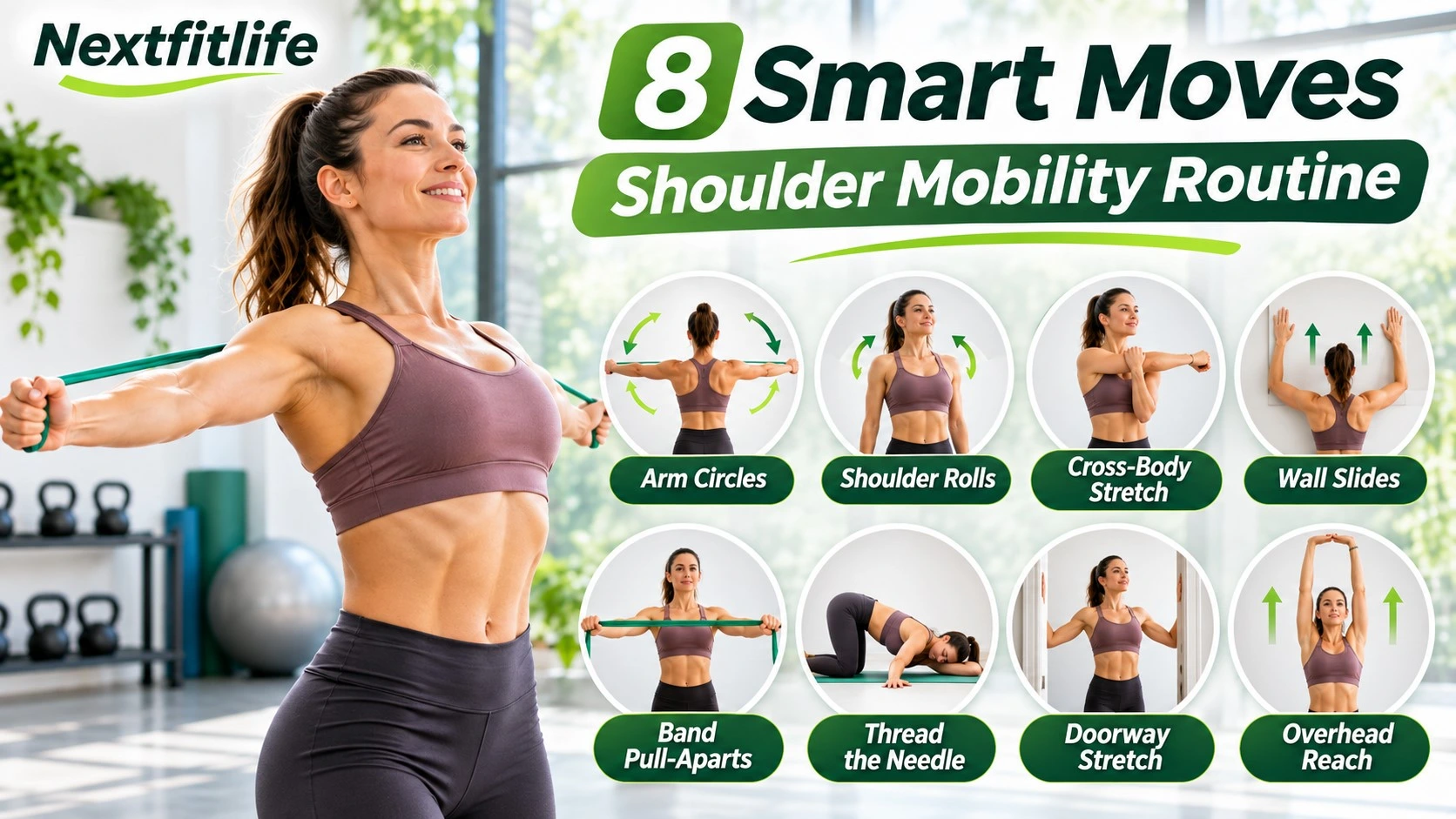
| Move | Main Job | Starting Amount |
|---|---|---|
| 1. Thoracic extension | Upper back and overhead position | 5 to 8 reps |
| 2. Open book rotation | Upper back rotation | 5 to 8 each side |
| 3. Wall slide | Overhead motion and scapular control | 8 to 10 reps |
| 4. Scapular pushup | Serratus and scapular motion | 8 to 12 reps |
| 5. Cross body stretch | Posterior shoulder range | 20 to 30 seconds each |
| 6. Band external rotation | Rotator cuff control | 8 to 12 each side |
| 7. Band row to rotation | Pulling plus cuff control | 6 to 10 reps |
| 8. Task rehearsal | Prepare for the real lift | 1 to 3 light sets |
You do not need all eight forever.
Once you learn which movements actually improve your reach and first warm up sets, keep those and remove the rest.
How Long Should the Routine Take?
It should not become the workout.
Move through the useful drills efficiently, then start your actual warm up sets.
Many lifters eventually need only four or five of the eight moves.
A good routine becomes more specific over time, not longer.
Should You Stretch Before Lifting?
Yes, if stretching gives you useful range for the lift ahead.
The idea that any static stretch before training automatically ruins strength is too broad.
A systematic review of upper body warm ups found that short static stretching did not reduce power outcomes, while dynamic loaded warm ups showed stronger performance benefits.
I would use brief targeted stretching where you need range, then follow it with active movement and light loaded practice.
Strength Training Can Improve Range of Motion Too
You do not need to spend your whole life fixing mobility before you are allowed to train.
A large systematic review found that resistance training with external load improved range of motion, with gains similar to stretching in the studies reviewed.
That means controlled strength work can become part of the mobility plan.
- A controlled press trains range under load
- A full range row trains shoulder blade movement
- A controlled pulldown trains overhead motion
Mobility and strength are not enemies.
Why “Shoulders Down and Back” Is Not a Rule for Everything
This cue gets used far too often.
During a row, some shoulder blade retraction is normal.
During an overhead reach, however, the scapula needs to rotate upward and move on the rib cage.
Trying to pin both shoulder blades down and back while reaching overhead can work against normal movement.
Better cue:
Let the shoulder blade move, then control that movement.
How Should the Routine Change Before Bench Pressing?
Bench pressing does not need the same overhead range as an overhead press.
I would emphasize:
- Comfortable upper back position
- Scapular control
- External rotation
- Light rows
- Progressive bench warm up sets
You do not need ten minutes of overhead stretching when overhead range is not the main task.
How Should the Routine Change Before Overhead Pressing?
Here I care much more about overhead flexion.
Use thoracic extension, wall slides, scapular pushups, light external rotation, then light overhead pressing.
If you cannot raise the arms overhead without a painful pinch or a large back arch, do not force a heavy bar into that position.
Change the load, grip, range, or exercise while you work out why the position is limited.
How Should the Routine Change Before Pullups?
Pullups need comfortable overhead reach plus control while the body hangs below the arms.
A useful sequence is:
- Wall slides
- Scapular pushups
- Light pulldowns
- Comfortable scapular pullups
- Assisted pullups
Do not hang aggressively from a shoulder that feels painful or unstable.
What if Your Shoulder Clicks?
A painless click by itself does not automatically mean something is damaged.
The better questions are:
- Does it hurt?
- Is strength dropping?
- Does the shoulder feel unstable?
- Did it start after an injury?
- Is your range getting worse?
Painful clicking with weakness or instability deserves assessment.
Five Mistakes I Would Avoid
- Stretching harder when the shoulder pinches. A pinch is not proof that you need more force.
- Doing mobility for twenty-five minutes before every upper body session. The warm-up should prepare the workout, not replace it.
- Training flexibility without control. Range you cannot control is less useful under load.
- Freezing the shoulder blades down and back. The scapula needs to move during overhead elevation.
- Using a general routine to treat an injury. Pain, instability, weakness, or sudden loss of motion changes the plan.
A Short Pre Press Routine
- Thoracic extension for 6 reps
- Wall slides for 8 reps
- Scapular pushups for 10 reps
- Band external rotation for 10 reps per side
- Two or three light sets of the press you are about to train
A Short Pre-Pull Routine
- Open book rotations for 5 reps per side
- Wall slides for 8 reps
- Scapular pushups for 10 reps
- Band row to external rotation for 8 reps
- Two or three easy sets of your row, pulldown, or assisted pullup
How Do You Know the Routine Is Working?
Repeat the same overhead reach you tested at the start.
Look for:
- Smoother overhead reach
- Less shrugging
- Less rib flare
- More comfortable rotation
- Better control
- Easier first warm up sets
Do not judge success by how intense a stretch feels.
Better movement is the result you want.
The same principle applies lower in the body. The Hip Mobility Routine for Desk Workers also combines range with strength and control rather than stretching alone.
When Should You Seek Medical Care?
Get urgent or prompt medical advice when:
- Pain is sudden or severe
- You cannot move the arm
- The shoulder or arm changes shape
- There is major swelling
- Numbness or persistent tingling develops
- The arm feels unusually hot or cold
- A hot swollen shoulder comes with fever or feeling unwell
- Symptoms started after a significant injury
Do not assume chest related symptoms are coming from the shoulder.
Shoulder or arm discomfort with chest pressure, shortness of breath, fainting, sweating, or pain spreading to the jaw needs urgent medical assessment.
Conclusion
A good shoulder mobility routine should prepare you to press or pull, not leave you tired before training.
Move the upper back, let the scapula move, train the rotator cuff lightly, then rehearse the actual lift.
Your next step: test your overhead reach today, complete one round of the eight moves, then retest. Keep the drills that clearly improve your movement and remove the ones that only add time.
References and Sources
- American Academy of Orthopedic Surgeons. Rotator Cuff and Shoulder Conditioning Program.
https://www.orthoinfo.org/bodypart/shoulder/rotator-cuff-and-shoulder-conditioning-program/ - PubMed. A Systematic Review of the Effects of Upper Body Warm-Up on Performance and Injury.
https://pubmed.ncbi.nlm.nih.gov/25694615/ - PubMed. Resistance Training Induces Improvements in Range of Motion: A Systematic Review and Meta Analysis.
https://pubmed.ncbi.nlm.nih.gov/36622555/ - PubMed. Exercise Based Strategies From Warm Up to Training: A Systematic Review of Performance Enhancement and Injury Prevention. 2026.
https://pubmed.ncbi.nlm.nih.gov/42188564/ - PubMed Central. Open access review of scapular and humeral motion during shoulder elevation.
https://pmc.ncbi.nlm.nih.gov/articles/PMC11788122/ - NHS. Shoulder Pain.
https://www.nhs.uk/symptoms/shoulder-pain/
Internal Links and NextFitLife Hub
- How to Get Fit: 9 Proven Steps
- Fitness Program: 9 Smart Steps
- Strength Training for Desk Workers: 9 Smart Moves
- Hip Mobility Routine for Desk Workers: 7 Smart Moves
- Ankle Mobility Exercises for Squats: 7 Smart Moves
- Cardio After 40: 8 Smart Rules for Endurance
- NextFitLife About Us and Editorial Standards
Frequently Asked Questions
What is a good shoulder mobility routine before lifting?
A useful routine combines upper back movement, wall slides, scapular control, a gentle posterior shoulder stretch, external rotation, and light rehearsal of the press or pull you are about to train.
How long should a shoulder mobility routine take?
It should be short enough that it does not become the workout. Once you know which drills help, use only the movements that clearly improve your reach, control, or first warm up sets.
Should shoulder mobility exercises hurt?
No. Mild stretching can be normal, but sharp pain, a strong pinch, numbness, sudden weakness, or instability is a reason to stop and reassess the exercise.
Do I need to stretch before bench pressing?
Not everyone needs the same stretches. Before bench pressing, focus on comfortable shoulder motion, scapular control, light external rotation, rows, and progressive bench warm up sets.
What should I do before overhead pressing?
Prioritize thoracic extension, wall slides, scapular pushups, light external rotation, and controlled overhead press warm up sets. Do not force a painful overhead position.
Do the shoulder blades need to stay down and back?
No. The shoulder blades need to move during overhead elevation. They should rotate and glide on the rib cage rather than being pinned down and back through every movement.
Can strength training improve shoulder mobility?
Yes. Resistance training through comfortable ranges can improve joint range of motion. Controlled presses, rows, and pulldowns can therefore support mobility as well as strength.
Is shoulder clicking a problem?
A painless click does not automatically mean the shoulder is damaged. Clicking with pain, weakness, instability, injury, or worsening range deserves professional assessment.
When should shoulder stiffness be checked by a doctor?
Get medical advice for severe or persistent pain, inability to move the arm, deformity, major swelling, numbness, sudden weakness, a hot swollen shoulder, or symptoms that begin after a significant injury.

