Published on: November 15, 2026
Updated on: November 15, 2026
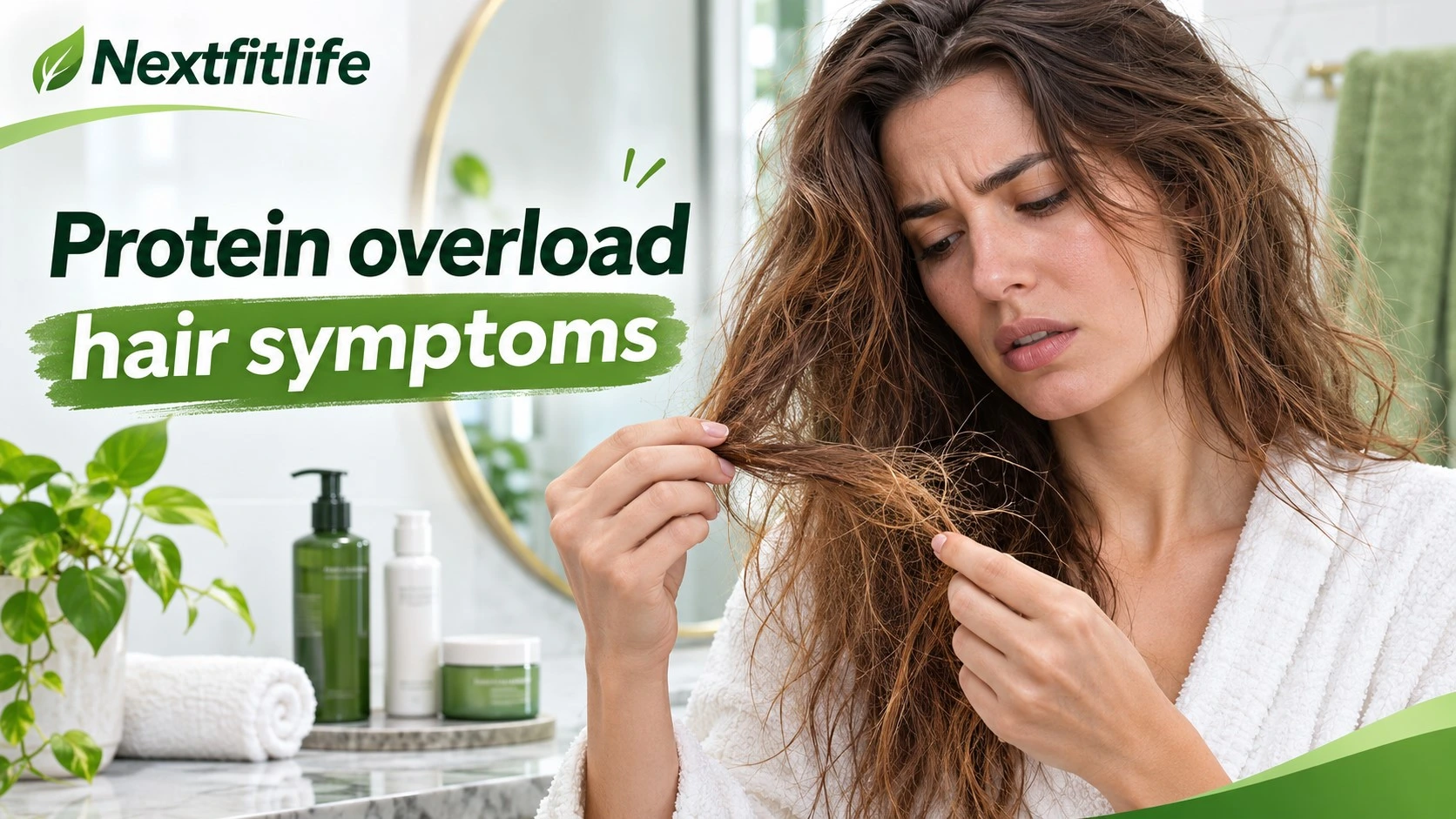
If your hair became stiff, rough, tangled, or easier to snap after you started using strengthening treatments, do not add another repair mask yet.
Those changes are often called protein overload hair symptoms. The symptoms can be real, but “protein overload” is mainly a hair care term, not a formal medical diagnosis. Heat, bleach, tight hairstyles, rough handling, scalp problems, and mineral buildup can cause very similar signs.
Quick answer: Common protein overload hair symptoms include stiff strands, rough texture, tangles, dullness, less flexibility, split ends, and more breakage after repeated use of protein rich hair products. The best first step is to pause the suspected product, condition gently, reduce heat, and make sure the problem is breakage rather than true hair loss.
Health note: This article is for general information and education. It does not replace medical advice, diagnosis, or treatment.
See a doctor or dermatologist if you notice round bald patches, rapid thinning, a widening part, heavy shedding from the root, scalp pain, pus, sores, marked redness, scarring, or loss of eyebrows or eyelashes. These signs are not typical cosmetic protein overload.
If your main concern is thinning or shedding rather than snapped strands, read the NextFitLife Hair Loss Causes and Treatment Guide.
Table of Contents
- Is protein overload a real hair condition?
- 11 warning symptoms to check
- Breakage versus shedding
- Protein ingredients on product labels
- Protein overload versus dry hair
- Protein overload versus heat damage
- Hard water and mineral buildup
- Low porosity hair and protein
- How to reset your routine
- What not to do
- When to see a dermatologist
- References and Sources
- Internal links and hubs
- About the author
- Frequently asked questions
Is Protein Overload a Real Hair Condition?
The term sounds more medical than it really is.
“Protein overload” is widely used in hair care, but it is not a standard medical diagnosis with a validated home test. There is no accepted strand test that can tell you with certainty that your hair contains too much protein.
That does not mean the hair changes are imaginary.
Hair can become rough, fragile, hard to comb, and easy to snap. Dermatology sources also show that heat, dyes, straightening, tight styles, friction, and repeated grooming can damage the hair shaft.
At the same time, protein ingredients are not automatically harmful. Hydrolyzed proteins, keratin based ingredients, and amino acids are used in cosmetic hair products because they can condition damaged fibers and improve how hair feels for a time.
So the better question is simple:
Did your hair become worse after you changed to a protein heavy routine?
That timeline is much more useful than a viral strand test.
For broader hair care guidance, visit the NextFitLife Hair and Scalp Care Hub.
11 Warning Protein Overload Hair Symptoms to Check
One sign alone does not prove the cause. Look at the full pattern and compare it with what changed in your routine.
1. Hair Feels Much Stiffer Than Usual
Hair should move and bend without feeling like wire.
If your strands suddenly feel rigid, crunchy, or unusually hard after a new strengthening product, the product deserves attention.
This can happen after repeated use of keratin masks, strengthening conditioners, or other protein treatments. Heat and chemical damage can cause the same feeling, so treat stiffness as a clue rather than proof.
2. Hair Feels Rough or Straw Like
Run your fingers gently down the lengths.
If hair that once felt fairly smooth now feels coarse or straw like, the outer surface of the strand may be damaged or coated.
Rough hair can appear with bleaching, heat, weathering, mineral buildup, and repeated chemical treatments. Protein is only one possible part of the story.
If the problem started after a move or change in water supply, compare your symptoms with the Hard Water Hair Damage Guide.
3. Hair Snaps More Easily
Hair breakage happens when a strand breaks somewhere between the scalp and the end.
You may notice small pieces on your clothing, sink, brush, pillow, or bathroom floor. Broken pieces are often different lengths because the hair did not leave from the root.
| What You Notice | More Likely Meaning | What to Check |
|---|---|---|
| Short pieces of many lengths | Breakage | Heat, friction, chemicals, brittle hair |
| Many full length hairs | Shedding | Hair cycle and medical causes |
| Wider part | Possible hair loss | Dermatology review |
| Round bald patch | Not typical breakage | Medical assessment |
4. Hair Tangles More Than Before
Rough strands catch against nearby hairs.
That creates more knots, harder detangling, and extra pulling during brushing. The pulling then creates more damage, so the problem can feed itself.
Tangled hair is common in damaged hair and should be read together with stiffness, roughness, and breakage.
5. Hair Looks Dull
Healthy looking hair usually reflects light better than heavily damaged hair.
If your hair suddenly looks flat or dull after adding several strengthening products, the change may be worth testing.
Dullness can also come from mineral deposits, styling residue, chemical damage, or damaged cuticles.
6. Hair Feels Coated After Washing
This is where protein overload and product buildup can look almost identical.
Your hair may feel heavy, waxy, stiff, or as if something sits on the strand even after washing.
Look at everything you are layering, including oils, dry shampoo, silicone rich products, masks, leave ins, styling creams, and strengthening formulas.
A coated feeling does not tell you which ingredient caused it.
7. Split Ends Become More Obvious
Split ends mean the hair shaft is damaged.
They do not prove protein overload. Heat, friction, bleaching, straightening, weathering, and normal wear on long hair can all contribute.
Once a strand has physically split, a cosmetic product can improve the look and feel for a while, but it does not restore the fiber to untouched hair.
For ways to reduce damage, see 17 Essential Tips for Healthy Hair and Less Breakage.
8. Hair Has Less Flexibility
Hair should bend before it snaps.
If your strands suddenly feel rigid and break during normal handling, something in the routine may be increasing the damage load.
Online guides often suggest stretching one wet strand to diagnose protein overload. I would not use that as proof.
Reduced hair elasticity can happen with several kinds of hair damage, and a home stretch test cannot identify one exact cause.
9. Conditioner Stops Making Hair Feel Soft
This clue compares your hair with its own normal response.
You wash, condition, and rinse, but the lengths still feel hard, rough, or difficult to comb.
Conditioners normally help reduce friction. If one new strengthening product repeatedly leaves the hair less manageable, stop that product for now rather than adding more treatment.
10. Breakage Gets Worse After Protein Treatments
The timing matters.
If you use a keratin mask and notice more snapping afterward, then repeat the treatment and the problem gets worse again, that is a stronger clue than texture alone.
You still cannot prove protein overload from this pattern, but it gives you a clear product to pause.
11. The Problem Began After You Layered Several Strengthening Products
This is one of the most useful real world clues.
You may have a protein shampoo, strengthening conditioner, keratin mask, and repair leave in all in the same routine.
Each product may be fine on its own.
Together, they may leave your hair harder to manage.
Strip the routine back and change one thing at a time.
Breakage and Hair Shedding Are Not the Same
This difference matters because it changes what you should do next.
What Hair Breakage Looks Like
- Short broken pieces
- Uneven hair lengths
- Frayed ends
- Split ends
- Snapping while brushing
- More damage around bleached or heated areas
What Hair Shedding Looks Like
Shedding happens when the whole hair leaves the follicle.
The American Academy of Dermatology notes that losing some hair each day is normal. A large change from your normal pattern, visible thinning, bald areas, or a changing hairline needs a different approach.
If you are dealing with hair shedding, use the Hair Loss Causes and Treatment Guide instead of treating the problem as a moisture versus protein issue.
Which Hair Products Contain Protein?
Read the ingredient list instead of relying on the words printed on the front of the bottle.
Common protein derived ingredients include:
- Hydrolyzed keratin
- Keratin
- Hydrolyzed wheat protein
- Hydrolyzed rice protein
- Hydrolyzed soy protein
- Hydrolyzed silk
- Hydrolyzed collagen
- Amino acids
- Peptides
One of these ingredients on a label does not make a product harmful.
The formula, amount, frequency, other ingredients, chemical history of your hair, and the rest of your routine all matter.
Does Eating Too Much Protein Cause Protein Overload Hair?
No good evidence shows that topical protein overload and dietary protein are the same problem.
Protein from fish, eggs, yogurt, beans, chicken, tofu, and other foods does not coat the outside of your hair in the way a cosmetic product does.
Nutrition does affect hair growth, but that is a separate issue.
Do not cut dietary protein because a hair mask made your strands feel stiff.
If you are worried about diet and hair health, visit the NextFitLife Nutrition and Vitamins Hub.
Protein Overload or Dry Hair?
They can look almost the same.
| Clue | Protein Product Problem | Dry or Damaged Hair |
|---|---|---|
| Stiffness | Possible | Possible |
| Rough texture | Possible | Common |
| Tangling | Possible | Common |
| Breakage | Possible | Common |
| Started after a new protein product | Useful clue | Look for another cause |
The timeline is usually more useful than the appearance alone.
Protein Overload or Heat Damage?
Heat damaged hair can copy almost every symptom people call protein overload.
Flat irons, curling tools, dryers, bleaching, coloring, chemical straightening, and repeated grooming can weaken the shaft.
Think about the full routine rather than picking one cause too early.
If you bleach, straighten, use high heat, and apply strengthening masks, several sources of damage may be acting at once.
Could Hard Water Be Causing the Same Symptoms?
Yes.
Hard water can leave mineral deposits on hair. The strands may feel dull, coated, stiff, rough, or harder to detangle.
That makes mineral buildup an important look alike.
If the problem appeared after moving, changing water supply, traveling, or washing in very hard water, read the Hard Water Hair Damage Guide.
Does Low Porosity Hair Get Protein Overload More Easily?
You will see this claim often, but treat it as a practical hair care idea rather than a medical rule.
Low porosity hair is usually described as hair that takes up water less easily. Home porosity tests cannot diagnose why hair is brittle, rough, or stiff.
If a protein rich product repeatedly makes your hair harder and less manageable, that is enough reason to use it less often.
You do not need a porosity label to stop a product that is not working for you.
How to Fix Suspected Protein Overload Safely
The best first move is usually to simplify.
Step 1: Pause the Suspected Product
Stop the newest keratin mask, strengthening treatment, protein leave in, or similar product.
Do not change everything at once. One change gives you a clearer answer.
Step 2: Wash Gently
Clean the scalp and lengths without aggressive rubbing.
If you clearly have heavy buildup, an occasional clarifying wash may help. Avoid turning clarifying shampoo into a daily treatment because that can leave fragile hair even drier.
Step 3: Use a Moisturizing Conditioner
Conditioner helps lower friction between strands, which matters when hair is tangling and breaking.
Use enough slip to detangle with less force.
Step 4: Reduce Heat
Fragile hair needs less stress.
Cut back on hot tools while breakage is active. When you use them, choose the lowest heat that still works for your hair.
Step 5: Loosen Tight Hairstyles
A braid, bun, extension, or ponytail should not hurt.
Repeated pulling can cause breakage and, over time, can also damage follicles.
Step 6: Handle Wet Hair Gently
Wet hair can be easier to stretch and damage.
Detangle in sections, use a conditioner with good slip, and avoid pulling knots apart with force.
Step 7: Watch Several Wash Days
Do not judge your routine after one shampoo.
Watch for less tangling, easier combing, more flexibility, and less snapping over several washes.
Step 8: Recheck the Cause if Nothing Improves
If stopping the protein product makes no difference, look at heat, bleach, hard water, tension, scalp disease, and other causes of hair shaft damage.
What Not to Do
- Do not keep adding repair masks. More products can make the cause harder to identify.
- Do not use a floating strand test as a diagnosis. It cannot prove protein overload.
- Do not keep stretching hairs until they break. Testing can create more damage.
- Do not use very high heat on brittle hair. Heat adds another source of stress.
- Do not assume all shedding is breakage. Progressive thinning needs another explanation.
- Do not cut protein from your diet without a medical reason. Food protein and topical hair treatments are different issues.
Should You Avoid Protein Products Forever?
Usually, no.
If one product makes your hair stiff, that tells you something about that formula, the amount you used, the frequency, or the condition of your hair at the time.
It does not prove that every keratin or hydrolyzed protein product will cause the same reaction.
Protein derived ingredients are used in conditioners because they can help damaged hair feel stronger or smoother for a time.
The goal is not to become “protein free.”
The goal is hair that feels manageable and breaks less.
When Should You See a Dermatologist?
Stop treating the problem as a cosmetic product issue if the pattern looks like true hair loss or scalp disease.
Arrange medical assessment if you notice:
- Rapid unexplained thinning
- A widening part
- A receding hairline
- Round bald patches
- Heavy shedding that continues
- Scalp pain or burning
- Marked redness
- Pus, sores, or crusting
- Scarring
- Loss of eyebrows or eyelashes
- Broken hairs with scaly bald areas
A dermatologist can examine the hair and scalp, review the pattern, and decide whether blood tests, scalp testing, or other checks are needed.
If itching, scaling, or redness is a major symptom, see the NextFitLife Scalp Dermatitis Guide.
A Simple Three Question Check
1. What Changed First?
Write down any new shampoo, mask, chemical treatment, heat habit, hairstyle, supplement, or change in water.
2. Is It Breakage or Shedding?
Short snapped pieces point more toward shaft damage. Bald patches, widening parts, or clear thinning point toward a different problem.
3. Does Removing the Suspected Product Help?
Pause it and keep the rest of the routine simple.
If your hair becomes easier to manage after several washes, that is useful information. If nothing changes, keep looking for the real cause.
Conclusion
The safest way to use the phrase protein overload hair symptoms is as a troubleshooting pattern, not as a firm diagnosis.
Stiffness, roughness, tangling, dullness, less flexibility, split ends, and new breakage after repeated protein treatments are good reasons to simplify your routine.
Your next step: pause the newest protein heavy product, use gentle conditioning care, reduce heat and tension, then watch your hair over several wash days. If you see true thinning, bald patches, scalp inflammation, or heavy shedding, book a dermatologist instead of trying another hair mask.
References and Sources
- American Academy of Dermatology. Hair loss: Diagnosis and treatment.
https://www.aad.org/public/diseases/hair-loss/treatment/diagnosis-treat - American Academy of Dermatology. Hair loss: Tips for managing fragile or thinning hair.
https://www.aad.org/public/diseases/hair-loss/treatment/tips - DermNet. Defects of the hair shaft.
https://dermnetnz.org/topics/defects-of-the-hair-shaft - National Library of Medicine, PubMed Central. Hair Cosmetics for the Hair Loss Patient.
https://pmc.ncbi.nlm.nih.gov/articles/PMC8719955/ - National Library of Medicine, PubMed Central. Hair care physicochemistry, hair structure, damage, and conditioning agents.
https://pmc.ncbi.nlm.nih.gov/articles/PMC9921463/
Internal Links and NextFitLife Hubs
- Hair and Scalp Care Hub
- Healthy Hair and Breakage Prevention Guide
- Hair Loss Causes and Treatment Guide
- Hard Water Hair Damage Guide
- Scalp Dermatitis Guide
- Nutrition and Vitamins Hub
- NextFitLife Home
Frequently Asked Questions
What are the most common protein overload hair symptoms?
Commonly reported protein overload hair symptoms include stiffness, roughness, tangling, dullness, reduced flexibility, split ends, and increased breakage after repeated use of protein rich hair products.
Is protein overload a medical diagnosis?
No. Protein overload is mainly a hair care term. There is no standard medical test that proves a person has too much protein in the hair shaft.
How can I tell protein overload from dry hair?
You usually cannot tell from texture alone. Both can cause roughness, tangling, dullness, and breakage. A clear change after starting a protein heavy product makes that product worth pausing.
Can protein overload cause hair loss?
Protein heavy products may be blamed for breakage, but true hair loss from the follicle is different. Bald patches, a widening part, or progressive thinning should be assessed as hair loss rather than assumed to be protein overload.
How do I fix suspected protein overload?
Pause the suspected protein treatment, wash gently, use a moisturizing conditioner, reduce heat and tight hairstyles, and watch the hair over several wash days.
Should I stop using protein products forever?
No. One product may not suit your hair at a certain time, but protein derived ingredients can also be useful conditioning agents in damaged hair products.
Does eating too much protein cause protein overload hair?
No good evidence shows that eating protein causes the cosmetic hair care problem called protein overload. Dietary protein and topical hair products are separate issues.
Can hard water look like protein overload?
Yes. Mineral buildup from hard water can make hair feel rough, dull, coated, stiff, or harder to detangle, which can look similar to suspected protein overload.