
Published on: November 17, 2026
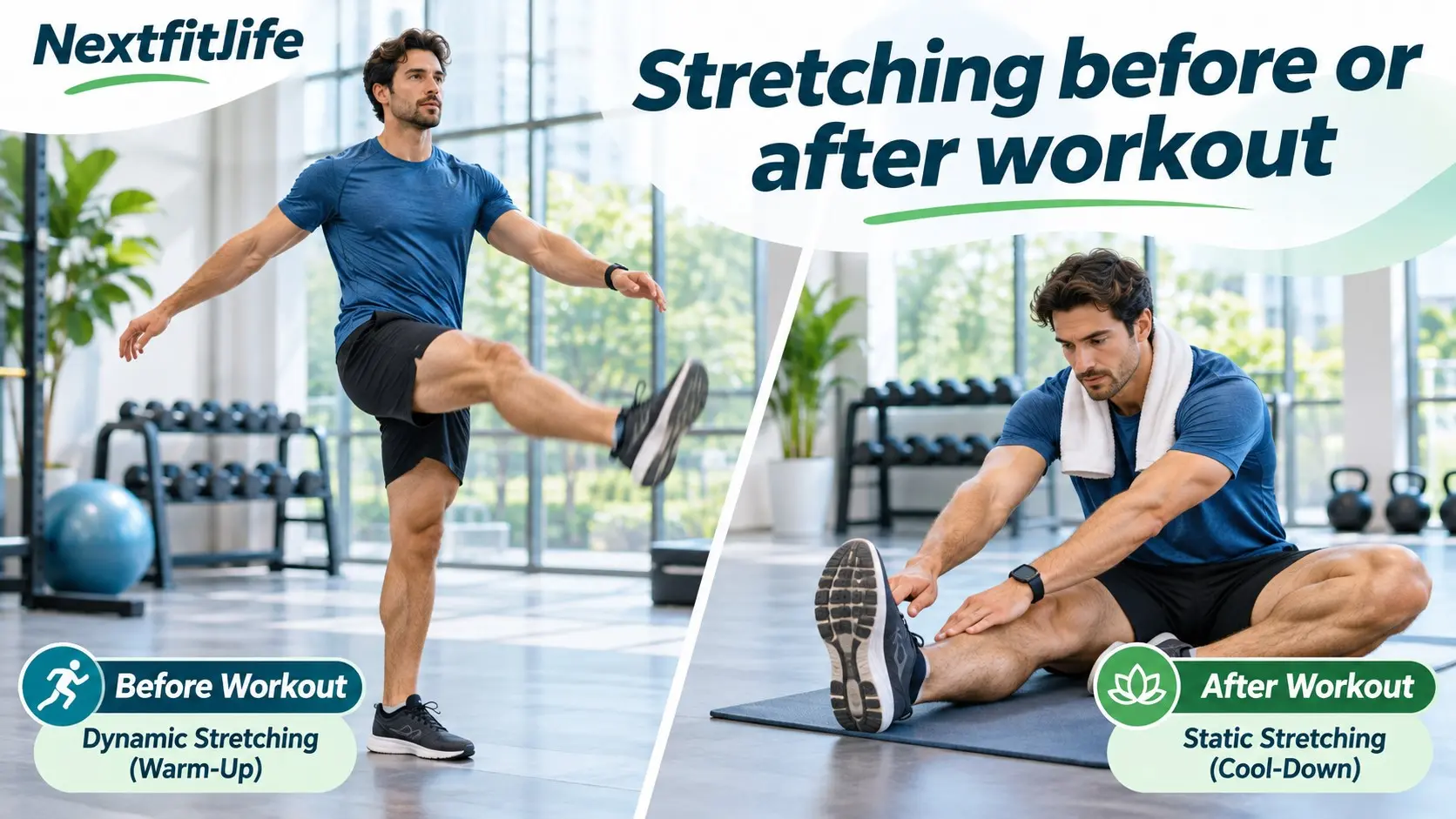
If you are deciding between stretching before or after workout sessions, use one simple rule: move dynamically before training and save longer static stretches for after the workout or a separate flexibility session.
That advice fits most strength workouts, runs, cardio sessions, and sports. The details still matter, because a short calf stretch before a run is not the same as holding several deep stretches for minutes before a sprint.
Quick answer: Before most workouts, warm up with easy movement and dynamic stretching that matches the activity. After exercise, static stretching fits better if you want more flexibility or simply enjoy it. Avoid long static holds immediately before sprinting, jumping, or heavy maximal lifting.
Health note: This article is for general information and education. It does not replace medical advice, diagnosis, or treatment.
Stop stretching and get medical advice if a movement causes sharp pain, numbness, tingling, weakness, joint instability, major swelling, or worsening pain after an injury. Do not force an injured joint or muscle into a deeper stretch.
If you mainly want to know how long each static stretch should last, read the NextFitLife How Long to Hold a Stretch Guide.
Table of Contents
- The simple before versus after rule
- 8 smart stretching timing rules
- Strength training
- Running
- HIIT and sports
- Yoga and flexibility sessions
- Stretch duration
- Mobility versus stretching
- Common stretching mistakes
- When pain needs medical advice
- References and Sources
- Internal Links and NextFitLife Hubs
- About the Author
- Frequently Asked Questions
Should You Stretch Before or After a Workout?
Both can make sense, but they have different jobs.
Before exercise, your main goal is to prepare your body for what comes next. That usually means raising your temperature, moving the joints you will use, and gradually increasing effort.
After exercise, performance is no longer the immediate goal. That makes it a better time for longer static stretching if you want to train flexibility.
| Timing | Best Choice | Main Goal |
|---|---|---|
| Before workout | Dynamic movement | Prepare for exercise |
| Before explosive exercise | Dynamic warm up, brief static stretch only if needed | Protect strength and power |
| After workout | Static stretching | Flexibility or relaxation |
| Separate session | Static or PNF stretching | Focused flexibility training |
8 Smart Rules for Stretching Before or After Workout
1. Warm Up Before Doing Deep Stretches
Do not go straight from sitting at a desk into an aggressive stretch.
Start with easy movement.
The American Heart Association recommends a gradual warm up before moderate or vigorous activity. Walking, easy cycling, light jogging, or a slower version of the exercise you plan to do can all work.
A simple sequence is:
- Move easily for a few minutes.
- Increase the pace slowly.
- Add controlled mobility.
- Practice the movements you will use.
- Start the main workout.
For beginners who want a complete example, see the Morning Exercise Routine for Beginners.
2. Use Dynamic Stretching Before Most Workouts
Dynamic stretching means moving through a controlled range rather than holding one position.
Good examples include:
- Leg swings
- Walking lunges
- Arm circles
- Hip circles
- Controlled squats
- Calf raises
- High knees
These movements keep the body active while preparing the joints and muscles for harder work.
That makes dynamic movement a good fit before running, lifting, HIIT, and many sports.
3. Avoid Long Static Holds Before Explosive Exercise
This is where stretching advice becomes more specific.
Static stretching before exercise is not automatically bad.
The bigger concern is prolonged static stretching immediately before maximal strength, sprinting, jumping, or another explosive task.
Recent expert consensus recommends avoiding static stretching that lasts more than about 60 seconds per muscle right before maximal or explosive contractions.
If you are about to:
- Sprint
- Jump
- Lift near your maximum
- Throw
- Perform explosive intervals
- Compete in a power based sport
use dynamic preparation and task practice instead of ending the warm up with several long passive holds.
4. A Short Static Stretch Before Exercise Can Still Be Fine
This is where many fitness articles become too strict.
If one area feels restricted, a short static stretch can still fit into your warm up.
For example, a brief calf or hip flexor stretch may make a movement feel easier.
The better sequence is:
- Warm up.
- Use the brief stretch if needed.
- Follow it with dynamic movement.
- Practice the exercise you are about to perform.
A short stretch inside a full warm up is very different from spending ten minutes doing deep passive stretching before heavy lifting.
5. Static Stretching Fits Better After Exercise
After your workout, the need to produce maximum force right away is gone.
Your muscles are also warm.
That makes post workout time convenient for static stretching if improving flexibility is one of your goals.
You might stretch:
- Calves
- Hamstrings
- Hip flexors
- Chest
- Shoulders
- Upper back
You do not need to stretch every muscle you trained.
Choose the areas where you want more comfortable range of motion.
6. Do Not Expect Post Workout Stretching to Stop Soreness
Stretching after exercise can feel relaxing.
That does not mean it prevents DOMS, the delayed soreness that can appear after a hard or unfamiliar workout.
Systematic reviews have found little meaningful improvement in muscle soreness or strength recovery from post exercise stretching compared with passive recovery.
So stretch after exercise because:
- You want better flexibility
- You enjoy the routine
- A comfortable stretch feels good
- It helps you transition out of the workout
Do not treat it as a guaranteed soreness cure.
7. Stretching Is Not a Complete Injury Prevention Plan
Stretching improves flexibility and range of motion.
That is useful when your activity needs those qualities.
But injury risk also depends on:
- Strength
- Training load
- Exercise technique
- Recovery
- Fatigue
- Previous injury
- Sport demands
A good training plan should address more than flexibility.
If your upper body feels restricted before lifting, the NextFitLife Shoulder Mobility Routine combines mobility, control, and task practice instead of relying on passive stretching alone.
8. Use a Separate Session for Serious Flexibility Goals
You do not have to fit all your stretching into the warm up or cool down.
If flexibility is a major training goal, a separate session is often cleaner.
That gives you time for longer static or PNF stretching without worrying about an upcoming sprint or heavy lift.
This can suit:
- Yoga students
- Dancers
- Gymnasts
- Martial artists
- People working on a specific mobility limit
Stretching Before Strength Training
Before lifting, I would prioritize movement that resembles the task.
Start with easy general activity, then move the joints you will use and perform lighter sets of the actual exercise.
If you plan to squat, for example, bodyweight squats followed by progressively heavier warm up sets prepare you more directly than a long stretching session.
A simple strength warm up might look like this:
- Three to five minutes of easy movement
- Hip, ankle, shoulder, or upper back mobility as needed
- Dynamic drills
- One to three lighter practice sets
- Your working sets
For upper body lifting, the Shoulder Mobility Routine gives a useful task specific example.
Stretching After Strength Training
Static stretching after lifting is optional.
Use it if you want more flexibility in a specific area.
It is not required for muscle growth, and it does not replace sleep, food, sensible training volume, or recovery time.
Stretching is also not a substitute for resistance training when the goal is building strength.
Stretching Before Running
Before running, dynamic movement usually fits better.
For an easy run, simply walking and gradually increasing your pace may be enough.
For a harder run or interval session, add:
- Leg swings
- Walking lunges
- Calf raises
- High knees
- Controlled skips
For sprinting, make the warm up more specific and progressive.
Long passive hamstring or calf stretches immediately before sprinting are a poor final warm up because sprinting requires rapid force production.
Stretching After Running
Static stretching after a run is fine if you enjoy it or want to improve flexibility.
It is not mandatory.
If you would rather walk for a few minutes, drink water, eat, and continue with your day, you are not missing a required recovery step.
That is especially true if your only reason for stretching is preventing soreness.
Stretching Before HIIT or Sports
HIIT and fast sports need a proper warm up.
Start easy, then increase movement speed.
Use movements such as:
- Light jogging
- Bodyweight squats
- Walking lunges
- Arm swings
- Leg swings
- Short practice efforts
Your final warm up movements should look more like the workout you are about to perform.
That is more useful than finishing with long passive stretches.
Stretching Before Yoga
Yoga already contains a lot of mobility and stretching.
You usually do not need a separate long static stretching session first.
Start with gentle movement and let the early part of the practice prepare you for deeper poses.
This is safer than trying to reach your deepest position while your body still feels cold.
Mobility and Stretching Are Not the Same Thing
Mobility exercises involve being able to move and control a joint through a useful range.
Stretching focuses more directly on range and tissue tolerance.
A person can have enough passive flexibility but still lack control in that range.
In that case, more passive stretching may not solve the real problem.
For the upper back, try the 8 Smart Thoracic Mobility Exercises Guide. It focuses on controlled rotation and extension rather than simply forcing a stretch.
How Long Should Static Stretching Last?
For many adults, about 10 to 30 seconds per static stretch is a practical range.
Thirty seconds is an easy default.
Longer is not automatically better, especially before a workout that needs strength or speed.
The How Long to Hold a Stretch Guide explains timing for general flexibility, older adults, pre workout stretching, and post workout stretching in more detail.
A Simple 8 Minute Pre Workout Warm Up
| Time | What to Do | Purpose |
|---|---|---|
| Minutes 1 to 3 | Walk, cycle, or jog easily | Raise body temperature |
| Minutes 4 to 5 | Leg swings, arm circles, hip circles | Dynamic mobility |
| Minutes 6 to 7 | Squats, lunges, or task specific drills | Prepare movement patterns |
| Minute 8 | Practice the first exercise at easy intensity | Bridge into the workout |
A Simple Post Workout Stretching Routine
You do not need twenty minutes.
Start by walking slowly for a few minutes and letting your breathing settle.
Then choose two to four areas where you want more flexibility.
| Area | Starting Hold | Main Cue |
|---|---|---|
| Calves | 20 to 30 seconds | Keep the heel controlled |
| Hamstrings | 20 to 30 seconds | Stop before pain |
| Hip flexors | 20 to 30 seconds | Avoid arching the lower back |
| Chest | 20 to 30 seconds | Use gentle tension |
What If You Feel Tight Before Training?
Do not assume every feeling of tightness means you need a longer stretch.
Sometimes the feeling improves once your body warms up.
Try this sequence:
- Move easily.
- Use controlled mobility.
- Practice the exercise for several easy repetitions.
- Reassess the area.
If one joint still feels restricted, a brief static stretch may help.
If the same area limits you every workout, look at strength, technique, training load, and daily movement habits too.
Does Stretching Prevent Injuries?
Stretching can improve flexibility, but it is not complete injury protection.
A current expert consensus found that stretching should not be treated as a broad injury prevention strategy for everyone.
Injury risk depends on far more than flexibility.
Useful factors include good strength, sensible training progression, recovery, sport specific practice, and enough range of motion for the activity.
Does Stretching Help Muscle Soreness?
Not much.
Research comparing post workout stretching with passive recovery has not found a meaningful reduction in delayed muscle soreness.
That does not make stretching useless.
It simply means the reason to stretch after training should be flexibility or personal comfort rather than expecting it to erase soreness.
Common Stretching Mistakes
Doing Long Static Stretches Before Sprinting
Use dynamic movement and gradual practice efforts instead.
Stretching Cold Muscles Aggressively
Move first and increase range gradually.
Bouncing Into a Stretch
For normal static stretching, move smoothly and hold a controlled position.
Stretching Into Pain
A good stretch creates tension, not sharp pain.
Assuming Every Tight Feeling Means Short Muscles
Warm up and reassess before deciding that more flexibility is the answer.
Using Stretching Instead of Strength Training
Flexibility and strength solve different problems.
A complete fitness plan needs more than stretching alone.
When Should You Stop Stretching?
Stop a stretch if it causes:
- Sharp pain
- Numbness
- Tingling
- Weakness
- Joint instability
- Major swelling
- Worsening symptoms after an injury
If pain is persistent, severe, follows a significant injury, or affects normal movement, get it assessed instead of repeatedly forcing the area into a deeper stretch.
Conclusion
For most people asking about stretching before or after workout sessions, the best answer is both, but for different reasons.
Use dynamic movement before exercise to prepare for the task. Save longer static stretching for after training or for a separate flexibility session. A brief static stretch before exercise is fine when it helps movement, but long passive holds do not belong right before maximal or explosive work.
Your next step: replace your long pre workout stretching routine with five to eight minutes of progressive movement this week. If you want more flexibility, move the longer static stretches to the end of the session.
References and Sources
- American Heart Association. Warm Up, Cool Down.
https://www.heart.org/en/healthy-living/exercise-and-physical-activity/fitness-basics/warm-up-cool-down - American Heart Association. Flexibility Exercise and Stretching.
https://www.heart.org/en/healthy-living/exercise-and-physical-activity/fitness-basics/flexibility-exercise-stretching - PubMed Central. Practical Recommendations on Stretching Exercise: A Delphi Consensus Statement of International Research Experts.
https://pmc.ncbi.nlm.nih.gov/articles/PMC12305623/ - PubMed. The Effectiveness of Post Exercise Stretching in Short Term and Delayed Recovery.
https://pubmed.ncbi.nlm.nih.gov/34025459/ - PubMed. Does Pre Exercise Static Stretching Inhibit Maximal Muscular Performance?
https://pubmed.ncbi.nlm.nih.gov/22316148/ - PubMed. Post Exercise Stretching Versus No Stretching on Lower Limb Muscle Recovery and Performance: A Meta Analysis.
https://pubmed.ncbi.nlm.nih.gov/41103301/
Internal Links and NextFitLife Hubs
- How Long to Hold a Stretch
- Thoracic Mobility Exercises
- Shoulder Mobility Routine
- Morning Exercise Routine for Beginners
- How to Get Fit
- Exercise Benefits Guide
- NextFitLife Fitness and Health Guides
Frequently Asked Questions
Is it better to stretch before or after a workout?
Dynamic stretching fits best before most workouts because it prepares you to move. Longer static stretching usually fits better after exercise or during a separate flexibility session.
Is static stretching bad before exercise?
No. Short static stretches can fit into a full warm up. The bigger concern is prolonged static stretching immediately before maximal strength, sprinting, jumping, or other explosive exercise.
How long should I stretch before a workout?
Keep pre workout static stretches brief when you use them, then follow with dynamic movement. Avoid spending more than about 60 seconds stretching one muscle immediately before maximal or explosive work.
Does stretching after exercise prevent soreness?
Research does not show a meaningful reduction in delayed muscle soreness from post workout stretching compared with passive recovery. Stretch after exercise for flexibility or comfort instead.
What type of stretching is best before running?
Dynamic movements such as leg swings, lunges, calf raises, and gradual running drills usually fit best before running, especially before intervals or sprinting.
Should I stretch after strength training?
You can stretch after strength training if you want to improve flexibility or enjoy it, but it is not required for muscle growth or recovery.
Should I stretch before lifting weights?
Warm up with easy movement, controlled mobility, and lighter practice sets. Brief static stretching can help a restricted area, but long passive holds are not a good final step before heavy lifting.
Does stretching prevent injuries?
Stretching can improve range of motion, but it is not a complete injury prevention plan. Strength, workload, technique, recovery, and sport specific preparation also matter.
Is dynamic stretching better before a workout?
For most workouts that require movement, speed, strength, or power, dynamic stretching is a better default because it prepares the body while keeping the muscles active.
Can I do flexibility training on a separate day?
Yes. A separate flexibility session is a good option if improving range of motion is a major goal because you can use longer static or PNF stretches without affecting an upcoming hard workout.

