

Published on: November 15, 2026
Updated on: November 15, 2026
If your upper back feels stiff when you turn, reach overhead, or sit for a long time, a few well chosen thoracic mobility exercises can make movement feel easier.
You do not need a long stretching routine. The better goal is controlled motion through the upper back without letting the neck, hips, or lower back do all the work.
Quick answer: Useful thoracic mobility exercises include open books, thread the needle, quadruped rotation, seated rotation, cat cow, foam roller extension, wall reach rotation, and child pose rotation. Move slowly, keep the hips controlled, breathe normally, and stop if you feel sharp pain, numbness, weakness, chest pain, or trouble breathing.
Health note: This article is for general information and education. It does not replace medical advice, diagnosis, or treatment.
Do not try to stretch through severe upper back pain. Get medical help if pain follows major trauma, comes with chest pain or trouble breathing, or is linked with weakness, numbness, fever, unexplained weight loss, balance trouble, or bladder or bowel changes.
For broader mobility and flexibility work, visit the NextFitLife Yoga and Flexibility Hub or the main Fitness Hub.
Table of Contents
- What the thoracic spine does
- How to know if mobility is limited
- 8 thoracic mobility exercises
- A simple 6 minute routine
- How often to train mobility
- Mobility versus strength
- Shoulder and neck connections
- Common technique mistakes
- When to see a physical therapist
- References and Sources
- Internal links and hubs
- About the author
- Frequently asked questions
What Is the Thoracic Spine?
The thoracic spine is the middle and upper part of your back.
It includes 12 vertebrae and sits between the neck and lower back. Your ribs attach in this region, so movement here also affects how your chest and rib cage move.
The thoracic spine contributes to:
- Rotation
- Extension
- Flexion
- Side bending
- Reaching
- Overhead movement
The upper back also works with the shoulders, neck, ribs, and lower back.
That is why limited thoracic spine mobility can show up as awkward turning, a stiff upper back, or extra movement from the lumbar spine when you reach overhead.
Do You Really Need More Thoracic Mobility?
Not everyone does.
More range is not automatically better. The goal is enough comfortable movement for the task you want to do.
Ask yourself:
- Can you rotate without your hips turning first?
- Can you reach overhead without a large lower back arch?
- Does one side feel much stiffer than the other?
- Does your upper back feel blocked after long periods of sitting?
If the answer is yes to one or more, mobility work may help.
If you already move well, you may need more strength or movement variety rather than more stretching.
8 Smart Thoracic Mobility Exercises
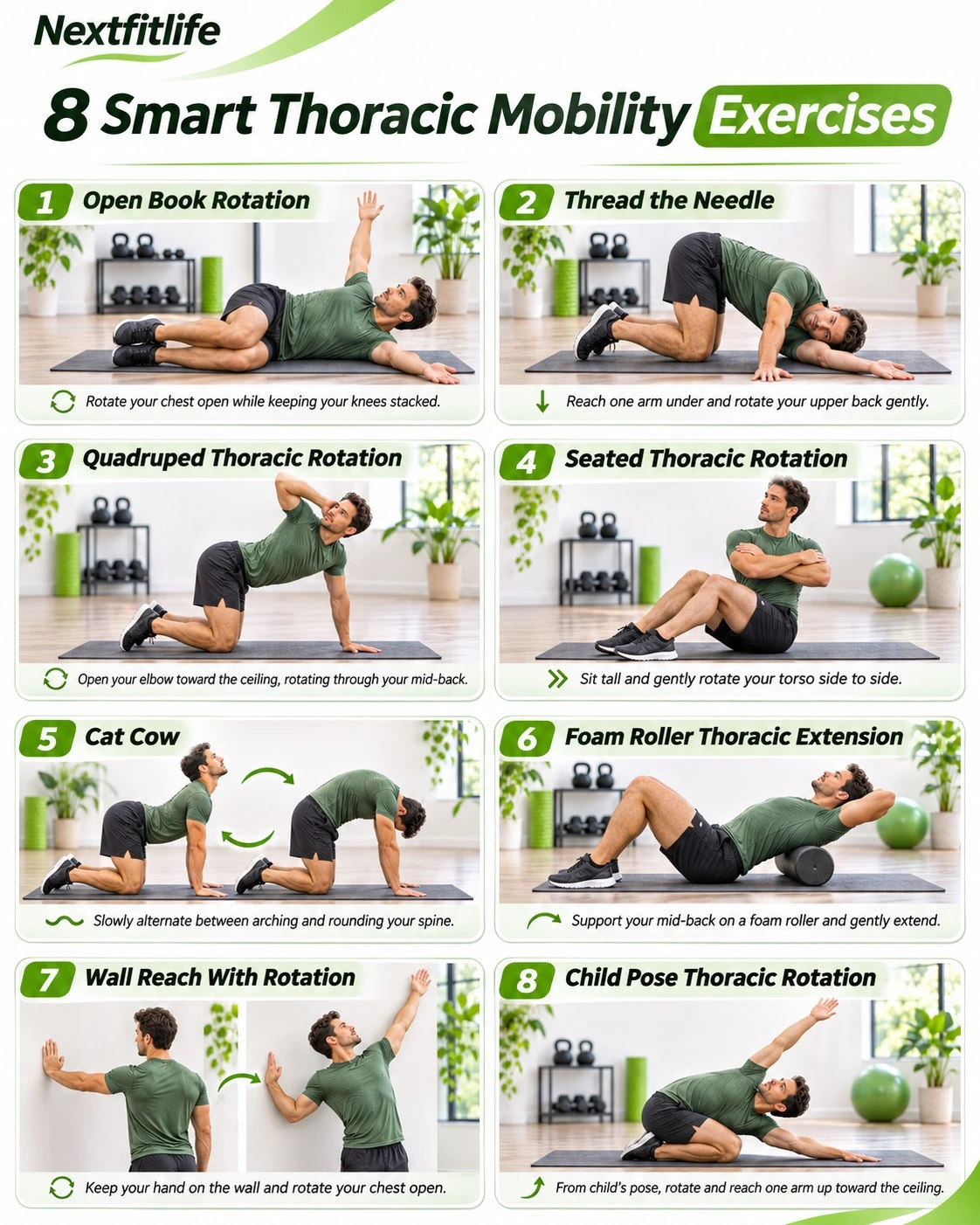
You do not need to perform all eight every day.
Pick three or four that match the movement you want to improve.
1. Open Book Rotation
The open book exercise is one of the simplest ways to practice thoracic rotation.
How to do it
- Lie on your side.
- Bend your hips and knees so the legs are stacked.
- Reach both arms straight in front of you.
- Slowly open the top arm toward the other side.
- Let your chest rotate while keeping your knees together.
- Return slowly.
Try 6 to 10 smooth repetitions per side.
Do not force the top hand to touch the floor.
The useful range is the range you can control.
2. Thread the Needle
Thread the needle works on rotation while the hips stay fairly quiet.
How to do it
- Start on your hands and knees.
- Slide one arm underneath the other arm.
- Let the upper back rotate gently.
- Reverse the movement.
- Reach the same arm toward the ceiling.
Move with your breath and keep the hips from rocking side to side.
This is also a useful drill to combine with the NextFitLife Beginner Yoga Moves Guide.
3. Quadruped Thoracic Rotation
This version gives you a little more control than thread the needle.
How to do it
- Start on all fours.
- Place one hand lightly behind your head.
- Bring that elbow toward the opposite forearm.
- Rotate the elbow toward the ceiling.
- Keep the hips as still as possible.
Try 6 to 8 controlled repetitions on each side.
If your pelvis keeps turning, sit your hips slightly toward your heels. That makes it harder for the lower back to take over.
4. Seated Thoracic Rotation
This is one of the easiest thoracic rotation exercises to use during a workday.
How to do it
- Sit tall on a firm chair.
- Keep both feet flat.
- Keep your knees pointing forward.
- Cross your arms over your chest.
- Turn your rib cage slowly to one side.
- Return to the middle and repeat on the other side.
Do not pull yourself farther with your arms.
Keep the motion smooth and relaxed.
5. Cat Cow
Cat cow moves the whole spine, but it is useful for learning flexion and extension through the upper back.
How to do it
- Start on your hands and knees.
- Slowly round your back.
- Then reverse the movement.
- Gently lift your chest.
- Try to feel movement through the middle of the spine.
Do 6 to 10 slow repetitions.
Avoid throwing the head backward or forcing a large lower back arch.
You will also find this movement in the NextFitLife Somatic Yoga Guide.
6. Foam Roller Thoracic Extension
This drill focuses more on thoracic extension than rotation.
How to do it
- Place a foam roller across your upper back.
- Support your head with your hands.
- Keep the ribs controlled.
- Gently extend the upper back over the roller.
- Return to neutral.
- Move the roller slightly and repeat at another upper back level.
The movement should feel small and controlled.
If your ribs flare and your belly pushes forward, your lower back is probably doing too much.
Use caution: If you have osteoporosis, a known spinal fracture, recent trauma, or significant spinal disease, do not force extension over a foam roller without professional advice.
7. Wall Reach With Rotation
This drill links upper back mobility with shoulder movement.
How to do it
- Stand beside a wall.
- Place the inside hand lightly against it.
- Reach the outside arm forward.
- Sweep that arm outward and backward.
- Turn your chest while keeping the hips mostly forward.
Move through a comfortable range.
This is a useful warm up before overhead lifting or sports that need rotation.
8. Child Pose Thoracic Rotation
This final drill reduces movement from the hips and lower back while giving the upper back room to rotate.
How to do it
- Start on your hands and knees.
- Sit the hips gently toward your heels.
- Place one hand behind your head.
- Bring the elbow toward the floor.
- Then rotate the elbow upward.
Use 6 to 8 slow repetitions per side.
Keep the motion comfortable rather than trying to force the elbow as high as possible.
A Simple 6 Minute Thoracic Mobility Routine
If you want a short routine instead of eight separate drills, use this one.
| Exercise | Amount | Main Focus |
|---|---|---|
| Cat cow | 8 slow reps | Flexion and extension |
| Open book | 8 each side | Rotation |
| Quadruped rotation | 6 each side | Controlled rotation |
| Foam roller extension | 5 reps at 2 positions | Extension |
| Seated rotation | 6 each side | Easy daily movement |
A small 2024 study found immediate gains in some measures of thoracic movement after a brief mobility session in healthy adults.
That is encouraging, but it does not mean one session permanently changes your spine.
Think of mobility as practice.
How Often Should You Do Thoracic Mobility Exercises?
You can use a short thoracic mobility routine on most days if stiffness is your main issue and the exercises feel comfortable.
You can also use these drills:
- Before upper body training
- Before overhead lifting
- Before golf or throwing sports
- After a long desk session
- As part of a movement break
There is no single perfect schedule for everyone.
If you already move well, two or three short sessions a week may be enough.
Do You Need Mobility or Strength?
Sometimes you need both.
Getting a little more range can help. Being able to control that new range matters too.
Once the upper back moves comfortably, add exercises for the muscles around the shoulder blades and upper back.
Useful options include:
- Rows
- Band pull aparts
- Wall angels
- Bird dog variations
- Prone Y raises
- Low cobra holds
If your back feels loose for ten minutes and then tight again, another stretch may not be the missing piece.
You may need more strength, more daily movement, or fewer long periods in the same position.
For simple whole body training, see the NextFitLife Home Workouts Guide.
Does Thoracic Mobility Improve Posture?
Do not chase one perfect posture all day.
Humans are built to change position.
Sitting upright for eight hours without moving is still eight hours without much movement.
A better goal is variety.
Stand up, walk, turn, reach, and change how you sit. Use mobility exercises when a movement actually feels restricted.
Posture by itself does not tell you whether someone is in pain or needs treatment.
Why Does Thoracic Mobility Matter for the Shoulders?
Overhead movement does not come from the shoulder joint alone.
The shoulder blade moves on the rib cage, while the thoracic spine helps position the upper body.
If your upper back stays very flexed or rotates poorly, you may borrow movement from somewhere else.
That does not mean every shoulder problem comes from thoracic stiffness.
It means shoulder mobility and upper back movement work together.
For a focused routine, use the Yoga and Flexibility Hub alongside your shoulder mobility work.
Can Thoracic Mobility Help Neck Stiffness?
Sometimes.
The neck, upper back, ribs, and shoulder blades share movement during many daily tasks.
If the thoracic spine does very little, the neck may do more of the turning.
Improving comfortable upper back motion can make some tasks feel easier.
But neck pain has many causes.
Do not rely on thoracic exercises alone if you have arm weakness, numbness, severe pain, or symptoms that keep getting worse.
The Most Common Technique Mistakes
Letting the Lower Back Do the Work
This is the mistake I would watch first.
If a thoracic extension drill turns into a large low back arch, reduce the movement.
During rotation drills, keep the pelvis as quiet as you can.
Moving Too Fast
Fast twisting makes it harder to feel where the movement comes from.
Slow down enough to control the start and end of each rep.
Holding Your Breath
Your ribs move with breathing.
Use relaxed breathing during spinal rotation and extension rather than bracing as hard as possible.
Forcing the End Range
The biggest range is not automatically the best range.
Stop where you still feel in control.
Doing Mobility but Never Moving During the Day
A short routine cannot fully replace normal movement.
Walk, reach, rotate, stand, and change positions during the day.
How Do You Know the Exercises Are Helping?
Look for useful changes rather than dramatic ones.
You may notice:
- Easier turning
- More comfortable overhead reaching
- Less upper back stiffness after sitting
- Better left to right symmetry
- Less need to arch the lower back during an overhead reach
Retest the same movement every week or two rather than checking it after every set.
When Should You See a Physical Therapist?
Get professional advice if:
- The stiffness is painful rather than simply tight
- One side becomes steadily more limited
- The problem started after trauma
- Pain travels around the ribs
- You have numbness or weakness
- The same problem keeps returning despite regular exercise
- Overhead movement causes significant pain
- You are not sure whether the upper back is actually the source
A physical therapist can check the thoracic spine, ribs, shoulders, neck, hips, movement control, and other possible sources.
That is more useful than blindly adding more stretches.
Conclusion
The most useful thoracic mobility exercises are simple, controlled movements that improve the range you actually need.
Start with open books, thread the needle, quadruped rotation, cat cow, seated rotation, and gentle extension work. Keep the hips and lower back from stealing the movement, then add strength so the range becomes useful.
Your next step: use the 6 minute routine three times this week, then compare how turning and overhead reaching feel. If pain rather than stiffness is limiting you, get the cause checked instead of forcing more motion.
References and Sources
- Choi GP, Seo JH, Kim DE, Kim SY. Immediate Effects of Thoracic Mobility Exercises on Thoracic Range of Motion and Chest Expansion in Healthy Adults. Journal of the Korean Society of Physical Medicine. 2024.
https://doi.org/10.13066/kspm.2024.19.3.73 - National Library of Medicine, PubMed Central. Clinical reasoning framework for thoracic spine exercise prescription in sport: systematic review and narrative synthesis.
https://pmc.ncbi.nlm.nih.gov/articles/PMC7173996/ - American Council on Exercise. Thoracic Mobility Exercises to Address Shoulder Pain.
https://www.acefitness.org/resources/pros/expert-articles/7960/thoracic-mobility-exercises-to-address-shoulder-pain/ - NHS. Back pain: symptoms and when to seek medical care.
https://www.nhs.uk/conditions/back-pain/ - Cleveland Clinic. Upper Back Pain: Causes and When to Seek Care.
https://my.clevelandclinic.org/health/diseases/22866-upper-back-pain
Internal Links and NextFitLife Hubs
- Fitness Hub
- Yoga and Flexibility Hub
- Home Workouts Guide
- Yoga Moves for Beginners
- Chair Yoga for Seniors
- Somatic Yoga Guide
- Yoga Exercises at Home
- Bodyweight CrossFit Workouts
Frequently Asked Questions
What are the best thoracic mobility exercises?
Useful thoracic mobility exercises include open books, thread the needle, quadruped rotation, seated rotation, cat cow, foam roller extension, wall reach rotation, and child pose rotation.
How often should I do thoracic mobility exercises?
You can use a short routine on most days if stiffness is your main issue and the exercises feel comfortable. If you already move well, a few short sessions per week may be enough.
What is thoracic mobility?
Thoracic mobility is the ability of the middle and upper back to move through useful rotation, extension, flexion, and side bending during daily activity and exercise.
Can thoracic mobility help shoulder movement?
Yes, upper back movement works with the shoulder blades and rib cage during reaching and overhead tasks. Thoracic stiffness can be one factor in limited shoulder movement, but it is not the cause of every shoulder problem.
Can thoracic mobility exercises fix posture?
They can improve movement where stiffness is present, but there is no single perfect posture to fix. Regular position changes, strength, movement variety, and comfortable mobility are better goals.
Should thoracic mobility exercises hurt?
No. Mild stretching or stiffness can be expected, but sharp pain, numbness, weakness, chest pain, or trouble breathing are reasons to stop and seek appropriate medical advice.
Do I need a foam roller for thoracic mobility?
No. Open books, thread the needle, cat cow, seated rotation, and quadruped rotation need little or no equipment. A foam roller is simply another option for extension work.
How long should a thoracic mobility routine take?
A useful routine can take about 5 to 10 minutes. Quality and control matter more than doing a very long list of exercises.

